Solar panels and PACE loans: risks and scams
Before you sign for solar panels or a PACE loan: buying, leasing or a PPA, the tax credit that ended, the lien on your property tax and scam warning signs.
Verified against official sources on October 31, 2026 9 official sources

Show contents
In short
What you need to know
Quick answer
Solar panels can save you money, but many offers hide 20-year contracts, payments that go up or a debt tied to your property tax. The FTC says "free" solar panel offers are scams. If you lease the system or sign a PPA, you do not own it. The 30% federal tax credit no longer applies to systems placed in service after December 31, 2025. A PACE loan is collected through your property tax, leaves a lien that can come before your mortgage and, since March 1, 2026, the lender must check whether you can repay it.
What matters most
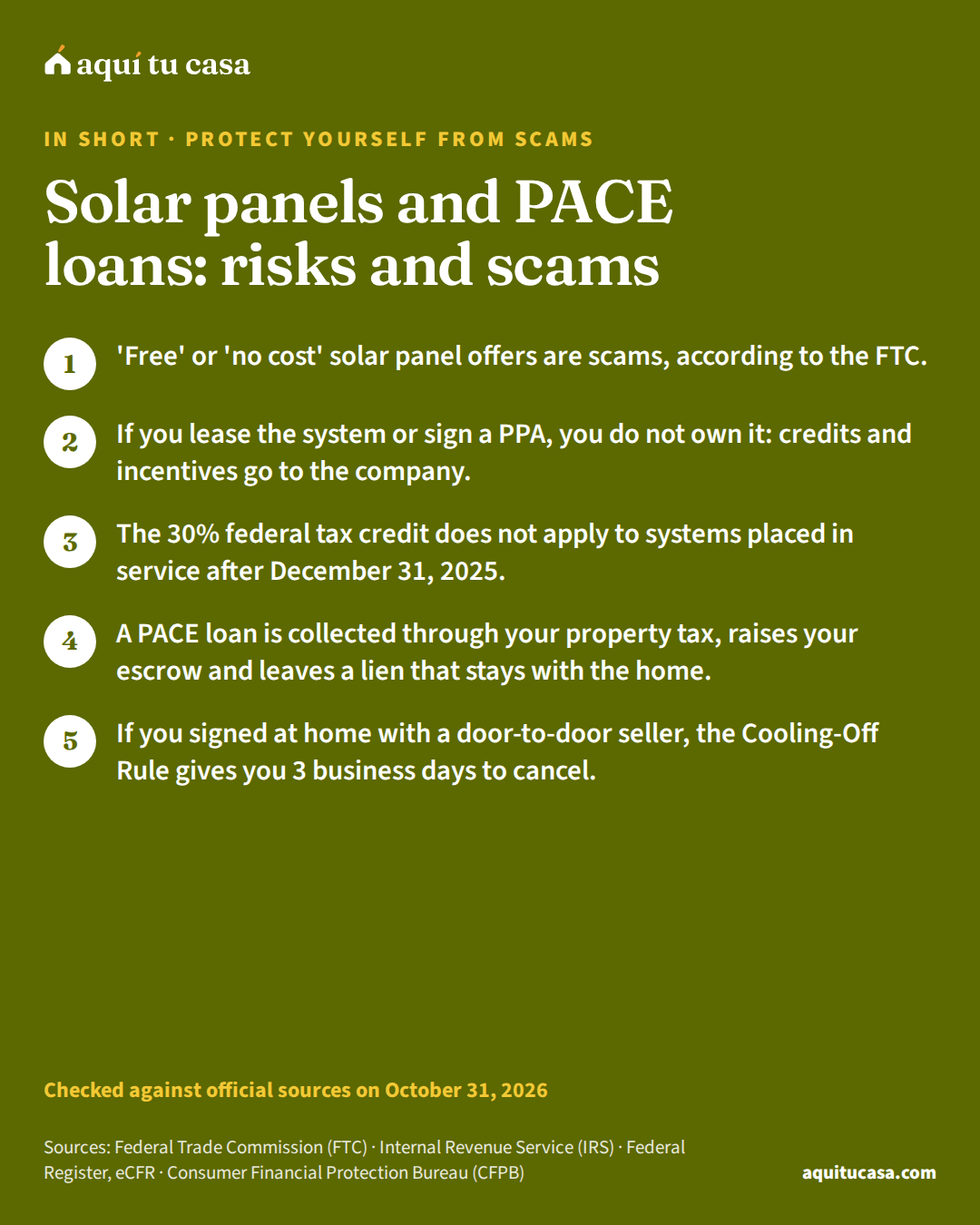
- 'Free' or 'no cost' solar panel offers are scams, according to the FTC.
- If you lease the system or sign a PPA, you do not own it: credits and incentives go to the company.
- The 30% federal tax credit does not apply to systems placed in service after December 31, 2025.
- A PACE loan is collected through your property tax, raises your escrow and leaves a lien that stays with the home.
Is this for you?
This guide is for you if…
- Someone offered you solar panels at your door, by phone or on social media, and you want to know whether it is a good idea.
- You were offered home improvements paid with a PACE loan collected through your property tax.
- You already signed a solar or PACE contract and your payment, escrow or property tax went up.
Get direct help first if…
- You are looking for free energy-saving repairs on a low income: read the Weatherization Assistance Program (WAP) guide first.
- You already paid someone who disappeared: read «I was scammed, what now?» today and report it.
Solar panels can lower your power bill. But they are also among the products that draw the most complaints when they are sold door to door. Some offers hide 20-year contracts, payments that go up or a debt collected through your property tax. This guide explains what to ask before you sign, what changed with the federal tax credit, how a PACE loan works and what the warning signs of a scam are, according to federal agencies.
The warning signs of a solar scam
The FTC explains how many of these scams start: with a call, a social media message or a visit you did not expect. These are its warning signs:1
- You are promised “free” or “no cost” panels.
- They claim to be from the utility or the government.
- They pressure you to sign now, or ask for payment up front or immediately.
- They ask for your name, address or other information in a message you did not expect.
The FTC also says to be wary of anyone who pressures you to decide quickly or asks you to pay in cash.2 And one new sign: if you are told the government energy-saving program will install panels, DOE’s Weatherization Assistance Program (WAP) no longer allows new renewable electricity technologies starting in program year 2026.9 Our Weatherization Assistance Program (WAP) guide explains what it does do.
Buying, leasing or signing a PPA
There are three common ways to get panels. The most important difference is who owns them.
Three ways to get solar panels
You own it
Buy
- You pay the full cost when it is installed, with savings or a loan
- Any incentives and credits that exist are yours
- Review the loan as carefully as a mortgage
The company owns it
Lease
- You pay each month to use the system; you do not own it
- Some contracts last 20 years and the payment can go up
- Ending early can be difficult and expensive
The company owns it
Power purchase agreement (PPA)
- You buy the power the panels produce, at the company's price
- Credits and incentives belong to the company
- The contract can affect you when you sell the home
Before you sign a lease or a PPA, get detailed bids from several companies.
The FTC explains that if you buy, you pay the full cost when it is installed. If you lease, a company installs the system and you sign a contract to use it; with a PPA, you buy the power it produces at a price the company sets. Either way you do not own it, and tax credits and incentives go to the owner, meaning the company. These are long-term contracts: some last 20 years. The contract may say your monthly payment goes up over time, ending early can be hard and expensive, and the contract can complicate selling your home.2
Before you sign, the FTC recommends getting detailed bids from several companies and asking whether each one has the licenses, certificates or bonding your state, county and city require.2 Our contractor scams guide explains how to check a license.
The federal tax credit has ended for new systems
Many sellers still talk about “a 30% tax credit.” That credit existed: the IRS explains that the Residential Clean Energy Credit was 30% of the cost of systems installed from 2022 through December 31, 2025. But it is not available for property placed in service after December 31, 2025. It was also nonrefundable: it could never give you more than the tax you owed.3
If someone promises you that credit for a system installed today, ask in writing what it is based on and check the IRS website. If your “savings” were calculated counting on that credit, the number is wrong.

What a PACE loan is and why it is different
A PACE loanPACE loanA PACE loan is financing for home repairs or improvements, such as energy-efficiency upgrades, that you repay through your property taxes. According to the CFPB, the payment is added to your property tax bill each year until it is paid off, and if you do not pay you risk losing your home in a tax sale. Most lenders will not refinance your mortgage or lend to a buyer while the home has an unpaid PACE loan. Under Regulation Z, the lender must evaluate whether you can repay it, and a PACE loan cannot be a qualified mortgage.See the full definition (Property Assessed Clean Energy) pays for home improvements, such as panels, roofs or air conditioning, and is collected along with your property taxproperty taxProperty tax is the tax the county, city, school district and other local bodies charge real property owners every year to pay for schools, police, fire and other public services. It is computed on the value the assessor's office assigns to your home, at each body's rate, minus the exemptions you qualify for, such as the primary-residence exemption in many states. If you have a mortgage you normally pay it month by month inside your payment, through the escrow account. It is generally deductible on your federal return if you itemize.See the full definition. Under Regulation Z, it is financing for improvements that results in a tax assessment on your property.4
The FTC explains what that means for you:2
- Your county or state does not lend you the money: a private company does.
- A property tax lienlienA lien is a legal right a creditor holds in your property to make sure you repay a debt. It usually prevents the property from being sold until the debt is paid, and if you do not pay, the creditor may be able to take the property. Your mortgage is a lien on your home: when you pay it off, the lien is released and that shows up in your county's property records. There are other kinds, such as a federal tax lien, which is the government's legal claim against all your property when you do not pay a tax debt.See the full definition is placed on your home.
- You must pay your tax bill on time to avoid default and foreclosureforeclosureForeclosure is the process by which the lender or servicer takes back the property after the homeowner fails to make mortgage payments. The rules and timelines depend on each state; all of them include advance notices and, in general, time to catch up or ask for an alternative, such as a repayment plan or a loan modification. If you fall behind, call your servicer and a HUD-approved housing counseling agency early: foreclosure counseling is free and exists for exactly this.See the full definition.
- That lien can take priority over your mortgage.
HUD adds that PACE is collected like a local government special assessmentspecial assessmentA special assessment is a charge, separate from regular dues, that a homeowners association, a city, a county or a special district can impose, usually to pay for construction, major repairs or the upkeep of facilities. In Florida, the summary you get before buying in a community with a mandatory association warns that you will have to pay any special assessments the association imposes, that you may owe others to the local government or a special district, and that not paying could result in a lien on your property. In Arizona, when you buy you must be told about special assessments the board has approved but not yet charged.See the full definition, and that if the home is sold, even at foreclosure, the debt stays with the property and the new owner becomes responsible for the payments.7
How a PACE loan works, from contract to tax bill
2. The Loan Estimate
Before you sign
It must show the 'PACE Payment' and the PACE company's details, including its NMLS ID.6
3. The ability-to-repay check
Before you sign
The creditor must determine that you can repay, including the rise in your escrow.4
5. Your tax bill
Every year
The PACE payment comes in your property tax; with escrow, your monthly payment rises.6
6. If you sell
Later on
The debt stays with the home; with FHA, the seller must pay it off at or before closing.7
The new PACE protections since March 2026
For a long time, PACE loans did not follow the same rules as a mortgage. That changed. The EGRRCPA law directed the CFPB to write ability-to-repay rules for PACE and to apply the Truth in Lending Act’s civil liability. The final rule took effect on March 1, 2026.5 Here is what changes:
- They must check whether you can repay. The creditor cannot make the PACE loan without a reasonable and good faith determination that you can repay it. If you pay your taxes through escrow, it must consider how much your escrow payments will rise.4
- It is not a qualified mortgagequalified mortgage (QM)A qualified mortgage (QM) is, according to the CFPB, a loan with less risky features and protections that make it more likely you can afford it. Under the ability-to-repay rule, the lender must make a good-faith effort to determine whether you can repay; if the loan is a QM, the lender is presumed to have followed that rule. In general, a QM cannot have an interest-only period, negative amortization or, with some exceptions, a balloon payment; it cannot exceed the rule's maximum term; it has limits on upfront points and fees; and the lender must verify your income and debts. FHA, VA and USDA loans are qualified loans.See the full definition, and a PACE company involved in the credit decision must also follow these rules and can be liable if it does not.4
- You must get a Loan EstimateLoan EstimateThe Loan Estimate is a three-page form you receive from the lender within days of applying for a mortgage. In the same format at every bank, it sums up the terms of the loan being offered: amount, interest rate, whether the payment can change, the estimated monthly payment with taxes and insurance, the itemized closing costs and how much cash you need at closing. Because every lender uses the same form, it lets you compare offers side by side. It commits you to nothing: requesting one is not accepting the loan.See the full definition with PACE details. It must explain that the PACE loan will be part of your property tax payment; that, if you already have a mortgage with escrow, your escrow payment will go up; that you should call your servicer to learn what you will owe and when; and it must give the PACE company’s name, NMLSNMLS IDThe NMLS (Nationwide Multistate Licensing System) is the official system state regulators use to license and register financial-services companies and individuals, such as mortgage loan originators. Loan originators get a unique number, the NMLS ID, that identifies them and lets the public see their employment history and any disciplinary actions against them. The loan originator must put its name and NMLS ID on the application, the Loan Estimate, the Closing Disclosure, the promissory note and the security instrument. With NMLS Consumer Access you can check for free whether they are authorized in your state.See the full definition ID or license, email and phone.6
If you already have escrow, that increase may show up as a shortageescrow shortageAn escrow shortage is, under Regulation X, the amount by which your escrow account falls short of the balance it should have when your loan servicer analyzes the account. The servicer reviews the account every year, and it can come up short if, for example, your property taxes or insurance went up. If the shortage is less than one month's escrow payment, the servicer can leave it, ask you to pay it within a short time or spread it over monthly payments; if it is larger, the servicer can leave it or spread it over equal monthly payments for at least twelve months.See the full definition in your next annual analysis. Our guide Why did my escrow payment go up? explains how to read it.

If you have PACE and want to sell or refinance
PACE debt does not go away when you sell. HUD explains that it stays with the property and that the new owner becomes responsible for the payments. That is why homes that will remain encumbered with PACE do not qualify for FHA insurance, and if the buyer uses FHA, the contract must say the seller will pay off the PACE at or before closing.7 That can reduce what you keep from the sale or keep some buyers from being able to buy your home.
Before you sign a PACE loan, ask: how much is due each year? What is the payoff balance? Are there charges for paying early? And if you plan to sell in the next few years, compare PACE with other ways to pay for the improvement, such as saving, a personal loan or a home equity line of credithome equity line of credit (HELOC)A home equity line of credit (HELOC) lets you borrow again and again against the equity in your home: what the home is worth minus what you owe on your mortgage. During the draw period you can take out money up to your credit limit, usually with special checks or a card. When that period ends you can no longer borrow and you enter the repayment period, when payments are often much higher; sometimes the whole balance is due at once. It usually has a variable interest rate. If you do not repay it, you could lose your home.See the full definition. Our guide HELOC vs. cash-out refinance explains those options.
Example with real numbers
A family that signed a PACE loan for panels
An example in words, not a real case, of how PACE reaches the tax bill.
- What they signed
- Panels paid with a PACE loan collected through their property tax
- Their mortgage has escrow
- Their escrow payment rises to cover PACE along with the tax
- If one year the money for the tax runs short
- They can default; the lien can come before the mortgage
- If they decide to sell
- The debt stays with the home; a buyer using FHA needs it paid off at closing
- What would have helped
- Reviewing the PACE Loan Estimate and comparing other ways to pay
The rules come from the FTC, Regulation Z and HUD.267 Use the property tax calculator to see what you pay today.
Run it with your numbersProperty taxIf you signed at home: you can cancel
If a door-to-door seller had you sign a purchase of $25 or more at your home, the FTC Cooling-Off RuleFTC Cooling-Off RuleThe Cooling-Off Rule is a federal FTC rule that gives you the right to cancel certain sales a seller makes to you in person away from its place of business, for example in your home, even if you invited the seller. You can cancel before midnight of the third business day after the purchase. The seller must give you a contract in the same language used in the sales pitch, such as Spanish, with two copies of a cancellation notice, and tell you out loud that you can cancel. It does not cover, among others, sales of real estate or insurance, or purchases below a certain price.See the full definition lets you cancel before midnight of the third business day after the sale. The seller must give you written notice of your right to cancel, with a cancellation form in duplicate, and tell you orally. The contract cannot make you give up that right.8
To cancel, fill out and send the form before the deadline, in a way you can prove, and keep a copy. If you were not given the form, write a letter with the date, your name and a sentence saying you cancel the contract. Your state may give you more rights: ask your state attorney general’s office or free legal aidlegal aidLegal aid is the free civil legal help that nonprofit organizations and their lawyers provide to low-income people in civil, not criminal, matters. In housing, that includes representing families facing eviction or foreclosure, alongside matters such as custody, child support, protection from domestic violence and access to benefits. In the United States, the Legal Services Corporation, created by Congress, funds a nationwide network of these organizations; its finder points you to the one in your area. Each sets its own income limits.See the full definition.
If this is you
A seller keeps insisting at your door
Do not sign that day. Anyone who pressures you or asks for payment up front is a scammer, the FTC says.1
You are offered PACE financing
Ask for the PACE Loan Estimate and check how much your escrow will rise.6
You plan to sell in a few years
PACE debt stays with the home and complicates a sale to a buyer using FHA.7
You were promised the 30% tax credit
It does not apply to systems placed in service after December 31, 2025.3
You signed at home yesterday
You have until midnight of the third business day to cancel in writing.8
The seller spoke Spanish but the contract is in English
Do not sign what you do not understand; ask for the full contract and have it reviewed.2

Mistakes that cost you
Mistake: Believing in 'free' panels from the government or the utility.
Instead: The FTC says those offers are scams.1
Mistake: Signing on a tablet without seeing the full contract.
Instead: Ask for the contract on paper and detailed bids from several companies.2
Mistake: Counting on the 30% tax credit for a new system.
Instead: It no longer applies to systems placed in service after December 31, 2025.3
Mistake: Thinking PACE is a government program you never repay.
Instead: A private company lends it and it is collected through your tax, with a lien on your home.2
Mistake: Signing PACE without checking your escrow.
Instead: Your escrow payment will rise; the Loan Estimate must tell you so.6
Mistake: Leasing a system without reading how much the payment rises.
Instead: The contract may go up each year and ending it early can be expensive.2
Mistake: Letting the 3 business days to cancel go by.
Instead: Send your cancellation in writing before midnight of the third business day.8
What to do this week
- If someone offered you panels, do not sign yet: ask for the full contract and the total price in writing.2
- Get bids from two other companies and check their licenses in your state or city.2
- If you are offered PACE, ask for the Loan Estimate and look up the company’s NMLS ID.6
- Check on the IRS website that any tax credit you are promised still exists.3
- If you signed at home, write down the cancellation deadline and send the cancellation if you change your mind.8
- If you think it was a scam, report it at ReportFraud.ftc.gov and read I was scammed, what now?.1
Your household this month
Let's do the math
Left each month
Enter what at least one person takes home to see the result.
What helps
- Pay savings first: set the goal aside the day the money arrives, before flexible spending.
- Add up the bills that come every few months (car insurance, school) and divide by twelve.
- If income changes, plan on a low month and save the extra from good months.
- A HUD-approved housing counselor can go over the budget with you, often for free.
This is a planning tool with your numbers, not a credit evaluation or an approval. The split reference is only a guide.
Ready to see the numbers? Find your county here
See how this applies in your county: its loan limits, prices and rents, from the official data.
Printable checklist
Frequently asked questions
Are there free government solar panels?
No. The FTC says 'free' or 'no cost' solar panel offers are scams, and that people claiming to be from the utility or the government are not. Also, DOE's Weatherization Assistance Program no longer installs new renewable electricity technologies starting in program year 2026.
Is there still a 30% tax credit for solar panels?
Not for new systems. The IRS says the Residential Clean Energy Credit is not available for property placed in service after December 31, 2025. If a seller promises you that credit today, ask them to show you in writing what it is based on.
What is the difference between buying, leasing and a PPA?
If you buy, you pay the full cost and you own the system. If you lease or sign a PPA, the company owns the system and keeps the credits and incentives; you pay for years, sometimes 20, and the payment can go up.
What is a PACE loan?
It is financing for home improvements that you repay as part of your property tax. The FTC explains that it puts a property tax lien on your home that can take priority over your mortgage, and that if you do not pay the tax you can face foreclosure.
Do they have to check whether I can afford a PACE loan?
Yes. Since March 1, 2026, under Regulation Z, the creditor must make a reasonable and good faith determination that you can repay it, taking into account how much your escrow will rise. And you must get a Loan Estimate with the PACE information.
Can I sell my home if it has PACE?
It can get complicated. HUD says the PACE obligation stays with the property when it is sold and that homes that will keep PACE do not qualify for an FHA loan; that is why the contract must say the seller pays it off at or before closing.
I signed at home and changed my mind. Can I cancel?
If it was a door-to-door sale of $25 or more made at your home, the FTC Cooling-Off Rule lets you cancel before midnight of the third business day. Do it in writing, with the cancellation form you must be given, and keep a copy.
Sources
Every figure in this guide comes from one of these official sources. The number next to a sentence leads to the source behind it.
Each source on one line: who publishes it, its title, its address and the date we read it.
- 1. Federal Trade Commission (FTC) · How to avoid getting burned by solar or clean energy scams · consumer.ftc.gov · Accessed October 31, 2026
- 2. Federal Trade Commission (FTC) · Solar Power for Your Home · consumer.ftc.gov · Accessed October 31, 2026
- 3. Internal Revenue Service (IRS) · Residential Clean Energy Credit · irs.gov · Accessed October 31, 2026
- 4. Federal Register, eCFR · 12 CFR §1026.43, Minimum standards for transactions secured by a dwelling (Regulation Z) · ecfr.gov · Accessed October 31, 2026
- 5. Consumer Financial Protection Bureau (CFPB) · Residential Property Assessed Clean Energy Financing (Regulation Z) · consumerfinance.gov · Accessed October 31, 2026
- 6. Federal Register, eCFR · 12 CFR §1026.37, Content of disclosures for certain mortgage transactions (Loan Estimate) · ecfr.gov · Accessed October 31, 2026
- 7. U.S. Department of Housing and Urban Development (HUD) · Handbook 4000.1, FHA Single Family Housing Policy Handbook · hud.gov · Accessed October 31, 2026
- 8. Federal Trade Commission (via Cornell LII) · 16 CFR Part 429, Rule Concerning Cooling-Off Period for Sales Made at Homes or at Certain Other Locations · law.cornell.edu · Accessed October 31, 2026
See the other 1 sources
- 9. U.S. Department of Energy (DOE) · Weatherization Program Notice 26-1: Program Year 2026 Weatherization Grant Application · energy.gov · Accessed October 31, 2026
Keep reading
Related guides
If this guide helped, these follow the same path.

Help and programs 10 minute read
Weatherization Assistance Program (WAP): energy repairs for your home
How DOE's Weatherization Assistance Program (WAP) works: who qualifies, what gets fixed in your home, how to apply and what protects renters.
- WAP fixes your home so it uses less energy: it seals air leaks, adds insulation and repairs heating.
- Households with income up to 200% of the poverty level or receiving SSI qualify.
- Older people, people with disabilities and families with children get priority.
- Protect yourself from scams Predatory refinancing: warning signs and your rights How to spot a predatory refinance that eats your home equity, what the law bans in high-cost mortgages and how to cancel in time if you already signed. 14 minute read
- Owning a home Property tax explained: how it is calculated and paid Who charges property tax, how it is calculated, how it is paid through escrow, which exemptions and appeals exist and what part is deductible. 13 minute read
Tools for this topic
Was this guide useful?
Thank you. Your answer stays in your browser; nothing is sent.