HUD homes and Good Neighbor Next Door: how to buy one
How HUD sells its homes on HUD Homestore, the priority period for buyers who will live in the home and the rules of the Good Neighbor Next Door discount.
Verified against official sources on October 31, 2026 6 official sources

Show contents
In short
What you need to know
Quick answer
HUD homes are homes FHA took back after a foreclosure. HUD sells them as they are, without repairs, and you can bid only through a HUD-registered real estate broker. If you will live in the home, you get a priority period before investors. If you are a full-time police officer, teacher, firefighter or emergency medical technician, Good Neighbor Next Door gives you 50% off certain homes, in return for living there 36 months and signing a second mortgage that goes away little by little.
What matters most
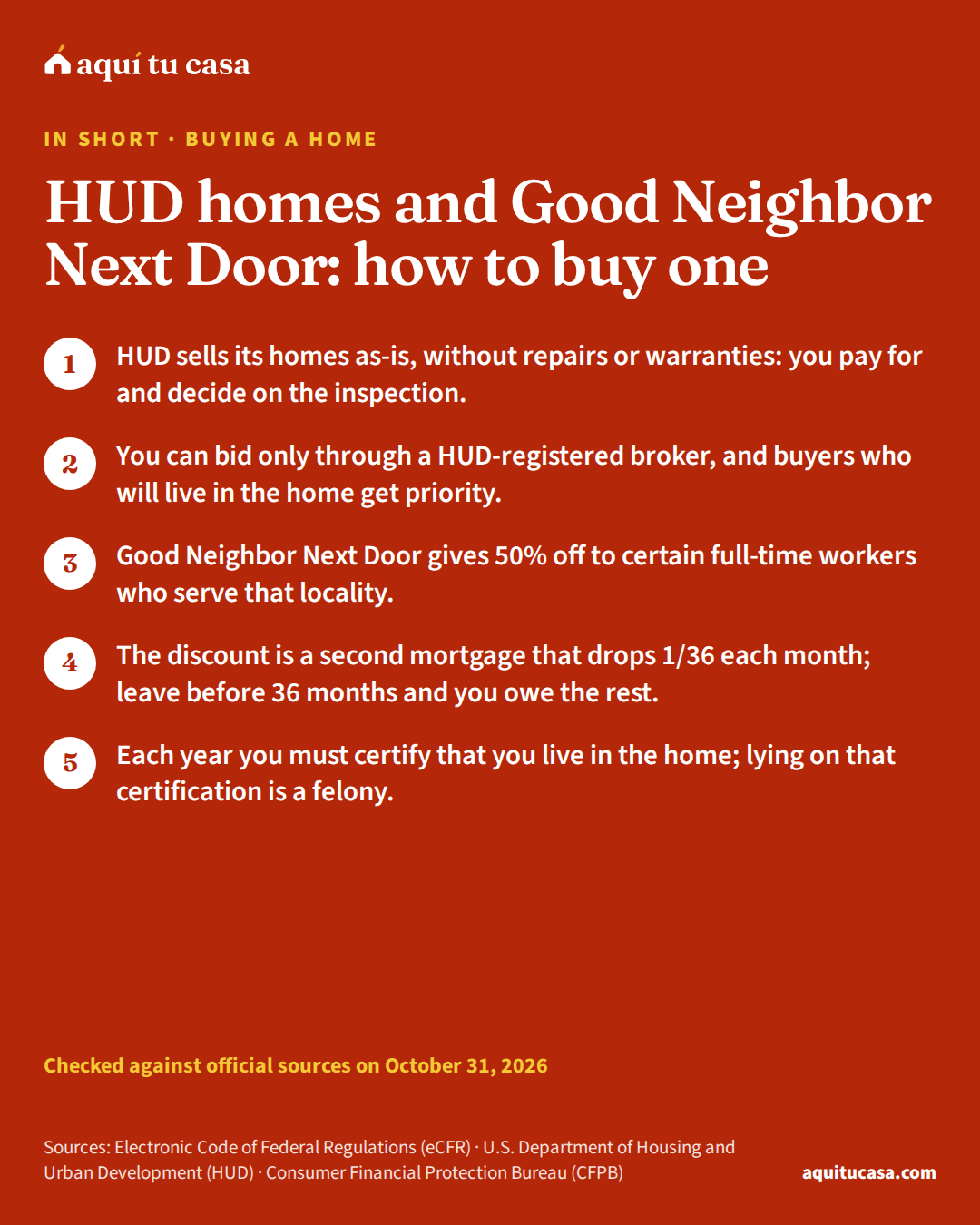
- HUD sells its homes as-is, without repairs or warranties: you pay for and decide on the inspection.
- You can bid only through a HUD-registered broker, and buyers who will live in the home get priority.
- Good Neighbor Next Door gives 50% off to certain full-time workers who serve that locality.
- The discount is a second mortgage that drops 1/36 each month; leave before 36 months and you owe the rest.
Is this for you?
This guide is for you if…
- You saw a home on HUD Homestore and want to know how to make an offer.
- You are a police officer, teacher, firefighter or emergency medical technician and heard about the Good Neighbor Next Door discount.
- You want to buy a home FHA took back after a foreclosure and you plan to live in it.
Get direct help first if…
- You are looking at a foreclosed home owned by a bank, Fannie Mae or Freddie Mac, or one sold at auction: read «Buying a foreclosed or auction home».
- You are behind on your mortgage and afraid of losing your home: read «If you can't pay your mortgage» first.
When an FHA-insured loan ends in foreclosureforeclosureForeclosure is the process by which the lender or servicer takes back the property after the homeowner fails to make mortgage payments. The rules and timelines depend on each state; all of them include advance notices and, in general, time to catch up or ask for an alternative, such as a repayment plan or a loan modification. If you fall behind, call your servicer and a HUD-approved housing counseling agency early: foreclosure counseling is free and exists for exactly this.See the full definition, the home can end up owned by FHA, which is part of HUD.4 HUD sells it again, and those are the “HUD homes” you see on HUD Homestore. They are sold under their own rules. This guide explains how to make an offer, what priority you get if you will live in the home and how the Good Neighbor Next Door discount works for some workers.13
How a HUD home is sold
HUD sells its homes one at a time, through local real estate brokers. It generally sells them as-is, without repairs or warranties.1 That means if the roof leaks or the stove is missing, fixing it is on you after you buy.
To bid you need a HUD-registered real estate broker. HUD Homestore has a search tool to find one nearby.4 Your agent submits the bid in HUD’s system, along with the earnest money depositearnest moneyEarnest money is a deposit the buyer pays when signing the purchase contract to show good faith that the offer is serious. The seller does not keep it: a neutral third party (the title company or a closing agent) normally holds it, and at closing it is applied to your down payment or closing costs. If you back out for a reason the contract allows, such as an inspection or financing contingency, you get it back; if you back out without a valid reason, you can lose it.See the full definition.
The bid period is generally 10 days, though HUD can change it. At the end, HUD accepts the bid that leaves it the most net money, with priority for buyers who will live in the home.1 Net money is your price minus the closing costs you ask HUD to pay and the broker’s commission. So a bid with a slightly higher price that asks for no help with costs can win.1
Who can buy. Anyone can bid, regardless of race, color, religion, sex, national origin, familial status, age or disability. There are few exceptions, such as a former owner who did not live in the home and stopped paying the loan.2
The priority if you will live in the home
If the home is offered with insured financing, HUD gives priority to buyers who will live in it for a period of up to 30 days, ahead of investors.1 For that, your bid must say you will live in the home. If it does not, HUD treats it as an investor bid.1
That priority brings other advantages:
- Help with costs. If you ask for it in your bid, HUD may pay all or part of your financing and closing costs, up to a percentage it sets for the area. Investors get no such help.1
- Ties. If your bid and an investor’s are identical, HUD picks yours.1
The deposit. If the price is $50,000 or less, the deposit is $500. Above that, the local HUD office sets it between $500 and $2,000. It is credited to you at closing if you win, returned if you lose, and you can lose it if you fail to close.1 The earnest money guide explains how to protect that money.
How to finance it: the FHA code on the listing
When listing a home, HUD may say whether it can be financed with an FHA loanFHA loanAn FHA loan is a mortgage made by a private lender and insured by the Federal Housing Administration (FHA), an agency of the U.S. government. That insurance protects the lender if you stop paying, which is why the lender can accept a lower down payment and a less-than-perfect credit history than on a conventional loan. Federal law sets the minimum cash investment at 3.5% of the property's value and caps the loan amount at the FHA limit, which changes by county. In exchange for the insurance you pay a mortgage insurance premium.See the full definition. Check this before you bid, because it decides which loan you can use:2
The three ways to finance a HUD home with FHA
Ready for FHA
Insured
- The home meets FHA's minimum standards
- You can use a regular FHA loan
- It is still sold as-is
Small repairs
Insured with a repair escrow
- Needs no more than $10,000 in repairs to qualify
- A cash escrow is set up to finish the repairs
- The FHA loan is approved on that condition
Needs work
With a 203(k) loan
- For homes that need more repairs
- A home flagged as uninsurable can be financed with FHA only this way
- The loan includes the cost of the work
Ask your lender to read the listing with you before you bid.
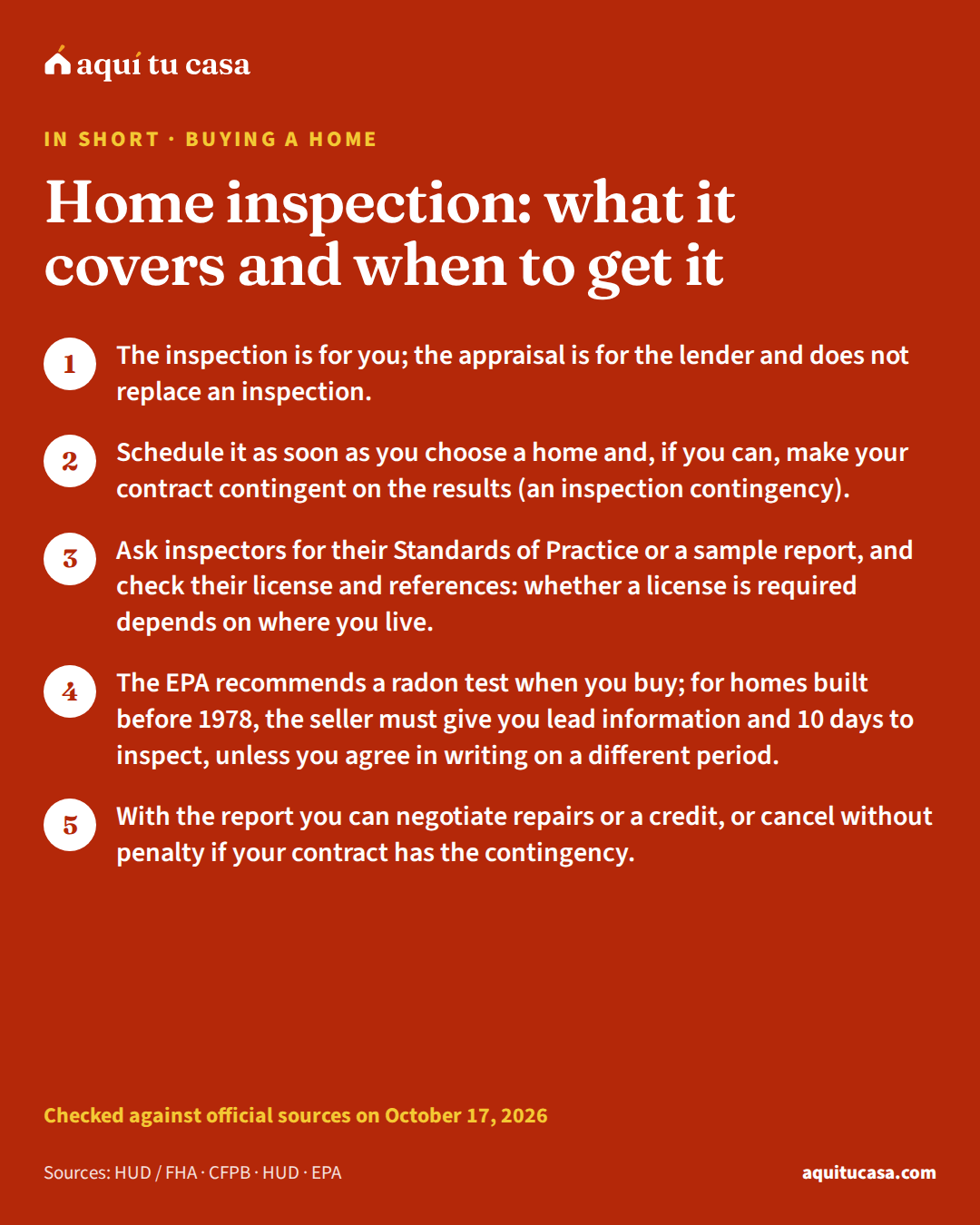
If the home needs a lot of work, the FHA 203(k) loan guide explains how one loan can pay for both the purchase and the work. And before you bid, pay for a home inspectionhome inspectionA home inspection is a review of the property's physical condition by an inspector before you finish buying: roof, foundation, plumbing, electrical, heating and cooling, signs of moisture or pests. It is often part of the home buying process and you pay for it, not the lender; unlike the appraisal, it does not say what the home is worth but what problems it has. With the report you can ask for repairs, negotiate the price or walk away if your contract includes an inspection contingency. Some assistance programs require one.See the full definition: since HUD repairs nothing, the report is your best defense. The home inspection guide explains what to check.
Good Neighbor Next Door: the 50% discount
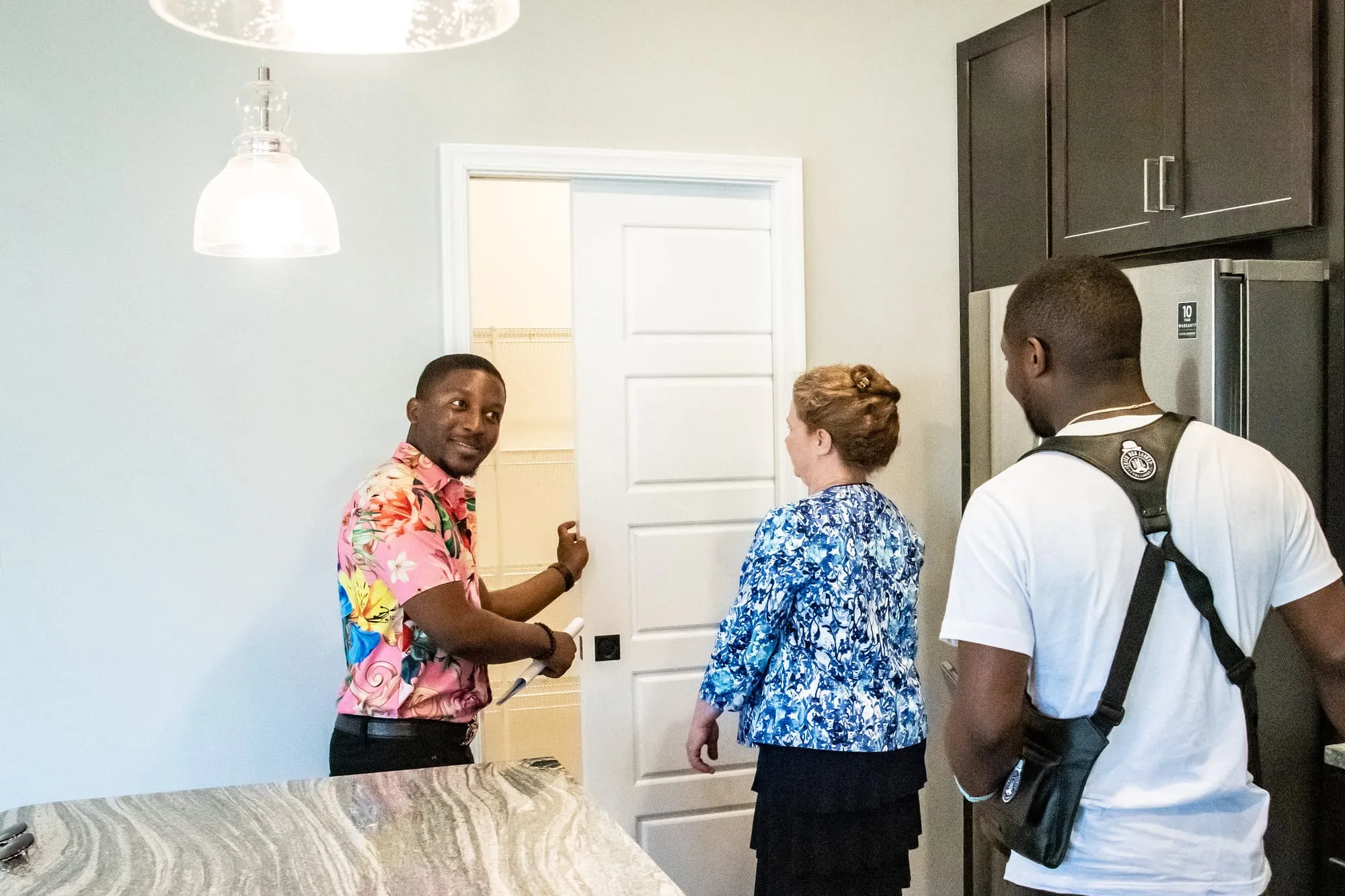
Good Neighbor Next Door is a HUD program to help certain workers live in the communities they serve. It offers single-unit HUD homes in revitalization areas at 50% off the list price. If you finance with FHA, the down payment is just $100.3 Each home is listed only through this program for seven days, the number is limited and the list changes every week.5
Who qualifies. You must work full-time in one of these professions, and your job must serve the locality where the home is:3
- Law enforcement officer: with a federal, state, local or tribal agency, sworn to uphold the law and make arrests.
- Teacher: at a state-accredited public or private school, pre-K through grade 12.
- Firefighter or emergency medical technician: with a federal, state, local or tribal department or unit.
Other requirements. You must hold that job when you bid and when you close, and certify that you plan to stay at least one year. Neither you nor your spouse may have owned a home in the year before the bid, or have bought through the program before. If both of you qualify, HUD approves only one spouse’s bid.3
If there are several bids. HUD picks the winner by lottery and draws two backup bids in case the first one does not close. Bids also go through a participating broker.3 The deposit is 1% of the list price, between $500 and $2,000, and you lose all of it if you fail to close.3
The second mortgage and the 36 months
The discount is not an instant gift. You sign a second mortgagesecond mortgageA second mortgage (or junior lien) is a loan you take out using your home as collateral while you still have another loan secured by it. Home equity loans and HELOCs are common examples. It is called "second" because, if you stop paying and the home is sold to pay the debts, this loan is paid after the first one; if there is not enough money, the second lender may not get everything it is owed. That is why it often has a higher interest rate. It adds to your total debt and, if you cannot repay it, you could lose your home.See the full definition and a promissory notepromissory noteThe promissory note (or simply the note) is the document you sign at closing to promise you will repay the loan to the lender. It describes what you are agreeing to: how much you owe, the interest rate, the payment dates, the total you will pay, the length of the loan, whether the payments can change and where to send them. It is separate from the mortgage or deed of trust, the document that gives the lender the right to take the home if you do not pay. Some terms, such as a prepayment penalty, may be in an addendum to the note. You can ask for copies of the documents before closing to review them.See the full definition to HUD for the amount of the discount. You pay no interest or monthly payments if you live in the home for three years.5
That debt drops 1/36 on the last day of each month you live in the home, and reaches zero at the end of month 36. If you sell or stop living in the home earlier, you owe HUD what is left on that day.3
Example with real numbers
How the second mortgage goes down
An example in words, not a real case, of a teacher who buys with the discount.
- First day of the term
- She owes HUD the whole discount
- After 12 months living there
- 12/36 has been erased; she owes 24/36 of the discount
- After 24 months
- She owes 12/36 of the discount
- At the end of month 36
- The debt reaches zero
- If she moves in month 12
- She pays HUD 24/36 of the discount when she sells
The 1/36 rule comes from HUD's regulation.3 Work out your first-mortgage payment with your own numbers.
Run it with your numbersMortgage calculatorWhen the 36 months start. It depends on how much repair work HUD says the home needs: 30 days after closing if $10,000 or less, 90 days if more than $10,000 and up to $20,000, and 180 days if more than $20,000. If you need to be away because of a hardship, ask HUD in writing at least 30 days ahead.3
The loan. With a conventional loan, the mortgage cannot exceed the discounted price. With FHA you can finance reasonable closing costs and, with a 203(k), the repairs. HUD does not pay your closing costs or the broker’s commission in this program. If you refinance someday, the new loan plus what is left on the second mortgage cannot exceed 95% of the value.3

The yearly certifications
During the 36 months you must live in the home as your sole residence and certify it every year. HUD mails you the form around the purchase anniversary. If you fail to return at least one certification a year, HUD refers the case for investigation, and an investigator may come to the home. If they cannot confirm you live there, the case goes to the Office of Inspector General. Falsifying that certification is a felony.5
If you are called to active military duty, you do not have to live in the home during that time and may rent it only while on active duty, but you must notify HUD. At the end of three years, if you complied, HUD files the release of its second mortgage with the county recorder’s office.5
From the search to the keys
1. Talk to a lender
Before you search
Get a preapproval and ask whether you can use FHA, a repair escrow or a 203(k).2
2. Find a HUD-registered broker
Before you bid
Use the HUD Homestore search; only a registered broker can submit your bid.4
3. Check the listing and the home
During the bid period
Look at the FHA code and pay for an inspection: HUD sells without repairs.1
4. Bid as a buyer who will live there
Before the deadline
Say you will live in the home and have the earnest money ready.1
6. With Good Neighbor Next Door, certify every year
Around each anniversary
Sign and return the certification that you live in the home.5
If this is you
It is your first home
Mark in your bid that you will live in the home: you get priority and can ask for help with costs.1
You have little money for repairs
Look for insured homes or homes with a repair escrow of up to $10,000, or ask about a 203(k).2
You are a teacher and your husband is a police officer
Both of you can bid through Good Neighbor Next Door, but HUD approves only one spouse's bid.3
You are in the Reserve and could be called up
If you are activated, tell HUD; you may rent the home only while on active duty.5
You sold your home recently
For Good Neighbor Next Door, neither you nor your spouse may have owned a home in the past year.3
Costly mistakes
Mistake: Bidding without an inspection because the home is cheap.
Instead: HUD sells without repairs or warranties; the inspection report tells you how much you will spend.1
Mistake: Forgetting to mark in the bid that you will live in the home.
Instead: Without that, HUD treats your bid as an investor's and you lose the priority.1
Mistake: Thinking the Good Neighbor Next Door discount is yours at closing.
Instead: It is a second mortgage that drops 1/36 a month; leave early and you owe the rest.3
Mistake: Not returning the yearly certification.
Instead: HUD refers the case for investigation if a year's certification is missing.5
Mistake: Renting the home out during the term.
Instead: It must be your sole residence; only on active military duty may you rent it, after telling HUD.5

Free help
A HUD-approved housing counselorHUD-approved housing counselorA HUD-approved housing counselor works at an agency HUD has approved to provide housing counseling: independent, expert advice customized to your situation about buying a home, renting, a missed mortgage payment, a foreclosure or credit problems. The agencies usually charge little or nothing; many serve in Spanish and offer the homebuyer education course several assistance programs require. They are not lenders or real estate agents and sell you nothing. Your county page lists the official agencies with phone numbers.See the full definition can go over with you whether a HUD home makes sense and which loan to use, often for free or at low cost; the CFPB keeps a list of agencies.6 The guide to HUD-approved housing counselors explains how to find one. If you are looking at foreclosed homes owned by others, such as banks, Fannie Mae or Freddie Mac, read Buying a foreclosed or auction home. And to get your money ready, use the how much house can I afford calculator and the closing costs tool.
What to do this week
- Get a preapproval and ask which kind of loan you can use on a HUD home.2
- Find a HUD-registered broker on HUD Homestore.4
- If you work as a police officer, teacher, firefighter or emergency medical technician, check your state’s Good Neighbor Next Door list every week.5
- Set aside the money for the earnest money deposit.1
- Mark the 36 months and each anniversary on your calendar if you buy with the discount.3
Your numbers
The minimum for this loan is 3.5%. More down lowers the monthly payment.
Adjust advanced details
First number: share of income for housing. Second: housing plus debts. Lender references, not fixed rules.
Let's do the math
Estimated top price
National figure$227,000
Limited by the housing payment: at that price it would be about $1,883 a month, 28% of your income.
- By the housing payment (28% of income)Limits you$227,000
- By your total debts (36% of income)$292,000
- By your cash (down payment + closing)$330,500
- Typical home in the United States
- $332,700
- Your cap is 68% of the typical home.
What changes if…?
- …you save $10,000 more$227,000
- …you cut $200 a month in debts$227,000
Your maximum price with four loans
Same income, debts and savings; only the down payment and the loan type change. ITIN uses an example down payment and rate.
| FHA 3.5% | Conventional 5% | Conventional 20% | ITIN 15% (example) | |
|---|---|---|---|---|
| Maximum price | $227,000 | $232,000 | $93,000 | $119,000 |
| Payment per month | $1,883 | $1,882 | $616 | $898 |
Educational estimate, not a pre-approval. Uses example insurance (0.5% of value per year) and example closing costs (3% of price); the tax is the place’s typical rate.
Ready to see the numbers? Find your county here
See how this applies in your county: its loan limits, prices and rents, from the official data.
Printable checklist
Frequently asked questions
Can anyone buy a HUD home?
Yes. Under HUD's regulation, anyone may bid regardless of race, color, religion, sex, national origin, familial status, age or disability. There are few exceptions, such as a former owner who did not live in the home and whose default led FHA to pay the claim.
Can I bid without an agent?
Not on your own. HUD Homestore says you need a HUD-registered real estate broker to submit your bid, and the site has a broker search.
Does HUD fix the home before selling it?
No. It generally sells as-is, without repairs or warranties. That is why it makes sense to pay for an inspection and check whether the home can be financed with FHA, with a repair escrow or with a 203(k) loan.
Who qualifies for Good Neighbor Next Door?
Full-time law enforcement officers, pre-K through grade 12 teachers, firefighters and emergency medical technicians whose jobs serve the home's locality. Also, neither you nor your spouse may have owned a home in the year before the bid, or have bought through the program before.
Is the 50% discount a gift?
Not exactly. You sign a second mortgage to HUD for the discount amount. You pay no interest or payments if you live in the home 36 months, and the debt drops 1/36 each month. If you sell or move out early, you owe what is left.
What if I move for work before three years are up?
You owe HUD what is left on the second mortgage on the date you sell or leave the home. HUD says its contractor processes those payoffs, for example after a job relocation.
How much is the earnest money deposit?
In a regular HUD sale it is $500 if the price is $50,000 or less; above that, the local HUD office sets it between $500 and $2,000. In Good Neighbor Next Door it is 1% of the list price, between $500 and $2,000. If you fail to close, you can lose it.
Sources
Every figure in this guide comes from one of these official sources. The number next to a sentence leads to the source behind it.
Each source on one line: who publishes it, its title, its address and the date we read it.
- 1. Electronic Code of Federal Regulations (eCFR) · 24 CFR Part 291, Subpart C, Sales Procedures (§291.205) · ecfr.gov · Accessed October 31, 2026
- 2. Electronic Code of Federal Regulations (eCFR) · 24 CFR §291.100, General policy on HUD acquisition, ownership, and disposition of real estate assets · ecfr.gov · Accessed October 31, 2026
- 3. Electronic Code of Federal Regulations (eCFR) · 24 CFR Part 291, Subpart F, Good Neighbor Next Door Sales Program · ecfr.gov · Accessed October 31, 2026
- 4. U.S. Department of Housing and Urban Development (HUD) · HUD Homes for Sale (HUD Homestore) · hudhomestore.gov · Accessed October 31, 2026
- 5. U.S. Department of Housing and Urban Development (HUD) · HUD Good Neighbor Next Door Program · hud.gov · Accessed October 31, 2026
- 6. Consumer Financial Protection Bureau (CFPB) · Find a housing counselor · consumerfinance.gov · Accessed October 31, 2026
Keep reading
Related guides
If this guide helped, these follow the same path.

Buying a home 10 minute read
Buying a foreclosed (REO) or auction home: risks and steps
Buying a home the bank already owns or at a foreclosure auction: Freddie Mac's First Look period, the offer, tenants in the home and the risks to check.
- A foreclosure auction and an REO home (already owned by a bank or agency) are very different purchases.
- At a Florida judicial sale, for example, you pay a 5% deposit on the day of the sale and the rest soon after.
- REO homes are bought with an agent, a written offer and preapproval, but almost always as-is.
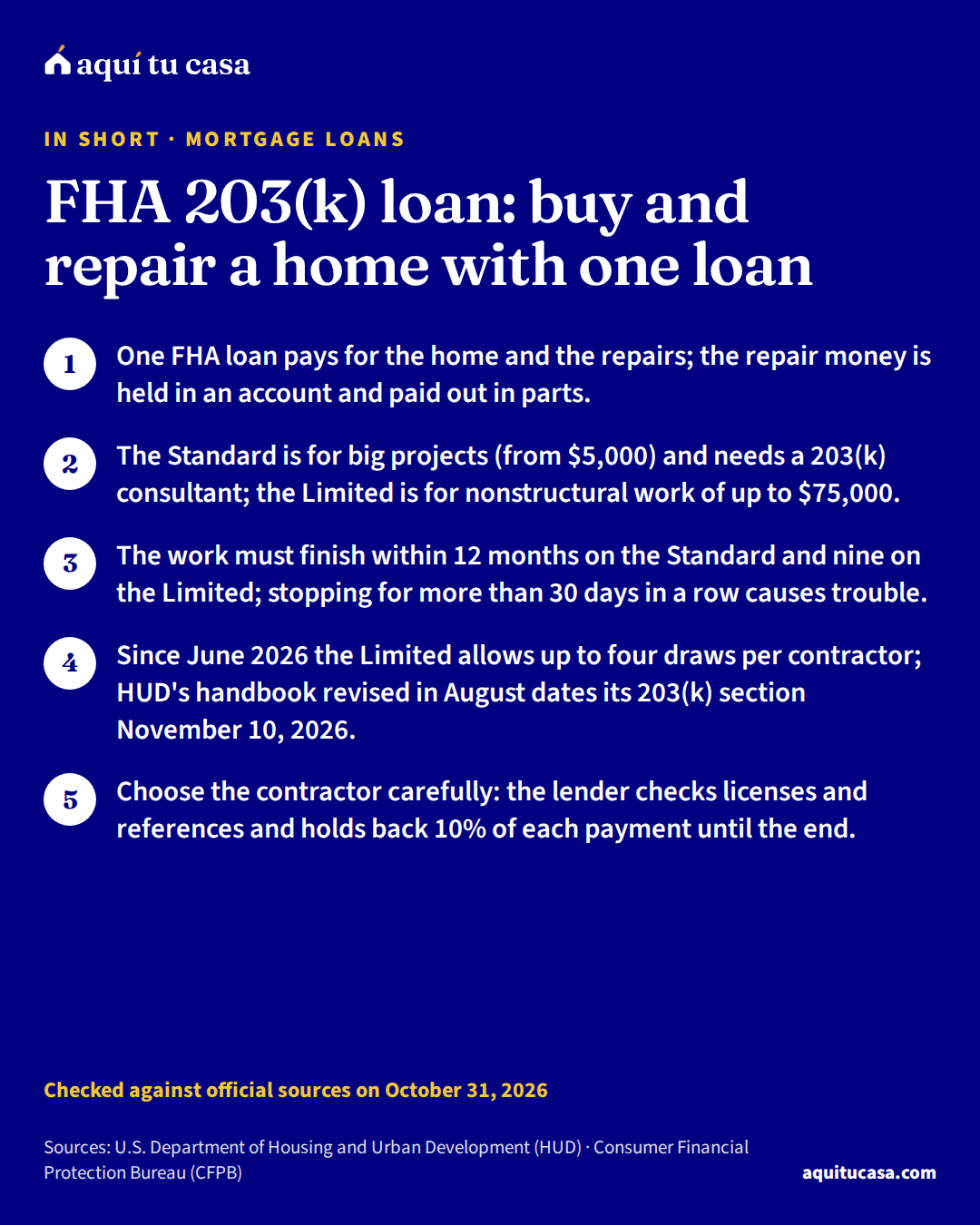
- Mortgage loans FHA 203(k) loan: buy and repair a home with one loan How FHA's Standard and Limited 203(k) loans work: which repairs they pay for, the consultant, the draws, the deadlines and the dates on HUD's rules. 11 minute read
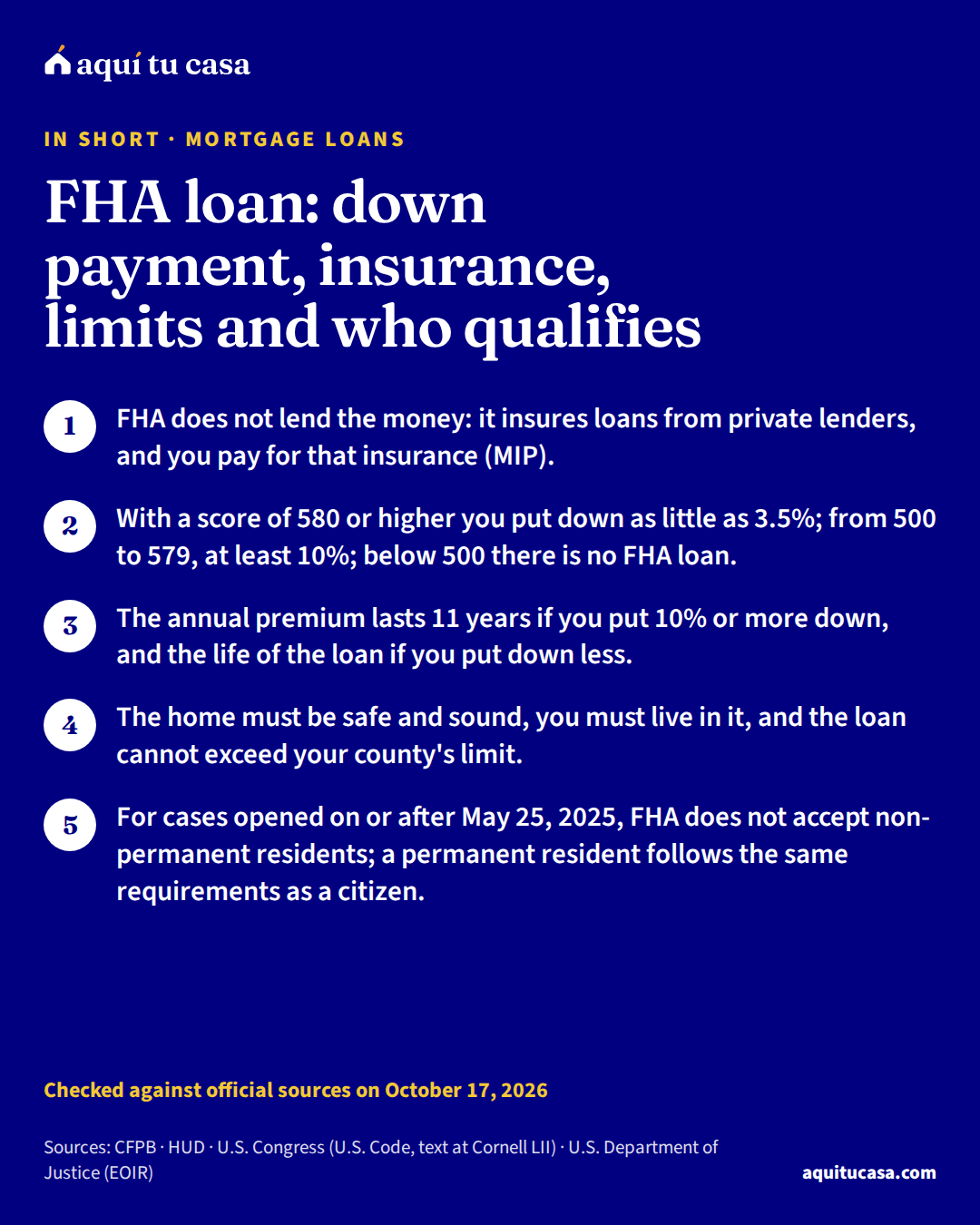
- Mortgage loans FHA loan: down payment, insurance, limits and who qualifies How an FHA loan works: the down payment and credit score HUD requires, MIP mortgage insurance, your county limit, the home and the residency rules. 14 minute read
- Buying a home Home inspection: what it covers and when to get it What a home inspection is, how it differs from the appraisal, when to get it under a contingency, radon and lead tests, and what to do with the report. 12 minute read
Tools for this topic
Was this guide useful?
Thank you. Your answer stays in your browser; nothing is sent.