Buying a foreclosed (REO) or auction home: risks and steps
Buying a home the bank already owns or at a foreclosure auction: Freddie Mac's First Look period, the offer, tenants in the home and the risks to check.
Verified against official sources on October 31, 2026 7 official sources

Show contents
In short
What you need to know
Quick answer
There are two ways to buy a foreclosed home. At a foreclosure auction, the home is sold before the bank owns it: in Florida, for example, you pay a deposit the same day and the rest soon after. After the auction, if no one buys it, the home goes to the bank or an agency (an REO home) and is sold like any other, with an agent, preapproval and inspection, though almost always as-is. Freddie Mac and HUD give a priority period to buyers who will live in the home. If the home has tenants, federal law gives them at least 90 days' notice.
What matters most
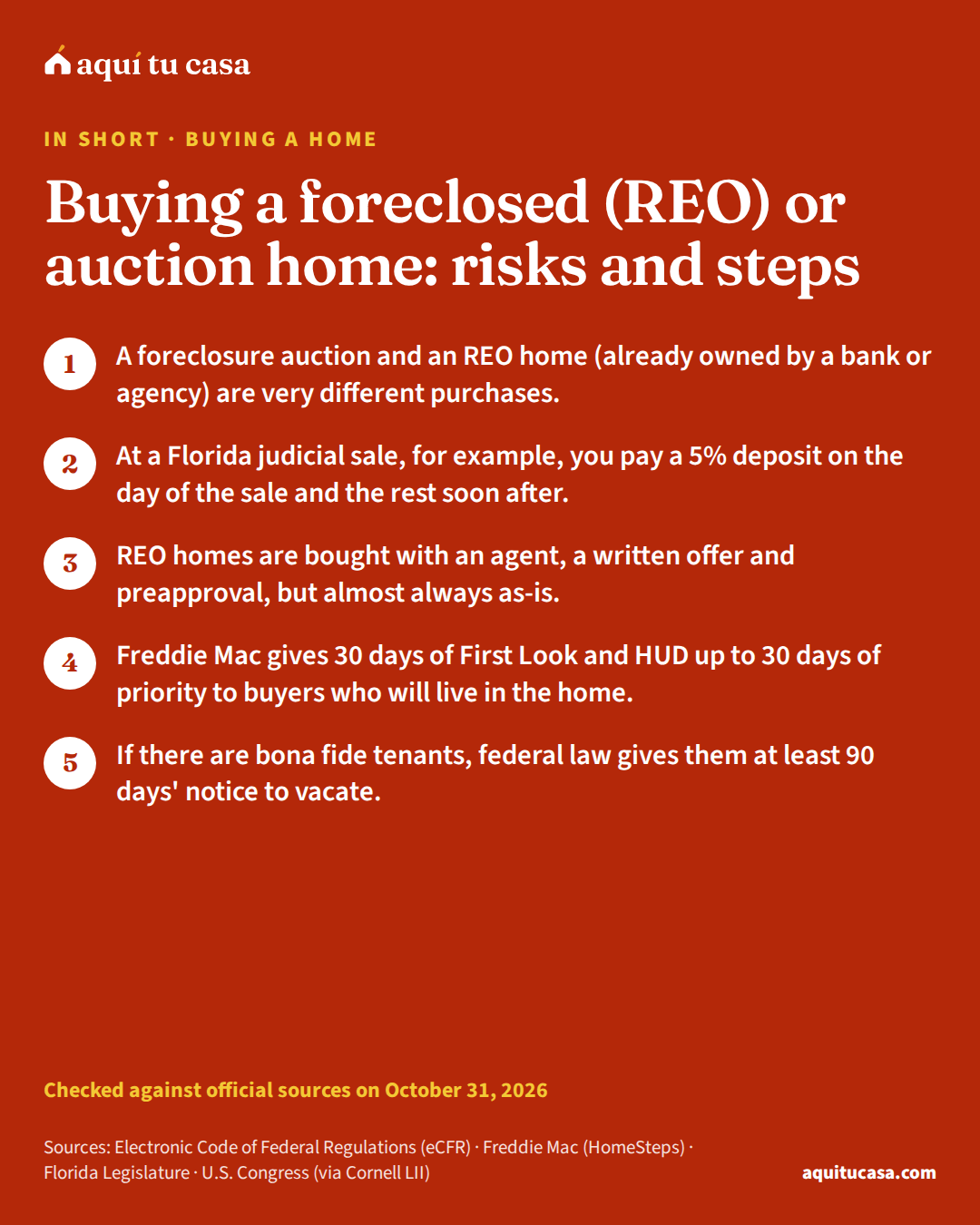
- A foreclosure auction and an REO home (already owned by a bank or agency) are very different purchases.
- At a Florida judicial sale, for example, you pay a 5% deposit on the day of the sale and the rest soon after.
- REO homes are bought with an agent, a written offer and preapproval, but almost always as-is.
- Freddie Mac gives 30 days of First Look and HUD up to 30 days of priority to buyers who will live in the home.
Is this for you?
This guide is for you if…
- You saw a foreclosed home that a bank, Freddie Mac or HUD already owns, and you want to make an offer.
- You were told foreclosure auctions have cheap homes and want to know how they work.
- The home you like has tenants and you do not know what happens to them.
Get direct help first if…
- You are about to lose your own home to foreclosure: read «The foreclosure process step by step».
- You rent a home that went into foreclosure: read «Tenant rights when the building is sold or foreclosed».
A foreclosed home can cost less than others, but buying one comes with rules and risks a normal purchase does not have. The first thing is to know when you are buying it: at the foreclosure auction, or later, when a bank or agency already owns it (an REO home, for “real estate owned”). This guide explains both, the priority period for buyers who will live in the home, what happens to tenants and the costliest mistakes.24
Auction or REO home: two different purchases
The two ways to buy a foreclosed home
Before the bank owns it
Foreclosure auction
- Run by the court or a trustee, depending on the state
- In Florida, a 5% deposit on the day of the sale
- Each auction's written rules say how and when to pay
- The rules vary a lot from state to state
Already owned by a bank or agency
REO home
- Sold through an agent, like other homes
- You offer with preapproval and an earnest money deposit
- You can ask for an inspection, but they almost never repair
- Some sellers give priority to buyers who will live there
Understand each one's rules well before you make an offer.
The foreclosure auction. When an owner stops paying and the lender forecloses, the home is sold at a public auction. How it works depends on the state. In Florida, for example, at a judicial sale the court sets the auction between 20 and 35 days after the judgment. The winner must post a deposit of 5% of the bid with the clerk at that moment. If the balance is not paid on time, the sale is repeated and the deposit pays the costs. If no one objects within 10 days after the certificate of sale, the clerk files the certificate of title and the property passes to the buyer.4
The REO home. If no one buys the home at the auction, it generally becomes the property of the lender or of an agency, such as Freddie Mac or HUD. That home is then sold through agents, much more like a normal purchase.3 The guide The foreclosure process step by step explains the whole process from the owner’s side.
How to buy a Freddie Mac REO home
Freddie Mac sells its foreclosed homes on HomeSteps. The process is like that of almost any home: your agent contacts the listing agent, or, if you have no agent, you call the listing agent yourself.3
The First Look period. During the first 30 days a HomeSteps home is for sale, only buyers who will live in the home, certain Neighborhood Stabilization Program grantees and nonprofits can buy it, without competing with investors. You do not have to be a first-time buyer; the home just has to be your primary residence.2
What goes with your offer. HomeSteps asks for:3
- The purchase contract, signed and dated by all buyers.
- A preapprovalpreapproval letterA preapproval or prequalification letter is a document from a lender saying it is generally willing to lend you up to a certain amount. It is not a guaranteed loan offer. Lenders use the two words differently: some issue a prequalification based on information you report, without verifying it, and only issue a preapproval after reviewing your documents; others use the words the other way around or interchangeably. That is why it pays to ask what the letter is based on. Sellers often ask for one before accepting an offer.See the full definition letter, or proof of funds if you pay cash.
- The earnest money depositearnest moneyEarnest money is a deposit the buyer pays when signing the purchase contract to show good faith that the offer is serious. The seller does not keep it: a neutral third party (the title company or a closing agent) normally holds it, and at closing it is applied to your down payment or closing costs. If you back out for a reason the contract allows, such as an inspection or financing contingency, you get it back; if you back out without a valid reason, you can lose it.See the full definition in certified funds at contract signing. Personal checks and money orders are not accepted.
- HomeSteps’ own addenda. Ask your agent to explain them.
The answer. Complete offers are usually answered or countered within about 48 hours. If several offers arrive at once, HomeSteps asks everyone for their highest and best offer by a set date and time. And legal acceptance happens only when all parties sign the contract.3
For HUD homes, which have their own bidding system and priority period, read HUD homes and Good Neighbor Next Door.1

The risks worth checking
The home’s condition. A foreclosed home can have damage that does not show in the listing photos. Because sellers of foreclosed homes almost never repair, get a home inspectionhome inspectionA home inspection is a review of the property's physical condition by an inspector before you finish buying: roof, foundation, plumbing, electrical, heating and cooling, signs of moisture or pests. It is often part of the home buying process and you pay for it, not the lender; unlike the appraisal, it does not say what the home is worth but what problems it has. With the report you can ask for repairs, negotiate the price or walk away if your contract includes an inspection contingency. Some assistance programs require one.See the full definition and use the report to decide. HUD sells without repairs or warranties.1 The home inspection guide explains what to check.
The financing. If the home needs a lot of work, a regular loan may not be approved. An FHA 203(k) loanFHA 203(k) loanThe FHA 203(k) loan is an FHA-insured mortgage that combines, in a single loan, the purchase of a home (or the refinance of yours) and the cost of repairing or renovating it. You get it through an FHA-approved lender. Part of the money pays the seller or the old mortgage, and the rest goes into an escrow account and is released when the work is completed. There are two types: Standard, for major or structural repairs, and Limited, for smaller, non-structural work. Eligible properties include one- to four-unit homes, townhomes and certain condominium units, among others.See the full definition combines the purchase and the repairs; a HUD home can be financed that way if the contract marks it as eligible, though investors cannot use it.6 The FHA 203(k) loan guide explains it.
The title. After a foreclosure there can be lienslienA lien is a legal right a creditor holds in your property to make sure you repay a debt. It usually prevents the property from being sold until the debt is paid, and if you do not pay, the creditor may be able to take the property. Your mortgage is a lien on your home: when you pay it off, the lien is released and that shows up in your county's property records. There are other kinds, such as a federal tax lien, which is the government's legal claim against all your property when you do not pay a tax debt.See the full definition or title problems. Ask for a title searchtitle searchA title search is a review of public records to find defects or encumbrances in a property's chain of title, such as someone else's claim or a lien. It keeps the buyer and the lender from being surprised later by an ownership problem that could have been foreseen. According to the CFPB, the title search fee is part of the title service fees, along with the premium for the lender's title insurance, and it appears on page 2 of your Loan Estimate and your Closing Disclosure. You can often shop for who provides these services.See the full definition and review the title insurance offer; the title insurance guide explains what it protects.
The tenants. If the home has bona fide tenants, federal law requires giving them a notice to vacate of at least 90 days. If they have a bona fide lease signed before the foreclosure notice, they can stay until it ends, unless you buy the home to live in it, and even then they get the 90-day notice. Some state or local laws give more protection.5
Example with real numbers
A couple buying an REO home during First Look
An example in words, not a real case, of how the purchase comes together.
- The period
- The home has been for sale less than 30 days; investors cannot bid yet
- The offer
- A contract signed by both, preapproval and a deposit in certified funds
- The inspection
- The report shows an old roof; they adjust their offer
- Several offers
- They are asked for their highest and best offer by a set date
- When it is theirs
- Only when all parties sign the contract
The rules in the example come from HomeSteps.23 Work out how much house you can afford before you offer.
Run it with your numbersHow much house can I afford?Before you offer on a foreclosed home
1. Get preapproved
Before you search
HomeSteps asks for it with the offer, or proof of funds if you pay cash.3
2. Check whether there is a priority period
When you see the listing
Freddie Mac gives 30 days of First Look; HUD, up to 30 days to buyers who will live there.2
3. Visit and inspect the home
Before you sign
The seller almost never repairs; the report tells you what you will spend.1
6. Check the title
Before closing
Ask for the title search and title insurance.
If you plan to go to an auction
Foreclosure auctions carry more risk, especially for first-time buyers. Before you go:
- Read your state’s and county’s rules. They vary a lot. In Florida, for example, the deposit is 5% of your final bid on the day of the sale, and if you do not pay the rest on time, the clerk advertises another sale and uses your deposit to pay its costs.4
- Have the money ready. Ask your lender ahead of time whether a loan can close within the time the auction requires.
- Research the title yourself. Ask a title company to check for other liens before you bid.
- Think about the occupants. If someone lives in the home, it may take time for them to leave, and bona fide tenants are entitled to their 90-day notice.5
If this is you
It is your first home
An REO home in First Look lets you compete without investors for 30 days.2
You have owned a home before
You still qualify for First Look if the home will be your primary residence.2
The home needs repairs
If it is a HUD home marked as eligible, a 203(k) can pay for the purchase and the work.6
The home you like has tenants
They must get at least 90 days' notice; some states give more time.5
You plan to pay cash
HomeSteps asks for proof of funds with the offer and the deposit in certified funds.3
Questions for your agent before you offer
A good agent knows how each bank or agency sells. Bring these questions:
- Is the home still in a priority period for buyers who will live in it? Until when?2
- Which addenda does the seller require, and what do they say about repairs, inspection and deadlines?3
- Are there other offers? How does the highest-and-best process work?3
- Do we know whether anyone lives in the home?5
- Can it be financed with FHA, or do I need a 203(k)?6
Write down each answer with its date. If anything is unclear, ask for it in writing before you sign.

Costly mistakes
Mistake: Offering without an inspection because the price is low.
Instead: Sellers of foreclosed homes almost never repair; inspect first.1
Mistake: Paying the deposit with a personal check.
Instead: HomeSteps asks for certified funds; personal checks are not accepted.3
Mistake: Going to an auction without reading the state's rules.
Instead: In Florida, for example, you pay 5% the same day and the rest within a short time.4
Mistake: Believing you can remove tenants right away.
Instead: Federal law gives them at least 90 days' notice.5
Mistake: Celebrating before everyone signs.
Instead: With HomeSteps, legal acceptance happens only when all parties sign the contract.3
Free help
A HUD-approved housing counselorHUD-approved housing counselorA HUD-approved housing counselor works at an agency HUD has approved to provide housing counseling: independent, expert advice customized to your situation about buying a home, renting, a missed mortgage payment, a foreclosure or credit problems. The agencies usually charge little or nothing; many serve in Spanish and offer the homebuyer education course several assistance programs require. They are not lenders or real estate agents and sell you nothing. Your county page lists the official agencies with phone numbers.See the full definition can go over whether a foreclosed home makes sense for you and which loan to use, often for free or at low cost.7 The guide to HUD-approved housing counselors explains how to find one. If you buy a home with tenants, the guide Tenant rights when the building is sold or foreclosed explains what they can expect. And before you offer, use the closing costs calculator.

What to do this week
- Get preapproved and ask whether you can use a 203(k).6
- Look for Freddie Mac homes on HomeSteps and check whether they are in First Look.2
- Keep the deposit in an account you can draw certified funds from.3
- If you plan to go to an auction, get your county’s written rules.4
- Always ask whether the home has tenants.5
Your numbers
The minimum for this loan is 3.5%. More down lowers the monthly payment.
Adjust advanced details
First number: share of income for housing. Second: housing plus debts. Lender references, not fixed rules.
Let's do the math
Estimated top price
National figure$227,000
Limited by the housing payment: at that price it would be about $1,883 a month, 28% of your income.
- By the housing payment (28% of income)Limits you$227,000
- By your total debts (36% of income)$292,000
- By your cash (down payment + closing)$330,500
- Typical home in the United States
- $332,700
- Your cap is 68% of the typical home.
What changes if…?
- …you save $10,000 more$227,000
- …you cut $200 a month in debts$227,000
Your maximum price with four loans
Same income, debts and savings; only the down payment and the loan type change. ITIN uses an example down payment and rate.
| FHA 3.5% | Conventional 5% | Conventional 20% | ITIN 15% (example) | |
|---|---|---|---|---|
| Maximum price | $227,000 | $232,000 | $93,000 | $119,000 |
| Payment per month | $1,883 | $1,882 | $616 | $898 |
Educational estimate, not a pre-approval. Uses example insurance (0.5% of value per year) and example closing costs (3% of price); the tax is the place’s typical rate.
Ready to see the numbers? Find your county here
See how this applies in your county: its loan limits, prices and rents, from the official data.
Printable checklist
Frequently asked questions
What is an REO home?
It is a home that became the property of a bank or an agency, such as Freddie Mac or HUD, after a foreclosure and that no one bought at the auction. It is sold through an agent, almost always as-is.
Can I inspect an REO home?
You can usually get an inspection as in any purchase, but the seller almost never makes repairs. HUD, for example, sells without repairs or warranties. So the inspection helps you decide how much to offer or whether to walk away.
What is Freddie Mac's First Look period?
It is the first 30 days a HomeSteps home is on the market. During that time only buyers who will live in the home, certain stabilization program grantees and nonprofits can buy, without competing with investors.
How do you pay at a foreclosure auction?
It depends on the state. In Florida, for example, the law requires the winner to post a deposit of 5% of the bid on the day of the sale and pay the rest within the set time; if they do not, the sale is repeated and the deposit pays the costs.
What happens to the tenants if I buy a foreclosed home?
Federal law requires giving them at least 90 days' notice to vacate. If they have a bona fide lease, they can stay until it ends, unless you buy the home to live in it, and even then they get the 90-day notice. Some state laws give more protection.
How long does Freddie Mac take to answer my offer?
According to HomeSteps, complete offers are usually answered or countered within about 48 hours, though final approval can take longer. Legal acceptance happens only when all parties sign the contract.
Can I use an FHA loan for a HUD home that needs repairs?
Yes, if the home is marked as eligible for a 203(k), which pays for the purchase and the repairs. Investors cannot use a 203(k) for HUD homes.
Sources
Every figure in this guide comes from one of these official sources. The number next to a sentence leads to the source behind it.
Each source on one line: who publishes it, its title, its address and the date we read it.
- 1. Electronic Code of Federal Regulations (eCFR) · 24 CFR Part 291, Subpart C, Sales Procedures (§291.205) · ecfr.gov · Accessed October 31, 2026
- 2. Freddie Mac (HomeSteps) · Freddie Mac First Look Initiative · homesteps.com · Accessed October 31, 2026
- 3. Freddie Mac (HomeSteps) · Making an Offer · homesteps.com · Accessed October 31, 2026
- 4. Florida Legislature · Florida Statutes §45.031, Judicial sales procedure · leg.state.fl.us · Accessed October 31, 2026
- 5. U.S. Congress (via Cornell LII) · Protecting Tenants at Foreclosure Act (Pub. L. 111-22, §702), note to 12 U.S.C. §5220 · law.cornell.edu · Accessed October 31, 2026
- 6. U.S. Department of Housing and Urban Development (HUD) · Handbook 4000.1, FHA Single Family Housing Policy Handbook · hud.gov · Accessed October 31, 2026
- 7. Consumer Financial Protection Bureau (CFPB) · Find a housing counselor · consumerfinance.gov · Accessed October 31, 2026
Keep reading
Related guides
If this guide helped, these follow the same path.

Buying a home 11 minute read
HUD homes and Good Neighbor Next Door: how to buy one
How HUD sells its homes on HUD Homestore, the priority period for buyers who will live in the home and the rules of the Good Neighbor Next Door discount.
- HUD sells its homes as-is, without repairs or warranties: you pay for and decide on the inspection.
- You can bid only through a HUD-registered broker, and buyers who will live in the home get priority.
- Good Neighbor Next Door gives 50% off to certain full-time workers who serve that locality.
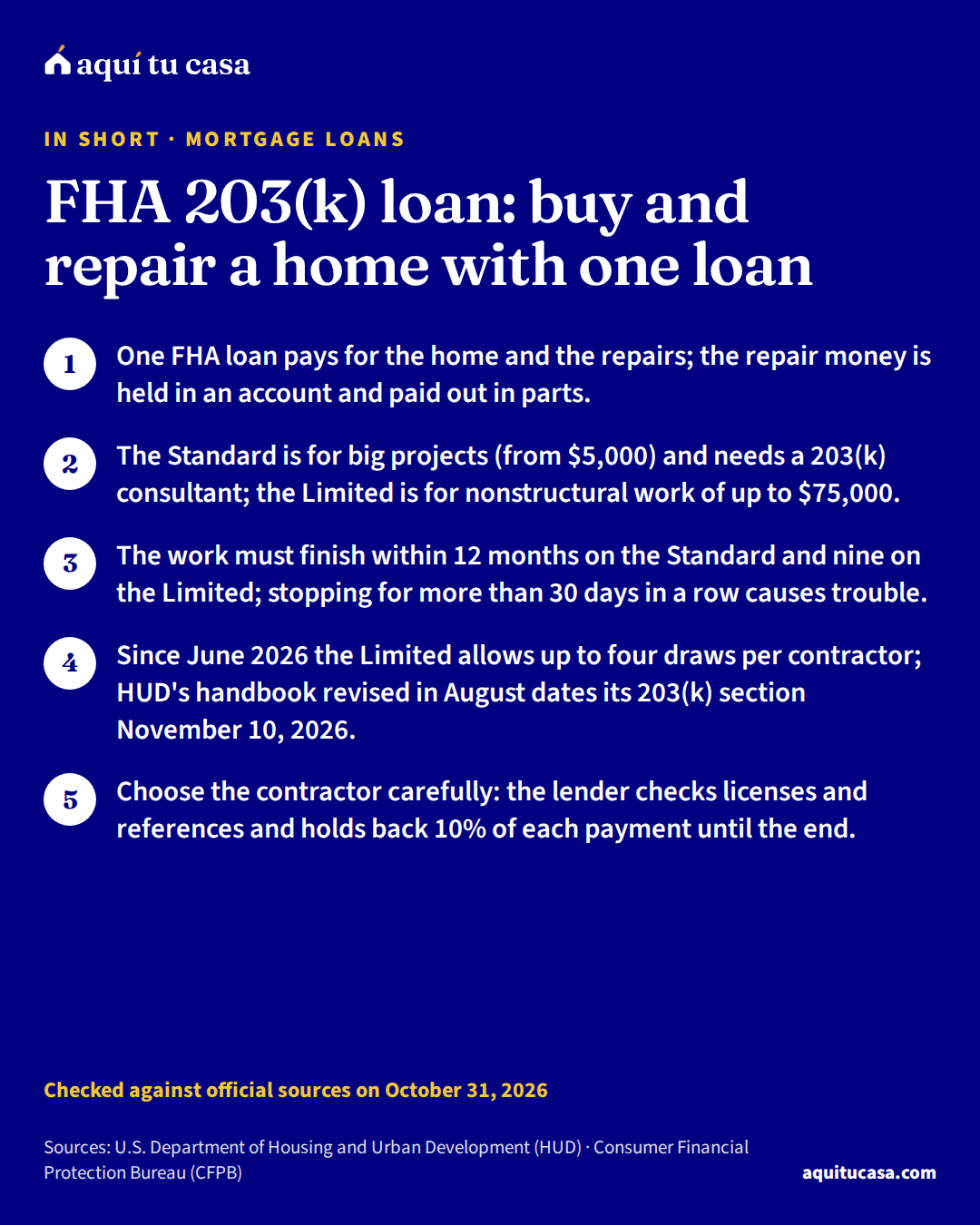
- Mortgage loans FHA 203(k) loan: buy and repair a home with one loan How FHA's Standard and Limited 203(k) loans work: which repairs they pay for, the consultant, the draws, the deadlines and the dates on HUD's rules. 11 minute read
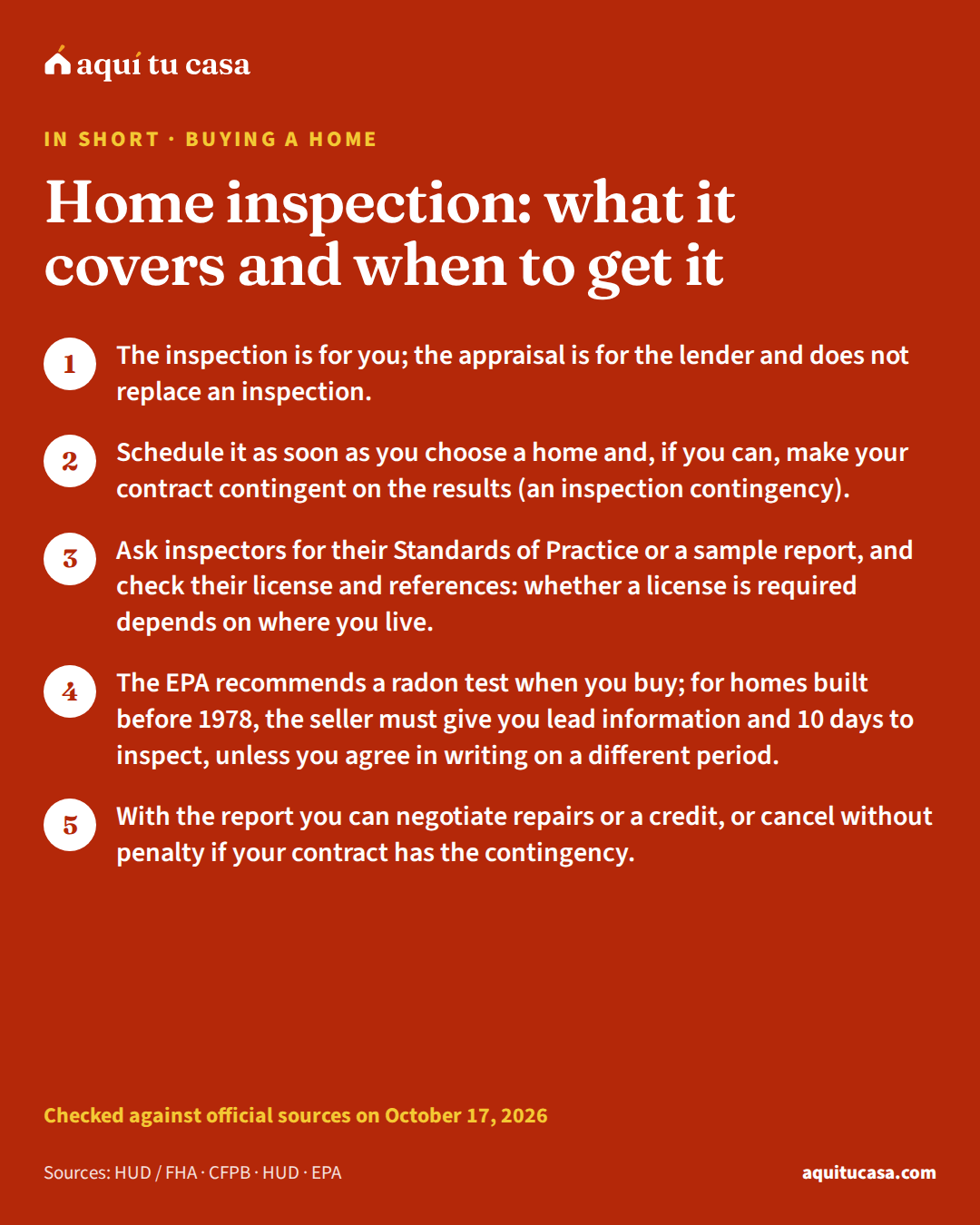
- Buying a home Home inspection: what it covers and when to get it What a home inspection is, how it differs from the appraisal, when to get it under a contingency, radon and lead tests, and what to do with the report. 12 minute read
- Buying a home Title insurance and your home's title: what they protect What your home's title is, the difference between the lender's and the owner's title insurance, where they appear on the Loan Estimate and how to compare. 10 minute read

Tools for this topic
Was this guide useful?
Thank you. Your answer stays in your browser; nothing is sent.