Tenant rights when the building is sold or foreclosed
What happens to your lease, deposit and voucher if the owner sells or loses the building to foreclosure, and the federal 90-day notice.
Verified against official sources on October 31, 2026 8 official sources

Show contents
In short
What you need to know
Quick answer
If the building you rent in is sold, your lease generally continues: the new owner is bound by it until it ends. If the owner loses the property in a foreclosure, federal law protects you: whoever takes the home must give you a notice of at least 90 days before asking you to leave, and if you have a lease signed earlier, you can generally stay until it ends. If you have a Section 8 voucher, the new owner takes the home subject to your lease and the housing agency's contract. Keep paying rent, but first confirm who the legal owner is.
What matters most
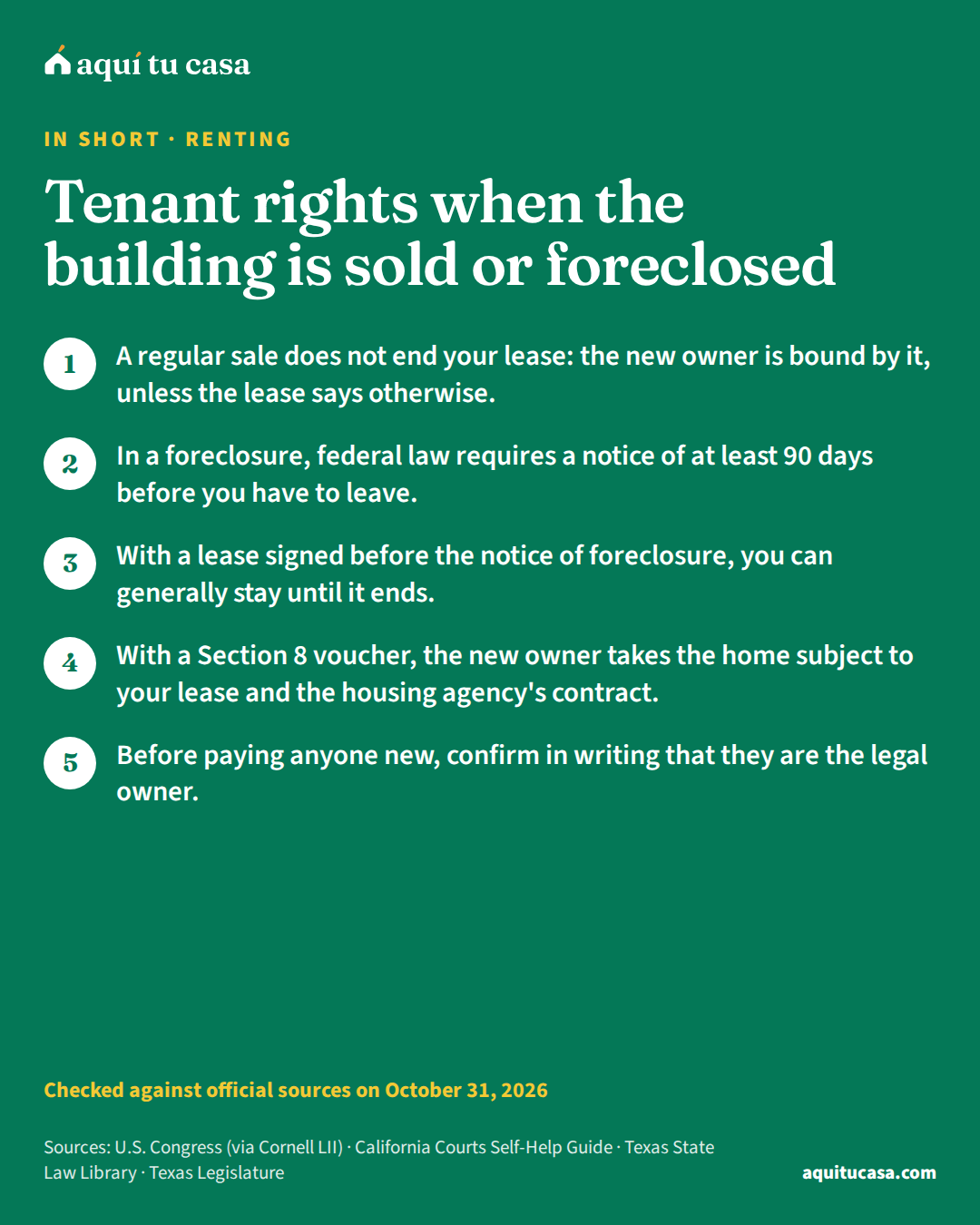
- A regular sale does not end your lease: the new owner is bound by it, unless the lease says otherwise.
- In a foreclosure, federal law requires a notice of at least 90 days before you have to leave.
- With a lease signed before the notice of foreclosure, you can generally stay until it ends.
- With a Section 8 voucher, the new owner takes the home subject to your lease and the housing agency's contract.
Is this for you?
This guide is for you if…
- You rent and were told the building or house was sold.
- You found out your landlord's home is in foreclosure.
- A new owner is asking you to leave or to sign a new lease.
Get direct help first if…
- You already got an eviction lawsuit from the court: read «What to do if you get an eviction notice» first and get legal help today.
- You own the home in foreclosure: read «The foreclosure process step by step».
Finding out that the building you rent in was sold, or that the owner is losing the home to foreclosure, is frightening. Many families think they have to leave right away. Usually that is not the case: your lease and federal law give you time and rights. This guide explains what changes and what does not when the owner changes, what happens to your deposit and your voucher, and how to protect yourself from scams.
A regular sale or a foreclosure: not the same
There are two ways your home can change owners, and your rights change depending on which one it is:
- A regular sale. The owner decides to sell and someone else buys the building or house. The owner is current on the mortgage, or pays it off with the sale.
- A foreclosure. The owner stopped paying the loan and the lender sells the property, or takes it, to collect the debt. The guide The foreclosure process step by step explains that process from the owner’s side.
What happens to your lease in each case
Your state's law
Regular sale
- The new owner is bound by your lease
- If the lease does not say it ends with a sale, it stays the same
- When it ends, the new owner can renew, raise the rent or change terms
Federal and state law
Foreclosure
- Notice of at least 90 days before you have to leave
- With a lease signed before the notice of foreclosure, you stay until it ends
- Exception: if sold to someone who will live there, still with 90 days' notice
In both cases, your state or city may give you more protection than this.
If the owner sells the building
In a regular sale, your leaseleaseA lease, or rental agreement, is the contract in which the owner or landlord gives you the right to live in and use a property for a set period of time in exchange for payment, usually rent. While the lease lasts you have possession, but the landlord still owns the property. The lease says how much you pay and when, who handles maintenance and how the agreement can end. Your rights as a tenant are usually spelled out in the lease and in your state and local laws. Before complaining to the landlord, it helps to read the lease and make sure you are also following the rules you agreed to.See the full definition does not end because the owner changed. The Texas State Law Library explains it this way: when a property changes ownership, the new owner is bound by the terms of the existing lease. If the lease does not say it ends when the property is sold, the owner generally cannot remove you or change the lease. When the lease ends, the new owner can renew it, change the rent or change the terms.4
So the first step is to read your lease and look for a clause about a sale. The guide Your lease explained helps you find it. If your lease is month to monthmonth-to-month tenancyA month-to-month tenancy is a rental arrangement with no end date: it continues month after month as long as you pay the rent, until you or the landlord give notice to end it. It can be in writing, but it can also start without a contract, for example if you stay after your lease ends and the landlord accepts your payment. To end it, you must give the notice your state's law requires. In New York, for example, the notice alone does not let the landlord remove you: if you do not leave, the landlord has to go to court.See the full definition, the new owner can end it with the notice your state requires; the tenant rights by state tool shows each state’s notice periods.
You also have the right to know who the owner is. In Texas, for example, if you ask, the landlord must give you the name and an address of the owner shown in the county records, and that of the company managing the building if it is elsewhere, by the seventh day after your request, unless it is already in your lease.5
If there is a foreclosure
Here a federal law protects you: the Protecting Tenants at Foreclosure Act. Whoever takes the property in the foreclosure must give you a notice to vacate at least 90 days in advance.1 In addition:
- If you have a lease signed before the notice of foreclosure, you can stay until it ends. The exception is if the home is sold to someone who will live in it as their primary residence; even then, you get the 90-day notice.1
- If you have no lease or one that can be ended at will, you also get the 90-day notice.1
- Your state may give you more. The federal law does not override state or local laws that give more time or other protections, or the rules for subsidized housing.1
To have these protections you must be a bona fide tenant: not the owner who owed the mortgage or that owner’s child, spouse or parent; your lease made between independent parties; and paying rent that is not substantially below market, or that is reduced by a subsidy.1 This law was set to end in late 2014, but in 2018 Congress repealed that end date and restored it.1
An example of how your state can add protection: according to the California courts, a foreclosure by itself is not just cause to end your tenancy under the state’s tenant protection law, with exceptions. And you can record a Request for Notice with your county recorder’s office to be notified if a foreclosure starts.3
If you have a Section 8 voucher
If you pay your rent with a housing choice voucherHousing Choice Voucher (Section 8)The Housing Choice Voucher, the program almost everyone calls Section 8, is the country's largest federal rental assistance. HUD pays rental subsidies so eligible families can afford decent, safe and sanitary housing. Local public housing agencies administer it with HUD funds. The family finds its own home on the private market; if the agency approves the unit and the tenancy, it contracts with the owner to pay part of the rent, and the family pays the rest. Waiting lists are usually long and open for limited periods.See the full definition, you have extra protection. Under the program’s federal law, in a foreclosure of the property where you live, whoever takes it takes it subject to your lease with the prior owner and to the housing assistance payments contract with the public housing agencypublic housing agency (PHA)A public housing agency (PHA) is a state, county, municipal or other governmental entity or public body authorized to operate public housing or rental assistance programs. These are the agencies that locally administer the Housing Choice Vouchers (Section 8) and public housing with HUD funds: they open and manage the waiting lists, review eligibility and income, inspect units and pay the owner its share of the rent. Each county usually has one or several; your page shows the ones serving your area with their phone numbers.See the full definition.2 Tell your housing agency as soon as you hear about the foreclosure or the sale, so your assistance is not interrupted.
Your security deposit
Your security depositsecurity depositA security deposit is money you pay the landlord when you start renting as security that you will follow the lease: pay the rent and take care of the home. The money still belongs to you. The landlord holds it and, when you move out, must return it minus the charges the law allows, such as past-due rent or damage beyond normal wear and tear. You should not be charged for damage that was already there when you moved in. The maximum amount and the deadline to return it depend on your state's law and sometimes your city's.See the full definition is not lost because the owner changed, but who returns it depends on your state. Three examples:
- Texas. If the owner’s interest ends by sale, death, bankruptcy or otherwise, the new owner is liable for your deposit from the date it acquires title, and must give you a signed statement with the exact amount. The prior owner remains liable until the new one receives or assumes the deposit. This rule does not apply to a lender that takes the home by foreclosure.5
- Florida. When the property is sold, deposits and advance rents must pass to the new owner with their interest and an accurate accounting. The new owner is presumed to have received your deposit, but only up to one month’s rent.6
- California. After a foreclosure, the new owner must return your deposit if the prior owner did not.3
The guide Security deposits explains how to ask for it back when you move out.

How to protect yourself when the owner changes
The California courts recommend continuing to pay rent on time to the new owner or manager, but first confirming they are the legal owner, because scammers pose as owners. If you get no notice of whom to pay, set the rent aside so you do not spend it.3
Get everything in writing. If the new owner or manager tells you something by phone or in person, ask them to send it in writing, dated and signed. If you ever have to show a court what you were told and when, those papers are your proof. And keep a copy of everything you send.
What to do as soon as you hear about the change
2. Keep every notice
Each time one arrives
Write down the date you got it; in a foreclosure, 90 days count.1
4. Keep paying or set the rent aside
Every month
Pay the legal owner with a method that leaves a record; if you do not know whom, set it aside.3
5. Ask about your deposit
When the owner changes
In some states the new owner must give you a statement with the amount.5
Example with real numbers
A family renting a home in foreclosure
An example in words, not a real case, of how the rules apply.
- They signed a one-year lease before the foreclosure
- They can stay until the lease ends
- The bank sells the home to someone who will live there
- The new owner can end the lease, but with 90 days' notice
- They are not related to the prior owner and pay market rent
- They are bona fide tenants
- A man knocks on the door asking for rent in cash
- They first confirm he is the legal owner
- What they do
- Keep the notice, count the 90 days and look for legal aid
The rules come from federal law and the California courts.113 Check your state's eviction timeline.
Run it with your numbersEviction timelines by stateIf this is your situation
You have a one-year lease
In a foreclosure, you can generally stay until the end; in a sale, the new owner is bound by it.14
You rent month to month
In a foreclosure you get at least 90 days' notice if you are a bona fide tenant.1
You have a Section 8 voucher
The new owner takes the home subject to your lease and the housing agency's payments contract.2
You are told to leave in a week
In a foreclosure, federal law requires at least 90 days; get legal help today.17
Someone new asks for the rent
Confirm in writing that they are the legal owner before paying.3
Note: a notice to vacate is not the same as a court order. Nobody can remove you by changing the locks or cutting off utilities; read Illegal lockouts and utility shutoffs. If you get a lawsuit, read What to do if you get an eviction notice today.
Costly mistakes
Mistake: Moving out as soon as you hear the building was sold.
Instead: Read your lease: the new owner is generally bound by it.4
Mistake: Stopping rent payments because there is a foreclosure.
Instead: Keep paying the legal owner, or set the rent aside if you do not know whom to pay.3
Mistake: Paying cash to someone who says they are the new owner.
Instead: First confirm they are the legal owner; scammers pose as owners.3
Mistake: Throwing away the notice without noting the date.
Instead: The federal 90 days are counted from the notice.1
Mistake: Writing off your deposit.
Mistake: Not telling your housing agency if you have a voucher.
Instead: Your lease and the agency's contract carry over to the new owner; tell them.2

Free help
A legal aidlegal aidLegal aid is the free civil legal help that nonprofit organizations and their lawyers provide to low-income people in civil, not criminal, matters. In housing, that includes representing families facing eviction or foreclosure, alongside matters such as custody, child support, protection from domestic violence and access to benefits. In the United States, the Legal Services Corporation, created by Congress, funds a nationwide network of these organizations; its finder points you to the one in your area. Each sets its own income limits.See the full definition office can review your notice and tell you how much time your state gives you. LSC helps you find the nearest one with your address or city.7 Read Free legal aid to know what to bring. HUD-approved housing counselors also help renters, often for free.8 And if someone asks you for money to “stop the foreclosure” of your landlord, read How to avoid rental scams.
What to do this week
- Read your lease and note when it ends and whether it says anything about a sale.4
- Keep every notice with the date it arrived.1
- Ask in writing for the new owner’s name and address.5
- Keep paying rent to the legal owner, with a receipt, or set it aside if you do not know whom to pay.3
- If you have a voucher, call your public housing agency.2
- Check your state’s eviction timeline and get legal help if you are asked to leave.7
Ready to see the numbers? Find your county here
See how this applies in your county: its loan limits, prices and rents, from the official data.
Printable checklist
Frequently asked questions
The building was sold. Do I have to leave?
Not because of the sale alone. According to the Texas State Law Library, the new owner is bound by your lease, and if the lease does not say it ends with a sale, the owner generally cannot remove you or change it. Check your lease and your state's laws.
How much time do I get after a foreclosure?
Under federal law, at least 90 days' notice to vacate. If you have a lease signed before the notice of foreclosure, you can generally stay until it ends, unless the home is sold to someone who will live in it. Your state may give you more.
Does the 90-day protection still exist?
Yes. The law was set to end in late 2014, but in 2018 Congress repealed that end date and restored it.
I have no written lease or I am month to month. Am I protected?
Yes. Federal law also requires the 90-day notice if you have no lease or one that can be ended at will, as long as you are a bona fide tenant.
I have a Section 8 voucher. What happens to it?
Under the program law, whoever takes the property in the foreclosure takes it subject to your lease and to the payments contract with the housing agency. Tell your public housing agency.
Who returns my deposit?
It depends on your state. In Texas, after a sale the new owner is liable for the deposit and must give you a signed statement with the amount. In Florida, the deposit must pass to the new owner. In California, after a foreclosure the new owner must return it if the prior owner did not.
Someone says they are the new owner and asks for rent. Do I pay?
First confirm they are the legal owner: the California courts warn that scammers pose as owners. Ask for proof in writing and pay with a method that leaves a record.
Sources
Every figure in this guide comes from one of these official sources. The number next to a sentence leads to the source behind it.
Each source on one line: who publishes it, its title, its address and the date we read it.
- 1. U.S. Congress (via Cornell LII) · Protecting Tenants at Foreclosure Act (Pub. L. 111-22, §702), note to 12 U.S.C. §5220 · law.cornell.edu · Accessed October 31, 2026
- 2. U.S. Congress (via Cornell LII) · 42 U.S.C. §1437f, Low-income housing assistance · law.cornell.edu · Accessed October 31, 2026
- 3. California Courts Self-Help Guide · Tenants' rights in a foreclosure · selfhelp.courts.ca.gov · Accessed October 31, 2026
- 4. Texas State Law Library · Legal FAQs: What happens to my lease if the property is sold? · sll.texas.gov · Accessed October 31, 2026
- 5. Texas Legislature · Texas Property Code, Chapter 92, Residential Tenancies · tcss.legis.texas.gov · Accessed October 31, 2026
- 6. Florida Legislature · Florida Statutes §83.49, Deposit money or advance rent; duty of landlord and tenant · leg.state.fl.us · Accessed October 31, 2026
- 7. Legal Services Corporation (LSC) · I Need Legal Help · lsc.gov · Accessed October 31, 2026
- 8. Consumer Financial Protection Bureau (CFPB) · Find a housing counselor · consumerfinance.gov · Accessed October 31, 2026
Keep reading
Related guides
If this guide helped, these follow the same path.

Money problems 12 minute read
Foreclosure: the process step by step
How foreclosure works, the federal deadlines that protect you before the sale, and what you can still do: apply for help, short sale or deed in lieu.
- The process differs by state: it may go through a court or not, but you must always be notified.
- Under the federal rule, foreclosure cannot start until you are more than 120 days behind.
- A complete application submitted more than 37 days before the sale stops the sale while you are evaluated.
- Renting What to do if you get an eviction notice Notice, lawsuit and the judge's order: what you can do at each moment, where free legal help is and what federal law says about the 30-day notice. 14 minute read
- Renting Security deposits: how much and how to get yours back What a security deposit is, how much a landlord may charge in your state, what can be deducted, when it must be returned and where to complain if it isn't. 14 minute read
- Renting Your lease explained: what to check before you sign What a lease is, which clauses to read before you sign, the lead paint disclosure, your fair housing rights and where to get free help. 15 minute read
Tools for this topic
Was this guide useful?
Thank you. Your answer stays in your browser; nothing is sent.