
How much house can I afford?
The price your income can carry.
What you get → maximum price
Someone shared this page with you.
Questions and answers
Every question our 25 guides about mortgage loans answer, grouped by guide. Each answer is the guide's own and leads to it, with its sources.
Open a question to read its answer. Each group ends with the full guide, its sources and, when it has one, its calculator.
We found no questions with those words. Try another word or open a topic.
From the guide
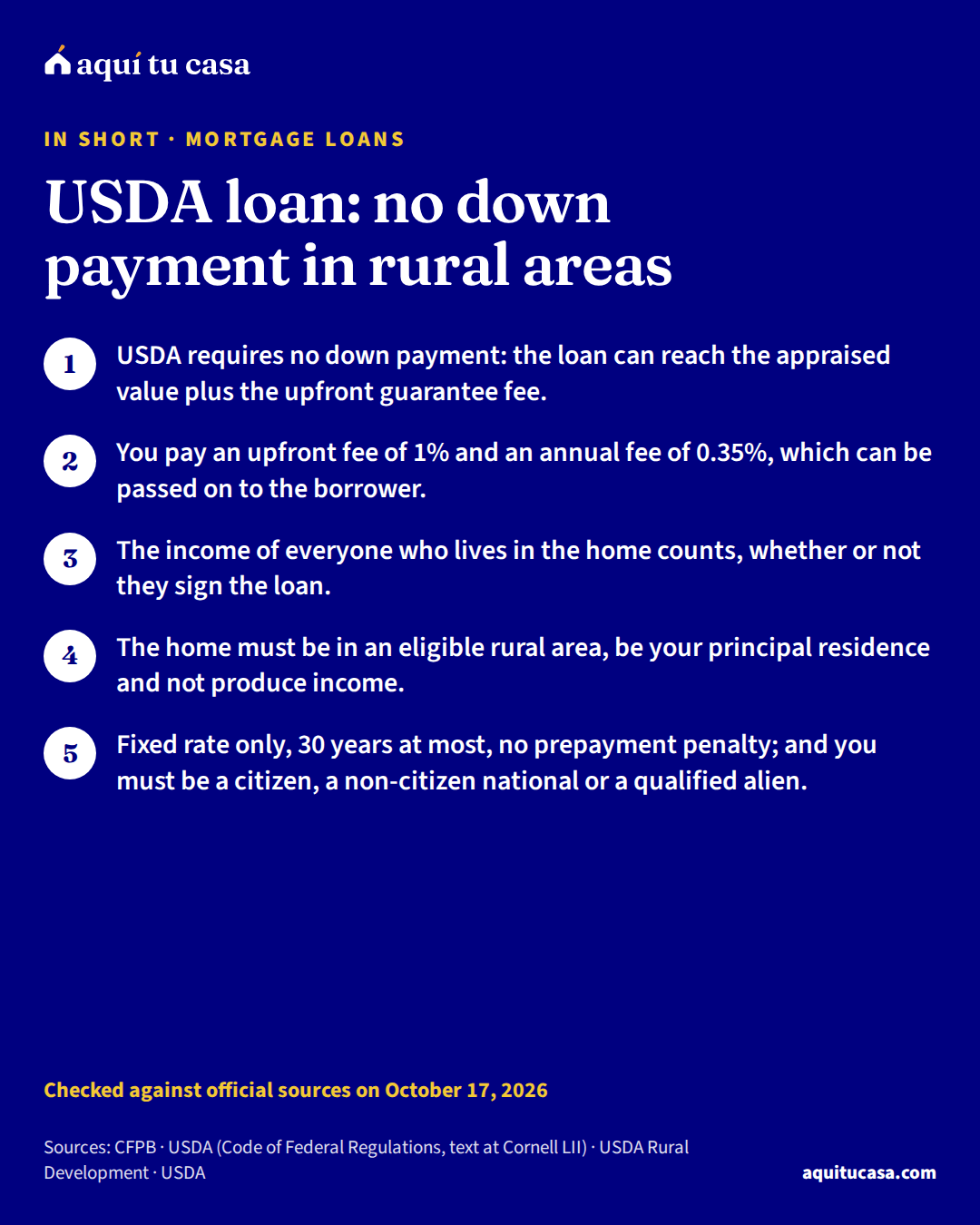
How the USDA guaranteed loan works: rural areas, the household income limit, guarantee fees, who can apply and the steps from address to keys.
Verified on October 17, 2026 19 official sources
Yes. The regulation lets the loan reach the lesser of the appraised value plus the upfront guarantee fee or the price plus allowable costs, so the minimum down payment is 0%. You still pay closing costs, except those that can go into the loan or that the seller pays.
Read the full guideFor fiscal year 2027 (October 1, 2026 to September 30, 2027), the upfront guarantee fee is 1% and the annual fee is 0.35%, on purchases and refinances. The upfront fee can be added to the loan, and the annual fee is charged in your monthly payment.
Read the full guideIt is your area's 'moderate income': the greatest of 115% of U.S. median family income and two other figures that depend on your state, your area and your household size. The income of everyone living in the home counts, with some deductions. USDA's eligibility site gives you an idea; your lender does the final math.
Read the full guideCheck the address on USDA's eligibility site, in the property section. USDA only guarantees loans in areas Rural Development designates as rural, and that designation can change; if it does, existing commitments are honored.
Read the full guideThe regulation requires evidence that you are a citizen, a non-citizen national or a 'qualified alien.' That category is defined in federal law and includes, among others, permanent residents, asylees and refugees. If you are not sure which category you fall in, an attorney or an accredited representative can guide you. Rules can change: check the verification date.
Read the full guideThe regulation requires a verifiable credit history and an acceptable score, without setting one number for everyone. A score of 680 or higher counts as a compensating factor if your payments exceed the 29% and 41% caps. If you have no history, other methods can be used, such as a non-traditional credit report.
Read the full guideOnly if you meet several conditions: your current home no longer meets your family's needs, you will live in the new one, you lack the resources to buy without the guarantee, you keep no more than one other home and you can afford both.
Read the full guideNot with a USDA guaranteed loan. The regulation rules out land or buildings used principally to produce income, and property used primarily for agriculture or a business. The lot must be typical in size for the area.
Read the full guideThe data behind these guides
The guides on Mortgage loans cite these figures. They update when their sources publish new ones; what you see here is current.
See all the dataSources: Freddie Mac (As of November 5, 2026) · HUD (2026 data) · FHFA (2026 data)
From the guide
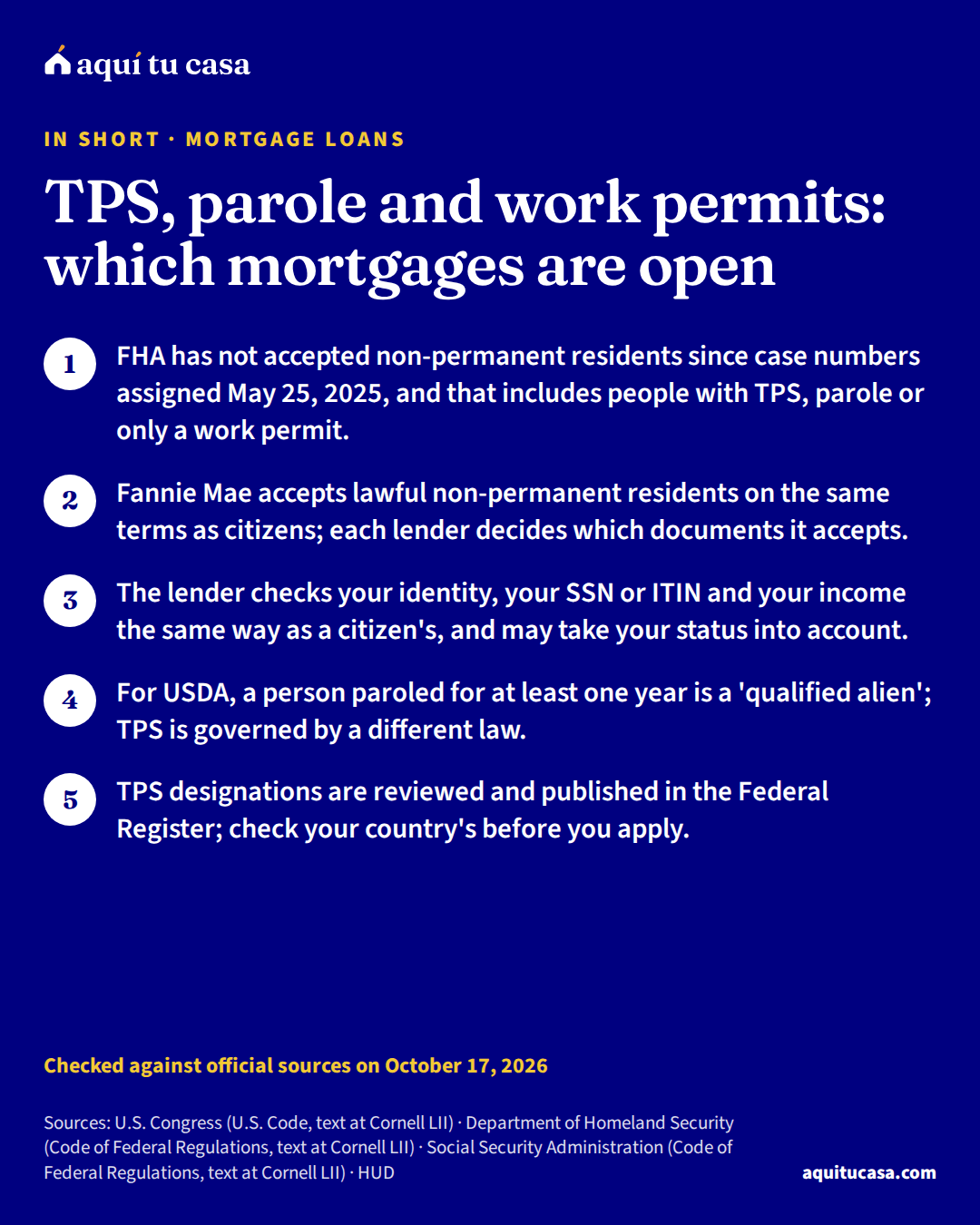
If you have TPS, parole or a work permit (EAD): what FHA, Fannie Mae and USDA say today, what documents a lender checks and how to compare offers.
Verified on October 17, 2026 25 official sources
Read the full guide Do the math: How much house can I afford?
Not today. HUD Mortgagee Letter 2025-09 eliminated eligibility for non-permanent residents for case numbers assigned on or after May 25, 2025. Citizens, permanent residents and citizens of Micronesia, the Marshall Islands and Palau remain eligible.
Read the full guideFannie Mae's rule accepts lawful non-permanent residents on the same terms as citizens. But it does not say which documents prove legal presence: each lender decides, case by case. That is why it makes sense to ask several, in writing, before you apply.
Read the full guideFannie Mae does not set a list: the lender uses the documentation it deems appropriate for your status. It must also confirm your identity, require a Social Security number or an ITIN and verify your employment and income the same way as for a citizen. Bring your current work permit and ask what else it needs.
Read the full guideThe law requires the government to review each designation at least 60 days before it ends and to publish its decision in the Federal Register. If a designation ends, the termination cannot take effect earlier than 60 days after it is published. Look up your country's notice in the Federal Register and, if you have questions, ask an accredited representative.
Read the full guideUSDA requires being a citizen, a non-citizen national or a 'qualified alien,' and the law puts someone paroled for a period of at least one year on that list. USDA also only guarantees loans in areas it designates as rural. If you are not sure whether your parole qualifies, ask an accredited representative.
Read the full guideRegulation B allows a lender to take your immigration status into account, and Fannie Mae requires your income to be reasonably expected to continue. In Illinois, the Department of Human Rights treats refusing to rent to someone because their status has an expiration date as discrimination. Ask each lender, before you apply, how it treats your permit's date.
Read the full guideThat is a question for a representative accredited by the Department of Justice or an immigration lawyer, not for a lender or this site. A notario cannot give legal advice.
Read the full guide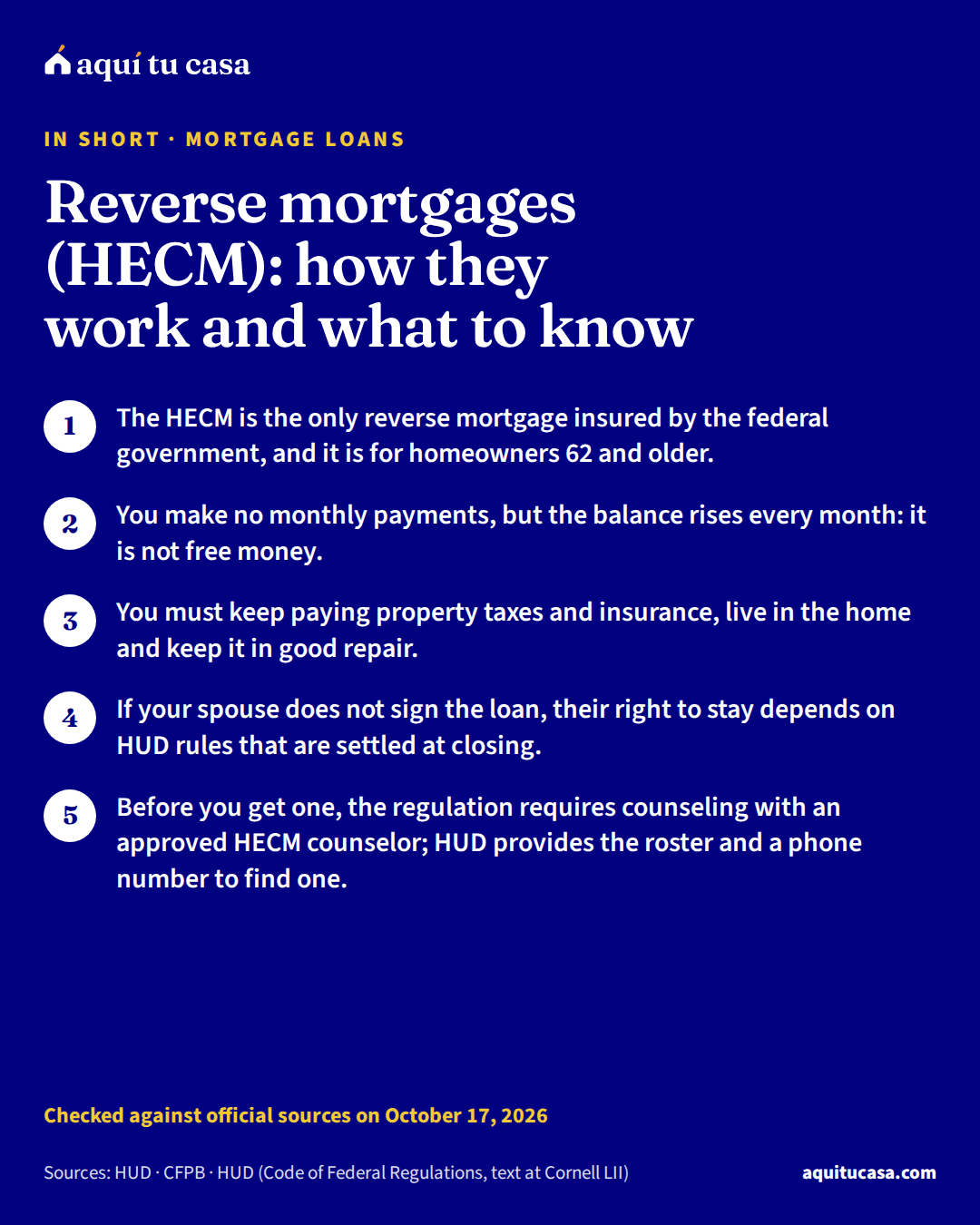
From the guide
What a HECM reverse mortgage is, who can get one, the required counseling, what happens to your spouse and heirs, and how to avoid scams.
Verified on October 17, 2026 15 official sources
It is a loan for homeowners 62 and older that uses the home as security. You make no monthly payments: interest and fees are added to the balance each month, and the loan is repaid when you no longer live in the home, usually by selling it. The title stays in your name.
Read the full guideThe CFPB says that failing to pay property taxes or homeowners insurance may lead to foreclosure. That is why the regulation requires you to pay those charges, maintain the home and live in it. If you are struggling to pay them, the CFPB suggests getting help right away from a reverse mortgage counselor.
Read the full guideNot personally: the regulation says the borrower has no personal liability for the balance and the lender can collect only through sale of the home. If the balance is more than the home's value, your heirs don't have to pay more than 95 percent of the appraised value. If they want to keep the home, they must pay the full balance.
Read the full guideIf they meet HUD's conditions (married to you at closing, named as an eligible non-borrowing spouse and living in the home), they can stay after your death without paying the balance, as long as within 90 days they establish a legal right to stay and keep meeting the loan's obligations. If they don't meet those conditions at closing, the loan becomes due when you die.
Read the full guideYes. HUD's regulation says the borrower, any non-borrowing spouse and any other owner must receive counseling from an approved HECM counselor, and the counselor gives you a certificate for the lender. To find one, HUD points to its counselor roster or (800) 569-4287.
Read the full guideAccording to HUD, it depends on the age of the youngest borrower (or eligible non-borrowing spouse), the interest rate and the lesser of the appraised value, the HECM FHA limit and the sales price. You can take it as monthly payments, a line of credit, a combination of both or, with a fixed rate only, a single lump sum.
Read the full guideWith most reverse mortgages, yes: you have three business days after closing to cancel for any reason without penalty, by notifying the lender in writing. The CFPB suggests sending the letter by certified mail with a return receipt. The lender has 20 days to return what you paid.
Read the full guide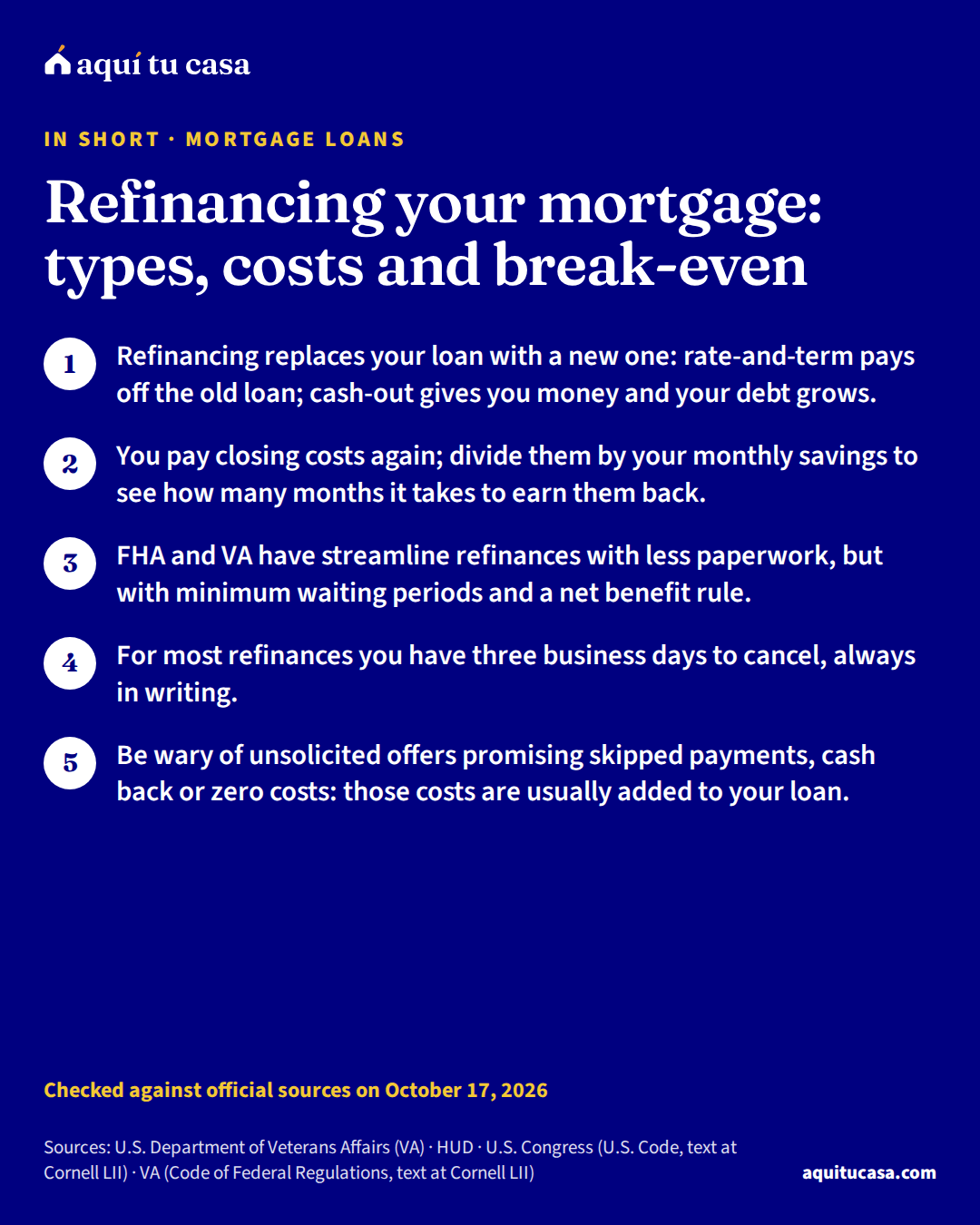
From the guide
Refinancing explained: rate-and-term vs cash-out, closing costs, the break-even point and FHA and VA streamline refinances.
Verified on October 17, 2026 17 official sources
It depends on your numbers. VA suggests dividing your closing costs by how much you expect to save each month to see whether it is worth it. For IRRRLs, the law requires those costs to be recouped within 36 months through lower payments. A HUD-approved housing counselor can review your situation, often for free.
Read the full guideYou pay closing costs again, and VA says they can add up to thousands of dollars. Your real figure is on the Loan Estimate, which the lender must give you within three business days of your application. A loan advertised as no-cost covers those costs with a higher rate or by adding them to the loan.
Read the full guideIt is a refinance with less paperwork for people who already have an FHA or VA loan. In a non-credit qualifying FHA streamline, your credit is not analyzed and no appraisal is ordered; with a VA IRRRL, you refinance your VA loan to lower the rate or switch to a fixed rate. Both require a net benefit to you and a minimum time since the previous loan.
Read the full guideFor most refinances, yes: you have three business days (Saturdays count) after you sign, receive the Closing Disclosure and receive two copies of the notice of your right to cancel. You must notify the lender in writing. If you refinance with the same lender without borrowing more, you do not have this right.
Read the full guideIt depends on the program. For an FHA streamline, at least 210 days must have passed since the old loan closed and six months since its first payment. For a VA IRRRL, the law requires six consecutive monthly payments and 210 days since the first payment. For an FHA cash-out refinance, at least six months of payments.
Read the full guideYes, with a cash-out refinance. With FHA, the loan cannot exceed 80 percent of the home's adjusted value. Your debt grows: VA says to understand how the new loan amount relates to your home's value.
Read the full guideYou may need approval from the HELOC lender to refinance your first mortgage. According to the CFPB, that lender can refuse, and then you may need to pay off the HELOC first.
Read the full guide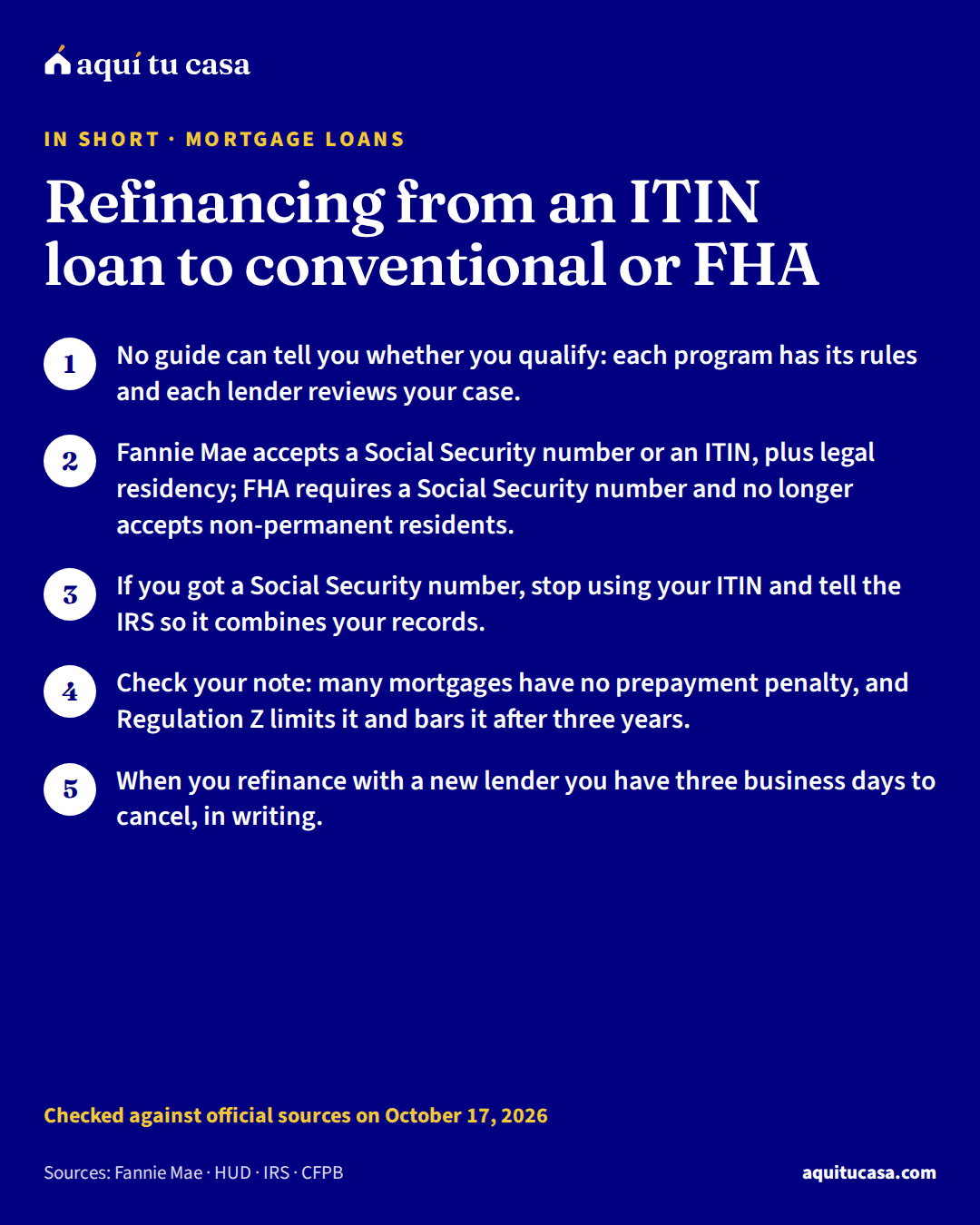
From the guide
If you bought with an ITIN loan and your situation changed: what Fannie Mae and FHA require to refinance, what to check in your loan, and your rights.
Verified on October 17, 2026 18 official sources
Fannie Mae's Selling Guide accepts a valid Social Security number or an ITIN, plus documented legal residency, and buys loans to lawful permanent and non-permanent residents on the same terms as citizens. The lender decides which documents it accepts, so the answer depends on your case and on each lender. Your credit, income and home value also count.
Read the full guideFor case numbers assigned on or after May 25, 2025, FHA accepts only citizens, lawful permanent residents and citizens of Micronesia, the Marshall Islands and Palau, and each borrower must show a valid Social Security number. A Social Security card alone does not prove status. Rules can change: check the verification date.
Read the full guideNot all mortgages have one; if yours does, you agreed to it at closing and it is in your note. Regulation Z allows a penalty only on certain fixed-rate qualified mortgages, and even then it cannot exceed 2% of the balance in the first two years or 1% in the third, or apply after three years. If you are not sure, ask your loan servicer.
Read the full guideWith a Fannie Mae conventional loan, a cash-out refinance requires your current mortgage to be at least 12 months old and you to have been on title for at least six months. With FHA, you must have lived in the home for the previous 12 months, paid on time and stay at or below 80% of the value. Without cash-out, Fannie Mae limits the cash you receive to the greater of 1% of the loan or $2,000.
Read the full guideOn most refinances you have three business days to cancel, counting Saturdays but not Sundays or holidays. You must give notice in writing. It does not apply if you refinance with the same lender and borrow no additional money. If you cancel, you still owe your original loan.
Read the full guideIt depends on the rate, the closing costs, any penalty you have and how long you plan to stay. The CFPB recommends getting Loan Estimates from at least three lenders and comparing the APR. A loan advertised as no-cost covers those costs with a higher rate or by adding them to the loan.
Read the full guideOnly an attorney or an accredited representative can give you legal advice about your immigration case; notarios and consultants cannot. For the refinance numbers, a HUD-approved housing counselor gives independent advice, often free or at low cost.
Read the full guide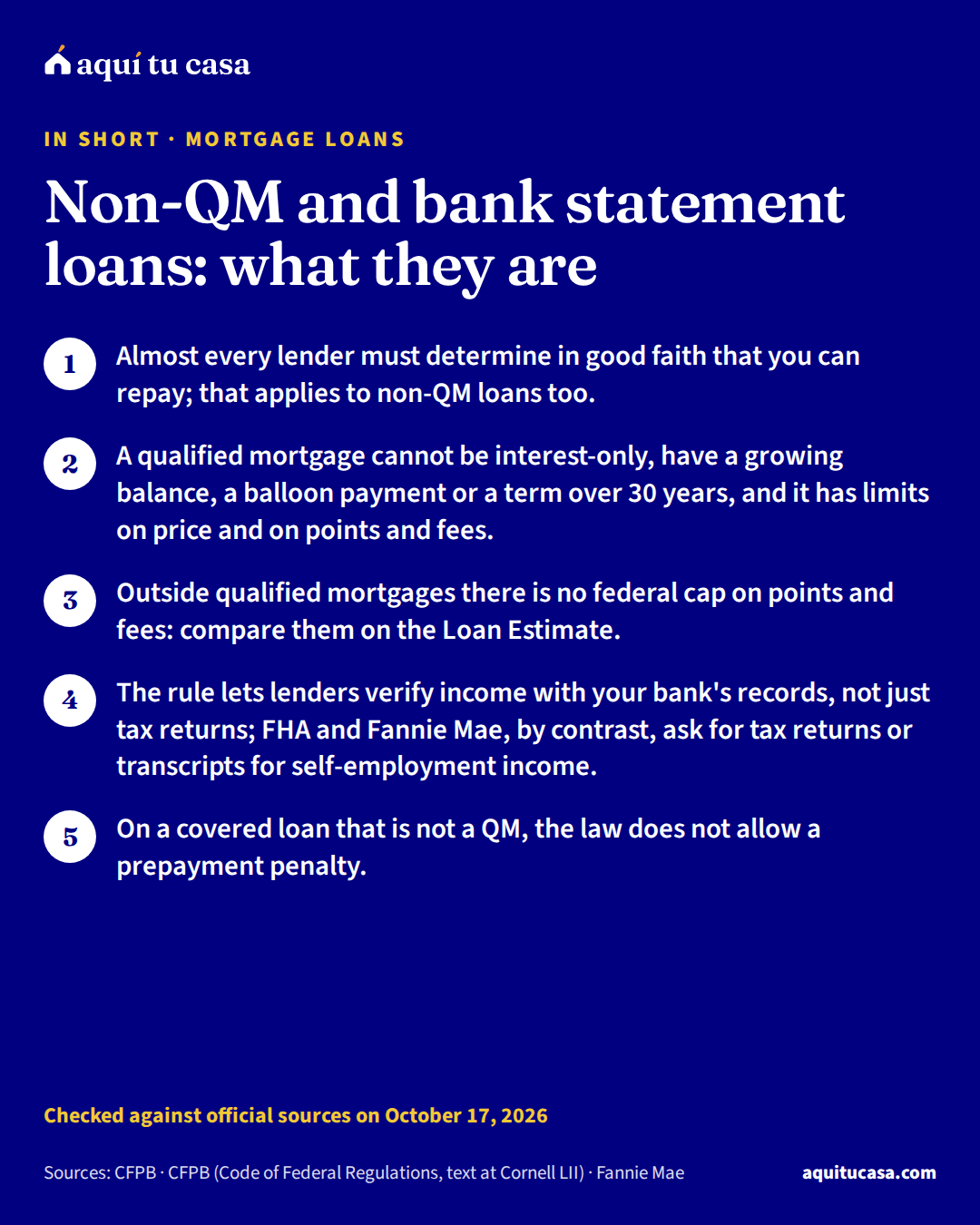
From the guide
What a qualified mortgage (QM) is, what changes with a non-QM or bank statement loan, and what to check before you accept one.
Verified on October 17, 2026 12 official sources
It is a loan that meets federal requirements that make it less risky: no interest-only period, no growing balance, no balloon payment (with exceptions for small lenders), a term of up to 30 years, limits on the APR and on points and fees, and your income and debts verified. If your loan is a QM, it is assumed that the lender followed the ability-to-repay rule.
Read the full guideIt is a mortgage that does not meet the requirements of a qualified mortgage. It is allowed: the CFPB says lenders are not required to make only qualified mortgages. But most lenders still have to determine in good faith that you can repay the loan.
Read the full guideIt is a loan where the lender calculates your income from your bank statements instead of your tax returns. Regulation Z allows verifying income with financial institution records. Fannie Mae's rules for self-employment income, by contrast, are based on your signed tax returns or IRS transcripts. Always ask whether the offer is a qualified mortgage.
Read the full guideYes. According to the CFPB, all government-backed loans (FHA, USDA and VA) are qualified mortgages. Conventional and jumbo loans must meet special requirements to be QMs.
Read the full guideOn a loan covered by the rule, only if it is a qualified mortgage with an APR that cannot go up, it is not higher-priced, and the law otherwise allows it. Even then, the penalty cannot apply after three years or exceed 2% of the balance prepaid in the first two years or 1% in the third. Check the "Prepayment Penalty" line on your Loan Estimate.
Read the full guideOn a qualified mortgage of $100,000 or more (an amount adjusted for inflation), points and fees cannot exceed 3% of the loan. Outside qualified mortgages there is no such cap: the CFPB says lenders can charge more if they choose. Compare section A of each Loan Estimate.
Read the full guideYes, a few. The CFPB lists Community Development Financial Institutions (CDFIs), state housing finance agencies, certain down payment assistance providers and nonprofits that lend rarely and only to low- or moderate-income borrowers, which must follow their own written procedures.
Read the full guideGet a Loan Estimate for each one: every lender uses the same form and must give it to you within three business days of your application. Compare the rate, the APR, the points and fees, and the "Loan Terms" table, which says whether there is a prepayment penalty, a balloon payment or payments that can go up. The CFPB recommends getting at least three offers in writing.
Read the full guide
From the guide
What conforming and FHA loan limits are, how they are set county by county, what a jumbo loan is and how to find the limit where you live.
Verified on October 17, 2026 10 official sources
Read the full guide Do the math: How much house can I afford?
It is a loan larger than the conforming loan limit, that is, larger than what Fannie Mae and Freddie Mac can buy by law. According to the CFPB, rules for a jumbo vary by lender, but you usually need good credit and a high down payment.
Read the full guideFor a one-unit home it is $832,750 in most counties, and in high-cost areas it can go up to $1,299,500. The law sets higher limits for two- to four-unit homes, and all of them change every year. Find your county's limit on the conforming loan limits page.
Read the full guideIt depends on the county: in our data it ranges from $541,287 to $1,299,500 for a one-unit home. The law sets it from the area's median home price, with a national floor and ceiling. Look it up on the FHA loan limits page or your county's page.
Read the full guideTo the loan. FHFA refers to the loan's origination balance and Fannie Mae to the original loan amount. With FHA, the upfront mortgage insurance premium is not counted against the limit, and the maximum loan is the lesser of the limit or a percentage of the home's value.
Read the full guideBecause the law ties it to home prices. The conforming limit is adjusted on January 1 each year based on FHFA's house price index (if prices fall, there is no adjustment), and FHA publishes new limits for each calendar year.
Read the full guideYes, if it meets the requirements. The CFPB explains that government loans are always qualified mortgages, while conventional and jumbo loans must meet special requirements to qualify. Ask the lender, and see the non-QM loans guide.
Read the full guideIf you have full entitlement, VA says you have no loan limit, as long as you can afford the loan and the appraisal supports the price; the lender still has to approve you. If you have used part of your entitlement, what remains is based on the county limit, which is the same as FHFA's.
Read the full guideThe law sets higher conforming limits for 2-, 3- and 4-family homes, and Fannie Mae says its limits vary with the number of units. FHA law also sets different limits for 2-, 3- and 4-family homes. Check your county's limit for the number of units you are buying.
Read the full guideTools
The calculators these guides use. Each one leaves you with a result you can use today.
The price your income can carry.
What you get → maximum price
Your monthly payment with taxes and insurance.
What you get → monthly payment
What each loan costs per month and over five years.
What you get → payment per loan
The cash you need on closing day.
What you get → cash to close
From the guide
A home equity line of credit (HELOC) or a cash-out refinance: how each works, what it costs, your rights and the risks to your home.
Verified on October 17, 2026 15 official sources
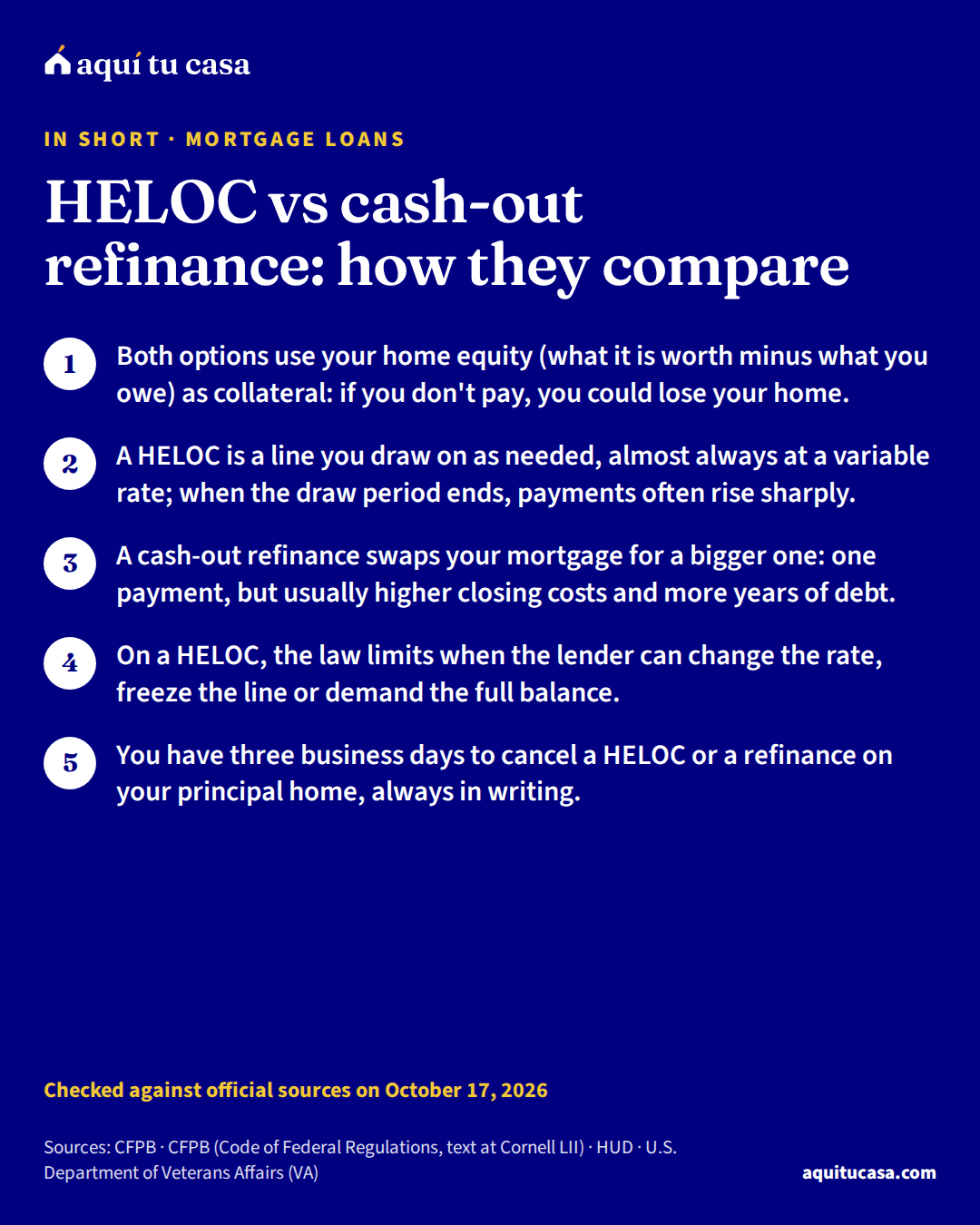
It depends on what you need the money for, your current rate and how long you expect to take to repay it. The CFPB says a HELOC lets you draw and repay over years, almost always at a variable rate, and that a cash-out refinance leaves you with one payment but usually higher closing costs. A HUD-approved housing counselor can review your situation, often for free.
Read the full guideThe CFPB says yes: if you fall behind or can't repay on schedule, you could lose your home, because it is the collateral. That is why it recommends considering a HELOC only if you are confident you can keep up with the payments.
Read the full guideWhen the draw period ends, repayment begins, and according to the CFPB monthly payments are often significantly higher. In some cases you must repay everything at once. And the rate is usually variable, so the payment can change from month to month.
Read the full guideYes, in certain cases. Under Regulation Z, the lender may stop extending credit or lower your limit if your home's value drops significantly below the appraisal, if it believes you can't pay because of a material change in your finances, or if you default on the agreement.
Read the full guideYes. You have three business days to cancel the line when it is opened, by notifying the lender in writing. The lender must return the fees you paid, including application and appraisal fees.
Read the full guideAccording to IRS Publication 936, you can no longer deduct interest on a loan secured by your home to the extent the money was not used to buy, build or substantially improve the home, and you must itemize to deduct it. If you want help with your return, you can look for an IRS VITA site.
Read the full guideNo. According to the CFPB, for a HELOC you receive Truth-in-Lending disclosures instead of a Loan Estimate. A cash-out refinance does come with a Loan Estimate.
Read the full guide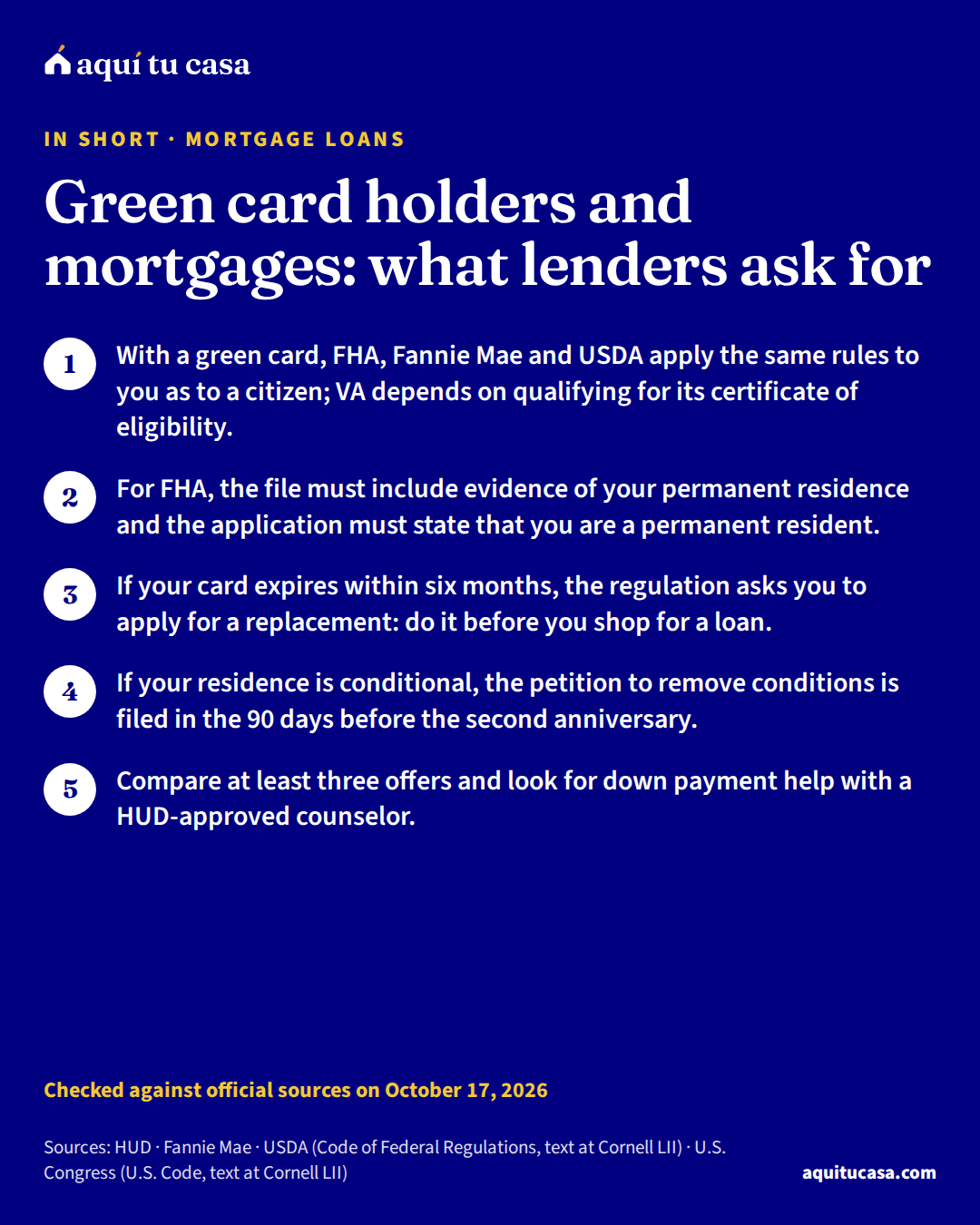
From the guide
With a green card you get the same mortgages as a citizen: what FHA, Fannie Mae and USDA say, the papers you need and what to check if your card expires.
Verified on October 17, 2026 26 official sources
Read the full guide Do the math: How much house can I afford?
Yes. HUD says a borrower with lawful permanent resident status may be eligible for FHA under the same requirements, terms and conditions as a citizen. The file must include evidence of your permanent residence, and a Social Security card alone is not enough to prove status.
Read the full guideUnder FHA and Fannie Mae rules, no: the same terms apply as for a citizen. The FHA minimum down payment is 3.5% with a score of 580 or more, and Fannie Mae's HomeReady can start at 3% if you meet the income limit. Each lender may have its own additional requirements: compare.
Read the full guideThe regulation asks you to apply for a replacement card when it will expire within six months. HUD requires evidence of your permanent residence and Fannie Mae leaves it to the lender to decide which documents it accepts. Ask each lender which evidence it accepts if your card is about to expire or is being replaced.
Read the full guideThe law says that residence is obtained on a conditional basis and that the petition to remove the conditions is filed in the 90 days before the second anniversary; if it is not filed, residence ends on that date. Ask each lender how it treats a conditional card, and for questions about your case talk to an accredited representative or a lawyer.
Read the full guideFor USDA, a permanent resident is a 'qualified alien,' so the status rule is met; the home must be in an area USDA designates as rural. A VA loan depends on qualifying for its Certificate of Eligibility (COE), and it often requires no down payment.
Read the full guideYes. Regulation B allows a lender to ask about your permanent residency and immigration status, and to take them into account. What it may not do is discriminate against you because of your national origin.
Read the full guideAccording to the IRS, if you are a lawful permanent resident at any time during the year, you are a resident for federal tax purposes. The CFPB recommends having your signed federal tax returns for the last two years on hand before you talk to lenders.
Read the full guide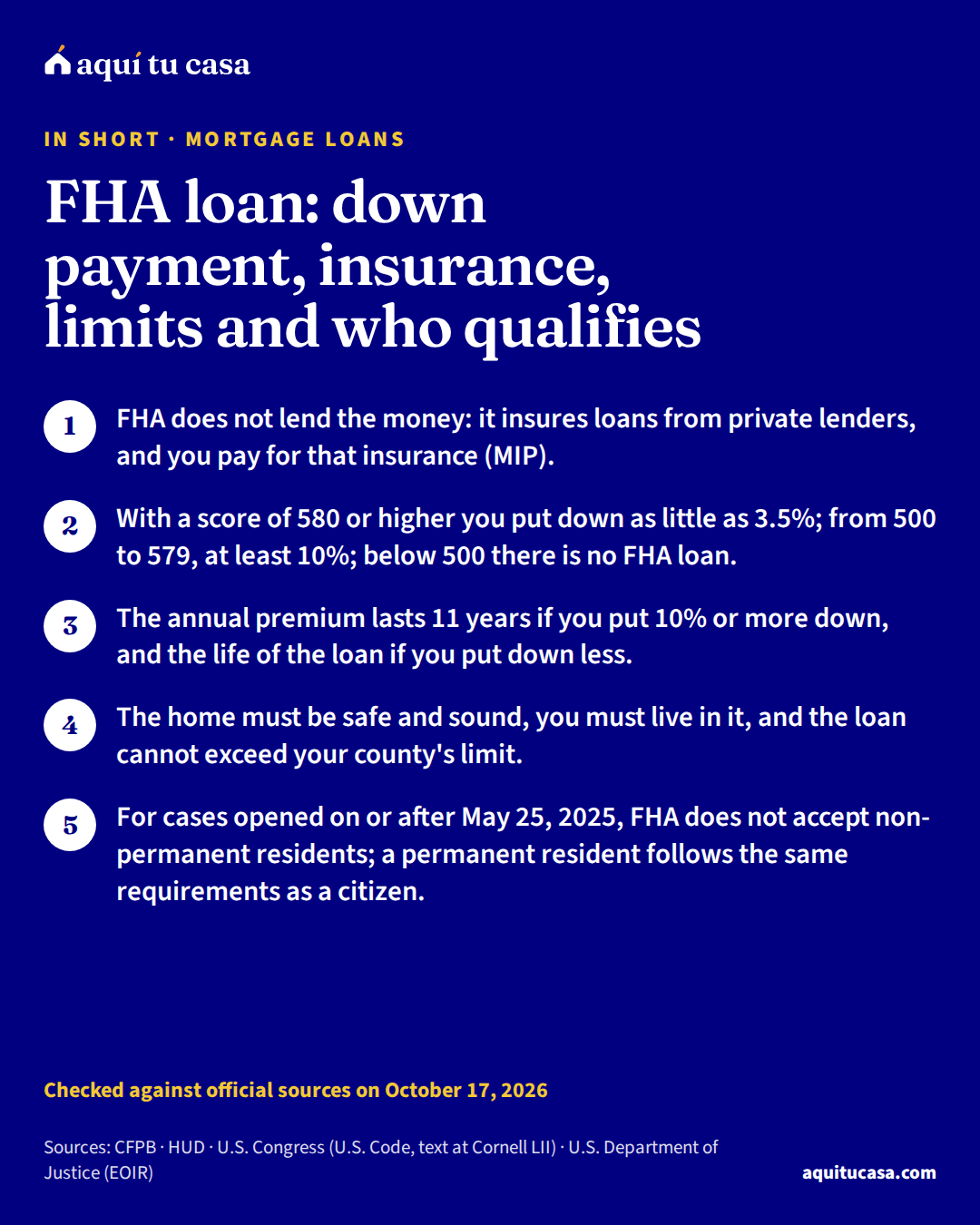
From the guide
How an FHA loan works: the down payment and credit score HUD requires, MIP mortgage insurance, your county limit, the home and the residency rules.
Verified on October 17, 2026 13 official sources
HUD requires a minimum investment of 3.5% of the home's value if your score is 580 or higher. With a score from 500 to 579, the loan cannot exceed 90% of the value, so you put down at least 10%. On a $332,700 home, the typical US value, 3.5% comes to $11,645, plus closing costs.
Read the full guideUnder HUD's handbook, at 580 or higher you can get maximum financing; from 500 to 579, up to 90% of the value; and below 500 you are not eligible. If you have no credit score, you can still get maximum financing, but your loan is underwritten manually.
Read the full guideIt depends on your down payment. On a loan of more than 15 years, if you put 10% or more down, the annual premium lasts 11 years; if you put down less, it lasts for the life of the loan. The CFPB says FHA rules differ from PMI rules and that questions about your FHA insurance go to your loan servicer.
Read the full guideFor case numbers assigned on or after May 25, 2025, HUD eliminated eligibility for non-permanent residents. Citizens, permanent residents and citizens of Micronesia, the Marshall Islands and Palau can qualify, and each borrower must show a valid Social Security number. The ITIN mortgage guide explains other options. Rules can change: check the verification date.
Read the full guideIt depends on your county. The law sets the limit from each area's median home price, and HUD publishes new limits every year. In our data, the limit for a one-unit home ranges from $541,287 to $1,299,500; look up your county on our FHA loan limits page.
Read the full guideYes, if the building has four units or fewer, you buy the whole building and you live in one of the units. Limits are higher for multi-unit homes. At least one borrower must move in within 60 days of signing and live there for at least one year.
Read the full guideYes, up to a point. The seller, agents and other interested parties can contribute up to 6% of the sales price toward your closing costs, prepaids and points. Anything above that cap counts as an inducement, and none of it can go toward your minimum investment.
Read the full guideYes. HUD accepts gifts from a family member, your employer or union, a close friend with a documented interest, a charity or a government homeownership program. It is money you do not repay; the gift money guide explains the paperwork.
Read the full guide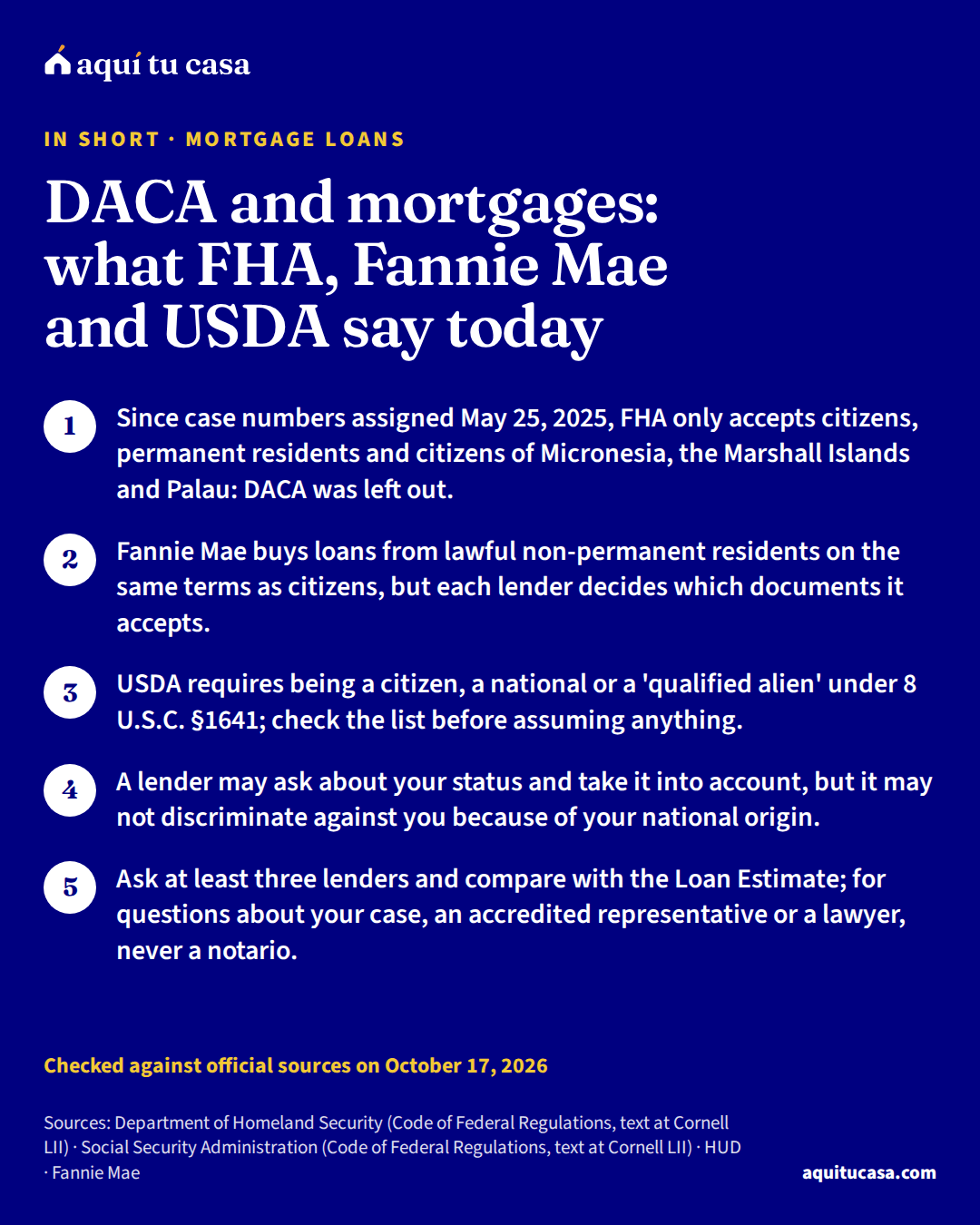
From the guide
If you have DACA and want to buy a home: what FHA, Fannie Mae and USDA rules say today, what a lender may ask you and how to compare offers.
Verified on October 17, 2026 25 official sources
Read the full guide Do the math: How much house can I afford?
Not today. HUD Mortgagee Letter 2025-09 eliminated eligibility for non-permanent residents for case numbers assigned on or after May 25, 2025. Citizens, permanent residents and citizens of Micronesia, the Marshall Islands and Palau remain eligible. Between 2021 and 2025, FHA did accept DACA recipients with a current work permit.
Read the full guideFannie Mae's rule allows it if you are a lawful non-permanent resident: it buys those loans on the same terms as for citizens. But Fannie Mae does not say which documents prove legal presence; each lender decides. That is why one lender may say yes and another no. Ask in writing before you apply.
Read the full guideDACA and its work permit are granted for 2-year periods. Fannie Mae requires your income to be stable and reasonably expected to continue, and noncitizens face the same employment and income verification as citizens. How each lender treats a pending renewal is something to ask directly, before you apply.
Read the full guideYes. Regulation B allows a creditor to ask about your immigration status and take it into account. What it may not do is discriminate against you because of your national origin, meaning the country where you were born or where your ancestors came from.
Read the full guideUSDA requires being a citizen, a non-citizen national or a 'qualified alien.' The law defines that list: permanent residents, asylees, refugees, people paroled for at least one year and other categories. If you are not sure whether your status fits, that is an immigration question for an accredited representative or a lawyer.
Read the full guideThat is an immigration question neither a lender nor this site can answer. You can ask a representative accredited by the Department of Justice or an immigration lawyer; never a notario, who cannot give legal advice.
Read the full guide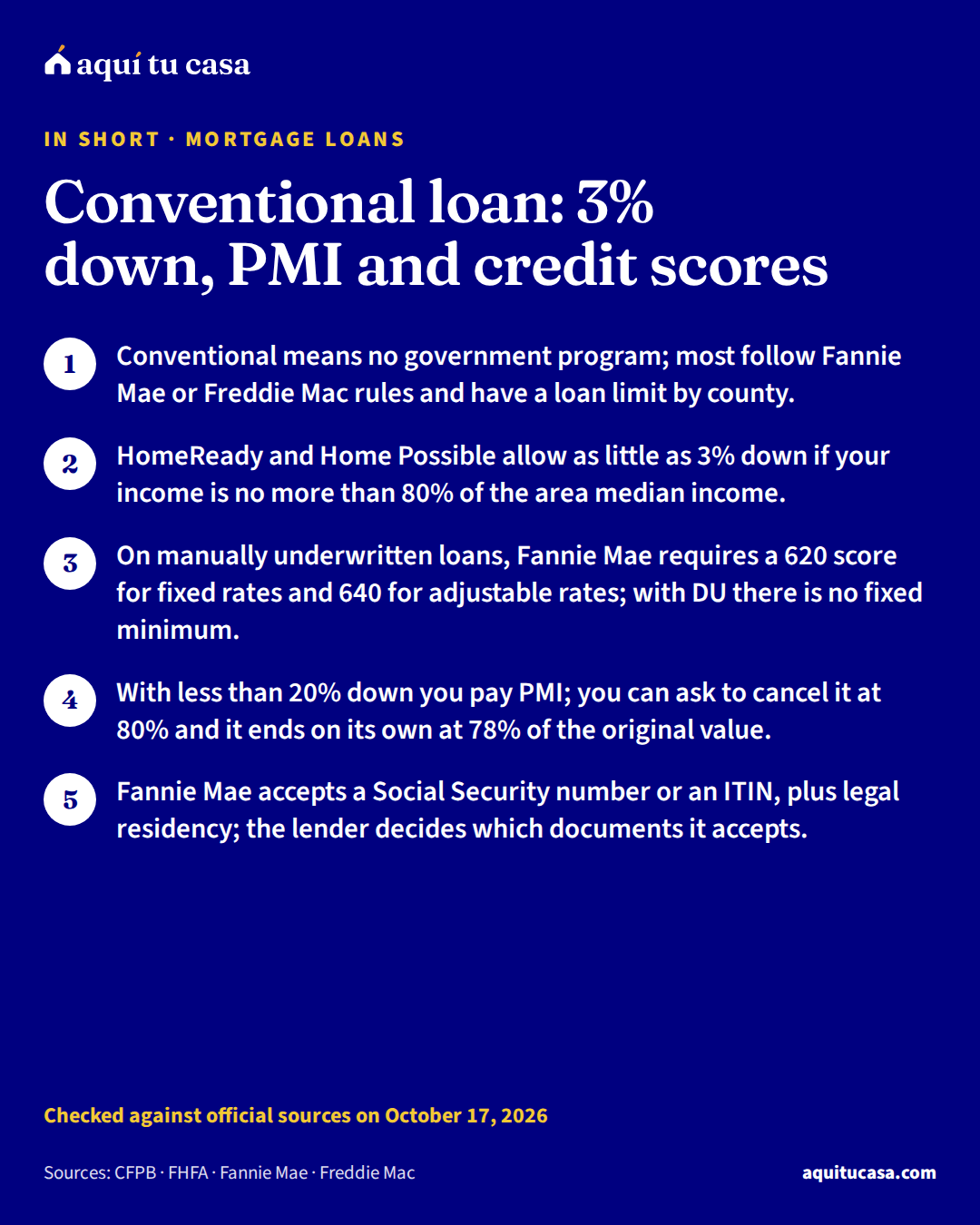
From the guide
How a conventional loan works: HomeReady and Home Possible from 3% down, the credit score Fannie Mae requires, PMI and when the law ends it.
Verified on October 17, 2026 21 official sources
It depends on the program and the lender. Fannie Mae's HomeReady and Freddie Mac's Home Possible allow as little as 3% if you meet the income limit. On a $332,700 home, the typical US value, that is $9,981. With less than 20% down you pay private mortgage insurance (PMI).
Read the full guideIf the loan is underwritten by hand, Fannie Mae requires at least 620 on a fixed-rate loan and 640 on an adjustable-rate loan. If it goes through its automated system (DU), there is no fixed minimum: the system weighs your risk using several factors. Your score also affects the loan's price.
Read the full guideBy law, you can ask in writing to cancel it when your balance reaches 80% of the home's original value, if you have a good payment history, are current, have no second mortgage and the home has not lost value. It ends on its own when the scheduled balance reaches 78%, if you are current, and no later than the midpoint of the loan. The first date you can ask is on the PMI notice you got at closing.
Read the full guideIt is a Fannie Mae conventional mortgage for people whose income is no more than 80% of the area median income where the home is. It can finance up to 97% of the value on a one-unit home, with a fixed rate for up to 30 years. If everyone who will live in the home is a first-time buyer, it requires a homebuyer education course.
Read the full guideFannie Mae's Selling Guide accepts a valid Social Security number or an ITIN, plus documented legal residency, and buys loans to lawful permanent and non-permanent residents on the same terms as citizens. The lender decides which residency documents it accepts, and not every lender offers this. The ITIN mortgage guide explains how to ask.
Read the full guideYes. On a principal residence, Fannie Mae accepts gifts from relatives and from people with a familial relationship, such as your partner or fiancé. On a one-unit home you do not have to put in any of your own money: all of it can be a gift. The donor signs a gift letter saying no repayment is expected.
Read the full guideThere is no answer for everyone. The CFPB says conventional loans typically cost less than FHA loans but can be harder to get, and that PMI is generally cheaper than FHA insurance for borrowers with good credit. PMI also ends by law, while FHA insurance with less than 10% down lasts the life of the loan. Get Loan Estimates for both and compare.
Read the full guideIt is a loan above the conforming limit, the most Fannie Mae and Freddie Mac can buy. The CFPB says jumbo rules vary by lender but usually require good credit and a high down payment.
Read the full guideChange topic without leaving the questions.

These answers explain the rules but do not know your situation. These organizations go over it with you, free.