Mortgage insurance: PMI vs. MIP, and when it ends
What mortgage insurance is, how conventional-loan PMI differs from FHA MIP, when each one ends and how to ask your servicer to remove it.
Verified against official sources on October 31, 2026 11 official sources
Show contents
In short
What you need to know
Quick answer
Mortgage insurance protects the lender, not you, and you pay for it when you put little money down. On a conventional loan it is called PMI, and the law lets you get rid of it: you can ask in writing when your balance reaches 80% of the home's original value, and it must end on its own at 78%, if you are current. On an FHA loan it is called MIP and follows HUD's chart: if you put down 10% or more it lasts 11 years; if you put down less, it lasts for the life of the loan. VA loans have no monthly insurance, and USDA charges an annual fee.
What matters most
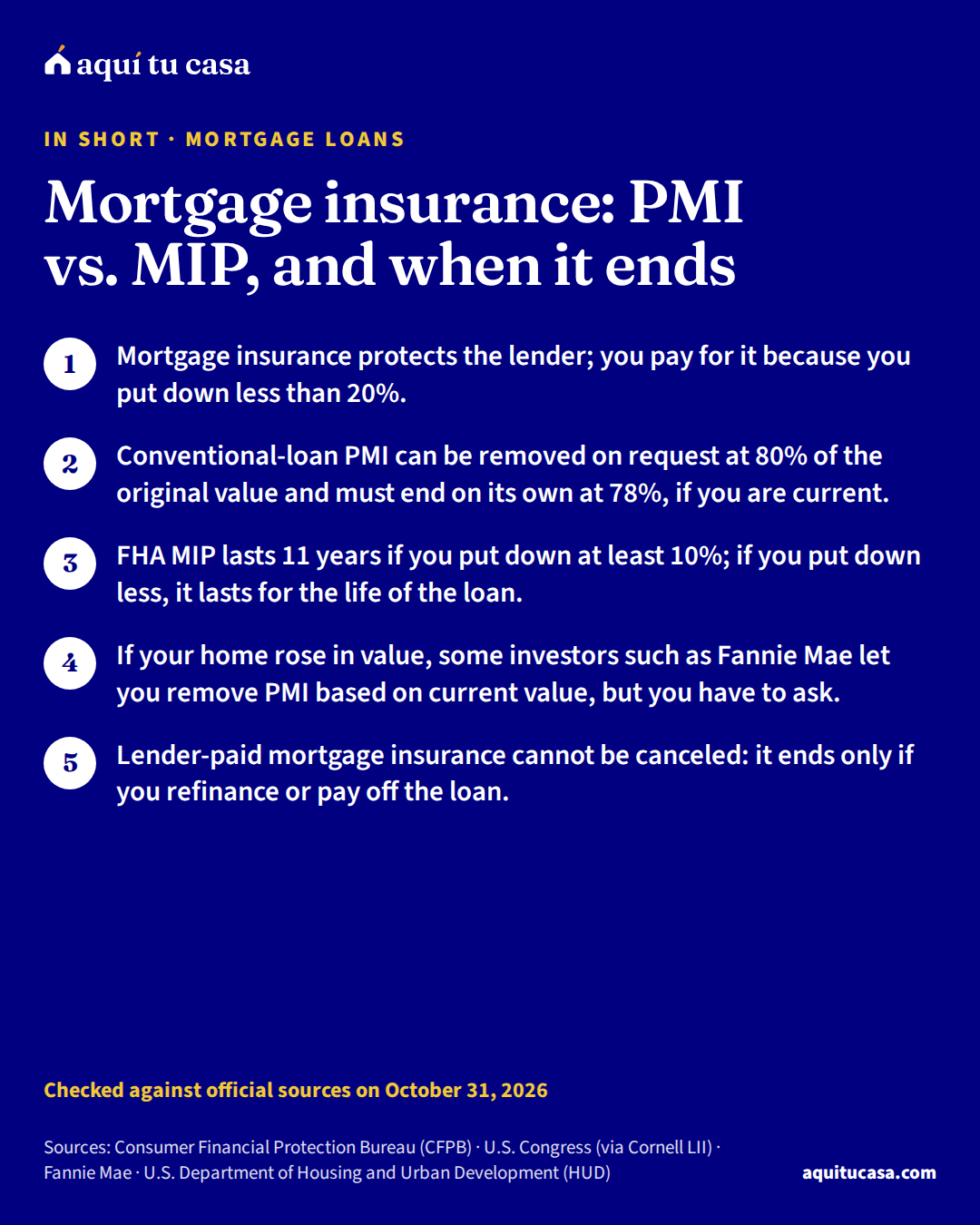
- Mortgage insurance protects the lender; you pay for it because you put down less than 20%.
- Conventional-loan PMI can be removed on request at 80% of the original value and must end on its own at 78%, if you are current.
- FHA MIP lasts 11 years if you put down at least 10%; if you put down less, it lasts for the life of the loan.
- If your home rose in value, some investors such as Fannie Mae let you remove PMI based on current value, but you have to ask.
Is this for you?
This guide is for you if…
- You pay mortgage insurance (PMI or MIP) inside your monthly payment and want to know when it ends.
- You are buying with less than 20% down and want to compare a conventional loan's insurance with FHA's.
- You have paid down your loan or your home went up in value, and you want to ask for PMI to be removed.
Get direct help first if…
- You are behind on payments or cannot pay your mortgage: read our guide «If you can't pay your mortgage» first.
- You are looking for insurance against fire or theft (homeowners insurance): that is a different policy; read our home insurance guide.
If you made a small down paymentdown paymentThe down payment is the part of the home's price you pay out of your own pocket when you buy; the loan covers the rest. In U.S. Spanish it is also called enganche, cuota inicial or entrada. Each loan type has its own minimum: FHA requires at least 3.5% of the value, VA and USDA loans may require none, and conventional loans ask for more if you want to avoid private mortgage insurance. A larger down payment lowers the loan, the monthly payment and the total interest; many state programs help families put it together.See the full definition, you very likely pay mortgage insurance inside your monthly payment. That insurance does not protect you: it protects the lender if you stop paying.1 The good news is that it is not always forever. This guide explains how PMI and MIP are alike and how they differ, when each one ends and how to ask to have it removed, using the rules in federal law and HUD’s handbook.
What mortgage insurance is and why you pay it
Mortgage insurancemortgage insuranceMortgage insurance protects the lender, not you, if you fall behind on your loan payments. You pay for it, as part of the monthly payment and sometimes also as an upfront charge. It exists because it lets the lender accept a lower down payment. On an FHA loan it is called the mortgage insurance premium (MIP) and is charged by the FHA; on a conventional loan with a small down payment it is called private mortgage insurance (PMI) and comes from a private insurer. The rules for when you can stop paying it differ in each case.See the full definition lowers the lender’s risk. Because of it, you can get a loan with less money down. Borrowers who put down less than 20% of the price typically pay for it, and it is also typically required on FHA and USDA loans. It raises the cost of your loan and is charged in your monthly payment, your closing costs or both.1
The most important part: if you fall behind, the insurance does not cover you. It pays the lender if the home is sold in a foreclosure and the sale does not cover what you owe.1 That is why it makes sense to remove it as soon as the law or your lender allows: it is money that leaves your pocket every month and gives you no protection.
Each loan type charges it in its own way:1
- Conventional (PMI). It comes from a private company. Its rate depends on your down payment and your credit scorecredit scoreA credit score is a number that predicts how likely you are to pay back a loan on time. It is computed from the information in your credit report: whether you pay on time, how much you owe relative to your limits, how long you have used credit and how many new accounts you opened. FICO is one brand of score; VantageScore is another, and each lender decides which one it uses. A higher score usually brings a lower interest rate and more loan options; each program publishes the minimum it accepts. You can check your report for free and dispute errors.See the full definition.
- FHA (MIP). It is paid to FHA. It costs the same no matter your score, and it has an upfront premium and a monthly premium.
- USDA. You pay a fee at closing and another inside your monthly payment. Our USDA loan guide explains the guarantee feeUSDA guarantee feeThe USDA guarantee fee is what the U.S. Department of Agriculture (USDA) charges to guarantee a home loan under its guaranteed program. Under the federal regulation, the lender pays an upfront fee that is not refunded once the guarantee is issued, and it may pass that cost on to the borrower. USDA may also charge the lender an annual fee on the loan balance for the life of the loan, which may also be passed on to the borrower. The regulation caps each fee; USDA announces the current amount, and it can change.See the full definition.
- VA. There is no monthly insurance. Instead you pay an upfront funding feeVA funding feeThe VA funding fee is a one-time payment the Veteran, service member or surviving spouse makes on a VA loan. It helps lower the loan's cost to taxpayers, because the VA loan does not require a down payment or monthly mortgage insurance. It is a percentage of the loan amount that depends on the loan type, the down payment and whether you have used the benefit before. You can pay it at closing or add it to the loan. Among others, people who receive VA compensation for a service-connected disability do not pay it.See the full definition. Our VA loan guide explains it.
Where you see what you pay
Before you sign, find the insurance in your papers. The most common way to pay PMI is monthly: it appears on page 1 of the Loan EstimateLoan EstimateThe Loan Estimate is a three-page form you receive from the lender within days of applying for a mortgage. In the same format at every bank, it sums up the terms of the loan being offered: amount, interest rate, whether the payment can change, the estimated monthly payment with taxes and insurance, the itemized closing costs and how much cash you need at closing. Because every lender uses the same form, it lets you compare offers side by side. It commits you to nothing: requesting one is not accepting the loan.See the full definition and the Closing Disclosure, under Projected Payments. Sometimes it is a single premium paid at closing; that one appears on page 2, section B. Careful: if you pay that premium up front and later move or refinance, you might not get it back.2
Some lenders offer conventional loans without PMI in exchange for a higher interest rate.2 That insurance is paid by the lender, but you pay for it another way: the law says it usually comes with a higher rate and that you cannot cancel it. It ends only if you refinance or pay off the loan.7 Ask to see both options with numbers and compare what you would pay over the time you plan to stay in the home. Our guide How to compare Loan Estimates helps you read offers side by side.
PMI and MIP, side by side
Removable by law
PMI (conventional loan)
- From a private company; its price depends on your down payment and score
- You can ask to remove it at 80% of the original value
- It must end on its own at 78%, or at the loan's midpoint, if you are current
- Unearned premiums come back within 45 days
Follows HUD's chart
MIP (FHA loan)
- Paid to FHA; costs the same no matter your score
- Has an upfront premium and an annual premium paid monthly
- At 90% or less of the value, the annual premium lasts 11 years
- Above 90%, it lasts for the life of the loan
PMI has an exit written into the law; MIP with a small down payment only goes away if you pay off or replace the loan.
When PMI comes off: your rights under the law
The Homeowners Protection Act gives you three exits. They apply to single-family principal-residence loans that closed on or after July 29, 1999. They do not apply to FHA or VA, which have their own rules, or to insurance the lender pays.3
Everything is measured against your home’s original value. Generally it is the lower of the contract price and the appraisalhome appraisalAn appraisal is a written document that gives a professional appraiser's opinion of how much a property is worth. The lender orders it before approving the mortgage, because the home is the loan's collateral and the lender does not want to lend more than it is worth. If the appraisal comes in below the price you agreed, the bank bases the loan on the lower value and you will have to cover the difference, renegotiate the price or walk away if your contract allows it. An appraisal is not an inspection: it measures value, not the home's condition.See the full definition when you bought. If you refinanced, it is the appraisal from the refinance.3 This is how your balance is compared with that value:
1. When you ask, at 80%. On a fixed-rate loan, you can ask for cancellation on the date your balance is scheduled to reach 80% of the original value, or when it gets there through your actual payments, for example if you paid extra toward principalprincipalThe principal is the amount of money you borrowed and have to pay back, not counting the interest. In Spanish it is also called "capital". When you start, the principal is the loan amount; with every payment a part goes toward reducing it, and what remains is called the balance. Interest is computed on that balance, so the less principal you owe, the less interest you pay. On your monthly payment you will see P&I: principal and interest, the part of the payment that goes to the loan, separate from taxes and insurance.See the full definition.4 The first date you can ask should appear on the PMI disclosure you got with your loan.3 For the servicer to have to say yes, the law requires four things:5
- You ask the loan servicerloan servicerThe loan servicer is the company that sends you your mortgage statements and handles the day-to-day tasks of the loan: it processes your payments, answers your questions, keeps track of principal and interest paid and manages your escrow account, if you have one. It can also offer options if you fall behind and, in certain cases, start a foreclosure. It may be the same company that lent you the money or a different one, and it is common for another company to take over the loan after closing.See the full definition in writing.
- You have a good payment history. That means no payment 30 or more days late in the last 12 months, and none 60 or more days late in the 12 months before those.4
- You are current on your payments.
- You show the home has not lost value compared with the original value, if the loan’s owner asks (for example, with an appraisal), and you certify there is no junior lien, such as a second mortgagesecond mortgageA second mortgage (or junior lien) is a loan you take out using your home as collateral while you still have another loan secured by it. Home equity loans and HELOCs are common examples. It is called "second" because, if you stop paying and the home is sold to pay the debts, this loan is paid after the first one; if there is not enough money, the second lender may not get everything it is owed. That is why it often has a higher interest rate. It adds to your total debt and, if you cannot repay it, you could lose your home.See the full definition.3
2. On its own, at 78%. Even if you do not ask, PMI must end on the date your balance is scheduled to reach 78% of the original value, if you are current that day. If you are behind, it ends on the first day of the month after you catch up.5
3. At the loan’s midpoint. If for some reason it did not end earlier, it cannot be charged past the first day of the month after the midpoint of the amortizationamortizationAmortization means paying off a loan with regular payments over time, so that the amount you owe decreases with each payment. On a fixed-rate mortgage the principal-and-interest payment is always the same, but its split changes: at first most of each payment is interest and only a small part reduces the debt; over the years it is the other way around. The amortization schedule shows, month by month, how much goes to interest, how much to principal and how much is left to pay. Paying a little extra toward principal brings the end of the loan forward.See the full definition period. On a 30-year loan, that is after 15 years.3 This comes up more with interest-only periods or balloon payments.
Once it is canceled or terminated, no premiums may be charged more than 30 days later, and the servicer must return unearned premiums no later than 45 days after.5 There is one exception: the request and automatic exits do not apply to certain loans that were considered high-risk when they closed.5 If that is your case, ask your servicer when yours ends.

If your home went up in value: current value
The law measures against the original value. But loan owners such as Fannie Mae and Freddie Mac may give you better rules, never worse.3 Fannie Mae, for example, lets you ask to remove the insurance based on your home’s current value:8
- On a one-unit principal residence, your balance must be 75% or less of current value if the loan is two to five years old, or 80% or less if it is older than five years.
- If you made improvements that raised the value, the two-year minimum can be waived, at 80% or less.
- On a two- to four-unit principal residence, the balance must be 70% or less and the loan must be more than two years old.
The improvements that count are renovations that substantially improve the home, such as the kitchen or bathroom, or added square footage. Maintenance repairs do not count.8 The servicer orders a valuation that inspects the home inside and out, and it may not offer this on its own: you have to ask.8 If the answer is no, it must give you the reasons, including the valuation results, within 30 days.8
Not every conventional loan belongs to Fannie Mae. Ask your servicer who owns your loan and what rules it uses for current value. If your loan belongs to another investor, its rules may differ, but they cannot be worse than the law’s.3
How to ask to remove PMI
1. Find your papers
Today
Your PMI disclosure from closing or the latest annual letter, and your statement with the balance.6
2. Do the math
This week
Divide your balance by the home's original value; if it is 80% or less, you can ask now.4
Try it with your numbersAmortization schedule3. Call and ask about the rules
This week
Ask who owns the loan, whether they accept current value and what valuation they require.8
4. Ask for cancellation in writing
When you qualify
Send a letter with the date, your loan number and your signature, and keep a copy.5
5. Check your payment
In one or two months
The charge must stop, and unearned premiums must come back within 45 days.5
6. If they say no
When you get the answer
Ask for the reasons in writing; if you believe they broke the law, you can complain to the CFPB.10
FHA MIP: HUD’s chart
FHA insurance does not follow the PMI law. It follows a HUD chart with two parts. The first is an upfront premium (UFMIP) of 1.75% of the base loan amount.9 The second is an annual premium paid monthly inside your payment. Its amount depends on the loan-to-value ratioloan-to-value ratio (LTV)The loan-to-value ratio (LTV) compares the amount of your mortgage with the appraised value of the property. It is expressed as a percentage: a loan that covers almost the whole value has a high LTV; one with a large down payment, a low LTV. Lenders use it to measure risk: the higher the LTV, the stricter the requirements and the more likely you will be asked for mortgage insurance. Over time, as you pay down principal or the home gains value, your LTV falls, which can let you cancel PMI on a conventional loan.See the full definition (LTV), the base loan amount and the term.9
What matters most to you is how long the annual premium lasts. On a loan of more than 15 years whose base amount is at or below HUD’s threshold, the chart reads:9
| Your loan compared with the value (LTV) | Annual premium | How long it lasts |
|---|---|---|
| 90% or less | 50 basis points | 11 years |
| Above 90% and up to 95% | 50 basis points | Mortgage term |
| Above 95% | 55 basis points | Mortgage term |
On an FHA loan of 15 years or less, the premium is lower: 15 basis points for 11 years at an LTV of 90% or less, and 40 basis points for the mortgage term above 90%.9 A basis point is one hundredth of 1%; 50 basis points is 0.50% a year.
What does that mean for you? If you made FHA’s minimum down payment of 3.5%, your LTV is above 95% and the annual premium lasts for the life of the loan.9 HUD’s chart does not remove it when your balance gets low. The upfront premium is not refunded either, except as a credit if you refinance into another FHA loan.9 Older FHA loans may follow other rules; the CFPB says to ask your servicer about insurance on an FHA loan.3 Our FHA loan guide explains the rest of the program.
Example with real numbers
A family that bought with FHA using the minimum down payment
An example in words, not a real case, of how to read HUD's chart.
- Their down payment
- FHA's minimum, so their loan is above 95% of the value
- Their annual premium
- 55 basis points a year, paid monthly
- How long it lasts
- The whole mortgage term, under HUD's chart
- If they refinance into another FHA loan within 3 years
- They get a credit that lowers the new loan's upfront premium
- What they decide
- Pay on time, save and, later on, calmly compare whether a refinance makes sense
The premiums and their duration come from HUD Handbook 4000.1.9 Use the amortization schedule to see how your balance falls over the years.
Run it with your numbersAmortization schedule
Refinancing to stop paying mortgage insurance
If your MIP lasts for the life of the loan, HUD’s chart has no other exit: it lasts as long as the loan.9 Some families, when their home rises in value or their balance falls, look at a refinancerefinanceTo refinance is to take out a new mortgage loan to pay off and replace the one you have. According to the CFPB, common reasons are to lower the interest rate, lower the monthly payment or borrow additional money. When you refinance you usually pay closing costs again. If your payment goes down, the CFPB says to understand how much of the drop comes from a lower rate and how much from a longer loan term. In many refinances you have a right to cancel (right of rescission) until midnight of the third business day, but not if you refinance with the same lender without borrowing more.See the full definition into a conventional loan. At a balance of 80% or less of the value, that new loan usually does not carry PMI: the CFPB explains that PMI is required when you refinance a conventional loan with less than 20% equity.2
But refinancing is not free. It has closing costsclosing costsClosing costs are all of the costs you pay on closing day on top of the down payment: lender fees, the appraisal, the credit report, title insurance, the closing agent's fees, any transfer taxes your state or county charges and the first deposits into the escrow account. The lender must itemize them on the Loan Estimate within days of your application and confirm them on the Closing Disclosure before you sign. Some can be paid by the seller, and several state programs help cover them.See the full definition, changes your rate and stretches or shortens your term. If you refinance from one FHA loan into another within 3 years, HUD gives you a credit on the new loan’s upfront premium that starts at 80% in the first month and falls each month.9 Do the full math before you decide: what you save in insurance each month, minus what it costs to close the new loan, over the time you plan to stay. Our guide Refinancing your mortgage explains how to compare, and the refinance calculator helps with the numbers.
Lender-paid insurance works the same way: you cannot cancel it, and it only ends if you refinance, pay off the loan or the loan otherwise ends.7
If this is you
You are buying with a small down payment
Ask the lender for one offer with PMI and one with FHA, and compare how long the insurance lasts in each.1
Your balance is close to 80%
Find the date on your PMI disclosure and ask in writing for cancellation as soon as you get there.3
Your home went up a lot in value
Ask whether your loan's owner accepts current value; with Fannie Mae, you have to request it.8
You have FHA with the minimum down payment
Your annual premium lasts for the life of the loan; the only exit is paying off or replacing the loan.9
You are a veteran or service member
A VA loan has no monthly insurance; you pay a funding fee up front.1
You were late on a payment this year
Catch up and wait: the law requires a good payment history to remove PMI.4
Mistakes that cost you
Mistake: Believing mortgage insurance protects you if you cannot pay.
Instead: It protects the lender; if you fall behind, you can still lose the home.1
Mistake: Waiting for PMI to drop off on its own at 78%.
Instead: You can ask in writing from 80% of the original value and save months of premiums.3
Mistake: Asking by phone and keeping nothing.
Instead: The law requires a written request; send a letter and keep a dated copy.5
Mistake: Making an improvement and waiting for the servicer to tell you.
Instead: With Fannie Mae, the servicer may not offer current-value cancellation: you ask for it.8
Mistake: Thinking FHA MIP ends like PMI.
Instead: It follows HUD's chart; above 90% LTV it lasts for the life of the loan.9
Mistake: Taking lender-paid insurance without comparing.
Instead: It cannot be canceled and usually means a higher rate; ask for both offers in writing.7
Mistake: Taking out a second mortgage right before asking for cancellation.
Instead: To cancel on request you must certify there is no junior lien on the home.5

Free help and where to complain
If you do not understand your papers or the servicer does not answer, a HUD-approved housing counselorHUD-approved housing counselorA HUD-approved housing counselor works at an agency HUD has approved to provide housing counseling: independent, expert advice customized to your situation about buying a home, renting, a missed mortgage payment, a foreclosure or credit problems. The agencies usually charge little or nothing; many serve in Spanish and offer the homebuyer education course several assistance programs require. They are not lenders or real estate agents and sell you nothing. Your county page lists the official agencies with phone numbers.See the full definition can help you for free or at low cost; search by ZIP code on the CFPB’s site.11 Our guide HUD-approved housing counselors explains what they do and what to ask.
If you believe your servicer did not follow the law, you can file a complaint with the CFPB online or by phone.10 Gather your letter, the answer and your statements first. If the insurance is paid through your escrowescrow accountAn escrow account is an account set up by your mortgage lender to pay certain property-related expenses on your behalf, mainly property taxes and homeowners insurance. The money comes from a portion of your monthly mortgage payment: each month you contribute a share and the loan servicer pays the bills when they come due. That is why your payment is higher than principal and interest alone, and why it can change when taxes or the insurance premium go up. In some states the word also names the period between the offer and the closing.See the full definition account, check your next annual escrow analysis: our guide Why did my escrow payment go up? explains how your payment is adjusted.
What to do this week
- Find your latest statement and write down your balance and your loan type (conventional, FHA, VA or USDA).1
- If it is conventional, find the annual PMI letter and the date you reach 80% of the original value.6
- Run the numbers in the amortization schedule to see the month you reach 80% and 78%.4
- If your home rose in value, call your servicer and ask whether they accept current value.8
- If you already qualify, send your written request and keep a copy.5
- If you have FHA, check your down payment and the chart in this guide to know how long your MIP lasts.9
Your loan
Example: the typical home value in the United States ($332,700) less the FHA minimum down payment (3.5%). Enter what you owe or plan to borrow.
Adjust advanced details
Let's do the math
Your monthly payment
$2,175
Principal and interest at 7.18% over 30 years. Taxes and insurance not included.
What extra payments would save you
Add an extra payment to see how much interest and how many months you would save.
- Total interest
- $461,924
- Paid off in
- 30 years
- Total you pay
- $782,980
Where your money goes
- Principal (what you borrowed)$321,056 · 41%
- Interest$461,924 · 59%
Your schedule by year
Tap a year to see its monthly payments.
| Year | Principal | Interest | Balance |
|---|---|---|---|
| $3,150 | $22,950 | $317,906 | |
| $3,384 | $22,716 | $314,523 | |
| $3,635 | $22,465 | $310,888 | |
| $3,904 | $22,195 | $306,983 | |
| $4,194 | $21,905 | $302,789 | |
| $4,505 | $21,594 | $298,284 | |
| $4,840 | $21,260 | $293,444 | |
| $5,199 | $20,900 | $288,245 | |
| $5,585 | $20,515 | $282,660 | |
| $5,999 | $20,100 | $276,661 | |
| $6,444 | $19,655 | $270,217 | |
| $6,923 | $19,177 | $263,294 | |
| $7,436 | $18,663 | $255,858 | |
| $7,988 | $18,111 | $247,870 | |
| $8,581 | $17,518 | $239,289 | |
| $9,218 | $16,881 | $230,071 | |
| $9,902 | $16,197 | $220,169 | |
| $10,637 | $15,463 | $209,532 | |
| $11,426 | $14,673 | $198,106 | |
| $12,274 | $13,825 | $185,832 | |
| $13,185 | $12,914 | $172,647 | |
| $14,163 | $11,936 | $158,484 | |
| $15,214 | $10,885 | $143,269 | |
| $16,343 | $9,756 | $126,926 | |
| $17,556 | $8,543 | $109,369 | |
| $18,859 | $7,240 | $90,510 | |
| $20,259 | $5,841 | $70,251 | |
| $21,762 | $4,337 | $48,489 | |
| $23,377 | $2,722 | $25,112 | |
| $25,112 | $987 | $0 |
This is an educational estimate, not a loan offer. Your statement may differ because of rounding or how your lender applies payments.
Ready to see the numbers? Find your county here
See how this applies in your county: its loan limits, prices and rents, from the official data.
Printable checklist
Frequently asked questions
Does mortgage insurance protect me if I lose my job?
No. The CFPB explains that mortgage insurance protects the lender, not you. If you fall behind, you can lose the home even though you pay for it. If you cannot pay, call your servicer and a HUD-approved housing counselor.
When can I ask to have PMI removed?
When your balance is scheduled to reach 80% of your home's original value, or earlier if you made extra payments. The first date appears on the PMI disclosure you got with the loan. You ask in writing, and you must be current with a good payment history.
If I do not ask, does it go away on its own?
Yes. By law, PMI must end on the date your balance is scheduled to reach 78% of the original value, if you are current. And it cannot continue past the midpoint of the loan term, if you are current.
My home went up in value. Can I remove PMI sooner?
It depends on who owns your loan. Fannie Mae, for example, lets you ask based on current value: on a one-unit home, with a balance of 75% or less of current value if the loan is two to five years old, or 80% or less if it is older than five years. Ask your servicer which rules apply.
Can MIP be removed from an FHA loan?
It depends on your down payment. Under HUD's chart, if your loan-to-value was 90% or less, the annual premium lasts 11 years; if it was more than 90%, it lasts for the mortgage term. Older FHA loans may follow other rules: ask your servicer.
Do I get back what I overpaid?
For PMI, yes: the servicer must return unearned premiums no later than 45 days after it is canceled or terminated. FHA's upfront premium is not refunded, except as a credit if you refinance into another FHA loan within 3 years.
What do I do if the servicer will not remove my PMI?
Ask for the answer and the reasons in writing. If you believe the servicer broke the law, you can file a complaint with the CFPB, and a HUD-approved housing counselor can help you review your case for free.
Sources
Every figure in this guide comes from one of these official sources. The number next to a sentence leads to the source behind it.
Each source on one line: who publishes it, its title, its address and the date we read it.
- 1. Consumer Financial Protection Bureau (CFPB) · What is mortgage insurance and how does it work? · consumerfinance.gov · Accessed October 31, 2026
- 2. Consumer Financial Protection Bureau (CFPB) · What is private mortgage insurance? · consumerfinance.gov · Accessed October 31, 2026
- 3. Consumer Financial Protection Bureau (CFPB) · When can I remove private mortgage insurance (PMI) from my loan? · consumerfinance.gov · Accessed October 31, 2026
- 4. U.S. Congress (via Cornell LII) · 12 U.S.C. §4901, Definitions (Homeowners Protection Act) · law.cornell.edu · Accessed October 31, 2026
- 5. U.S. Congress (via Cornell LII) · 12 U.S.C. §4902, Termination of private mortgage insurance · law.cornell.edu · Accessed October 31, 2026
- 6. U.S. Congress (via Cornell LII) · 12 U.S.C. §4903, Disclosure requirements · law.cornell.edu · Accessed October 31, 2026
- 7. U.S. Congress (via Cornell LII) · 12 U.S.C. §4905, Disclosure requirements for lender paid mortgage insurance · law.cornell.edu · Accessed October 31, 2026
- 8. Fannie Mae · Servicing Guide B-8.1-04, Termination of Conventional Mortgage Insurance · servicing-guide.fanniemae.com · Accessed October 31, 2026
See the other 3 sources
- 9. U.S. Department of Housing and Urban Development (HUD) · Handbook 4000.1, FHA Single Family Housing Policy Handbook · hud.gov · Accessed October 31, 2026
- 10. Consumer Financial Protection Bureau (CFPB) · Submit a complaint · consumerfinance.gov · Accessed October 31, 2026
- 11. Consumer Financial Protection Bureau (CFPB) · Find a housing counselor · consumerfinance.gov · Accessed October 31, 2026
Keep reading
Related guides
If this guide helped, these follow the same path.

Mortgage loans 14 minute read
FHA loan: down payment, insurance, limits and who qualifies
How an FHA loan works: the down payment and credit score HUD requires, MIP mortgage insurance, your county limit, the home and the residency rules.
- FHA does not lend the money: it insures loans from private lenders, and you pay for that insurance (MIP).
- With a score of 580 or higher you put down as little as 3.5%; from 500 to 579, at least 10%; below 500 there is no FHA loan.
- The annual premium lasts 11 years if you put 10% or more down, and the life of the loan if you put down less.
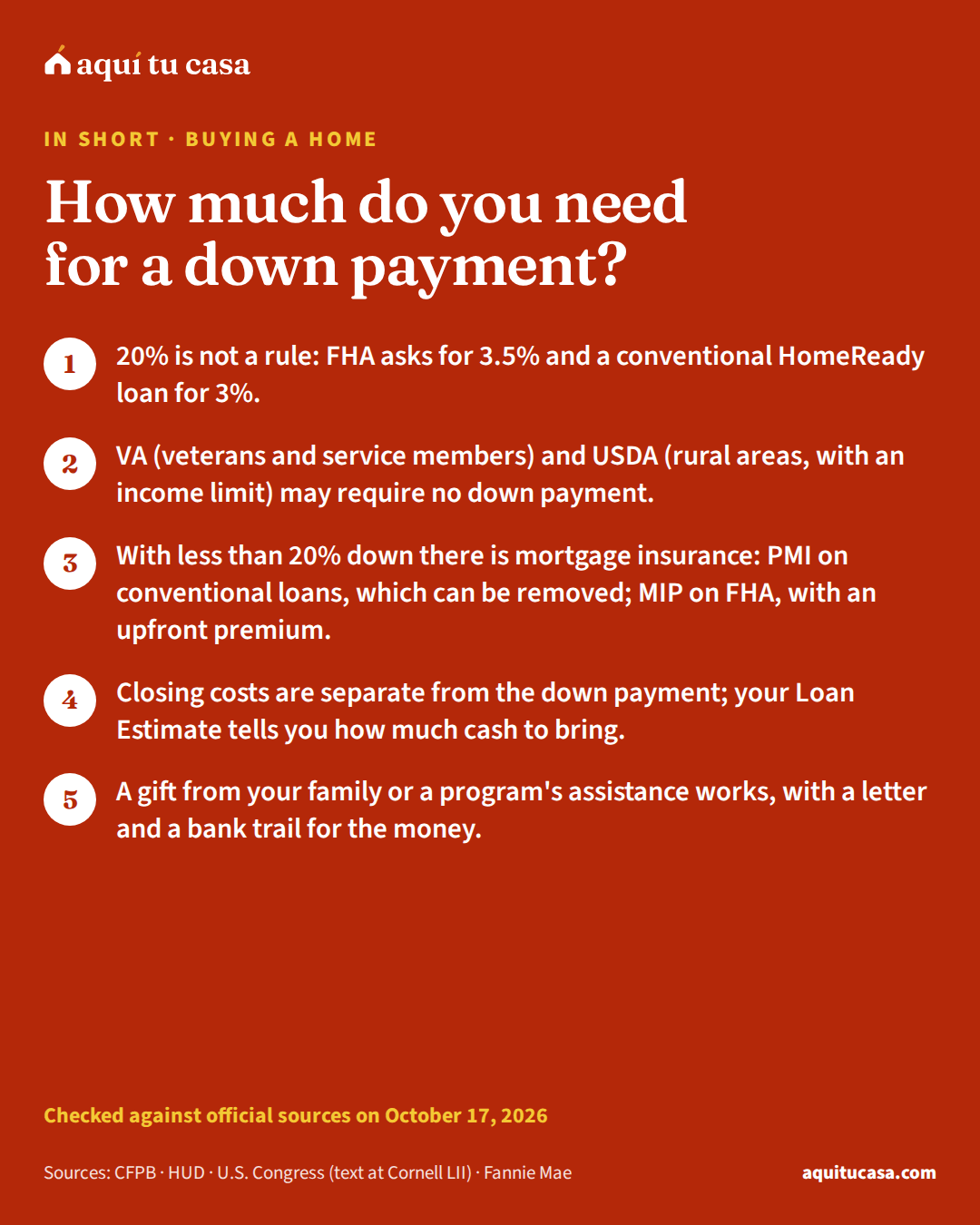
- Buying a home How much do you need for a down payment? 20% is not required: what each loan asks for (FHA, conventional, VA, USDA), what changes with less than 20% down, and where the money can come from. 11 minute read
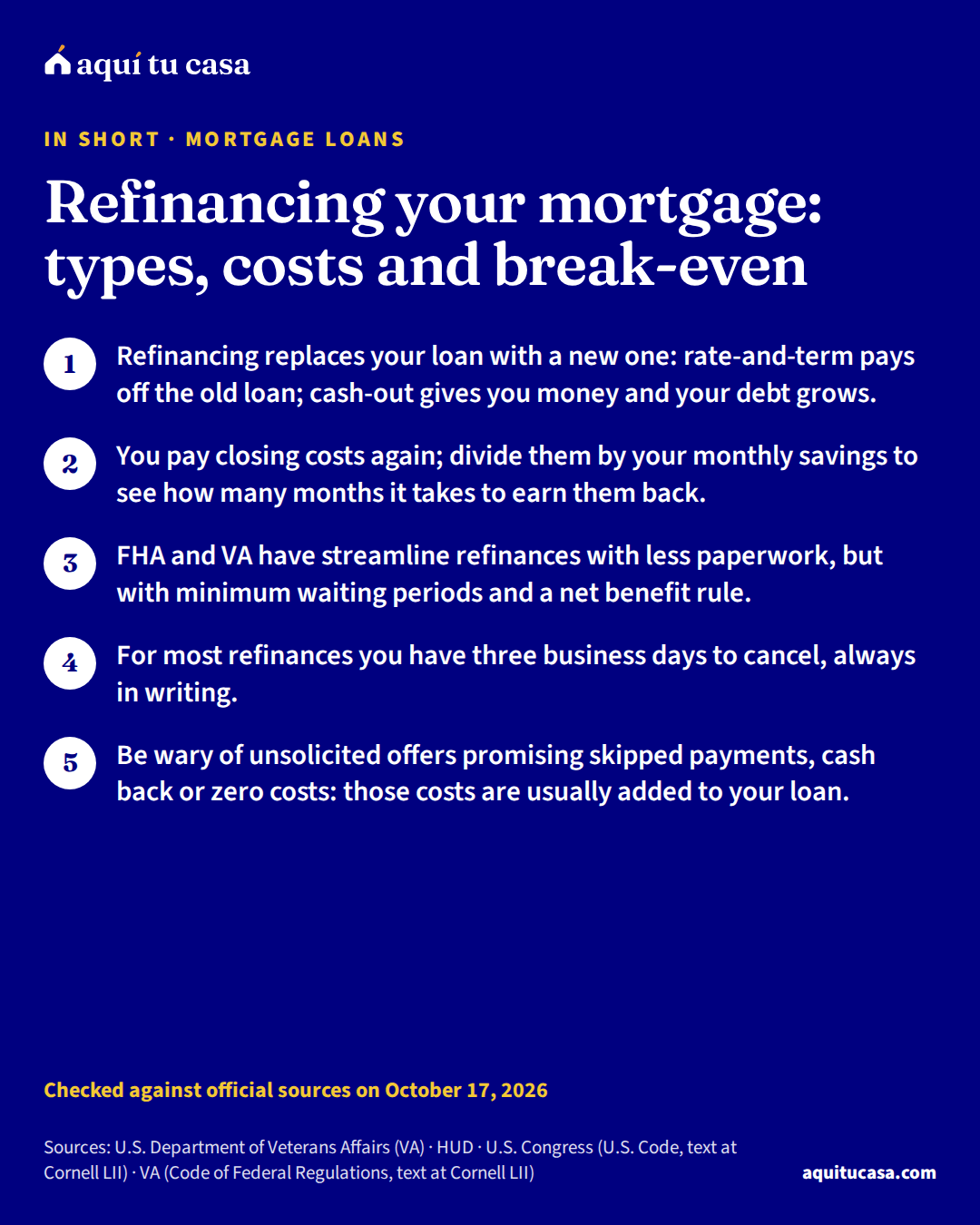
- Mortgage loans Refinancing your mortgage: types, costs and break-even Refinancing explained: rate-and-term vs cash-out, closing costs, the break-even point and FHA and VA streamline refinances. 12 minute read
Tools for this topic
Was this guide useful?
Thank you. Your answer stays in your browser; nothing is sent.