Child support, alimony and your mortgage application
When the child support or alimony you receive counts as income, and when what you pay counts as debt, under FHA, Fannie Mae and federal law.
Verified against official sources on October 31, 2026 9 official sources

Show contents
In short
What you need to know
Quick answer
If you receive child support or alimony, it can count as income toward buying a home, but only if you choose to disclose it. Fannie Mae asks for a written agreement or order, six months of payments received and for the payment to continue at least three years; FHA asks for three months of payments with a court order and also three more years. If you pay child support, it counts as debt: with Fannie Mae when more than ten months of payments remain, and with FHA always. Child support is not taxed, and that lets the lender gross it up a little when figuring your income.
What matters most
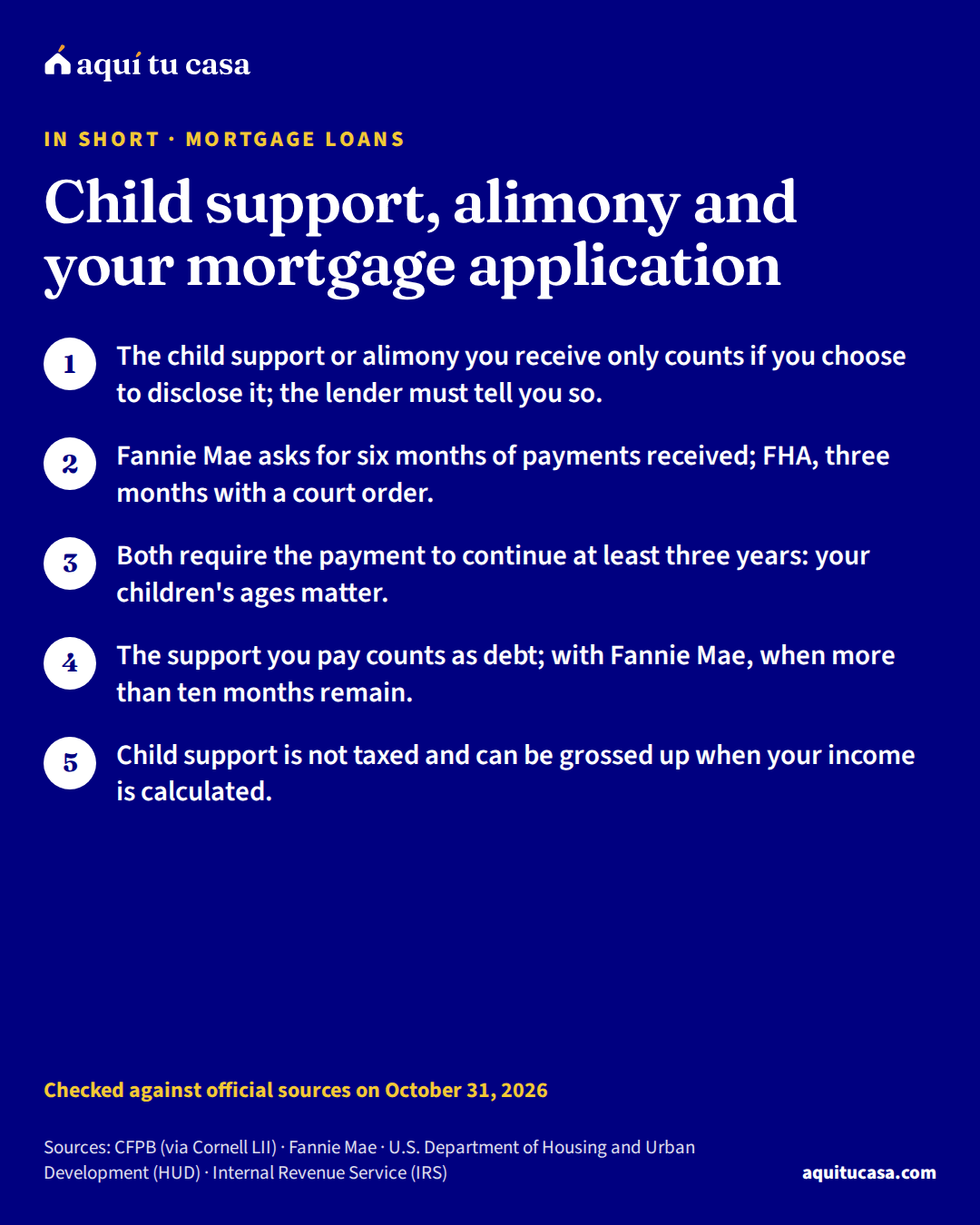
- The child support or alimony you receive only counts if you choose to disclose it; the lender must tell you so.
- Fannie Mae asks for six months of payments received; FHA, three months with a court order.
- Both require the payment to continue at least three years: your children's ages matter.
- The support you pay counts as debt; with Fannie Mae, when more than ten months remain.
Is this for you?
This guide is for you if…
- You receive child support or alimony and want it to count toward buying a home.
- You pay child support or alimony and want to know how much it weighs on your application.
- You are separating or divorcing and plan to buy a home soon.
Get direct help first if…
- You need to know who keeps the house in a divorce: read «Divorce, separation or death: who keeps the house» first.
- You need to change or collect a support order: that is for the court or your state's child support agency.
After a separation or a divorce, many families want to buy a home of their own. If you receive child support or alimony, that money can help you qualify. If you pay it, it will weigh on your application. In both cases, what counts is not what you say but what you can document. This guide explains the rules of FHA, Fannie Mae and federal law, so you arrive with your papers ready.
You decide whether support counts as income
Federal fair lending law gives you control. Under Regulation B, a lender cannot ask whether part of your income comes from alimony or child support, unless it tells you that you do not have to reveal that income if you do not want it considered.1 If you choose to disclose it and you rely on that money, the lender must count it as income to the extent the payments are likely to be consistently made.2
The same regulation says a lender cannot assume your income will drop because you have or will have children.2 If you think you were treated differently for being a single mother or father, read Lending discrimination: your rights.
Fannie Mae says the same: the lender can only count child support or alimony if you disclose it on the application and ask that it be considered.3
What Fannie Mae requires to count it as income
For a conventional loan that follows Fannie Mae, the lender needs three things:3
- A document with the terms. A copy of the divorce decree, separation agreement or other written legal agreement or court decree. Note: if you are separated and have no agreement that sets the payments, proposed or voluntary payments are not counted.
- Six months of payments received. The history must show full, regular and timely payments, through bank statements, canceled checks or other proof that you received them.
- Three more years of payments. The lender must document that the income will continue for at least three years from the application, and check limits such as the children’s ages.
There is a detail that helps you: documented child support is not taxed, and so it can be grossed up when your income is calculated. Fannie Mae says the lender should add an amount equal to 25% of that income, or more if the taxes someone with similar income would pay are higher.4
What FHA requires
For an FHA loan, HUD Handbook 4000.1 accepts a signed copy of the final divorce decree, legal separation agreement, court order or a voluntary payment agreement with proof that you receive it.6
- With an order or decree, proof for the last three months is required: deposits on your bank statements, canceled checks or child support agency documents.
- With a voluntary agreement, 12 months of canceled checks, deposit slips or tax returns are required.
- In both cases, the lender must show the income will continue for at least three years.6
If you received payments consistently for the last three months (with an order) or six months (voluntary), the current payment is used. If not, the average you received over the previous two years is used, or over the time you have received it if less.6 FHA also lets the lender gross up child support because it is not taxed: up to the greater of 15% or your tax rate, or 15% if you did not have to file the year before.6
The support you receive, two programs
Selling Guide B3-3.4-02
Fannie Mae (conventional)
- Written agreement or court order; without one, voluntary payments do not count
- Six months of full, regular and timely payments
- Must continue at least three years
- Can be grossed up 25% because it is not taxed
HUD Handbook 4000.1
FHA
- Order, decree or voluntary agreement with proof of payment
- Three months of proof with an order; 12 months if voluntary
- Must continue at least three years
- Can be grossed up by up to 15% or your tax rate
If your ex pays you without a court order, FHA can count it with 12 months of proof; Fannie Mae generally does not.

If you pay child support or alimony
What you pay is reviewed too, and it goes into your debt-to-income ratiodebt-to-income ratio (DTI)Your debt-to-income ratio (DTI) is all your monthly debt payments divided by your gross monthly income, that is, income before taxes. If you pay a certain amount each month across a car, cards, student loans and the mortgage you are asking for, and you earn three times that, your DTI is one third. Lenders use it to measure whether you can manage the payment; each loan type and lender sets its own limit, and assistance programs usually publish theirs. Paying down debt before applying improves your DTI.See the full definition:
Fannie Mae. If a decree, separation agreement or other written legal agreement requires you to pay alimony or child support, and those payments must continue for more than ten months, they count as monthly debt. Voluntary payments do not need to be counted. For alimony there is an option: instead of adding it to your debts, the lender can subtract it from your qualifying income.5
FHA. The child support you pay always counts as monthly debt. Alimony counts as debt if it was not subtracted from your income. The lender verifies it with the signed decree, agreement or order, and asks for your pay stubspay stubA pay stub is the statement that comes with your pay and shows how much you earned before deductions (gross pay), what was taken out and what you keep (net pay). Deductions include taxes, such as federal income tax, Social Security and Medicare, and sometimes health insurance or retirement savings. It also shows year-to-date totals. The federal wage law (FLSA) does not require employers to give you pay stubs, but it does require them to keep records of your hours and wages. For a mortgage, the lender may ask for your most recent one.See the full definition covering at least 28 consecutive days to see whether you have a wage garnishmentwage garnishmentA wage garnishment is an order that lets a creditor take part of your pay to collect a debt; it can also reach certain benefits or the money in your bank account. According to the CFPB, most creditors can garnish only after a court issues a judgment saying you owe the debt. Federal and state laws limit how much can be taken, so you have something left to live on, and banks must protect a certain amount of directly deposited federal benefits, such as Social Security. Some government agencies, such as the IRS, can sometimes garnish without a court order, and states can garnish to collect child support.See the full definition for those payments. It uses the greater of the amount on the most recent document or the garnishment.6
Example with real numbers
A mother who receives child support and wants to buy
An example in words, not a real case, of how the rules are reviewed.
- She has a court order
- It works for FHA and for Fannie Mae
- The deposits are in her account
- Six months for Fannie Mae; three months is enough for FHA
- Her youngest daughter is 10
- The support continues more than three years
- Child support is not taxed
- It can be grossed up when her income is calculated
- What she does
- Discloses the support, brings the order and statements, and asks for preapproval
The rules come from Fannie Mae and HUD.366 Use the how-much-house calculator with your total income.
Run it with your numbersHow much house can I afford?
If your agreement is still being negotiated
If you are in the middle of a separation, the timing of your application matters. With Fannie Mae, if you are separated and do not yet have an agreement that sets the payments, proposed and voluntary payments are not counted.3 With FHA, a voluntary agreement can count, but you need 12 months of proof.6 That is why many families are better off waiting until the agreement is signed and a few months of payments are deposited.
When you review the draft agreement, on your own or with a legal aid office, check that it states the amount, how often it is paid and until when. Those are the details the lender will look for. If the order changes later, keep the most recent one: on FHA, for what you pay, the lender uses the amount on the most recent document or the garnishment, whichever is greater.6 And if payments go through your state’s child support agency, its history works as proof.6
Taxes: why child support can be grossed up
According to the IRS, child support is never deductible and is not considered income. And for divorce or separation agreements executed after 2018, the payer of alimony cannot deduct it and the recipient does not include it in income.7 That is why lenders treat child support as income that is not taxed, and can gross it up when figuring how much you earn, as the rules above explain.46
If your agreement is from before 2019, the tax rules for alimony may be different. Ask at a free tax preparation site before you file; the guide Free tax filing: VITA, TCE and Free File explains where.
Get your papers ready before you apply
1. Find your complete order or agreement
Today
With every page and signature; it must state the amount and how long it is paid.6
2. Deposit every payment in your account
Every month
Deposits on your bank statements are the easiest proof.3
3. Ask the child support agency for your history
If you are paid through it
FHA accepts child support agency documents as proof.6
4. Count the years left
Before applying
Support must continue at least three years from the application.3
5. Decide whether to disclose it
When filling out the application
It only counts if you disclose it and ask that it be considered.1
Try it with your numbersHow much house can I afford?
If this is your situation
You receive support under a court order
FHA asks for three months of proof; Fannie Mae, six months of full, timely payments.63
Your ex pays you in cash
Deposit it every month: you need bank statements, canceled checks or other proof that you receive it.3
Your ex pays you without a court order
FHA can count it with 12 months of checks, deposits or tax returns; Fannie Mae does not count voluntary payments without an agreement.63
You pay child support
It counts as debt; FHA checks your pay stubs for a garnishment.6
You pay alimony
With Fannie Mae, it can be subtracted from your income instead of added to your debts.5
Costly mistakes
Mistake: Receiving support in cash and spending it without depositing it.
Instead: Without bank statements or checks there is no proof you receive it.36
Mistake: Counting on support that ends soon.
Instead: It must continue at least three years from the application.36
Mistake: Bringing only the first page of the decree.
Instead: Bring the complete, signed document with the payment terms.6
Mistake: Forgetting a wage garnishment for support.
Instead: FHA checks 28 days of pay stubs and uses the greater amount.6
Mistake: Not asking for child support to be grossed up because it is not taxed.
Instead: Fannie Mae and FHA allow it to be grossed up when your income is calculated.46

Free help
If you need a written support order, or need to change the one you have, a legal aidlegal aidLegal aid is the free civil legal help that nonprofit organizations and their lawyers provide to low-income people in civil, not criminal, matters. In housing, that includes representing families facing eviction or foreclosure, alongside matters such as custody, child support, protection from domestic violence and access to benefits. In the United States, the Legal Services Corporation, created by Congress, funds a nationwide network of these organizations; its finder points you to the one in your area. Each sets its own income limits.See the full definition office can guide you. LSC helps you find the nearest one with your address or city.8 To review your budget and application before you apply, a HUD-approved housing counselor can help, often for free.9 If the divorce also decides what happens to a home you already own, read Divorce, separation or death: who keeps the house and How to remove a co-borrower from a mortgage.
What to do this week
- Find your complete, signed decree, agreement or support order.6
- Gather six months of bank statements with the support or alimony deposits.3
- Figure out how many more years you will receive support; you need at least three.3
- If you pay support, check whether your pay stubs show a garnishment.6
- Try the how-much-house calculator and your family budget.5
- Read Debt-to-income ratio and how to lower it and the guide to the FHA loan.
Your numbers
The minimum for this loan is 3.5%. More down lowers the monthly payment.
Adjust advanced details
First number: share of income for housing. Second: housing plus debts. Lender references, not fixed rules.
Let's do the math
Estimated top price
National figure$227,000
Limited by the housing payment: at that price it would be about $1,883 a month, 28% of your income.
- By the housing payment (28% of income)Limits you$227,000
- By your total debts (36% of income)$292,000
- By your cash (down payment + closing)$330,500
- Typical home in the United States
- $332,700
- Your cap is 68% of the typical home.
What changes if…?
- …you save $10,000 more$227,000
- …you cut $200 a month in debts$227,000
Your maximum price with four loans
Same income, debts and savings; only the down payment and the loan type change. ITIN uses an example down payment and rate.
| FHA 3.5% | Conventional 5% | Conventional 20% | ITIN 15% (example) | |
|---|---|---|---|---|
| Maximum price | $227,000 | $232,000 | $93,000 | $119,000 |
| Payment per month | $1,883 | $1,882 | $616 | $898 |
Educational estimate, not a pre-approval. Uses example insurance (0.5% of value per year) and example closing costs (3% of price); the tax is the place’s typical rate.
Ready to see the numbers? Find your county here
See how this applies in your county: its loan limits, prices and rents, from the official data.
Printable checklist
Frequently asked questions
Do I have to tell the lender I receive child support?
No, if you do not want it counted. Under Regulation B, the lender cannot ask whether part of your income is child support or alimony unless it tells you that you do not have to reveal it. If you want it to count, you do have to disclose and document it.
My ex pays me without a court order. Does it count?
It depends on the program. FHA accepts a voluntary payment agreement with 12 months of canceled checks, deposit slips or tax returns. Fannie Mae does not count voluntary payments if you are separated without an agreement that sets them.
My child turns 18 in two years. Will they count my child support?
Probably not. Fannie Mae and FHA require the income to continue at least three years, and Fannie Mae says to check limits such as the children's ages.
Why does the lender want a month of my pay stubs?
On an FHA loan, to see whether you have a wage garnishment for child support or alimony. It asks for stubs covering at least 28 consecutive days and uses the greater of the order or the garnishment.
I pay alimony. Does it count as debt?
Yes, but there is an option. With Fannie Mae, the lender can subtract alimony from your income instead of adding it to your debts. With FHA, it counts as debt if it was not subtracted from your income.
Is the child support I receive taxed?
No. According to the IRS, child support is not considered income and the payer cannot deduct it. That is why FHA and Fannie Mae let the lender gross it up a little when figuring your income.
The payments arrive late or short. What happens?
With Fannie Mae, the history must show full, regular and timely payments. With FHA, if payments were not consistent, the average you received over the previous two years is used.
Sources
Every figure in this guide comes from one of these official sources. The number next to a sentence leads to the source behind it.
Each source on one line: who publishes it, its title, its address and the date we read it.
- 1. CFPB (via Cornell LII) · 12 CFR §1002.5, Rules concerning requests for information (Regulation B) · law.cornell.edu · Accessed October 31, 2026
- 2. CFPB (via Cornell LII) · 12 CFR §1002.6, Rules concerning evaluation of applications (Regulation B) · law.cornell.edu · Accessed October 31, 2026
- 3. Fannie Mae · Selling Guide B3-3.4-02, Alimony, Child Support, Equalization Payments, or Separate Maintenance · selling-guide.fanniemae.com · Accessed October 31, 2026
- 4. Fannie Mae · Selling Guide B3-3.1-01, General Income Information · selling-guide.fanniemae.com · Accessed October 31, 2026
- 5. Fannie Mae · Selling Guide B3-6-05, Monthly Debt Obligations · selling-guide.fanniemae.com · Accessed October 31, 2026
- 6. U.S. Department of Housing and Urban Development (HUD) · Handbook 4000.1, FHA Single Family Housing Policy Handbook · hud.gov · Accessed October 31, 2026
- 7. Internal Revenue Service (IRS) · Topic no. 452, Alimony and separate maintenance · irs.gov · Accessed October 31, 2026
- 8. Legal Services Corporation (LSC) · I Need Legal Help · lsc.gov · Accessed October 31, 2026
See the other 1 sources
- 9. Consumer Financial Protection Bureau (CFPB) · Find a housing counselor · consumerfinance.gov · Accessed October 31, 2026
Keep reading
Related guides
If this guide helped, these follow the same path.

Money problems 13 minute read
Divorce, separation or a death: who keeps the house
What happens to the deed, the mortgage and the payments in a divorce, a separation or a death in the family, and what federal law protects for you.
- The deed, the loan and the payments are three different things: changing one does not change the others.
- Under Garn-St Germain, the lender cannot demand the whole loan when a spouse or children receive the house through a death, a divorce or a legal separation; the regulation requires you to live in it.
- If you received the house from a borrower, the servicer must tell you which documents it needs to confirm you as a successor, and then treats you as a borrower.
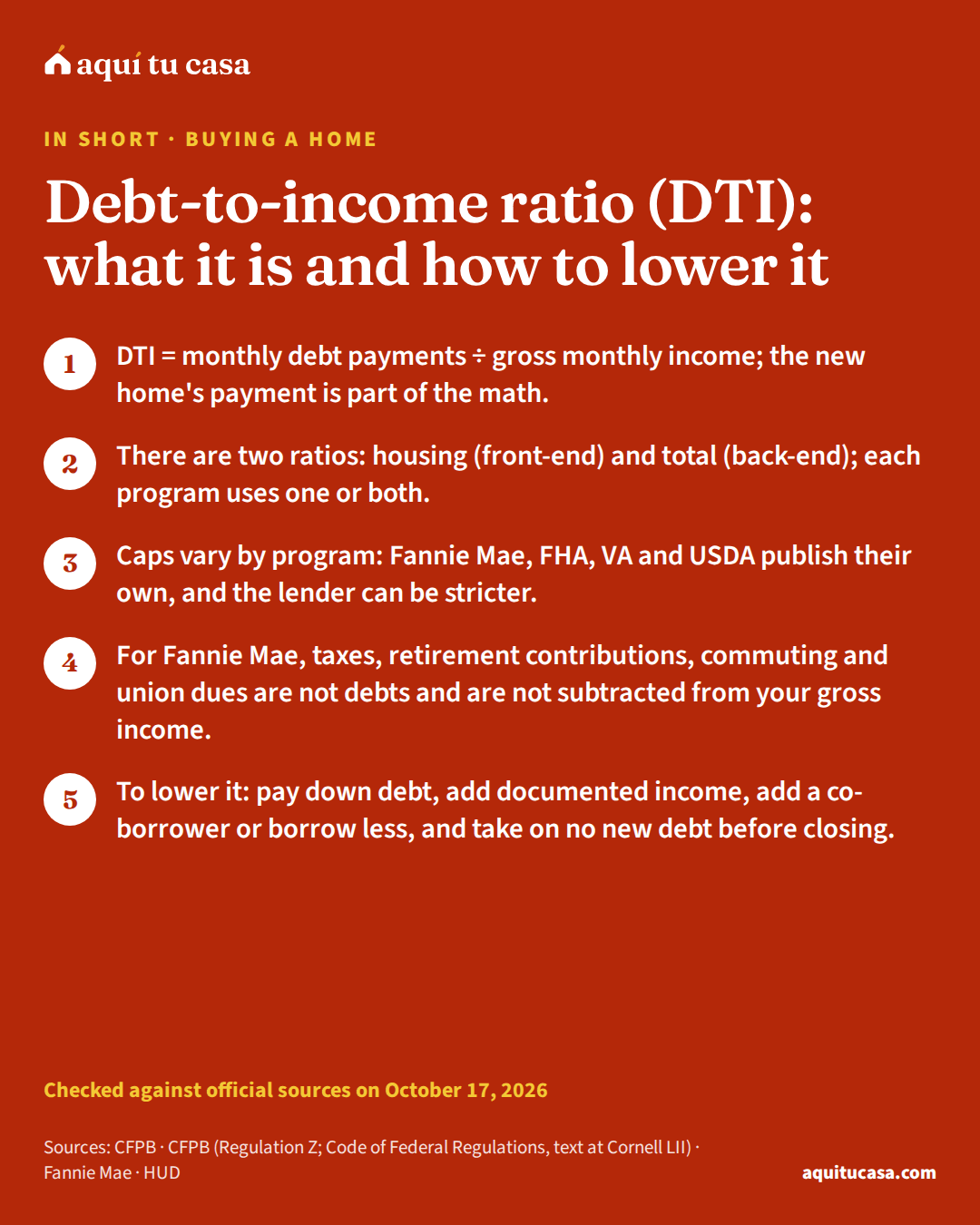
- Buying a home Debt-to-income ratio (DTI): what it is and how to lower it What the debt-to-income ratio (DTI) is, how to calculate it, which payments count, the caps FHA, Fannie Mae, VA and USDA publish and how to lower it. 14 minute read
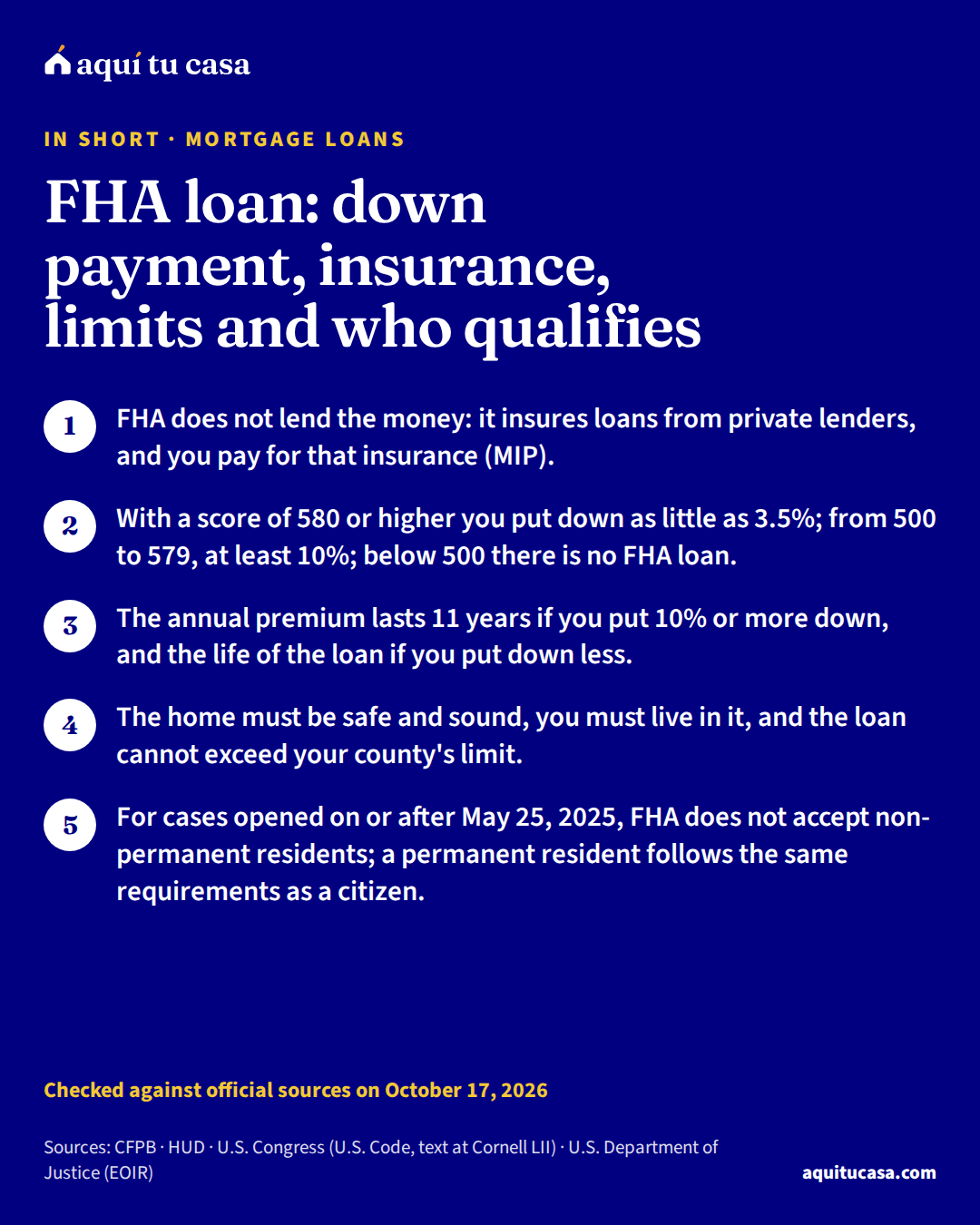
- Mortgage loans FHA loan: down payment, insurance, limits and who qualifies How an FHA loan works: the down payment and credit score HUD requires, MIP mortgage insurance, your county limit, the home and the residency rules. 14 minute read
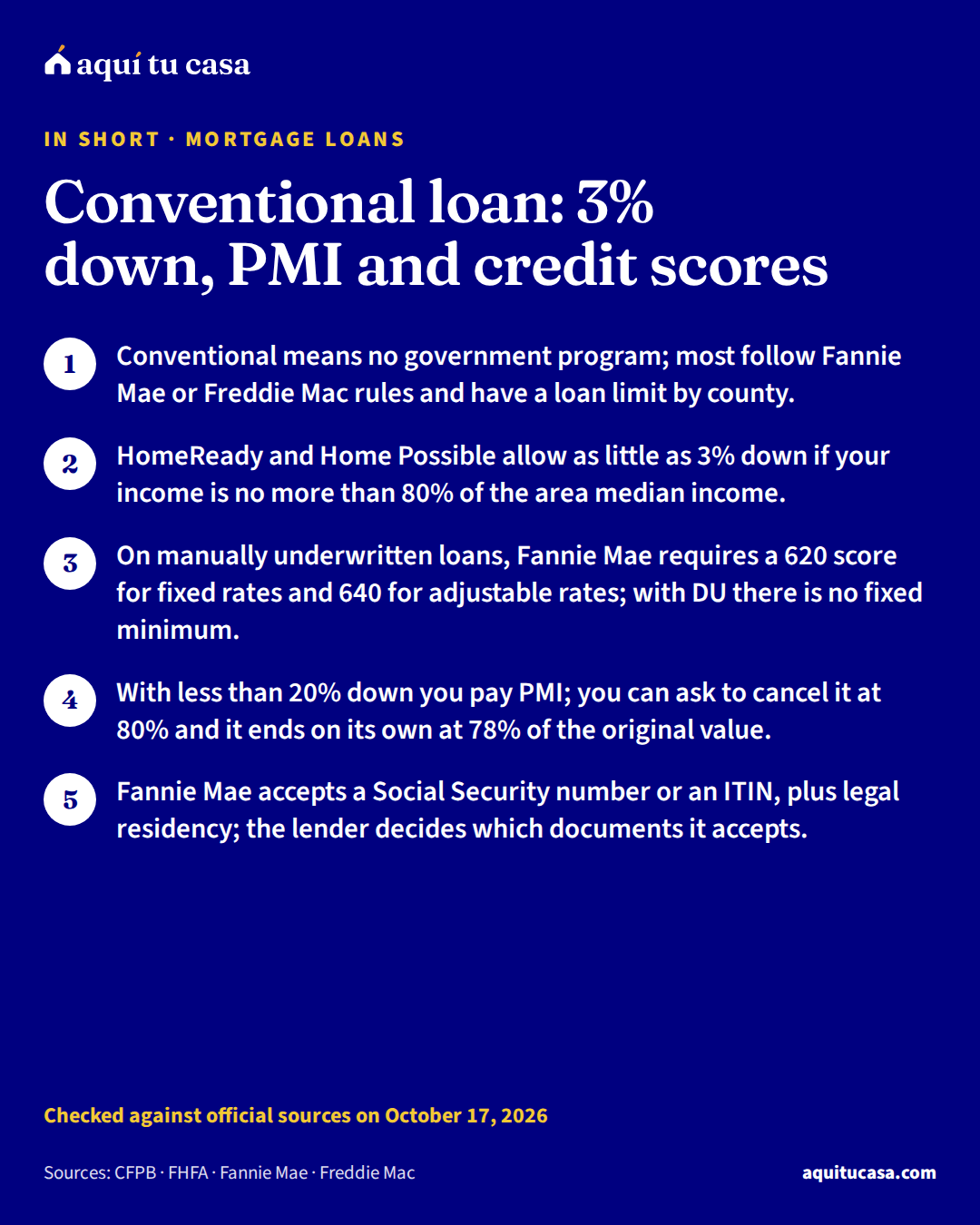
- Mortgage loans Conventional loan: 3% down, PMI and credit scores How a conventional loan works: HomeReady and Home Possible from 3% down, the credit score Fannie Mae requires, PMI and when the law ends it. 12 minute read
Tools for this topic
Was this guide useful?
Thank you. Your answer stays in your browser; nothing is sent.