Divorce, separation or a death: who keeps the house
What happens to the deed, the mortgage and the payments in a divorce, a separation or a death in the family, and what federal law protects for you.
Verified against official sources on October 31, 2026 13 official sources

Show contents
In short
What you need to know
Quick answer
In a divorce, a separation or a death there are three different things: who owns the house (the deed), who owes the loan and who makes the payments. The federal Garn-St Germain law stops the lender from demanding the whole loan at once when the house passes to you because of the borrower's death, because you are their spouse or child, or through a divorce or legal separation, if you live in it. Under Regulation X, if you received the house that way, the servicer must confirm you as a successor and, once confirmed, treats you as a borrower. Who keeps the house is decided by your state's law.
What matters most
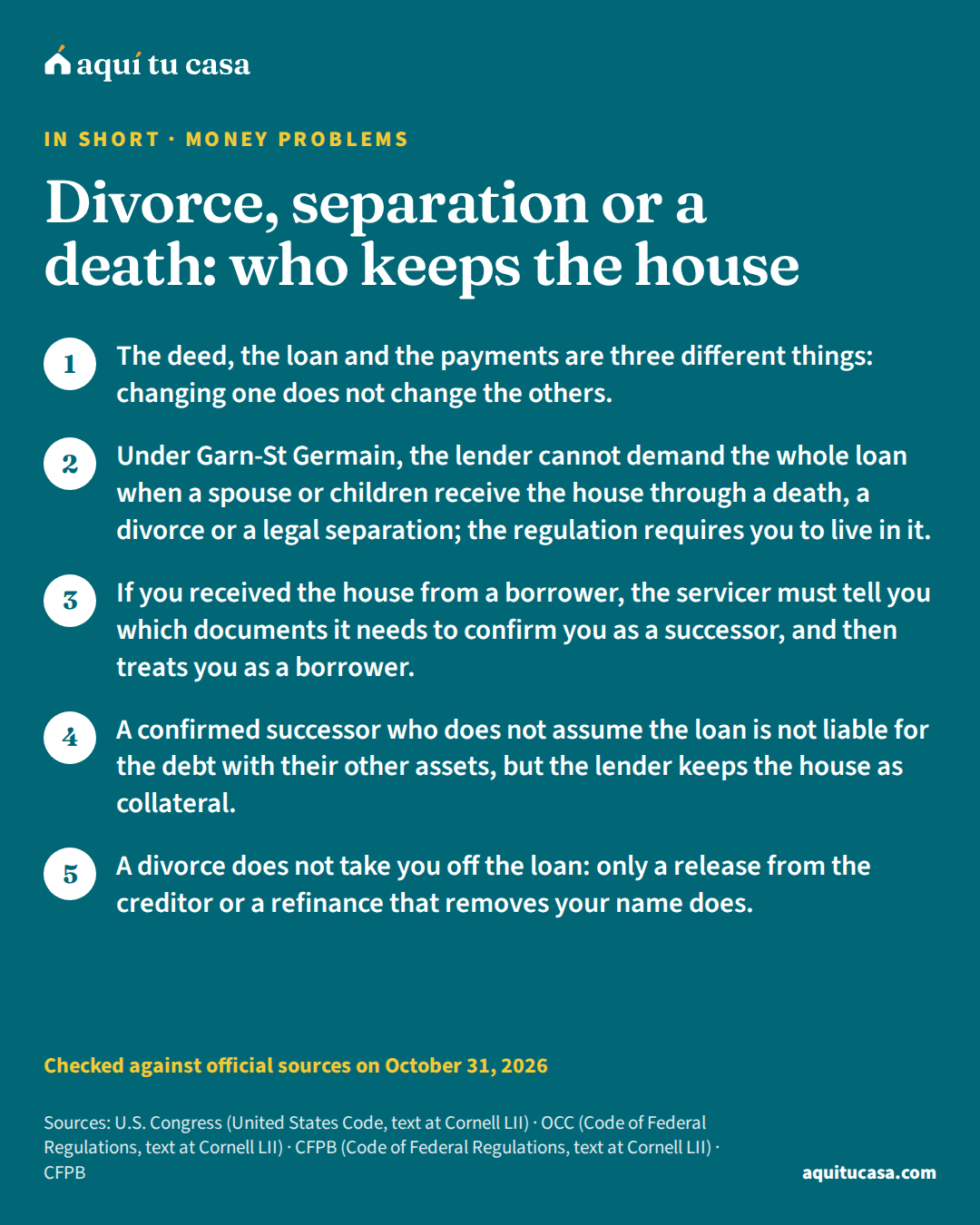
- The deed, the loan and the payments are three different things: changing one does not change the others.
- Under Garn-St Germain, the lender cannot demand the whole loan when a spouse or children receive the house through a death, a divorce or a legal separation; the regulation requires you to live in it.
- If you received the house from a borrower, the servicer must tell you which documents it needs to confirm you as a successor, and then treats you as a borrower.
- A confirmed successor who does not assume the loan is not liable for the debt with their other assets, but the lender keeps the house as collateral.
Is this for you?
This guide is for you if…
- You are divorcing or separating and do not know what happens to the house and the mortgage.
- Your husband, wife, father or mother died, and you stayed in the house that was in their name.
- The mortgage servicer will not give you information because the loan is not in your name.
Get direct help first if…
- You already have a foreclosure sale date or received court papers: call a legal aid program and a HUD-approved housing counselor today; the dates do not wait.
- You need to know how the house is divided in your divorce or in an inheritance: your state's law decides that; this guide covers only the federal rules on the loan.
A divorce or the death of someone in the family is hard enough. Then come the questions about the house: who keeps it? who pays? can they take it from us? This guide is for you if you are in that moment: it explains, using federal law only, what happens to the deed, the mortgage and the payments, what protects you and how to deal with the loan servicer. How the house is divided is decided by your state’s law, and for that we tell you where to get free help.
Three different papers: the deed, the loan and the payments
The first step is to separate three things people often confuse:
- The deeddeedA deed is the legal document the seller uses to transfer ownership of the home to you. The seller signs it at closing, it lists the names of all the buyers and you receive a copy. Afterward, the settlement agent records it with the county records office; that recording puts the public on notice that you are now the owner. There are several types: a warranty deed gives the most promises about the title, and a quitclaim deed promises nothing. Do not confuse it with a deed of trust, which is the mortgage document.See the full definition says who owns the house.
- The mortgage loan says who owes money to the lender. The house is the collateral for that loan.
- The payments go to the loan servicerloan servicerThe loan servicer is the company that sends you your mortgage statements and handles the day-to-day tasks of the loan: it processes your payments, answers your questions, keeps track of principal and interest paid and manages your escrow account, if you have one. It can also offer options if you fall behind and, in certain cases, start a foreclosure. It may be the same company that lent you the money or a different one, and it is common for another company to take over the loan after closing.See the full definition, the company that sends the monthly statement.9
Changing one does not change the others. The CFPB explains it for divorce: taking your name off the home title does not take your name off the mortgage, and sending creditors a copy of your divorce decree does not end your responsibility on a joint account.11 And the other way around: receiving the house through an inheritance or a divorce does not, by itself, put you on the loan.7
What each paper decides
Who owns it
The deed
Who owes
The loan
While it is being decided who keeps the house, what protects it is that someone keeps paying and talking to the servicer.9
The law that stops them from demanding it all at once
The federal Garn-St Germain law defines a due-on-sale clausedue-on-sale clauseA due-on-sale clause is a part of the mortgage contract that lets the lender demand the full balance if you sell or transfer the home, or part of it, without its written consent. A federal law, the Garn-St Germain Act, allows these clauses, but for homes with fewer than five units it bars using them for certain transfers: for example, to a relative on the borrower's death, when the borrower's spouse or children become owners, in a divorce, on the death of a joint tenant, or into the borrower's living trust.See the full definition as the part of the contract that lets the lender, at its option, declare the whole debt due if the house, or part of it, is sold or transferred without its written consent. And it sets exceptions for families. For a loan secured by a home with fewer than five dwelling units (including a cooperative unit and a manufactured home), the lender may not use that clause for, among others:1
- a transfer by will, inheritance or operation of law on the death of a joint tenantjoint tenancy with right of survivorshipJoint tenancy with right of survivorship is a way for two or more people to own property, each with an equal, undivided interest in the whole. When one owner dies, that share passes to the surviving owners, not to the owner's heirs; that is the main difference from a tenancy in common. Generally the deed has to say so; if it does not, the ownership is presumed to be a tenancy in common. That is the case, for example, in Arizona and Florida, where the law requires the deed to state the right of survivorship expressly.See the full definition or tenant by the entirety;
- a transfer to a relative resulting from the borrower’s death;
- a transfer in which the borrower’s spouse or children become owners;
- a transfer by a divorce decree, a legal separation agreement or a property settlement agreement by which the borrower’s spouse becomes an owner;
- a transfer into a living trust in which the borrower is and remains a beneficiary.
The requirement to live in the house. The federal regulation implementing that law spells it out for a home the borrower occupies or will occupy: for transfers to a relative on the borrower’s death, to the spouse or children, or to the spouse through divorce or separation, the exception applies if the person receiving the house occupies or will occupy it. Also, the lender can use the clause if a later event removes the exception.2
If you received the house: you are a successor in interest
Regulation X, the federal rules for mortgage servicers, has a name for someone who receives the house from a borrower in these situations: successor in interestsuccessor in interestA successor in interest is, under Regulation X, a person who receives ownership of a mortgaged home from the borrower in certain cases: on the death of a joint tenant, when it passes to a relative on the borrower's death, when the borrower's spouse or children become owners, through a divorce or legal separation, or by transfer into the borrower's living trust. When the loan servicer learns of a potential successor, it must say which documents it needs to confirm that person. A confirmed successor in interest counts as a borrower under the mortgage servicing rules.See the full definition. The transfers that count are the same ones as in Garn-St Germain: on the death of a joint tenant, to a relative on the borrower’s death, to the spouse or children, to the spouse through a divorce or legal separation, or into a living trust. A confirmed successor is one whose identity and ownership the servicer has already confirmed.3
The servicer has obligations to you. Under Regulation X it must have policies so that, when it learns of a borrower’s death or a transfer of the house, it promptly facilitates communication with potential successors. When it learns of you, it must promptly decide which documents it needs to confirm your identity and ownership, and give you a description of those documents and of how to request information in writing. When it receives your documents, it must promptly decide and tell you whether it confirmed you, needs more documents (and which ones) or decided you are not a successor.5
How to ask in writing. Send a letter saying you may be a successor in interest, with the name of the borrower you received the house from and information to identify the account, such as the loan number or the address. The servicer must answer in writing with the list of documents it reasonably needs and a phone number for more help. If information is missing, it can give you examples of documents it typically accepts and tell you what else it needs. Before confirming you it does not have to give you other information, but it must tell you that you can ask again once confirmed.6
The deadlines: the servicer must acknowledge your request in writing within five business days, and generally answer within 30 business days, with a possible 15-day extension if it tells you in writing beforehand, with the reason.6
Which documents? The servicer decides. For an inheritance, the CFPB gives as examples a copy of the executed will and the death certificate, or a letter from the executor of the estate, and warns that the proof you can get varies from state to state.9
From the loss or the divorce to confirmation
2. Send your request in writing
The same week
Say you may be a successor in interest, with the borrower's name and account details.6
3. Get the acknowledgment
Within 5 business days
The servicer confirms in writing that it received your request.6
5. Send the documents
As soon as you have them
For example, the death certificate and the will, or the divorce decree.9
6. You are confirmed and treated as a borrower
When the servicer decides
You can request information, report errors and ask for alternatives.4

What changes once you are confirmed
Once confirmed, Regulation X considers you a borrower for the escrowescrow accountAn escrow account is an account set up by your mortgage lender to pay certain property-related expenses on your behalf, mainly property taxes and homeowners insurance. The money comes from a portion of your monthly mortgage payment: each month you contribute a share and the loan servicer pays the bills when they come due. That is why your payment is higher than principal and interest alone, and why it can change when taxes or the insurance premium go up. In some states the word also names the period between the offer and the closing.See the full definition account rules and for the servicing rules in that part of the regulation.4 In plain words: you can request account information, report errors and ask for alternatives if you fall behind, like any borrower.
That does not make the debt yours. On confirming you, the servicer may send you a notice that must explain that, unless you assume the loan under your state’s law, you are not liable for the debt and cannot be required to pay it with your other assets; but the lender still has the house as collateral and can foreclose if it is not paid, when the law and the contract allow. With that notice comes a form: if you sign and return it (there is no deadline), you will receive the loan notices, and signing it does not make you liable for the debt. Whether or not you sign, you can submit notices of error, request information and ask for the payoff amount.7
What if you want to keep the loan? According to the CFPB, if you already have title to the house through inheritance, divorce, legal separation, a living trust, a transfer from parents to children, joint tenancy with right of survivorship or another family transfer, its rules do not require the lender to evaluate your ability to repay before letting you take over the loan.10 You can ask the servicer how to keep making payments or how to seek a loan modificationloan modificationA loan modification is a change in the terms of your mortgage that you agree on with your loan servicer when you have trouble paying. It is a type of loss mitigation, meaning one of the options to avoid foreclosure. It can extend the time you have to repay, lower the interest rate, or defer or reduce part of the principal balance, which can lower your monthly payment. Often you start with a trial modification for a few months; if you make those payments on time, the change becomes permanent.See the full definition.9 The options by loan type (FHA, VA, Fannie Mae) are in the guide how to remove a co-borrower from a mortgage.
Example with real numbers
A widow who stays in the house
An example in words: the house and the loan were in the name of the husband, who died; she lives in the house and receives it by inheritance.
- Can the lender demand the whole loan because of the transfer?
- No, if she lives in the house
- What is she to the servicer?
- A potential successor in interest, until it confirms her
- What does she do first?
- She tells the servicer and asks in writing for the list of documents
- Is she liable for the debt with her other assets?
- No, unless she assumes the loan under her state's law
- What protects the house meanwhile
- That someone keeps paying and that she asks for alternatives if she falls behind
That is what Garn-St Germain,1 the regulation on living in the house2 and Regulation X say.67 Who inherits the house is decided by her state's law.
Run it with your numbersFamily budget
If the payments fall behind
In the middle of a divorce or grief, it is easy for a payment to slip. Regulation X sets rules before a foreclosureforeclosureForeclosure is the process by which the lender or servicer takes back the property after the homeowner fails to make mortgage payments. The rules and timelines depend on each state; all of them include advance notices and, in general, time to catch up or ask for an alternative, such as a repayment plan or a loan modification. If you fall behind, call your servicer and a HUD-approved housing counseling agency early: foreclosure counseling is free and exists for exactly this.See the full definition. Generally, the servicer cannot make the first notice or filing of a foreclosure, judicial or non-judicial, until the loan is more than 120 days delinquent. If you submit a complete loss mitigation application before that first filing, it generally cannot start until the application is resolved; and if you submit it afterward, but more than 37 days before the sale, it generally cannot move for judgment or hold the sale until it is resolved. The rule does not require the servicer to give you any particular option.8
Two cautions. First, one of the exceptions to the 120 days is a foreclosure based on a violation of the due-on-sale clause.8 That is why it matters that your transfer falls within the Garn-St Germain exceptions and that you live in the house.2 Second, these rules have exemptions: they do not apply the same way to small servicers or reverse mortgages, and the delinquency procedures are for a principal residence.4 The guide if you can’t pay your mortgage explains the options step by step.
What federal law does not decide
This guide covers only the federal rules on the loan. Many questions are decided by your state’s law:
- Who keeps the house in a divorce is decided by your state’s law and your agreement or decree. The CFPB notes that the decree can assign the debts to one spouse, but the creditor can still collect from anyone listed as a borrower, and you generally remain responsible until the creditor releases you or your former spouse refinances and removes your name.11
- Who inherits the house depends on the will, how it was titled and your state’s law. The guide on wills, transfer-on-death deeds and inheriting a home explains how a house can pass to the family.
- Which documents you can get to prove your right varies from state to state.9
There is free help for these questions. Free legal aid can be found by address on the Legal Services Corporation website, which funds organizations in every state, the District of Columbia and the territories.13 A HUD-approved housing counselorHUD-approved housing counselorA HUD-approved housing counselor works at an agency HUD has approved to provide housing counseling: independent, expert advice customized to your situation about buying a home, renting, a missed mortgage payment, a foreclosure or credit problems. The agencies usually charge little or nothing; many serve in Spanish and offer the homebuyer education course several assistance programs require. They are not lenders or real estate agents and sell you nothing. Your county page lists the official agencies with phone numbers.See the full definition advises on delinquencies, forbearances and foreclosures, often at little or no cost.12 The CFPB also mentions the HOPE Hotline, at (888) 995-4673.9
If this is your situation
Your husband died and the loan was in his name
Tell the servicer and ask in writing for the list of documents to confirm you as a successor.6
You keep the house in the divorce
Garn-St Germain covers the transfer to a spouse by divorce,1 but your former spouse stays on the loan until released or until you refinance.11
You move out of the house in the divorce
Taking your name off the title does not take you off the loan; ask the creditor to release you or for a refinance.11
Payments are already late
Generally a foreclosure cannot start before 120 days of delinquency; ask for alternatives and talk to a HUD counselor.8

Mistakes that can cost you the house
Mistake: Stopping payments while the inheritance or divorce is resolved.
Instead: The law stops them from demanding it all because of the transfer, but does not forgive the debt; keep paying and ask how.9
Mistake: Calling the servicer and accepting a 'we can't talk to you'.
Instead: Send a written request as a potential successor; it has to answer with the list of documents.6
Mistake: Thinking that signing a quitclaim deed takes you off the loan.
Instead: Taking your name off the title does not take your name off the loan.11
Mistake: Moving out and renting the inherited house without checking the occupancy rule.
Instead: The exception for relatives, spouses and children applies if the person receiving the house occupies or will occupy it.2
Mistake: Signing to assume the loan without understanding what changes.
Instead: A confirmed successor who does not assume the loan is not liable with other assets; ask before you sign.7
Mistake: Waiting for a foreclosure notice before asking for help.
Instead: A complete loss mitigation application before the first filing gives you more protection.8
What to do this week
- Find the latest loan statement to learn who the servicer is and the account number.9
- Call the servicer to let it know, and also send a letter as a potential successor in interest; keep a copy and the date.6
- Gather the documents it asks for: for example, the death certificate and the will, or the divorce decree.9
- Keep making payments if you can, and keep every receipt; see what fits in your month with the family budget.9
- Look for free legal aid for the state-law part, and a HUD-approved housing counselor if payments are behind.12
Your household this month
Let's do the math
Left each month
Enter what at least one person takes home to see the result.
What helps
- Pay savings first: set the goal aside the day the money arrives, before flexible spending.
- Add up the bills that come every few months (car insurance, school) and divide by twelve.
- If income changes, plan on a low month and save the extra from good months.
- A HUD-approved housing counselor can go over the budget with you, often for free.
This is a planning tool with your numbers, not a credit evaluation or an approval. The split reference is only a guide.
Ready to see the numbers? Find your county here
See how this applies in your county: its loan limits, prices and rents, from the official data.
Printable checklist
Frequently asked questions
My husband died and the loan was only in his name. Can they demand that I pay it all at once?
The federal Garn-St Germain law says the lender cannot use the due-on-sale clause for a transfer to a relative resulting from the borrower's death, or when the spouse becomes an owner. The regulation requires that you live or will live in the house. What you do need to keep doing is pay, and tell the servicer.
The servicer will not give me information because I am not on the loan. What do I do?
Send a written request saying you may be a successor in interest, with the borrower's name and the account number or address. Under Regulation X, it must answer in writing with the list of documents it needs to confirm you and a phone number for help.
Which documents will they ask for?
The servicer decides, and must tell you. For an inheritance, the CFPB mentions a copy of the executed will and the death certificate, or a letter from the executor. The proof you can get varies by state.
If I am confirmed as a successor, do I have to pay the debt with my other assets?
Under Regulation X, unless you assume the loan under your state's law, you are not liable for the debt and cannot be required to pay it with your assets. But the lender keeps the house as collateral and can foreclose if it is not paid, when the law allows.
My ex-husband kept the house in the divorce. Do I no longer owe the loan?
Not necessarily. The CFPB explains that the divorce decree does not change what you owe the creditor: you remain responsible unless the creditor releases you or your former spouse refinances and removes your name. Taking your name off the title does not take you off the loan.
Can the lender refuse to let me take over the loan because of my income?
According to the CFPB, if you already have title to the house through inheritance, divorce, legal separation or another family transfer, its rules do not require the lender to evaluate your ability to repay before letting you take over the loan.
I fell behind on payments after the death. Can they foreclose right away?
Under Regulation X, the servicer generally cannot start a foreclosure until the loan is more than 120 days delinquent. If you are confirmed as a successor, it treats you as a borrower and you can ask for alternatives. Talk to a HUD-approved housing counselor today.
Sources
Every figure in this guide comes from one of these official sources. The number next to a sentence leads to the source behind it.
Each source on one line: who publishes it, its title, its address and the date we read it.
- 1. U.S. Congress (United States Code, text at Cornell LII) · 12 U.S.C. §1701j-3, Preemption of due-on-sale prohibitions (Garn-St Germain) · law.cornell.edu · Accessed October 31, 2026
- 2. OCC (Code of Federal Regulations, text at Cornell LII) · 12 CFR §191.5, Limitation on exercise of due-on-sale clauses · law.cornell.edu · Accessed October 31, 2026
- 3. CFPB (Code of Federal Regulations, text at Cornell LII) · 12 CFR §1024.31, Definitions (Regulation X) · law.cornell.edu · Accessed October 31, 2026
- 4. CFPB (Code of Federal Regulations, text at Cornell LII) · 12 CFR §1024.30, Scope (Regulation X) · law.cornell.edu · Accessed October 31, 2026
- 5. CFPB (Code of Federal Regulations, text at Cornell LII) · 12 CFR §1024.38, General servicing policies, procedures, and requirements (Regulation X) · law.cornell.edu · Accessed October 31, 2026
- 6. CFPB (Code of Federal Regulations, text at Cornell LII) · 12 CFR §1024.36, Requests for information (Regulation X) · law.cornell.edu · Accessed October 31, 2026
- 7. CFPB (Code of Federal Regulations, text at Cornell LII) · 12 CFR §1024.32, General disclosure requirements (Regulation X) · law.cornell.edu · Accessed October 31, 2026
- 8. CFPB (Code of Federal Regulations, text at Cornell LII) · 12 CFR §1024.41, Loss mitigation procedures (Regulation X) · law.cornell.edu · Accessed October 31, 2026
See the other 5 sources
- 9. CFPB · How do I get mortgage information about a home I inherited? · consumerfinance.gov · Accessed October 31, 2026
- 10. CFPB · I recently inherited a house. The mortgage lender said it's required to determine my ability to repay before it will let me take over the mortgage loan. Is this true? · consumerfinance.gov · Accessed October 31, 2026
- 11. CFPB · Can a debt collector contact me about a debt after a divorce? · consumerfinance.gov · Accessed October 31, 2026
- 12. CFPB · Find a Housing Counselor · consumerfinance.gov · Accessed October 31, 2026
- 13. Legal Services Corporation (LSC) · I Need Legal Help · lsc.gov · Accessed October 31, 2026
Keep reading
Related guides
If this guide helped, these follow the same path.

Owning a home 19 minute read
How to remove a co-borrower from a mortgage
Refinance, assume the loan or request a release of liability: what FHA, VA, Fannie Mae and federal law say in divorce, separation and death.
- The deed says who owns; the note says who owes. Taking a name off the deed does not take it off the loan.
- Only two things get you off the loan: a written release from the lender or a refinance in the other person's name.
- FHA and VA allow assuming the loan and releasing the original borrower; Fannie Mae processes the release if the person staying passes the credit review.
- Owning a home Wills, transfer-on-death deeds and inheriting a home What a will requires, how a transfer-on-death deed works, what happens to the mortgage when you inherit a home and what heirs' property is. 14 minute read
- Money problems Can't pay your mortgage? What to do in the first week Can't pay your mortgage? Call your servicer, learn the options that exist, the federal rules that protect you and the rescue scams to avoid. 14 minute read
- Help and programs Free legal aid: who qualifies and where to find it What free legal aid is, who qualifies, which rules apply if you are not a citizen, and where to get help with immigration and tax problems. 11 minute read
Tools for this topic
Was this guide useful?
Thank you. Your answer stays in your browser; nothing is sent.