Lending discrimination: your rights and how to complain
What the law bans when you apply for a loan or mortgage, what lenders may ask, including immigration status, and how to complain to the CFPB or HUD.
Verified against official sources on October 17, 2026 21 official sources

Show contents
In short
What you need to know
Quick answer
Two federal laws ban discrimination when you apply for credit: the Equal Credit Opportunity Act (ECOA), which covers race, color, religion, national origin, sex, marital status, age and public assistance income, and the Fair Housing Act, which covers home loans and adds disability and familial status. A lender may ask about and consider your immigration status, but it cannot use it as an excuse to discriminate against you based on national origin. If you are denied, you must get the specific reasons in writing or be told how to request them. You can complain to the CFPB, to HUD (within one year) or to your state attorney general.
What matters most
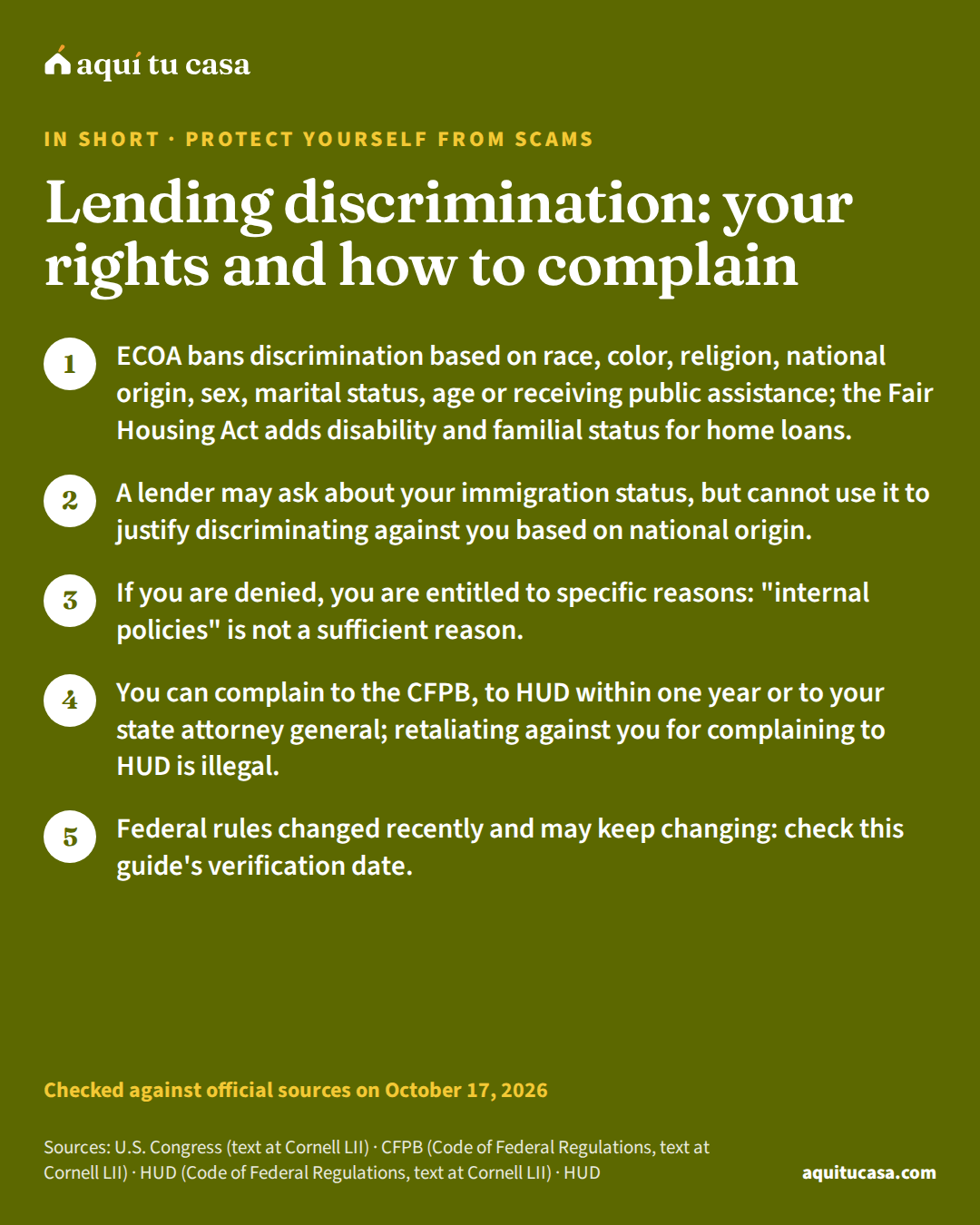
- ECOA bans discrimination based on race, color, religion, national origin, sex, marital status, age or receiving public assistance; the Fair Housing Act adds disability and familial status for home loans.
- A lender may ask about your immigration status, but cannot use it to justify discriminating against you based on national origin.
- If you are denied, you are entitled to specific reasons: "internal policies" is not a sufficient reason.
- You can complain to the CFPB, to HUD within one year or to your state attorney general; retaliating against you for complaining to HUD is illegal.
Is this for you?
This guide is for you if…
- You applied for a loan or mortgage and feel you were treated differently because of your origin, your family, your age or because you receive government assistance.
- You were turned down for a loan and not given a clear reason.
- You are about to apply for a loan and want to know what you can and cannot be asked.
Get direct help first if…
- The problem is renting a home, not getting a loan: start with the guide on housing discrimination.
- You were denied because of an error on your credit report: the guide to disputing errors explains how to fix it.
- You have a question about your immigration case: this guide does not answer it; an accredited representative or a legal aid office can guide you.
Applying for a loan is stressful, and more so if you feel you are being treated differently because of your accent, your last name or your family. This guide is for anyone who is applying, or already applied, for a loan or mortgage and wants to know what the law bans, what lenders may ask (including about immigration status), what to do if they are turned down and where to complain. It explains what the laws and agencies say; it does not evaluate your case.
Which laws protect you
Two federal laws cover discrimination when you apply for credit for your home. The first is the Equal Credit Opportunity Act (ECOA). It bans a creditor from discriminating against you in any part of a credit transaction because of your race, color, religion, national originnational originNational origin is one of the characteristics the Fair Housing Act protects. According to the Department of Justice, national origin discrimination can be based on the country where you were born or where your ancestors came from. The law prohibits refusing to sell or rent you a home, setting different terms or publishing ads that state a preference based on your national origin. According to the CFPB, the Equal Credit Opportunity Act also prohibits lenders from discriminating against you because of your national origin when you apply for credit, such as a mortgage.See the full definition, sex, marital status or age; because all or part of your income comes from a public assistance program; or because you exercised in good faith a right under that law.1 According to the CFPB, it applies to almost every kind of loan: mortgages, auto loans, credit cards and student loans.16
The second is the Fair Housing ActFair Housing ActThe Fair Housing Act is the federal law that makes it illegal to refuse to sell or rent a dwelling, or to discriminate in its terms, because of race, color, religion, sex, familial status (having children), national origin or disability. It applies to landlords, real estate agents and managers, and also to banks and lenders when their practices make housing or credit unavailable for those reasons. National origin covers your language and the country you come from, regardless of immigration status. If you believe you were discriminated against, you can file a complaint with HUD at no cost; many states add protections.See the full definition. For residential real estate transactions, such as loans to buy, build, repair or maintain a home, or appraising it, it bans discrimination because of race, color, religion, sex, disability, familial statusfamilial statusFamilial status is one of the characteristics the Fair Housing Act protects. The law defines it as having one or more children under 18 living with a parent, with another person who has legal custody of them or with someone that person designates in writing. It also protects anyone who is pregnant or is in the process of getting custody of a child. So, with some exceptions, such as certain housing for older persons, no one may refuse to rent or sell you a home, or impose special conditions, because you live with children.See the full definition or national origin.9 Your state or city laws may protect you on additional grounds.16
The two laws, side by side
Almost any kind of credit
Equal Credit Opportunity Act (ECOA)
If the loan is for your home, both may apply: in that case you can go to the CFPB and to HUD.15
What a lender cannot do
Under Regulation B, which implements ECOA, a creditor may not discriminate against you on a prohibited basis at any step of the credit process. Nor may it discourage you: it cannot say, in an ad or in person, something that would make a reasonable person believe it would deny credit, or grant it on worse terms, for that reason.3 Except as the law allows, it may not consider your race, color, religion, national origin or sex.5
The Fair Housing Act and its regulation give concrete examples for home loans. It is illegal, because of a protected basis, to:
- Refuse to give you information about available loans, requirements or the process, or give you wrong information or information different from what others get.12
- Discourage you from applying for a loan in a way that discriminates.12
- Use different rules to decide whether you deserve credit, or set a different amount, rate, cost or term for you.13
- Service your loan in a discriminatory way after you get it.13
Regulation B also sets limits on how your income is treated. A lender may not discount or leave out your income, or your spouse’s, because it comes from part-time work or a pension, though it can look at how much it is and whether it will continue. And if you rely on alimony or child support, it must count it as income to the extent it is likely to be paid consistently.5
What does discrimination look like? The CFPB lists these red flags: you are treated differently in person than on the phone; you are discouraged from applying; you are offered a higher rate even though you qualify for a lower one; you are denied without being told why or how to find out; or you feel pushed or pressured to sign.16
What lenders are allowed to ask
Knowing which questions are legal helps you avoid needless worry, and spot when something is wrong.
Your immigration status. Regulation B lets a lender ask about your permanent residency and immigration status, and consider it in its decision.45 The CFPB draws the line: a creditor may not discriminate against you based on national origin, and may not use your immigration status to justify discriminating against you based on national origin, race or another protected characteristic.16 The guide to ITIN mortgages explains which loans exist for people with an ITIN.
Your race, ethnicity and sex, only to monitor the law. In general, a lender may not ask your race, color, religion, national origin or sex.4 The most common exception: if you apply for a loan to buy or refinance the home you live in, the lender must ask your ethnicity (for example, “Hispanic or Latino”), race, sex, marital status and age so the federal government can check that no one discriminates. You must be asked, but you are not required to answer; if you do not, the lender records it based on visual observation or surname.7
Your public assistance income. You cannot be discriminated against because you receive public assistance; as with any income, the lender can consider whether it will continue.16 If you worry about how using assistance affects your immigration situation, the guide to rental help and public charge explains what official sources say.

If you are denied: your adverse action notice
When a lender turns you down or offers you less than you asked for, that is called adverse action, and you must be told in writing. That document, the adverse action noticeadverse action noticeAn adverse action notice is the notice you get when a company denies you credit or takes another action against you on your application or account. Under federal law, the lender must give you the main reasons or tell you how to ask for them. If the decision was based on a credit report or another consumer report, the company must also give you the score that was used, the name and contact information of the company that supplied the report, and explain your right to a free copy of that report and to dispute errors. The reporting company did not make the decision and cannot tell you why it was made.See the full definition, is your best tool.
From denial to complaint, step by step
1. You receive the decision
Within 30 days of your completed application
A denial must be in writing and name the federal agency that supervises that lender.6
2. Check the reasons
When you get the notice
They must be specific: “internal policies” or “did not reach the score” are not sufficient reasons.6
3. If no reasons were given, ask for them
Within 60 days of the notice
The lender must give you the reasons within 30 days of your request.6
4. Ask for a copy of the appraisal
If it was a mortgage
You must get copies of appraisals with no charge for the copies, even if you were denied.8
5. If you think it was discrimination, complain
As soon as possible
To the CFPB, to HUD if it was a home loan, or to your state attorney general.16
Example with real numbers
A denial letter, line by line
An example of phrases you might see and what the rules say about each one.
- “You do not meet our internal policies”
- Not a sufficient reason: you must get specific reasons.6
- No reason at all
- It must tell you that you can ask within 60 days, and whom to ask.6
- “Because of your immigration status”
- They may consider it, but not as an excuse to discriminate based on national origin.16
- “Your SSI income doesn't count”
- They cannot dismiss it for being public assistance; they may check whether it will continue.16
- What to do
- Keep the letter and, if you think you were discriminated against, file a complaint.18
This is a practice example; your real letter may say other things. If the denial was because of your credit report, review that report too.
Run it with your numbersCompare loansIf the denial was because of your credit report, the guide to disputing credit report errors helps you correct it. And comparing offers from several lenders, as explained in how to choose a mortgage lender, helps you see whether you were offered something very different from others.

Language and documents
If Spanish is your language, it helps to know what the rule says so you do not expect something that is not guaranteed. Regulation B allows a lender to give you disclosures in another language, as long as they are available in English on request; it does not require Spanish.3
FHFA, together with Fannie Mae and Freddie Mac, runs a Mortgage Translations clearinghouse with translated documents, education materials and a standardized glossary of mortgage terms in Spanish and other languages. FHFA notes that the material is for information only.19 Our glossary also explains the terms in plain language.
Most important: the CFPB warns never to sign anything you do not understand.20 Being pressured to sign without an explanation is one of the CFPB’s red flags.16 A HUD-approved housing counselorHUD-approved housing counselorA HUD-approved housing counselor works at an agency HUD has approved to provide housing counseling: independent, expert advice customized to your situation about buying a home, renting, a missed mortgage payment, a foreclosure or credit problems. The agencies usually charge little or nothing; many serve in Spanish and offer the homebuyer education course several assistance programs require. They are not lenders or real estate agents and sell you nothing. Your county page lists the official agencies with phone numbers.See the full definition can go over the papers with you, often at little or no cost.21
How and where to complain
You have several doors, and you can use more than one:
| If the problem was… | Where to complain |
|---|---|
| With any loan or card | The CFPB, online or at 1-855-411-CFPB (2372); also the FTC |
| With a home loan | HUD (FHEO office), online or at 1-800-669-9777 |
| In your state | Your state attorney general or consumer protection office |
The CFPB lists those channels,16 and HUD lists its own.14 The Justice Department explains that people who believe they were victims in a loan involving residential property may report to HUD or file their own lawsuit, and that the Department itself may sue when there is a pattern of discrimination.15
Deadlines. A HUD complaint must be filed no later than one year after what happened, and HUD asks you to report as soon as possible.1014 To sue, the Fair Housing Act allows 2 years11 and ECOA, 5 years.2 A free legal aid office can tell you whether a lawsuit makes sense in your case; going to court is not required to complain.
What to include. The CFPB asks for the key facts in your own words and supporting documents, such as account statements and communications with the company. You generally cannot submit a second complaint about the same problem, so include everything from the start. Companies generally respond in 15 days.18 HUD also asks for as much information as possible.14
Your information. The CFPB keeps complaint information, including your personal information, for 25 years, and shares it with certain state and federal agencies as the law allows.18 If that worries you because of your situation, you can talk it over first with a legal aid office.
Retaliation. HUD says it is illegal to retaliate against anyone for filing an allegation,14 and ECOA bars a creditor from discriminating against you because you exercised in good faith a right under that law.1 For complaints about renting a home, the guide on housing discrimination explains the full process.
Recent rule changes
In practice, documenting what happened to you (dates, names, what was said, the letters) is what makes a clear complaint possible.18
If this is you
If this is you
You are applying with an ITIN or without permanent residency
You may be asked about your immigration status, but it cannot be used as an excuse to discriminate against you based on national origin.16
You receive government assistance
You cannot be discriminated against because your income comes from public assistance, such as SSI, unemployment or SNAP.16
You have children
The Fair Housing Act protects familial status in home lending.9

Mistakes that weaken your complaint
Mistake: Throwing away the denial letter or not asking for the reasons.
Instead: Keep it and, if it gives no reasons, request them in writing within 60 days.6
Mistake: Waiting months to report to HUD.
Instead: The deadline to report to HUD is one year, and HUD asks you to report as soon as possible.1014
Mistake: Filing a short complaint and planning to add more later.
Instead: Include all facts and documents from the start: there is generally no second complaint.18
Mistake: Assuming any lender can ask your sex or religion.
Instead: In general they cannot ask, except for the information used to monitor the law.4
Mistake: Signing documents you do not understand because you are being rushed.
Instead: The CFPB warns never to sign what you do not understand, and pressure is a red flag.2016
What to do this week
- Gather your application, the lender’s letters and notes on every call, with dates and names.18
- If you were denied and not given specific reasons, request them in writing.6
- If it was a mortgage, ask for the copy of the appraisal.8
- If you think you were discriminated against, file a complaint with the CFPB and, for a home loan, with HUD before a year passes.1610
- Ask other lenders for written offers to compare.13
- If you want help, talk with a HUD-approved housing counselor or a free legal aid office.21
Your numbers
We start with the typical home value in the United States. Enter the price you are looking at.
Adjust advanced details
FHA
Estimated monthly payment
$2,759
Principal and interest, tax, homeowners insurance and mortgage insurance.
- Down payment
- $11,645 (3.5%)
- Mortgage insurance
- $147 a monthFHA annual premium · whole term
- Upfront premium or fee
- $5,618FHA upfront mortgage insurance · added to the loan
- Paid in 5 years
- $141,609
- Balance after 5 years
- $308,088
- County limit
- Find your county to see the limit
Rules and notes
- Minimum down payment of 3.5% with a score of 580 or more; between 500 and 580 at least 10% is required.In effect since September 14, 2016 · Source ↗
- Mortgage insurance: 1.75% upfront plus an annual premium; with less than 10% down it lasts the whole term.In effect since March 20, 2023 · Source ↗
- Only citizens, lawful permanent residents and citizens of the Freely Associated States; non-permanent residents are no longer eligible.In effect since May 25, 2025 · Source ↗
Conventional, 3% down
Estimated monthly payment
$2,747
Principal and interest, tax, homeowners insurance and mortgage insurance.
- Down payment
- $9,981 (3%)
- Mortgage insurance
- $161 a monthPMI (example) · ends around year 13
- Upfront premium or fee
- None
- Paid in 5 years
- $140,854
- Balance after 5 years
- $304,358
- County limit
- Find your county to see the limit
Rules and notes
- Fannie Mae requires a minimum score of 620 on manually underwritten fixed-rate loans; its automated system (DU) sets no fixed minimum.In effect since April 22, 2026 · Source ↗
- Private mortgage insurance (PMI) with less than 20% down; it cancels on its own at 78% of the original value.In effect since January 1, 2024 · Source ↗
- Fannie Mae buys loans to lawful permanent and non-permanent residents on the same terms as citizens; the lender verifies the status.In effect since July 28, 2015 · Source ↗
Conventional, 5% down
Estimated monthly payment
$2,698
Principal and interest, tax, homeowners insurance and mortgage insurance.
- Down payment
- $16,635 (5%)
- Mortgage insurance
- $158 a monthPMI (example) · ends around year 12
- Upfront premium or fee
- None
- Paid in 5 years
- $137,950
- Balance after 5 years
- $298,082
- County limit
- Find your county to see the limit
Rules and notes
- Fannie Mae requires a minimum score of 620 on manually underwritten fixed-rate loans; its automated system (DU) sets no fixed minimum.In effect since April 22, 2026 · Source ↗
- Private mortgage insurance (PMI) with less than 20% down; it cancels on its own at 78% of the original value.In effect since January 1, 2024 · Source ↗
- Fannie Mae buys loans to lawful permanent and non-permanent residents on the same terms as citizens; the lender verifies the status.In effect since July 28, 2015 · Source ↗
Conventional, 20% down
Lowest paymentEstimated monthly payment
$2,202
Principal and interest, tax, homeowners insurance and mortgage insurance.
- Down payment
- $66,540 (20%)
- Mortgage insurance
- None
- Upfront premium or fee
- None
- Paid in 5 years
- $108,184
- Balance after 5 years
- $251,017
- County limit
- Find your county to see the limit
Rules and notes
- Fannie Mae requires a minimum score of 620 on manually underwritten fixed-rate loans; its automated system (DU) sets no fixed minimum.In effect since April 22, 2026 · Source ↗
- Private mortgage insurance (PMI) with less than 20% down; it cancels on its own at 78% of the original value.In effect since January 1, 2024 · Source ↗
- Fannie Mae buys loans to lawful permanent and non-permanent residents on the same terms as citizens; the lender verifies the status.In effect since July 28, 2015 · Source ↗
VA
Estimated monthly payment
$2,702
Principal and interest, tax, homeowners insurance and mortgage insurance.
- Down payment
- $0 (0%)
- Mortgage insurance
- None
- Upfront premium or fee
- $7,153VA funding fee · added to the loan
- Paid in 5 years
- $138,137
- Balance after 5 years
- $320,517
- County limit
- Find your county to see the limit
Rules and notes
- Military service requirements by period of service; you must meet VA's and your lender's credit standards.In effect since September 22, 2026 · Source ↗
- No down payment as long as the price is not above the appraisal; funding fee of 2.15% on first use with no down payment (exempt: zero). No monthly mortgage insurance.In effect since April 7, 2023 · Source ↗
- Up to the conforming limit with no down payment in most areas; more with a down payment.In effect since January 7, 2026 · Source ↗
USDA
Estimated monthly payment
$2,773
Principal and interest, tax, homeowners insurance and mortgage insurance.
- Down payment
- $0 (0%)
- Mortgage insurance
- $97 a monthUSDA annual fee · whole term
- Upfront premium or fee
- $3,327USDA upfront fee · added to the loan
- Paid in 5 years
- $142,404
- Balance after 5 years
- $316,909
- County limit
- No county limit
Rules and notes
- Home in an eligible rural area and income within the area limit; finances the full price for those who qualify.In effect since December 9, 2013 · Source ↗
- Upfront fee of 1% and annual fee of 0.35% of the balance.In effect since October 1, 2026 · Source ↗
- Each lender sets the score.
- Applicants must show they are U.S. citizens, U.S. non-citizen nationals or qualified aliens, as the federal rule defines them.In effect since November 29, 2022 · Source ↗
ITIN loan (example)
ExampleEstimated monthly payment
$2,315
Principal and interest, tax, homeowners insurance and mortgage insurance.
- Down payment
- $49,905 (15%)
- Mortgage insurance
- None
- Upfront premium or fee
- None
- Paid in 5 years
- $114,945
- Balance after 5 years
- $266,705
- County limit
- No county limit
Rules and notes
- Not a federal program: each lender sets the down payment, rate and documents. The 15% is only an example; rates are usually higher.
- They usually ask for ITIN tax returns for the last two years and more reserves; compare several lenders.
An educational estimate, not a loan offer. The same rate for every program (the real one differs); homeowners insurance is an example (0.5% of the value a year) and so is PMI (0.6% a year). The rules quoted are dated; check with your lender.
Ready to see the numbers? Find your county here
See how this applies in your county: its loan limits, prices and rents, from the official data.
Printable checklist
Frequently asked questions
Can I be denied a loan for not being a citizen?
Regulation B lets a lender ask about and consider your immigration status or whether you are a permanent resident. What it cannot do, according to the CFPB, is use immigration status to justify discriminating against you based on national origin, race or another protected characteristic. For questions about your immigration case, an accredited representative or a legal aid office can guide you.
Do I have to give my race or say whether I am Hispanic on a mortgage application?
On a loan to buy or refinance the home you live in, the lender must ask so the federal government can monitor compliance with anti-discrimination laws, but you are not required to answer. If you do not, the lender notes ethnicity, race and sex based on visual observation or surname.
How long does the lender have to answer me?
Under Regulation B, it must tell you its decision within 30 days after receiving your completed application. If it denies you, the notice must be in writing and either give the specific reasons or tell you that you can request them within 60 days.
Can I be denied because I receive SNAP or Social Security?
Not for that reason: ECOA bans discrimination because all or part of your income comes from a public assistance program. The CFPB gives Social Security, SSI, unemployment, TANF and SNAP as examples. The lender may still consider whether that income will continue, as with any other income.
Do they have to give me documents in Spanish?
Regulation B allows disclosures in other languages as long as they are available in English on request, but it does not require Spanish. FHFA, Fannie Mae and Freddie Mac offer translated documents and a Spanish glossary of mortgage terms for information only. The CFPB warns never to sign anything you do not understand.
Where do I complain if I think I was discriminated against?
You can complain to the CFPB online or at 1-855-411-CFPB (2372), to the FTC, or to your state attorney general or consumer protection office. If it was a home loan, you can also report it to HUD at 1-800-669-9777 no later than one year after it happened.
Can I be punished for complaining?
HUD says it is illegal to retaliate against anyone for filing a housing discrimination allegation. And ECOA bars a creditor from discriminating against you because you exercised in good faith a right under that law.
Sources
Every figure in this guide comes from one of these official sources. The number next to a sentence leads to the source behind it.
Each source on one line: who publishes it, its title, its address and the date we read it.
- 1. U.S. Congress (text at Cornell LII) · 15 U.S.C. §1691, Scope of prohibition (Equal Credit Opportunity Act) · law.cornell.edu · Accessed October 17, 2026
- 2. U.S. Congress (text at Cornell LII) · 15 U.S.C. §1691e, Civil liability · law.cornell.edu · Accessed October 17, 2026
- 3. CFPB (Code of Federal Regulations, text at Cornell LII) · Regulation B, 12 CFR §1002.4, General rules · law.cornell.edu · Accessed October 17, 2026
- 4. CFPB (Code of Federal Regulations, text at Cornell LII) · Regulation B, 12 CFR §1002.5, Rules concerning requests for information · law.cornell.edu · Accessed October 17, 2026
- 5. CFPB (Code of Federal Regulations, text at Cornell LII) · Regulation B, 12 CFR §1002.6, Rules concerning evaluation of applications · law.cornell.edu · Accessed October 17, 2026
- 6. CFPB (Code of Federal Regulations, text at Cornell LII) · Regulation B, 12 CFR §1002.9, Notifications · law.cornell.edu · Accessed October 17, 2026
- 7. CFPB (Code of Federal Regulations, text at Cornell LII) · Regulation B, 12 CFR §1002.13, Information for monitoring purposes · law.cornell.edu · Accessed October 17, 2026
- 8. CFPB (Code of Federal Regulations, text at Cornell LII) · Regulation B, 12 CFR §1002.14, Rules on providing appraisals and other valuations · law.cornell.edu · Accessed October 17, 2026
See the other 13 sources
- 9. U.S. Congress (text at Cornell LII) · 42 U.S.C. §3605, Discrimination in residential real estate-related transactions (Fair Housing Act) · law.cornell.edu · Accessed October 17, 2026
- 10. U.S. Congress (text at Cornell LII) · 42 U.S.C. §3610, Administrative enforcement; preliminary matters · law.cornell.edu · Accessed October 17, 2026
- 11. U.S. Congress (text at Cornell LII) · 42 U.S.C. §3613, Enforcement by private persons · law.cornell.edu · Accessed October 17, 2026
- 12. HUD (Code of Federal Regulations, text at Cornell LII) · 24 CFR §100.120, Discrimination in the making of loans and in the provision of other financial assistance · law.cornell.edu · Accessed October 17, 2026
- 13. HUD (Code of Federal Regulations, text at Cornell LII) · 24 CFR §100.130, Discrimination in the terms and conditions for making available loans or other financial assistance · law.cornell.edu · Accessed October 17, 2026
- 14. HUD · Report Housing Discrimination · hud.gov · Accessed October 17, 2026
- 15. U.S. Department of Justice, Civil Rights Division · The Equal Credit Opportunity Act · justice.gov · Accessed October 17, 2026
- 16. CFPB · What do I do if I think a lender discriminated against me? · consumerfinance.gov · Accessed October 17, 2026
- 17. CFPB · Guaranteeing Fair Banking for All Americans and Fighting Debanking · consumerfinance.gov · Accessed October 17, 2026
- 18. CFPB · Submit a complaint · consumerfinance.gov · Accessed October 17, 2026
- 19. FHFA · Mortgage Translations · fhfa.gov · Accessed October 17, 2026
- 20. CFPB · At the mortgage loan closing, do I have to sign if I don't like the terms? · consumerfinance.gov · Accessed October 17, 2026
- 21. CFPB · Find a Housing Counselor · consumerfinance.gov · Accessed October 17, 2026
Keep reading
Related guides
If this guide helped, these follow the same path.

Buying a home 13 minute read
How to choose a mortgage lender: compare, verify, ask
How to find and compare mortgage lenders, check their license on NMLS, what to ask the loan officer and which warning signs to watch for.
- Contact at least three lenders, including some you find on your own, even if your agent or builder recommends one.
- Check on NMLS Consumer Access that the company and the loan officer are licensed in your state; their NMLS ID must appear on your documents.
- Compare Loan Estimates for the same kind of loan: fees in Sections A and B, credits in J, the APR and the five-year table.
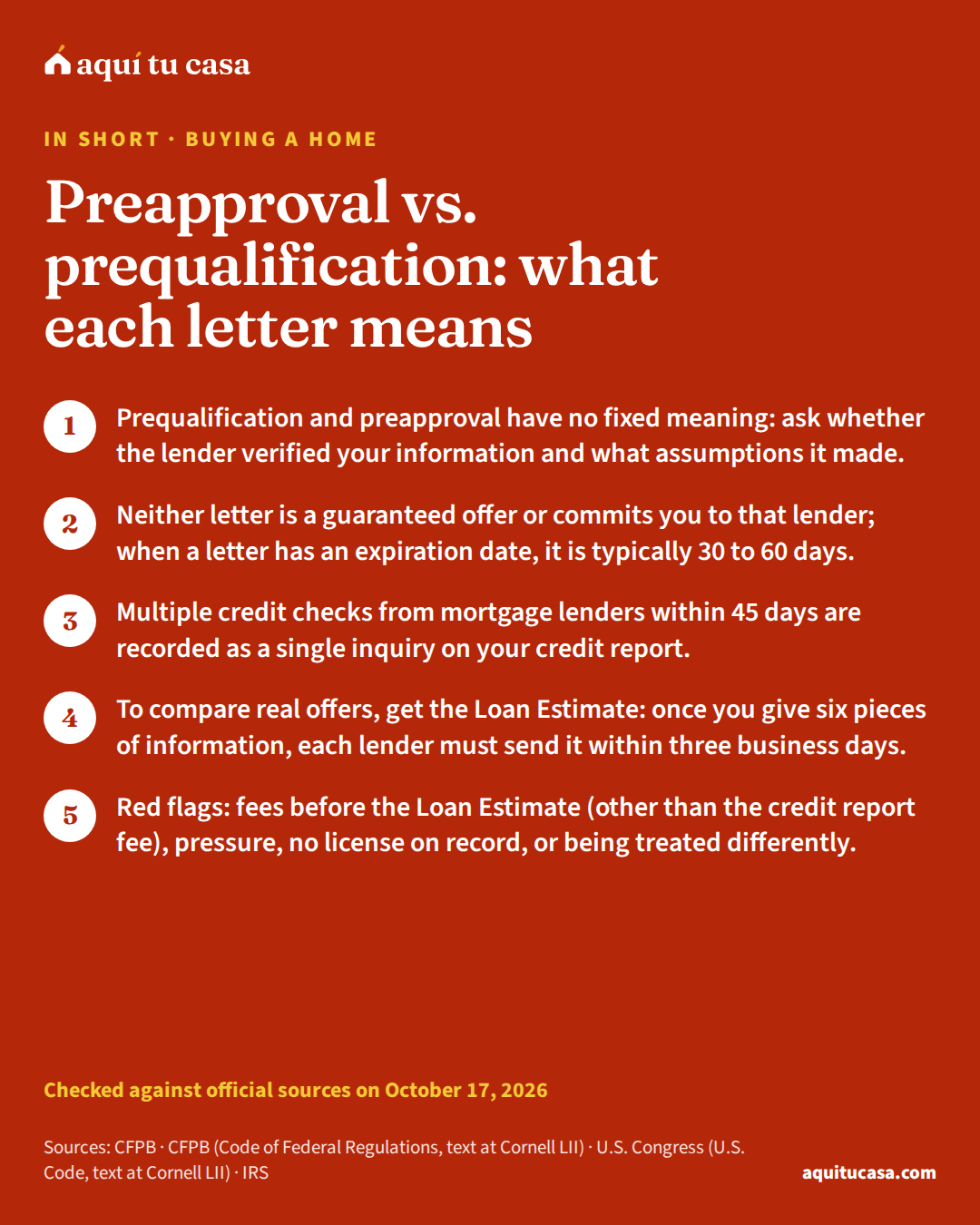
- Buying a home Preapproval vs. prequalification: what each letter means What prequalification and preapproval letters are, what lenders check, why neither one is a loan, and how to compare lenders without hurting your credit. 14 minute read
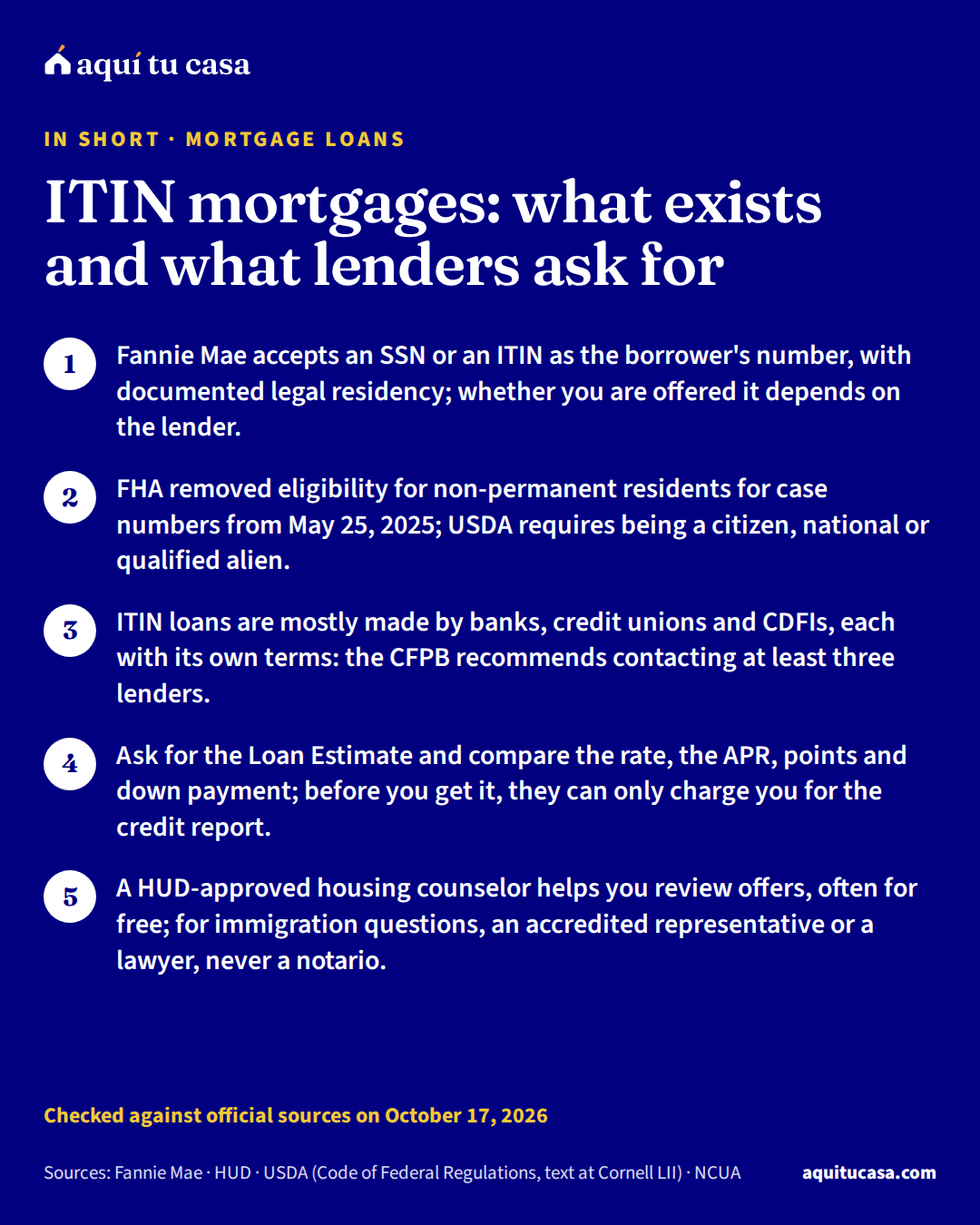
- Mortgage loans ITIN mortgages: what exists and what lenders ask for Which home loans accept an ITIN and which do not: Fannie Mae's rule, what FHA and USDA say, who lends and how to compare offers. 12 minute read
Tools for this topic
Was this guide useful?
Thank you. Your answer stays in your browser; nothing is sent.