Disability income (SSI and SSDI) and your mortgage
How FHA and Fannie Mae count SSDI, SSI and other disability benefits, which papers they ask for, the tax gross-up and what a lender cannot ask you.
Verified against official sources on October 31, 2026 8 official sources

Show contents
In short
What you need to know
Quick answer
Yes, you can use SSDI, SSI and other disability benefits to qualify for a mortgage. FHA and Fannie Mae accept them with the award letter and proof that you receive them. If the letter has no end date, the income is generally treated as continuing, and a pending medical review is not a reason to leave it out. Because part of that income is not taxed, the lender can gross it up when figuring your debts. And the lender cannot ask you about your disability or your health.
What matters most
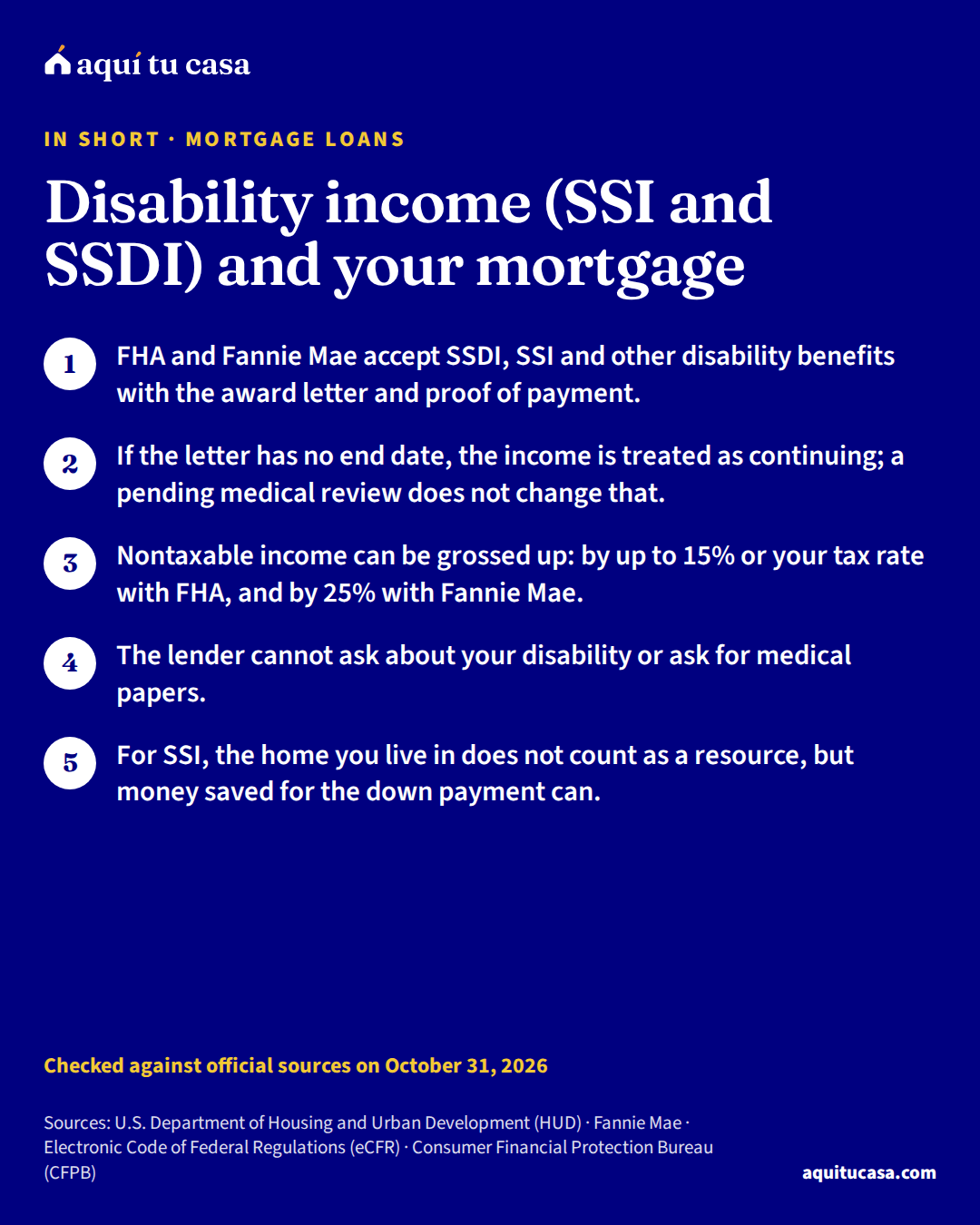
- FHA and Fannie Mae accept SSDI, SSI and other disability benefits with the award letter and proof of payment.
- If the letter has no end date, the income is treated as continuing; a pending medical review does not change that.
- Nontaxable income can be grossed up: by up to 15% or your tax rate with FHA, and by 25% with Fannie Mae.
- The lender cannot ask about your disability or ask for medical papers.
Is this for you?
This guide is for you if…
- You receive SSDI, SSI, VA disability benefits or private disability insurance and want to buy a home.
- A lender told you your benefit does not count, or asked you for medical papers.
- You receive SSI and worry about losing it if you save for a down payment or buy a home.
Get direct help first if…
- You rent and need a rule changed because of your disability: read «Reasonable accommodations for disabilities».
- Your benefit is a retirement or family benefit, not disability: read «FHA loan» or «Conventional loan».
Many people who receive a disability benefit think they cannot buy a home because they do not have a paycheck. That is not so. FHA and Fannie Mae accept SSDI (Social Security Disability Insurance), SSI (Supplemental Security Income), VA disability benefits and private disability insurance as income to qualify.12 This guide explains which papers they ask for, how they decide whether the income will continue, how nontaxable income is adjusted and what they cannot ask you.
How FHA counts your disability benefit
For FHA, disability benefits are those paid by SSA, VA, other public agencies or a private insurer. The lender must confirm you receive them and have the document that shows the award.1
The Social Security papers. For SSDI and SSI, the lender asks for the last Notice of Award and one of these:1
- Your tax returns.
- Your most recent bank statementbank statementA bank statement is the summary your bank or credit union gives you of the activity in your account over a period: deposits, withdrawals, payments and the ending balance. Most send one every month, on paper or online; the law only requires a monthly statement when there was at least one electronic transfer that month, and otherwise it may come quarterly. When you apply for a mortgage, the lender can use your statements to verify you have money for the down payment, closing and reserves. Under Fannie Mae's rules, they must show the bank's name, your name, part of the account number, the period, all transactions and the ending balance.See the full definition showing the SSA deposit.
- An SSA proof of income letter, also called a Benefits Letter or Budget Letter.
- Your form SSA-1099.
For VA disability benefits, it asks for the last VA Benefits Letter and your tax returns or a bank statement.1
Will it continue? If your benefit ends within three years of the application, FHA does not count it. But if the Notice of Award has no end date, the lender may treat it as continuing. And it cannot use a pending or current medical review as proof the payment will stop.1
How Fannie Mae counts it
On a conventional loanconventional loanA conventional loan is any mortgage that is not insured or guaranteed by the federal government: it is not FHA, VA or USDA. The lender, or the companies that buy the loans (Fannie Mae and Freddie Mac), carry the risk. When the amount is within the conforming loan limit the loan is called "conforming"; above it, it is a "jumbo" loan. It usually asks for a higher credit score than an FHA loan and, if your down payment is less than 20% of the price, you are normally required to buy private mortgage insurance (PMI) until you build enough equity in the home.See the full definition that follows Fannie Mae’s rules, the Selling Guide asks for:2
- For SSDI on your own record: the SSA award letter, the SSA-1099, your most recent signed tax returns or proof that you receive it now.
- For SSI: the award letter and proof that you receive it now.
No minimum history is needed. For disability on your own record, the lender does not have to prove it will continue unless it has reason to doubt it.2
Benefits on someone else’s record or a dependent’s. Fannie Mae also accepts Social Security you receive on the record of a spouse, ex-spouse or parent, or that a dependent of yours receives, such as a minor or disabled child. In those cases it must be shown to continue at least three years; for example, with the beneficiary’s age if SSA ties the payment to age.2
Private long-term disability insurance. The lender asks for the policy or benefits statement, to see the amount, the frequency and any end date. It needs proof you will get at least one payment before your first mortgage payment. A review of benefits is not a reason to think they will end. And if you get short-term benefits now that will drop when they convert to long-term, the lower amount is used.3
Grossing up income that is not taxed
Part of Social Security income and certain disability payments are not subject to federal income tax. Because the lender compares your income with that of someone who pays taxes, it can gross it up when figuring your debt-to-income ratiodebt-to-income ratio (DTI)Your debt-to-income ratio (DTI) is all your monthly debt payments divided by your gross monthly income, that is, income before taxes. If you pay a certain amount each month across a car, cards, student loans and the mortgage you are asking for, and you earn three times that, your DTI is one third. Lenders use it to measure whether you can manage the payment; each loan type and lender sets its own limit, and assistance programs usually publish theirs. Paying down debt before applying improves your DTI.See the full definition.14
Think of it this way: if you and another person get the same amount each month, but she has taxes taken out and you do not, you have more money left for the house payment. The adjustment recognizes that difference when the lender figures how much you can pay. That is why your lender should know which part of your benefit is not taxed and have the award letter or tax return that shows it.
How each program grosses up nontaxable income
Up to 15% or your rate
FHA
- The greater of 15% or your tax rate from last year
- If you did not have to file, 15%
- The lender documents the amount and the rate
- No extra adjustments for dependents
25% or more
Fannie Mae
- Adds 25% of the nontaxable income
- More if a similar earner's taxes would be higher
- 15% of Social Security can be adjusted with no extra papers
- To go higher, nontaxable status must be documented
Ask your lender whether it already grossed up your nontaxable income in the math.
Example with real numbers
A person who receives SSDI
An example in words, not a real case, of how the adjustment helps someone qualify.
- The benefit
- Monthly SSDI, with an award letter that has no end date
- The nontaxable part
- The part the lender documents; with Fannie Mae, 15% with no extra papers
- The adjustment
- A percentage of that part is added, depending on the program
- The result
- A higher income for figuring the debt-to-income ratio
- What it gains
- She may qualify for a slightly larger payment than without the adjustment
The rules come from FHA and Fannie Mae.12 Work out how much house you can afford with your income.
Run it with your numbersHow much house can I afford?
Your rights and SSI
The lender cannot discount your benefit because it is public assistance. Regulation B of the equal credit law says it is a prohibited basis that your income comes from a public assistance program, and the creditor may not discount or exclude your income because of it. It can consider how much it is and whether it will continue.5 If you think you were treated differently, the guide on lending discrimination explains how to complain, and if you are turned down you should receive an adverse action noticeadverse action noticeAn adverse action notice is the notice you get when a company denies you credit or takes another action against you on your application or account. Under federal law, the lender must give you the main reasons or tell you how to ask for them. If the decision was based on a credit report or another consumer report, the company must also give you the score that was used, the name and contact information of the company that supplied the report, and explain your right to a free copy of that report and to dispute errors. The reporting company did not make the decision and cannot tell you why it was made.See the full definition.
If you receive SSI, watch your savings. For SSI, the home you live in does not count as a resource, whatever its value, as long as it is your principal residence.6 But the money you gather before buying can count: the resource limit is $2,000 for an individual and $3,000 for an individual and spouse.7 Before you save for a down payment, ask SSA how it affects your benefit, and check whether you qualify for down payment assistance.
If you move. If you leave the home without intending to return, it becomes a countable resource for SSI. If you leave because of domestic abuse, SSA does not count it.6

How to get ready to apply
1. Ask SSA for your proof of income letter
Before you look for a home
Along with your last award letter, it is the core of your application.1
2. Check whether the letter has an end date
When you gather your papers
With no end date, the income is generally treated as continuing.1
3. Gather your SSA-1099 and bank statements
This week
The lender asks for at least one of those along with the letter.1
4. Ask about grossing up your nontaxable income
When you get preapproved
FHA and Fannie Mae allow that part of your income to be adjusted up.1
5. If you receive SSI, check your resources
Before you save a lot
The home does not count, but savings can.7
If this is you
You have received SSDI for years
If your letter has no end date, FHA may treat the income as continuing.1
You receive SSI and have little savings
The home does not count as a resource, but savings do; ask SSA first.67
You receive VA disability benefits
FHA asks for your last VA Benefits Letter and your taxes or a bank statement.1
Your child receives a disability benefit
With Fannie Mae, it can count if it is documented to continue at least three years.2
Your benefit is under medical review
FHA does not allow that review to be used as proof the payment will end.1
The rest of your application
Your benefit is only one part. The lender also reviews your credit, your other debts, your down payment and your savings, just as with anyone. With an FHA loan, the down payment can be as low as 3.5% of the price; with a conventional loan, as low as 3%. The debt-to-income ratio guide explains how to lower your debts before you apply.
Questions for your lender:
- Which Social Security, VA or insurance papers do you need, and how recent?
- Did you already gross up the part of my income that is not taxed? By what percentage?
- If my benefit has an end date, does it count in my case?
- Does my benefit count the same way on an FHA loan and a conventional one?
Get the answers in writing, especially if you are told your benefit does not count. Compare with another lender: the FHA and Fannie Mae rules in this guide are the same for every lender that uses those programs.12
Costly mistakes
Mistake: Handing over medical papers because the lender asked.
Instead: FHA forbids asking about your disability or your health; they only need proof of the benefit.1
Mistake: Believing your benefit does not count because it is not a paycheck.
Instead: FHA and Fannie Mae accept SSDI, SSI and other disability benefits.12
Mistake: Not asking for the nontaxable income gross-up.
Instead: Ask whether your lender adjusted that part; it can help you qualify.14
Mistake: Saving a lot of money without knowing how it affects your SSI.
Instead: The SSI resource limit is $2,000 for an individual; ask SSA first.7
Mistake: Accepting that your benefit be discounted because it is public assistance.
Instead: The equal credit law forbids it.5

Free help
A HUD-approved housing counselorHUD-approved housing counselorA HUD-approved housing counselor works at an agency HUD has approved to provide housing counseling: independent, expert advice customized to your situation about buying a home, renting, a missed mortgage payment, a foreclosure or credit problems. The agencies usually charge little or nothing; many serve in Spanish and offer the homebuyer education course several assistance programs require. They are not lenders or real estate agents and sell you nothing. Your county page lists the official agencies with phone numbers.See the full definition can help you put together your application and check whether a loan makes sense, often for free or at low cost.8 The guide to HUD-approved housing counselors explains how to find one. If a lender turns you down because of your benefit or asks for medical papers, free legal aid can advise you. And for your list of papers, use the document checklist.
What to do this week
- Ask SSA for your proof of income letter and find your last award letter.1
- Check whether your letter has an end date.1
- Gather your SSA-1099 and your most recent bank statement.1
- If you receive SSI, ask SSA how saving for a down payment would affect you.7
- Get preapproved and ask whether your nontaxable income was grossed up.14
Your numbers
The minimum for this loan is 3.5%. More down lowers the monthly payment.
Adjust advanced details
First number: share of income for housing. Second: housing plus debts. Lender references, not fixed rules.
Let's do the math
Estimated top price
National figure$227,000
Limited by the housing payment: at that price it would be about $1,883 a month, 28% of your income.
- By the housing payment (28% of income)Limits you$227,000
- By your total debts (36% of income)$292,000
- By your cash (down payment + closing)$330,500
- Typical home in the United States
- $332,700
- Your cap is 68% of the typical home.
What changes if…?
- …you save $10,000 more$227,000
- …you cut $200 a month in debts$227,000
Your maximum price with four loans
Same income, debts and savings; only the down payment and the loan type change. ITIN uses an example down payment and rate.
| FHA 3.5% | Conventional 5% | Conventional 20% | ITIN 15% (example) | |
|---|---|---|---|---|
| Maximum price | $227,000 | $232,000 | $93,000 | $119,000 |
| Payment per month | $1,883 | $1,882 | $616 | $898 |
Educational estimate, not a pre-approval. Uses example insurance (0.5% of value per year) and example closing costs (3% of price); the tax is the place’s typical rate.
Ready to see the numbers? Find your county here
See how this applies in your county: its loan limits, prices and rents, from the official data.
Printable checklist
Frequently asked questions
Does SSDI count as income for a mortgage?
Yes. FHA and Fannie Mae accept it. With FHA you need the last Notice of Award and one more document, such as the SSA-1099, a bank statement showing the deposit or an SSA proof of income letter.
What about SSI?
It counts too. FHA includes it with Social Security disability income, and Fannie Mae asks for the award letter and proof that you receive it now.
My case has a medical review pending. Can I be turned down for that?
According to FHA, the lender may not treat a pending or current medical review as evidence that the benefit will not continue. Fannie Mae says something similar for long-term disability: a review of benefits is not a reason to think the income will end.
Can the lender ask what disability I have?
No. FHA's handbook says that under no circumstance may the lender ask about or request documents on the nature of the disability or your medical condition.
What does grossing up nontaxable income mean?
It means adding the tax you do not pay to your income, so it compares fairly with someone who pays taxes. FHA allows up to the greater of 15% or your tax rate; Fannie Mae, 25% or more if a similar earner's taxes would be higher.
Will I lose SSI if I buy a home?
The home you live in does not count as a resource for SSI, whatever its value. But the money you save before you buy can count, and the limit is $2,000 for an individual and $3,000 for a couple. Ask SSA before you save a large amount.
Can I use the benefit my disabled child receives?
With Fannie Mae, Social Security income a dependent receives can count if it is documented to continue at least three years.
Sources
Every figure in this guide comes from one of these official sources. The number next to a sentence leads to the source behind it.
Each source on one line: who publishes it, its title, its address and the date we read it.
- 1. U.S. Department of Housing and Urban Development (HUD) · Handbook 4000.1, FHA Single Family Housing Policy Handbook · hud.gov · Accessed October 31, 2026
- 2. Fannie Mae · Selling Guide B3-3.4-15, Social Security Income · selling-guide.fanniemae.com · Accessed October 31, 2026
- 3. Fannie Mae · Selling Guide B3-3.4-09, Long-term Disability Income · selling-guide.fanniemae.com · Accessed October 31, 2026
- 4. Fannie Mae · Selling Guide B3-3.1-01, General Income Information · selling-guide.fanniemae.com · Accessed October 31, 2026
- 5. Electronic Code of Federal Regulations (eCFR) · 12 CFR Part 1002 (Regulation B), §§1002.2 and 1002.6 · ecfr.gov · Accessed October 31, 2026
- 6. Electronic Code of Federal Regulations (eCFR) · 20 CFR §416.1212, Exclusion of the home · ecfr.gov · Accessed October 31, 2026
- 7. Electronic Code of Federal Regulations (eCFR) · 20 CFR §416.1205, Limitation on resources · ecfr.gov · Accessed October 31, 2026
- 8. Consumer Financial Protection Bureau (CFPB) · Find a housing counselor · consumerfinance.gov · Accessed October 31, 2026
Keep reading
Related guides
If this guide helped, these follow the same path.

Mortgage loans 14 minute read
FHA loan: down payment, insurance, limits and who qualifies
How an FHA loan works: the down payment and credit score HUD requires, MIP mortgage insurance, your county limit, the home and the residency rules.
- FHA does not lend the money: it insures loans from private lenders, and you pay for that insurance (MIP).
- With a score of 580 or higher you put down as little as 3.5%; from 500 to 579, at least 10%; below 500 there is no FHA loan.
- The annual premium lasts 11 years if you put 10% or more down, and the life of the loan if you put down less.
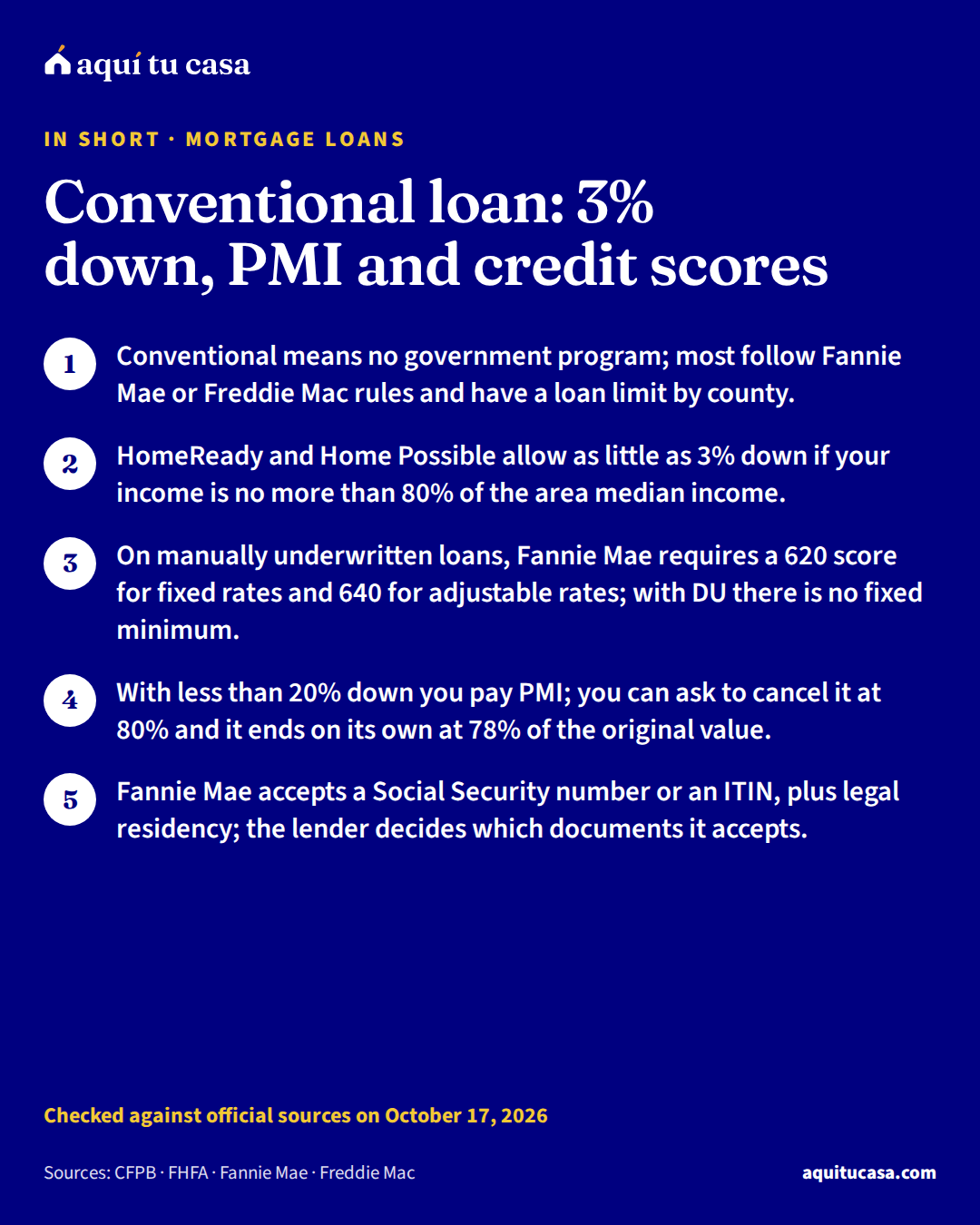
- Mortgage loans Conventional loan: 3% down, PMI and credit scores How a conventional loan works: HomeReady and Home Possible from 3% down, the credit score Fannie Mae requires, PMI and when the law ends it. 12 minute read
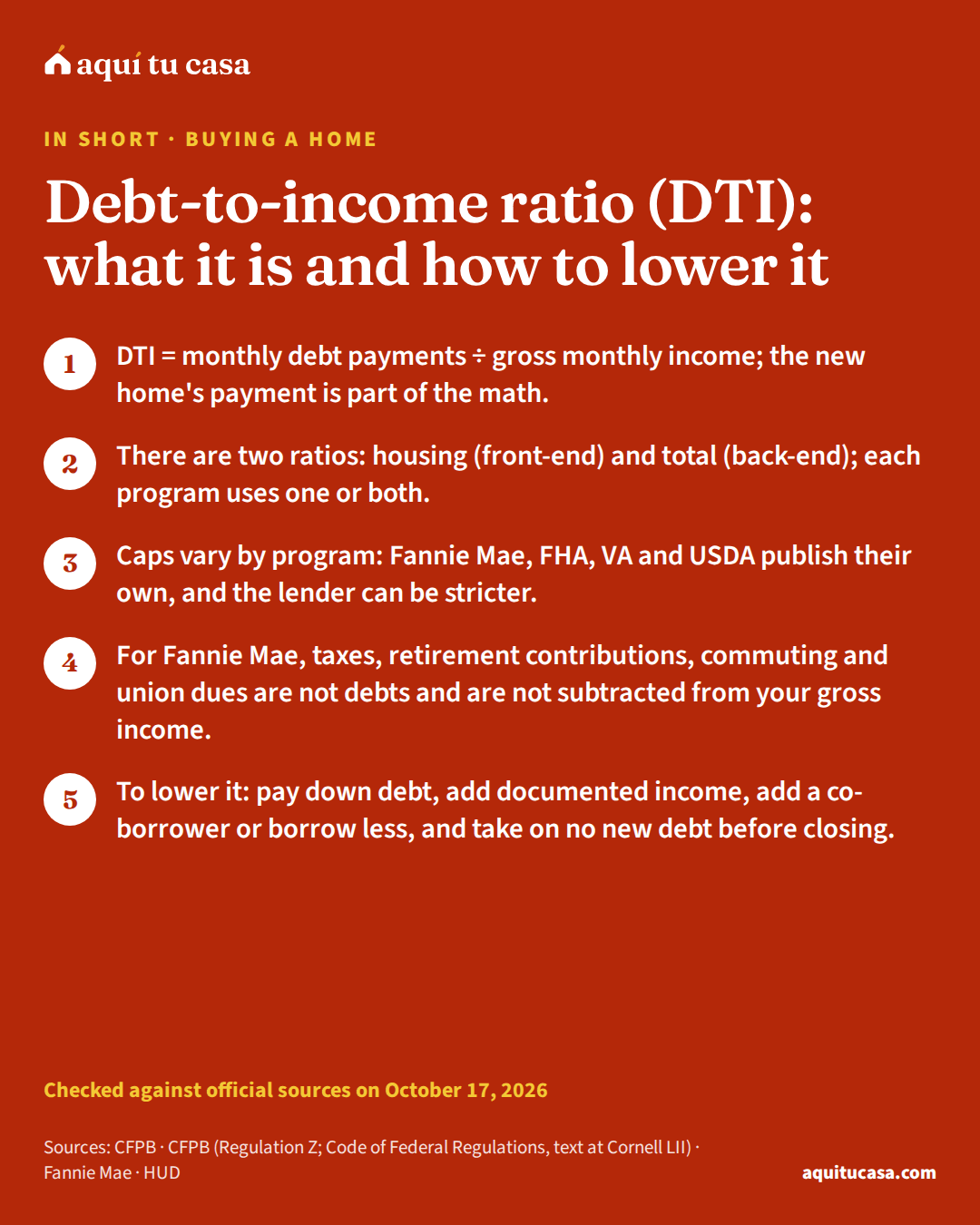
- Buying a home Debt-to-income ratio (DTI): what it is and how to lower it What the debt-to-income ratio (DTI) is, how to calculate it, which payments count, the caps FHA, Fannie Mae, VA and USDA publish and how to lower it. 14 minute read
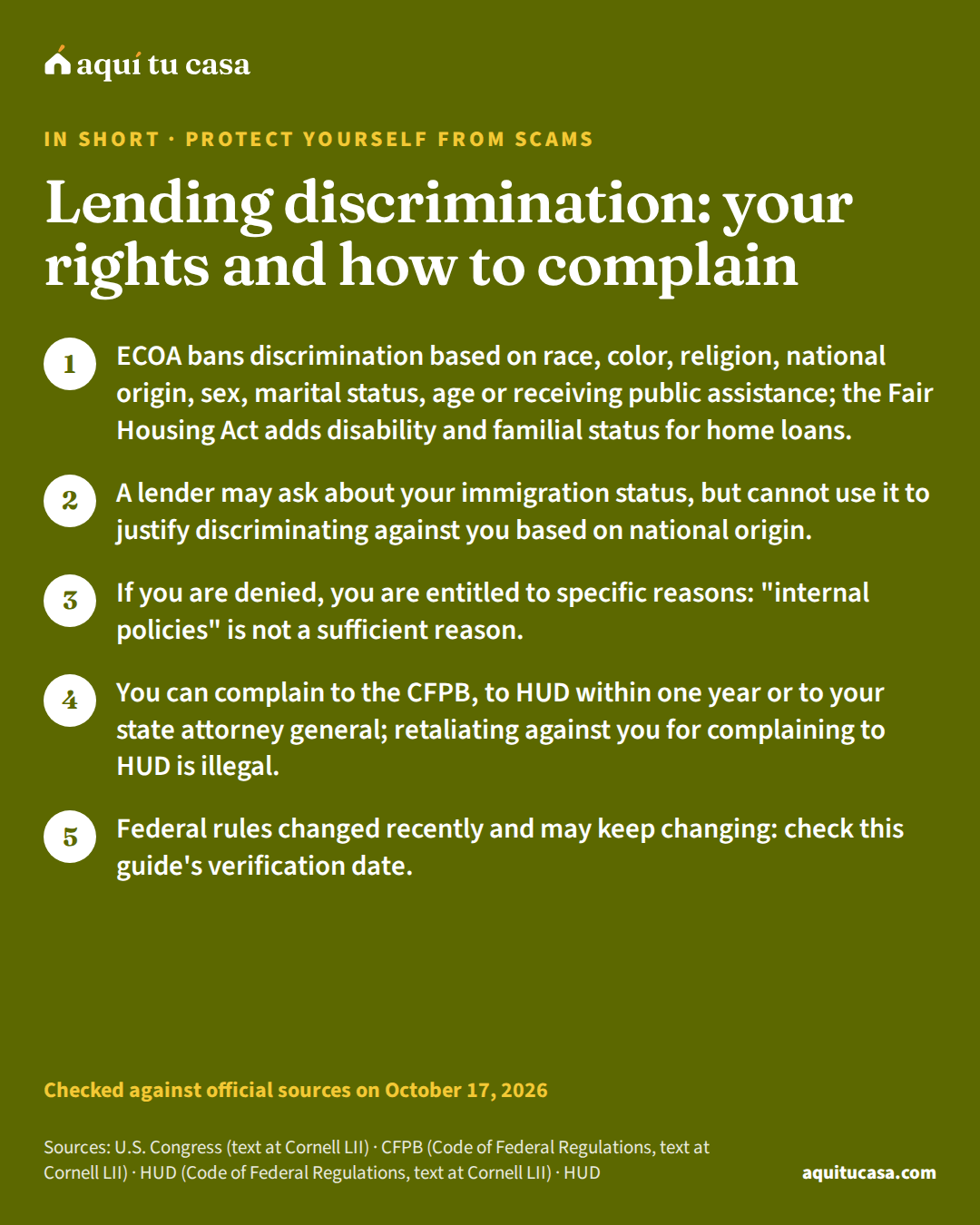
- Protect yourself from scams Lending discrimination: your rights and how to complain What the law bans when you apply for a loan or mortgage, what lenders may ask, including immigration status, and how to complain to the CFPB or HUD. 12 minute read
Tools for this topic
Was this guide useful?
Thank you. Your answer stays in your browser; nothing is sent.