If your immigration status changes mid-process: mortgage and HUD
What FHA, Fannie Mae and HUD say if your immigration status changes while you apply for or pay a mortgage or get HUD help, and your rights when you appeal.
Verified against official sources on October 29, 2026 24 official sources

Show contents
In short
What you need to know
Quick answer
It depends on the moment. If you are applying for a mortgage, the lender decides with the status you can document: FHA no longer accepts non-permanent residents for case numbers assigned on or after May 25, 2025, and Fannie Mae accepts lawful non-permanent residents but lets each lender decide which documents prove legal presence. If you already pay the mortgage, the servicing rules revolve around payment: the servicer must contact you if you fall behind and, with narrow exceptions, may not start foreclosure before 120 days of delinquency. If you receive HUD assistance, the regulation (24 CFR 5.514) bars delaying, denying, reducing or terminating assistance because of a member's status while verification or an appeal is pending, and gives you 30 days to appeal.
What matters most
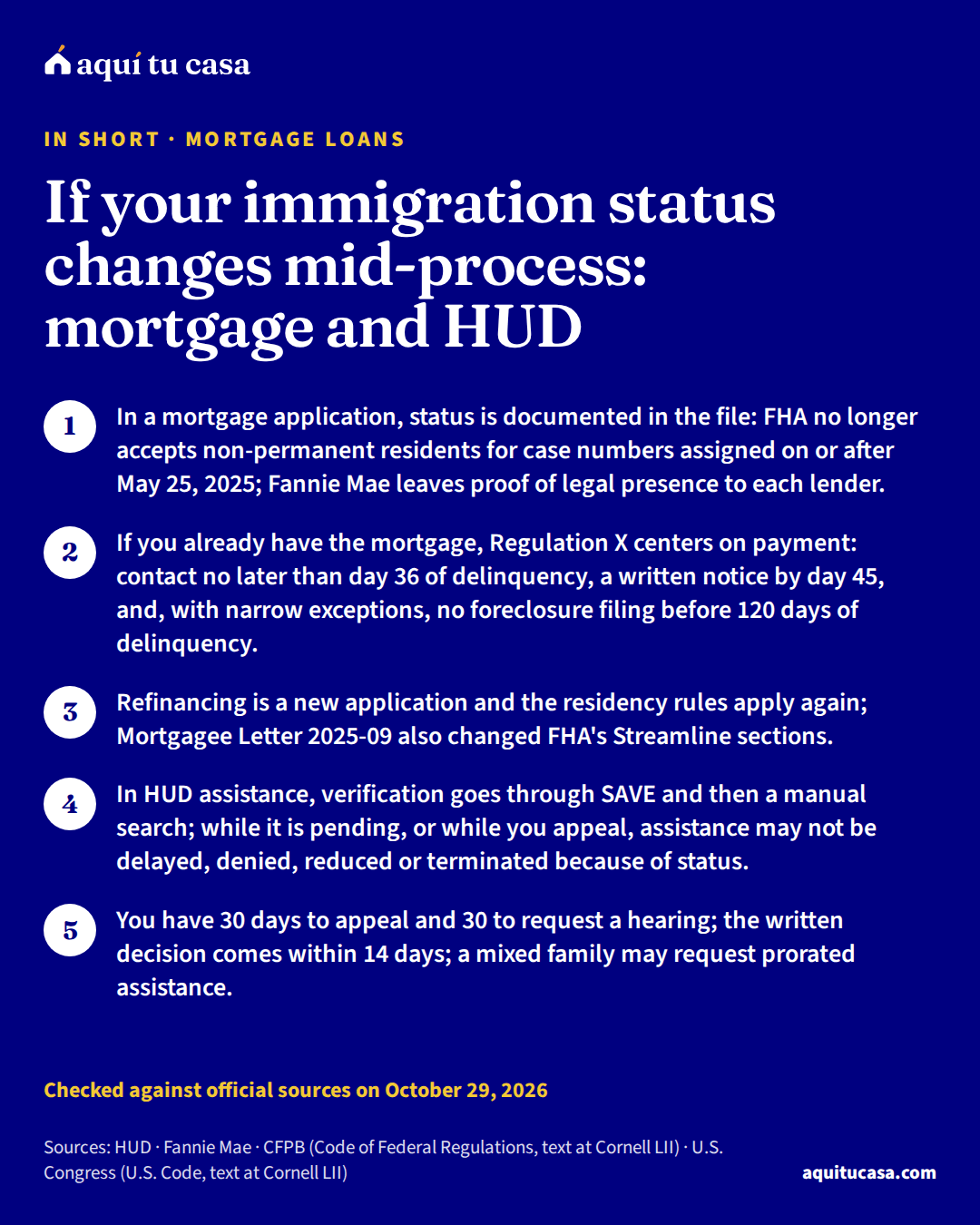
- In a mortgage application, status is documented in the file: FHA no longer accepts non-permanent residents for case numbers assigned on or after May 25, 2025; Fannie Mae leaves proof of legal presence to each lender.
- If you already have the mortgage, Regulation X centers on payment: contact no later than day 36 of delinquency, a written notice by day 45, and, with narrow exceptions, no foreclosure filing before 120 days of delinquency.
- Refinancing is a new application and the residency rules apply again; Mortgagee Letter 2025-09 also changed FHA's Streamline sections.
- In HUD assistance, verification goes through SAVE and then a manual search; while it is pending, or while you appeal, assistance may not be delayed, denied, reduced or terminated because of status.
Is this for you?
This guide is for you if…
- You are applying for a mortgage and your work permit, TPS, parole or green card changes before closing.
- You already pay a mortgage and your status changed, or you want to refinance with a different status than you had.
- Your family receives HUD housing assistance (Section 8, public housing) and the housing authority is verifying someone's status, or denied it.
Get direct help first if…
- Your question is whether buying a home, getting a loan or receiving housing assistance affects your immigration case: this guide does not answer that. A representative accredited by the Department of Justice or an immigration lawyer can.
- You have not applied for anything yet and want to know which loans exist for your status: start with the guides on TPS and parole, DACA or green card holders.
A work permit that expires, a green card that finally arrives, a TPS that ends, a parole that is renewed. Immigration status can change right when you are applying for a mortgage, when you already pay one, or when your family receives HUD housing assistance. This guide explains what the FHA, Fannie Mae and HUD rules say today at each of those three moments, what protection you have while HUD verifies your status or you appeal (24 CFR §5.514), and where to get free help.17 It is a fast-changing subject: the date of the last verification is above.
- From case numbers assigned on this date, FHA no longer accepts non-permanent residents
- May 25, 20252
- To appeal if HUD's verification does not confirm your status
- 30 days17
- To receive the informal hearing decision in writing
- 14 days17
- Of delinquency, as a general rule, before a servicer may make the first foreclosure filing
- 120 days10
Three moments, three different rules
The rules are not the same if you are applying, if you already signed, or if you receive HUD assistance. First find which one you are in.
Which rule applies at each moment
Before closing
You are applying for a mortgage
- FHA: the lender determines your status from the application and documentation; only permanent residents and citizens of Micronesia, the Marshall Islands and Palau.1
- Fannie Mae: accepts lawful non-permanent residents; each lender decides which documents prove legal presence.3
- The lender may ask about your status and consider it.67
After closing
You already pay the mortgage
- The residency rules cited speak of the application and of delivering the loan when it is originated.13
- Regulation X revolves around payment: contact if you fall behind and, with exceptions, no foreclosure filing before 120 days of delinquency.910
- Refinancing is a new application: the residency rules apply again.2
Section 8, public housing
You receive HUD assistance
In all three cases, what matters is which document you hold today, what date it carries and whom you must tell.15
If you are applying for a mortgage
FHA. The FHA Handbook says citizenship is not required, but the lenderlenderThe lender is the financial institution that lends you the money for your mortgage. The mortgage is the agreement that gives the lender the right to take your home if you do not repay what it lent you. After closing, it is common for another company, the loan servicer, to collect your payments and keep track of the loan; it may be the same company that lent you the money or a different one. On the Loan Estimate, the lender's name appears on the first page, and the last page lists it as "Lender" with its NMLS or license number.See the full definition must determine your residency status from the information on the application and other documentation. Today only lawful permanent residents are eligible, under the same terms as citizens, along with citizens of Micronesia, the Marshall Islands and Palau. The file must include evidence of permanent residence, and a Social Security card is not enough to prove status.1 That change comes from Mortgagee Letter 2025-09, which eliminated eligibility for non-permanent residents for case numbers assigned on or after May 25, 2025.2 If your green cardPermanent Resident Card (green card)The Permanent Resident Card (Form I-551, known as a green card) is the document that shows a person is a lawful permanent resident of the United States, meaning they have the privilege of living here permanently as an immigrant. Under federal regulations, it serves as evidence of registration and shows the person may work without limits on location or type of job. The expiration date only shows when the card must be renewed; it does not mean the person's work authorization has ended. For the IRS, having this card makes you a resident for tax purposes.See the full definition arrives mid-process, bring it to the lender and ask in writing how it goes into the file. If you had TPSTPS (Temporary Protected Status)Temporary Protected Status (TPS) is a status created by a federal law, 8 U.S.C. 1254a. The government may designate a country, or part of one, when there is armed conflict, an environmental disaster or other extraordinary and temporary conditions that keep people from returning safely. The designation is published in the Federal Register and lasts a limited period that can be extended or ended. While a person has TPS, the law says they may not be removed and are authorized to work. Being from a designated country is not enough: the law sets other requirements.See the full definition, paroleparole (immigration)In immigration, parole is permission to enter or stay in the United States temporarily. Federal law, 8 U.S.C. 1182(d)(5), lets the Secretary of Homeland Security grant it at their discretion, case by case, for urgent humanitarian reasons or significant public benefit. The law says parole is not an admission to the country. When its purpose has been served, the person returns to the situation they were in and their case continues like that of any other applicant for admission. Under the regulation, parole ends automatically if the person leaves the country or the authorized time expires.See the full definition or only a work permitEmployment Authorization Document (EAD)The Employment Authorization Document (EAD, Form I-766) is a photo document issued by the federal government to show that a person is authorized to work in the United States. Federal regulations say some people may work because of their status and others must apply for permission; in those cases USCIS decides and, if approved, the document is valid for a specific period. The EAD is one of the documents an employer may accept on Form I-9. When it expires, the employer must reverify that you can work. It is not the same as a permanent resident card.See the full definition, the guide on TPS, parole and work permits explains what remains open.
Conventional loan. Fannie Mae accepts lawful permanent and non-permanent residents under the same terms as citizens, but it does not set which documents prove legal presence: each lender decides, case by case, and warrants to Fannie Mae that you are legally present when it delivers the mortgage.3 So if your permit expires before closing or your status changes, two lenders can answer differently under the same rule. Ask in writing and compare.
What the lender checks regardless. Each borrower needs a valid Social Security number or an ITINITIN (Individual Taxpayer Identification Number)An ITIN is a nine-digit number the IRS, the federal tax agency, issues to people who need a U.S. taxpayer identification number to file taxes and are not eligible for a Social Security number. It is for tax purposes only: it does not authorize you to work in the United States, does not qualify you for Social Security benefits or the Earned Income Tax Credit, and says nothing about your immigration status. You apply with Form W-7, and it expires if it goes unused for several years. Some lenders accept an ITIN for a mortgage.See the full definition, and the lender confirms your identity before extending credit.4 Your income must be stable and reasonably expected to continue; a non-citizen gets the same employment and income verification as a citizen.5 A work permit with a near expiration date can fall under that question of whether income continues. Gather your papers with the document checklist.
What it may ask you. Regulation B lets the lender ask about your residency and immigration status,6 and consider them along with the information it needs about how it would collect the loan; what it may not consider is your race, color, religion, national originnational originNational origin is one of the characteristics the Fair Housing Act protects. According to the Department of Justice, national origin discrimination can be based on the country where you were born or where your ancestors came from. The law prohibits refusing to sell or rent you a home, setting different terms or publishing ads that state a preference based on your national origin. According to the CFPB, the Equal Credit Opportunity Act also prohibits lenders from discriminating against you because of your national origin when you apply for credit, such as a mortgage.See the full definition or sex.7 The equal credit law bans discrimination on those grounds in any aspect of the loan.8 If you think you were treated differently because of your origin and not your document, the guide on lending discrimination explains how to report it.
If you already pay the mortgage
The residency rules you just read speak of the moment the loan is originated: FHA, of the information “on the mortgage application”; Fannie Mae, of what the lender warrants “by delivering the mortgage”.13 This guide cannot tell you more than those sources say. What is written clearly is what happens with payment.
If your income drops because you lost your work permit and you fall behind, Regulation X requires the servicerloan servicerThe loan servicer is the company that sends you your mortgage statements and handles the day-to-day tasks of the loan: it processes your payments, answers your questions, keeps track of principal and interest paid and manages your escrow account, if you have one. It can also offer options if you fall behind and, in certain cases, start a foreclosure. It may be the same company that lent you the money or a different one, and it is common for another company to take over the loan after closing.See the full definition to try to make live contact with you no later than day 36 of delinquency, tell you about loss mitigation options, and send you a written notice no later than day 45.9 And it may not make the first notice or filing for foreclosureforeclosureForeclosure is the process by which the lender or servicer takes back the property after the homeowner fails to make mortgage payments. The rules and timelines depend on each state; all of them include advance notices and, in general, time to catch up or ask for an alternative, such as a repayment plan or a loan modification. If you fall behind, call your servicer and a HUD-approved housing counseling agency early: foreclosure counseling is free and exists for exactly this.See the full definition unless the loan is more than 120 days delinquent, with two narrow exceptions (a due-on-sale clause, or joining another lienholder’s foreclosure); if you submit a complete loss mitigation application before that step, it may not take it until it has answered you under the rule.10 The guide on if you can’t pay your mortgage explains what to ask for and in what order, and the family budget helps you see how much room you have.
If you want to refinance. Refinancing is a new application, so the residency rules above apply again with the status you hold that day. Mortgagee Letter 2025-09 also changed the sections on FHA’s non-credit qualifying Streamline Refinances.2 If your current loan is an ITIN loan and you now have a green card, the guide on refinancing from an ITIN loan explains the path.
If your status improved. With legal authorization to work, Social Security can assign you a number.11 And if you paid taxes with an ITIN and now have an SSN, the IRS says you cannot have both: stop using the ITIN, use the SSN and notify the IRS so it combines your records; if you do not, you may not receive credit for all your wages and taxes withheld.12 Tell your lender too and ask it to update your file.

If you receive HUD housing assistance
Assistance under HUD programs covered by Section 214 is restricted to citizens and noncitizens with eligible status; a family is not eligible unless every member living in the unit has it, or it meets the conditions for mixed families.13 The statute lists the eligible categories: among others, permanent residents, refugees and asylees, people paroled under section 212(d)(5), people granted withholding of deportation, and residents under the Compacts of Free Association.14 The guide on Section 8 and mixed-status families explains which programs these are and how assistance is calculated.
Each member, regardless of age, submits evidence: citizens sign a declaration; noncitizens 62 or older sign a declaration of eligible status and show proof of age; all other noncitizens sign a declaration of eligible status, show one of the immigration documents and sign a consent to verification. Evidence is submitted only one time during continuously assisted occupancy, and if someone new comes to live in the unit, they submit it at the first reexamination after moving in.15 If your new document has not arrived yet, the housing authoritypublic housing agency (PHA)A public housing agency (PHA) is a state, county, municipal or other governmental entity or public body authorized to operate public housing or rental assistance programs. These are the agencies that locally administer the Housing Choice Vouchers (Section 8) and public housing with HUD funds: they open and manage the waiting lists, review eligibility and income, inspect units and pay the owner its share of the rent. Each county usually has one or several; your page shows the ones serving your area with their phone numbers.See the full definition must give you more time if you sign the declaration and certify that you will make diligent efforts to obtain it; the extension does not exceed 30 days and the decision comes in writing.15
Verification has two steps. First, the authority queries the immigration service’s automated SAVE system (the regulation still uses the name INS). If SAVE does not confirm status, it must request within 10 days a secondary verification, which is a manual search of immigration records. Only if the secondary search also fails to confirm it do you receive the notice with your right to appeal.16

The protection while verification or an appeal is pending (24 CFR §5.514)
This is the central rule. Assistance may not be delayed, denied, reduced or terminated because of a member’s immigration status while primary and secondary verification of timely submitted documents is not complete, while the appeal has not concluded, if assistance is already prorated, or if that member moved out. And a tenant’s assistance also cannot be taken away until the informal hearing is complete.17
If verification fails, the notice must explain the reasons, tell you that you may qualify for prorated assistanceprorated assistanceProrated assistance is the reduced housing assistance mixed families receive in HUD programs such as Section 8 and public housing. A mixed family has members with citizenship or eligible immigration status and members without it. With a voucher, the housing agency figures the full assistance using everyone's income, multiplies it by the share of members with eligible status, and the family pays the rest of the rent. Under current rules, a mixed family that asks for it must receive it. HUD has proposed making it only temporary; that is not a final rule, and the rules can change.See the full definition, state your right to appeal to the immigration service and to submit more documents, and your right to an informal hearing, after the appeal or instead of it. For someone applying, the notice makes clear that assistance may not be delayed until the appeal concludes, but may be delayed while the hearing is pending.17
From the notice to the final decision
1. You receive the notice
Day 0
It must carry the reasons, your prorated assistance option and your appeal and hearing rights. Write down the date.17
2. You request the appeal in writing
Within 30 days of the notice
Directly to the immigration service, with a copy and proof of mailing for the housing authority. You can add documents or an explanation.17
3. The immigration service decides
Within 30 days of receiving your documents
If it cannot decide in that time, it must tell you and the authority why. Meanwhile, assistance cannot be touched because of status.17
4. You request the informal hearing
Within 30 days of the notice or of the appeal decision
You can request it even if you did not appeal. You have the right to see the documents in advance, to bring a representative and to an interpreter.17
5. You receive the written decision
Within 14 days of the hearing
Based only on what was presented at the hearing. A decision against you does not stop you from going to court.17
6. If the result goes against you
Afterwards
A mixed family may request prorated assistance; if it does not accept it, or no one has eligible status, it may request a temporary deferral.18
Example with real numbers
The deadlines if SAVE and the manual search do not confirm status
An example in words with the regulation's deadlines. The exact dates come from your notice.
- The authority receives the primary result
- Requests secondary verification within 10 days16
- The dated notice reaches you
- You have 30 days to request the appeal in writing17
- The immigration service receives your appeal
- Must decide within 30 days or explain the delay17
- The appeal decision reaches you
- You have 30 days to request the informal hearing17
- Written hearing decision
- Within 14 days of the hearing17
All along that path, assistance may not be delayed, denied, reduced or terminated because of status.17 You can ask for free legal aid from the first notice and bring an attorney or another person to represent you at the hearing.17
Run it with your numbersHow much rent can I afford?If status is not confirmed in the end
Assistance is denied or terminated when evidence is not submitted by the deadline or its extension, or when it is submitted on time but verification does not confirm status and the family does not appeal or request a hearing, or loses.17 Even so, a mixed family has ways out. After the appeal and hearing are complete, it may receive one of three types of preservation assistance, and prorated assistance must be provided if the family requests it; housing authorities and project owners must offer it to eligible mixed families.18 The statute calculates it by the number of members with established eligibility.14
If the family decides not to accept prorated assistance, or if no one has eligible status, it may request a temporary deferral of termination to move in an orderly way to other affordable housing: periods of up to six months, renewable, with a total cap of eighteen months, and at the start of each period the authority must give you referrals to find housing. The decision on preservation assistance comes with its reasons and, for tenants, the appeal rights.19 To see how much rent your family could pay without assistance or with less, use how much rent can I afford.

HUD’s 2026 proposal
On February 20, 2026, HUD published a proposed rule that would change several pieces of this guide: verify all applicants and recipients regardless of age; make prorated assistance temporary, pending verification of everyone, instead of indefinite; remove the appeal to the immigration service in §5.514(e) and instead have the notice say you may seek a records correction with the agency that issued your documents; and require tenants in mixed families who have not submitted evidence to do so within 90 days of the effective date of a final rule. The comment period closed April 21, 2026.20
A proposal is not a final rule: by itself it does not change the regulation this guide explains.20 If you receive a notice from your housing authority about these changes, read it calmly, note the deadlines and look for free legal aid. Because the subject changes, we review this guide every month.
If this is your situation
Mixed family with HUD assistance and a member whose status was not confirmed
Assistance cannot be touched while verification or the appeal is pending.17 If the result goes against you, prorated assistance must be provided if you request it.18
You already own the home and lost your work permit
The servicer must contact you if you fall behind and, with exceptions, may not file before 120 days of delinquency.10 Ask for the loss mitigation options in writing.9
Costly mistakes
Mistake: Letting the 30 days from the notice pass because you expect the authority to 'sort it out'.
Instead: Request the appeal in writing within 30 days, with a copy and proof of mailing; and the hearing within another 30.1717
Mistake: Moving out or stopping your share of the rent as soon as the notice arrives.
Instead: Assistance may not be terminated until verification, the appeal and the hearing have concluded.17
Mistake: Declaring a status you do not have so the assistance is not reduced.
Instead: A mixed family may request prorated assistance; the family identifies in writing the member who elects not to claim eligible status.1815
Mistake: Assuming your FHA loan stays the same if you refinance with a different status.
Instead: Refinancing is a new application and Mortgagee Letter 2025-09 also touched Streamlines.2
Mistake: Still using the ITIN on your tax return after receiving the SSN.
Instead: The IRS asks you to stop using the ITIN and notify it so it combines your records.12
Mistake: Paying a 'notario' to tell you whether the change affects your case.
Instead: A notario cannot give you legal advice; an accredited representative or a lawyer can.22

Where to find free help
- For the mortgage: a HUD-approved housing counselorHUD-approved housing counselorA HUD-approved housing counselor works at an agency HUD has approved to provide housing counseling: independent, expert advice customized to your situation about buying a home, renting, a missed mortgage payment, a foreclosure or credit problems. The agencies usually charge little or nothing; many serve in Spanish and offer the homebuyer education course several assistance programs require. They are not lenders or real estate agents and sell you nothing. Your county page lists the official agencies with phone numbers.See the full definition gives advice on buying, defaults, forbearances and foreclosures, often at little or no cost.21 The guide on HUD-approved counselors explains how to find one.
- For the hearing or the appeal: the Legal Services Corporation funds civil legal aid organizations for low-income people in every state and lets you search for the nearest one by address.24 You have the right to bring an attorney or another person to represent you at the informal hearing.17
- For your immigration case: only licensed attorneys and accredited representativesDOJ-accredited representativeAn accredited representative is a non-attorney whom the U.S. Department of Justice, through its Recognition and Accreditation Program, authorizes to represent people in immigration matters before DHS and, with full accreditation, before the immigration courts. They may only do so through a recognized organization, which must be a non-profit, federally tax-exempt entity. It is the safe way to get low-cost immigration help: the Department of Justice publishes the official roster by state. Anyone who is not on that roster and is not a lawyer is not authorized to represent you.See the full definition can represent you; notarios and immigration consultants cannot give you legal advice.22 EOIR publishes the lists by state.23 The guide on a notario is not a lawyer explains the difference.
What to do this week
- Write down in one place the dates of your old document and the new one, and the date of any notice you have received.17
- If you are applying for a mortgage, tell the lender about the change in writing and ask in writing how it adds it to the file.13
- If you already pay the mortgage and your income dropped, call the servicer before you fall behind and ask for the loss mitigation options in writing.9
- If you received a notice from the housing authority, request the appeal in writing within 30 days and keep the proof of mailing.17
- Look for free legal aid on the LSC list and, if you have questions about your immigration case, an accredited representative on the EOIR lists.2423
Your numbers
We start with the typical home value in the United States. Enter the price you are looking at.
Adjust advanced details
FHA
Estimated monthly payment
$2,759
Principal and interest, tax, homeowners insurance and mortgage insurance.
- Down payment
- $11,645 (3.5%)
- Mortgage insurance
- $147 a monthFHA annual premium · whole term
- Upfront premium or fee
- $5,618FHA upfront mortgage insurance · added to the loan
- Paid in 5 years
- $141,609
- Balance after 5 years
- $308,088
- County limit
- Find your county to see the limit
Rules and notes
- Minimum down payment of 3.5% with a score of 580 or more; between 500 and 580 at least 10% is required.In effect since September 14, 2016 · Source ↗
- Mortgage insurance: 1.75% upfront plus an annual premium; with less than 10% down it lasts the whole term.In effect since March 20, 2023 · Source ↗
- Only citizens, lawful permanent residents and citizens of the Freely Associated States; non-permanent residents are no longer eligible.In effect since May 25, 2025 · Source ↗
Conventional, 3% down
Estimated monthly payment
$2,747
Principal and interest, tax, homeowners insurance and mortgage insurance.
- Down payment
- $9,981 (3%)
- Mortgage insurance
- $161 a monthPMI (example) · ends around year 13
- Upfront premium or fee
- None
- Paid in 5 years
- $140,854
- Balance after 5 years
- $304,358
- County limit
- Find your county to see the limit
Rules and notes
- Fannie Mae requires a minimum score of 620 on manually underwritten fixed-rate loans; its automated system (DU) sets no fixed minimum.In effect since April 22, 2026 · Source ↗
- Private mortgage insurance (PMI) with less than 20% down; it cancels on its own at 78% of the original value.In effect since January 1, 2024 · Source ↗
- Fannie Mae buys loans to lawful permanent and non-permanent residents on the same terms as citizens; the lender verifies the status.In effect since July 28, 2015 · Source ↗
Conventional, 5% down
Estimated monthly payment
$2,698
Principal and interest, tax, homeowners insurance and mortgage insurance.
- Down payment
- $16,635 (5%)
- Mortgage insurance
- $158 a monthPMI (example) · ends around year 12
- Upfront premium or fee
- None
- Paid in 5 years
- $137,950
- Balance after 5 years
- $298,082
- County limit
- Find your county to see the limit
Rules and notes
- Fannie Mae requires a minimum score of 620 on manually underwritten fixed-rate loans; its automated system (DU) sets no fixed minimum.In effect since April 22, 2026 · Source ↗
- Private mortgage insurance (PMI) with less than 20% down; it cancels on its own at 78% of the original value.In effect since January 1, 2024 · Source ↗
- Fannie Mae buys loans to lawful permanent and non-permanent residents on the same terms as citizens; the lender verifies the status.In effect since July 28, 2015 · Source ↗
Conventional, 20% down
Lowest paymentEstimated monthly payment
$2,202
Principal and interest, tax, homeowners insurance and mortgage insurance.
- Down payment
- $66,540 (20%)
- Mortgage insurance
- None
- Upfront premium or fee
- None
- Paid in 5 years
- $108,184
- Balance after 5 years
- $251,017
- County limit
- Find your county to see the limit
Rules and notes
- Fannie Mae requires a minimum score of 620 on manually underwritten fixed-rate loans; its automated system (DU) sets no fixed minimum.In effect since April 22, 2026 · Source ↗
- Private mortgage insurance (PMI) with less than 20% down; it cancels on its own at 78% of the original value.In effect since January 1, 2024 · Source ↗
- Fannie Mae buys loans to lawful permanent and non-permanent residents on the same terms as citizens; the lender verifies the status.In effect since July 28, 2015 · Source ↗
VA
Estimated monthly payment
$2,702
Principal and interest, tax, homeowners insurance and mortgage insurance.
- Down payment
- $0 (0%)
- Mortgage insurance
- None
- Upfront premium or fee
- $7,153VA funding fee · added to the loan
- Paid in 5 years
- $138,137
- Balance after 5 years
- $320,517
- County limit
- Find your county to see the limit
Rules and notes
- Military service requirements by period of service; you must meet VA's and your lender's credit standards.In effect since September 22, 2026 · Source ↗
- No down payment as long as the price is not above the appraisal; funding fee of 2.15% on first use with no down payment (exempt: zero). No monthly mortgage insurance.In effect since April 7, 2023 · Source ↗
- Up to the conforming limit with no down payment in most areas; more with a down payment.In effect since January 7, 2026 · Source ↗
USDA
Estimated monthly payment
$2,773
Principal and interest, tax, homeowners insurance and mortgage insurance.
- Down payment
- $0 (0%)
- Mortgage insurance
- $97 a monthUSDA annual fee · whole term
- Upfront premium or fee
- $3,327USDA upfront fee · added to the loan
- Paid in 5 years
- $142,404
- Balance after 5 years
- $316,909
- County limit
- No county limit
Rules and notes
- Home in an eligible rural area and income within the area limit; finances the full price for those who qualify.In effect since December 9, 2013 · Source ↗
- Upfront fee of 1% and annual fee of 0.35% of the balance.In effect since October 1, 2026 · Source ↗
- Each lender sets the score.
- Applicants must show they are U.S. citizens, U.S. non-citizen nationals or qualified aliens, as the federal rule defines them.In effect since November 29, 2022 · Source ↗
ITIN loan (example)
ExampleEstimated monthly payment
$2,315
Principal and interest, tax, homeowners insurance and mortgage insurance.
- Down payment
- $49,905 (15%)
- Mortgage insurance
- None
- Upfront premium or fee
- None
- Paid in 5 years
- $114,945
- Balance after 5 years
- $266,705
- County limit
- No county limit
Rules and notes
- Not a federal program: each lender sets the down payment, rate and documents. The 15% is only an example; rates are usually higher.
- They usually ask for ITIN tax returns for the last two years and more reserves; compare several lenders.
An educational estimate, not a loan offer. The same rate for every program (the real one differs); homeowners insurance is an example (0.5% of the value a year) and so is PMI (0.6% a year). The rules quoted are dated; check with your lender.
Ready to see the numbers? Find your county here
See how this applies in your county: its loan limits, prices and rents, from the official data.
Printable checklist
Frequently asked questions
My FHA loan was approved and my green card arrived after my case number was assigned. Does the date matter?
Mortgagee Letter 2025-09 says it must be implemented for case numbers assigned on or after May 25, 2025, and the Handbook requires the file to include evidence of lawful permanent residence. Bring your new document to the lender right away and ask in writing how it goes into the file. A HUD-approved housing counselor can review it with you.
My work permit expires before closing. Can they deny my conventional loan?
Fannie Mae accepts lawful non-permanent residents, but it does not set which documents prove legal presence: each lender decides, case by case. It also requires that income be reasonably expected to continue, and Regulation B lets the lender consider your status. Ask in writing, before closing, how it treats your permit's date, and compare with other lenders.
I already pay my mortgage and lost my status. Can the bank take my house because of that?
This guide can only tell you what the cited sources say. The FHA and Fannie Mae residency rules we cite speak of the application and of delivering the loan when it is originated. The servicing rules (Regulation X) revolve around payment: the servicer must contact you if you fall behind and may not make the first foreclosure filing unless the loan is more than 120 days delinquent. If your case is specific, you can review your loan documents with free legal aid.
I got my green card and now have a Social Security number. What do I do with my ITIN?
The IRS says you cannot have both: stop using the ITIN, use the SSN for taxes and notify the IRS so it combines your records. If you do not, you may not receive credit for all wages and taxes withheld. Also tell your lender if your loan was opened with the ITIN.
The housing authority says SAVE did not confirm my status. Will they take away my assistance now?
The regulation does not allow that for that reason alone. If SAVE does not confirm, it requires a manual secondary verification. And assistance may not be delayed, denied, reduced or terminated because of status while verification of the documents you submitted on time is not complete, nor while your appeal has not concluded. If it is not confirmed in the end, you receive a notice with your rights.
How long do I have to appeal, and what happens in the meantime?
You have 30 days from the date of the notice to request the appeal in writing directly to the immigration service, with a copy and proof of mailing for the housing authority. The immigration service must decide within 30 days or explain the delay. While the appeal is pending, assistance may not be delayed, denied, reduced or terminated because of status.
We are a mixed family and one member's status was not confirmed. Do we lose everything?
The regulation says prorated assistance must be provided if the family requests it: it is divided by the number of members with established eligible status. If the family does not accept it, or no one has eligible status, it may request a temporary deferral of termination, in periods of up to six months and up to eighteen in total. The Section 8 and mixed-status families guide explains the calculation.
Has HUD's 2026 proposal already changed these rules?
No. It is a proposed rule published February 20, 2026; the comment period closed April 21, 2026. It proposes verifying everyone regardless of age, making prorated assistance temporary and removing the appeal to the immigration service. To change the regulation, HUD would have to publish a final rule. This guide is reviewed every month.
Can a notario tell me whether the status change affects my loan or my assistance?
No. According to the Department of Justice, notarios, document preparers and immigration consultants cannot give you legal advice or tell you whether you qualify for immigration relief. An accredited representative or a lawyer can; EOIR publishes the lists by state.
Sources
Every figure in this guide comes from one of these official sources. The number next to a sentence leads to the source behind it.
Each source on one line: who publishes it, its title, its address and the date we read it.
- 1. HUD · FHA Single Family Housing Policy Handbook 4000.1 · hud.gov · Accessed October 29, 2026
- 2. HUD · HUD Mortgagee Letter 2025-09, Revisions to Residency Requirements · hud.gov · Accessed October 29, 2026
- 3. Fannie Mae · Fannie Mae Selling Guide B2-2-02, Non-U.S. Citizen Borrower Eligibility Requirements · selling-guide.fanniemae.com · Accessed October 29, 2026
- 4. Fannie Mae · Fannie Mae Selling Guide B2-2-01, General Borrower Eligibility Requirements · selling-guide.fanniemae.com · Accessed October 29, 2026
- 5. Fannie Mae · Fannie Mae Selling Guide B3-3.1-01, General Income Information · selling-guide.fanniemae.com · Accessed October 29, 2026
- 6. CFPB (Code of Federal Regulations, text at Cornell LII) · Regulation B, 12 CFR §1002.5, Rules concerning requests for information · law.cornell.edu · Accessed October 29, 2026
- 7. CFPB (Code of Federal Regulations, text at Cornell LII) · Regulation B, 12 CFR §1002.6, Rules concerning evaluation of applications · law.cornell.edu · Accessed October 29, 2026
- 8. U.S. Congress (U.S. Code, text at Cornell LII) · Equal Credit Opportunity Act, 15 U.S.C. §1691, Scope of prohibition · law.cornell.edu · Accessed October 29, 2026
See the other 16 sources
- 9. CFPB (Code of Federal Regulations, text at Cornell LII) · Regulation X, 12 CFR §1024.39, Early intervention requirements for certain borrowers · law.cornell.edu · Accessed October 29, 2026
- 10. CFPB (Code of Federal Regulations, text at Cornell LII) · Regulation X, 12 CFR §1024.41, Loss mitigation procedures · law.cornell.edu · Accessed October 29, 2026
- 11. Social Security Administration (Code of Federal Regulations, text at Cornell LII) · 20 CFR §422.104, Who can be assigned a social security number · law.cornell.edu · Accessed October 29, 2026
- 12. IRS · Individual Taxpayer Identification Number · irs.gov · Accessed October 29, 2026
- 13. HUD (Code of Federal Regulations, text at Cornell LII) · 24 CFR §5.506, General provisions (Restrictions on Assistance to Noncitizens) · law.cornell.edu · Accessed October 29, 2026
- 14. U.S. Congress (U.S. Code, text at Cornell LII) · 42 U.S.C. §1436a, Restriction on use of assisted housing by non-resident aliens (Section 214) · law.cornell.edu · Accessed October 29, 2026
- 15. HUD (Code of Federal Regulations, text at Cornell LII) · 24 CFR §5.508, Submission of evidence of citizenship or eligible immigration status · law.cornell.edu · Accessed October 29, 2026
- 16. HUD (Code of Federal Regulations, text at Cornell LII) · 24 CFR §5.512, Verification of eligible immigration status · law.cornell.edu · Accessed October 29, 2026
- 17. HUD (Code of Federal Regulations, text at Cornell LII) · 24 CFR §5.514, Delay, denial, reduction or termination of assistance · law.cornell.edu · Accessed October 29, 2026
- 18. HUD (Code of Federal Regulations, text at Cornell LII) · 24 CFR §5.516, Availability of preservation assistance to mixed families and other families · law.cornell.edu · Accessed October 29, 2026
- 19. HUD (Code of Federal Regulations, text at Cornell LII) · 24 CFR §5.518, Types of preservation assistance available to mixed families and other families · law.cornell.edu · Accessed October 29, 2026
- 20. HUD (Federal Register, text at GovInfo) · Housing and Community Development Act of 1980: Verification of Eligible Status (proposed rule, 91 FR 8151) · govinfo.gov · Accessed October 29, 2026
- 21. CFPB · Find a Housing Counselor · consumerfinance.gov · Accessed October 29, 2026
- 22. U.S. Department of Justice (EOIR) · Can Someone Represent You Before EOIR? · justice.gov · Accessed October 29, 2026
- 23. U.S. Department of Justice (EOIR) · Recognition & Accreditation Roster Reports · justice.gov · Accessed October 29, 2026
- 24. Legal Services Corporation (LSC) · Get Legal Help · lsc.gov · Accessed October 29, 2026
Keep reading
Related guides
If this guide helped, these follow the same path.

Mortgage loans 10 minute read
TPS, parole and work permits: which mortgages are open
If you have TPS, parole or a work permit (EAD): what FHA, Fannie Mae and USDA say today, what documents a lender checks and how to compare offers.
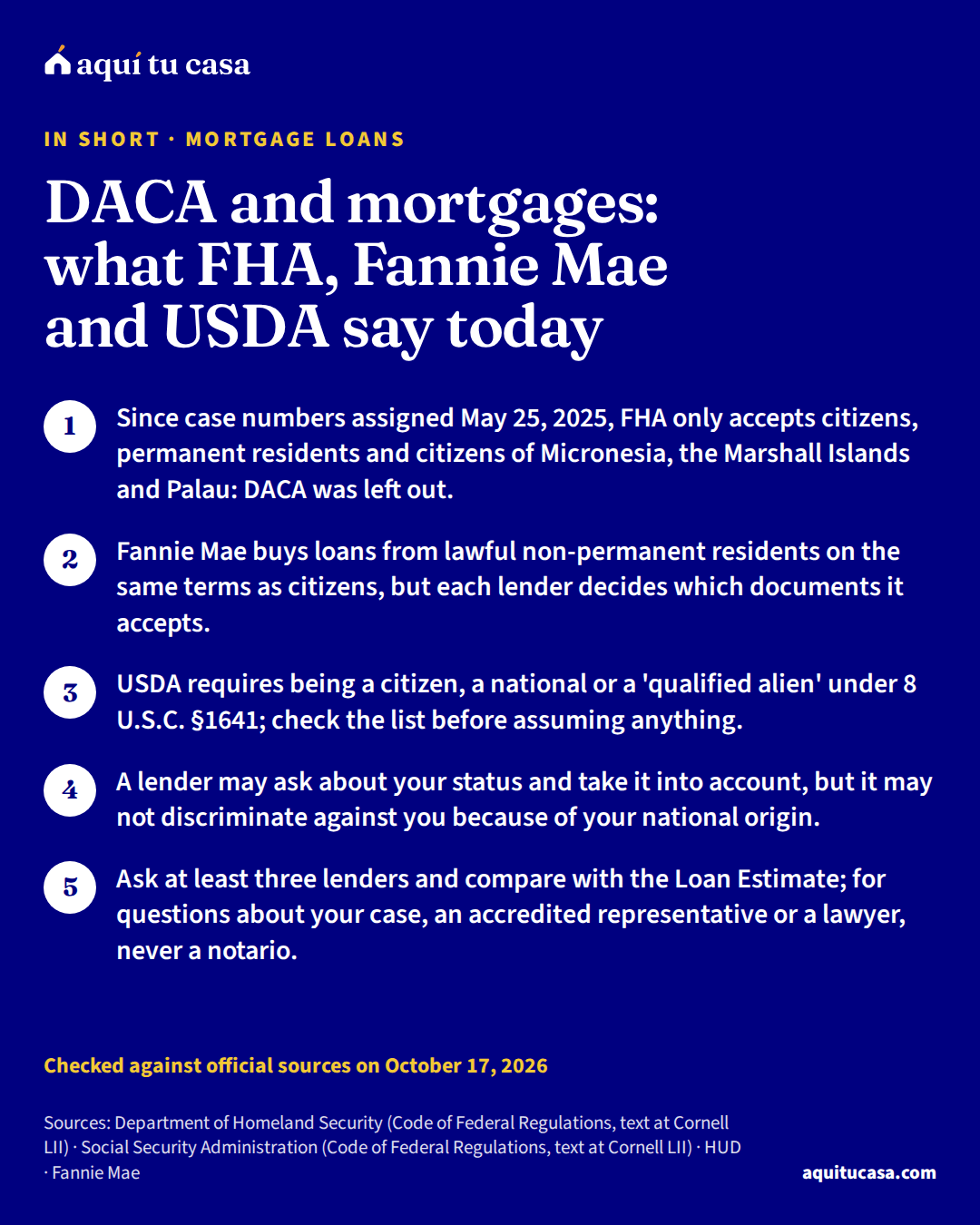
- FHA has not accepted non-permanent residents since case numbers assigned May 25, 2025, and that includes people with TPS, parole or only a work permit.
- Fannie Mae accepts lawful non-permanent residents on the same terms as citizens; each lender decides which documents it accepts.
- The lender checks your identity, your SSN or ITIN and your income the same way as a citizen's, and may take your status into account.
- Mortgage loans DACA and mortgages: what FHA, Fannie Mae and USDA say today If you have DACA and want to buy a home: what FHA, Fannie Mae and USDA rules say today, what a lender may ask you and how to compare offers. 11 minute read
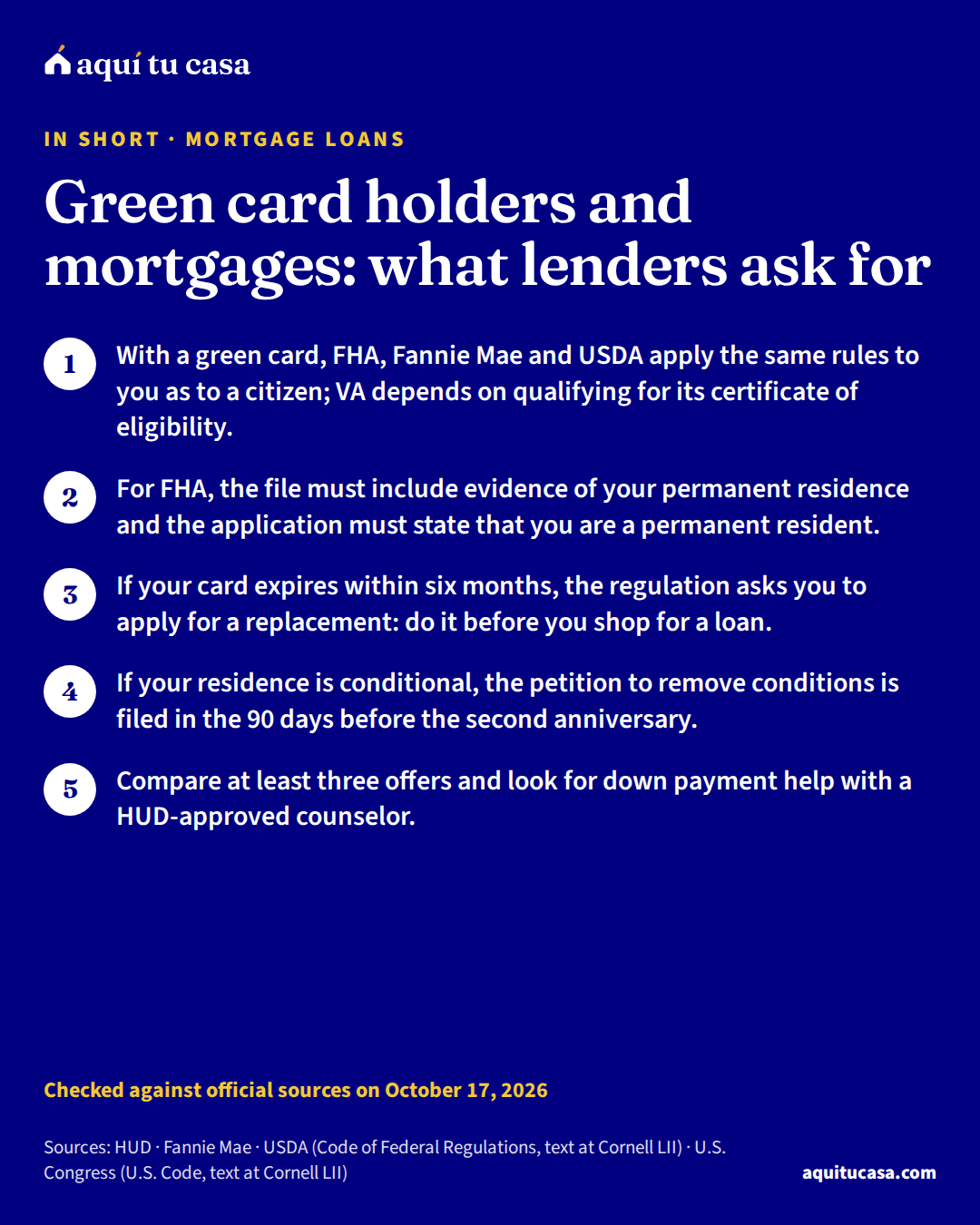
- Mortgage loans Green card holders and mortgages: what lenders ask for With a green card you get the same mortgages as a citizen: what FHA, Fannie Mae and USDA say, the papers you need and what to check if your card expires. 10 minute read
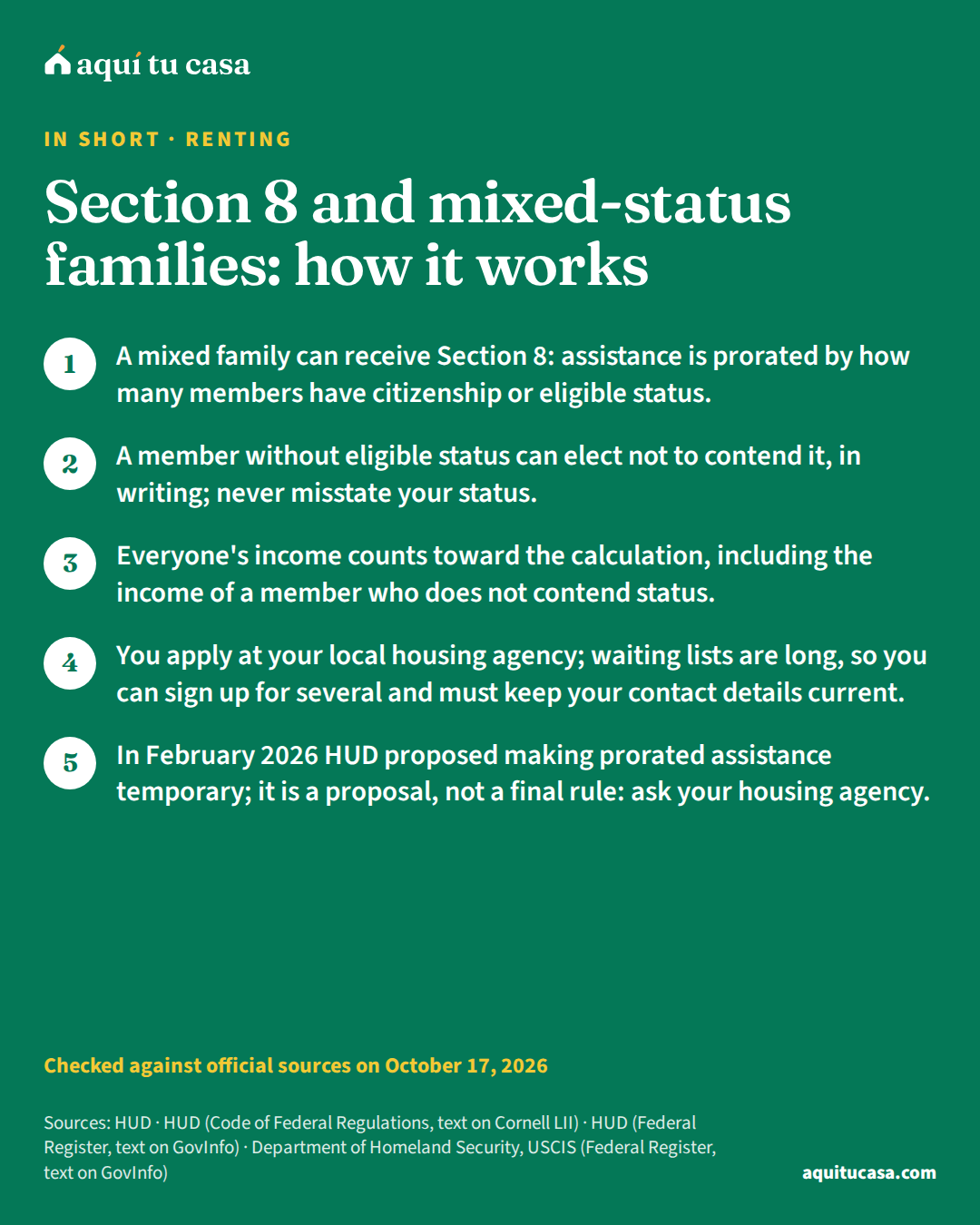
- Renting Section 8 and mixed-status families: how it works How the Section 8 voucher works, how aid is prorated in a mixed-status family, how to apply through your housing agency and what HUD proposed. 12 minute read
Tools for this topic
Was this guide useful?
Thank you. Your answer stays in your browser; nothing is sent.