USDA 502 Direct loan and payment assistance
USDA's Section 502 Direct loan: who qualifies, how payment assistance is figured, the modest home rule, the waiting list and paying back the subsidy.
Verified against official sources on October 31, 2026 3 official sources

Show contents
In short
What you need to know
Quick answer
The Section 502 Direct loan comes from USDA itself, not a bank, for low-income households in rural areas that cannot get credit elsewhere. It asks for no down payment unless you have savings above a set amount, and the rate is USDA's rate on the day of approval or closing, whichever is lower. The key feature is payment assistance: depending on your income, it can bring your payment down to what you would pay at 1% interest. That help is reviewed every year and is paid back, in part or in full, when you sell or stop living in the home.
What matters most
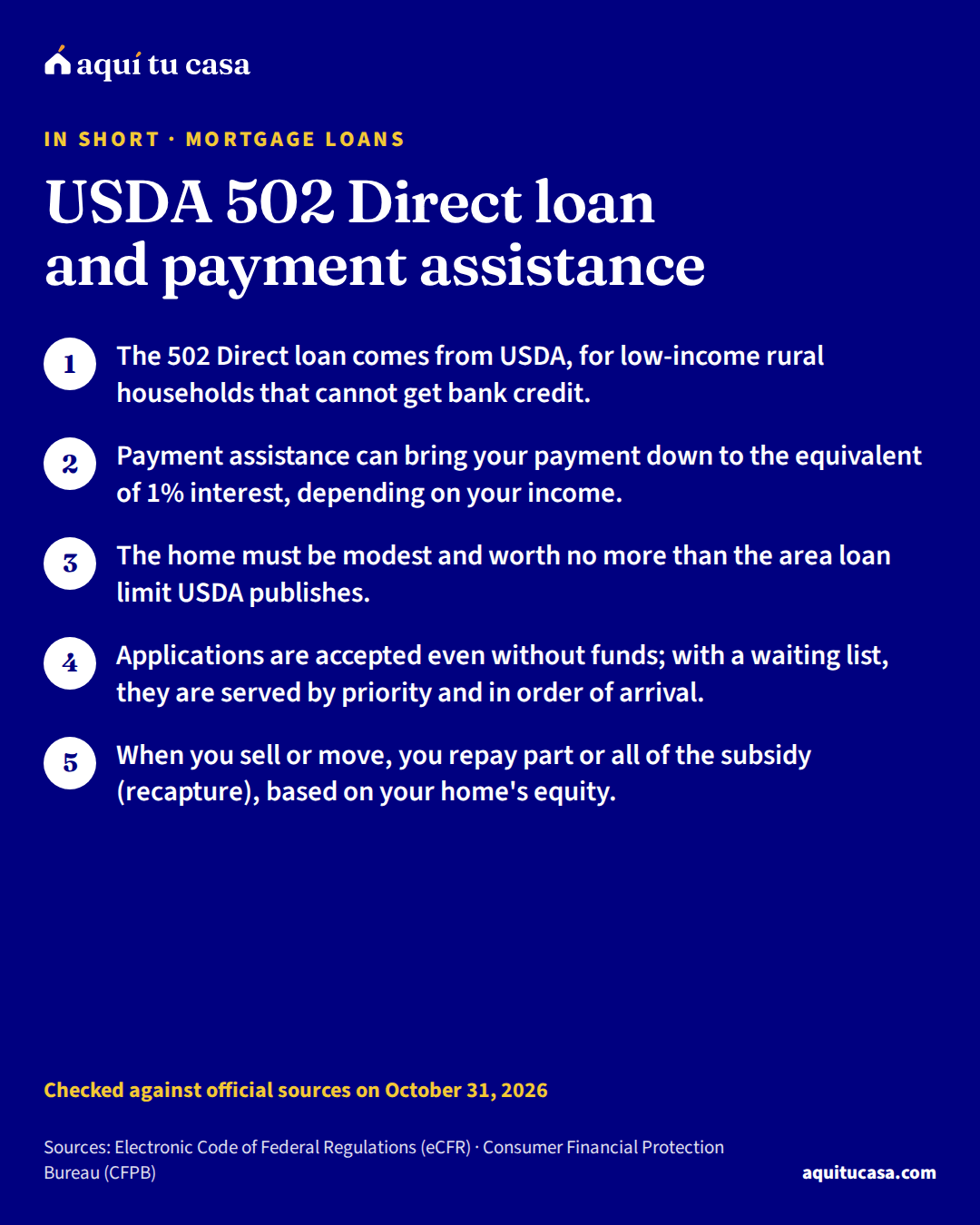
- The 502 Direct loan comes from USDA, for low-income rural households that cannot get bank credit.
- Payment assistance can bring your payment down to the equivalent of 1% interest, depending on your income.
- The home must be modest and worth no more than the area loan limit USDA publishes.
- Applications are accepted even without funds; with a waiting list, they are served by priority and in order of arrival.
Is this for you?
This guide is for you if…
- You live in a rural area, your income is low and no bank has given you a loan.
- You were told USDA lends directly and can lower your payment, and you want to know how.
- You already have a USDA direct loan and want to understand subsidy recapture before you sell.
Get direct help first if…
- You are looking for USDA's guaranteed loan, the one banks make: read «USDA loan».
- You want to build your home with other families in a self-help group: read «USDA farm labor housing and mutual self-help».
USDA has two loans for buying a home in rural areas. One is made by banks and guaranteed by USDA; the USDA loan guide explains it. The other is the Section 502 Direct loan: USDA itself lends, through Rural Development, to low-income households that cannot get credit anywhere else. Its biggest advantage is payment assistance, which can lower what you pay each month by a lot. This guide explains who qualifies, how that assistance is figured and what happens to it when you sell.11
Who can apply for the direct loan
USDA’s regulation asks for, among other things:1
- Low income. At approval, your household’s adjusted income cannot exceed your area’s low-income limit; at closing, it cannot exceed the moderate-income limit.
- Status. Being a U.S. citizen or a noncitizen who qualifies as a legal alien.
- Living in the home. Agreeing to live there and being able to. If the home is being built or repaired, an adult in the household must be able to make inspections and authorize payments for the work.
- Not owning another home. As a rule, current homeowners do not qualify for an initial loan, with exceptions, such as when their current home is deficient housing.
Credit. You need a history that shows you pay your debts. Some signs that count against you: being more than 30 days late in the past year, a foreclosureforeclosureForeclosure is the process by which the lender or servicer takes back the property after the homeowner fails to make mortgage payments. The rules and timelines depend on each state; all of them include advance notices and, in general, time to catch up or ask for an alternative, such as a repayment plan or a loan modification. If you fall behind, call your servicer and a HUD-approved housing counseling agency early: foreclosure counseling is free and exists for exactly this.See the full definition in the last 36 months, a tax lien with no arrangement or two late rent payments in the last 2 years. A bankruptcy with debts discharged more than 36 months ago does not count against you. If you are turned down for credit, you must be told the reason and where the information came from. And if you are a first-time buyer, you must take a homebuyer education coursehomebuyer education courseA homebuyer education course is a class with a set curriculum that covers the homebuying process, how to maintain a home, budgeting and why good credit matters. It can be in a group, in person, online or by phone. It is not the same as housing counseling, which is one-on-one help with an action plan for your situation. Some loans and some down payment assistance programs require you to finish a course before closing, especially first-time homebuyers. When you finish, you get a certificate.See the full definition from a certified provider.1
Ability to pay. Your house payment (principal, interest, taxes and insurance) should be no more than 33% of your repayment income, and with your other debts, no more than 41%. If you are slightly over, USDA can look at compensating factors such as your savings history. And if you fall short, a cosignerco-signerA co-signer is a person who signs another person's loan or credit account to back it up, and by doing so becomes responsible for the debt. If the borrower does not pay, the creditor can collect up to the full debt from the co-signer, plus late fees or collection costs, without first trying to collect from the borrower, and the default may become part of the co-signer's credit record. A federal FTC rule calls for the co-signer to get a written notice explaining these risks before signing. On a mortgage, according to Fannie Mae, a co-signer signs the note and shares liability for the debt with the borrower but has no ownership interest in the home on the title.See the full definition or other household members can join.1 The debt-to-income ratio guide explains how those percentages are figured.
Payment assistance: how it is figured
This is what makes the direct loan different. USDA has three kinds of payment subsidy; if you never had one, you get payment assistance method 2.1
To get it you must live in the home, have adjusted income at or below the moderate-income limit and have a loan of 25 years or more. The assistance is the lesser of two amounts:1
- What you pay per year on the loan, plus taxes and insurance, minus 24% of your adjusted income.
- What you pay per year on the loan minus what you would pay at 1% interest.
In plain words: your share of the payment moves toward 24% of your income, but the assistance never lowers your payment more than a 1% interest rate would. You cannot switch methods.1
Example with real numbers
A household with seasonal work
An example in words, not a real case, of how the assistance applies.
- The loan payment at USDA's rate
- More than fits in their budget
- 24% of their adjusted income
- Roughly what method 2 aims for them to pay
- The 1% floor
- The assistance cannot lower the payment below that
- Every year
- USDA reviews their income and adjusts the assistance
- What they pay
- The loan payment minus the assistance, with taxes and insurance
The formula comes from USDA's regulation.1 Test your budget with the family budget tool.
Run it with your numbersFamily budgetThe yearly review. USDA reviews your income once a year. You have to report it if an adult in the household starts or changes jobs, if the people living with you change or if your income rises at least 10%.1 If your income goes up, the assistance goes down.
Deferred payments. If your income is very low and the loan is 38 years (30 for a manufactured home), USDA may defer up to 25% of your principal and interest payment for up to 15 years. It is granted only at the first loan closing, reviewed every year and also paid back when you sell or move.1
The home, the rate and the term
A modest home. The home must be modest for your area, not built to produce income and worth no more than the area loan limit. That limit is based on a percentage of your area’s FHA limit, is reviewed at least every year and is posted on USDA’s website. There can be exceptions for a very large household or for a reasonable accommodation for a disability. An existing home must be sound, in good repair or repaired with the loan, with adequate water, sewer, power and heat, and free of termites.1
The down payment. As a rule none is needed, unless you have savings: non-elderly families must put in net assets above $15,000, and elderly families assets above $20,000.1
The rate and the term. The rate is USDA’s rate in effect at approval or closing, whichever is lower; you can ask for it at any Rural Development office. The term is up to 33 years, or up to 38 if your adjusted income is no more than 60% of the area median and you need it to afford the payment. For a manufactured home, up to 30 years.1
What else the loan covers. Besides the purchase, reasonable loan costs (closing, title, appraisalhome appraisalAn appraisal is a written document that gives a professional appraiser's opinion of how much a property is worth. The lender orders it before approving the mortgage, because the home is the loan's collateral and the lender does not want to lend more than it is worth. If the appraisal comes in below the price you agreed, the bank bases the loan on the lower value and you will have to cover the difference, renegotiate the price or walk away if your contract allows it. An appraisal is not an inspection: it measures value, not the home's condition.See the full definition, surveying), changes for a household member’s disability, water and power connections, taxes due at closing and the escrowescrow accountAn escrow account is an account set up by your mortgage lender to pay certain property-related expenses on your behalf, mainly property taxes and homeowners insurance. The money comes from a portion of your monthly mortgage payment: each month you contribute a share and the loan servicer pays the bills when they come due. That is why your payment is higher than principal and interest alone, and why it can change when taxes or the insurance premium go up. In some states the word also names the period between the offer and the closing.See the full definition account, essential appliances and energy-saving improvements. It does not pay for-profit companies to prepare your application.1

The application and the waiting list
You fill out a complete written application in USDA’s format. USDA accepts applications even when funds are not available. If something is missing, it sends the application back in writing saying what is missing. USDA may ask you to confirm your interest; if you do not answer in time, it can withdraw your application.1
When funds run short, eligible households go on a waiting listwaiting list (public housing and Section 8)The waiting list is where a public housing agency (PHA) places families who qualify for public housing or a Section 8 voucher when it cannot help them right away. When your name comes up, the PHA contacts you. Because more families need help than there are resources, long waits are common and a PHA may close its list. Each PHA can give preference to certain groups under its written policies. In the voucher program, a PHA may remove you if you do not answer its requests for information, but if that was because of a family member's disability, it must put you back in your place.See the full definition. It is served by priority:1
- USDA customers who need to fix health and safety hazards.
- Purchases of USDA-owned homes or transfers of homes with USDA loans.
- Households facing hardship, such as living in deficient housing for more than 6 months or being about to lose their home to foreclosure.
- Mutual self-help homes, packages from approved intermediaries and loans that combine other financing.
- Everyone else.
Within each group, applications are served in the order complete ones arrived, and if they arrive the same day, veterans get preference.1 That is why it pays to turn in a complete application as soon as you can.
From the first step to the keys
1. Confirm the area is rural for USDA
Before you look for a home
The USDA loan guide explains how to check an address.
2. Check whether your income fits the low-income limit
Before you apply
At approval it must be within your area's low-income limit.1
3. Turn in a complete application
As soon as you can
USDA accepts it even without funds and serves applications in order within each priority.1
4. Take the homebuyer course
While you wait
First-time buyers must complete it with a certified provider.1
6. Sign and keep the subsidy agreement
At closing
That agreement says how what you repay when you sell is figured.2
When you sell or move: subsidy recapture
Payment assistance is not a permanent gift. If your loan was approved on or after October 1, 1979, you must repay the subsidy and any deferred assistance when you transfer title or stop living in the home, even in a foreclosure. This is called subsidy recapture.2
How much you repay. It is figured with your subsidy repayment agreement and your home equityhome equityHome equity (or equity) is what your home is worth today minus what you still owe on the mortgages on it. You can borrow against that equity: with a home equity loan, which you receive as a lump sum and which usually has a fixed rate; with a HELOC; or with a cash-out refinance. In all of these the home is the collateral and, if you do not repay, the lender could take it. With a reverse mortgage, the balance grows each month and your equity goes down.See the full definition when the loan is paid off. It is the lesser of two amounts: the subsidy you received or a portion of how much your home’s value rose (the appreciationhome appreciationHome appreciation is the increase in your home's value over time. It is one of the two ways your home equity grows, equity being the difference between what the home is worth and what you owe; the other is paying down your mortgage principal. A home's value can go up or down: it can fall because of economic conditions, lack of upkeep or a drop in neighborhood home values, and some markets appreciate faster than others. The FHFA House Price Index (HPI) measures how single-family home values change.See the full definition). If that calculation shows no equity, the part of the principal the subsidy paid down is not collected.2
If you refinance and stay. If you pay off the USDA loan without transferring title and keep living in the home, you can defer the repayment, interest-free, until you sell or move. If you pay it in full at closing, it may be discounted.2
If someone assumes your loan. In an assumption on new rates and terms, the seller can pay the recapture or the buyer can add it to the loan being assumed.2
If this is you
Your income is very low
You can ask for a 38-year term and, if you qualify, for USDA to defer part of your payment.1
Your household is very large
USDA can make an exception to the home's size or limit for a very large household.1
Someone in the household has a disability
The loan can pay for special design features or equipment, and there can be an exception to the limit.11
Your income changes a lot during the year
Tell USDA if your income rises at least 10%; the review is every year.1
You plan to sell in a few years
Keep your subsidy agreement: it is used to figure what you repay when you sell.2

Costly mistakes
Mistake: Waiting for funds before applying.
Instead: USDA accepts applications even without funds, and order of arrival counts.1
Mistake: Paying a for-profit company to prepare your application.
Instead: The loan does not pay those fees; a housing counselor can help, often for free.13
Mistake: Not telling USDA when your income goes up.
Instead: You must report it if it rises at least 10% or if an adult's job changes.1
Mistake: Selling without working out the recapture.
Instead: Ask USDA for the figure before you put the home up for sale.2
Mistake: Looking at a home that costs more than the area limit.
Instead: The home must be modest and worth no more than the loan limit USDA publishes.1
Free help
A HUD-approved housing counselorHUD-approved housing counselorA HUD-approved housing counselor works at an agency HUD has approved to provide housing counseling: independent, expert advice customized to your situation about buying a home, renting, a missed mortgage payment, a foreclosure or credit problems. The agencies usually charge little or nothing; many serve in Spanish and offer the homebuyer education course several assistance programs require. They are not lenders or real estate agents and sell you nothing. Your county page lists the official agencies with phone numbers.See the full definition can help you prepare your application and your budget, often for free or at low cost.3 The guide to HUD-approved housing counselors explains how to find one, and the homebuyer education courses guide helps with the course USDA asks for. If you want to build your home with other families, read USDA farm labor housing and mutual self-help. And if you already own a home and need repairs, the USDA 504 home repair loans and grants guide explains another program.

What to do this week
- Find the USDA Rural Development office that serves your county and ask for the current 502 Direct rate.1
- Gather proof of income for every adult in the household.1
- Review your credit and rent history for the last 2 years.1
- Turn in a complete application even if you are told there are no funds.1
- Build your budget with the family budget tool, planning for a payment near 24% of your income.1
Your numbers
The minimum for this loan is 3.5%. More down lowers the monthly payment.
Adjust advanced details
First number: share of income for housing. Second: housing plus debts. Lender references, not fixed rules.
Let's do the math
Estimated top price
National figure$227,000
Limited by the housing payment: at that price it would be about $1,883 a month, 28% of your income.
- By the housing payment (28% of income)Limits you$227,000
- By your total debts (36% of income)$292,000
- By your cash (down payment + closing)$330,500
- Typical home in the United States
- $332,700
- Your cap is 68% of the typical home.
What changes if…?
- …you save $10,000 more$227,000
- …you cut $200 a month in debts$227,000
Your maximum price with four loans
Same income, debts and savings; only the down payment and the loan type change. ITIN uses an example down payment and rate.
| FHA 3.5% | Conventional 5% | Conventional 20% | ITIN 15% (example) | |
|---|---|---|---|---|
| Maximum price | $227,000 | $232,000 | $93,000 | $119,000 |
| Payment per month | $1,883 | $1,882 | $616 | $898 |
Educational estimate, not a pre-approval. Uses example insurance (0.5% of value per year) and example closing costs (3% of price); the tax is the place’s typical rate.
Ready to see the numbers? Find your county here
See how this applies in your county: its loan limits, prices and rents, from the official data.
Printable checklist
Frequently asked questions
How is the direct loan different from USDA's guaranteed loan?
With the guaranteed loan, a bank lends and USDA guarantees it. With the 502 Direct loan, USDA lends, only to low-income households that cannot get credit elsewhere, and it can give you payment assistance. The USDA loan guide covers the other program.
How much does the assistance lower my payment?
It depends on your income. If you never had a subsidy, you get method 2: your share of the payment moves toward 24% of your adjusted income, but the assistance never lowers the payment more than a 1% interest rate would.
Do I need a down payment?
As a rule no, unless you have savings. Non-elderly families must use net assets above $15,000, and elderly families assets above $20,000.
What is subsidy recapture?
It is paying back the payment assistance you received. It comes due when you sell or stop living in the home, and it is based on your home's equity: it is the lesser of the subsidy you received and a portion of how much the value rose.
Can I apply if there are no funds?
Yes. USDA accepts applications even when funds are not available. If you are eligible, you go on the waiting list, where certain priority cases are served first and then in order of arrival.
Can I apply if I am not a citizen?
You must be a U.S. citizen or a noncitizen who qualifies as a legal alien under USDA's regulation. If you are not sure about your case, talk to a lawyer or a Justice Department-accredited representative before you hand over documents.
What happens if my income goes up?
USDA reviews your income every year. You must report it if your income rises at least 10%, if an adult in the household starts or changes jobs or if the people living with you change. The assistance may go down.
Sources
Every figure in this guide comes from one of these official sources. The number next to a sentence leads to the source behind it.
Each source on one line: who publishes it, its title, its address and the date we read it.
- 1. Electronic Code of Federal Regulations (eCFR) · 7 CFR Part 3550, Subpart B, Section 502 Origination · ecfr.gov · Accessed October 31, 2026
- 2. Electronic Code of Federal Regulations (eCFR) · 7 CFR §3550.162, Recapture · ecfr.gov · Accessed October 31, 2026
- 3. Consumer Financial Protection Bureau (CFPB) · Find a housing counselor · consumerfinance.gov · Accessed October 31, 2026
Keep reading
Related guides
If this guide helped, these follow the same path.

Mortgage loans 12 minute read
USDA loan: no down payment in rural areas
How the USDA guaranteed loan works: rural areas, the household income limit, guarantee fees, who can apply and the steps from address to keys.
- USDA requires no down payment: the loan can reach the appraised value plus the upfront guarantee fee.
- You pay an upfront fee of 1% and an annual fee of 0.35%, which can be passed on to the borrower.
- The income of everyone who lives in the home counts, whether or not they sign the loan.
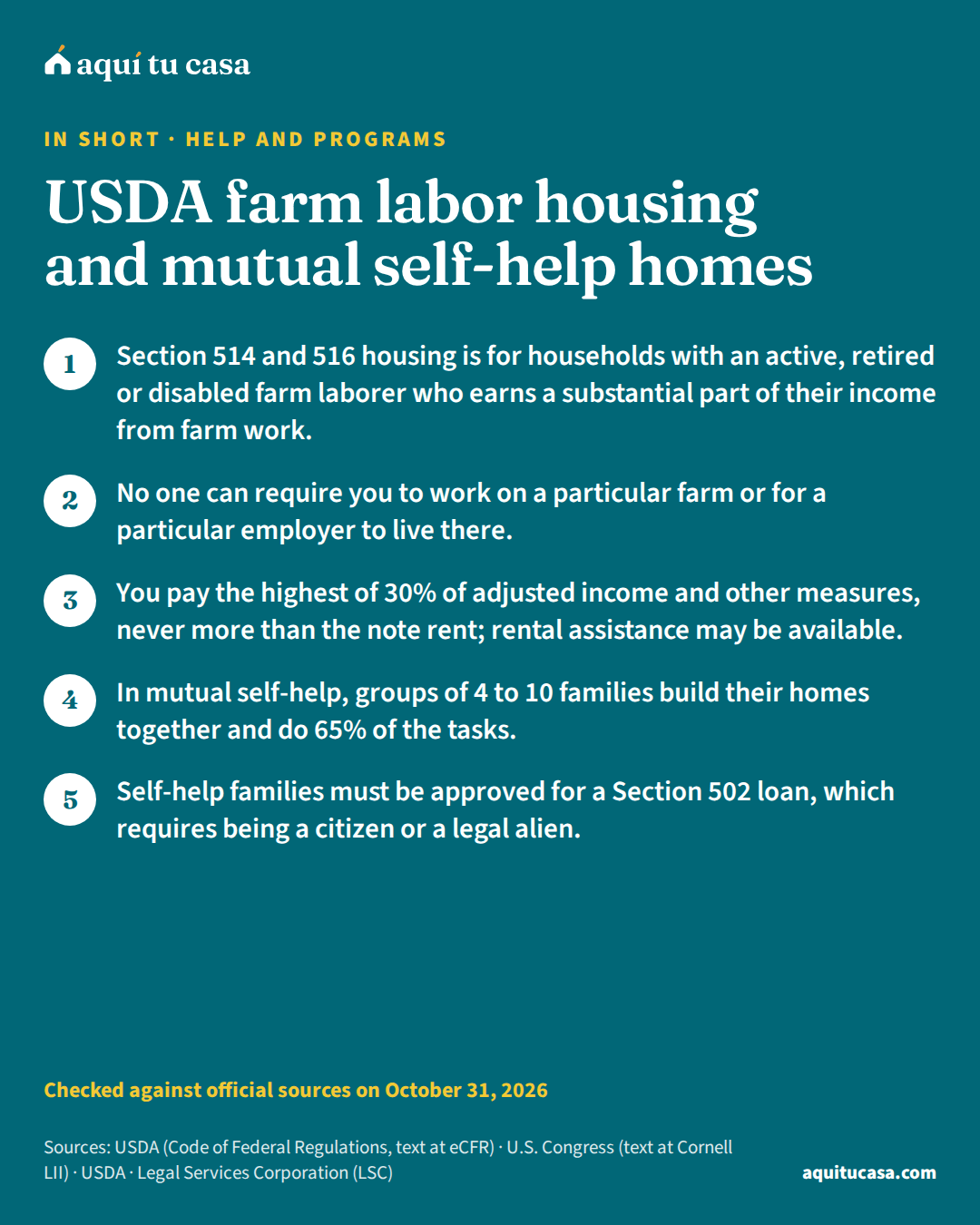
- Help and programs USDA farm labor housing and mutual self-help homes How USDA farm labor housing (Sections 514 and 516) and mutual self-help housing (Section 523), where families build their homes together, work. 12 minute read
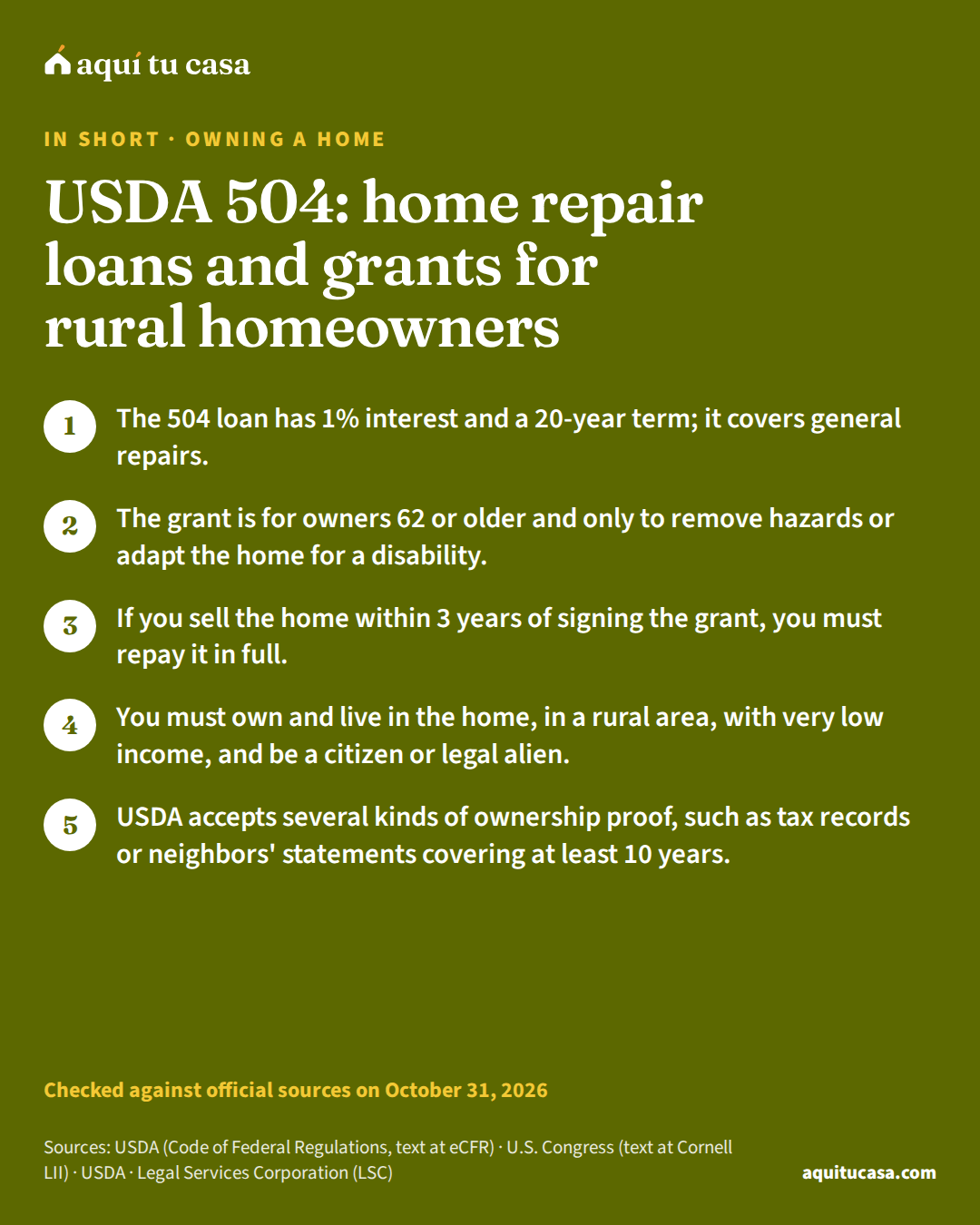
- Owning a home USDA 504: home repair loans and grants for rural homeowners USDA Section 504 repair loans and grants for very-low-income rural homeowners: the age rule for grants, the 1% interest rate and how to apply. 13 minute read
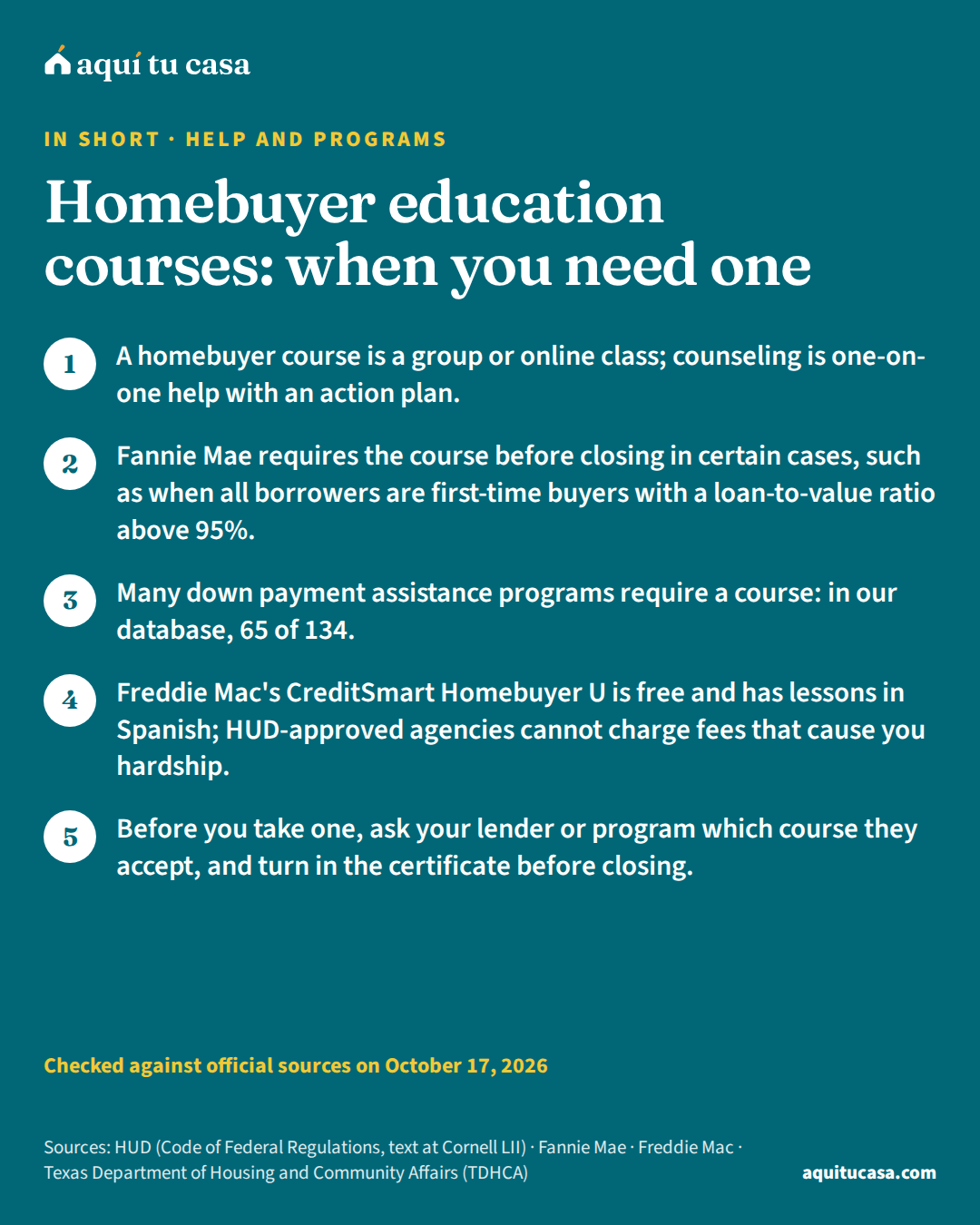
- Help and programs Homebuyer education courses: when you need one What a homebuyer education course is, when Fannie Mae, Freddie Mac and assistance programs require one, and where to take it for free or in Spanish. 10 minute read
Tools for this topic
Was this guide useful?
Thank you. Your answer stays in your browser; nothing is sent.