Public charge and housing: what the rules say
Public charge: which housing help DHS may consider, who is exempt, how HUD prorates assistance for mixed-status families and where to get free advice.
Verified against official sources on October 29, 2026 17 official sources

Show contents
In short
What you need to know
Quick answer
Public charge is an immigration rule weighed when a person applies for a visa, entry to the country or a green card. Since September 18, 2026 a DHS rule has applied that says its officers may consider housing help that depends on income, such as public housing and rent subsidies, case by case and depending on the program; help received before that date is measured under the 2022 rule. DHS says it generally does not consider your family members' benefits, such as U.S. citizen children's. Some people are not subject to the rule, such as refugees, asylees and victims with VAWA or a U visa. In HUD programs, a mixed family can receive prorated assistance. Before you decide, you can get free advice from an accredited representative.
What matters most
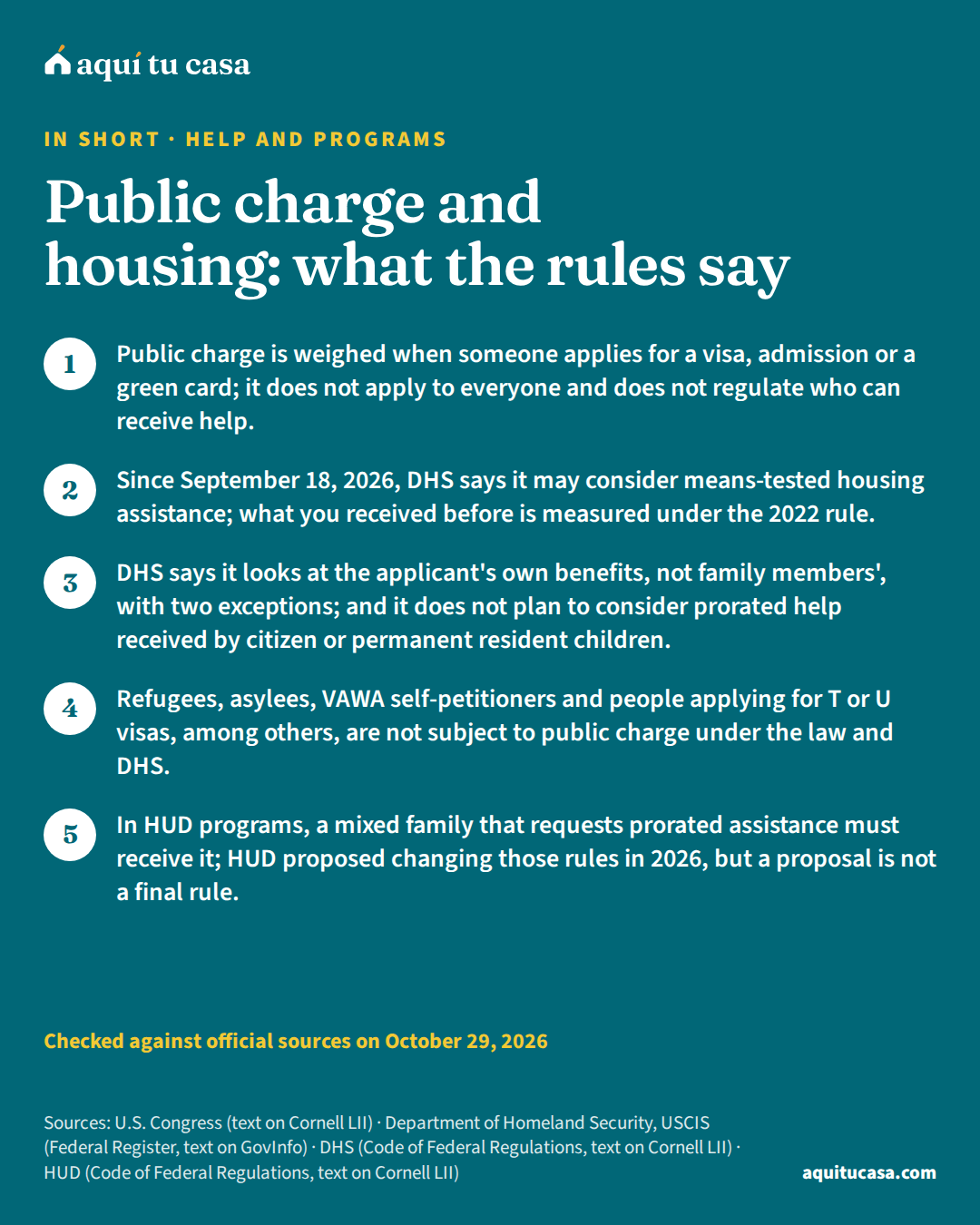
- Public charge is weighed when someone applies for a visa, admission or a green card; it does not apply to everyone and does not regulate who can receive help.
- Since September 18, 2026, DHS says it may consider means-tested housing assistance; what you received before is measured under the 2022 rule.
- DHS says it looks at the applicant's own benefits, not family members', with two exceptions; and it does not plan to consider prorated help received by citizen or permanent resident children.
- Refugees, asylees, VAWA self-petitioners and people applying for T or U visas, among others, are not subject to public charge under the law and DHS.
Is this for you?
This guide is for you if…
- Someone in your family will apply for a visa, entry to the country or a green card, and you want to know what the rules say about housing assistance.
- Your family is mixed-status: for example, your children are citizens and you are not, and they receive or want to apply for HUD help.
- You heard that public charge changed and want to read what the law and the DHS rule say, without rumors.
Get direct help first if…
- You already have an appointment with USCIS or a consulate, or an open case: bring your questions to a Justice Department-accredited representative or a lawyer; this guide cannot say what will happen in your case.
- You are short on rent this month and need money fast: start with the guide on rental help, which explains where to ask for it.
Many families stop asking for housing help out of fear of public chargepublic chargePublic charge is a term in immigration law. The law says that a noncitizen who, in the government's opinion when applying for a visa, admission or adjustment of status, is likely to become a public charge is inadmissible. To decide, officials must consider at least the person's age, health, family status, assets, resources and financial status, and education and skills. The law does not apply this ground to some groups, such as U visa applicants. A recent federal rule rescinded the previous rule and left officers to decide case by case. These rules can change, and the definition alone does not say how it applies to any person.See the full definition. This guide explains, from official sources, what that rule is, which housing help DHS says it may consider, who is not subject to it, how HUD divides assistance in a mixed-status family and where to get free advice. It does not say what will happen in your case: only someone authorized, such as an accredited representativeDOJ-accredited representativeAn accredited representative is a non-attorney whom the U.S. Department of Justice, through its Recognition and Accreditation Program, authorizes to represent people in immigration matters before DHS and, with full accreditation, before the immigration courts. They may only do so through a recognized organization, which must be a non-profit, federally tax-exempt entity. It is the safe way to get low-cost immigration help: the Department of Justice publishes the official roster by state. Anyone who is not on that roster and is not a lawyer is not authorized to represent you.See the full definition, can review that.
What public charge is and when it is weighed
Public charge is part of the Immigration and Nationality Act. It says a person is inadmissible if, in the opinion of the consular officer when applying for a visa, or of the government when applying for admission or adjustment of status (a green card), they are likely at any time to become a public charge.1
To decide, the law requires officials to consider at least five factors: age, health, family status, assets, resources and financial status, and education and skills. An affidavit of support may also be considered.1
This matters for two reasons. First, the review happens at three moments: when applying for a visa, for entry and for adjustment of status.1 Second, DHS says the determination focuses on the person making that application, not on their family members, and that receiving benefits alone does not decide the outcome.5 The rule also does not regulate who can receive help or prohibit participation in programs.5
What changed with the 2026 rule
On July 20, 2026, DHS published a final rule rescinding the 2022 public charge regulations and restoring broader discretion for its officers. The rule took effect on September 18, 2026 and applies to applications for admission and adjustment of status submitted on or after that date. Means-tested benefits someone received before that date are measured under the 2022 rule.5
The 2022 rule and the 2026 rule
For help received before 9/18/2026
2022 rule
- Only counted cash assistance for income maintenance (SSI, TANF cash and state or local cash aid) and long-term institutional care.6
- Receiving a benefit only on someone else's behalf did not count.6
- Housing help was not on that list; if you received it before the change, DHS says it does not consider it, unless the approval covers a period that extends to or beyond that date.5
For applications from 9/18/2026
2026 rule
Dates matter: what you received before September 18, 2026 is measured under the 2022 rule.5
The 2022 rule defined public charge as becoming primarily dependent on the government for subsistence, and only counted cash assistance for income maintenance and long-term institutional care.6 Under the 2026 rule, DHS says its officers consider the law’s minimum factors, the means-tested benefits the person received and any other factor in their case, and that USCIS issues nonbinding guidance for its officers, in effect from that same date, which it plans to include in its Policy Manual.5
One detail about dates. DHS says it does not consider benefits the 2022 rule excluded, including housing benefits, if they were received before the change. But if a benefit was approved for a period that extends to or beyond September 18, 2026, DHS says it does consider it, unless the person withdrew the application or told the agency they no longer wanted it.5
Which housing help DHS says it may consider
The key word is means-tested, which we also describe here as “based on need” or “depending on income”. DHS says the term is understood as a government program or benefit where eligibility depends on the person’s or family’s income or assets being below a certain threshold. And it says benefits given to everyone regardless of income are not considered, because they are not means-tested.5
On that basis, DHS says it considers all housing assistance the government provides, pays for or subsidizes, as long as it depends on income. It does not exclude public housingpublic housingPublic housing is a program of rental homes for low-income families, older adults and people with disabilities. HUD funds local public housing agencies (PHAs), which manage the homes and charge rents those families can afford. It comes in all sizes and types, from scattered single-family houses to high-rise apartments. The PHA decides whether you qualify based on your annual gross income, whether you are elderly, have a disability or are a family, and your U.S. citizenship or eligible immigration status. To apply, you contact your local PHA. In general, you can stay as long as you comply with the lease.See the full definition or housing subsidies. Its officers have discretion to decide how much that help weighs in the totality of the circumstances, taking the type of program into account.5
DHS also describes how they may look at it. Officers may consider whether the need for subsidized housing was due to a temporary situation, such as losing a job or suffering domestic violence; the amount and duration of the help; how recent it was; and whether it was isolated. And it repeats that participation in housing programs is just one aspect of one consideration within the whole.5

On tax credits, which many families use for rent or a down payment: DHS describes the Earned Income Tax Credit (EITC) as a tax break for low- and moderate-income workers, says the Child Tax Credit amount depends on income, and considers receipt of means-tested tax credits relevant to public charge.5
This guide cannot tell you which group each program in your city or state falls into. What you can do: ask the program how it decides who qualifies (by income or assets?), keep the approval letter with the period it covers and bring that information to an accredited representative.5 If the help is for electricity or gas, the LIHEAP guide explains how that program works.

Your family members: citizen children and mixed-status families
DHS says it only considers means-tested benefits received by the person themselves, not by family members such as U.S. citizen children. There are two exceptions: the person is legally obligated to support those family members and they receive the help because the person’s income is below a certain threshold, or the person lives off the family member’s benefits. In those cases, DHS looks at that fact as part of the person’s assets, resources and financial status. DHS also says it does not plan to consider benefits, such as prorated housing assistance, received by citizen or permanent resident children.5
On mixed families, DHS acknowledges that under HUD’s current rules, people without eligible status may live in a mixed household with family members who receive federal housing assistance, or in public housing, as long as they receive no assistance and the family pays a greater portion of the rent.5 And it repeats that its rule does not prevent a person subject to public charge from receiving the food, clothing or housing benefits they qualify for.5
How HUD prorates assistance for a mixed family
Section 214 of the housing law says HUD may not make financial assistance available to a noncitizen unless they reside in the United States and hold one of the statuses the law lists. But if the eligibility of at least one family member is established, and other members have not been found ineligible, assistance is prorated based on the number of eligible members compared with the total.4 HUD’s regulations call a family with members who have citizenship or eligible status and members who do not a “mixed family.”7
The regulations restrict help from Section 214 covered programs to citizens and noncitizens with eligible status, but say a mixed family may be eligible for one of three types of assistance.8 That includes public housing and Section 8 programs, such as the housing choice voucherHousing Choice Voucher (Section 8)The Housing Choice Voucher, the program almost everyone calls Section 8, is the country's largest federal rental assistance. HUD pays rental subsidies so eligible families can afford decent, safe and sanitary housing. Local public housing agencies administer it with HUD funds. The family finds its own home on the private market; if the agency approves the unit and the tenancy, it contracts with the owner to pay part of the rent, and the family pays the rest. Waiting lists are usually long and open for limited periods.See the full definition. The most common type is prorated assistanceprorated assistanceProrated assistance is the reduced housing assistance mixed families receive in HUD programs such as Section 8 and public housing. A mixed family has members with citizenship or eligible immigration status and members without it. With a voucher, the housing agency figures the full assistance using everyone's income, multiplies it by the share of members with eligible status, and the family pays the rest of the rent. Under current rules, a mixed family that asks for it must receive it. HUD has proposed making it only temporary; that is not a final rule, and the rules can change.See the full definition: a mixed family that requests it must receive it, it is available to first-time applicants, and the housing agencypublic housing agency (PHA)A public housing agency (PHA) is a state, county, municipal or other governmental entity or public body authorized to operate public housing or rental assistance programs. These are the agencies that locally administer the Housing Choice Vouchers (Section 8) and public housing with HUD funds: they open and manage the waiting lists, review eligibility and income, inspect units and pay the owner its share of the rent. Each county usually has one or several; your page shows the ones serving your area with their phone numbers.See the full definition must offer it to eligible families.9
With a voucher, the calculation has two steps. First, the agency determines the pre-proration assistance payment, using the income of every member, including anyone who has not established eligible status. Second, it multiplies it by a fraction: the number of members with eligible status over the total number of members. The family pays the owner the portion of rent that payment does not cover.10
Example with real numbers
A family of four with three eligible members
An example in words. Your figures come from your housing agency's calculation.
- Family members
- Four (mom, dad and two children)
- Members with citizenship or eligible status
- Three (mom and the two children)
- Income used for the calculation
- All four, including dad's10
- Assistance before proration
- What they would get if all four were eligible
- Prorated assistance
- Three quarters of the pre-proration assistance10
Dad receives no assistance; the family pays a greater share of the rent.5 To see which programs your household might qualify for, use the tool.
Run it with your numbersWhich programs might I qualify for?In public housing the method is different: the agency subtracts the total tenant payment from the unit’s flat rent, divides that maximum subsidy by every person in the family, multiplies it by the number of members with citizenship or eligible status, and the family’s rent is the flat rent minus that subsidy.10 The law also warns: if someone knowingly permits an ineligible person to live in the assisted unit, the household’s eligibility ends for at least 24 months, unless that person was already counted in the proration.4 The guide to Section 8 and mixed-status families explains the documents and the waiting list.
HUD published on February 20, 2026 a proposed rule that would require verifying the status of all applicants and recipients, regardless of age, and would make prorated assistance temporary while all family members are verified. A proposal is not a final rule; on its own it does not change what this section explains.11

Who is not subject to public charge
Not everyone goes through this review. Under the law and the DHS rule:
- People admitted as refugees.2
- People adjusting status as refugees or asylees.3
- VAWA self-petitioners, people applying for or holding a U visa, and certain battered persons the law defines as qualified aliensqualified alien"Qualified alien" is a term in a federal law, 8 U.S.C. 1641, used to decide who may apply for or receive certain federal public benefits. The law defines it with a list of categories. They include lawful permanent residents, people granted asylum, refugees, certain people paroled into the country for at least one year, people whose deportation is being withheld, Cuban and Haitian entrants and, in certain cases, people subjected to battery or extreme cruelty. The same law has exceptions and other conditions, so the definition alone does not say whether a person can receive a benefit.See the full definition; for the latter, the law says benefits they received under that definition may not be considered.1
- People seeking a T visa, special immigrant juveniles adjusting status, people applying for or re-registering for TPS and people adjusting under the Cuban Adjustment Act, according to DHS.5
DHS says its rule does not apply to U.S. citizens or to people who are exempt.5 There are more categories and details. If you don’t know whether public charge applies to you, that is the first question for an accredited representative.
Where to get free, trustworthy advice
According to the Justice Department’s EOIR, only certain people can represent you before EOIR (the immigration courts): licensed attorneys and accredited representatives. Notarios, document preparers and immigration consultants cannot give you legal advice or tell you whether you qualify for anything; if they do, they break the law.12 The guide A notario is not a lawyer explains why.
Accredited representatives are not lawyers, but they can represent you before DHS and EOIR. They work at recognized non-profit organizations, and the program exists to expand representation for low-income people.13 EOIR publishes the list of organizations and representatives by state.14
Free legal aidlegal aidLegal aid is the free civil legal help that nonprofit organizations and their lawyers provide to low-income people in civil, not criminal, matters. In housing, that includes representing families facing eviction or foreclosure, alongside matters such as custody, child support, protection from domestic violence and access to benefits. In the United States, the Legal Services Corporation, created by Congress, funds a nationwide network of these organizations; its finder points you to the one in your area. Each sets its own income limits.See the full definition is another option. LSC has a search tool for organizations near you and points to LawHelp.org for free information and forms.15 Organizations funded by LSC have limits on helping ineligible noncitizens, although they can take your call and refer you.16 Their regulations do allow them to help someone who has been battered or is a victim of sexual assault or trafficking, in matters related to that abuse, which can include housing and public benefits.17 The free legal aid guide explains other options, and HUD-approved housing counselors can help with the housing side.
Before you apply for or drop a benefit
1. Write down who receives what help and since when
Today
For each person in your household, note the benefit, whose name it is in, the start date and the period the approval covers. The September 18, 2026 date matters.5
2. Ask the program how it decides who qualifies
This week
If eligibility depends on income or assets, DHS calls it means-tested; if it is given to everyone regardless of income, DHS says it does not consider it.5
3. Find out whether public charge applies to you
Before you decide
It does not apply to everyone; for example, not to people adjusting status as refugees or asylees.3
4. Find an accredited representative
Before you decide
Look in EOIR's list by state for a recognized organization near you and bring your notes.14
5. If you receive HUD help, ask for the calculation
Whenever you want
The housing agency must offer prorated assistance to eligible mixed families; ask it to show you how it was calculated.9
6. Be wary of anyone who charges to tell you whether it affects you
Always
A notario or immigration consultant cannot give you legal advice.12
If this is you
Your children are citizens and you are not
DHS says it generally does not consider your family members' benefits and does not plan to consider prorated help received by citizen or permanent resident children.5 Ask about the two exceptions at your appointment.
You will apply for a green card or visa
Since September 18, 2026, officers may consider means-tested housing help you yourself receive, depending on the program, the amount and the duration.5 What came before is measured under the 2022 rule.5

Mistakes to avoid
Mistake: Pulling your citizen children out of Section 8 out of fear, without getting informed.
Instead: DHS says it does not plan to consider prorated help received by citizen or permanent resident children; ask about your case before deciding.5
Mistake: Believing public charge applies to every immigrant.
Instead: It does not apply, for example, to refugees and asylees3 or to people applying for a T or U visa.5
Mistake: Thinking the rule bars you from applying for housing help.
Instead: DHS says the rule does not regulate eligibility or prohibit participation in programs.5
Mistake: Forgetting the date each benefit started.
Instead: What you received before September 18, 2026 is measured under the 2022 rule; what was approved for a period that extends to or beyond that date, DHS says it does consider.5
Mistake: Letting a relative without eligible status move into your HUD housing without notice.
Instead: Knowingly allowing it ends eligibility for at least 24 months; ask the agency to include them in the proration.4
Mistake: Paying a notario to tell you whether it affects you.
Instead: Only a lawyer or an accredited representative can give you legal advice.12
What to do this week
- Write down what help each person in your household receives, whose name it is in and since what date.5
- Ask each program whether it decides who qualifies by income or assets.5
- Find a recognized organization near you on EOIR’s list and ask for an appointment.14
- Bring your questions in writing: whether public charge applies to you and what happens with your family’s benefits.5
- If your mixed family receives HUD help, ask for the prorated assistance calculation.9
- Don’t pay anyone who promises immigration advice without being authorized.12
Your income
Let's do the math
Rent that fits your budget (30% of income)
$2,018
With an income of $6,728 a month. Up to $3,364 would already be a severe burden (50% of income).
Compared with HUD’s Fair Market Rent in the United States
- 2 bedrooms$1,750Fits · 26%Needs $33.65 an hour
The wage needed pays that rent without going over 30% of income, working 40 hours a week all year.
The typical rent households actually pay in the United States is $1,413 a month (Census).
A reference to give you an idea. Each landlord and each program sets its own requirements.
Ready to see the numbers? Find your county here
See how this applies in your county: its loan limits, prices and rents, from the official data.
Printable checklist
Frequently asked questions
What is public charge?
It is a rule in immigration law. When someone applies for a visa, admission or adjustment of status, the government weighs whether the person is likely to become dependent on the government. The law requires officials to consider at a minimum their age, health, family status, assets and resources, and education and skills.
Which housing help does DHS say it may consider?
DHS says it considers all housing assistance the government provides, pays for or subsidizes, as long as it is means-tested: it does not exclude public housing or housing subsidies. It also says benefits given to everyone regardless of income are not considered, and that its officers decide case by case, taking into account the type of program, the amount, the duration and how recent the help was.
Does the Section 8 my citizen children receive count?
DHS says it only considers benefits received by the person themselves, not by family members, and that it does not plan to consider prorated housing assistance received by citizen or permanent resident children. There are two exceptions: if you are legally obligated to support them and they receive the help because your income is below a threshold, DHS considers that low income as part of your financial status; and if you live off the family member's benefits.
What about housing help I received before September 18, 2026?
DHS says it does not consider benefits the 2022 rule excluded, including housing benefits, if they were received before that date. But if the help was approved for a period that extends past that date and you kept receiving it, DHS says it does consider it, unless you withdrew the application or told the agency you no longer wanted it.
Does public charge apply to every immigrant?
No. The law says it does not apply to people admitted or adjusting status as refugees or asylees, to VAWA self-petitioners or to people applying for or holding a U visa. DHS also names people seeking a T visa, special immigrant juveniles, people applying for or re-registering for TPS and people adjusting under the Cuban Adjustment Act. If you don't know whether it applies to you, ask an accredited representative.
How does HUD's prorated assistance work for a mixed family?
The housing agency calculates the full assistance using the income of every member, including anyone who does not claim eligible status, and multiplies it by the number of members with eligible status divided by the total number of members. The family pays the rest of the rent. A mixed family that requests it must receive it.
Does applying for housing help bar me from other benefits or get me removed from the program?
DHS says its rule does not regulate eligibility or prohibit participation in programs, and does not prevent a person subject to public charge from receiving benefits they qualify for. Each program has its own eligibility rules; the housing agency explains them.
Where can I get free, trustworthy advice about my case?
From a Justice Department-accredited representative, who works at a recognized non-profit organization; EOIR publishes the list by state. Free legal aid is another option; LSC has a search tool. A notario or consultant cannot give you immigration legal advice.
Sources
Every figure in this guide comes from one of these official sources. The number next to a sentence leads to the source behind it.
Each source on one line: who publishes it, its title, its address and the date we read it.
- 1. U.S. Congress (text on Cornell LII) · 8 U.S.C. §1182, Inadmissible aliens (Immigration and Nationality Act §212) · law.cornell.edu · Accessed October 29, 2026
- 2. U.S. Congress (text on Cornell LII) · 8 U.S.C. §1157, Annual admission of refugees and admission of emergency situation refugees · law.cornell.edu · Accessed October 29, 2026
- 3. U.S. Congress (text on Cornell LII) · 8 U.S.C. §1159, Adjustment of status of refugees · law.cornell.edu · Accessed October 29, 2026
- 4. U.S. Congress (text on Cornell LII) · 42 U.S.C. §1436a, Restriction on use of assisted housing by non-resident aliens (Section 214) · law.cornell.edu · Accessed October 29, 2026
- 5. Department of Homeland Security, USCIS (Federal Register, text on GovInfo) · Public Charge Ground of Inadmissibility; Final Rule (91 FR 45324, FR Doc. 2026-14539) · govinfo.gov · Accessed October 29, 2026
- 6. DHS (Code of Federal Regulations, text on Cornell LII) · 8 CFR §212.21, Definitions (2022 public charge rule) · law.cornell.edu · Accessed October 29, 2026
- 7. HUD (Code of Federal Regulations, text on Cornell LII) · 24 CFR §5.504, Definitions (restrictions on assistance to noncitizens) · law.cornell.edu · Accessed October 29, 2026
- 8. HUD (Code of Federal Regulations, text on Cornell LII) · 24 CFR §5.506, General provisions · law.cornell.edu · Accessed October 29, 2026
See the other 9 sources
- 9. HUD (Code of Federal Regulations, text on Cornell LII) · 24 CFR §5.516, Availability of preservation assistance to mixed families and other families · law.cornell.edu · Accessed October 29, 2026
- 10. HUD (Code of Federal Regulations, text on Cornell LII) · 24 CFR §5.520, Proration of assistance · law.cornell.edu · Accessed October 29, 2026
- 11. HUD (Federal Register, text on GovInfo) · Housing and Community Development Act of 1980: Verification of Eligible Status; Proposed Rule (91 FR 8151) · govinfo.gov · Accessed October 29, 2026
- 12. Department of Justice, Executive Office for Immigration Review (EOIR) · Can Someone Represent You Before EOIR? · justice.gov · Accessed October 29, 2026
- 13. Department of Justice, EOIR · Recognition & Accreditation (R&A) Program · justice.gov · Accessed October 29, 2026
- 14. Department of Justice, EOIR · Recognition and Accreditation (R&A) Roster Reports · justice.gov · Accessed October 29, 2026
- 15. Legal Services Corporation (LSC) · I Need Legal Help · lsc.gov · Accessed October 29, 2026
- 16. LSC (Code of Federal Regulations, text on Cornell LII) · 45 CFR §1626.3, Prohibition (restrictions on legal assistance to aliens) · law.cornell.edu · Accessed October 29, 2026
- 17. LSC (Code of Federal Regulations, text on Cornell LII) · 45 CFR §1626.4, Aliens eligible for assistance under anti-abuse laws · law.cornell.edu · Accessed October 29, 2026
Keep reading
Related guides
If this guide helped, these follow the same path.

Renting 10 minute read
Rental help and public charge: what the rules say
What public charge is, what changed in September 2026, whether housing help counts, and where to find rent help and free advice.
- Public charge is weighed when someone applies for a visa, admission or adjustment of status; it does not apply to everyone.
- A new DHS rule has applied since September 18, 2026; what you received before that date is measured under the 2022 rule.
- DHS says officers may consider means-tested housing assistance, case by case and depending on the type of program.
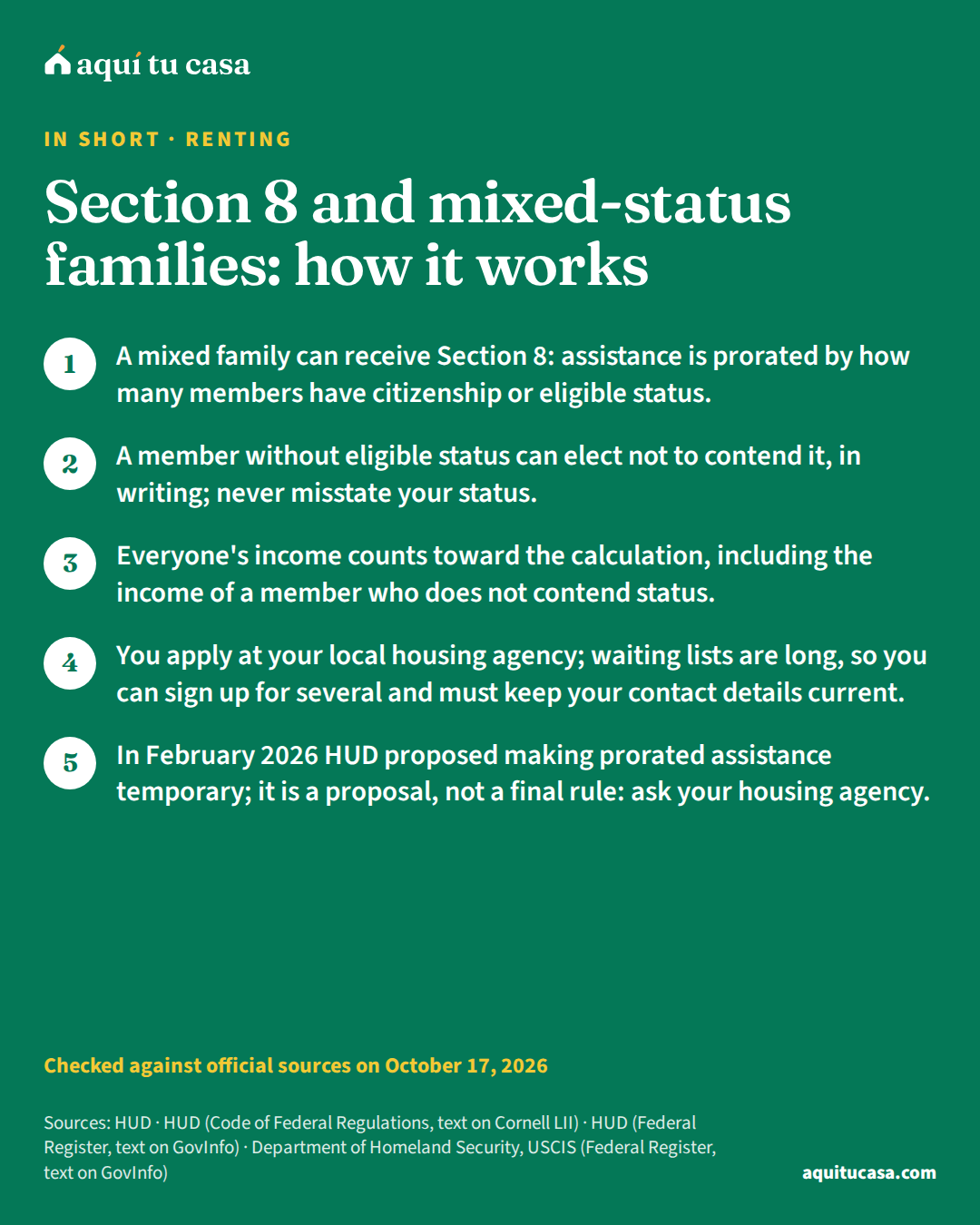
- Renting Section 8 and mixed-status families: how it works How the Section 8 voucher works, how aid is prorated in a mixed-status family, how to apply through your housing agency and what HUD proposed. 12 minute read
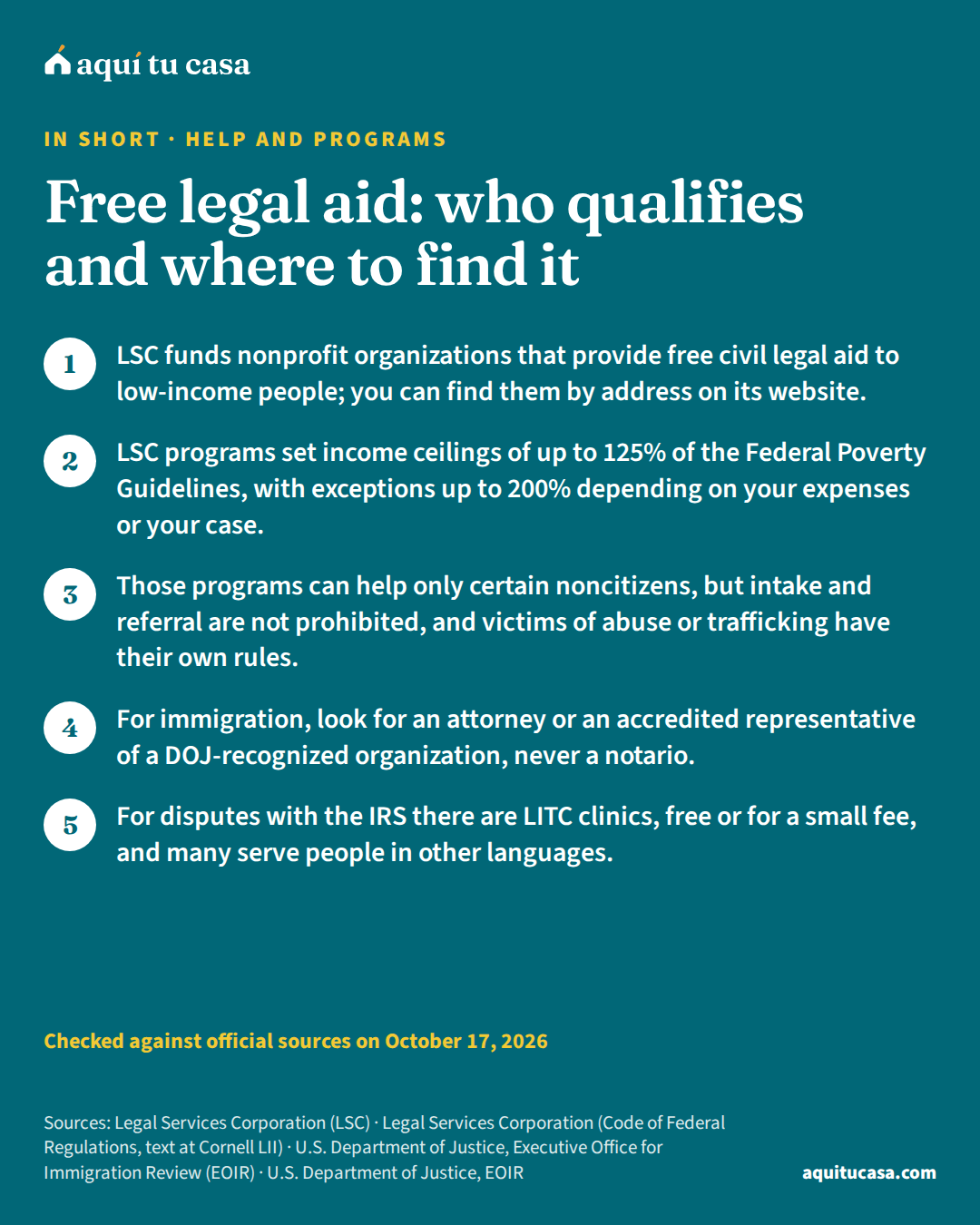
- Help and programs Free legal aid: who qualifies and where to find it What free legal aid is, who qualifies, which rules apply if you are not a citizen, and where to get help with immigration and tax problems. 11 minute read
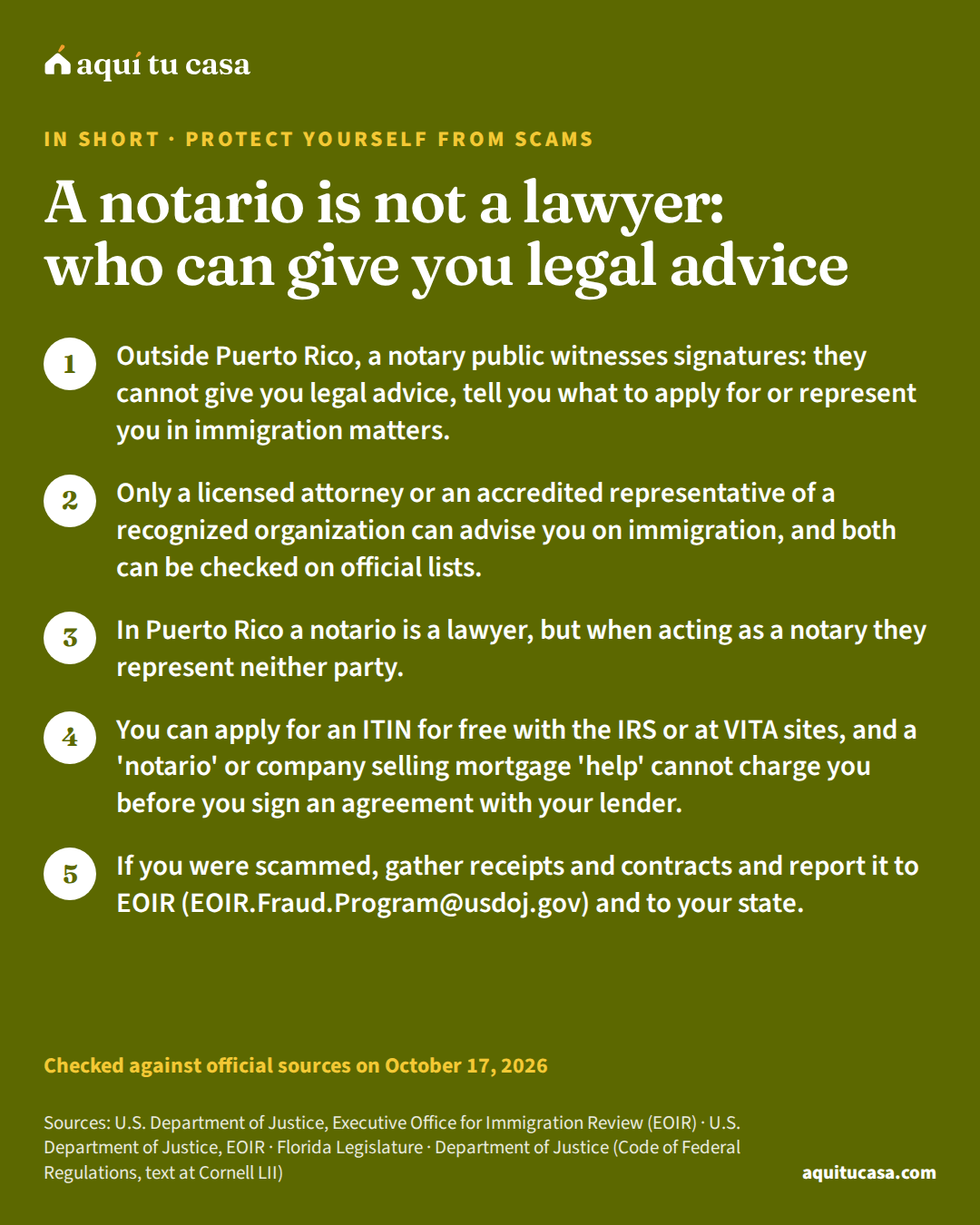
- Protect yourself from scams A notario is not a lawyer: who can give you legal advice Outside Puerto Rico, a notary public is not a lawyer. What a notary can do, who can advise you for free or at low cost, warning signs and how to report it. 12 minute read
Tools for this topic
Was this guide useful?
Thank you. Your answer stays in your browser; nothing is sent.