VAWA: your housing if you face domestic violence or stalking
How VAWA protects you in federally assisted housing: no denial or eviction for being a victim, Form HUD-5382 and emergency transfers to a safe home.
Verified against official sources on October 31, 2026 15 official sources

Show contents
In short
What you need to know
Quick answer
If you live or want to live in federally assisted housing, such as public housing or with a Section 8 voucher, VAWA bars the provider from denying you housing, ending your assistance or evicting you because you are a victim of domestic violence, dating violence, sexual assault or stalking. If they ask for proof in writing, you get at least 14 business days and can use Form HUD-5382. You can request an emergency transfer to a safe home, and the owner can remove the abuser from the lease without penalizing you. If you are in danger now, call 911.
What matters most
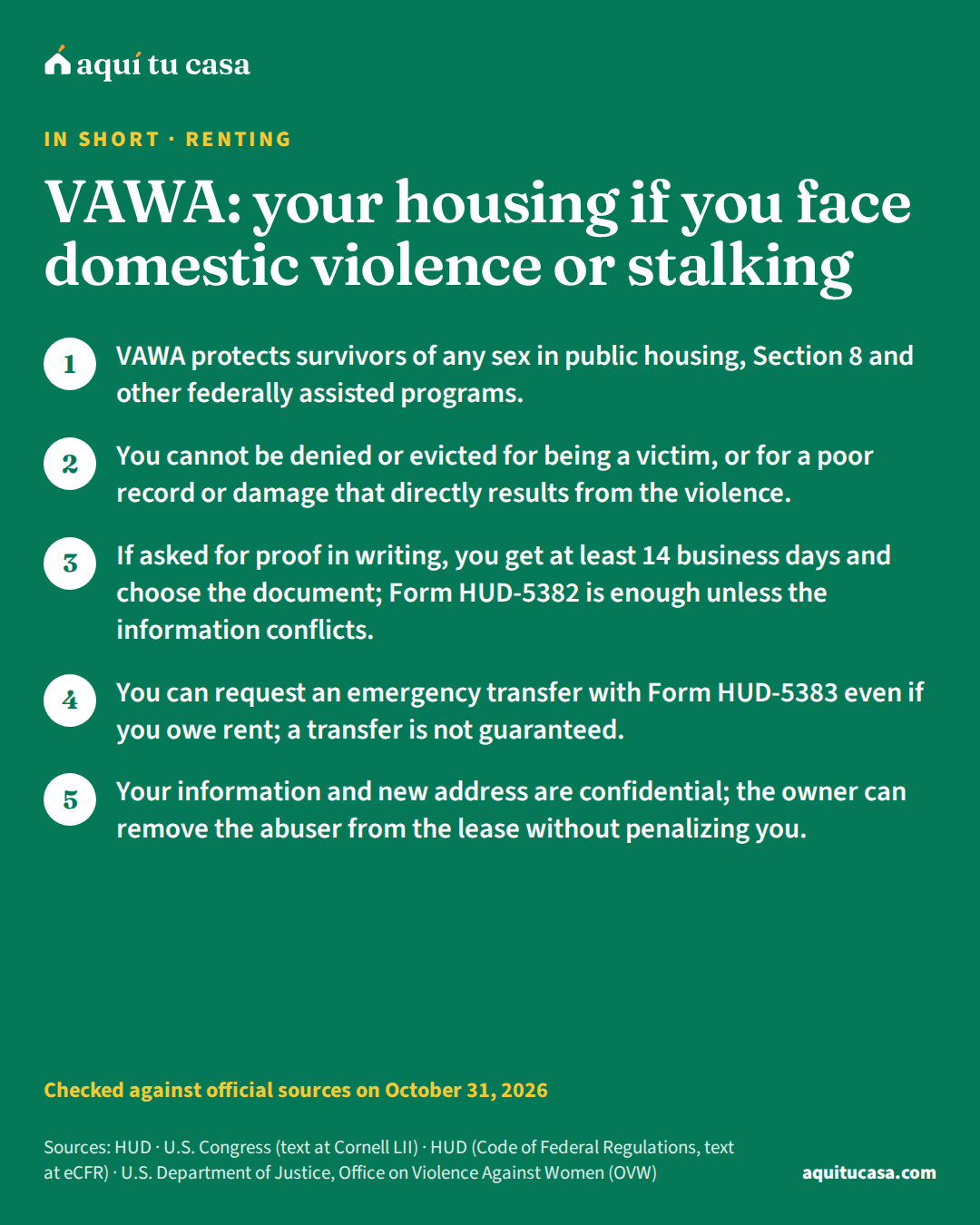
- VAWA protects survivors of any sex in public housing, Section 8 and other federally assisted programs.
- You cannot be denied or evicted for being a victim, or for a poor record or damage that directly results from the violence.
- If asked for proof in writing, you get at least 14 business days and choose the document; Form HUD-5382 is enough unless the information conflicts.
- You can request an emergency transfer with Form HUD-5383 even if you owe rent; a transfer is not guaranteed.
Is this for you?
This guide is for you if…
- You are experiencing or have experienced domestic violence, dating violence, sexual assault or stalking, and you live or want to live in public housing, with a Section 8 voucher or in other federally assisted housing.
- You got an eviction notice or a notice ending your assistance over something connected to the violence you experienced.
- You want to move to a safe home without losing your rental assistance, or to get the abuser off your lease.
Get direct help first if…
- You are in danger right now: call 911. This guide can wait.
- You rent on the private market with no federal assistance: the rules in this guide are for housing covered by VAWA; free legal aid can advise you on your situation.
No one should have to choose between their safety and their home. This guide is for you if you are experiencing or have experienced domestic violence, dating violence, sexual assault or stalking, and you live or want to live in federally assisted housing, such as public housingpublic housingPublic housing is a program of rental homes for low-income families, older adults and people with disabilities. HUD funds local public housing agencies (PHAs), which manage the homes and charge rents those families can afford. It comes in all sizes and types, from scattered single-family houses to high-rise apartments. The PHA decides whether you qualify based on your annual gross income, whether you are elderly, have a disability or are a family, and your U.S. citizenship or eligible immigration status. To apply, you contact your local PHA. In general, you can stay as long as you comply with the lease.See the full definition or with a Section 8 voucherHousing Choice Voucher (Section 8)The Housing Choice Voucher, the program almost everyone calls Section 8, is the country's largest federal rental assistance. HUD pays rental subsidies so eligible families can afford decent, safe and sanitary housing. Local public housing agencies administer it with HUD funds. The family finds its own home on the private market; if the agency approves the unit and the tenancy, it contracts with the owner to pay part of the rent, and the family pays the rest. Waiting lists are usually long and open for limited periods.See the full definition. It explains what the provider cannot do to you, how to ask for protection, how to get the abuser off the leaseleaseA lease, or rental agreement, is the contract in which the owner or landlord gives you the right to live in and use a property for a set period of time in exchange for payment, usually rent. While the lease lasts you have possession, but the landlord still owns the property. The lease says how much you pay and when, who handles maintenance and how the agreement can end. Your rights as a tenant are usually spelled out in the lease and in your state and local laws. Before complaining to the landlord, it helps to read the lease and make sure you are also following the rules you agreed to.See the full definition and how to ask for a transfer to a safe place. You decide which steps to take and when.
What VAWA is and who it protects
The Violence Against Women Act, known as VAWA, is a federal law. According to HUD, part of it protects the housing of people who apply for or live in federally subsidized units and who have experienced domestic violence, dating violence, sexual assault or stalking. The goal is to help keep you safe and to keep you from becoming homeless.1
Despite the name, it is not only for women. HUDDepartment of Housing and Urban Development (HUD)HUD (the U.S. Department of Housing and Urban Development) is the federal department that runs housing and community development assistance programs and works to ensure fair and equal housing opportunity. The Federal Housing Administration (FHA), which insures mortgages made by private lenders, is part of HUD. HUD funds local public housing agencies (PHAs) that run public housing and Section 8 vouchers. It also approves housing counseling agencies across the country, and you can file a housing discrimination complaint with its Office of Fair Housing and Equal Opportunity (FHEO).See the full definition’s regulation protects victims regardless of sex, gender identity or sexual orientation.4 You do not have to be married to the abuser, related to them or living with them, and it does not matter how long ago the violence happened.1
These are the four forms of violence the law covers, according to the regulation:5
- Domestic violence: violent crimes by your spouse, partner or former partner, by someone you share a child with, or by someone who lives or lived with you as a partner.
- Dating violence: violence by someone you are or were in a romantic or intimate relationship with.
- Sexual assault: any sexual act without your consent that the law prohibits.
- Stalking: a course of conduct aimed at you that would make anyone fear for their safety or the safety of others, or suffer substantial emotional distress.
The law also looks out for your family: you cannot be evicted because of someone else’s criminal acts related to violence against you, a member of your household or another affiliated person.10 The law calls your spouse, parents, siblings and children, anyone you care for as a parent, and anyone living in your household an “affiliated individual.”2
Which housing VAWA covers
VAWA does not cover every rental. It covers federally assisted housing programs. HUD programs include public housing, Section 8 vouchers and project-based Section 8, Section 202 housing for older adults and Section 811 housing for people with disabilities, HOPWA, HOME, homeless programs, Section 221(d)(3) and Section 236 multifamily housing, and the Housing Trust Fund.5
The law adds programs outside HUD, such as certain rural housing assistance, the low-income housing tax credit (LIHTC) and housing programs for homeless veterans.2 In September 2024, HUD, the Department of Agriculture, the Treasury, Veterans Affairs and the Justice Department issued a joint statement on these protections.1
You do not need to know your program’s name to ask for protection, and you can raise it at any time.10 If your housing has no federal assistance, these rules do not apply. Where they do apply, VAWA does not override any federal, state or local law that gives victims more protection.9
What the provider cannot do because you are a victim
In covered housing, you cannot be denied admission or assistance, terminated from the program or evictedevictionEviction is the legal process a landlord uses to get back a rented home when the tenant does not want to leave. The most common reasons are unpaid rent, serious lease violations or a lease that has ended. First the landlord must give you written notice. If it is not resolved, the landlord needs a court order, and a law enforcement officer must carry out the removal. If you are sued, you have the right to file a written answer explaining to the court why you should not be evicted. The rules change by state and city.See the full definition because you are or were a victim, if you otherwise qualify.2 An incident of violence, or a threat of violence, is not a serious or repeated violation of your lease, nor a good reason to take away your assistance.2
You also cannot be punished for the consequences of the violence. HUD’s notice gives concrete examples: if you have a poor rental or credit history, or a criminal record, that directly results from the violence, it cannot be used to deny you housing. And if the violence led to noise complaints or property damage, those cannot be used to evict you.10
If your abuser commits a crime related to the violence, no one can take your home from you just for that, even if the abuser is a household member or a guest.2
If you already got an eviction noticeeviction noticeAn eviction notice, also called a notice to quit or notice to vacate, is the written letter in which the landlord demands that you leave the home within a certain time. In general the landlord must give you this notice before starting an eviction case in court. At a minimum it should say why the landlord wants you out and what you can do to avoid it, such as paying the back rent. Your state's law decides when it can be given, how it must be delivered and how much time you get. The notice is not a court order: with the notice alone, the landlord cannot remove you.See the full definition, our guide on what to do if you get an eviction notice and the eviction timeline tool help you see your deadlines.

How to ask for protection: Form HUD-5382
The owner or housing agency must give you two papers: the notice of your rights (Form HUD-5380) and the certification form (HUD-5382).1 They must give them to you when you are denied housing, when you are admitted and with any eviction notice or notice ending your assistance, and they must be available in multiple languages.6
The owner does not have to ask you for proof.7 If they do, it must be in writing, and you get at least 14 business days to respond; they can give you more time. You choose which document to provide:7
If you are asked for proof in writing
1. Check the date of the request
The day you receive it
You get at least 14 business days from when you receive the written request; you can ask for more time.7
2. Choose a single document
Before the deadline
Form HUD-5382, a statement from a professional who helped you, a police or court record, or your own statement if the owner accepts it.7
3. Fill out Form HUD-5382, if you choose it
When you are ready
You or someone else can fill it out. The abuser's name goes in only if you know it and it is safe.10
4. Say how to reach you safely
On the same form
Mark whether it is safe to get a voicemail, an email or a letter.11
5. Submit it and keep a copy
Before the deadline
The owner must accept the document you chose and cannot ask for more unless it receives conflicting information.10
Form HUD-5382 is short. It asks for the victim’s name and the names of other household members, the safest way to contact you, and your signature. By signing, you certify that what you wrote is true to the best of your knowledge and recollection. The form itself says you cannot be required to prove your status in any other way than HUD’s notice describes.11 And HUD says you must be able to prove it with this form alone, unless the owner has conflicting information.1
If the owner receives documents that contradict each other, for example two people in the same household accusing each other, they can ask for a third-party document, such as a letter from a professional or an official record, and must give you 30 calendar days.7
If you speak Spanish or another language, the owner must give you language help, such as an interpreter or a translation, and HUD has translated forms.11 And if you have a disability, you can ask for a reasonable accommodation, such as more time or help filling out the papers, even during an eviction.11 Our guide on reasonable accommodations for disabilities explains how to ask.

Getting the abuser off the lease
The owner can divide the lease, which is called “lease bifurcation,” to evict or end assistance only for the abuser, whether or not they signed the lease, without evicting or penalizing you.8 You can ask for it, and if the owner does it, they must follow federal, state or local law and the program’s rules.1
What if the abuser was the one who qualified for the assistance? As a general rule, the owner must give you and your family 90 calendar days to show you qualify for the same program or another one, or to find other housing. They can extend that by up to 60 more days, and the period does not run past the end of the lease unless the program allows it. Each program can set its own time frame.8
Example with real numbers
How much time your family gets if the person who qualified is removed
What HUD's notice says for some programs.
- Section 8 and public housing, if the abuser was the only one with established eligible citizenship or immigration status
- 30 calendar days
- HUD-VASH, if the veteran is removed
- Your family can keep the assistance
- Sections 202 and 811 (PRAC contract)
- 90 days or until the lease ends
- Section 236 and project-based Section 8
- 30 calendar days
- HOPWA
- 90 days to one year
The time frames come from Form HUD-5380.10 The regulation's general period is 90 calendar days, with up to 60 more.8
If your family has mixed immigration status, the 30 days can go fast. Our guide on Section 8 and mixed-status families explains how prorated assistance is calculated, and free legal aid can advise you before the time runs out.10
Emergency transfer to a safe home
If you have rental assistance or live in covered housing, you can ask for an emergency transfer. You qualify if you expressly ask and reasonably believe you are in danger of more violence if you stay in the same unit. If you were sexually assaulted on the property, you also qualify if you ask within the following 90 days.6 Those 90 days include weekends and holidays.10
You can ask even if you are behind on your lease, for example if you owe rent. But a transfer is not guaranteed.10 To ask, a written request certifying that you meet the conditions is enough; the owner can ask you to document the violence if you have not already, and cannot require anything else.6
Form HUD-5383 is for that. It lets you list who would move with you and what would make a unit safe for you: a new neighborhood or building, a first floor or an upper floor, near an exit, well-lit hallways, 24-hour security or an accessible unit. The form says the owner should not look at whether you are in good standing when deciding on the transfer.12
Internal or external transfer
Within the same program
Internal transfer
With a Section 8 voucher, HUD says you must be allowed to move with your assistance.1
Every owner or housing agency must have an emergency transfer plan and give it to you if you ask. The plan must keep the location of your new home strictly confidential. A “safe unit” is one that you believe is safe.6
Your information is confidential
Everything you share about the violence, even the fact that you are a victim, is kept in strict confidence. It does not go into a shared database and is not given to anyone, unless you allow it in writing for a limited time, it is needed in an eviction or a hearing about your assistance, or another law requires it.7 The owner must also keep your information apart from your other files and protect your address so it does not reach the person who hurt you.11
And you cannot be punished for standing up for these rights. The law bars a housing agency or owner from threatening, intimidating or retaliating against you for using these protections or for helping someone else use them.3 Our guide on landlord retaliation explains other protections.
If this is you
You got an eviction notice after a fight at home
An incident of violence is not a serious lease violation.2 Ask for Form HUD-5380, which must come with the eviction notice.6
Your abuser lives with you and is on the lease
You can ask for the lease to be divided to remove them without penalizing you.8
You have a Section 8 voucher and need to leave now
Ask for an emergency transfer; HUD says you must be allowed to move with your assistance.1
You are not a U.S. citizen
LSC-funded legal aid can help noncitizen victims with protection orders and housing.14
You have a disability
You can ask for more time or help with the forms as a reasonable accommodation.11
If your rights are violated: complaints and free help
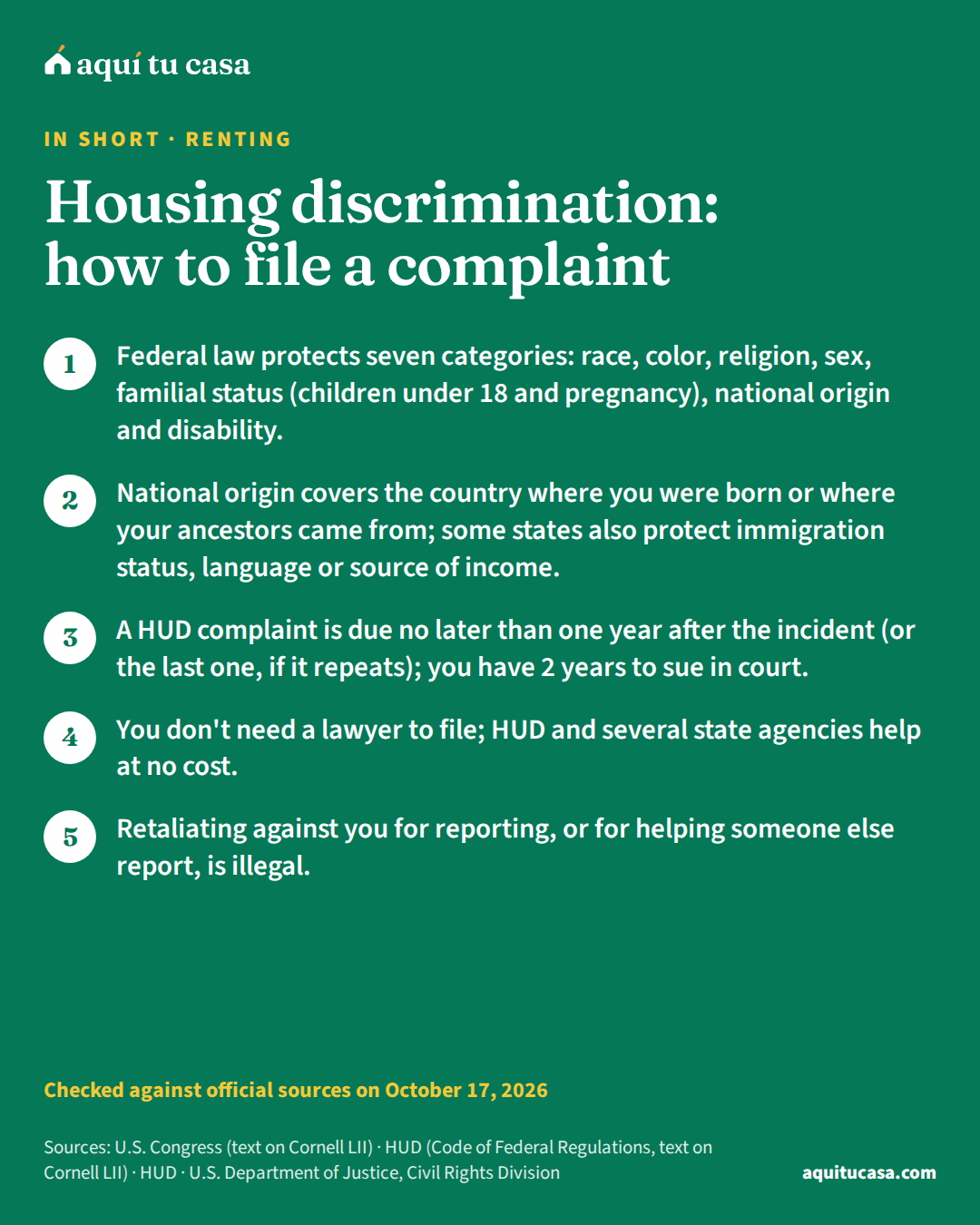
If you believe your VAWA rights were violated, you can file a complaint with HUD’s Office of Fair Housing and Equal Opportunity (FHEO). HUD has information in multiple languages, and you can file online, by email, by mail or by phone. On the form, explain in the narrative section why you believe your rights were violated. Retaliating against someone who files a complaint is unlawful.1 Our guide on how to report housing discrimination walks through HUD’s complaint process.
Free legal aidlegal aidLegal aid is the free civil legal help that nonprofit organizations and their lawyers provide to low-income people in civil, not criminal, matters. In housing, that includes representing families facing eviction or foreclosure, alongside matters such as custody, child support, protection from domestic violence and access to benefits. In the United States, the Legal Services Corporation, created by Congress, funds a nationwide network of these organizations; its finder points you to the one in your area. Each sets its own income limits.See the full definition can help with an eviction, a protection order or a transfer. The Legal Services Corporation has a search tool for organizations near you.15 If you are not a citizen, its regulation allows help for victims of abuse, sexual assault or trafficking, and that help can include protection orders, custody and housing.14 Our guide on free legal aid explains who qualifies.
Costly mistakes
Mistake: Letting the 14 business days pass without answering the request for proof.
Instead: Provide a document on time or ask for more time in writing; the owner can extend the deadline.7
Mistake: Handing over several documents or your whole medical file.
Instead: One of the allowed documents, such as Form HUD-5382, is enough.10
Mistake: Writing the abuser's name even when it is not safe.
Instead: The form asks for it only if you know it and it is safe to give.11
Mistake: Not asking for a transfer because you owe rent.
Instead: You can ask even if you are behind on your lease.10
Mistake: Giving a phone number or email your abuser checks.
Instead: Put the safest way to reach you on the form.11
Mistake: Thinking VAWA is only for married women.
Instead: It protects victims of any sex, married or not, no matter when the violence happened.4
What to do this week
- If you are in danger, call 911, or the National Domestic Violence Hotline at 1-800-799-7233.13
- Ask your owner or housing agency for Form HUD-5380 and Form HUD-5382, in your language.6
- If you were asked for proof in writing, write down the date and provide one document within the 14 business days.7
- If you need to leave, ask for the emergency transfer plan and fill out Form HUD-5383.6
- Keep copies of everything in a safe place and look for free legal aid near you.15
Ready to see the numbers? Find your county here
See how this applies in your county: its loan limits, prices and rents, from the official data.
Printable checklist
Frequently asked questions
Can I be evicted because my partner hit me and the police came?
In housing covered by VAWA, you cannot be evicted because you are a victim, and an incident of violence is not a serious lease violation. You also cannot lose your home just because of your abuser's criminal acts related to that violence. VAWA still allows eviction for other violations unrelated to the violence, as long as you are not held to a stricter standard than other tenants.
What proof do I have to give to be protected?
Sometimes none: the owner does not have to ask. If they do, the request must be in writing and give you at least 14 business days. You choose the document: Form HUD-5382, a statement signed by a professional who helped you, a police or court record or, if the owner allows it, your own statement. They can ask for more only if they receive conflicting information.
Do I have to write my abuser's name on the form?
Only if you know it and it is safe to give. Form HUD-5382 says exactly that. It also asks for the safest way to contact you, so the owner does not leave messages where they could put you at risk.
Can I move to another unit without losing my Section 8?
Yes, you can request an emergency transfer if you reasonably believe you are in danger if you stay, or if you suffered a sexual assault on the property in the past 90 days. HUD says that if you have a Section 8 voucher, you must be allowed to move with your assistance. You can ask even if you owe rent, but a transfer is not guaranteed.
Will the owner tell my abuser where I live?
They must not. Everything you share about the violence is strictly confidential and does not go into any shared database. The emergency transfer plan must protect your new location, and Form HUD-5382 says the owner must keep your address strictly confidential.
Is VAWA only for women?
No. Despite the name, HUD's regulation says it protects victims regardless of sex, gender identity or sexual orientation. You do not have to be married to, related to or living with the abuser, and it does not matter how long ago the violence happened.
What happens to my family if the person with eligible immigration status is removed from the lease?
According to Form HUD-5380, in Section 8 and public housing, if the person removed was the only one who had established eligible citizenship or immigration status, the others get 30 calendar days to establish eligibility or find other housing. If your family has mixed immigration status, get free legal help before that time runs out.
Who do I call if I am in danger?
If you are in immediate danger, call 911. The Justice Department also lists the National Domestic Violence Hotline, 1-800-799-7233, and the National Sexual Assault Hotline, 1-800-656-4673, which connect you with services near you.
Sources
Every figure in this guide comes from one of these official sources. The number next to a sentence leads to the source behind it.
Each source on one line: who publishes it, its title, its address and the date we read it.
- 1. HUD · Violence Against Women Act (VAWA) · hud.gov · Accessed October 31, 2026
- 2. U.S. Congress (text at Cornell LII) · 34 U.S.C. §12491, Housing protections for victims of domestic violence, dating violence, sexual assault, and stalking · law.cornell.edu · Accessed October 31, 2026
- 3. U.S. Congress (text at Cornell LII) · 34 U.S.C. §12494, Prohibition on retaliation · law.cornell.edu · Accessed October 31, 2026
- 4. HUD (Code of Federal Regulations, text at eCFR) · 24 CFR §5.2001, Applicability (Protection for Victims of Domestic Violence, Dating Violence, Sexual Assault, or Stalking) · ecfr.gov · Accessed October 31, 2026
- 5. HUD (Code of Federal Regulations, text at eCFR) · 24 CFR §5.2003, Definitions · ecfr.gov · Accessed October 31, 2026
- 6. HUD (Code of Federal Regulations, text at eCFR) · 24 CFR §5.2005, VAWA protections · ecfr.gov · Accessed October 31, 2026
- 7. HUD (Code of Federal Regulations, text at eCFR) · 24 CFR §5.2007, Documenting the occurrence of domestic violence, dating violence, sexual assault, or stalking · ecfr.gov · Accessed October 31, 2026
- 8. HUD (Code of Federal Regulations, text at eCFR) · 24 CFR §5.2009, Remedies available to victims of domestic violence, dating violence, sexual assault, or stalking · ecfr.gov · Accessed October 31, 2026
See the other 7 sources
- 9. HUD (Code of Federal Regulations, text at eCFR) · 24 CFR §5.2011, Effect on other laws · ecfr.gov · Accessed October 31, 2026
- 10. HUD · Notice of Occupancy Rights under the Violence Against Women Act (Form HUD-5380) · hud.gov · Accessed October 31, 2026
- 11. HUD · Certification of Domestic Violence, Dating Violence, Sexual Assault, or Stalking (Form HUD-5382) · hud.gov · Accessed October 31, 2026
- 12. HUD · Emergency Transfer Request for Victims of Domestic Violence, Dating Violence, Sexual Assault, or Stalking (Form HUD-5383) · hud.gov · Accessed October 31, 2026
- 13. U.S. Department of Justice, Office on Violence Against Women (OVW) · Local Resources · justice.gov · Accessed October 31, 2026
- 14. Legal Services Corporation (Code of Federal Regulations, text at Cornell LII) · 45 CFR §1626.4, Aliens eligible for assistance under anti-abuse laws · law.cornell.edu · Accessed October 31, 2026
- 15. Legal Services Corporation (LSC) · I Need Legal Help · lsc.gov · Accessed October 31, 2026
Keep reading
Related guides
If this guide helped, these follow the same path.

Renting 12 minute read
Section 8 and mixed-status families: how it works
How the Section 8 voucher works, how aid is prorated in a mixed-status family, how to apply through your housing agency and what HUD proposed.
- A mixed family can receive Section 8: assistance is prorated by how many members have citizenship or eligible status.
- A member without eligible status can elect not to contend it, in writing; never misstate your status.
- Everyone's income counts toward the calculation, including the income of a member who does not contend status.
- Renting What to do if you get an eviction notice Notice, lawsuit and the judge's order: what you can do at each moment, where free legal help is and what federal law says about the 30-day notice. 14 minute read
- Help and programs Free legal aid: who qualifies and where to find it What free legal aid is, who qualifies, which rules apply if you are not a citizen, and where to get help with immigration and tax problems. 11 minute read
- Renting Housing discrimination: how to file a complaint What the Fair Housing Act prohibits when you rent, how national origin and children are covered, and how to file with HUD or your state on time. 11 minute read
Tools for this topic
Was this guide useful?
Thank you. Your answer stays in your browser; nothing is sent.