Reasonable accommodations and modifications if you have a disability
What you can ask a landlord for because of a disability under the Fair Housing Act: rule changes, physical changes, assistance animals and complaints.
Verified against official sources on October 31, 2026 13 official sources

Show contents
In short
What you need to know
Quick answer
The Fair Housing Act gives you two rights if you have a disability. You can ask for a reasonable accommodation, a change to a rule or service, such as a parking space near your door; the landlord generally pays for it. And you can ask permission for a reasonable modification, a physical change, such as bathroom grab bars; in a private rental you pay for it, but in federally assisted housing the provider often does. You can ask orally or in writing. If your disability is not obvious, the landlord can ask for reliable information, but not your medical records.
What matters most
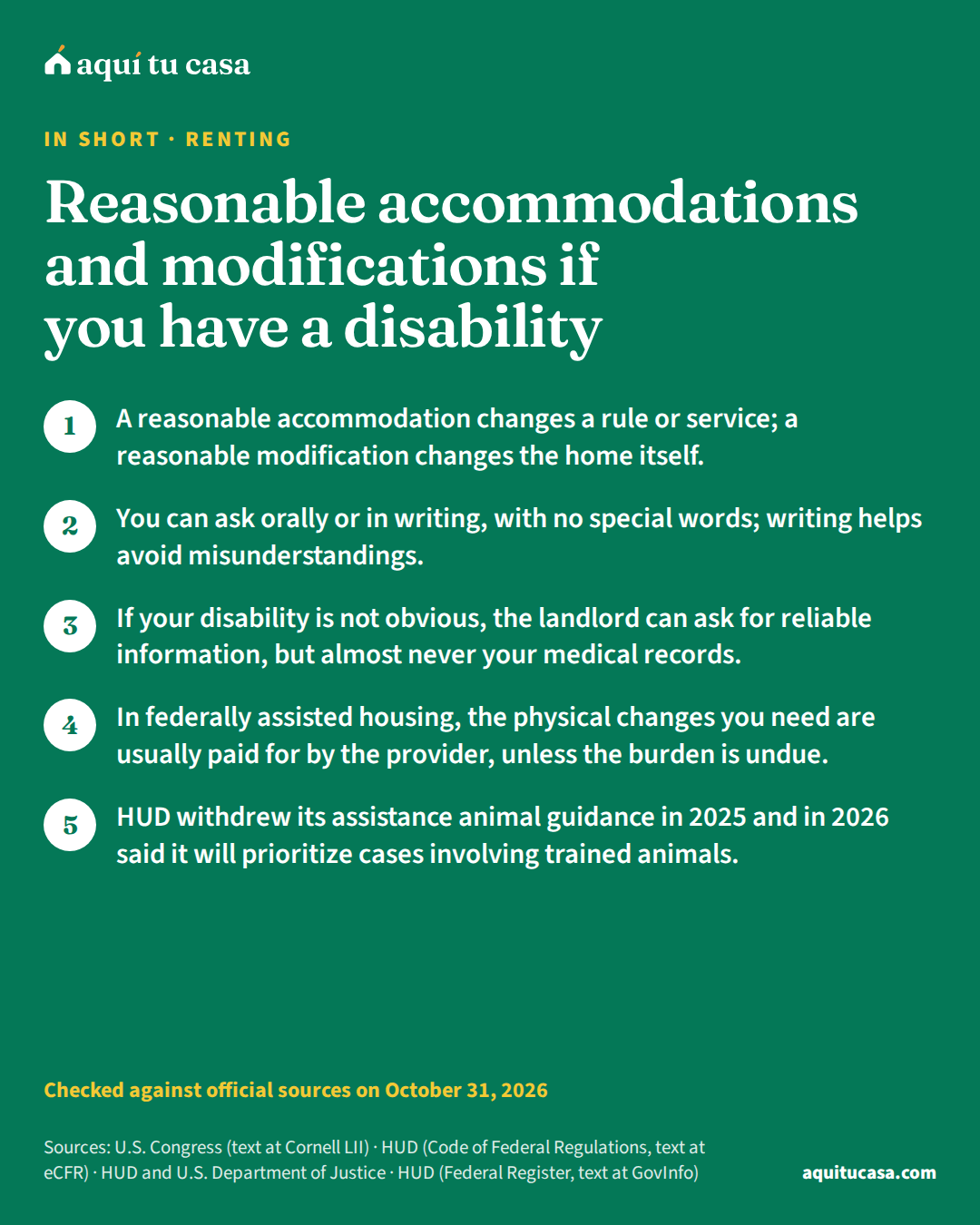
- A reasonable accommodation changes a rule or service; a reasonable modification changes the home itself.
- You can ask orally or in writing, with no special words; writing helps avoid misunderstandings.
- If your disability is not obvious, the landlord can ask for reliable information, but almost never your medical records.
- In federally assisted housing, the physical changes you need are usually paid for by the provider, unless the burden is undue.
Is this for you?
This guide is for you if…
- You or someone in your household has a physical or mental disability and you need the landlord to change a rule, such as where you park or how you pay rent.
- You need to make a physical change to your home, such as grab bars in the bathroom, a ramp or a wider door.
- You have an animal that helps you because of your disability and the building does not allow pets.
Get direct help first if…
- You face eviction in a few days: besides reading this guide, contact free legal aid today, because court dates do not wait.
- You want a loan to adapt a home you own: this guide is about renting; our USDA home repair guide covers help for owners in rural areas.
A disability should not close the door to your home. This guide is for you if you or someone in your household has a disability and you need the landlord to change a rule, let you make a physical change to your home or allow an animal that helps you. It explains what the Fair Housing ActFair Housing ActThe Fair Housing Act is the federal law that makes it illegal to refuse to sell or rent a dwelling, or to discriminate in its terms, because of race, color, religion, sex, familial status (having children), national origin or disability. It applies to landlords, real estate agents and managers, and also to banks and lenders when their practices make housing or credit unavailable for those reasons. National origin covers your language and the country you come from, regardless of immigration status. If you believe you were discriminated against, you can file a complaint with HUD at no cost; many states add protections.See the full definition says, how to ask for what you need, what you can be asked and what to do if the answer is no. It explains the rules; it does not decide your case.
What the law says and who is protected
The Fair Housing Act bars discrimination in renting because of a disability of the tenant, of someone who lives or will live with them, or of anyone associated with them. It also bars giving that person different conditions or services.1 The statute uses the word “handicap,” which has the same legal meaning as “disability.”8
Who has a disability under the law? HUDDepartment of Housing and Urban Development (HUD)HUD (the U.S. Department of Housing and Urban Development) is the federal department that runs housing and community development assistance programs and works to ensure fair and equal housing opportunity. The Federal Housing Administration (FHA), which insures mortgages made by private lenders, is part of HUD. HUD funds local public housing agencies (PHAs) that run public housing and Section 8 vouchers. It also approves housing counseling agencies across the country, and you can file a housing discrimination complaint with its Office of Fair Housing and Equal Opportunity (FHEO).See the full definition’s regulation says it is a physical or mental impairment that substantially limits one or more major life activities, such as caring for yourself, walking, seeing, hearing, speaking, breathing, learning or working. Having a record of such an impairment, or being treated as if you had one, also counts. It does not include current illegal drug use.4
The list of impairments is broad. The regulation mentions, among others, visual, hearing and speech impairments, autism, epilepsy, cancer, heart disease, diabetes, HIV, emotional illness and alcoholism.4
The law gives two separate rights: the reasonable accommodation and the reasonable modification. Refusing either one, when your disability makes it necessary, is discrimination.1 The law sets one limit: it does not require housing for someone whose tenancy would be a direct threat to the health or safety of others, or would cause substantial physical damage to others’ property.1
Reasonable accommodation or reasonable modification
Changes a rule or service
Reasonable accommodation
In federally assisted housing, the physical changes you need are usually paid for by the provider.9
The reasonable accommodation: changing a rule
According to HUD and the Justice Department, a reasonable accommodation is a change, exception or adjustment to a rule, policy, practice or service that may be necessary for you to have an equal opportunity to use and enjoy your home, including common areas. There must be a clear link between what you ask for and your disability.8
The regulation gives two examples. A blind applicant wants to live with a seeing eye dog in a building that does not allow pets. A tenant who cannot walk more than a short distance asks for a reserved parking space near his unit. In both cases, refusing is a violation.7 The Joint Statement adds another: letting a friend mail the rent for a tenant whose mental disability makes her afraid to leave home.8
When can the landlord say no? According to the Joint Statement, if the person asking does not have a disability, if there is no disability-related need, or if the accommodation would be an undue financial and administrative burden or fundamentally change what the landlord does. That is decided case by case. And if the landlord says it is not reasonable, it should talk with you about another solution; if that solution meets your need and is reasonable, it must provide it.8
You know your limitations better than anyone. You do not have to accept another solution the landlord proposes if you believe it will not work for you and what you asked for is reasonable.8
The reasonable modification: changing the home
A reasonable modification is a structural change to the home so you can fully enjoy it. It can be inside, outside or in common areas, and you can ask for it at any time while you rent. Some changes that are typically reasonable: widening doorways, installing bathroom grab bars, lowering kitchen cabinets, adding a ramp at the entrance or changing a walkway to reach the laundry room or gym.9
In a private rental, the law says the landlord must allow the change and you pay for it.1 You need the landlord’s approval before you start, but if you meet the requirements and provide the necessary documents and assurances, the landlord cannot refuse.9
The regulation gives the landlord some protections:6
- Where reasonable, it can require you to restore the interior when you leave, except normal wear and tear.
- It cannot raise your usual security depositsecurity depositA security deposit is money you pay the landlord when you start renting as security that you will follow the lease: pay the rent and take care of the home. The money still belongs to you. The landlord holds it and, when you move out, must return it minus the charges the law allows, such as past-due rent or damage beyond normal wear and tear. You should not be charged for damage that was already there when you moved in. The maximum amount and the deadline to return it depend on your state's law and sometimes your city's.See the full definition because of your disability.
- If needed to make sure the restoration money will be there, it can negotiate that you pay a reasonable amount, no more than the restoration cost, into an interest-bearing account in your favor over time.
- It can ask for a description of the work and assurances that it will be done properly and with any needed permits.
The regulation’s examples make this concrete. If you install bathroom grab bars, the landlord can ask you to remove them when you leave, but not to remove the wall reinforcement. And if you widen the bathroom door for your child’s wheelchair, it usually cannot ask you to narrow it again.6
Example with real numbers
Grab bars in the bathroom of a rented apartment
An example in words, using HUD's regulation.
- What you ask for
- Permission to install grab bars in the bathroom
- Who pays in a private rental
- You, the tenant
- What the landlord can ask for first
- A description of the work and that it be done properly, with permits
- What it can ask when you leave
- Remove the bars and repair the wall
- What it cannot ask
- Remove the wall reinforcement, or raise your usual deposit
- If the housing receives federal assistance
- The provider usually pays for the change, unless the burden is undue
The example's rules come from HUD's regulation.66 The rule for federally assisted housing comes from Section 504, according to HUD and the Justice Department.9

If you live in federally assisted housing
If you live in public housingpublic housingPublic housing is a program of rental homes for low-income families, older adults and people with disabilities. HUD funds local public housing agencies (PHAs), which manage the homes and charge rents those families can afford. It comes in all sizes and types, from scattered single-family houses to high-rise apartments. The PHA decides whether you qualify based on your annual gross income, whether you are elderly, have a disability or are a family, and your U.S. citizenship or eligible immigration status. To apply, you contact your local PHA. In general, you can stay as long as you comply with the lease.See the full definition or other housing that receives federal financial assistance, two laws protect you: the Fair Housing Act and Section 504 of the Rehabilitation Act. Under Section 504, the structural changes you need count as reasonable accommodations, and the provider must pay for them, unless that would be an undue financial and administrative burden or a fundamental change to the program, or it can meet your need another way, such as a transfer to another suitable unit.9
For example, a tenant who uses a wheelchair and needs a roll-in shower would pay for it in a private rental. In federally assisted housing, the provider would have to install it, unless the burden is undue or it moves the tenant to another unit that already has one.9

How to ask, step by step
You make a request when you make clear to the landlord that you are asking for an exception or change because of your disability. You do not need a special form, to mention the law or to use the words “reasonable accommodation.” A family member or someone else can ask for you. It can be oral or written, but writing helps avoid misunderstandings, and the landlord must consider it even if you do not use its form.8
From your request to an answer
1. Write down what you need
Before talking to the landlord
Which accommodation or modification you are asking for and, if it is not obvious, how it relates to your disability.8
2. Hand in the request and keep a copy
The day you hand it in
Asking orally works, but in writing you have proof of what you asked for and when.8
3. Answer what you are asked, only if needed
If your disability is not obvious
Reliable information about the disability, the accommodation and the link between them; almost never your medical records.8
4. Talk about other solutions
If the landlord says it is not reasonable
The landlord should work with you on another solution that meets your need.8
What you can and cannot be asked
Before you ask for an accommodation, the landlord cannot ask whether you have a disability or how severe it is. It can ask all applicants certain questions: whether you can meet the leaseleaseA lease, or rental agreement, is the contract in which the owner or landlord gives you the right to live in and use a property for a set period of time in exchange for payment, usually rent. While the lease lasts you have possession, but the landlord still owns the property. The lease says how much you pay and when, who handles maintenance and how the agreement can end. Your rights as a tenant are usually spelled out in the lease and in your state and local laws. Before complaining to the landlord, it helps to read the lease and make sure you are also following the rules you agreed to.See the full definition requirements, whether you qualify for housing or a priority for people with disabilities, whether you use illegal drugs or whether you were convicted of making or selling them.5
When you ask for an accommodation, the rule shifts a little. If your disability and the need are obvious or already known to the landlord, it cannot ask for more information. If they are not, it can ask for reliable information that shows your disability, describes the accommodation and explains the link between them. You can often provide it yourself: if you are under 65, proof that you receive SSI or SSDI, or a credible statement. So can a doctor, a support group, a service agency or another reliable person who knows you. In most cases your medical records are not needed, and the information must be kept confidential.8
Service animals and emotional support animals
HUD’s regulation still uses one clear example: a blind applicant who wants to live with a seeing eye dog in a no-pets building. Refusing is a violation.7
For other animals, HUD’s rules have changed, and it helps to know how. HUD withdrew its assistance animal guidance (FHEO-2020-01) and its earlier notice on service animals (FHEO 2013-01), effective September 17, 2025, and said they should no longer be relied on as authoritative. It also said that conduct that does not comply with the text of the law is still subject to enforcement.10
On May 22, 2026, HUD said that in complaints about animals it will find reasonable cause and recommend charges only when the animal is trained to provide disability-related assistance. Requests for trained animals are presumed reasonable; those for untrained emotional support animals are not. The animal can be another species if it is trained. And the memo does not address complaints under Section 504 or the ADA.11
If this is you
Walking from the parking lot is hard for you
A reserved space near your unit is an example from the regulation itself.7
You need bathroom grab bars
In a private rental you pay for them, and the landlord can ask you to remove them when you leave, but not the wall reinforcement.6
You live in public or federally assisted housing
Under Section 504, the provider usually pays for the physical changes you need.9
Your child uses a wheelchair
The landlord cannot refuse to let you widen the door at your own cost.6
Your assistance dog is trained and pets are not allowed
HUD presumes requests for animals trained for disability-related tasks are reasonable.11
If the answer is no: complaints and free help
If you believe an accommodation or modification was illegally denied, you have two paths that do not exclude each other. You can file a complaint with HUD no later than one year after what happened.2 And you can sue in federal or state court no later than 2 years afterward, whether or not you filed with HUD.3 Our guide on how to report housing discrimination explains how to file the complaint.
When you contact HUD’s fair housing office (FHEO), you can also ask for help related to your disability, such as reasonable accommodations and auxiliary aids, and HUD lists the regional office that serves your state.12 Free legal aidlegal aidLegal aid is the free civil legal help that nonprofit organizations and their lawyers provide to low-income people in civil, not criminal, matters. In housing, that includes representing families facing eviction or foreclosure, alongside matters such as custody, child support, protection from domestic violence and access to benefits. In the United States, the Legal Services Corporation, created by Congress, funds a nationwide network of these organizations; its finder points you to the one in your area. Each sets its own income limits.See the full definition can advise you; the Legal Services Corporation has a search tool for organizations near you.13 Our guide on free legal aid explains who qualifies.
If you also face violence at home and live in federally assisted housing, our guide on VAWA housing protections explains that you can ask for accommodations to use those protections too. And if the problem is a repair, see our guide on repairs and housing conditions.

Costly mistakes
Mistake: Making the physical change without asking permission.
Instead: Get the landlord's approval first; if you meet the requirements, it cannot refuse.9
Mistake: Asking only orally and keeping nothing.
Instead: Put it in writing and keep a copy; it helps avoid misunderstandings.8
Mistake: Handing over your entire medical file.
Instead: Reliable information about the disability and the need is enough; the file is almost never needed.8
Mistake: Accepting a solution that does not work for you.
Instead: You do not have to accept it if what you asked for is reasonable.8
Mistake: Waiting months for an answer without acting.
Instead: An undue delay can count as a denial; the deadline for a HUD complaint is one year.2
Mistake: Assuming your emotional support animal is protected the same way as before.
Instead: HUD changed how it handles these complaints in 2026; get legal advice.11
What to do this week
- Write a short letter saying which accommodation or modification you need and why, and keep a copy.8
- If your disability is not obvious, gather a letter from a professional or agency that knows you, or proof that you receive SSI or SSDI.8
- If you are asking for a physical change, prepare a description of the work, who will do it and the permits.6
- Ask whether your housing receives federal assistance; if it does, the provider usually pays for physical changes.9
- If you get no prompt answer or are told no, write down the date: you have one year to file a HUD complaint.2
Ready to see the numbers? Find your county here
See how this applies in your county: its loan limits, prices and rents, from the official data.
Printable checklist
Frequently asked questions
What is a reasonable accommodation?
It is a change, exception or adjustment to a rule, policy, practice or service that you need because of your disability to use your home like anyone else. For example, a reserved parking space near your door, or letting someone else mail your rent.
Who pays for a ramp or bathroom grab bars?
In a private rental, the Fair Housing Act says the landlord must allow the change and you pay for it. But if the housing receives federal financial assistance, Section 504 treats those changes as reasonable accommodations the provider pays for, unless the burden is undue or it can meet your need another way, such as a transfer.
Can the landlord ask for my medical records?
In most cases they are not needed. If your disability and the need are obvious, the landlord cannot ask for more information. If they are not, it can ask for reliable information showing the disability, the accommodation and the link between them; often a credible statement from you or from a professional or agency that knows you is enough.
Do I have to use the landlord's form?
No. According to HUD and the Justice Department, you can ask orally or in writing, and the landlord must consider your request even if you do not use its form. Putting it in writing and keeping a copy helps prove what you asked for and when.
Can they charge me an extra deposit for an accommodation?
The HUD–Justice Department Joint Statement says they cannot charge extra fees or deposits as a condition of a reasonable accommodation, although they can charge for damage if they charge everyone. For a modification, the regulation bars raising your usual deposit, but the landlord may ask you to save gradually toward restoring the interior.
Can I keep my emotional support animal in a no-pets building?
This has changed. HUD withdrew its assistance animal guidance in 2025 and, in May 2026, said it will find cause only in complaints about animals trained for disability-related tasks. The regulation still gives the guide dog example. The law did not change and you can sue in court; ask free legal aid for advice.
What if the landlord does not answer?
The landlord must respond promptly, and an undue delay can count as a denial. If you are denied, you can file a complaint with HUD no later than one year afterward, or sue in court no later than 2 years afterward.
Sources
Every figure in this guide comes from one of these official sources. The number next to a sentence leads to the source behind it.
Each source on one line: who publishes it, its title, its address and the date we read it.
- 1. U.S. Congress (text at Cornell LII) · 42 U.S.C. §3604, Discrimination in the sale or rental of housing and other prohibited practices · law.cornell.edu · Accessed October 31, 2026
- 2. U.S. Congress (text at Cornell LII) · 42 U.S.C. §3610, Administrative enforcement; preliminary matters · law.cornell.edu · Accessed October 31, 2026
- 3. U.S. Congress (text at Cornell LII) · 42 U.S.C. §3613, Enforcement by private persons · law.cornell.edu · Accessed October 31, 2026
- 4. HUD (Code of Federal Regulations, text at eCFR) · 24 CFR §100.201, Definitions (discrimination because of handicap) · ecfr.gov · Accessed October 31, 2026
- 5. HUD (Code of Federal Regulations, text at eCFR) · 24 CFR §100.202, General prohibitions against discrimination because of handicap · ecfr.gov · Accessed October 31, 2026
- 6. HUD (Code of Federal Regulations, text at eCFR) · 24 CFR §100.203, Reasonable modifications of existing premises · ecfr.gov · Accessed October 31, 2026
- 7. HUD (Code of Federal Regulations, text at eCFR) · 24 CFR §100.204, Reasonable accommodations · ecfr.gov · Accessed October 31, 2026
- 8. HUD and U.S. Department of Justice · Joint Statement of HUD and the Department of Justice: Reasonable Accommodations Under the Fair Housing Act · hud.gov · Accessed October 31, 2026
See the other 5 sources
- 9. HUD and U.S. Department of Justice · Joint Statement of HUD and the Department of Justice: Reasonable Modifications Under the Fair Housing Act · hud.gov · Accessed October 31, 2026
- 10. HUD (Federal Register, text at GovInfo) · Notification of Withdrawal of Fair Housing and Equal Opportunity Guidance Documents (91 FR 17291) · govinfo.gov · Accessed October 31, 2026
- 11. HUD, Office of Fair Housing and Equal Opportunity · Enforcement Guidance – Assessing Requests for the Use of an Animal as a Reasonable Accommodation Under the Fair Housing Act · hud.gov · Accessed October 31, 2026
- 12. HUD · Contact information for FHEO Offices · hud.gov · Accessed October 31, 2026
- 13. Legal Services Corporation (LSC) · I Need Legal Help · lsc.gov · Accessed October 31, 2026
Keep reading
Related guides
If this guide helped, these follow the same path.

Renting 15 minute read
Your lease explained: what to check before you sign
What a lease is, which clauses to read before you sign, the lead paint disclosure, your fair housing rights and where to get free help.
- Your rights are in your lease and in your state or local laws: read them together before you sign.
- Check the rent and due date, fees, the deposit, utilities, repairs, entry, occupants, subletting and how the lease ends.
- A landlord cannot charge fees you did not agree to, refuse necessary repairs or lock you out without a court order.
- Renting Security deposits: how much and how to get yours back What a security deposit is, how much a landlord may charge in your state, what can be deducted, when it must be returned and where to complain if it isn't. 14 minute read
- Renting Repairs as a renter: how to ask and what to do Which repairs fall on the landlord, how to request them in writing, when to call your city's code inspectors and the risks of withholding rent. 13 minute read
Tools for this topic
Was this guide useful?
Thank you. Your answer stays in your browser; nothing is sent.