Buying a home with a Section 8 voucher: the homeownership option
How to use your Section 8 voucher to buy a home: who qualifies, the required counseling, the inspections, what the housing authority pays and for how long.
Verified against official sources on October 31, 2026 2 official sources

Show contents
In short
What you need to know
Quick answer
The Section 8 voucher homeownership option lets you use your voucher to pay part of your mortgage and home costs instead of rent. Not every housing authority offers it: ask yours. Generally you must be a first-time homeowner, meet a minimum income and have an adult working full time for the past year (except elderly or disabled families), complete counseling with a HUD-approved counselor and pass two inspections. Assistance lasts up to 15 years with a mortgage of 20 years or more, or 10 years otherwise; there is no limit for elderly or disabled families.
What matters most
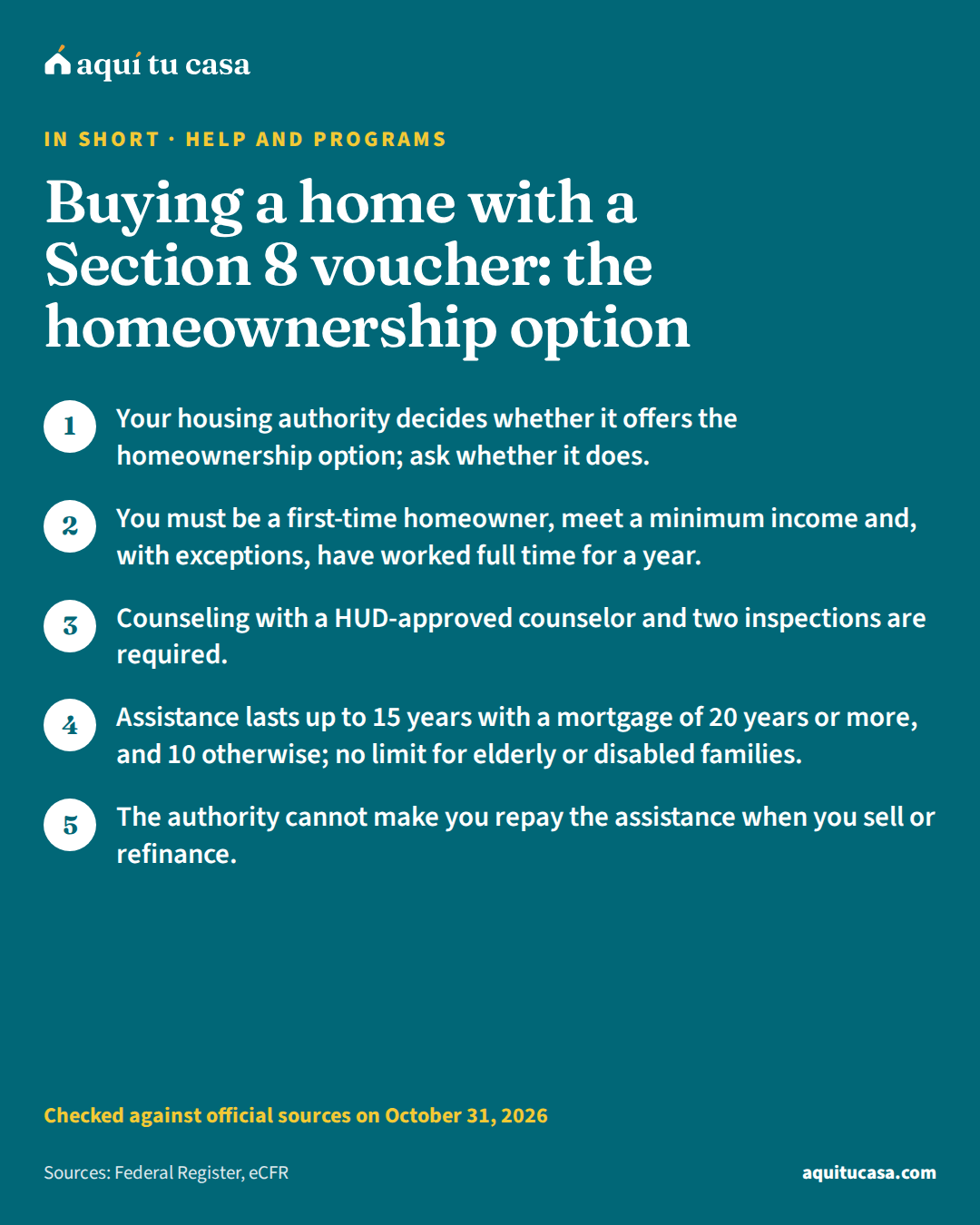
- Your housing authority decides whether it offers the homeownership option; ask whether it does.
- You must be a first-time homeowner, meet a minimum income and, with exceptions, have worked full time for a year.
- Counseling with a HUD-approved counselor and two inspections are required.
- Assistance lasts up to 15 years with a mortgage of 20 years or more, and 10 otherwise; no limit for elderly or disabled families.
Is this for you?
This guide is for you if…
- You have a Housing Choice Voucher (Section 8) and want to use it to buy a home instead of renting.
- Your housing authority mentioned its homeownership program and you want to understand the requirements.
- You have a disability or are an older adult with a voucher and want to know which rules change for you.
Get direct help first if…
- You do not have a voucher yet: read the Section 8 and mixed-status families guide first, which explains how to apply and the waiting list.
- You are looking for down payment help without a voucher: read the down payment assistance guide.
If you have a Section 8 voucher, you may think it is only for renting. But HUD’s rule includes a homeownership option: your housing authority can use the voucher’s assistance to pay part of your mortgage and home costs, instead of rent.1 Not every authority offers it, and it has its own requirements. This guide explains them step by step, using the federal rule.
How the homeownership option works
The homeownership option assists a family living in a home bought by one or more of its members. You can be a family new to the program or one that already has a voucher. There are two forms of assistance, and you can receive only one:1
- Monthly payments. The authority pays part of your home costs each month, the way it would pay part of your rent.
- A single down payment grant. One-time help at closing. Careful: the rule says the authority may not offer this grant until HUD publishes a notice in the Federal Register, so ask whether it is available where you live.2
The authority may offer one form, both or neither. But if it is needed as a reasonable accommodation for a person with a disability, it must offer it. And if it does offer it, you decide whether to participate.1 Our guide Reasonable accommodations for disabilities explains how to request an accommodation.
One important protection: the authority may not require you to repay the assistance when you sell or refinance the home.1
Who qualifies
Besides being admitted to the voucher program, your family must meet several conditions when assistance starts:2
- First-time homeowner. No one in your family can have owned a home in the three years before assistance starts. Single parents and displaced homemakers also count. There are exceptions for cooperative members and for families with a person with a disability who needs the option as a reasonable accommodation.
- No ownership today. No one in your family can own a home when assistance starts.
- No prior default. No one who was in a family that defaulted on a mortgage under this program.
- A signed contract of sale.
Minimum income. The adults who will own the home must earn at least the federal minimum wage times 2,000 hours a year. For a disabled family, the minimum is 12 times the monthly SSI benefit for one person. Welfare assistance does not count toward that minimum, except for elderly or disabled families. Your authority may set a higher minimum, but if you meet HUD’s and have a sufficient prequalification or preapproval, you meet it.2
Employment. One or more adults who will own the home must work full time (an average of at least 30 hours a week) and have done so continuously during the past year. The authority may count successive jobs and self-employment, and decides whether a gap breaks continuity. This requirement does not apply to elderly or disabled families, and the authority may not add any other employment requirement.2
The authority may set other requirements, but they must be in its Administrative Plan.2 If your family has mixed immigration status, the voucher rules still apply: our guide Section 8 and mixed-status families explains how assistance is calculated.
The path, step by step
From your voucher to your home
1. Ask whether your authority offers the program
Today
Ask for its Administrative Plan, with its financing and time rules.2
2. Check whether you qualify
This week
First-time homeowner, minimum income and employment, with exceptions.2
3. Complete the required counseling
Before you buy
With a HUD-certified counselor at a HUD-approved agency.2
5. Find a home and sign the contract
Within the time the authority sets
The contract must include the independent inspection and that you do not pay for repairs.2
6. Pass both inspections
Before closing
The authority's and one by an independent inspector you choose and pay.2
7. Close and start assistance
At closing
You sign the statement of family obligations before assistance begins.2
The authority may set a maximum time to find and buy a home. If you cannot do it in time, it may issue you a voucher to rent or put you on the waiting list.2

The required counseling
Before assistance starts, you must complete the counseling program your authority requires. It must be given by HUD-certified housing counselors working at a HUD-approved agency. Suggested topics include home maintenance, budgeting, credit, negotiating the price, getting a loan and a preapproval, finding a home, fair housing and fair lending, and how to identify and avoid loans with oppressive terms.2
Our guide HUD-approved housing counselors explains how to find one, and Homebuyer education courses what to expect from the course.
The home: what type and which inspections
The home must be a one-unit property, including a manufactured homemanufactured homeA manufactured home is a home built in a factory and moved in one or more sections, on its own chassis, to the site. Federal law defines it this way, with or without a permanent foundation, including its plumbing, heating, air-conditioning and electrical systems. Many people call it a mobile home or trailer. For Fannie Mae, it must meet HUD's federal standards; modular homes and what it calls prefabricated or panelized homes do not count as manufactured homes. It can be titled as real estate, generally when it sits on a permanent foundation on land the owner also owns, or as personal property, which is usually financed with a chattel loan.See the full definition, or a unit in a cooperative or a condominiumcondominium (condo)A condominium (condo) is a one-family home in a project where each owner owns their unit and shares ownership of the common areas with the other owners. Units can be attached, semi-detached or detached. The owners make up an association that manages the money and the common areas, and you usually pay condo or homeowners association (HOA) fees separately from your mortgage payment. If you do not pay them, the association can pursue debt collection and even foreclosure. In Texas, condominium insurance covers your belongings and the interior of your unit.See the full definition. It must meet the program’s housing quality standards. If you will not own the land, the home must be on a permanent foundation and you must have the right to occupy the site for at least 40 years.2
There are two inspections:2
- The authority’s, which confirms the home meets the quality standards.
- One by an independent professional inspector you choose and pay. It must cover the foundation and structure, interior and exterior, roofing, plumbing, electrical and heating. The authority may not make you use an inspector it chooses. The inspector sends the report to you and the authority, which may reject the home based on it.
Your purchase contractpurchase agreementA purchase agreement is the written contract between you and the seller that is final once the seller accepts your offer and both of you sign it. It gathers the details of the sale: the names of the buyers and sellers, the total price, the real estate agent's commission, the requested closing date and the contingencies. You use it to get your loan, and it is submitted with the closing paperwork. The settlement agent pays out the money according to the contract and the loan, and whether the seller pays some closing costs is also set by the contract.See the full definition must state the price and terms, that you will arrange an independent inspection, that you are not obligated to buy if the inspection does not satisfy you and that you are not obligated to pay for necessary repairs.2 Our Home inspection guide explains what an inspector checks.

The loan and what the authority pays
The loan. The authority may set requirements for your loan: for example, banning seller financing or balloon-paymentballoon paymentA balloon payment is a large, one-time payment at the end of the loan term, higher than the payments before it and sometimes much higher. On the Loan Estimate, "Balloon Payment" means any payment that is more than two times a regular payment. Loans with a balloon payment usually have shorter terms and lower monthly payments that do not pay off the whole debt. If you cannot make the final payment, you may have to refinance or sell the home, or face foreclosure. With limited exceptions, a Qualified Mortgage (QM) cannot have a balloon payment.See the full definition loans, requiring a minimum of your own resources or protections against predatory loans. FHA loans follow FHA rules. The authority may review the lender and terms, and reject a loan you cannot afford, considering other expenses such as child care and medical costs.2 Some authorities require a down paymentdown paymentThe down payment is the part of the home's price you pay out of your own pocket when you buy; the loan covers the rest. In U.S. Spanish it is also called enganche, cuota inicial or entrada. Each loan type has its own minimum: FHA requires at least 3.5% of the value, VA and USDA loans may require none, and conventional loans ask for more if you want to avoid private mortgage insurance. A larger down payment lowers the loan, the monthly payment and the total interest; many state programs help families put it together.See the full definition of at least 3% of the price, with at least 1% from your own resources.1 Our FHA loan guide explains that program.
The authority’s monthly payment. It is the lower of these two amounts:2
- The payment standard minus your total tenant payment, or
- Your monthly home expenses minus that total payment.
Counted expenses include mortgage principal and interest and mortgage insurance, property taxproperty taxProperty tax is the tax the county, city, school district and other local bodies charge real property owners every year to pay for schools, police, fire and other public services. It is computed on the value the assessor's office assigns to your home, at each body's rate, minus the exemptions you qualify for, such as the primary-residence exemption in many states. If you have a mortgage you normally pay it month by month inside your payment, through the escrow account. It is generally deductible on your federal return if you itemize.See the full definition, home insurancehomeowners insuranceHomeowners insurance pays for losses and damage to your property if something unexpected happens, like a fire or a burglary, and usually includes liability coverage if someone is hurt at your home. Lenders require it as long as you have a mortgage, because the home is their collateral, and almost always collect it inside your monthly payment through the escrow account. The price depends on the location, the rebuilding cost, the deductible and your history. A standard policy does not cover floods or, in many states, earthquakes: those risks are insured separately.See the full definition, the authority’s allowances for maintenance, major repairs and utilities, land lease payments if you do not own the land and, for condos and co-ops, association fees. The payment goes to you or, if the authority decides, to your lender. And assistance ends automatically 180 days after the last payment.2
Example with real numbers
A family with a voucher buying their first home
An example in words, not a real case, of how the assistance is calculated.
- Their total tenant payment
- The same as when they rented, based on their income
- The monthly home expenses
- Mortgage, mortgage insurance, taxes, home insurance and the authority's allowances
- The authority's payment
- The lower of the payment standard or those expenses, minus their total payment
- Their mortgage is 30 years
- Assistance can last up to 15 years
- What they do to avoid falling behind
- Save every month for when the assistance ends or costs rise
The rules come from HUD's rule.22 Use the how-much-house calculator to see a price you can sustain.
Run it with your numbersHow much house can I afford?How long assistance lasts and your obligations
How long it lasts. Except for elderly or disabled families, monthly assistance lasts at most 15 years if your initial mortgage is 20 years or longer, and 10 years in other cases. The limit adds up assistance received for different homes or authorities. For elderly or disabled families there is no limit; if the family stops qualifying as such, the limit starts to apply, but it gets at least 6 more months of assistance.2
Your obligations. Assistance is paid only while you live in the home. You must keep up with your mortgage, attend ongoing counseling if the authority requires it, give it any information it asks for about your mortgage and expenses, tell it before you move out and tell it if you fall behind on the mortgage. While you are assisted, no one in your family may own another home. Before assistance starts, you sign a statement of obligations.2
If you want to move. You can buy outside your authority’s area if the receiving authority runs a voucher homeownership program and is accepting new families.2
Because the assistance ends, plan from day one: save each month for repairs and for when the help stops. Our guide First year as a homeowner explains the costs people do not expect, and the family budget tool helps you plan.
If this is you
You are an older adult with a voucher
The employment requirement does not apply and there is no time limit on assistance.2
Someone in your family has a disability
The authority must offer the option if needed as a reasonable accommodation.1
You are self-employed
The authority may count self-employment for the employment requirement.2
You are a single parent and owned a home before
Single parents can count as first-time homeowners.2
You found a home you like
Make sure the contract says you do not pay for repairs and can walk away if the inspection is not satisfactory.2
Your income is low
Check the minimum: the federal minimum wage times 2,000 hours, or 12 times SSI for a disabled family.2

Mistakes that cost you
Mistake: Assuming your authority has the program.
Instead: Each authority decides whether to offer it; ask and request its Administrative Plan.1
Mistake: Signing a contract without the inspection clause.
Instead: The contract must say you are not obligated to buy if the inspection does not satisfy you.2
Mistake: Using the inspector the seller recommends without thinking.
Instead: You choose and pay the independent inspector; the authority cannot impose one.2
Mistake: Taking a balloon or seller-financed loan without asking.
Instead: The authority may ban them and reject loans you cannot afford.2
Mistake: Moving out without telling the authority.
Instead: You must tell it before you move; assistance is paid only while you live in the home.2
Mistake: Hiding a missed mortgage payment.
Instead: You must tell the authority if you fall behind; get help from a counselor right away.2
Mistake: Not planning for when assistance ends.
Instead: With a mortgage of 20 years or more, assistance lasts up to 15 years; save from the first month.2
What to do this week
- Call your housing authority and ask whether it offers the voucher homeownership option.1
- Ask for its Administrative Plan and read the financing, time and income requirements.2
- Gather proof of your income and employment over the past year.2
- Find a HUD-approved housing counselor for the required counseling.2
- Use the how much house can I afford calculator to see a price you can sustain.2
- Also read Community land trusts, Habitat and other affordable homes for other paths.
Your numbers
The minimum for this loan is 3.5%. More down lowers the monthly payment.
Adjust advanced details
First number: share of income for housing. Second: housing plus debts. Lender references, not fixed rules.
Let's do the math
Estimated top price
National figure$227,000
Limited by the housing payment: at that price it would be about $1,883 a month, 28% of your income.
- By the housing payment (28% of income)Limits you$227,000
- By your total debts (36% of income)$292,000
- By your cash (down payment + closing)$330,500
- Typical home in the United States
- $332,700
- Your cap is 68% of the typical home.
What changes if…?
- …you save $10,000 more$227,000
- …you cut $200 a month in debts$227,000
Your maximum price with four loans
Same income, debts and savings; only the down payment and the loan type change. ITIN uses an example down payment and rate.
| FHA 3.5% | Conventional 5% | Conventional 20% | ITIN 15% (example) | |
|---|---|---|---|---|
| Maximum price | $227,000 | $232,000 | $93,000 | $119,000 |
| Payment per month | $1,883 | $1,882 | $616 | $898 |
Educational estimate, not a pre-approval. Uses example insurance (0.5% of value per year) and example closing costs (3% of price); the tax is the place’s typical rate.
Ready to see the numbers? Find your county here
See how this applies in your county: its loan limits, prices and rents, from the official data.
Printable checklist
Frequently asked questions
Do all housing authorities have this program?
No. Under HUD's rule, each authority decides whether to offer the homeownership option. But it must offer it if needed as a reasonable accommodation for a person with a disability. Ask your authority and request its Administrative Plan, which contains its rules.
Do I have to be a first-time homeowner?
Generally yes: no one in your family can have owned a home in the three years before assistance starts. Single parents and displaced homemakers also count. There are exceptions for cooperative members and for reasonable accommodation because of a disability.
How much do I have to earn?
The adults who will own the home must earn at least the federal minimum wage times 2,000 hours a year. For a disabled family, the minimum is 12 times the monthly SSI benefit for one person. Welfare assistance does not count, except for elderly or disabled families. Your authority may set a higher minimum.
Do I have to work?
Yes, with exceptions: one or more adults who will own the home must work full time (an average of at least 30 hours a week) and have done so during the past year. It does not apply to elderly or disabled families. The authority may count self-employment.
How much does the authority pay?
The lower of the payment standard minus your total tenant payment, or your monthly home expenses minus that total payment. Expenses include the mortgage, mortgage insurance, taxes, home insurance and allowances for maintenance, repairs and utilities.
For how many years do I get assistance?
Up to 15 years if your initial mortgage is 20 years or longer, and up to 10 in other cases. For elderly or disabled families there is no time limit.
Can I sell the home later?
Yes. And the authority may not require you to repay the assistance when you sell or refinance. While you are assisted, you must live in the home, keep up with the mortgage and tell the authority before you move out.
Sources
Every figure in this guide comes from one of these official sources. The number next to a sentence leads to the source behind it.
Each source on one line: who publishes it, its title, its address and the date we read it.
- 1. Federal Register, eCFR · 24 CFR §982.625, Homeownership option: General · ecfr.gov · Accessed October 31, 2026
- 2. Federal Register, eCFR · 24 CFR part 982, subpart M, Homeownership option (§§982.626–982.643) and §982.4 · ecfr.gov · Accessed October 31, 2026
Keep reading
Related guides
If this guide helped, these follow the same path.

Renting 12 minute read
Section 8 and mixed-status families: how it works
How the Section 8 voucher works, how aid is prorated in a mixed-status family, how to apply through your housing agency and what HUD proposed.
- A mixed family can receive Section 8: assistance is prorated by how many members have citizenship or eligible status.
- A member without eligible status can elect not to contend it, in writing; never misstate your status.
- Everyone's income counts toward the calculation, including the income of a member who does not contend status.
- Help and programs HUD housing counselors: what they do and what they cost What a HUD-approved housing counselor does, what they help with (buying, renting, missed payments, credit), what they may charge and how to find one. 11 minute read
- Help and programs Homebuyer education courses: when you need one What a homebuyer education course is, when Fannie Mae, Freddie Mac and assistance programs require one, and where to take it for free or in Spanish. 10 minute read
- Buying a home Home inspection: what it covers and when to get it What a home inspection is, how it differs from the appraisal, when to get it under a contingency, radon and lead tests, and what to do with the report. 12 minute read
Tools for this topic
Was this guide useful?
Thank you. Your answer stays in your browser; nothing is sent.