Community land trusts, Habitat and other affordable homes
How community land trusts, Habitat for Humanity and price-restricted homes work: who qualifies, what you gain and which limits you accept.
Verified against official sources on October 31, 2026 7 official sources

Show contents
In short
What you need to know
Quick answer
Some homes are sold below market price to low- and moderate-income families. With a community land trust, you buy the house but the organization keeps the land and leases it to you long term; in exchange, you accept a limited resale price. Habitat for Humanity does not give away houses: you help build (sweat equity), take classes and pay a mortgage that does not exceed 30% of your gross income; in the U.S., your income must not exceed 60% of area median income. Every program is local: ask what exists where you live.
What matters most
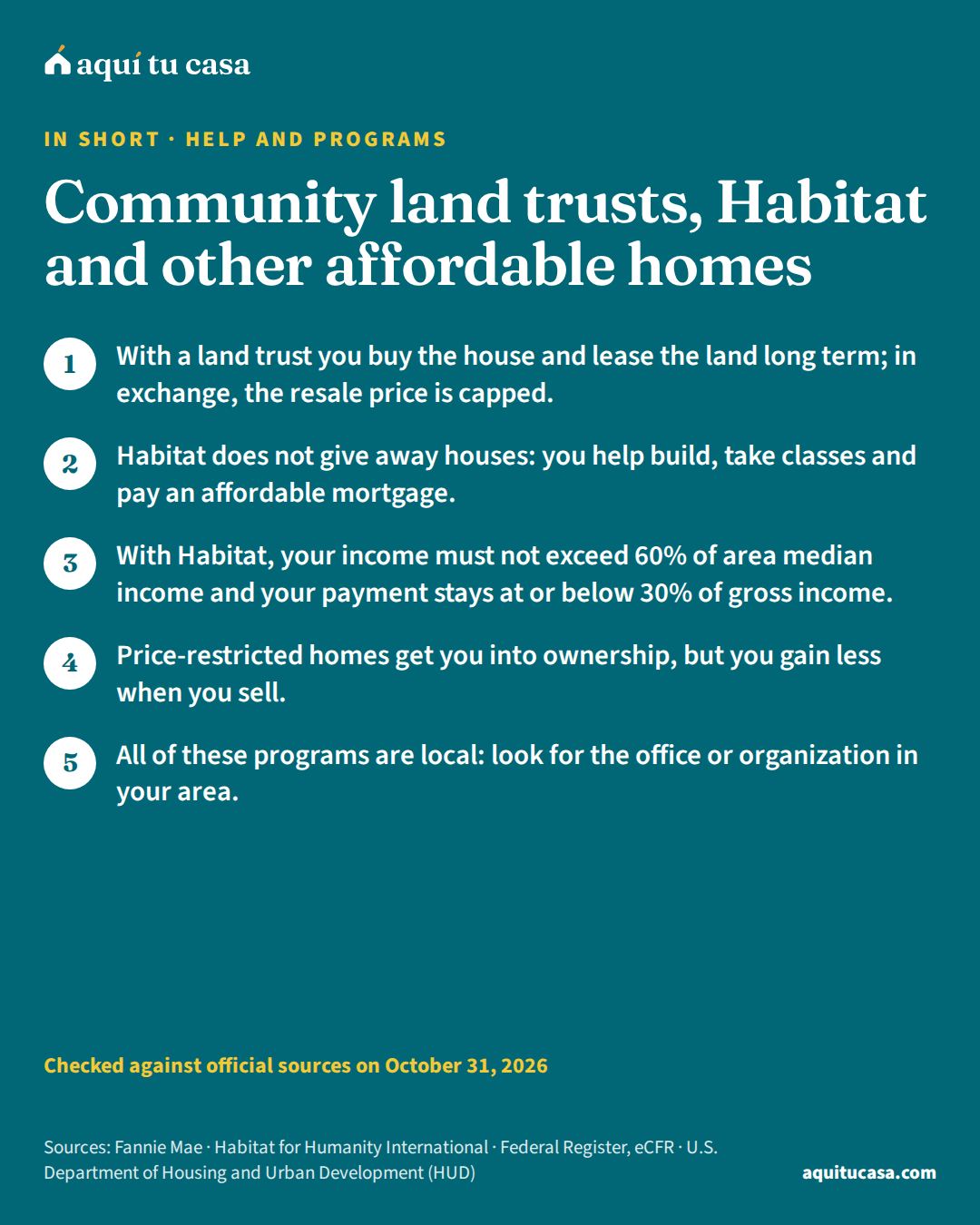
- With a land trust you buy the house and lease the land long term; in exchange, the resale price is capped.
- Habitat does not give away houses: you help build, take classes and pay an affordable mortgage.
- With Habitat, your income must not exceed 60% of area median income and your payment stays at or below 30% of gross income.
- Price-restricted homes get you into ownership, but you gain less when you sell.
Is this for you?
This guide is for you if…
- You want to buy a home, but prices in your area are out of reach.
- You have a low or moderate income and want to know whether you qualify for Habitat for Humanity or a community land trust.
- You were offered a home with a limited resale price and want to understand what you are signing.
Get direct help first if…
- You are looking for down payment help on a market-price home: read the down payment assistance guide.
- You need a place to live this week: read the emergency shelter and rapid rehousing guide first.
When home prices rise faster than paychecks, buying at market price can feel impossible. But there are other roads: homes sold below market to low- and moderate-income families, in exchange for certain rules. This guide explains three of those roads, community land trusts, Habitat for Humanity and self-help programs, with what you gain and what you accept in each one.
Price-restricted homes: the basic idea
Fannie Mae, which buys mortgages from lenders across the country, calls these shared equity programs, or “below-market programs.” They work like this: they limit who can buy based on income and set a maximum resale price, or a formula that limits what you receive when you sell. The program lowers the price for the first buyer and “recycles” that subsidy for later buyers. In exchange for buying below market value, you accept restrictions on future sale.1
Fannie Mae buys loans from three kinds of programs: community land trusts, programs with income and resale price restrictions, and limited equity co-ops.1 Those restrictions can last forever or for a set number of years, bind current and future owners, and generally end if there is a foreclosureforeclosureForeclosure is the process by which the lender or servicer takes back the property after the homeowner fails to make mortgage payments. The rules and timelines depend on each state; all of them include advance notices and, in general, time to catch up or ask for an alternative, such as a repayment plan or a loan modification. If you fall behind, call your servicer and a HUD-approved housing counseling agency early: foreclosure counseling is free and exists for exactly this.See the full definition or a deed in lieu of foreclosuredeed in lieu of foreclosureA deed in lieu of foreclosure is an arrangement in which you voluntarily turn over ownership of your home to the lender to avoid the foreclosure process. The lender agrees to take the house instead of the debt. It may help you avoid owing what is left on the mortgage, but in some states you could still owe the difference between the home's value and what you owe. That is why the CFPB says to make sure the deal covers the entire debt and to get any waiver of the difference in writing.See the full definition.1
Three roads to an affordable home
Buy the house, lease the land
Community land trust
- You buy the house below market
- You lease the land under a long-term lease
- The resale price and the next buyer's income are capped
You build and pay a mortgage
Habitat for Humanity
- Your income does not exceed 60% of area median income (U.S.)
- You contribute sweat equity and take classes
- Your payment stays at or below 30% of gross income at closing
You build with volunteers
Self-help (such as SHOP)
- Nonprofit organizations with HUD funding
- You contribute a lot of your own labor
- You buy below market price
All of them are local: find out which programs exist in your county and ask about requirements.
Community land trusts
A community land trust (CLT) is an organization that buys homes in its community and sells them to income-eligible families, but keeps the land. You own the house and lease the land through a long-term ground lease, at affordable monthly rents. That lease includes rules so the home stays affordable: limits on the future sales price and on the incomes of future owners.1
What you gain and what you accept:
- You gain a home at a price you can afford, a lower monthly payment and the stability of ownership.
- You accept that, when you sell, the price is set by the land trust’s formula, usually for another qualifying family. Your home appreciationhome appreciationHome appreciation is the increase in your home's value over time. It is one of the two ways your home equity grows, equity being the difference between what the home is worth and what you owe; the other is paying down your mortgage principal. A home's value can go up or down: it can fall because of economic conditions, lack of upkeep or a drop in neighborhood home values, and some markets appreciate faster than others. The FHFA House Price Index (HPI) measures how single-family home values change.See the full definition is smaller than in a market sale.
If your loan goes to Fannie Mae, the lender must review the ground lease. It must be based on an approved model (from Grounded Solutions Network or the Institute for Community Economics), or the program must be on the certified program list. The lease must limit future buyers’ incomes and the maximum sales price. Those restrictions must end automatically at foreclosure or a deed in lieu, and the lease must last at least five years beyond the loan.2 Fannie Mae also will not buy these loans if the program forces you into arbitration to settle disputes, unless that clause becomes void once the loan goes to Fannie Mae.1
Questions to ask a land trust before you buy: How much is the monthly land rent, and can it go up? How is the resale price calculated, and what happens to improvements you make? Who can I sell to, and how long does the trust have to find a buyer? Can I pass the home to my children? What happens if I fall behind on the mortgage? Write down each answer, with the date and the name of the person who gave it.
Habitat for Humanity
Habitat for Humanity is a nonprofit with local affiliates across the country. Each affiliate runs its own selection and application. Habitat says it does not give away houses: future owners partner with the local affiliate and volunteers to build or rehabilitate the home, and pay an affordable mortgage. Before owning, they complete financial education.3
Who qualifies. Besides meeting certain income requirements, you must:4
- Need affordable housing. For example, living in substandard housing, paying rent or a mortgage above 30% of your gross monthly income, living with mold or asthma triggers, or having a home that is inaccessible for a disability.
- Have a low or moderate income. In the U.S., household income must not exceed 60% of the area median incomearea median income (AMI)The area median income (AMI) is the median family income of an area, which HUD computes every year for each metropolitan area and county. Housing programs use it as the yardstick: under the federal rule, a family is low-income when it earns no more than 80% of its area's median income and very low-income when it earns no more than 50%, adjusted for family size. State down payment assistance programs and Section 8 vouchers publish their limits as a percentage of AMI, so the same salary can qualify in one county and not in the next.See the full definition HUD sets each year.
- Be willing to partner with Habitat. That includes “sweat equity”: helping build your home or other families’ homes, taking homeowner classes or volunteering at a ReStore.
- Be able to pay an affordable mortgage. Habitat makes sure your monthly payment does not exceed 30% of your gross monthly income at closing.
Each affiliate’s committee chooses owners based on three criteria: your level of need, your willingness to partner with Habitat and your ability to repay the mortgage. Buyers invest hundreds of hours of their own labor.5 Selection does not take into account your race, sex, color, national origin, religion, familial status, age, marital status, disability or whether you receive public assistance. For questions, you can call 1-800-422-4828.4
The road to a Habitat home
1. Check your area's income limit
Today
In the U.S., household income must not exceed 60% of area median income.4
Try it with your numbersDo I qualify by income?3. Fill out the application
When it opens
The committee looks at your need, your willingness to partner and your ability to pay.5
4. Put in your sweat equity
If you are selected
You help build, take classes or volunteer at a ReStore.4
5. Complete financial education
Before you own
You learn to manage your mortgage, your finances and your savings.3
6. Closing
At the end
Your mortgage payment does not exceed 30% of your gross monthly income at closing.4

Self-help programs: building with other families
In self-help programs, families build their homes with their own labor. HUD funds one of them, the Self-Help Homeownership Opportunity Program (SHOP). HUD gives grants to nonprofits with self-help housing experience, to build modest homes for low-income families who otherwise could not buy. Buyers must contribute a significant amount of their own labor to construction, with volunteer help, and the homes are sold below market price.7
You do not apply for SHOP funds directly: the organizations receive them, and you buy the home from them or their affiliates.7 If you live in a rural area, USDA has its own self-help program; our guide USDA farm labor housing and mutual self-help explains it.

Other roads you can combine
These programs are not the only doors. If you already have a Housing Choice VoucherHousing Choice Voucher (Section 8)The Housing Choice Voucher, the program almost everyone calls Section 8, is the country's largest federal rental assistance. HUD pays rental subsidies so eligible families can afford decent, safe and sanitary housing. Local public housing agencies administer it with HUD funds. The family finds its own home on the private market; if the agency approves the unit and the tenancy, it contracts with the owner to pay part of the rent, and the family pays the rest. Waiting lists are usually long and open for limited periods.See the full definition (Section 8), ask your housing authority whether it offers the homeownership option. Under HUD’s rule, the authority may provide monthly payments to help with the mortgage or a single down payment grant, and it can choose whether to offer the program.6 Our guide Buying a home with a Section 8 voucher explains how it works.
You can also combine a price-restricted home with down payment assistancedown payment assistance (DPA)Down payment assistance (DPA) is money a public or nonprofit program contributes toward your down payment and sometimes your closing costs. Many states, local governments and nonprofits offer programs to make homeownership more affordable; most focus on low- and moderate-income families buying their first home, and some target teachers, firefighters and other public service employees. The help can be a grant you never repay, a second loan with no payments that is forgiven over the years or repaid when you sell, and many can be used with a regular FHA or conventional loan.See the full definition from your state or city, if both programs’ rules allow it. Ask each program whether it accepts the other before you commit, and get the answer in writing. Many of these programs require a homebuyer education coursehomebuyer education courseA homebuyer education course is a class with a set curriculum that covers the homebuying process, how to maintain a home, budgeting and why good credit matters. It can be in a group, in person, online or by phone. It is not the same as housing counseling, which is one-on-one help with an action plan for your situation. Some loans and some down payment assistance programs require you to finish a course before closing, especially first-time homebuyers. When you finish, you get a certificate.See the full definition; taking it early gets you ready for any of them.
Example with real numbers
A family comparing a land trust home with a market-price home
An example in words, not a real case, of how to think through the decision.
- The purchase price
- Lower with the land trust, because the trust keeps the land
- The monthly payment
- A lower mortgage, plus an affordable monthly rent for the land
- If they sell in ten years
- They sell under the land trust's formula, to another qualifying family
- What they gain when they sell
- Less than in a market sale, but with a sustainable payment while they live there
- What they decide
- Get the formula in writing and review it with a counselor before signing
The rules in this example come from Fannie Mae.11 Use the income limits tool to see whether your household qualifies in your county.
Run it with your numbersDo I qualify by income?If this is you
Your income is low and rent eats your paycheck
Paying more than 30% of your income in rent is one of the needs Habitat looks at.4
Your family can contribute labor
In Habitat and self-help programs, your work counts as part of the path.7
You were offered a land trust home
Ask for the ground lease and the resale formula in writing.1
Your current home is not accessible for your disability
Habitat counts an inaccessible home as a housing need.4
You already own a price-restricted home and want to sell
Review the formula and restrictions; they also bind the next owner.1
You prefer to read in Spanish
Habitat's page has a Spanish version; you can also call 1-800-422-4828.4
Mistakes that cost you
Mistake: Thinking Habitat gives away houses.
Instead: You pay an affordable mortgage, contribute work and take classes.3
Mistake: Signing the land lease without reading it.
Instead: Get the resale formula in writing and review it with a counselor.1
Mistake: Expecting to sell a price-restricted home at market price.
Instead: You accepted a capped resale price in exchange for the low purchase price.1
Mistake: Not checking your income against your area's limit.
Instead: For Habitat, household income must not exceed 60% of area median income.4
Mistake: Accepting a mandatory arbitration clause without asking.
Instead: Fannie Mae will not buy these loans if arbitration stays mandatory once the loan goes to Fannie Mae.1
Mistake: Waiting to be called without applying.
Instead: Every program is local; find your area's office and ask when applications open.3

What to do this week
- Check your county’s area median income with the income limits tool.4
- Find your area’s Habitat affiliate and ask when applications open.3
- Ask your city or county whether there are community land trusts or price-restricted homes.1
- If you are offered a price-restricted home, ask for the resale formula and the ground lease in writing.2
- Make an appointment with a HUD-approved housing counselor; our guide HUD-approved housing counselors explains how to find one.
- Also read Down payment assistance: how it works and take a homebuyer education course.
Your numbers
The minimum for this loan is 3.5%. More down lowers the monthly payment.
Adjust advanced details
First number: share of income for housing. Second: housing plus debts. Lender references, not fixed rules.
Let's do the math
Estimated top price
National figure$227,000
Limited by the housing payment: at that price it would be about $1,883 a month, 28% of your income.
- By the housing payment (28% of income)Limits you$227,000
- By your total debts (36% of income)$292,000
- By your cash (down payment + closing)$330,500
- Typical home in the United States
- $332,700
- Your cap is 68% of the typical home.
What changes if…?
- …you save $10,000 more$227,000
- …you cut $200 a month in debts$227,000
Your maximum price with four loans
Same income, debts and savings; only the down payment and the loan type change. ITIN uses an example down payment and rate.
| FHA 3.5% | Conventional 5% | Conventional 20% | ITIN 15% (example) | |
|---|---|---|---|---|
| Maximum price | $227,000 | $232,000 | $93,000 | $119,000 |
| Payment per month | $1,883 | $1,882 | $616 | $898 |
Educational estimate, not a pre-approval. Uses example insurance (0.5% of value per year) and example closing costs (3% of price); the tax is the place’s typical rate.
Ready to see the numbers? Find your county here
See how this applies in your county: its loan limits, prices and rents, from the official data.
Printable checklist
Frequently asked questions
What is a community land trust?
It is an organization that buys homes, sells them to income-eligible families and keeps the land. You own the house and lease the land with a long-term ground lease, at affordable monthly rents. In exchange, you accept limits on the future sales price.
If I buy from a land trust, do I really own my home?
You own the house and have the right to use the land under the lease. But you accept rules: the price you can sell for and the income of whoever buys from you are limited. Read the ground lease with a housing counselor before you sign.
Does Habitat for Humanity give away houses?
No. Habitat says future owners partner with the local affiliate and volunteers to build or rehabilitate the home and pay an affordable mortgage. Habitat makes sure that payment does not exceed 30% of your gross monthly income at closing.
Who qualifies for Habitat?
In the U.S., household income must not exceed 60% of area median income. You must also need affordable housing, be willing to partner with Habitat (sweat equity and classes) and be able to pay an affordable mortgage. Each local affiliate runs its own application.
What is 'sweat equity'?
It is your work instead of money: helping build your home or other families' homes, taking homeowner classes or volunteering at a Habitat ReStore. Habitat buyers invest hundreds of hours.
Can I get a conventional loan for a land trust home?
Yes, in many cases. Fannie Mae buys community land trust loans if the ground lease meets its requirements, such as being based on an approved model and lasting at least five years past the loan. Ask the land trust which lenders it works with.
What happens if I want to sell later?
With a price-restricted home, you sell using the program's formula or maximum price, usually to another income-eligible family. You gain less than in a market sale. Get the formula in writing and run the numbers before you buy.
Sources
Every figure in this guide comes from one of these official sources. The number next to a sentence leads to the source behind it.
Each source on one line: who publishes it, its title, its address and the date we read it.
- 1. Fannie Mae · Selling Guide B5-5.3-01, Shared Equity Overview · selling-guide.fanniemae.com · Accessed October 31, 2026
- 2. Fannie Mae · Selling Guide B5-5.3-02, Shared Equity Transactions: General Requirements · selling-guide.fanniemae.com · Accessed October 31, 2026
- 3. Habitat for Humanity International · Apply for a Habitat house · habitat.org · Accessed October 31, 2026
- 4. Habitat for Humanity International · Qualifications for a Habitat homeowner · habitat.org · Accessed October 31, 2026
- 5. Habitat for Humanity International · Frequently asked questions · habitat.org · Accessed October 31, 2026
- 6. Federal Register, eCFR · 24 CFR §982.625, Homeownership option: General · ecfr.gov · Accessed October 31, 2026
- 7. U.S. Department of Housing and Urban Development (HUD) · Self-Help Homeownership Opportunity Program (SHOP) · hud.gov · Accessed October 31, 2026
Keep reading
Related guides
If this guide helped, these follow the same path.
Help and programs 12 minute read
Down payment assistance: how it works
What down payment assistance is, the types that exist (grant, forgivable or deferred second loan, tax credit), who qualifies and where to find it.
- It is almost never 'free money': often it is a second loan with no monthly payments that is forgiven over time or repaid when you sell or when it comes due.
- Programs come from states, counties, cities and nonprofits; you apply through a participating lender.
- Almost all ask for income under a cap tied to the area median income and a home price under a limit.
- Help and programs HUD housing counselors: what they do and what they cost What a HUD-approved housing counselor does, what they help with (buying, renting, missed payments, credit), what they may charge and how to find one. 11 minute read
- Help and programs Homebuyer education courses: when you need one What a homebuyer education course is, when Fannie Mae, Freddie Mac and assistance programs require one, and where to take it for free or in Spanish. 10 minute read
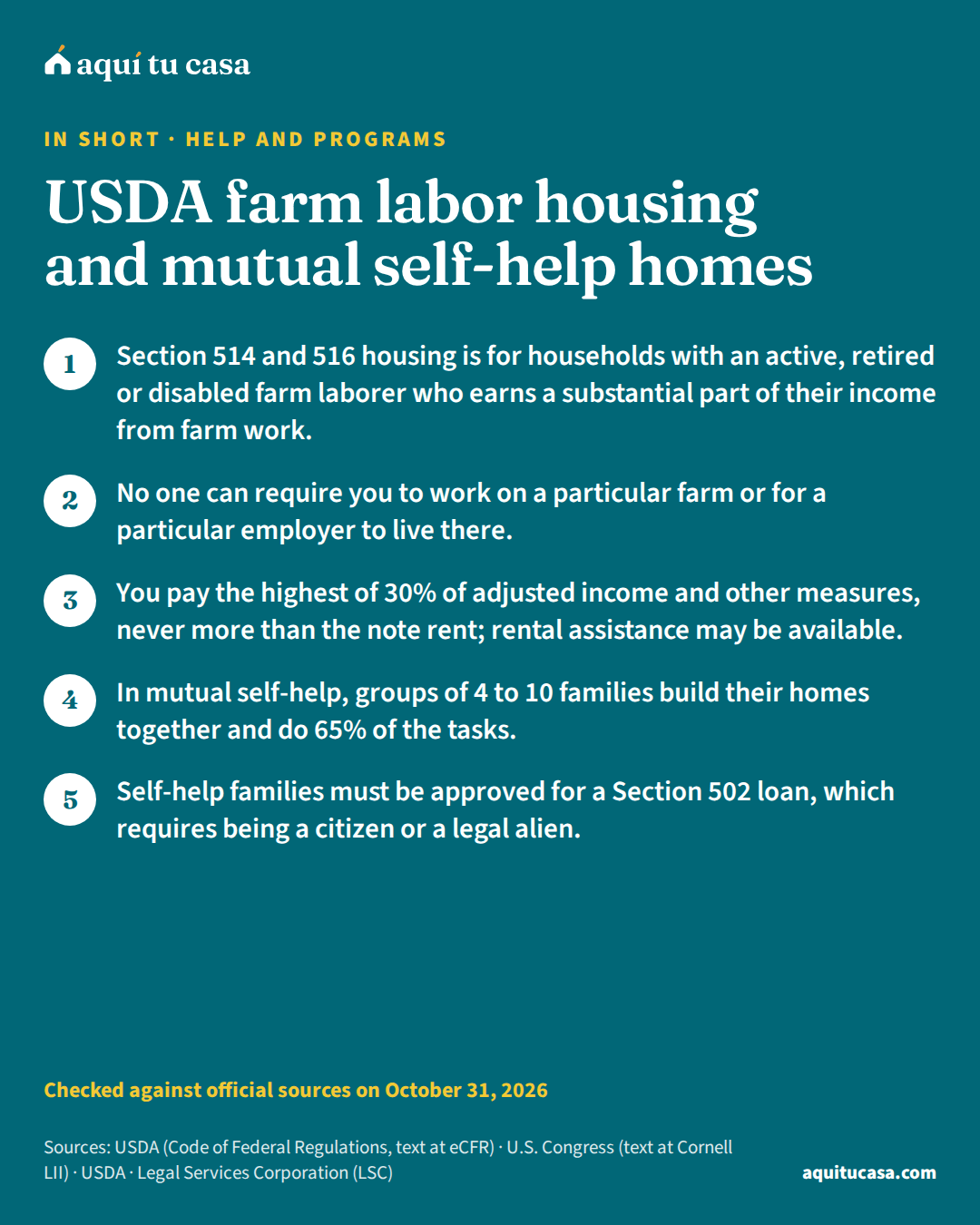
- Help and programs USDA farm labor housing and mutual self-help homes How USDA farm labor housing (Sections 514 and 516) and mutual self-help housing (Section 523), where families build their homes together, work. 12 minute read
Tools for this topic
Was this guide useful?
Thank you. Your answer stays in your browser; nothing is sent.