Your immigration status and your landlord: what they can ask
What a landlord may ask about your immigration status, what protects you, which states ban those questions and what to do if you are threatened.
Verified against official sources on October 17, 2026 19 official sources

Show contents
In short
What you need to know
Quick answer
It depends on your state. The federal fair housing law bans treating you differently because of your national origin, meaning the country where you were born or where your family comes from. Some states and cities go further: in California a landlord may not ask about your immigration status or threaten to reveal it, in Illinois they may only ask when a law requires it, and in New York City immigration status is protected. Everywhere, no one can force you out by changing the locks without a court order, and threatening you or retaliating because you exercise your fair housing rights is illegal.
What matters most
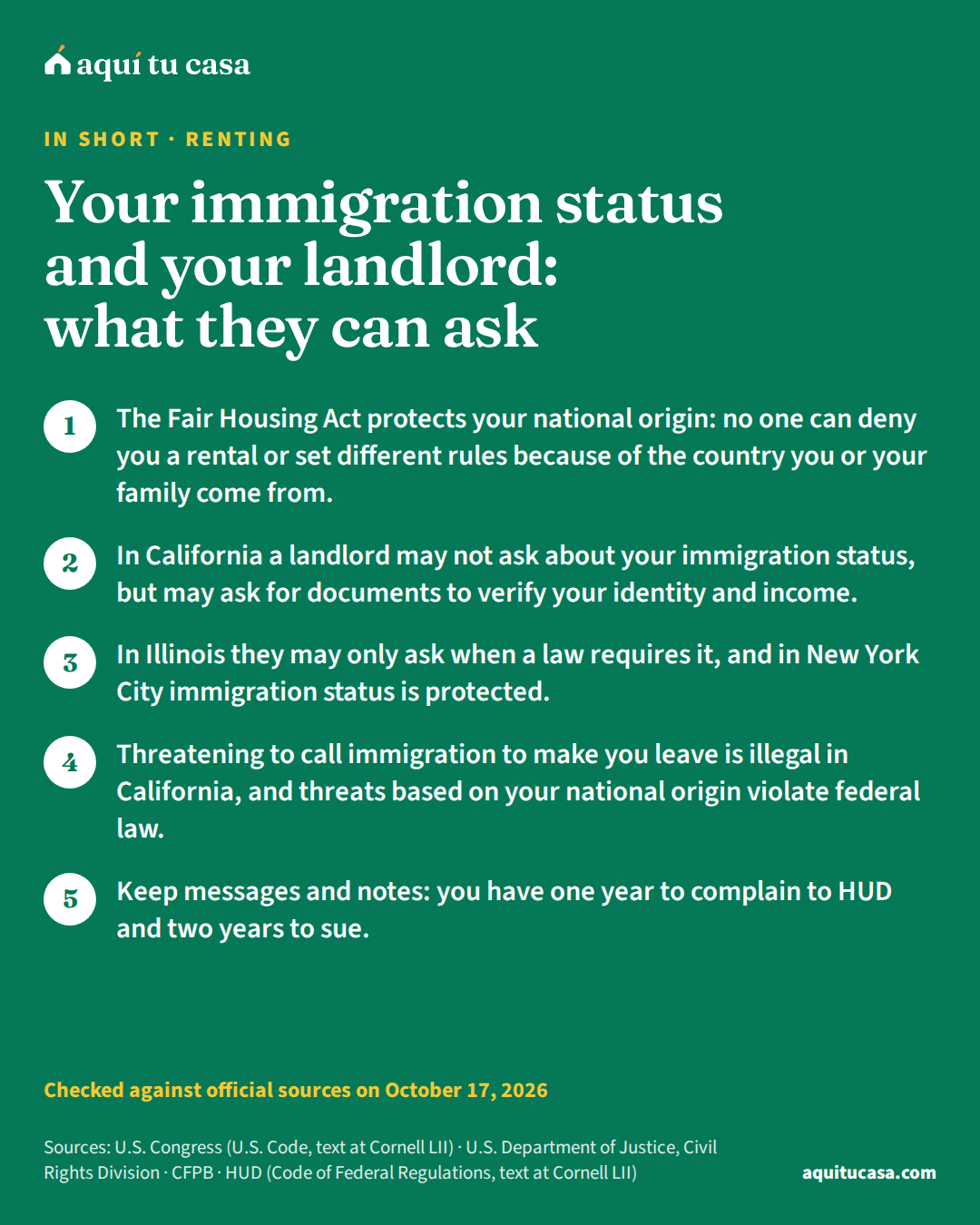
- The Fair Housing Act protects your national origin: no one can deny you a rental or set different rules because of the country you or your family come from.
- In California a landlord may not ask about your immigration status, but may ask for documents to verify your identity and income.
- In Illinois they may only ask when a law requires it, and in New York City immigration status is protected.
- Threatening to call immigration to make you leave is illegal in California, and threats based on your national origin violate federal law.
Is this for you?
This guide is for you if…
- You are about to rent and do not know whether the landlord can ask about your immigration status or ask for papers.
- Your landlord threatened to call immigration or treats you differently because of where you come from.
- You live in a mixed-status family and want to know which protections you have as a tenant.
Get direct help first if…
- Your question is about your immigration case: you can ask a representative accredited by the Department of Justice or an immigration lawyer.
- You are applying for public housing or Section 8: those programs do verify status, and the Section 8 and mixed-status families guide explains how.
- You already got an eviction notice: start with the guide on what to do if you get an eviction notice.
Many people who rent in the United States wonder whether a landlord can ask for their papers, and what happens if one day the landlord threatens to call immigration. This guide explains what the federal fair housing law says, what states like California and Illinois and New York City add, what to do if you are threatened and where to get free help. You do not need to tell us anything about your situation to use it.
- To file a discrimination complaint with HUD
- 1 year6
- To file a lawsuit in federal or state court
- 2 years7
- Damages per person, in California, if the landlord discloses your status to pressure you
- 6 to 12 times the rent10
- Maximum penalty per violation, in California, for threatening to disclose your status
- $2,0009
What federal law protects: your national origin
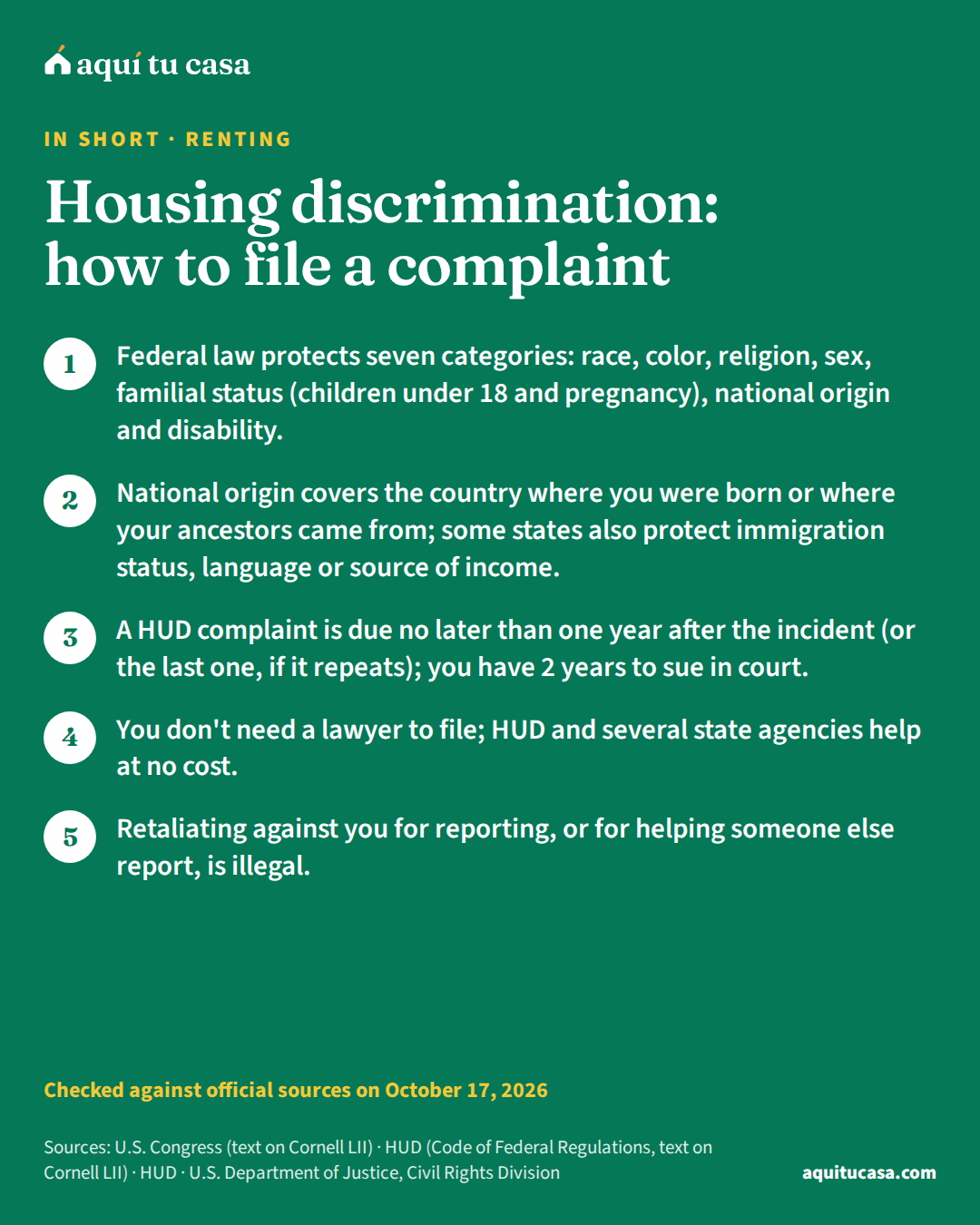
The Fair Housing ActFair Housing ActThe Fair Housing Act is the federal law that makes it illegal to refuse to sell or rent a dwelling, or to discriminate in its terms, because of race, color, religion, sex, familial status (having children), national origin or disability. It applies to landlords, real estate agents and managers, and also to banks and lenders when their practices make housing or credit unavailable for those reasons. National origin covers your language and the country you come from, regardless of immigration status. If you believe you were discriminated against, you can file a complaint with HUD at no cost; many states add protections.See the full definition bans refusing to rent to you, or making a home unavailable to you, because of race, color, religion, sex, familial status or national origin. It also bans giving you different terms, conditions or services for those reasons.1
National originnational originNational origin is one of the characteristics the Fair Housing Act protects. According to the Department of Justice, national origin discrimination can be based on the country where you were born or where your ancestors came from. The law prohibits refusing to sell or rent you a home, setting different terms or publishing ads that state a preference based on your national origin. According to the CFPB, the Equal Credit Opportunity Act also prohibits lenders from discriminating against you because of your national origin when you apply for credit, such as a mortgage.See the full definition is the country where you were born or where your ancestors came from. The Justice Department says it has taken action against private landlords who discriminated against immigrants, and that a person facing discrimination may complain to HUD or file their own lawsuit.2 The CFPB sums it up: landlords generally cannot refuse to rent to you, evict you or change the rules of your lease because of your country of origin or ancestry.3
The federal law’s list does not include immigration status as such.1 That is why questions about papers depend heavily on each state’s and city’s laws, covered below. But if you are treated differently because of the country you or your family come from, that falls under national origin; if your language or accent was part of it, say so in your complaint.2
What a landlord may ask when you apply
What a landlord may ask for when you apply depends on your state. The laws we verified say this:
- California. The landlord may not ask about your immigration or citizenship status, or require you to disclose it. The landlord may ask for the information or documents needed to verify your identity and your ability to pay, and may comply with federal legal obligations, such as those of federal rental assistance programs or a court order.8 The state Attorney General adds that you have the right to apply for and secure housing without sharing your immigration status.14
- Illinois. Housing providers may only ask about immigration status when state or federal law requires it, for example in housing with HUD funding. They must be able to explain why they ask and ask everyone the same questions. Screening out applicants without a Social Security number is an example of discrimination, and the Department recommends accepting alternatives for background and credit checks.15
- New York City. Tenants are protected against discrimination based on immigration status.16
Example with real numbers
A rental application in California, item by item
What Civil Code §1940.3 says a landlord may ask you for. It is one state's example; yours may have other rules.
- Identification
- May ask for documents to verify your identity8
- Income
- May ask for documents to verify your ability to pay8
- Immigration or citizenship status
- May not ask or require you to disclose it8
- Housing with federal rental assistance
- May ask for what federal law requires8
That is what California law says.8 To see how much rent fits your income before you apply, use the calculator.
Run it with your numbersHow much rent can I afford?In public housing and Section 8, federal rules do verify the status of the people who receive assistance; the Section 8 and mixed-status families guide explains how it works without the whole family losing support. If you do not have a Social Security number or credit history, the guide on renting without a Social Security number or credit explains which documents you can present during tenant screeningtenant screening reportA tenant screening report is a report many landlords use to decide whether to rent to you and how much to charge for the security deposit. Specialty companies prepare it, and it can include your credit report, your rental history including eviction cases and lawsuits, employment verification, criminal history and a score or recommendation. It is not the same as a credit report. If a landlord denies you, or asks for a larger deposit or higher rent, because of the report, federal law requires the landlord to tell you, name the company and explain your right to a free copy and to dispute errors.See the full definition.
States and cities that protect immigration status
Three places, three rules we verified
May not ask
California
Only if a law requires it
Illinois
Check your state's tenant rights page: your rights are usually in your lease and in state or local law.3
The tenant rights pages for California, Illinois and New York bring together what we verified in each state. If your state is not listed here, that does not mean you have no protection: the federal national origin law applies nationwide.1

If you are threatened with a call to immigration
A threat like that is meant to make you leave without a fight. Several laws treat it for what it is:
- Nationwide, the Fair Housing Act makes it unlawful to coerce, intimidate, threaten or interfere with a person exercising their fair housing rights.4 HUD’s rule includes threatening or intimidating someone in their home because of their national origin, or that of their visitors or associates, and retaliating because someone complained or reported discrimination.5
- In California, it is illegal to threaten to disclose the immigration status of a tenant, an occupant or someone associated with them to pressure them to leave; a tenant who wins in court, including small claims court, can collect a penalty of up to $2,000 per violation.9 Disclosing status to immigration or police to harass, intimidate or make the tenant leave carries damages of 6 to 12 times the monthly rent per person, and waiving that right is void.10 Reporting or threatening to report to immigration is also prohibited retaliationlandlord retaliationLandlord retaliation happens when the landlord punishes you for using a legal right. For example, the landlord tries to evict you because you complained in good faith to a government office about health or safety problems in the home, or because you organized with other tenants. Not every state recognizes it, and each one defines and proves it differently. In addition, the federal Fair Housing Act prohibits retaliating against a person for filing a housing discrimination complaint or taking part in that process.See the full definition.11 The Attorney General puts it plainly: landlords may never threaten to disclose your status to pressure you.13
- In Illinois, threatening to report a tenant to ICE because they complained about living conditions is an example of discrimination.15
If you receive a threat
1. Keep the proof
The same day
Write down the date, time, who spoke and what they said. Take screenshots and save messages in a safe place, not only on your phone.15
2. Do not sign or hand over anything under pressure
While you get help
No one can force you out by changing the locks without a court order.3
3. Get free legal help
That same week
LSC-funded legal aid exists in every state; search for the nearest office with your city.17
4. If you wish, file a complaint
Within 1 year with HUD
You can also sue in court within 2 years; your state may have its own agency.6
5. For questions about your immigration case
Whenever you need it
Talk to an accredited representative or an immigration lawyer, never a notario.18
No one can force you out without a judge
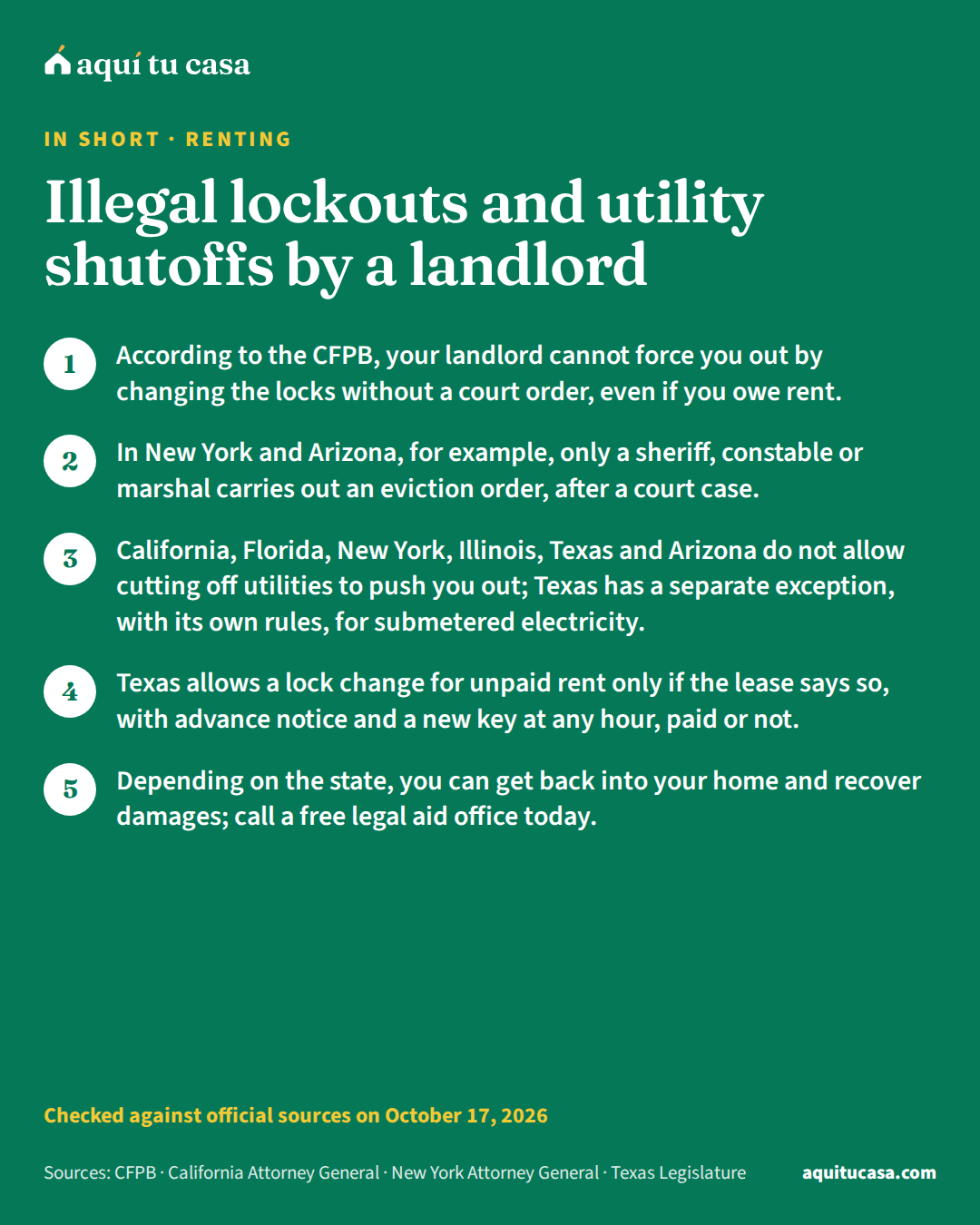
According to the CFPB, a landlord cannot force you out by changing the locks without a court order.3 A legal evictionevictionEviction is the legal process a landlord uses to get back a rented home when the tenant does not want to leave. The most common reasons are unpaid rent, serious lease violations or a lease that has ended. First the landlord must give you written notice. If it is not resolved, the landlord needs a court order, and a law enforcement officer must carry out the removal. If you are sued, you have the right to file a written answer explaining to the court why you should not be evicted. The rules change by state and city.See the full definition goes through court, and the illegal lockouts guide explains how it works in several states and what to do if you are locked out.
California adds another protection: a landlord may not force you to leave or sue to recover the home because of your immigration or citizenship status, except to comply with a federal rental assistance program. You can raise that as a defense in court. And if the landlord had already approved you as a tenant and then sues because you did not provide a valid Social Security number, the information for a credit report or an ID the landlord accepts, the law presumes you have that defense.12
If you already received an eviction notice, do not ignore it: the guide on what to do if you get an eviction notice explains the steps, and the eviction timeline tool shows your state’s deadlines.
How and where to report
You have one year to file a complaint with HUD from when the discrimination happened or ended,6 and two years to file a lawsuit in federal or state court.7 The housing discrimination guide explains how, step by step.
Some states have their own agency. In California, the Attorney General refers people to the state’s Civil Rights Department.13 In Illinois, the Department of Human Rights takes immigration status reports within one year, or you can sue in state court within two; it provides an interpreter, charges nothing, does not require a lawyer or that you be a resident or citizen, and retaliating against someone who reports is illegal.15
You may qualify for free legal aidlegal aidLegal aid is the free civil legal help that nonprofit organizations and their lawyers provide to low-income people in civil, not criminal, matters. In housing, that includes representing families facing eviction or foreclosure, alongside matters such as custody, child support, protection from domestic violence and access to benefits. In the United States, the Legal Services Corporation, created by Congress, funds a nationwide network of these organizations; its finder points you to the one in your area. Each sets its own income limits.See the full definition: LSC funds legal aid offices in every state and its search tool shows the nearest one.17 For questions about your immigration case, EOIR publishes lists of accredited representativesDOJ-accredited representativeAn accredited representative is a non-attorney whom the U.S. Department of Justice, through its Recognition and Accreditation Program, authorizes to represent people in immigration matters before DHS and, with full accreditation, before the immigration courts. They may only do so through a recognized organization, which must be a non-profit, federally tax-exempt entity. It is the safe way to get low-cost immigration help: the Department of Justice publishes the official roster by state. Anyone who is not on that roster and is not a lawyer is not authorized to represent you.See the full definition by state.19

If this is you
You already rent and your landlord started asking for papers
In California they may not ask about your status;8 in Illinois only if a law requires it.15 Keep a written record of what they asked.
People with different statuses live in your home
HUD's rule bans threatening or intimidating you in your home because of the national origin of your visitors or associates, not only your own.5 If you receive Section 8, see the mixed-status families guide.
You do not speak English
In Illinois, the Department of Human Rights provides an interpreter for reports.15 If you were treated differently because of your language or accent, say so in your complaint.2
You cannot pay a lawyer
LSC-funded legal aid is free for people with low incomes.17

Costly mistakes
Mistake: Moving out right away because the landlord threatened to call immigration.
Instead: Keep the proof and get legal help: that threat is illegal in California and can violate federal law.94
Mistake: Signing a paper that says you waive your rights.
Instead: In California, waiving the protection against having your status disclosed is void.10
Mistake: Believing you cannot complain without papers.
Instead: In Illinois you do not need to be a resident or citizen to report.15
Mistake: Letting time go by.
Instead: You have one year to complain to HUD and two to sue.67
Mistake: Asking a notario whether complaining could get you deported.
Instead: A notario cannot give legal advice; an accredited representative or a lawyer can.18
What to do this week
- If someone threatened you, write down today the date, time and exact words, and save the messages outside your phone.15
- Check your state’s tenant rights page and what it says about immigration status.3
- Find the nearest legal aid office with LSC’s search tool.17
- If you want to report, mark the one-year HUD deadline on your calendar.6
- For any immigration question, look for an accredited representative on your state’s list.19
Your income
Let's do the math
Rent that fits your budget (30% of income)
$2,018
With an income of $6,728 a month. Up to $3,364 would already be a severe burden (50% of income).
Compared with HUD’s Fair Market Rent in the United States
- 2 bedrooms$1,750Fits · 26%Needs $33.65 an hour
The wage needed pays that rent without going over 30% of income, working 40 hours a week all year.
The typical rent households actually pay in the United States is $1,413 a month (Census).
A reference to give you an idea. Each landlord and each program sets its own requirements.
Ready to see the numbers? Find your county here
See how this applies in your county: its loan limits, prices and rents, from the official data.
Printable checklist
Frequently asked questions
Can a landlord ask whether I have papers?
It depends on the state. In California, the law prohibits asking about your immigration status or requiring you to disclose it, except to comply with federal law, as in federal rental assistance programs. In Illinois a landlord may only ask when state or federal law requires it and must ask everyone the same questions. Rules vary in other states, but everywhere a landlord may not discriminate against you because of your national origin.
Can I be turned down because I do not have a Social Security number?
In Illinois, the Department of Human Rights gives screening out applicants without a Social Security number as an example of discrimination and recommends accepting alternatives. In California, a landlord may ask for documents to verify your identity and ability to pay. The guide on renting without a Social Security number explains what you can show instead.
My landlord threatened to call immigration. What do I do?
Save the message or write down the date, time and exact words. In California, threatening to disclose your status to make you leave, or reporting you to immigration in retaliation, is illegal. Federal law prohibits threatening or intimidating you because of your national origin. You can get free legal help and, if you wish, file a complaint.
Can I be evicted because of my immigration status?
No one can force you out by changing the locks without a court order. In California, the law prohibits evicting someone because of their immigration or citizenship status, except to comply with a federal rental assistance program, and the tenant can raise it as a defense in court.
Can I file a complaint if I am undocumented?
In Illinois, the Department of Human Rights says you do not need to be a permanent resident or citizen to report, that it provides an interpreter and that it charges nothing. Federal law gives you one year to complain to HUD. If you are worried about sharing your information, you can talk to legal aid or an accredited representative first.
What if I live in public housing or have Section 8?
Those federal programs do verify the status of the people who receive assistance, and California and Illinois law allow questions needed to comply with federal law. The Section 8 and mixed-status families guide explains how it works.
How long do I have to report?
For a complaint to HUD, one year from when the discrimination happened or ended. For a lawsuit in federal or state court, two years. Your state agency's deadlines may differ.
Sources
Every figure in this guide comes from one of these official sources. The number next to a sentence leads to the source behind it.
Each source on one line: who publishes it, its title, its address and the date we read it.
- 1. U.S. Congress (U.S. Code, text at Cornell LII) · Fair Housing Act, 42 U.S.C. §3604, Discrimination in the sale or rental of housing · law.cornell.edu · Accessed October 17, 2026
- 2. U.S. Department of Justice, Civil Rights Division · The Fair Housing Act · justice.gov · Accessed October 17, 2026
- 3. CFPB · Your tenant and debt collection rights · consumerfinance.gov · Accessed October 17, 2026
- 4. U.S. Congress (U.S. Code, text at Cornell LII) · Fair Housing Act, 42 U.S.C. §3617, Interference, coercion, or intimidation · law.cornell.edu · Accessed October 17, 2026
- 5. HUD (Code of Federal Regulations, text at Cornell LII) · 24 CFR §100.400, Prohibited interference, coercion or intimidation · law.cornell.edu · Accessed October 17, 2026
- 6. U.S. Congress (U.S. Code, text at Cornell LII) · Fair Housing Act, 42 U.S.C. §3610, Administrative enforcement; preliminary matters · law.cornell.edu · Accessed October 17, 2026
- 7. U.S. Congress (U.S. Code, text at Cornell LII) · Fair Housing Act, 42 U.S.C. §3613, Enforcement by private persons · law.cornell.edu · Accessed October 17, 2026
- 8. California Legislature (text at California.Public.Law) · California Civil Code §1940.3 (tenant immigration status) · california.public.law · Accessed October 17, 2026
See the other 11 sources
- 9. California Legislature (text at California.Public.Law) · California Civil Code §1940.2 (conduct prohibited to make a tenant leave) · california.public.law · Accessed October 17, 2026
- 10. California Legislature (text at California.Public.Law) · California Civil Code §1940.35 (disclosing a tenant's immigration status) · california.public.law · Accessed October 17, 2026
- 11. California Legislature (text at California.Public.Law) · California Civil Code §1942.5 (landlord retaliation) · california.public.law · Accessed October 17, 2026
- 12. California Legislature (text at California.Public.Law) · California Code of Civil Procedure §1161.4 (eviction based on immigration status) · california.public.law · Accessed October 17, 2026
- 13. California Attorney General · Landlord-Tenant Issues · oag.ca.gov · Accessed October 17, 2026
- 14. California Attorney General · Immigration · oag.ca.gov · Accessed October 17, 2026
- 15. Illinois Department of Human Rights · Immigration Status & Housing Frequently Asked Questions · dhr.illinois.gov · Accessed October 17, 2026
- 16. New York State Attorney General · Residential Tenants' Rights Guide · ag.ny.gov · Accessed October 17, 2026
- 17. Legal Services Corporation (LSC) · I Need Legal Help · lsc.gov · Accessed October 17, 2026
- 18. U.S. Department of Justice (EOIR) · Can Someone Represent You Before EOIR? · justice.gov · Accessed October 17, 2026
- 19. U.S. Department of Justice (EOIR) · Recognition & Accreditation Roster Reports · justice.gov · Accessed October 17, 2026
Keep reading
Related guides
If this guide helped, these follow the same path.

Renting 11 minute read
How to rent without a Social Security number or credit
What a landlord can ask for, what to offer instead of an SSN and credit, how much rent fits your income and your rights if you are turned down.
- Each landlord decides what to ask for: ask what they accept instead of a Social Security number and a credit history.
- Without credit, your file speaks for you: photo ID, proof of income, bank statements and references.
- If a report gets you rejected or asked for a cosigner or a bigger deposit, they must name the company; the copy is free if you ask within 60 days.
- Renting Housing discrimination: how to file a complaint What the Fair Housing Act prohibits when you rent, how national origin and children are covered, and how to file with HUD or your state on time. 11 minute read
- Renting Section 8 and mixed-status families: how it works How the Section 8 voucher works, how aid is prorated in a mixed-status family, how to apply through your housing agency and what HUD proposed. 12 minute read
- Renting Illegal lockouts and utility shutoffs by a landlord If your landlord changed the locks, removed your things or cut off water or power to make you leave: what several states' laws say and what to do today. 12 minute read
Tools for this topic
Was this guide useful?
Thank you. Your answer stays in your browser; nothing is sent.