Your tax refund: timing, refund advances and scams
How long an IRS refund takes, what preparer advances and refund checks cost, how to spot a ghost preparer and where to check the status of your refund.
Verified against official sources on October 31, 2026 13 official sources

Show contents
In short
What you need to know
Quick answer
According to the IRS, a refund from an e-filed return typically takes 3 weeks, and one from a mailed return 6 weeks or more; if you claim the EITC or the additional child tax credit, it does not arrive before mid-February. You check it in Where's My Refund at IRS.gov, in the IRS app or at 800-829-1954. A preparer's "advance" is a loan you repay even if your refund comes in lower, and a preparer who will not sign your return or enter a PTIN is a red flag.
What matters most
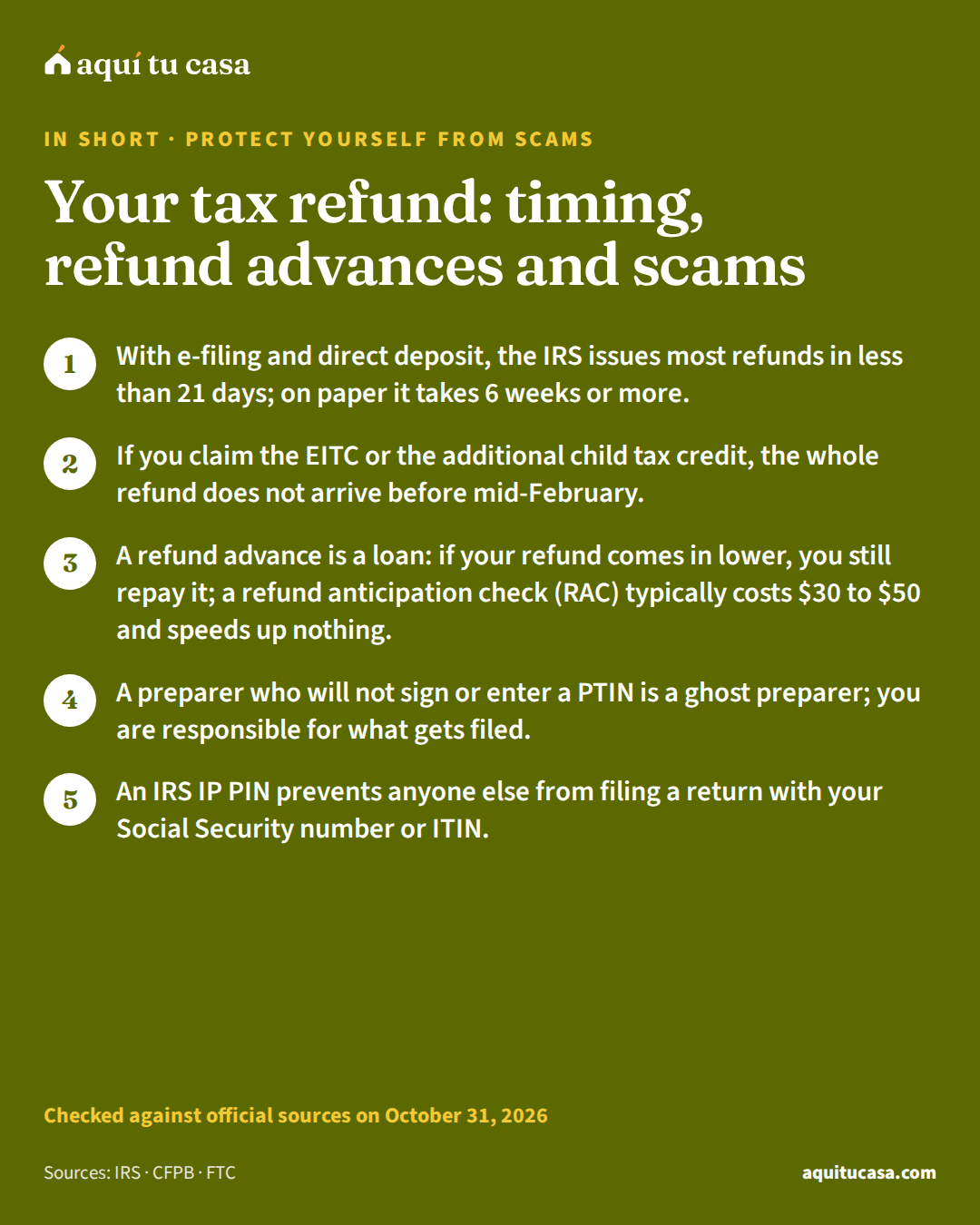
- With e-filing and direct deposit, the IRS issues most refunds in less than 21 days; on paper it takes 6 weeks or more.
- If you claim the EITC or the additional child tax credit, the whole refund does not arrive before mid-February.
- A refund advance is a loan: if your refund comes in lower, you still repay it; a refund anticipation check (RAC) typically costs $30 to $50 and speeds up nothing.
- A preparer who will not sign or enter a PTIN is a ghost preparer; you are responsible for what gets filed.
Is this for you?
This guide is for you if…
- You are waiting for your tax refund and want to know when it arrives and where to check it.
- A preparer offered you an 'advance', a 'fast refund' or to take their fee out of your refund.
- You think a preparer kept your refund or filed something you did not authorize.
Get direct help first if…
- You already sent money or personal information to a scammer: start with the guide on what to do if you were scammed.
- You have an IRS audit or collection: a Low Income Taxpayer Clinic (LITC) can represent you, free or for a small fee.
For many families, the tax refund is the biggest check of the year, which is also why scammers and expensive “advances” target it. This guide is for you if you are waiting for your refund: it explains how long it takes according to the IRS, where to check it, what preparers’ advances and refund checks cost, how to spot a “ghost” preparer and what to do if someone kept your money.
How long your refund takes
The IRS gives typical times based on how you filed: about 3 weeks from the date you e-file, and 6 weeks or more from the date it receives your mailed return. It can take longer if your return needs corrections or review.1
The CFPB explains that e-filing and choosing direct deposit is the fastest way: with direct deposit, the IRS issues more than nine out of ten refunds in less than 21 days. The IRS no longer mails paper checks to most taxpayers. If you do not have a bank account, a prepaid card that accepts direct deposit can receive the refund; get its routing and account numbers first.3 The guide on low-fee bank accounts (Bank On) explains low-cost options.
Why is it delayed? According to the IRS, because of common mistakes, such as forgetting to sign or a math error; an amended return; an injured spouse relief request; or the credits you claim.1 And there is a rule many families do not know: if you claim the Earned Income Tax Credit (EITC) or the additional child tax credit (ACTC), the IRS cannot issue your refund before mid-February, and that applies to the entire refund, not just the part from those credits.2 The guide on the EITC and the child tax credit explains who can claim them.
From your return to your account
Where to check your refund
The IRS tool for this is Where’s My Refund. Your refund status shows up 24 hours after you e-file a current-year return, 3 days after you e-file a prior-year return and 4 weeks after you mail a paper return. You check it in your IRS online account, without signing in through the refund tracker, with the IRS app or on the automated line at 800-829-1954.1
To check without signing in you need four pieces of information from your return: the exact refund amount, your Social Security number or ITINITIN (Individual Taxpayer Identification Number)An ITIN is a nine-digit number the IRS, the federal tax agency, issues to people who need a U.S. taxpayer identification number to file taxes and are not eligible for a Social Security number. It is for tax purposes only: it does not authorize you to work in the United States, does not qualify you for Social Security benefits or the Earned Income Tax Credit, and says nothing about your immigration status. You apply with Form W-7, and it expires if it goes unused for several years. Some lenders accept an ITIN for a mortgage.See the full definition, your filing status and the tax year.1 The service updates once a day, so checking every hour gains you nothing.2
Did less arrive than you expected? The IRS can reduce your refund to pay taxes you owed from prior years, or past-due debts such as child support, a federal agency debt that is not taxes, or state income tax. The Bureau of the Fiscal Service, which issues refunds, mails you a notice.1
Was your check lost? Once the processing time has passed (the check should arrive within 4 weeks of the date it is issued), you can request a trace. If you filed single, married filing separately or head of household, you request it through the refund tracker, the app or at 800-829-1954. If you filed jointly, at 800-829-1040 or with Form 3911. If the check was already cashed, the Bureau of the Fiscal Service mails you a claim package with a copy of the check.1
Refund advances and refund checks: what they cost
If you go to a fee-based preparer, they may offer you one of these two products. They are not the IRS refund: they are services of the preparer or its bank.
The refund anticipation check (RAC). According to the CFPB, it lets you pay the preparer’s fee out of your refund instead of upfront. When your refund arrives, the preparer takes out the RAC fee, the filing fee and its other fees. A RAC does not make your refund arrive faster, and its fees typically range from $30 to $50.3
The refund advance loan (RAL). Some preparers call it a tax refund advance. It is a loan for part of the refund you expect: the preparer lends you the money and, once the IRS sends your refund to the preparer, you receive what is left minus the loan fee and other fees. Some firms offer it with no fees or interest and others charge fees and interest. Because the IRS issues most e-filed refunds in less than 21 days, you could pay a big fee for a very short advance.3
The most important part is in the fine print. The CFPB warns that if your refund is less than what you borrowed, or it does not arrive, you still have to repay the loan to the preparer. And the fee for preparing your return is separate. Waiting a week or two can save you money.4
Three ways to receive the same refund
No middleman
IRS direct deposit
You pay the preparer from your refund
Refund anticipation check (RAC)
If you can wait a few weeks, direct deposit gives you the whole refund with no preparer fees.4
Example with real numbers
If the refund comes in lower than the advance
An example in words of how a refund advance loan is repaid, according to the CFPB.
- What you borrow
- Part of the refund the preparer estimated
- When the IRS sends the refund
- It goes to the preparer, who takes out the loan and its fees
- If the refund comes in lower or does not arrive
- You still owe the preparer the loan
- The fee for preparing the return
- It is separate from the loan
- What you save by waiting
- The loan fees; most e-filed refunds arrive in less than 21 days
That is how the CFPB guide3 and its handout on tax refund products explain it.4
Run it with your numbersFamily budgetSome preparers also offer to load the refund onto a prepaid card. The CFPB says their fees vary widely and that many charge for out-of-network ATMs.4 If what you need is money now, the guide on payday loans and their alternatives compares other options.

How to spot a ghost preparer
The IRS calls someone a “ghost” preparer when they prepare your return but refuse to sign it or to enter their Preparer Tax Identification Number (PTIN). Paid preparers must sign and include a valid PTIN on every return. Not doing so is a major red flag, because you are legally responsible for what is filed. These preparers often promise big refunds, exaggerate your deductions, claim credits you do not qualify for and disappear afterward, leaving you with the penalties, interest or audits.6
The IRS also gives signs for choosing a preparer well:7
- Be wary of anyone who says they can get you a bigger refund than others.
- Avoid anyone who charges a percentage of your refund or wants to deposit your refund into their accounts.
- Use someone who enters their PTIN, signs the return and gives you a copy.
- Never sign a blank form.
- A good preparer asks to see your records and receipts, and asks you questions.
Anyone with a PTIN can charge to prepare returns, but not everyone has the same training. The IRS has a directory of preparers in your area with IRS-recognized credentials.8 And only attorneys, certified public accountants (CPAs) and enrolled agents can represent you before the IRS in all matters.7
Another sign the IRS mentions: a preparer should not file your return using your last pay stub instead of the official Form W-2Form W-2Form W-2 (Wage and Tax Statement) is the document your employer must prepare for each employee. It shows the wages you were paid and the taxes withheld from your pay, such as income tax and Social Security and Medicare taxes. The employer files it with the government and sends you a copy, on paper or electronically, in January or February so you can file your tax return. If it does not arrive or has errors, you first ask your employer to fix it; if you still do not get it, the IRS can help you obtain it.See the full definition, and generally cannot file before receiving your W-2s.6 Your documents are yours: the CFPB says a preparer cannot keep your W-2s or your ID to force you to use their service.4

Tax-season scams
Every year the IRS publishes its “Dirty Dozen” list of scams. Among those that hit families hardest are emails and texts impersonating the IRS, sometimes with QR codes that lead to fake sites to “verify” your account or “claim” a refund; misleading social media advice that pushes people to claim credits they do not qualify for; a bogus “self-employment tax credit” promotion; schemes to inflate withholding and manufacture a bigger refund; and ghost preparers.9
The IRS says it generally contacts you by mail first, and that it does not leave threatening prerecorded messages, call to demand immediate payment or threaten arrest. Suspicious messages are forwarded to phishing@irs.gov, and fraud is reported at IRS.gov/SubmitATip.9 The FTC puts it this way: the IRS’s first contact with you will always come by mail, not by phone; do not give your information to an unexpected caller, and use only a phone number found on the IRS website.11 The guide on impostor calls and messages explains how to check whether a call is real.
Tax identity theft. According to the FTC, it is when someone uses your Social Security number and personal information to steal your refund. Many people discover it when they file their return, because the IRS rejects it as a duplicate. If it happens to you, report it at IdentityTheft.gov, or in Spanish at RobodeIdentidad.gov, which can submit the IRS identity theftidentity theftIdentity theft happens when someone uses your personal information without your permission to commit fraud: for example, your name, your Social Security or Medicare number, or your credit card or bank account number. With that information, a thief can rent a home, get credit cards, receive government benefits or tax refunds, or open other accounts in your name. You often find out when your credit report or a statement shows accounts or charges you do not recognize, or when a debt collector calls. The federal site IdentityTheft.gov takes reports and gives you a recovery plan.See the full definition affidavit for you; you can also mail Form 14039.10
To prevent it, the IRS offers the IP PINIRS Identity Protection PIN (IP PIN)The IP PIN (Identity Protection PIN) is a six-digit number from the IRS that keeps anyone else from filing a tax return with your Social Security number or ITIN. Only you and the IRS know it. Anyone with an SSN or ITIN who can verify their identity can get one: online, by application or in person at an IRS office. It changes every year, and you must use it on every federal return you file that year. The IRS will never ask for your IP PIN by phone, email or text message: that is a scam.See the full definition: a six-digit number that prevents anyone else from filing a return with your Social Security number or ITIN. Only you and the IRS know it, anyone with a Social Security number or ITIN who can verify their identity can request one, and parents can request one for their dependents. The fastest way is your IRS online account; if you cannot open it, there are other options, such as an appointment at an IRS office.12
If a preparer kept your refund
The IRS considers it fraud or misconduct when a preparer steals all or part of your refund, diverts it to an account that is not yours, gives you a copy with deposit information that is not yours or a copy that does not match what was filed, or files your return without your knowledge or consent.6
If it happened to you, there are two paths, and you can use both:6
- Report the preparer. You do it on the IRS preparer misconduct page, with specific information and your return and papers at hand. If you received Letter 4733 or Letter 6623, it is because the IRS believes a ghost preparer handled your return.
- Ask to have your account corrected. If you are an individual taxpayer and the preparer altered your data, misdirected your refund or filed without your permission, Form 14157-A asks the IRS to make your account reflect the return you meant to file. It is a separate process from the complaint and requires evidence. If you received no refund or only part of it, get an official police report as well.
If the problem was with an advance, a refund anticipation check or a prepaid card, you can also file a complaint with the CFPB.4 And if you already sent money or your information to someone, the guide I was scammed, what now? explains whom to call first.
If this is your situation
You need the money sooner
An advance is a loan you repay even if the refund comes in lower;4 with direct deposit, most arrive in less than 21 days.3
You claim the EITC or the child tax credit
Your whole refund does not arrive before mid-February; check Where's My Refund in mid-to-late February.2
You file with an ITIN
You check your refund with your ITIN,1 and you can request an IP PIN so no one else files with it.12
You are paid in cash
A preparer should not file your return with a pay stub instead of the official W-2.6

Mistakes that can cost you the refund
Mistake: Signing a blank return or one you have not reviewed.
Instead: Never sign a blank form; you are responsible for what is filed.6
Mistake: Letting the refund land in the preparer's account.
Instead: Avoid anyone who wants to deposit your refund into their accounts.7
Mistake: Accepting an 'instant refund' without reading the terms.
Instead: Ask whether it is a loan and what it costs; if the refund comes in lower, you still repay it.4
Mistake: Hiring whoever promises the biggest refund.
Instead: The IRS says to be wary of anyone who claims they can get you more than others.7
Mistake: Opening a link in a text that claims to be from the IRS.
Instead: Forward suspicious messages to phishing@irs.gov; the IRS generally contacts you by mail first.9
Mistake: Checking your refund on sites that are not the IRS.
Instead: Use Where's My Refund, the IRS app or 800-829-1954.1
What to do this week
- If you have not filed yet, look for a free VITAVITA (free tax preparation)VITA (Volunteer Income Tax Assistance) and TCE (Tax Counseling for the Elderly) are IRS programs that offer free basic tax return preparation by IRS-certified volunteers. They are meant for people with moderate income, people with disabilities and limited-English speakers; TCE focuses on people sixty and older. The IRS sets no program-wide income limit, but individual sites may set their own. Many sites serve in Spanish and help with ITIN applications and renewals. Filing taxes every year builds the record lenders ask for.See the full definition site with the IRS locator or at 800-906-9887.13 The guide free tax filing explains what to bring.
- Have your routing and account numbers ready to request direct deposit.3
- If you already filed, write down the exact refund amount, your filing status and the year, and check Where’s My Refund.1
- Request your IP PIN in your IRS online account.12
- Decide now how much of the refund you will save, with the emergency fund guide and the family budget.
Your household this month
Let's do the math
Left each month
Enter what at least one person takes home to see the result.
What helps
- Pay savings first: set the goal aside the day the money arrives, before flexible spending.
- Add up the bills that come every few months (car insurance, school) and divide by twelve.
- If income changes, plan on a low month and save the extra from good months.
- A HUD-approved housing counselor can go over the budget with you, often for free.
This is a planning tool with your numbers, not a credit evaluation or an approval. The split reference is only a guide.
Ready to see the numbers? Find your county here
See how this applies in your county: its loan limits, prices and rents, from the official data.
Printable checklist
Frequently asked questions
How long does my tax refund take?
According to the IRS, it typically takes 3 weeks from the date you e-filed, and 6 or more weeks from the date it received your mailed return. It can take longer if your return needs corrections or review, or if you claim the EITC or the additional child tax credit.
Why won't my refund arrive before mid-February?
By law, the IRS cannot issue refunds on returns claiming the Earned Income Credit or the additional child tax credit before mid-February, and that applies to the entire refund. The IRS suggests checking Where's My Refund in mid-to-late February.
Can I check my refund if I have an ITIN?
Yes. To check without signing in, the IRS asks for the exact refund amount, your Social Security number or ITIN, your filing status and the tax year.
Does a refund advance get me my money faster?
Not from the IRS. An advance is a loan from the preparer for part of your expected refund. The CFPB warns that if your refund comes in lower or does not arrive, you still have to repay the loan, and that the IRS issues most e-filed refunds in less than 21 days.
What is a ghost preparer?
Someone who charges you to prepare your return but will not sign it or enter their preparer number (PTIN). The IRS says it is a major red flag, because you are legally responsible for what is filed, and that these preparers sometimes inflate deductions or credits and disappear.
My preparer kept my refund. What do I do?
The IRS considers diverting your refund to an account that is not yours to be fraud. You can report the preparer and, as an individual taxpayer, ask the IRS to correct your account with Form 14157-A. If you did not receive your refund, the IRS also asks for an official police report.
Why was my refund smaller?
The IRS says it can be reduced to pay taxes you owed, or debts such as child support, federal nontax debts or state taxes. The Bureau of the Fiscal Service mails you a notice about the offset.
Sources
Every figure in this guide comes from one of these official sources. The number next to a sentence leads to the source behind it.
Each source on one line: who publishes it, its title, its address and the date we read it.
- 1. IRS · Refunds · irs.gov · Accessed October 31, 2026
- 2. IRS · Child Tax Credit · irs.gov · Accessed October 31, 2026
- 3. CFPB · Guide to filing your taxes · consumerfinance.gov · Accessed October 31, 2026
- 4. CFPB · Tax refund products: Understand your options if a tax preparer offers you a tax refund product · files.consumerfinance.gov · Accessed October 31, 2026
- 5. IRS · IRS Free File: Do your taxes for free · irs.gov · Accessed October 31, 2026
- 6. IRS · Tax return preparer misconduct · irs.gov · Accessed October 31, 2026
- 7. IRS · Topic no. 254, How to choose a tax return preparer · irs.gov · Accessed October 31, 2026
- 8. IRS · Choosing a tax professional · irs.gov · Accessed October 31, 2026
See the other 5 sources
- 9. IRS · IR-2026-30, Dirty Dozen tax scams for 2026: IRS reminds taxpayers to watch out for dangerous threats · irs.gov · Accessed October 31, 2026
- 10. FTC · What To Know About Tax Identity Theft · consumer.ftc.gov · Accessed October 31, 2026
- 11. FTC · Hang up on unexpected calls saying you owe back taxes. Those are scams · consumer.ftc.gov · Accessed October 31, 2026
- 12. IRS · Get an identity protection PIN · irs.gov · Accessed October 31, 2026
- 13. IRS · Free tax return preparation for qualifying taxpayers · irs.gov · Accessed October 31, 2026
Keep reading
Related guides
If this guide helped, these follow the same path.

Taxes and money 13 minute read
Free tax filing: IRS VITA, TCE and Free File
Who can file for free with VITA, TCE or Free File, what to bring, how to apply for an ITIN at a VITA site and how to find a free tax help site near you.
- VITA and TCE prepare basic returns for free; the IRS sets no program-wide income limit, but many sites serve people who make about $70,244 or less.
- Some VITA sites have Certifying Acceptance Agents who review your W-7, authenticate most documents and return them the same day.
- Bring photo ID, the whole family's Social Security cards or ITIN papers, your W-2s and 1099s and a blank check for direct deposit.
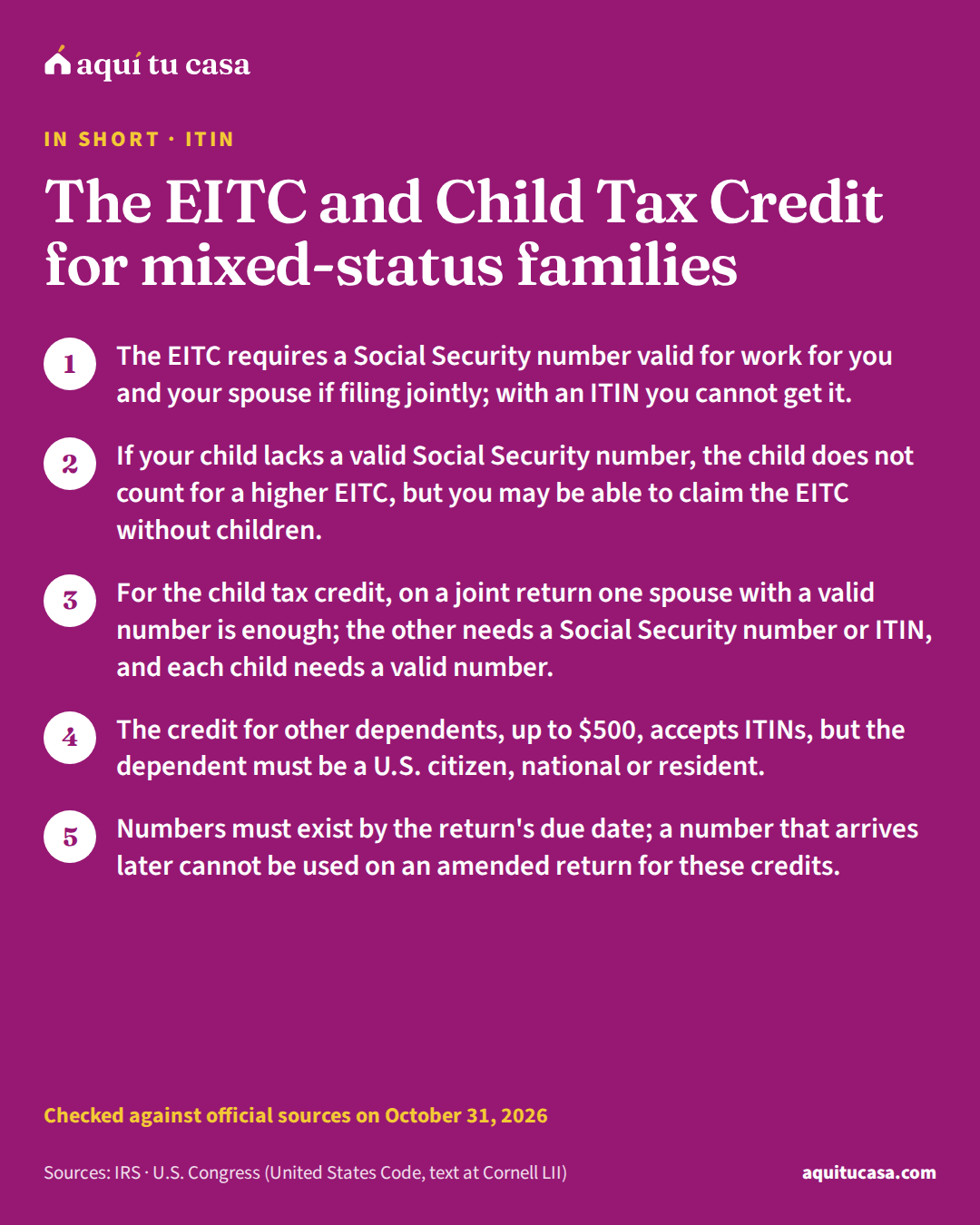
- ITIN The EITC and Child Tax Credit for mixed-status families Which number the IRS requires for the EITC and child tax credit, what an ITIN filer can claim and how the credit for other dependents works. 15 minute read
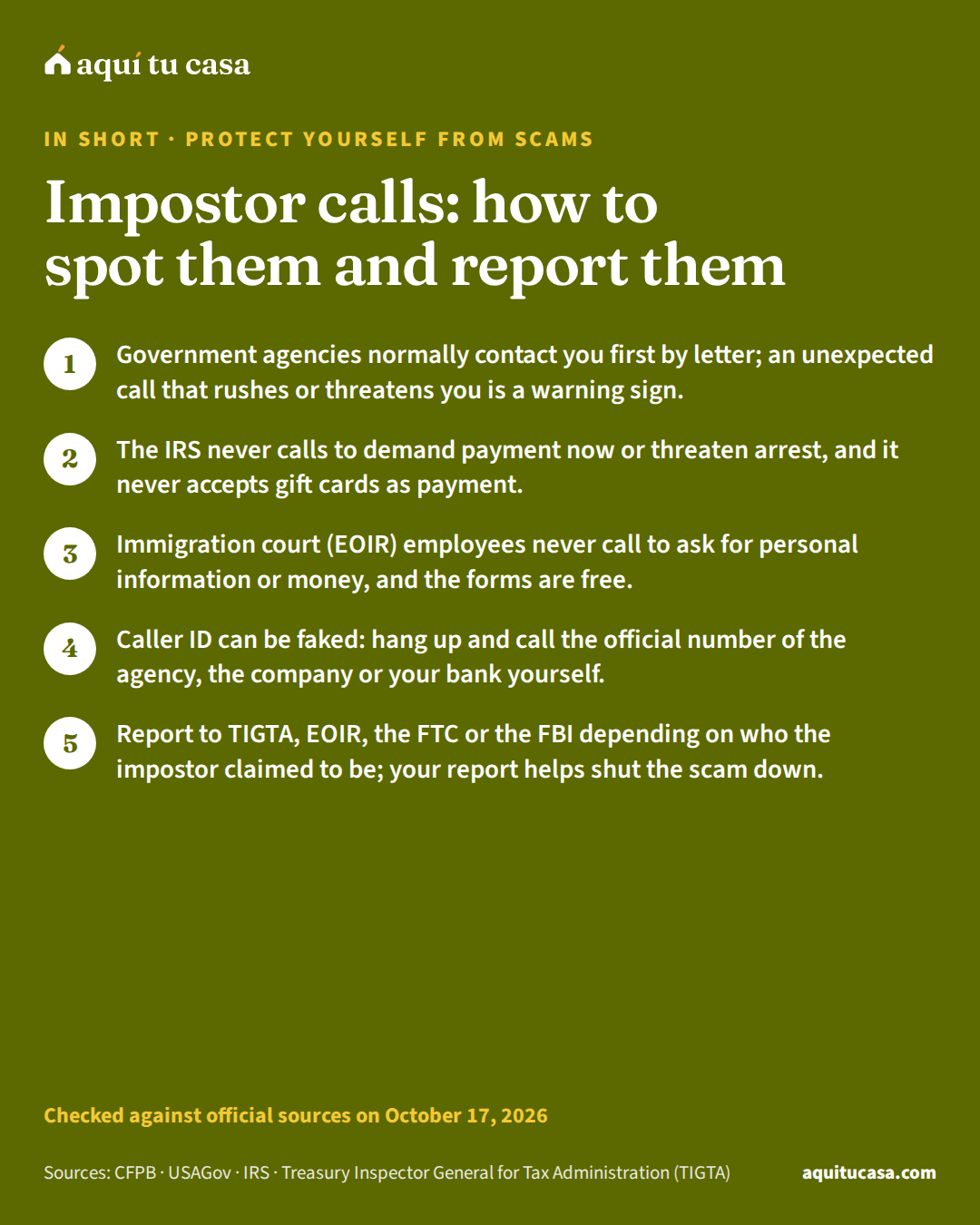
- Protect yourself from scams Impostor calls: how to spot them and report them How to tell whether a call or message from the IRS, immigration court, the power company or your bank is real, and where to report impostors. 14 minute read
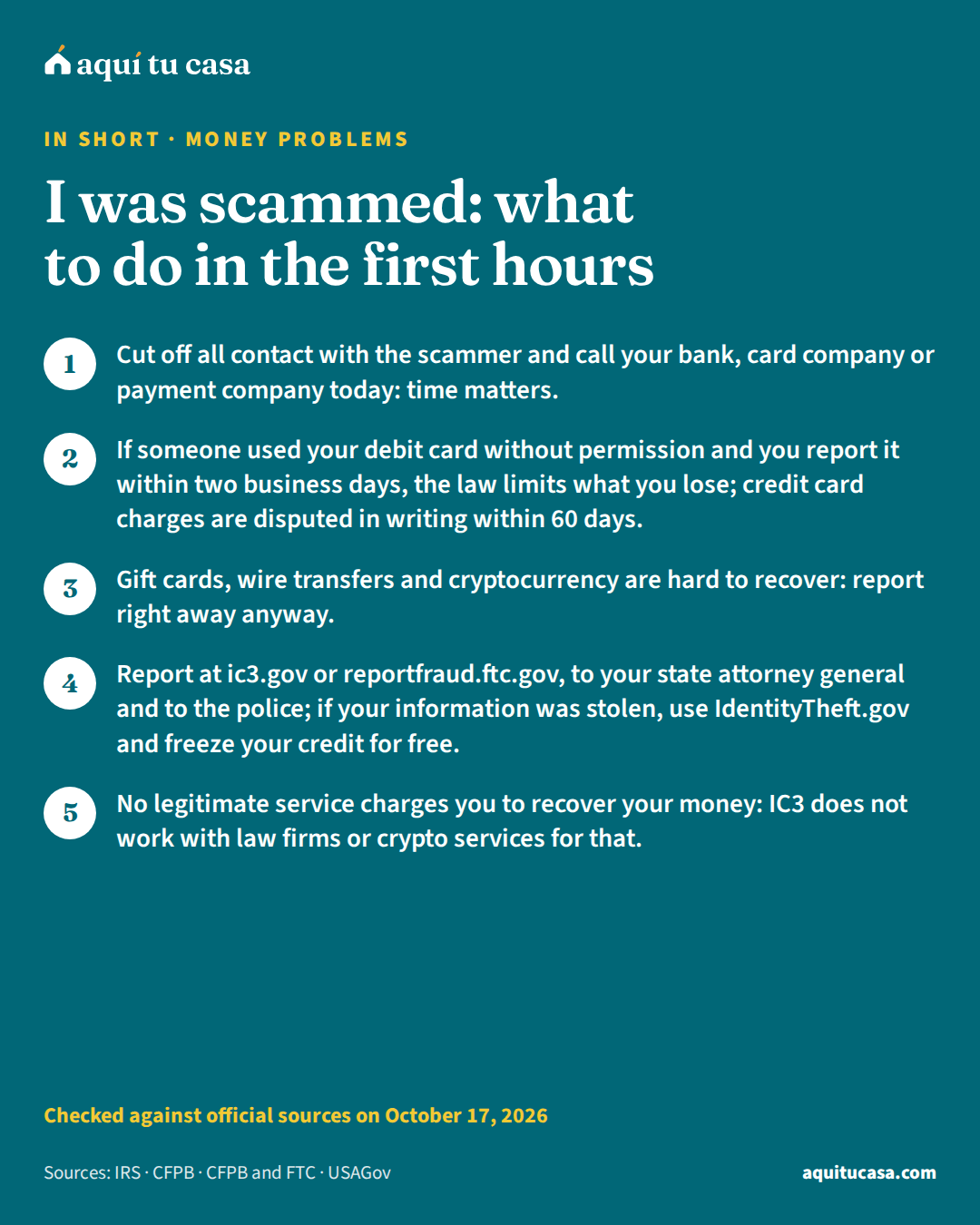
- Money problems I was scammed: what to do in the first hours If you sent money or personal information to a scammer: who to call first, how to dispute a charge, where to report it and how to stop identity theft. 13 minute read
Tools for this topic
Was this guide useful?
Thank you. Your answer stays in your browser; nothing is sent.