Affordable-housing lotteries and LIHTC apartments: how to apply
How affordable-housing lotteries (like NYC Housing Connect) and tax-credit (LIHTC) apartments work: who qualifies, what they cost and how to apply.
Verified against official sources on November 6, 2026 6 official sources

Show contents
In short
What you need to know
Quick answer
An affordable-housing lottery draws rent-restricted apartments among everyone who applies before the deadline; in New York you apply through NYC Housing Connect, online or by mail. To qualify, your income must fall within each building's range, which is set as a percentage of area median income (AMI). Many of these buildings use the LIHTC tax credit: their rent is capped by law and they can't refuse you because you have a Section 8 voucher. Applying is free, and there are organizations that help without charging.
What matters most
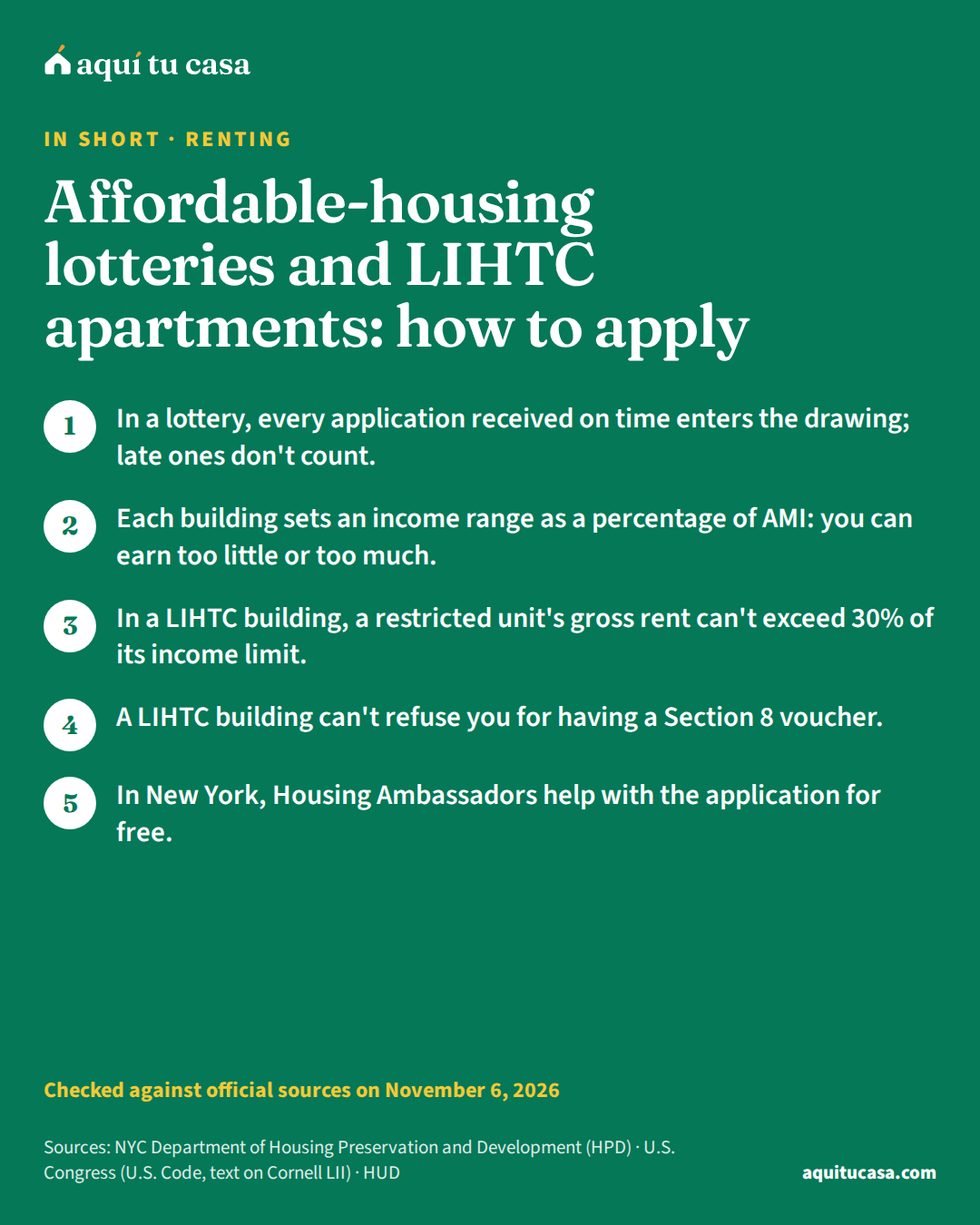
- In a lottery, every application received on time enters the drawing; late ones don't count.
- Each building sets an income range as a percentage of AMI: you can earn too little or too much.
- In a LIHTC building, a restricted unit's gross rent can't exceed 30% of its income limit.
- A LIHTC building can't refuse you for having a Section 8 voucher.
Is this for you?
This guide is for you if…
- You are looking for an apartment with below-market rent and heard about affordable-housing lotteries or LIHTC buildings.
- You live in or near New York and want to know how to apply through NYC Housing Connect.
- You have a Section 8 voucher and want to know which buildings must accept it.
Get direct help first if…
- You want a subsidy that lowers your rent based on your income: read the guide on how to apply for a Section 8 voucher or the one on public housing.
- You already have an eviction notice: read the guide on what to do if you get an eviction notice and look for legal aid today.
An affordable-housing lottery draws rent-restricted apartments among all applications received before the deadline; in New York you apply through NYC Housing Connect, online or by mail.2 To qualify, your income must fall within each building’s range, measured as a percentage of area median incomearea median income (AMI)The area median income (AMI) is the median family income of an area, which HUD computes every year for each metropolitan area and county. Housing programs use it as the yardstick: under the federal rule, a family is low-income when it earns no more than 80% of its area's median income and very low-income when it earns no more than 50%, adjusted for family size. State down payment assistance programs and Section 8 vouchers publish their limits as a percentage of AMI, so the same salary can qualify in one county and not in the next.See the full definition.1 Many of these buildings use the federal LIHTC tax credit, which caps their rent and prohibits them from turning you down for having a Section 8 voucherHousing Choice Voucher (Section 8)The Housing Choice Voucher, the program almost everyone calls Section 8, is the country's largest federal rental assistance. HUD pays rental subsidies so eligible families can afford decent, safe and sanitary housing. Local public housing agencies administer it with HUD funds. The family finds its own home on the private market; if the agency approves the unit and the tenancy, it contracts with the owner to pay part of the rent, and the family pays the rest. Waiting lists are usually long and open for limited periods.See the full definition.5 5 This guide explains how they work, who qualifies and how to apply without paying anyone.
What affordable housing is and how it is measured
In New York, HPD explains that affordable housing is based on your household’s percentage of area median income (AMI), set by the federal government every year. Housing is considered affordable if it costs about one-third or less of household income and is regulated so the rent can’t go up dramatically over time.1
That means each building publishes which incomes it is for: for example, households up to a certain percentage of AMI. Your income has to fit that range; you can be left out for earning too little, not only too much.1 HUD’s income limits for your county and family size give you an idea: look them up in places or with the income limits tool.

How the NYC Housing Connect lottery works
Each building is announced with its deadline. You can apply online through NYC Housing Connect or by mail, following the advertisement’s directions; paper applications are returned by regular mail only. Applications after the deadline are not considered. After the deadline, applications are selected for review through a lottery.2
From application to review
2. Apply online or by mail
By the deadline
Online through NYC Housing Connect, or on paper by regular mail.2
3. The lottery orders applications
After the deadline
Applications are selected for review at random.2
4. They ask for your papers
If you are selected for review
Income, assets and the building's selection criteria.1
To be eligible you must be 18 and have household income within each opportunity’s range. There are also asset limits and tenant selection criteria.1 HPD’s page to find affordable housing links Housing Connect, the application guides, Ready to Rent, which offers free one-on-one financial counseling, and affordable re-rentals.4

Before you apply: read each advertisement with your own numbers
An advertisement is not one offer but several: each unit size has its own income range and its own rent. Before you apply, write down three things about your household. First, how many people will live with you, counting children, because the income range depends on household size. Second, your household’s total income: everyone who will live in the unit and earns money counts, not only you. Third, your savings and other assets, because there are asset limits as well as income limits.1
Then compare. If your income falls below the bottom of a unit’s range, you will not qualify for that unit even if the rent looks low to you; if it falls above the top, you are over the limit. Look for the unit sizes whose range includes your income and your household size, and apply to those. Applying to a unit you can’t qualify for only uses up the time you have before each deadline, and late applications are not considered.2
Rent is the other number to check. In affordable housing, the rent is set so it costs about one-third or less of the household income it is designed for, not of your own income.1 If your income is near the bottom of a range, that rent can take a bigger share of what you earn. The how much rent can I afford calculator shows what share of your income a given rent would take.
Finally, keep your papers current while you wait. If you are selected for review, you will have to show your income, your assets and that you meet the building’s tenant selection criteria.1 Having recent pay stubs, tax returns and bank statements ready in one folder makes that step faster, and keeping a copy of each application and its confirmation number lets you answer any question about it. If your income, your household or your phone number changes while you wait, update every application you have open, so the building can reach you and judge you on your real situation.
What a LIHTC apartment is
LIHTC is the federal low-income housing tax credit. Building owners get it in exchange for keeping some of their units rent-restricted for low-income people. The law gives three tests, and the project elects one:5
The three income tests of a LIHTC project
At least 20% of units
20–50 test
- Rent-restricted and for people with incomes up to 50% of area median.5
At least 40% of units
40–60 test
- Rent-restricted and for people with incomes up to 60% of area median.5
At least 40% of units
Average income
- Each unit has its own limit: 20% to 80% of area median, in steps of 10.5
In all three, a restricted unit's gross rent can't exceed 30% of its income limit.5
The gross rent that counts toward that cap includes the utility allowance and excludes what a Section 8 voucher or similar rental assistance pays.5 So in a LIHTC building the rent is set by the unit’s limit, not by your income: if your income is very low, that rent can still be high for you, and a voucher helps cover the gap.
If you have a Section 8 voucher
The LIHTC law prohibits the building from refusing to rent to you because you have a Section 8 voucher, and lets people who meet the building’s income limit enforce that rule in state court.5 HUD tells voucher holders the same: LIHTC properties are required to accept vouchers, and its resource locator shows the ones near you.6
Having a voucher doesn’t skip the other requirements: you still have to meet the building’s income limit and selection criteria. Some landlords charge application fees, and some housing agencies require voucher holders to pay the deposit on their own.6 The guide on how to apply for a Section 8 voucher explains the search term and lease approval.
Example with real numbers
How a LIHTC unit's rent is set
An example in words; the building's advertisement has the real figures.
- The unit's income limit
- A percentage of area median, for example 60%5
- Maximum gross rent
- 30% of that limit, utility allowance included5
- If you have a voucher
- The voucher doesn't count as gross rent; it helps pay your share5
- What you pay
- The unit's rent, or your share if you have a voucher
Compare the unit's rent with your income before you apply.
Run it with your numbersHow much rent can I afford?
Outside New York: where to look
Every city and state announces its lotteries and buildings its own way. To find LIHTC buildings, use HUD’s locator;6 also ask your housing agency and your state’s housing agency. In places, your county’s rent page brings together HUD’s fair market rent, housing agencies and the rent-help programs we checked, for example Los Angeles County’s.
Mistake: Applying after the deadline.
Instead: Write down each lottery's deadline; late applications are not considered.2
Mistake: Applying everywhere without checking the income range.
Instead: Check each building's range: you can be left out for earning too little or too much.1
Mistake: Paying someone who promises a spot in the lottery.
Instead: Apply yourself or with a Housing Ambassador, who helps for free.3
Mistake: Not mentioning your voucher.
Instead: A LIHTC building can't turn you down for having it.5
Mistake: Arriving at the review without papers.
Instead: Have your income and assets ready; there are limits and selection criteria.1
Where to get free help
A HUD-approved housing counselorHUD-approved housing counselorA HUD-approved housing counselor works at an agency HUD has approved to provide housing counseling: independent, expert advice customized to your situation about buying a home, renting, a missed mortgage payment, a foreclosure or credit problems. The agencies usually charge little or nothing; many serve in Spanish and offer the homebuyer education course several assistance programs require. They are not lenders or real estate agents and sell you nothing. Your county page lists the official agencies with phone numbers.See the full definition can help for free or at low cost with your budget and applications; the guide to HUD-approved housing counselors explains how to find one. In New York, Ready to Rent offers free one-on-one financial counseling.4 If a LIHTC building refuses you for having a voucher, free legal aid can review your case.
If this is you
You have a Section 8 voucher
Look for LIHTC buildings: they can't turn you down for the voucher.5
Your income is very low
LIHTC rent is set by the unit; a voucher or a unit with a lower limit may help.5
You live in New York
Apply through Housing Connect before the deadline; a Housing Ambassador helps for free.3
You have no credit history
Ask about each building's selection criteria before you apply.1

What to do this week
- Add up your household income for the last 12 months and how many people live with you.1
- Look for open lotteries in your city and write down each deadline.2
- Look for LIHTC buildings in HUD’s locator.6
- Gather your pay stubs, tax returns and bank statements.1
- If you have a voucher, say so when you apply to a LIHTC building.5
Your income
Let's do the math
Rent that fits your budget (30% of income)
$2,018
With an income of $6,728 a month. Up to $3,364 would already be a severe burden (50% of income).
Compared with HUD’s Fair Market Rent in the United States
- 2 bedrooms$1,750Fits · 26%Needs $33.65 an hour
The wage needed pays that rent without going over 30% of income, working 40 hours a week all year.
The typical rent households actually pay in the United States is $1,413 a month (Census).
A reference to give you an idea. Each landlord and each program sets its own requirements.
Ready to see the numbers? Find your county here
See how this applies in your county: its loan limits, prices and rents, from the official data.
Printable checklist
Frequently asked questions
What is an affordable-housing lottery?
A drawing to assign rent-restricted apartments. In New York, HPD says that after the deadline applications are selected for review through a lottery; late applications are not considered.
How much do I have to earn to qualify?
It depends on each building. HPD explains that affordable housing is based on a percentage of area median income (AMI) and your income must be within each opportunity's range. You can be left out for earning too little or too much.
What is a LIHTC apartment?
An apartment in a building that received the federal low-income housing tax credit. The law requires some of its units to be rent-restricted and reserved for people with incomes below certain percentages of area median.
Can a LIHTC building turn me down for having Section 8?
Not for having the voucher: the law prohibits refusing to lease to a Section 8 voucher holder because they hold one. You still have to meet the building's income limit and selection criteria.
Do I have to pay to enter a lottery?
You apply to NYC Housing Connect online or by mail, following the advertisement, and Housing Ambassadors help for free. If someone charges you to get into the lottery or to move you up, be wary. Some landlords charge an application fee once they review your case, according to HUD.
How do I find LIHTC buildings outside New York?
HUD has a locator for LIHTC properties. You can also ask your housing agency or your state's housing agency, and check your county's rent page.
Sources
Every figure in this guide comes from one of these official sources. The number next to a sentence leads to the source behind it.
Each source on one line: who publishes it, its title, its address and the date we read it.
- 1. NYC Department of Housing Preservation and Development (HPD) · Do You Qualify? · nyc.gov · Accessed November 6, 2026
- 2. NYC Department of Housing Preservation and Development (HPD) · Housing Connect Application Guides · nyc.gov · Accessed November 6, 2026
- 3. NYC Department of Housing Preservation and Development (HPD) · Housing Ambassadors · nyc.gov · Accessed November 6, 2026
- 4. NYC Department of Housing Preservation and Development (HPD) · Find Affordable Housing · nyc.gov · Accessed November 6, 2026
- 5. U.S. Congress (U.S. Code, text on Cornell LII) · 26 U.S. Code §42, Low-income housing credit · law.cornell.edu · Accessed November 6, 2026
- 6. HUD · Housing Choice Voucher Tenants · hud.gov · Accessed November 6, 2026
Keep reading
Related guides
If this guide helped, these follow the same path.
Renting 10 minute read
How to apply for a Section 8 voucher: waiting lists and papers
How to apply for a Section 8 voucher: where to apply, how waiting lists and preferences work, the papers you need and what changes for a mixed family.
- You apply at a local housing agency when it opens its list; you can get on several lists.
- Your place depends on your application date, local preferences and how many vouchers there are; some agencies use a drawing.
- Report every change of address, phone or household size, or you can be removed from the list.
- Renting How to apply for public housing: who qualifies and what you pay How to apply for public housing: where you apply, who qualifies, what the application asks, waiting lists and preferences, and how your rent is set. 9 minute read
- Renting Emergency rental assistance: how it works and what to bring How to get help with back rent or utility bills: who offers it today, what papers to bring, how long it takes and what to do if you have an eviction case. 9 minute read
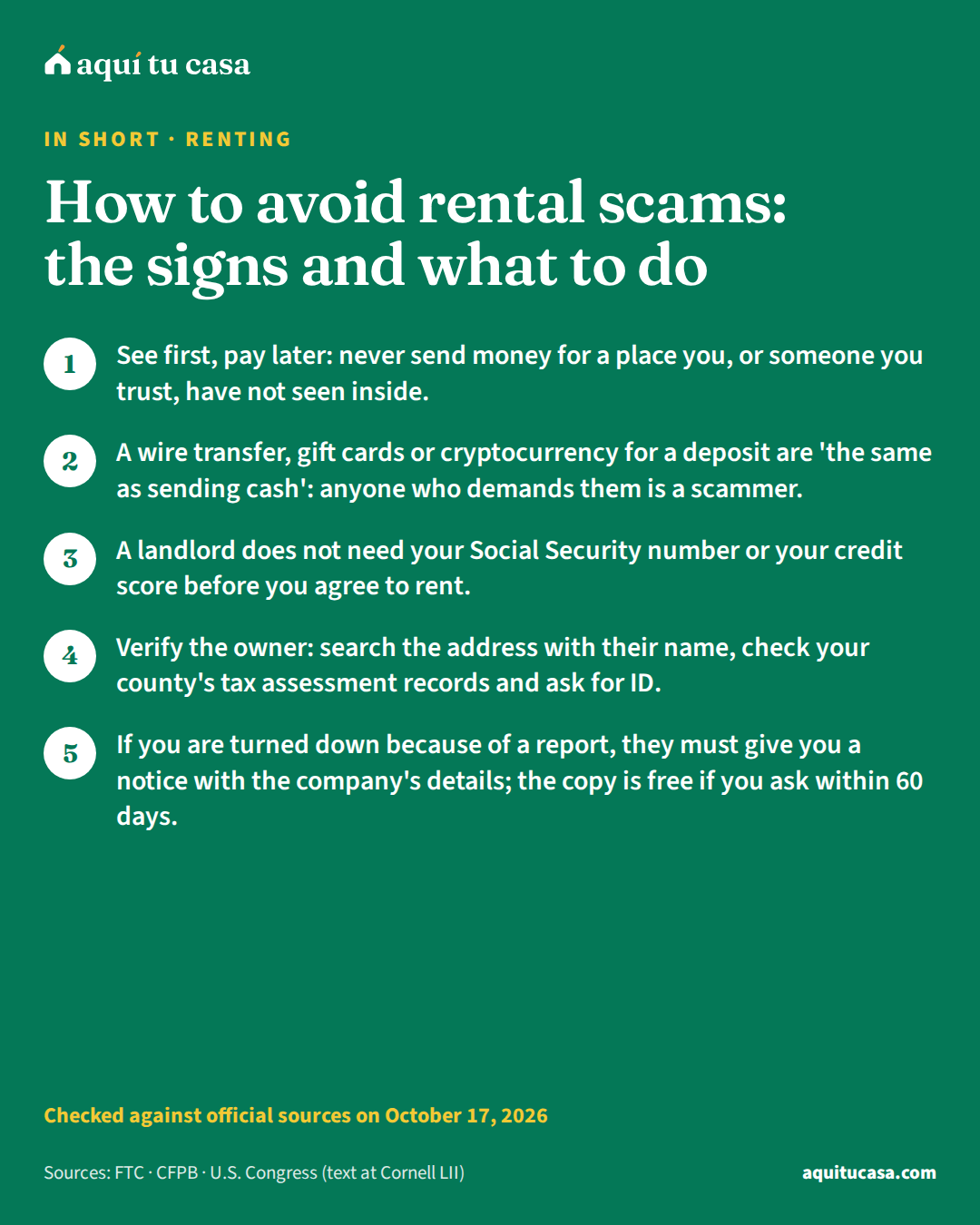
- Renting How to avoid rental scams: the signs and what to do The signs of a fake rental listing, what never to pay up front, what not to share before you sign and where to report, according to the FTC and CFPB. 12 minute read
Tools for this topic
Was this guide useful?
Thank you. Your answer stays in your browser; nothing is sent.