Subletting or adding a roommate to your lease
How to add someone to your lease, when you can sublet, what the rules say in HUD-assisted housing and what to put in an agreement between roommates.
Verified against official sources on October 31, 2026 8 official sources

Show contents
In short
What you need to know
Quick answer
Someone can join your home in three ways: as a co-tenant on the lease, as an occupant who does not sign, or as a subtenant while you are away for a while. Each has different rules, and you almost always need the landlord's permission; in Texas, for example, you may not sublet without prior consent. New York has a law that lets you share with one additional occupant and detailed sublet rules. If you live in public housing or have a voucher, you cannot sublet, and adding someone requires the housing authority's approval. Put the agreement with your roommate in writing.
What matters most
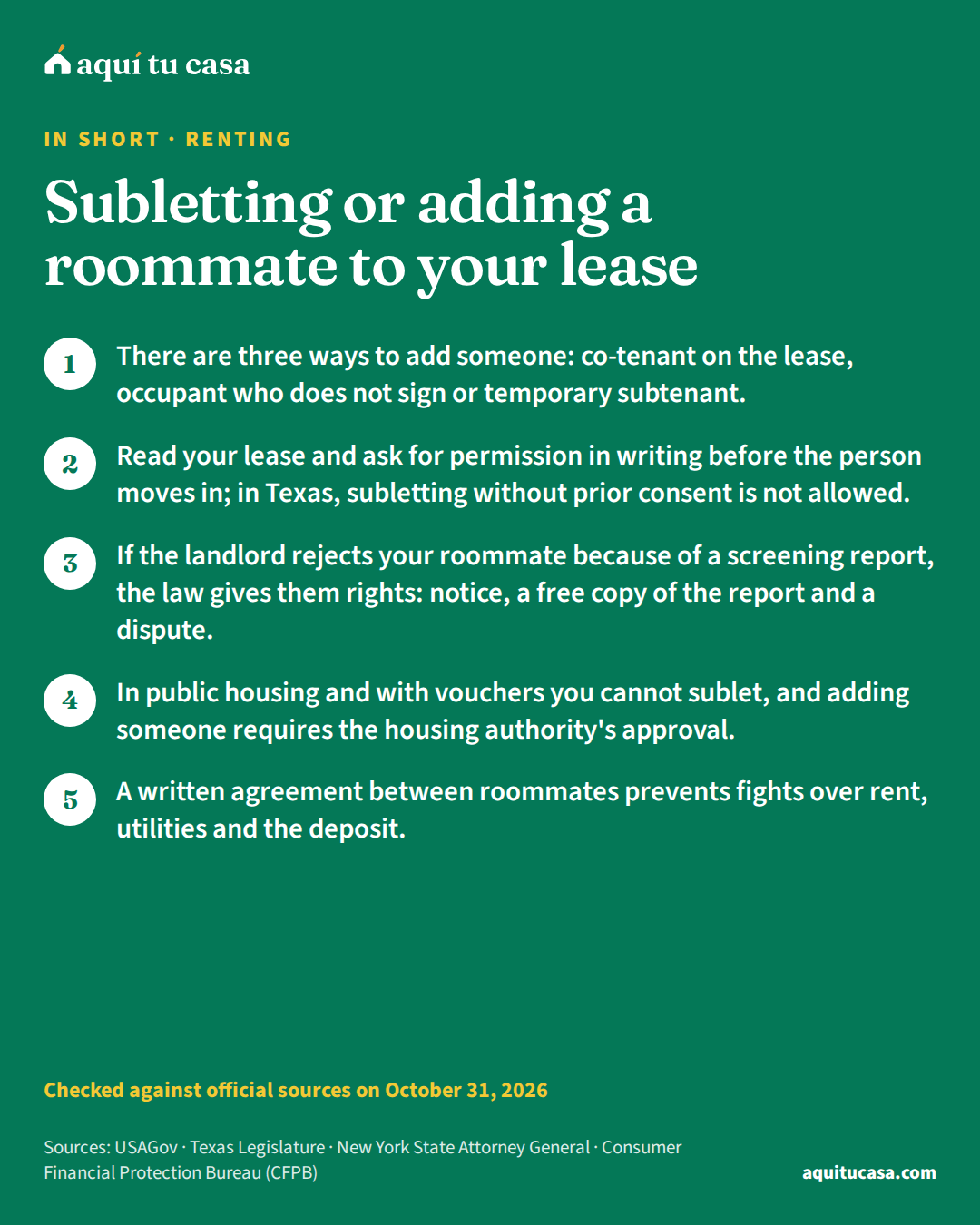
- There are three ways to add someone: co-tenant on the lease, occupant who does not sign or temporary subtenant.
- Read your lease and ask for permission in writing before the person moves in; in Texas, subletting without prior consent is not allowed.
- If the landlord rejects your roommate because of a screening report, the law gives them rights: notice, a free copy of the report and a dispute.
- In public housing and with vouchers you cannot sublet, and adding someone requires the housing authority's approval.
Is this for you?
This guide is for you if…
- You want a friend, relative or coworker to live with you and pay part of the rent.
- You are leaving for a few months and want someone to stay in your home meanwhile.
- You live with someone who is not on the lease and want to know the risks.
Get direct help first if…
- You want to know how many people can live in a home or whether you can be turned down for having children: read «Sharing a home: how many can live there and who signs».
- You own a home and want to rent out a room: read «Renting out a room or unit in your home».
Sharing the rent can ease your budget a lot. But if the other person is not on the lease, or if you leave and someone takes your place, there are rules worth knowing before they move in. This guide explains the three ways to add someone, when you can subletsubletTo sublet, or sublease, is to rent all or part of the home you rent to another person, for a shorter time than your own lease. It is a new contract between you and that person: you become their landlord, but the owner has no contract with them. You remain responsible to the owner for meeting your lease. The owner can forbid subletting, although some places allow it in certain cases despite that ban. In public housing, the federal rule requires the lease to prohibit subletting.See the full definition, what changes if you have HUD assistance and what to put in an agreement with your roommate. Our guide Sharing a home covers how many people can live in a home.1
Three ways to add someone
Not everyone who lives with you has the same relationship with the landlord:
- Co-tenant. Signs the leaseleaseA lease, or rental agreement, is the contract in which the owner or landlord gives you the right to live in and use a property for a set period of time in exchange for payment, usually rent. While the lease lasts you have possession, but the landlord still owns the property. The lease says how much you pay and when, who handles maintenance and how the agreement can end. Your rights as a tenant are usually spelled out in the lease and in your state and local laws. Before complaining to the landlord, it helps to read the lease and make sure you are also following the rules you agreed to.See the full definition with you. Has the same rights and obligations toward the landlord. If you both signed, many leases make each of you responsible for the whole rent, not just your share. Check whether your lease says so.
- Occupant or roommate who does not sign. Lives with you, but the lease is yours. In New York, if you are the only tenant on the lease, the law lets you share with your immediate family, one additional occupant and that occupant’s dependent children, if you or your spouse live there. If the lease has more than one tenant and one moves out, they can be replaced by another occupant. You must tell the landlord the occupant’s name within 30 days, and if you move out, the occupant has no right to stay without the landlord’s express consent.3
- Subtenant. Occupies your home while you are away for a while, and pays you. In New York, that is what subletting means: leaving the apartment temporarily.3
There are also guests: people staying temporarily with your permission. In public housing, HUD’s rule gives you the right to reasonable accommodation of your guests.5 A guest who stays for months and pays rent is no longer just a guest.
Co-tenant, occupant or subtenant
Signs the lease
Co-tenant
- Has rights toward the landlord
- Many leases make them responsible for the whole rent
- The landlord usually reviews their application
Lives with you
Occupant who does not sign
- The lease is still yours
- In New York you must tell the landlord their name
- If you leave, they cannot stay without permission
Temporary
Subtenant
- Takes your place while you are away
- You almost always need the landlord's permission
- You remain responsible for the lease
Before anyone moves in, decide together which of the three your relationship will be and put it in writing.
Adding someone to the lease
If you want your roommate to be a co-tenant, ask the landlord to add them to the lease. The landlord will usually review their application with a tenant screeningtenant screening reportA tenant screening report is a report many landlords use to decide whether to rent to you and how much to charge for the security deposit. Specialty companies prepare it, and it can include your credit report, your rental history including eviction cases and lawsuits, employment verification, criminal history and a score or recommendation. It is not the same as a credit report. If a landlord denies you, or asks for a larger deposit or higher rent, because of the report, federal law requires the landlord to tell you, name the company and explain your right to a free copy and to dispute errors.See the full definition report.
If the landlord rejects them because of information in that report, federal law gives your roommate rights. The CFPB explains that the landlord must give them an adverse action noticeadverse action noticeAn adverse action notice is the notice you get when a company denies you credit or takes another action against you on your application or account. Under federal law, the lender must give you the main reasons or tell you how to ask for them. If the decision was based on a credit report or another consumer report, the company must also give you the score that was used, the name and contact information of the company that supplied the report, and explain your right to a free copy of that report and to dispute errors. The reporting company did not make the decision and cannot tell you why it was made.See the full definition, in writing, orally or electronically, with the name, address and phone number of the company that made the report. The notice explains their right to a free copy if they ask within 60 days and to dispute anything that is wrong; the company generally has 30 days to investigate. Requiring a co-signer, a larger deposit or higher rent than other applicants also counts as adverse action.4 If someone asks you to be their co-signerco-signerA co-signer is a person who signs another person's loan or credit account to back it up, and by doing so becomes responsible for the debt. If the borrower does not pay, the creditor can collect up to the full debt from the co-signer, plus late fees or collection costs, without first trying to collect from the borrower, and the default may become part of the co-signer's credit record. A federal FTC rule calls for the co-signer to get a written notice explaining these risks before signing. On a mortgage, according to Fannie Mae, a co-signer signs the note and shares liability for the debt with the borrower but has no ownership interest in the home on the title.See the full definition, our guide Risks of cosigning a loan or lease explains the risks.
When you add someone, ask what happens to the security depositsecurity depositA security deposit is money you pay the landlord when you start renting as security that you will follow the lease: pay the rent and take care of the home. The money still belongs to you. The landlord holds it and, when you move out, must return it minus the charges the law allows, such as past-due rent or damage beyond normal wear and tear. You should not be charged for damage that was already there when you moved in. The maximum amount and the deadline to return it depend on your state's law and sometimes your city's.See the full definition: does part get added? In whose name is it returned at the end? Ask for the change to be signed.
Subletting while you are away
Subletting almost always requires the landlord’s permission. Read your lease first. Two examples of how the rules vary:
- Texas. During the lease, you may not rent the home to someone else without the landlord’s prior consent.2
- New York. In buildings with four or more apartments you have a right to sublet with the landlord’s advance consent, and a clause banning it is void. In buildings with three or fewer you do not have that right; if the landlord unreasonably refuses, your only remedy is to be let out of the lease after 30 days’ notice. If the landlord refuses on reasonable grounds, you cannot sublet; if the refusal is unreasonable, you may sublet anyway.3
How to ask in New York. The request goes in writing by certified mail, return receipt requested, and includes the length of the sublet, the name and addresses of the incoming person, the reason, your address while away, the written consent of any co-tenant or guarantor, and a copy of the proposed sublease and your lease. The landlord may ask for more information within ten days and must answer in writing within 30 days; if they do not answer, it counts as consent.3 Even if you live in another state, that list helps you put together a complete request.
You remain responsible. In New York, even with the landlord’s permission, you remain responsible for the whole lease, including future rent.3 If the subtenant does not pay or damages the home, the landlord comes to you.

If you have HUD assistance: public housing or a voucher
If you live in public housingpublic housingPublic housing is a program of rental homes for low-income families, older adults and people with disabilities. HUD funds local public housing agencies (PHAs), which manage the homes and charge rents those families can afford. It comes in all sizes and types, from scattered single-family houses to high-rise apartments. The PHA decides whether you qualify based on your annual gross income, whether you are elderly, have a disability or are a family, and your U.S. citizenship or eligible immigration status. To apply, you contact your local PHA. In general, you can stay as long as you comply with the lease.See the full definition or have a housing voucherHousing Choice Voucher (Section 8)The Housing Choice Voucher, the program almost everyone calls Section 8, is the country's largest federal rental assistance. HUD pays rental subsidies so eligible families can afford decent, safe and sanitary housing. Local public housing agencies administer it with HUD funds. The family finds its own home on the private market; if the agency approves the unit and the tenancy, it contracts with the owner to pay part of the rent, and the family pays the rest. Waiting lists are usually long and open for limited periods.See the full definition, the rules are stricter, and breaking them can put your assistance at risk.
In public housing, HUD’s rule says the unit is for the household members authorized in the lease, with reasonable accommodation of their guests. The lease obligates you not to assign the lease or sublease, not to take in paying boarders and to use the unit only as a residence for the household named in the lease.5
With a housing voucher, the housing authoritypublic housing agency (PHA)A public housing agency (PHA) is a state, county, municipal or other governmental entity or public body authorized to operate public housing or rental assistance programs. These are the agencies that locally administer the Housing Choice Vouchers (Section 8) and public housing with HUD funds: they open and manage the waiting lists, review eligibility and income, inspect units and pay the owner its share of the rent. Each county usually has one or several; your page shows the ones serving your area with their phone numbers.See the full definition must approve who lives in the unit. If a child is born or adopted, or you get custody, report it promptly; to add anyone else, ask for approval. Nobody but the approved family may live there, except an approved foster child or live-in aide. You must report when someone stops living with you. And you may not sublease or let the unit, or assign the lease.6 Our guide Section 8 and mixed-status families explains more about the program.
Before someone moves in with you
2. If you have HUD assistance, ask first
Before any change
With a voucher, adding someone requires the housing authority's approval.6
3. Ask for permission in writing
Before the person moves in
With the person's details and how long they will stay.3
4. If they are rejected, check the notice
When you get the answer
A rejection based on a report comes with rights: a free copy and a dispute.4
5. Sign an agreement between you
Before the move
Rent, utilities, deposit, guests and notice to leave.3
The roommate agreement
The lease with the landlord does not say how things are split between you. A written agreement signed by everyone prevents a lot of fights. It does not have to be a complicated legal document; write in plain words:
- Rent: how much each pays, when and how, and who hands it to the landlord.
- Utilities: whose name the electricity, water, gas and internet are in, and how they are split.
- Deposit: how much each put in and how it is split at the end.
- Rooms and shared spaces: who uses what.
- Guests and noise.
- Notice to leave: how much notice whoever leaves gives and what happens to their share of the rent.
If someone stops paying, that agreement and the receipts help you claim their share, for example in small claims court. Check your renters insurancerenters insuranceRenters insurance, also called tenants insurance, protects your belongings and protects you when you rent. The landlord's insurance covers the building, but not your furniture, clothes or electronics. It usually includes three coverages: your personal property, even if it is stolen away from home; additional living expenses if a covered loss forces you to move out for a while; and personal liability if someone is hurt in your home. A standard policy does not cover floods, which are insured separately. Some landlords require it.See the full definition too: our guide Renters insurance explains whether it covers another person’s belongings. The family budget helps you see what your share is.
Example with real numbers
Two roommates sharing an apartment
An example in words, not a real case, of why the written agreement helps.
- The lease
- Only the tenant signed it; her roommate lives with her as an occupant
- What they agree
- He pays half of the rent and internet, with a receipt each month
- What they report
- She tells the landlord her roommate's name in writing
- If he leaves
- He gives a month's notice and pays his share for that month, as their agreement says
- What they gain
- She keeps to her lease and has proof if he stops paying
In New York, the tenant must tell the landlord the occupant's name within 30 days.3 Use the family budget to split the costs.
Run it with your numbersFamily budgetIf this is you
You want a roommate to pay less rent
Read your lease and ask in writing; in Texas, subletting without prior consent is not allowed.2
A relative is moving in with you
In New York you may share with your immediate family and one additional occupant.3
You have a Section 8 voucher
Ask the housing authority for approval before adding anyone; you cannot sublet.6
Your roommate has no credit
If the landlord rejects them because of a report, it must give them a notice with their rights.4
You are leaving for a few months
If you sublet, you remain responsible for the rent; ask for permission in writing first.3

Mistakes that cost you
Mistake: Moving someone in without checking the lease.
Instead: Read what it says about occupants and subletting, and ask for permission in writing.1
Mistake: Subletting in Texas without the landlord's permission.
Instead: Texas law requires the landlord's prior consent.2
Mistake: Thinking that once you sublet you are no longer responsible.
Instead: In New York you remain responsible for the whole lease, including future rent.3
Mistake: Adding someone to a voucher unit without telling anyone.
Instead: The housing authority must approve any new person.6
Mistake: Taking in a paying boarder in public housing.
Instead: The public housing lease prohibits it; a temporary guest is allowed.5
Mistake: Splitting the rent by word of mouth.
Instead: Sign an agreement between you and pay with receipts.
Free help
If you have a problem with the landlord or a roommate, the LSC funds civil legal aidlegal aidLegal aid is the free civil legal help that nonprofit organizations and their lawyers provide to low-income people in civil, not criminal, matters. In housing, that includes representing families facing eviction or foreclosure, alongside matters such as custody, child support, protection from domestic violence and access to benefits. In the United States, the Legal Services Corporation, created by Congress, funds a nationwide network of these organizations; its finder points you to the one in your area. Each sets its own income limits.See the full definition for low-income people; its website finds the nearest organization, and LawHelp.org has free information and forms.7 A HUD-approved housing counselor also advises on renting, often for free or at low cost.8 The tenant rights by state tool summarizes your state’s rules, and if you want to leave before your lease ends, read Breaking a lease early.

What to do this week
- Read your lease and mark what it says about occupants, guests and subletting.1
- If you have HUD assistance, ask your housing authority before any change.6
- Write your request to the landlord with the person’s details and keep it with the date.3
- Decide whether your roommate will be a co-tenant, occupant or subtenant.3
- Write and sign your agreement on rent, utilities and deposit.3
Your income
Let's do the math
Rent that fits your budget (30% of income)
$2,018
With an income of $6,728 a month. Up to $3,364 would already be a severe burden (50% of income).
Compared with HUD’s Fair Market Rent in the United States
- 2 bedrooms$1,750Fits · 26%Needs $33.65 an hour
The wage needed pays that rent without going over 30% of income, working 40 hours a week all year.
The typical rent households actually pay in the United States is $1,413 a month (Census).
A reference to give you an idea. Each landlord and each program sets its own requirements.
Ready to see the numbers? Find your county here
See how this applies in your county: its loan limits, prices and rents, from the official data.
Printable checklist
Frequently asked questions
What is the difference between a roommate and a subtenant?
A roommate lives with you and may or may not be on the lease. A subtenant occupies your home, or part of it, while you are away for a while and rents your place from you. In New York, subletting means leaving the apartment temporarily.
Do I need the landlord's permission for someone to live with me?
It is almost always wise to ask in writing, and it depends on your lease and your state. In Texas you may not sublet without the landlord's prior consent. In New York, if you are the only tenant, you may share with one additional occupant and their dependent children, and you must tell the landlord their name.
What happens if I sublet and the subtenant does not pay?
In New York, even with the landlord's permission, you remain responsible for the whole lease, including future rent. In most cases the lease with the landlord is still yours, so their late rent is your problem.
I live in public housing. Can a friend stay with me?
As a temporary guest, yes: HUD's rule gives you the right to reasonable accommodation of your guests. But you cannot sublet or take in paying boarders, and the unit is only for the household named in the lease.
I have a Section 8 voucher. Can I add someone?
Only with the housing authority's approval. HUD's rule says nobody but the approved family may live in the unit. If a child is born or adopted, just report it promptly; for anyone else, ask for approval.
What do I do if the landlord rejects my roommate because of their report?
If the rejection is based on a tenant screening report, the landlord must give an adverse action notice with the company's details. Your roommate can ask for a free copy within 60 days and dispute anything that is wrong.
Sources
Every figure in this guide comes from one of these official sources. The number next to a sentence leads to the source behind it.
Each source on one line: who publishes it, its title, its address and the date we read it.
- 1. USAGov · Tenant rights · usa.gov · Accessed October 31, 2026
- 2. Texas Legislature · Texas Property Code, Chapter 91, Provisions Generally Applicable to Landlords and Tenants · tcss.legis.texas.gov · Accessed October 31, 2026
- 3. New York State Attorney General · Residential Tenants' Rights Guide · ag.ny.gov · Accessed October 31, 2026
- 4. Consumer Financial Protection Bureau (CFPB) · What should I do if my rental application is denied because of a tenant screening report? · consumerfinance.gov · Accessed October 31, 2026
- 5. U.S. Department of Housing and Urban Development (HUD), via eCFR · 24 CFR §966.4, Lease requirements (Public Housing) · ecfr.gov · Accessed October 31, 2026
- 6. U.S. Department of Housing and Urban Development (HUD), via eCFR · 24 CFR §982.551, Obligations of participant (Housing Choice Voucher Program) · ecfr.gov · Accessed October 31, 2026
- 7. Legal Services Corporation (LSC) · I Need Legal Help · lsc.gov · Accessed October 31, 2026
- 8. Consumer Financial Protection Bureau (CFPB) · Find a housing counselor · consumerfinance.gov · Accessed October 31, 2026
Keep reading
Related guides
If this guide helped, these follow the same path.

Renting 11 minute read
Sharing a home: occupancy limits and who signs the lease
How many people can live in a home, when an occupancy limit discriminates against families with children, and what to know before subletting.
- There is no national occupancy code: HUD sees two persons per bedroom as reasonable as a general rule, but reviews each case.
- Refusing to rent to you because you have children under 18 or are pregnant is illegal; a limit on children per unit is less likely to be reasonable.
- State and local laws can set how many people a home can hold; if the landlord's rule follows them, HUD sees it as more reasonable.
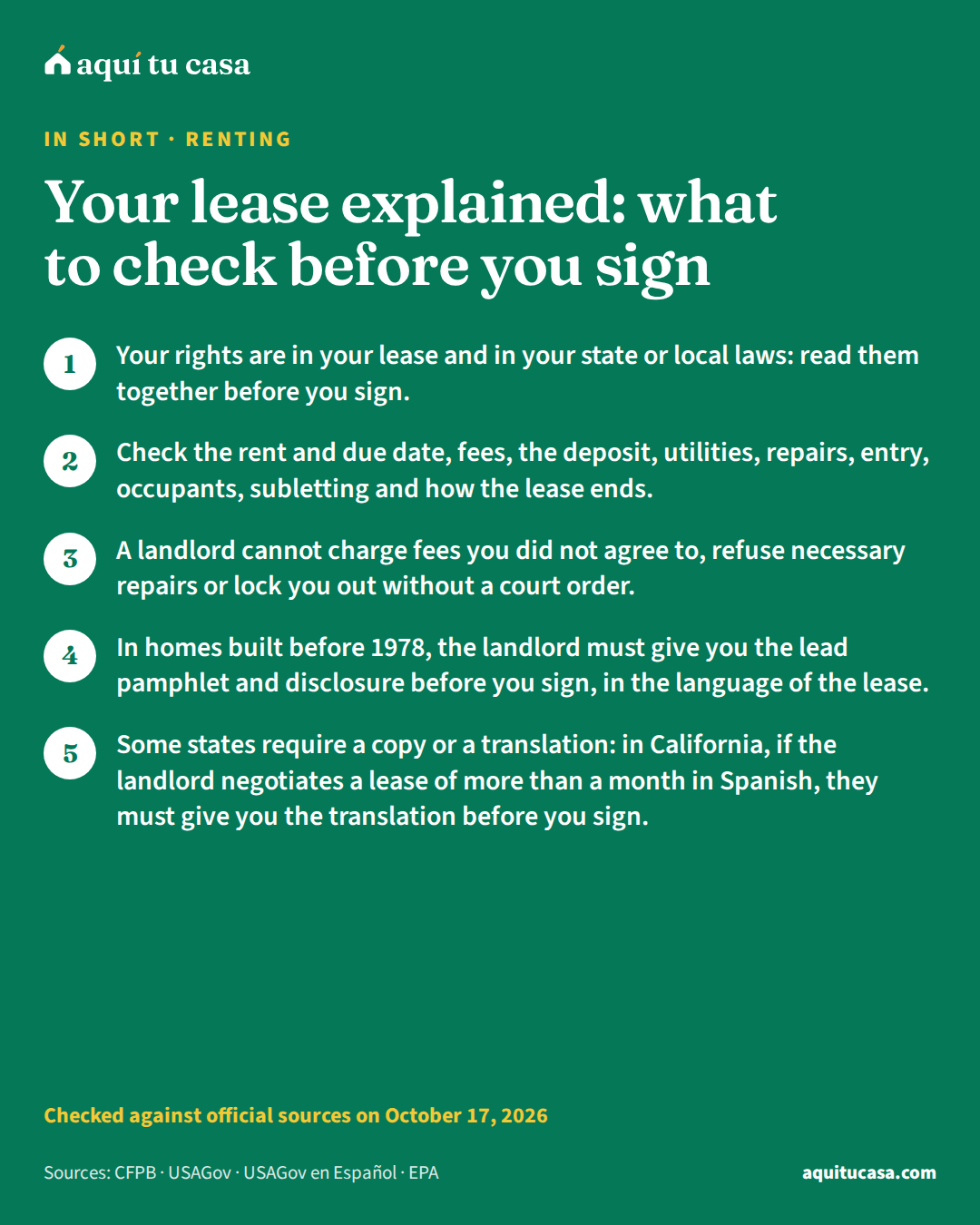
- Renting Your lease explained: what to check before you sign What a lease is, which clauses to read before you sign, the lead paint disclosure, your fair housing rights and where to get free help. 15 minute read
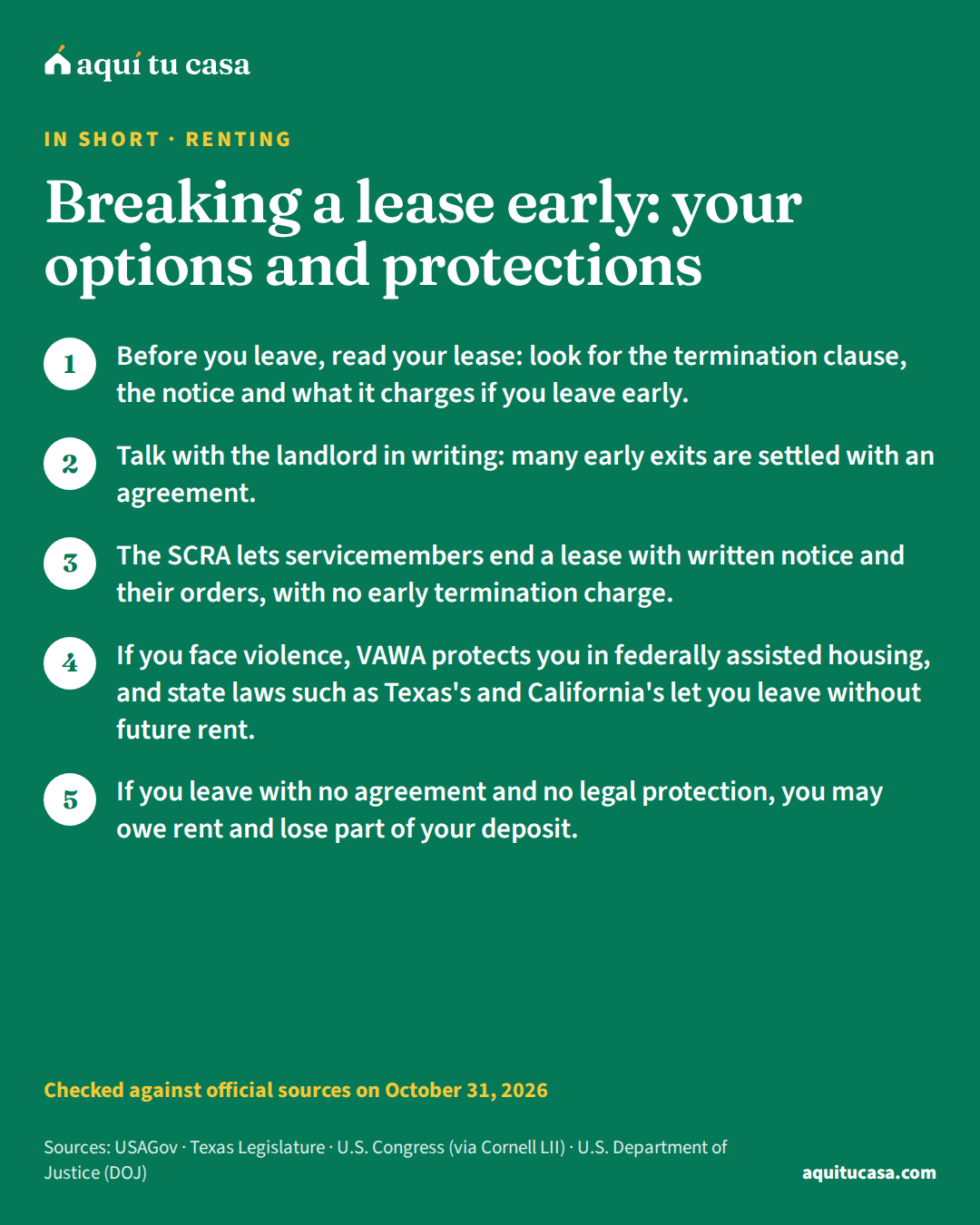
- Renting Breaking a lease early: your options and protections What happens if you leave before your lease ends, how to negotiate your way out and the protections for servicemembers (SCRA) and survivors of violence. 11 minute read
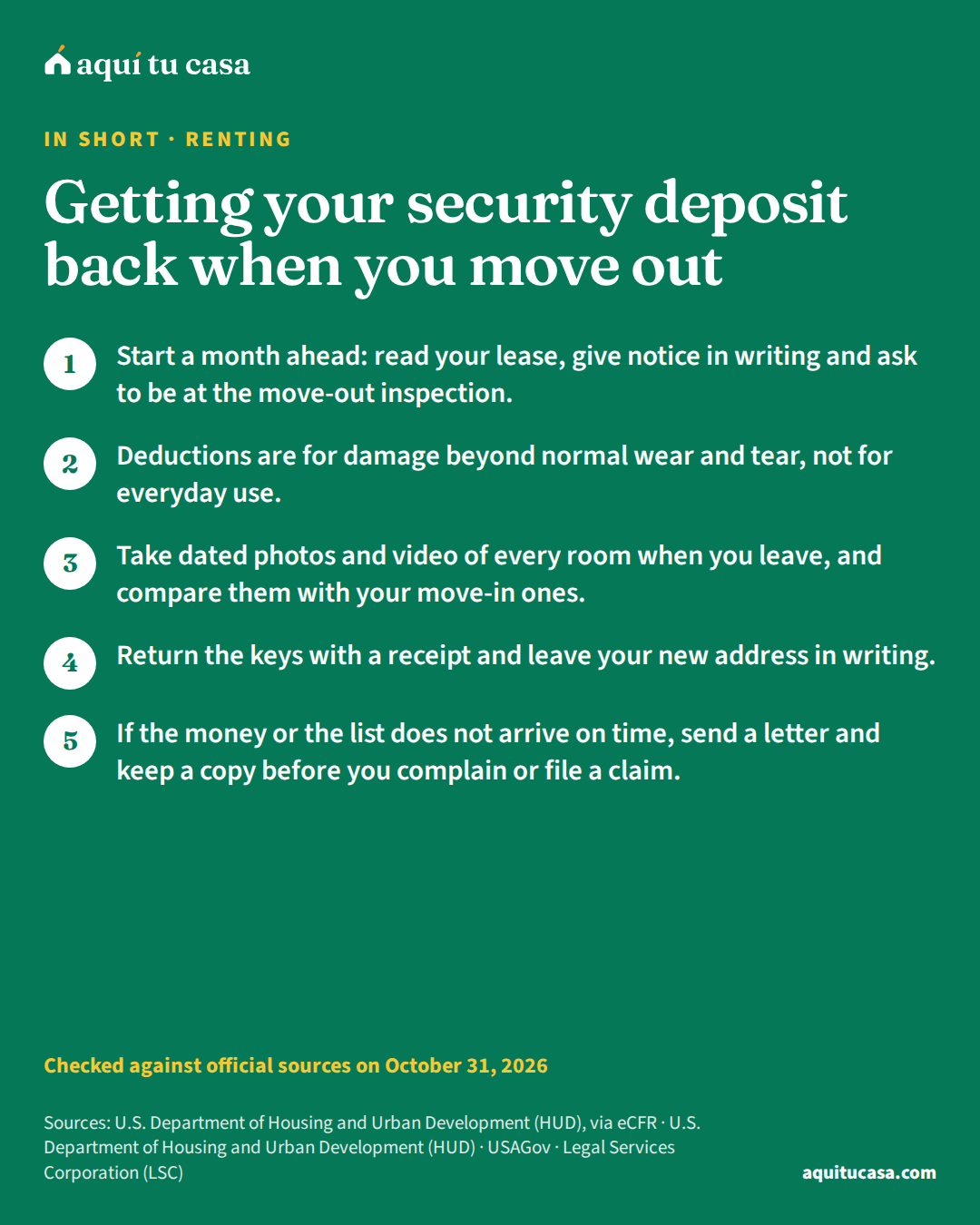
- Renting Getting your security deposit back when you move out A move-out plan: what to do before giving notice, the move-out inspection, photos, returning keys and the letter to request your deposit if it is late. 11 minute read
Tools for this topic
Was this guide useful?
Thank you. Your answer stays in your browser; nothing is sent.