Breaking a lease early: your options and protections
What happens if you leave before your lease ends, how to negotiate your way out and the protections for servicemembers (SCRA) and survivors of violence.
Verified against official sources on October 31, 2026 11 official sources

Show contents
In short
What you need to know
Quick answer
A fixed-term lease binds you until it ends. If you leave early, what you owe depends on your lease and your state's law: some leases have an exit clause, and in some states, such as Texas, the landlord must try to rent the home again. There are two special protections. The federal law for servicemembers (SCRA) lets you end the lease with written notice and your orders, with no early termination charge. And survivors of violence have VAWA protections in federally assisted housing and, in many states, laws that let them leave without owing future rent.
What matters most
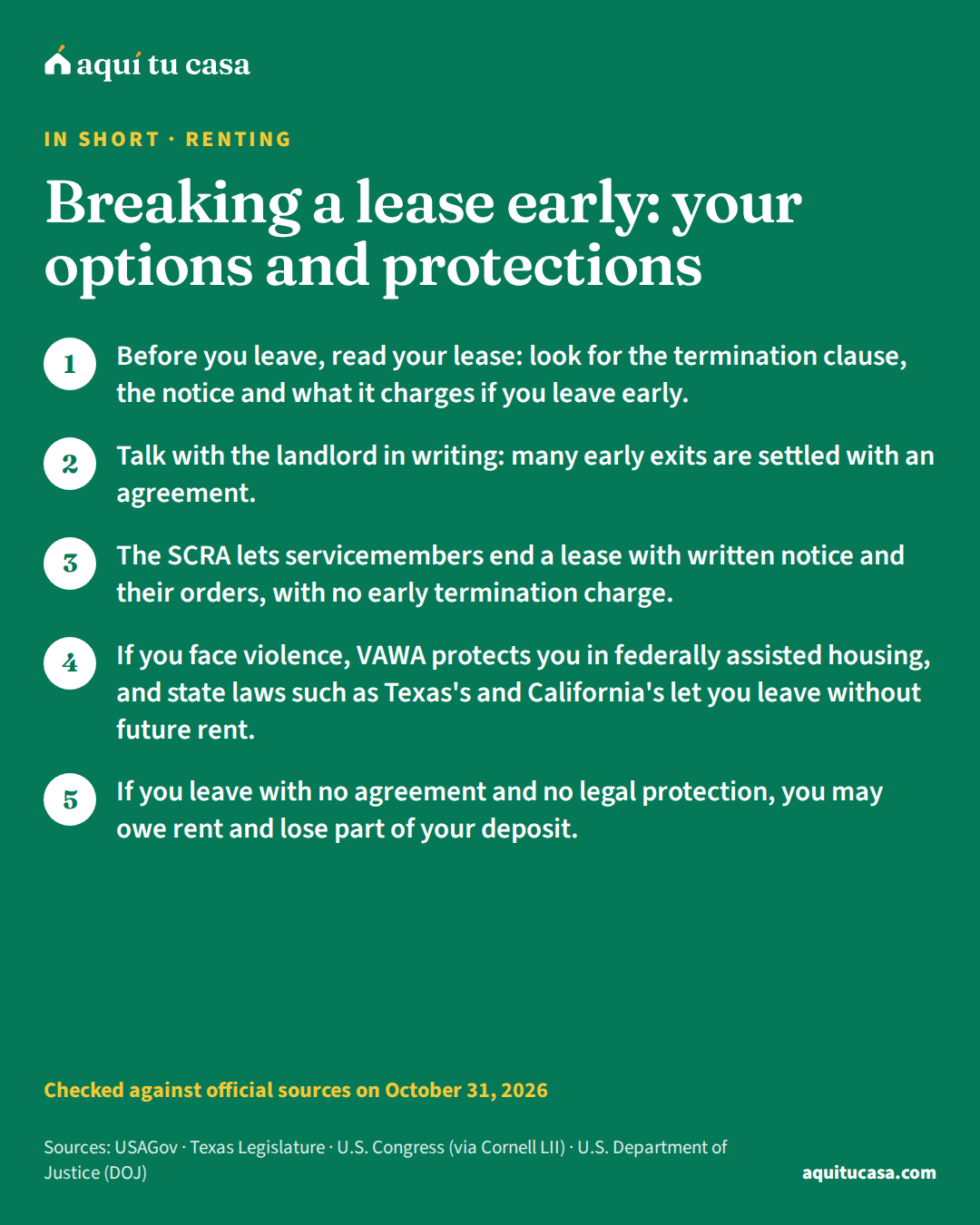
- Before you leave, read your lease: look for the termination clause, the notice and what it charges if you leave early.
- Talk with the landlord in writing: many early exits are settled with an agreement.
- The SCRA lets servicemembers end a lease with written notice and their orders, with no early termination charge.
- If you face violence, VAWA protects you in federally assisted housing, and state laws such as Texas's and California's let you leave without future rent.
Is this for you?
This guide is for you if…
- You need to move before your lease ends because of work, family, money or safety.
- You are a servicemember or a servicemember's dependent and received PCS or deployment orders.
- You are experiencing domestic violence, sexual assault or stalking and need to leave your home.
Get direct help first if…
- The landlord is forcing you out or gave you an eviction notice: read «What to do if you get an eviction notice».
- You are in danger right now: call 911.
Life changes: a new job, a relative who needs help, a paycheck that no longer stretches or a dangerous situation. If you signed a fixed-term leaseleaseA lease, or rental agreement, is the contract in which the owner or landlord gives you the right to live in and use a property for a set period of time in exchange for payment, usually rent. While the lease lasts you have possession, but the landlord still owns the property. The lease says how much you pay and when, who handles maintenance and how the agreement can end. Your rights as a tenant are usually spelled out in the lease and in your state and local laws. Before complaining to the landlord, it helps to read the lease and make sure you are also following the rules you agreed to.See the full definition, leaving early has rules. This guide explains what the law generally says, how to negotiate your exit and the special protections for servicemembers and survivors of violence. The first step is always the same: USAGov recommends reading your lease carefully before getting outside help.1
What the law generally says if you leave early
A fixed-term lease, for example for one year, obligates you to pay rent until it ends. If you leave early with no agreement and no legal protection, the landlord can claim the rent they lose and the charges the lease sets. How much depends on your lease and your state’s law.
The duty to mitigate. In some states the landlord cannot just sit back and charge you: they have to try to rent the home again. In Texas, for example, the law says the landlord has a duty to mitigate damages if you abandon the home in violation of the lease, and a clause that removes that duty is void.2 Ask legal aid in your state how it works there.
What your lease may say. Look in your lease for:
- An early termination clause: some let you leave with a certain notice and a set payment.
- The notice you must give and how.
- Whether it allows subletting or transferring the lease to someone else.
- What happens to your security depositsecurity depositA security deposit is money you pay the landlord when you start renting as security that you will follow the lease: pay the rent and take care of the home. The money still belongs to you. The landlord holds it and, when you move out, must return it minus the charges the law allows, such as past-due rent or damage beyond normal wear and tear. You should not be charged for damage that was already there when you moved in. The maximum amount and the deadline to return it depend on your state's law and sometimes your city's.See the full definition.
If you have a month-to-month leasemonth-to-month tenancyA month-to-month tenancy is a rental arrangement with no end date: it continues month after month as long as you pay the rent, until you or the landlord give notice to end it. It can be in writing, but it can also start without a contract, for example if you stay after your lease ends and the landlord accepts your payment. To end it, you must give the notice your state's law requires. In New York, for example, the notice alone does not let the landlord remove you: if you do not leave, the landlord has to go to court.See the full definition, you generally just need to give the notice your state requires. The tenant rights by state tool shows the notice to end a month-to-month tenancy in your state.
Negotiating your exit with the landlord
Many early exits are settled by talking. A landlord also benefits from knowing early that you are leaving and getting the home rented quickly. Before you leave:
- Give notice in writing and early. Explain the date you are leaving and why, if you want.
- Propose a solution. For example, paying an extra month, keeping the home ready to show, helping find a new tenant or, if your lease allows, a sublet; in Texas, for example, you may not sublet without the landlord’s prior consent.2 Our guide Subletting and adding a roommate explains how it works.
- Get the agreement in writing and signed, with the move-out date, what you pay and what happens to the deposit.
If you leave without an agreement, keep proof: your notice, the dates and photos of how you left the home. Our guide Getting your security deposit back explains how to document your move-out.
Three ways to leave early
Safest
With an agreement
- You negotiate it with the landlord
- It is in writing and signed
- You know what you pay and what happens to the deposit
If it applies
With a legal protection
- The SCRA for servicemembers
- VAWA in federally assisted housing
- State laws for survivors of violence
More risk
No agreement, no protection
- You may owe rent and lease charges
- You may lose part of the deposit
- It can end in a lawsuit
If you do not have a legal protection, look for a written agreement first.
If you are a servicemember: the SCRA
The Servicemembers Civil Relief Act (SCRA) lets you end the lease of the home where you or your dependents live in these cases:4
- You signed the lease before entering military service and then entered.
- While in service, you signed the lease and later received orders for a permanent change of station (PCS) or to deploy for at least 90 days.
- You signed the lease on receiving those orders and later received a stop movement order for an emergency, for at least 30 days or indefinitely.
Ending it also ends your dependents’ obligations under that lease.4
How it is done. You give the landlord or its agent written notice with a copy of your orders. You can deliver it by hand, by courier, by mail with return receipt requested or by electronic means, such as the email address the landlord designated.4
When it ends and what you pay. If rent is monthly, termination takes effect 30 days after the first date the next rent payment is due after your notice. You pay rent up to that date, prorated. The landlord may not impose an early termination charge, though you still owe what the lease provides, such as reasonable charges for excess wear. If you paid rent in advance for after that date, it must be refunded within 30 days.4
If the servicemember dies or is injured. If the servicemember dies in service, the spouse or dependent can end the lease during the following year. If they suffer a catastrophic injury or illness in service, they can also end it during the following year.4
If your rights are not respected. The Department of Justice recommends contacting your local military legal assistance office. If you are not eligible for that assistance, you can submit a complaint to the Department, which cannot investigate every one or act as your lawyer.5

If you face violence: VAWA and your state’s laws
If you are a victim of domestic violence, dating violence, sexual assault or stalking, you have protections. Our guide VAWA housing protections for survivors explains all of them in detail; here is what matters for leaving your home.
In federally assisted housing (VAWA). If you live in housing covered by VAWA, such as public housing or with a housing voucherHousing Choice Voucher (Section 8)The Housing Choice Voucher, the program almost everyone calls Section 8, is the country's largest federal rental assistance. HUD pays rental subsidies so eligible families can afford decent, safe and sanitary housing. Local public housing agencies administer it with HUD funds. The family finds its own home on the private market; if the agency approves the unit and the tenancy, it contracts with the owner to pay part of the rent, and the family pays the rest. Waiting lists are usually long and open for limited periods.See the full definition, you qualify for an emergency transfer if you expressly request it and reasonably believe there is a threat of imminent harm from further violence if you stay in the same unit.6 If you have a Section 8 voucher, you must be allowed to move with your assistance.8 And VAWA does not override state or local laws that give you more protection.7
In many states, even if your housing is private. Two examples:
- Texas. You can end the lease, move out and avoid future rent if you give the landlord a copy of a protective order or documentation of family violence from a health care provider, mental health provider or victim advocate, give written notice at least 30 days ahead and move out. If someone who lives with you committed the violence, that notice is not required. You still owe past-due rent, unless your lease lacks the notice about these special rights. And no one can make you give up this right.3
- California. You can give notice ending the lease if you, a household member or an immediate family member was a victim of domestic violence, sexual assault, stalking, human trafficking, elder abuse or other violent crimes. The notice goes in writing with a protective order, a police report or documentation from a qualified third party, within 180 days. You pay rent for no more than 14 days after the notice, and the landlord may not keep your deposit because of that termination.9
If you live in another state, a legal aidlegal aidLegal aid is the free civil legal help that nonprofit organizations and their lawyers provide to low-income people in civil, not criminal, matters. In housing, that includes representing families facing eviction or foreclosure, alongside matters such as custody, child support, protection from domestic violence and access to benefits. In the United States, the Legal Services Corporation, created by Congress, funds a nationwide network of these organizations; its finder points you to the one in your area. Each sets its own income limits.See the full definition organization or the national hotline can tell you which law protects you.10
Before you leave early
1. Read your lease
Before you decide
Look for the termination clause, the notice and whether it allows subletting.1
2. Check whether you have a legal protection
Before you give notice
Military orders, VAWA or your state's law for survivors of violence.4
3. Gather your documents
Before you give notice
Your orders, or the protective order or documentation your state requires.3
4. Give notice in writing
With the time the law or lease requires
With a copy of your documents and a delivery method that leaves proof.4
5. Ask for a signed agreement
If you negotiate
Move-out date, what you pay and what happens to the deposit.1
6. Document your move-out
The day you leave
Dated photos and keys returned with a receipt.2
Try it with your numbersTenant rights by state
Example with real numbers
A servicemember with PCS orders
An example in words, not a real case, of how the SCRA applies.
- Her situation
- She signed a one-year lease while in service and then received PCS orders
- What she delivers
- Written notice with a copy of her orders, by mail with return receipt
- When it ends
- 30 days after the next rent payment that comes due after the notice is delivered
- What she pays
- Prorated rent up to that date, with no early termination charge
- What she gets back
- Any rent she paid in advance for after that date, within 30 days
The rules in this example come from the SCRA.4 Use the move-in cash calculator to plan for the next home.
Run it with your numbersMove-in cashIf this is you
You are a servicemember with orders
Give written notice with a copy of your orders; the landlord may not charge an early termination fee.4
You face violence and need to leave
In federally assisted housing you can request an emergency transfer; your state may give you more protection.6
You have a Section 8 voucher
If you face violence, you must be allowed to move with your assistance.8
You are moving for work or family
Read your lease and negotiate in writing; in Texas, the landlord must try to rent the home again.2
You are on a month-to-month lease
Give the notice your state requires; the tenant rights tool shows it.1

Mistakes that cost you
Mistake: Leaving without reading your lease.
Instead: Look for the termination clause, the notice and whether it allows subletting.1
Mistake: Giving notice only out loud.
Instead: Give written notice with a delivery method that leaves proof.4
Mistake: As a servicemember, paying an early termination fee.
Instead: The SCRA bans that charge; you pay prorated rent up to the effective date.4
Mistake: Sending the military notice without your orders.
Instead: The SCRA requires written notice with a copy of your orders.4
Mistake: Thinking VAWA only matters in court.
Instead: In covered housing you can request an emergency transfer for your safety.6
Mistake: Signing away your rights as a survivor.
Instead: In Texas, that right cannot be waived.3
Free help
The LSC funds civil legal aid for low-income people; its website finds the nearest organization, and LawHelp.org has free information and forms.11 Our guide Free legal aid explains how to ask for it. If you are a servicemember, your military legal assistance office can help with the SCRA.5 If you face violence, the National Domestic Violence Hotline, 1-800-799-7233, connects you with local services, and if you are in immediate danger, call 911.10
If the landlord responds with threats or tries to force you out for using your rights, read our guide Landlord retaliation.
What to do this week
- Read your lease and mark the termination clause, the notice and what it says about subletting.1
- Check whether you have a legal protection: military orders, VAWA or your state’s law.7
- Gather your documents: your orders or the documentation your state requires.4
- Write your notice to the landlord and decide how you will deliver it so you have proof.4
- If you do not have a legal protection, propose a written agreement.2
Your move
We use the place's fair market rent and the state's deposit rule.
Adjust advanced details
Let's do the math
Cash to move in
$3,500
What you need before you get the keys.
What adds up
- First month
- $1,750
- Security deposit
- $1,750
- Total
- $3,500
When you'll have it
Enter what you can set aside each month to see how long it takes.
What helps
- Ask for a receipt for every payment and keep a copy of the lease.
- On move-in day, walk through the home and take dated photos.
- Never send money for a home you haven't seen or a lease you haven't read.
This is a planning estimate, not a price. What you are asked for depends on the landlord, your lease and your state's and city's rules. It is not legal advice.
Ready to see the numbers? Find your county here
See how this applies in your county: its loan limits, prices and rents, from the official data.
Printable checklist
Frequently asked questions
What happens if I leave before my lease ends?
It depends on your lease and your state's law. You may owe rent until the lease ends or until the home is rented again, plus charges the lease sets. In Texas, for example, the landlord has a duty to try to reduce those damages if you abandon the home.
How do I end my lease if I am a servicemember?
Under the SCRA, you give the landlord written notice with a copy of your orders, by hand, by courier, by mail with return receipt or electronically. If you pay monthly, termination takes effect 30 days after the next rent payment comes due.
Can I be charged an early termination fee as a servicemember?
No. The SCRA says the landlord may not impose an early termination charge. You do owe prorated rent up to the effective date and what the lease provides, such as reasonable charges for excess wear.
I am a survivor of domestic violence. Can I leave without paying the rest of the lease?
Often yes, depending on your state. In Texas, with a protective order or documentation from a health care provider or victim advocate, and 30 days' written notice. In California, with written notice and documentation, you pay rent for no more than 14 days. In federally assisted housing, VAWA protects you too.
What is a VAWA emergency transfer?
In housing covered by VAWA, you can ask to be moved to another unit if you reasonably believe you face further violence if you stay. If you have a Section 8 voucher, you must be allowed to move with your assistance. The site's VAWA guide explains it step by step.
Can I find someone to take my place?
It depends on your lease and your state. In Texas, for example, you may not sublet without the landlord's prior consent. Ask in writing whether they accept a new tenant or a sublet before you leave.
Where can I get free help?
The LSC helps you find free legal aid near you. If you are a servicemember, contact your military legal assistance office. If you face violence, the National Domestic Violence Hotline, 1-800-799-7233, connects you with local services.
Sources
Every figure in this guide comes from one of these official sources. The number next to a sentence leads to the source behind it.
Each source on one line: who publishes it, its title, its address and the date we read it.
- 1. USAGov · Tenant rights · usa.gov · Accessed October 31, 2026
- 2. Texas Legislature · Texas Property Code, Chapter 91, Provisions Generally Applicable to Landlords and Tenants · tcss.legis.texas.gov · Accessed October 31, 2026
- 3. Texas Legislature · Texas Property Code, Chapter 92, Residential Tenancies · tcss.legis.texas.gov · Accessed October 31, 2026
- 4. U.S. Congress (via Cornell LII) · 50 U.S.C. §3955, Termination of residential or motor vehicle leases (Servicemembers Civil Relief Act) · law.cornell.edu · Accessed October 31, 2026
- 5. U.S. Department of Justice (DOJ) · Servicemembers and Veterans Initiative: How We Can Help · justice.gov · Accessed October 31, 2026
- 6. U.S. Department of Housing and Urban Development (HUD), via eCFR · 24 CFR §5.2005, VAWA protections · ecfr.gov · Accessed October 31, 2026
- 7. U.S. Department of Housing and Urban Development (HUD), via eCFR · 24 CFR §5.2011, Effect on other laws · ecfr.gov · Accessed October 31, 2026
- 8. U.S. Department of Housing and Urban Development (HUD) · Violence Against Women Act (VAWA) · hud.gov · Accessed October 31, 2026
See the other 3 sources
- 9. California Legislature (text via California Public Law) · California Civil Code §1946.7 · california.public.law · Accessed October 31, 2026
- 10. U.S. Department of Justice, Office on Violence Against Women (OVW) · Local Resources · justice.gov · Accessed October 31, 2026
- 11. Legal Services Corporation (LSC) · I Need Legal Help · lsc.gov · Accessed October 31, 2026
Keep reading
Related guides
If this guide helped, these follow the same path.
Renting 14 minute read
VAWA: your housing if you face domestic violence or stalking
How VAWA protects you in federally assisted housing: no denial or eviction for being a victim, Form HUD-5382 and emergency transfers to a safe home.
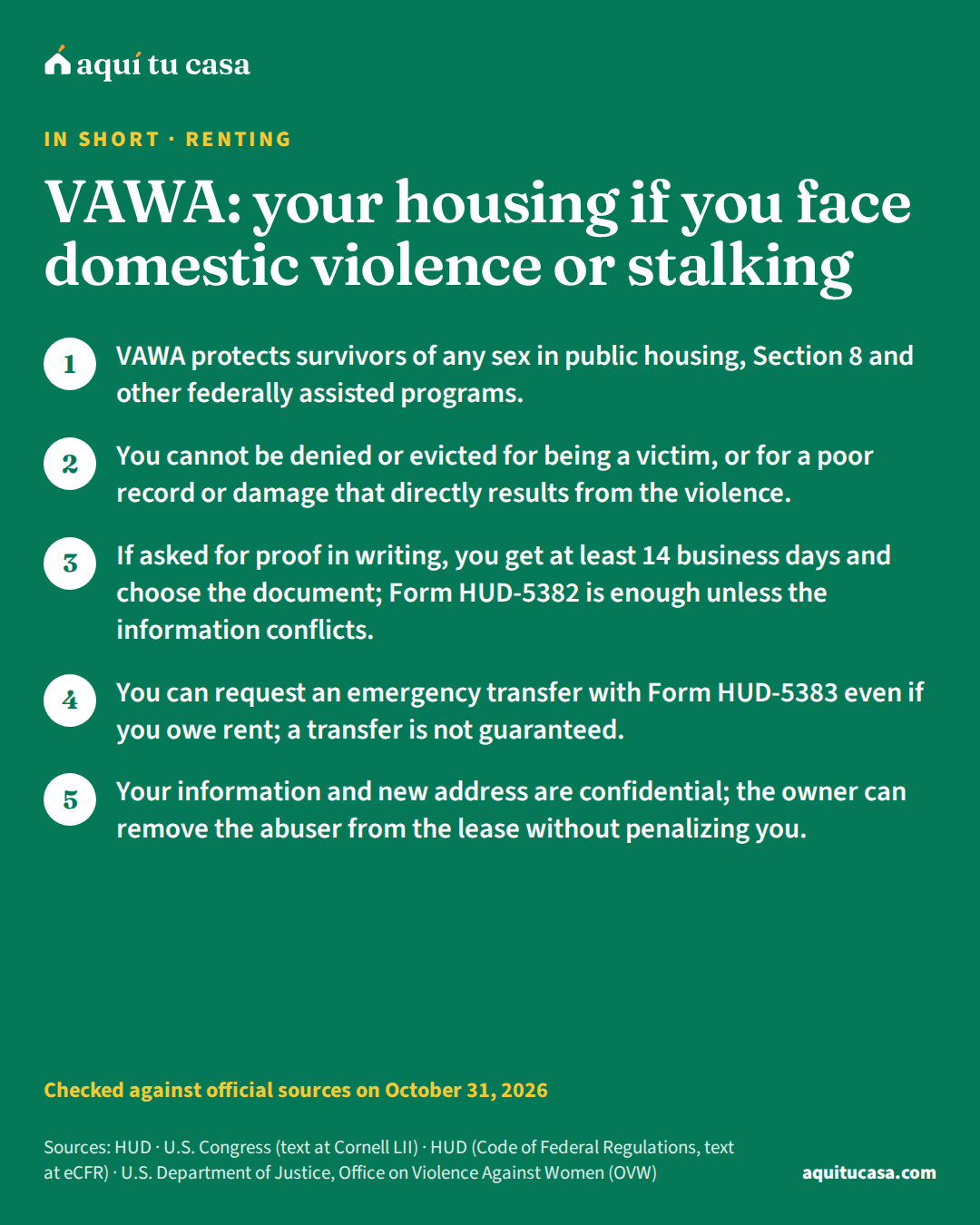
- VAWA protects survivors of any sex in public housing, Section 8 and other federally assisted programs.
- You cannot be denied or evicted for being a victim, or for a poor record or damage that directly results from the violence.
- If asked for proof in writing, you get at least 14 business days and choose the document; Form HUD-5382 is enough unless the information conflicts.
- Renting Your lease explained: what to check before you sign What a lease is, which clauses to read before you sign, the lead paint disclosure, your fair housing rights and where to get free help. 15 minute read
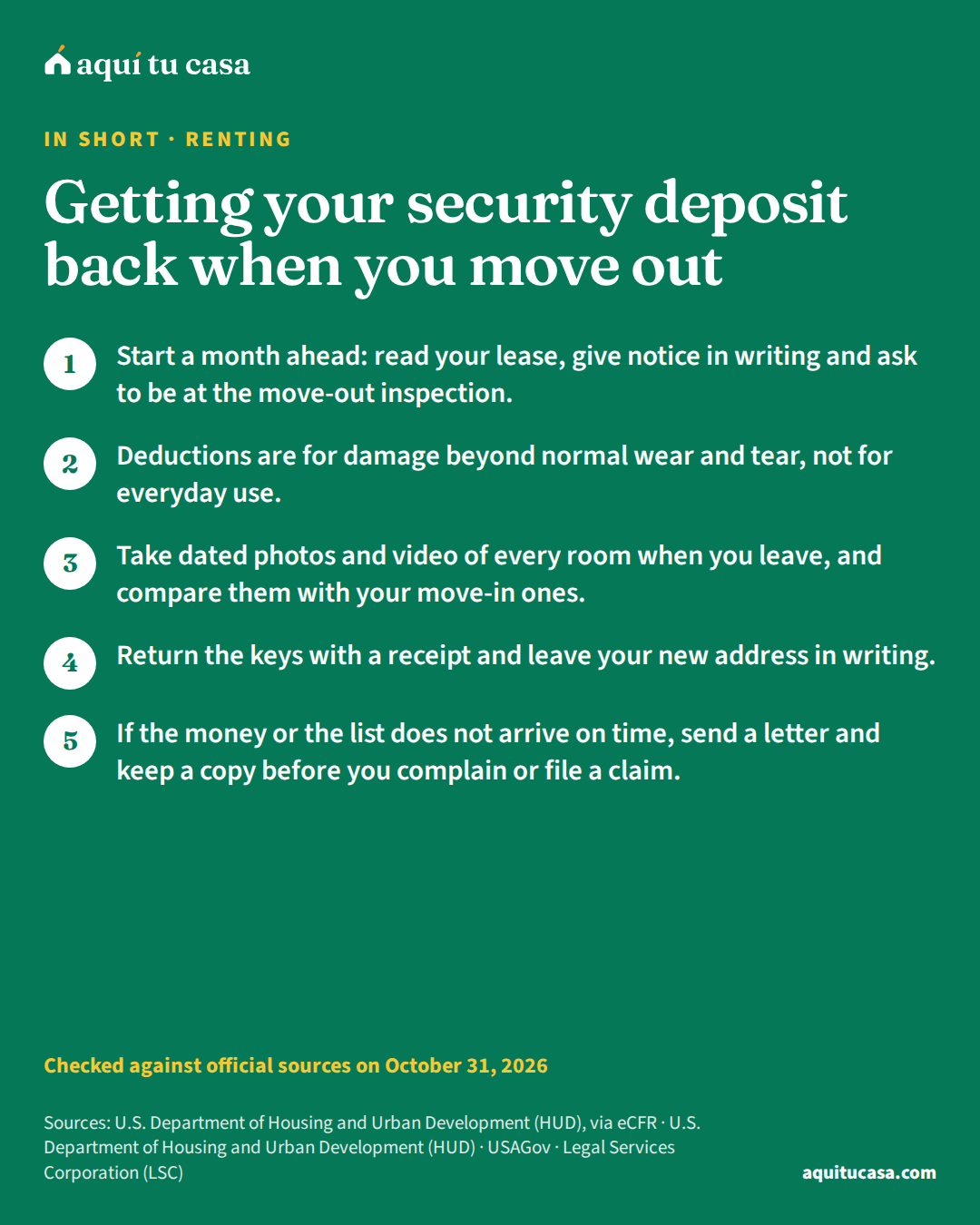
- Renting Getting your security deposit back when you move out A move-out plan: what to do before giving notice, the move-out inspection, photos, returning keys and the letter to request your deposit if it is late. 11 minute read
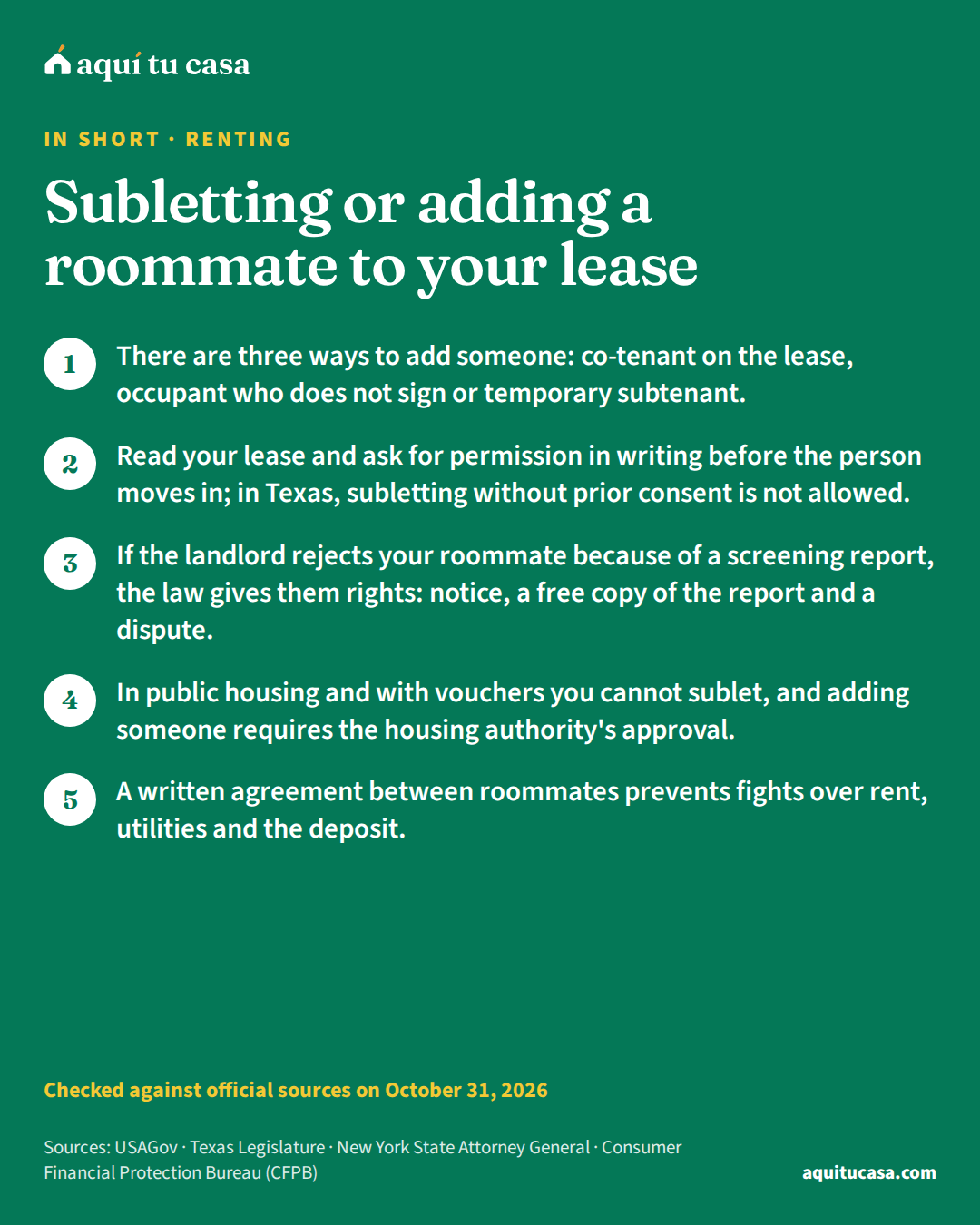
- Renting Subletting or adding a roommate to your lease How to add someone to your lease, when you can sublet, what the rules say in HUD-assisted housing and what to put in an agreement between roommates. 11 minute read
Tools for this topic
Was this guide useful?
Thank you. Your answer stays in your browser; nothing is sent.