Getting your security deposit back when you move out
A move-out plan: what to do before giving notice, the move-out inspection, photos, returning keys and the letter to request your deposit if it is late.
Verified against official sources on October 31, 2026 5 official sources

Show contents
In short
What you need to know
Quick answer
Getting your deposit back is decided in the last weeks before you leave. Read your lease to see how to give notice and what it requires at move-out, give notice in writing, ask to be at the move-out inspection, clean and fix what you damaged, and take dated photos of every room. Return the keys with a receipt and leave your new address in writing. The deadline for the landlord to return the money or send the list of deductions depends on your state; in HUD-assisted housing it is 30 days or less. If it does not arrive, request it with a letter and keep a copy.
What matters most
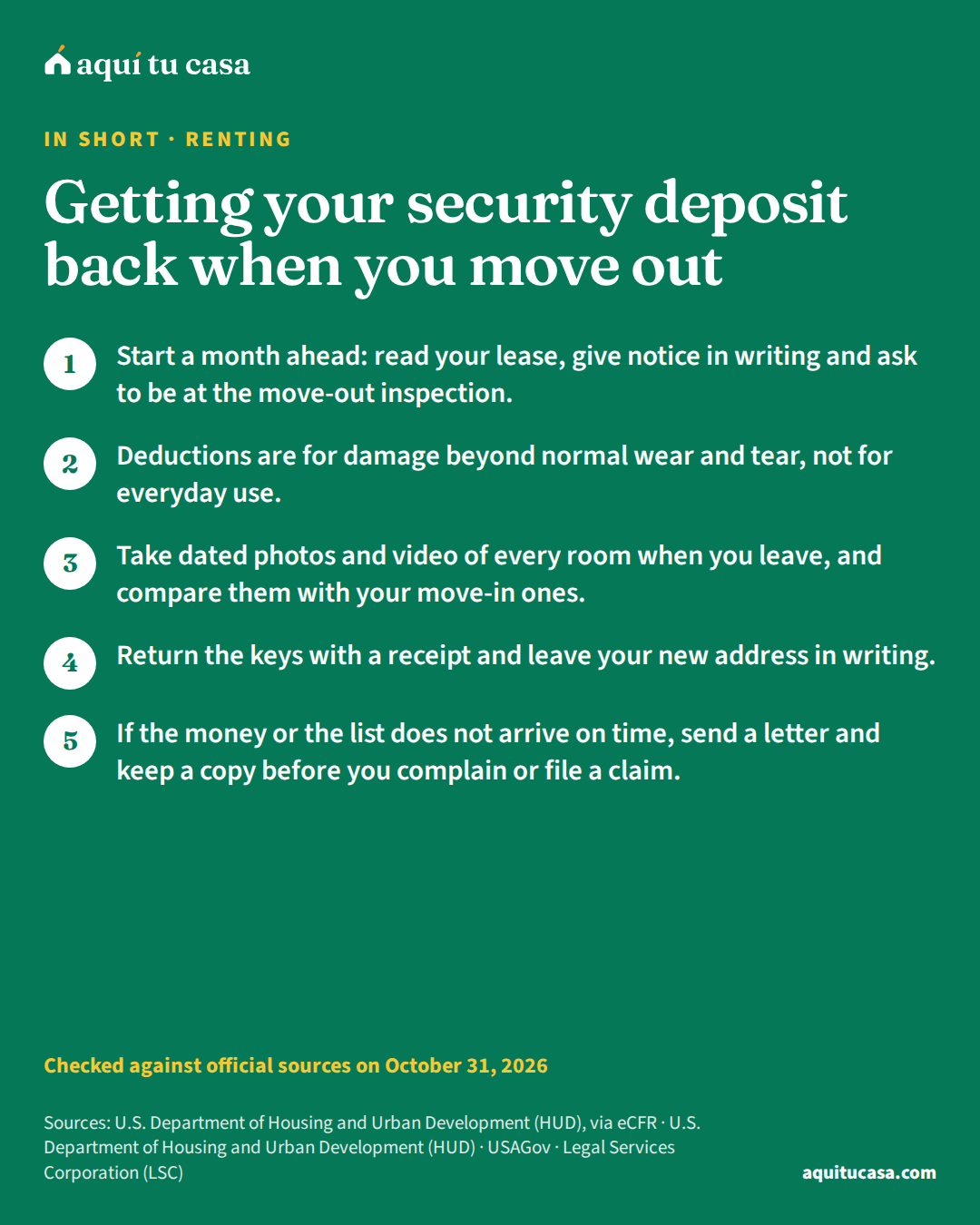
- Start a month ahead: read your lease, give notice in writing and ask to be at the move-out inspection.
- Deductions are for damage beyond normal wear and tear, not for everyday use.
- Take dated photos and video of every room when you leave, and compare them with your move-in ones.
- Return the keys with a receipt and leave your new address in writing.
Is this for you?
This guide is for you if…
- You are leaving your rental in the coming weeks and want to get your whole deposit back.
- You already moved out and the landlord has not returned the deposit or deducted things you do not understand.
- You live in public housing or a HUD-assisted building and want to know which rules apply.
Get direct help first if…
- You do not rent yet and want to know how much deposit can be charged: read «Security deposits: how much they charge and how to get it back».
- You want to leave before your lease ends: read «Breaking a lease early» first.
Your security depositsecurity depositA security deposit is money you pay the landlord when you start renting as security that you will follow the lease: pay the rent and take care of the home. The money still belongs to you. The landlord holds it and, when you move out, must return it minus the charges the law allows, such as past-due rent or damage beyond normal wear and tear. You should not be charged for damage that was already there when you moved in. The maximum amount and the deadline to return it depend on your state's law and sometimes your city's.See the full definition is your money. Many families lose part or all of it not because of major damage but because of missing proof: no photos, no written notice, no receipt for the keys. This guide is a plan for the weeks of your move, from the day you decide to leave until the money is in your hands. Our guide Security deposits explains how much can be charged and the rules in some states.3
A month ahead: read your lease and give notice
Before getting outside help in any dispute, USAGov recommends reading your lease carefully and following the rules you agreed to.3 For the move, look in your leaseleaseA lease, or rental agreement, is the contract in which the owner or landlord gives you the right to live in and use a property for a set period of time in exchange for payment, usually rent. While the lease lasts you have possession, but the landlord still owns the property. The lease says how much you pay and when, who handles maintenance and how the agreement can end. Your rights as a tenant are usually spelled out in the lease and in your state and local laws. Before complaining to the landlord, it helps to read the lease and make sure you are also following the rules you agreed to.See the full definition for:
- Notice. How many days ahead you must say you are leaving and how (by letter, email or a form). If you have a month-to-month leasemonth-to-month tenancyA month-to-month tenancy is a rental arrangement with no end date: it continues month after month as long as you pay the rent, until you or the landlord give notice to end it. It can be in writing, but it can also start without a contract, for example if you stay after your lease ends and the landlord accepts your payment. To end it, you must give the notice your state's law requires. In New York, for example, the notice alone does not let the landlord remove you: if you do not leave, the landlord has to go to court.See the full definition, notice counts too.
- Conditions for returning the deposit. For example, professional carpet cleaning or returning the keys to the office.
- The list of charges. In public housing, the lease must say how repair charges are determined, for example with a posted schedule.1 Ask for that list.
Give your notice in writing and keep a dated copy. If you are leaving before the lease ends, read Breaking a lease early first.
Also find what you have from move-in: the photos, video or move-in inspectionmove-in inspectionA move-in inspection is the walk-through of the home done before you move in to record in writing the condition of the unit and the equipment that comes with it. In public housing, the federal rule requires the agency and the tenant to inspect it together and sign a statement of its condition. Another inspection is done when you move out. The difference between the condition at move-in and at move-out is the basis for any charge against your deposit, if the damage goes beyond normal wear and tear. That record helps keep you from being charged for damage that was already there.See the full definition form. In public housing, HUD’s rule requires the authority and you to inspect the unit before you move in and sign a statement of its condition.1 Ask for a copy if you do not have one: it is what will be compared when you leave.
Normal wear and tear or damage: what can be charged
The key question is whether something is normal wear and tear or damage. Normal wear and tear is what happens with everyday use. Damage is what happens through abuse or negligence.
HUD’s rules put it this way:
- In public housing, the lease provides for charges for maintenance and repair beyond normal wear and tear.1
- In HUD-assisted multifamily housing, the owner lists damages on the move-out form and compares it with the move-in form to decide whether it is reasonable wear and tear or excessive damage from abuse or negligence.2
In private housing, your state’s law decides what can be deducted; many follow the same idea. With that in mind, make an honest list of what you damaged and fix it before you leave, if you can and your lease allows: a hole in the wall, a broken door, a stain that will not come out. What is simple use, like slightly worn paint, document with photos.
What shows up at the move-out inspection
Everyday use
Usually normal wear and tear
- Paint slightly worn over the years
- Carpet with normal foot traffic
- Small marks from hanging pictures, depending on your lease
- Old appliances that stopped working on their own
Abuse or negligence
Usually damage
- Large holes in the walls
- Stains or burns in the carpet
- Broken doors, windows or screens
- Trash or belongings left in the unit
These examples are a guide only: your lease and your state's rules decide each case.
The last two weeks: move-out inspection, cleaning and photos
Ask to be at the move-out inspection. It is your chance to see what the landlord plans to charge and talk about it on the spot:
- In public housing, HUD’s rule says the authority inspects the unit when you leave, gives you a statement of charges, and that you have the right to take part in that inspection unless you leave without notice.1
- In HUD-assisted multifamily housing, you should get prior notice of the inspection and may accompany the owner. HUD says ideally you go, to discuss any differences and decide who pays for what.2
- In private housing, the rules change from state to state. Ask for the inspection in writing and ask whether you can be present. The tenant rights by state tool summarizes your state’s rules.
Clean and repair. Leave the home as you received it, minus normal wear and tear. Take out all your belongings and the trash. Check the stove, refrigerator, bathrooms and closets.
Take dated photos and video of every room, the walls, floors, inside the appliances and the bathrooms. Note meter readings too if the utilities are in your name. Compare with your move-in photos and save everything in two places, such as your phone and your email.

The day you leave: keys, receipt and new address
- Return all keys (and remotes, cards or parking stickers) and ask for a dated receipt. If you drop them in a box, take a photo and send a written message saying so.
- Leave your new address in writing. In HUD-assisted multifamily housing, to receive the deposit you must give an address or arrange to pick it up.2 In private housing, leaving it in writing avoids delays and excuses.
- Change or cancel utilities in your name as of the move-out date.
From notice to refund
1. Read your lease
A month ahead
Look for the notice it requires, the move-out conditions and the list of charges.3
3. Ask to be at the move-out inspection
Two weeks ahead
In HUD housing you have the right to take part or accompany the owner.2
4. Clean, repair and take photos
The last few days
Dated photos and video of every room, to compare with your move-in.1
5. Return keys and leave your address
The day you leave
Ask for a receipt and leave your new address in writing.2
6. Count the days
After you leave
Check your state's deadline; in HUD housing it is 30 days or less.2
Try it with your numbersTenant rights by state
After you leave: the deadline and the list of deductions
The deadline for the landlord to return your deposit, or send the itemized list of what was deducted, is set by your state. This table shows what the state laws we have on record say:
Deadline to return the deposit, by state
| State | Time to return the deposit |
|---|---|
| Alabama | 60 calendar days |
| Arizona | 14 business days |
| Arkansas | 60 days |
| California | 21 days |
| Colorado | 1 day |
| Florida | 15 days |
| Georgia | 30 days |
| Hawaii | 14 days |
| Idaho | 21 days |
| Illinois | 45 days |
| Indiana | 45 days |
| Iowa | 30 days |
| Kansas | 30 days |
| Louisiana | 1 day |
| Maryland | 45 days |
| Massachusetts | 30 days |
| Michigan | 30 days |
| Minnesota | 21 days |
| Mississippi | 45 days |
| Missouri | 30 days |
| Nebraska | 14 days |
| Nevada | 30 days |
| New Hampshire | 30 days |
| New Jersey | 30 days |
| New York | 14 days |
| North Carolina | 30 days |
| North Dakota | 30 days |
| Ohio | 30 days |
| Oklahoma | 45 days |
| Oregon | 31 days |
| Pennsylvania | 30 days |
| Rhode Island | 20 days |
| South Carolina | 30 days |
| South Dakota | 21 days |
| Texas | 30 days |
| Utah | 30 days |
| Vermont | 14 days |
| Virginia | 45 days |
| Washington | 30 days |
| Wisconsin | 21 days |
| Wyoming | 30 days |
Tap your state to see the full rule, its citation and what the law requires in the list of deductions. Source: each state's laws
In HUD-assisted multifamily housing, within 30 days after move-out (or less, if your state or city law requires), the owner must refund your full deposit with interest, or give you an itemized list of unpaid rent, damages and estimated repair costs, with a statement of your rights. If the owner does not give you that list, you are entitled to the full deposit with interest.2
In public housing, repair charges cannot be collected until two weeks after the authority gives you written notice, and that notice counts as a notice of adverse action.1 If you disagree, ask the authority how to request a meeting or hearing.
Example with real numbers
A family moving out of an apartment
An example in words, not a real case, of how the proof gets used.
- Before leaving
- They give notice in writing and ask to be at the move-out inspection
- On moving day
- They take photos and video of every room and return the keys with a receipt
- The list they get
- They are charged to repaint the whole apartment
- Their response
- A letter with their photos: the paint only shows normal wear from the years they lived there
- The result
- They have proof to negotiate, complain to their state or file in court
The difference between normal wear and tear and damage comes from HUD's rules.12 Use your state's tool to see the deadline.
Run it with your numbersTenant rights by state
If it does not arrive: the letter asking for your deposit
If the deadline has passed and neither the money nor the list arrived, or if you disagree with the deductions, the first step is a letter. You do not need a special form. Include:
- Your name and the address of the home you left.
- The date you moved out and returned the keys.
- Your new address.
- The amount of the deposit you paid.
- What you are asking for: the full refund, or a written explanation of each deduction with receipts.
- A reasonable date to respond.
- Copies, not originals, of your photos, your notice and the key receipt.
Send it in a way that leaves proof, such as certified mail or an email you can keep, and keep a copy. Write calmly and stick to facts: the letter may end up in front of a judge.
If there is no response: USAGov recommends finding your state agency that handles tenant rights, such as the attorney general or the housing agency. If HUD insures or manages your building, you can also report the landlord to HUD’s Multifamily Housing Complaint Line.3 To recover the money, many people use their county’s small claims courtsmall claims courtSmall claims court is a state court for money cases that stay under a limit each state sets. The rules are simpler than in other courts, and many people represent themselves. In California, for example, you cannot bring a lawyer to the hearing, although you can ask one for advice beforehand. The judge's decision carries the same weight as a judgment from any other court. But if you win, it is usually up to you to collect the money: the court does not collect it for you.See the full definition. Asking for your deposit is your right; our guide Landlord retaliation explains what to do if the landlord responds with threats.
If this is you
You rent privately
Check your state's deadline in the tenant rights tool and leave your address in writing.3
You live in public housing
You have the right to take part in the move-out inspection, unless you leave without notice.1
You live in a HUD-assisted building
The owner has 30 days, or less if your state requires, to refund the deposit or give you the list.2
You have to leave in a hurry
Still give written notice and take photos; leaving without notice can cost you the inspection in public housing.1
You prefer to write in Spanish
You can write your letter in Spanish; keep a copy and ask free legal aid for help if you need it translated.4
Mistakes that cost you
Mistake: Saying you are leaving only out loud.
Instead: Give written notice, in the form and time your lease requires, and keep a copy.3
Mistake: Skipping the move-out inspection.
Instead: In HUD housing you can take part or accompany the owner; it is your chance to discuss each charge.2
Mistake: Leaving without taking photos.
Instead: Take dated photos and video of every room and compare them with your move-in.1
Mistake: Leaving the keys without a receipt.
Instead: Ask for a dated receipt or leave written proof of the return.
Mistake: Not leaving your new address.
Instead: In HUD housing it is needed to receive the deposit; leave it in writing.2
Mistake: Accepting a charge for normal wear and tear.
Instead: Charges are for damage beyond normal wear and tear; ask for each one to be explained.1

Free help
You do not have to do it alone. The LSC funds civil legal aidlegal aidLegal aid is the free civil legal help that nonprofit organizations and their lawyers provide to low-income people in civil, not criminal, matters. In housing, that includes representing families facing eviction or foreclosure, alongside matters such as custody, child support, protection from domestic violence and access to benefits. In the United States, the Legal Services Corporation, created by Congress, funds a nationwide network of these organizations; its finder points you to the one in your area. Each sets its own income limits.See the full definition for low-income people; its website finds the nearest organization, and LawHelp.org has free information and forms.4 Our guide Free legal aid explains how to ask for it. A HUD-approved housing counselorHUD-approved housing counselorA HUD-approved housing counselor works at an agency HUD has approved to provide housing counseling: independent, expert advice customized to your situation about buying a home, renting, a missed mortgage payment, a foreclosure or credit problems. The agencies usually charge little or nothing; many serve in Spanish and offer the homebuyer education course several assistance programs require. They are not lenders or real estate agents and sell you nothing. Your county page lists the official agencies with phone numbers.See the full definition also advises on renting, often for free or at low cost.5 And if you are moving to another state, our Moving to another state checklist helps with the rest.
What to do this week
- Find your lease and your move-in photos or inspection form.1
- Check your lease for the notice it requires and the conditions for returning the deposit.3
- Look up your state’s deadline in the tenant rights tool.3
- Write your move-out notice and ask in writing to be at the move-out inspection.2
- Make a list of what you need to clean or repair before you leave.1
Your move
We use the place's fair market rent and the state's deposit rule.
Adjust advanced details
Let's do the math
Cash to move in
$3,500
What you need before you get the keys.
What adds up
- First month
- $1,750
- Security deposit
- $1,750
- Total
- $3,500
When you'll have it
Enter what you can set aside each month to see how long it takes.
What helps
- Ask for a receipt for every payment and keep a copy of the lease.
- On move-in day, walk through the home and take dated photos.
- Never send money for a home you haven't seen or a lease you haven't read.
This is a planning estimate, not a price. What you are asked for depends on the landlord, your lease and your state's and city's rules. It is not legal advice.
Ready to see the numbers? Find your county here
See how this applies in your county: its loan limits, prices and rents, from the official data.
Printable checklist
Frequently asked questions
When should I start preparing to move out?
As soon as you can, ideally a month ahead. Read your lease to see how much notice it requires and what conditions it sets for returning the deposit. Give notice in writing and keep a dated copy.
Can they deduct for worn paint or used carpet?
Generally, normal wear and tear is not charged: HUD's public housing rules speak of charges for repairs beyond normal wear and tear, and in HUD multifamily housing the move-out condition is compared with the move-in condition. Your state's rules may be more specific.
Can I be present at the move-out inspection?
In public housing, HUD's rule says the lease must let you take part, unless you leave without notice. In HUD multifamily housing, you should get prior notice and may accompany the owner. In private housing, it depends on your state: ask, and ask in writing.
How long does the landlord have to return my deposit?
It depends on your state; the table in this guide and the tenant rights tool show the deadline. In HUD-assisted multifamily housing, it is 30 days after move-out, or less if your state's law requires.
What happens if I do not leave my new address?
It can delay or complicate the refund. In HUD-assisted multifamily housing, to receive the deposit you must give an address or arrange to pick it up. Leaving it in writing when you return the keys protects you.
What do I put in the letter asking for my deposit?
Your name, the rental's address, the date you moved out and returned the keys, your new address, the deposit amount, what you are asking for (the refund or the list of deductions) and a date to respond. Attach copies of your photos and keep a copy with the mailing date.
What if I disagree with the deductions?
Ask in writing for an explanation of each charge and the receipts. If it is not resolved, look for your state's tenant agency, small claims court or free legal aid. If HUD insures or manages your building, you can also call its complaint line.
Sources
Every figure in this guide comes from one of these official sources. The number next to a sentence leads to the source behind it.
Each source on one line: who publishes it, its title, its address and the date we read it.
- 1. U.S. Department of Housing and Urban Development (HUD), via eCFR · 24 CFR §966.4, Lease requirements (Public Housing) · ecfr.gov · Accessed October 31, 2026
- 2. U.S. Department of Housing and Urban Development (HUD) · Handbook 4350.3 REV-1, Occupancy Requirements of Subsidized Multifamily Housing Programs, Chapter 6 · archives.hud.gov · Accessed October 31, 2026
- 3. USAGov · Tenant rights · usa.gov · Accessed October 31, 2026
- 4. Legal Services Corporation (LSC) · I Need Legal Help · lsc.gov · Accessed October 31, 2026
- 5. Consumer Financial Protection Bureau (CFPB) · Find a housing counselor · consumerfinance.gov · Accessed October 31, 2026
Keep reading
Related guides
If this guide helped, these follow the same path.

Renting 14 minute read
Security deposits: how much and how to get yours back
What a security deposit is, how much a landlord may charge in your state, what can be deducted, when it must be returned and where to complain if it isn't.
- The deposit is yours: the landlord only holds it and, when you move out, returns it minus the deductions the law allows.
- In California (since July 1, 2024) and New York the general cap is one month's rent; the Texas and Florida laws we cite govern the return, not the amount.
- In California, New York and Texas you cannot be charged for normal wear and tear; date-stamped photos from move-in day help you prove the condition you received.
- Renting Your lease explained: what to check before you sign What a lease is, which clauses to read before you sign, the lead paint disclosure, your fair housing rights and where to get free help. 15 minute read
- Renting Breaking a lease early: your options and protections What happens if you leave before your lease ends, how to negotiate your way out and the protections for servicemembers (SCRA) and survivors of violence. 11 minute read
- Renting Repairs as a renter: how to ask and what to do Which repairs fall on the landlord, how to request them in writing, when to call your city's code inspectors and the risks of withholding rent. 13 minute read
Tools for this topic
Was this guide useful?
Thank you. Your answer stays in your browser; nothing is sent.