Service and support animals in your home: what the law says
Service animal or emotional support animal: what changed in HUD's guidance, what the ADA requires in public housing and what online certificates are worth.
Verified against official sources on October 31, 2026 7 official sources

Show contents
In short
What you need to know
Quick answer
Two laws matter. The ADA defines a service animal as a dog trained to do a task for your disability; it applies in public housing and other government programs, where you cannot be asked for certificates or charged a surcharge. The Fair Housing Act covers almost all housing and requires reasonable accommodations, such as letting a blind person live with a guide dog in a no-pets building. For emotional support animals, HUD withdrew its earlier guidance in 2025, so there is less certainty today. Certificates sold online prove nothing under the ADA.
What matters most
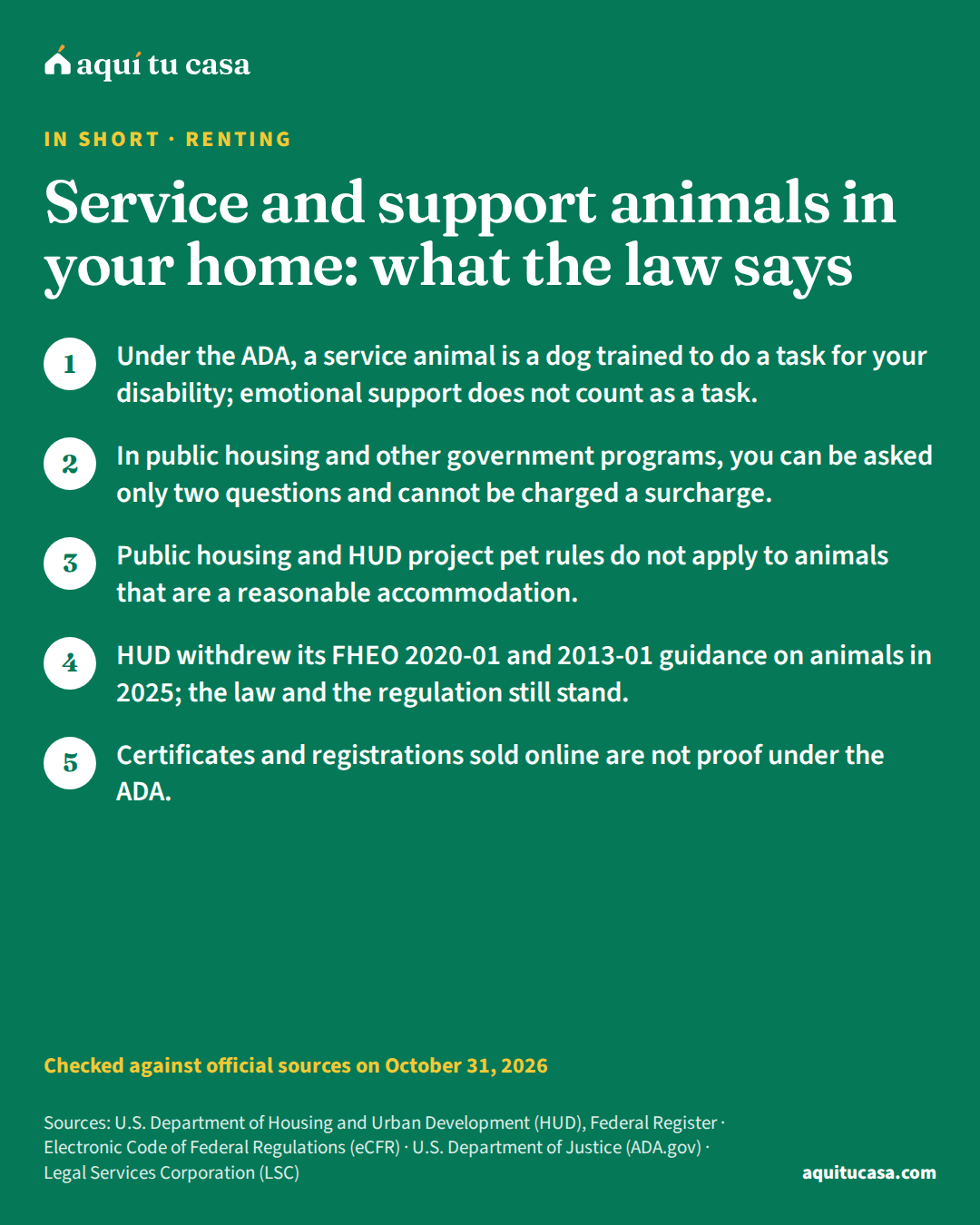
- Under the ADA, a service animal is a dog trained to do a task for your disability; emotional support does not count as a task.
- In public housing and other government programs, you can be asked only two questions and cannot be charged a surcharge.
- Public housing and HUD project pet rules do not apply to animals that are a reasonable accommodation.
- HUD withdrew its FHEO 2020-01 and 2013-01 guidance on animals in 2025; the law and the regulation still stand.
Is this for you?
This guide is for you if…
- You have a service dog or an emotional support animal and are looking for a place to rent.
- You live in public housing or a HUD building with pet rules and have an animal that helps you with a disability.
- Someone online offered you a certificate or registration for your animal and you do not know if it is worth anything.
Get direct help first if…
- You need to ask for another change because of your disability, such as a parking space or a ramp: read «Reasonable accommodations for disabilities».
- You were already turned down and want to file a complaint: read «Housing discrimination: how to file a complaint».
If an animal helps you live with a disability, finding a place to rent can be hard, especially in buildings that do not allow pets. The rules are not the same for a service dog as for an emotional support animal, and HUD also changed its guidance in 2025. This guide explains what the law says today, what happens in public housing and what certificates sold online are worth. For other changes you can ask for because of a disability, read Reasonable accommodations for disabilities.1
Service animal and emotional support animal: not the same thing
The service animal. Under the ADA, it is a dog individually trained to do work or a task for your disability, whether physical, sensory, psychiatric, intellectual or other. The task must relate to the disability: guiding a blind person, alerting a deaf person to a sound, pulling a wheelchair or helping during a seizure, for example.4
The emotional support animal. Under the ADA, it is not a service animal. Providing emotional support, comfort or companionship does not count as a task.4 The Justice Department explains with an example: if a dog is trained to sense an anxiety attack coming and does something to prevent it, it can be a service animal; if it just calms you by being there, it is not.6
The two kinds of animal, side by side
Trained dog
Service animal (ADA)
- A dog trained for a task related to your disability
- No certificate needed
- In government programs, only two questions
- No surcharge, but you pay for damage if everyone does
Not a service animal under the ADA
Emotional support animal
- Helps you through companionship, with no trained task
- The question is decided under the Fair Housing Act
- HUD withdrew its guidance on these requests in 2025
- Get legal advice if you are turned down
Before you move, check what kind of animal you have and which law applies to that home.
What changed in HUD’s guidance
For years, many people and landlords relied on two HUD documents: notice FHEO 2020-01, on requests to have an animal as a reasonable accommodation, and notice FHEO 2013-01, on service and assistance animals. HUD withdrew them, effective September 17, 2025, and says they should no longer be relied on as authoritative.1
That does not erase the law. HUD also said that anything that does not comply with the text of the Fair Housing Act is still subject to its enforcement.1 And HUD’s regulation still says that refusing a necessary reasonable accommodation is unlawful, with the example of a no-pets building that must accept a blind applicant with a seeing eye dog.2
In public housing and HUD buildings
Pet rules do not apply. HUD’s regulations say the pet rules of public housingpublic housingPublic housing is a program of rental homes for low-income families, older adults and people with disabilities. HUD funds local public housing agencies (PHAs), which manage the homes and charge rents those families can afford. It comes in all sizes and types, from scattered single-family houses to high-rise apartments. The PHA decides whether you qualify based on your annual gross income, whether you are elderly, have a disability or are a family, and your U.S. citizenship or eligible immigration status. To apply, you contact your local PHA. In general, you can stay as long as you comply with the lease.See the full definition and of projects for the elderly or persons with disabilities do not apply to animals that assist, support or provide service to persons with disabilities. The public housing authoritypublic housing agency (PHA)A public housing agency (PHA) is a state, county, municipal or other governmental entity or public body authorized to operate public housing or rental assistance programs. These are the agencies that locally administer the Housing Choice Vouchers (Section 8) and public housing with HUD funds: they open and manage the waiting lists, review eligibility and income, inspect units and pay the owner its share of the rent. Each county usually has one or several; your page shows the ones serving your area with their phone numbers.See the full definition or the project owner cannot apply those rules to an animal that is necessary as a reasonable accommodation, whether it lives there or just visits you.3
The ADA applies too. The Justice Department says the ADA covers housing programs run by state and local governments, such as public housing authorities.6 In those programs, with a service animal:5
- Only two questions: whether the animal is required because of a disability and what work or task it is trained to perform. They cannot ask about your disability.
- No documents: they cannot require proof of certification, training or licensing as a service animal.
- No surcharge: they cannot charge you an extra fee, even if they charge people with pets. They can charge you for damage if they normally charge everyone for damage.
- Under control: the dog must be on a harness or leash, unless your disability or the task prevents it. You can be asked to remove it if it is out of control and you do not control it, or if it is not housebroken.
If your building is for seniors, the Section 202 senior housing guide explains that program.

Certificates, registrations and local rules
Online, there are people and companies selling service animal “certificates” or “registrations.” The Justice Department says it does not recognize them as proof that a dog is a service animal, and that the ADA does not require the animal to be certified.6 You do not need to pay for one to have your rights under the ADA. If someone promises that a certificate “forces” the landlord to accept your animal, be wary: what counts is what your animal does and what the law says.
What you do have to follow are the local rules for all dogs: vaccinations, license and registration in your city or county. The ADA does not exempt you from those rules. Nor does it restrict service animal breeds.6
Example with real numbers
A tenant with a service dog in public housing
An example in words, not a real case, of how the rules apply.
- The building
- Has pet rules and charges a pet fee
- Her dog
- Is trained to alert her before a seizure
- What she is asked
- Whether the dog is required because of a disability and what task it does
- The pet fee
- She cannot be charged it; damage, yes, if everyone pays for damage
- What she keeps
- The dog's license and vaccinations, and a copy of her written request
The rules come from HUD and the ADA.35 Check your tenant rights in your state.
Run it with your numbersTenant rights by stateHow to ask to live with your animal
1. Identify what kind of animal you have
Before you look for housing
A dog trained for a task is a service animal under the ADA; emotional support is not.4
2. Check which law applies to that home
Before you sign
The ADA covers government housing programs; the Fair Housing Act, almost all housing.6
3. Make the request in writing
When you apply
Explain that the animal is needed because of a disability, without medical details nobody asked for.2
If this is you
Your dog is trained for a task
In a government program you can be asked only two questions and cannot be charged a surcharge.5
You live in a HUD building for seniors
Pet rules do not apply to an animal that is a reasonable accommodation.3
You have an emotional support animal
It is not a service animal under the ADA, and HUD withdrew its guidance; get legal advice.41
Someone online offers you a certificate
The Justice Department does not recognize it as proof; you do not need it under the ADA.6
The landlord does not answer you in Spanish
Ask for everything in writing and find free legal aid in your language through LSC.7
Before you sign the lease
Many problems can be avoided before you move in. These steps help you get everything clear from the start:
- Read the pet rules in your leaseleaseA lease, or rental agreement, is the contract in which the owner or landlord gives you the right to live in and use a property for a set period of time in exchange for payment, usually rent. While the lease lasts you have possession, but the landlord still owns the property. The lease says how much you pay and when, who handles maintenance and how the agreement can end. Your rights as a tenant are usually spelled out in the lease and in your state and local laws. Before complaining to the landlord, it helps to read the lease and make sure you are also following the rules you agreed to.See the full definition and the building’s rules. If your animal is a reasonable accommodation, ask in writing that those rules not apply to it. HUD’s regulation says reasonable accommodations include common areas, such as hallways, yards or the laundry room.2
- Ask about fees. If you are asked for a pet deposit or fee, ask in writing whether it applies to your animal. In a government program, the ADA does not allow a surcharge for a service animal.5 The security deposits guide explains what you can be charged when you move out.
- Take photos at move-in. If you are charged for damage when you leave, dated photos show how the home was.
- Keep everything in one place: your request, the answers, and the dog’s license and vaccinations.
The guide Your lease explained covers other clauses worth checking before you sign.

Costly mistakes
Mistake: Paying for an online certificate or registration.
Instead: The ADA does not require one and the Justice Department does not recognize it as proof.6
Mistake: Still citing HUD's FHEO 2020-01 guidance.
Instead: HUD withdrew it effective September 17, 2025.1
Mistake: Giving your full diagnosis when asked about your service dog.
Instead: In a government program they can only ask whether it is needed for a disability and what task it does.5
Mistake: Letting the dog's license or vaccinations lapse.
Instead: Local dog rules apply to service animals too.6
Mistake: Waiting too long to act if you are turned down.
Instead: The law gives you two years to sue in court; get help early.1
If you are turned down: where to get help
Keep a copy of your request, every answer and the building’s rules. You can file a complaint with HUD; the guide on housing discrimination explains how. And whatever HUD decides, the Fair Housing Act lets you sue in federal or state court within two years.1
Free legal aidlegal aidLegal aid is the free civil legal help that nonprofit organizations and their lawyers provide to low-income people in civil, not criminal, matters. In housing, that includes representing families facing eviction or foreclosure, alongside matters such as custody, child support, protection from domestic violence and access to benefits. In the United States, the Legal Services Corporation, created by Congress, funds a nationwide network of these organizations; its finder points you to the one in your area. Each sets its own income limits.See the full definition can review your case. The Legal Services Corporation funds civil legal aid for people with low incomes; on its site you search for an office by your address, and LawHelp.org has free information and forms.7 The free legal aid guide explains how to find it. For your tenant rights in your state, use the tenant rights by state tool.
What to do this week
- Write down the tasks your animal does and whether it is trained for them.4
- Check whether your housing is public, HUD-assisted or private.3
- Bring your dog’s license and vaccinations up to date.6
- If you are going to ask for the accommodation, do it in writing and keep a copy.2
- If you have an emotional support animal, get legal advice before you move.1
Your income
Let's do the math
Rent that fits your budget (30% of income)
$2,018
With an income of $6,728 a month. Up to $3,364 would already be a severe burden (50% of income).
Compared with HUD’s Fair Market Rent in the United States
- 2 bedrooms$1,750Fits · 26%Needs $33.65 an hour
The wage needed pays that rent without going over 30% of income, working 40 hours a week all year.
The typical rent households actually pay in the United States is $1,413 a month (Census).
A reference to give you an idea. Each landlord and each program sets its own requirements.
Ready to see the numbers? Find your county here
See how this applies in your county: its loan limits, prices and rents, from the official data.
Printable checklist
Frequently asked questions
Is my emotional support animal a service animal?
Not under the ADA. The Justice Department says emotional support, therapy or companion animals are not service animals because they are not trained for a specific task. A dog trained to sense an anxiety attack and act to prevent it can be.
Do I need a certificate or registration for my service dog?
No. The ADA does not require certificates, and the Justice Department says documents sold online are not proof that a dog is a service animal. Your dog must still follow local vaccination and licensing rules.
What can a public housing authority's office ask me?
Only two things: whether the animal is required because of a disability and what work or task it has been trained to perform. They cannot ask about your disability or require documents, and generally do not ask if the task is obvious.
Can I be charged a pet deposit for my service dog?
In a state or local government program, such as a public housing authority, the ADA does not allow a surcharge for a service animal, even if people with pets are charged. You can be charged for damage if everyone is normally charged for damage.
Is HUD's assistance animal guidance still in effect?
No. HUD withdrew guidance FHEO 2020-01 and FHEO 2013-01, effective September 17, 2025, and says it should no longer be relied on as authoritative. The Fair Housing Act and HUD's reasonable accommodation regulation remain in effect.
Can the building ban my service dog's breed?
Under the ADA, there is no breed restriction for service animals. In private housing, the question is decided under the Fair Housing Act; ask free legal aid for advice.
What do I do if I am turned down because of my animal?
Keep everything in writing and get legal advice. You can file a complaint with HUD, and the law also lets you sue in federal or state court within two years.
Sources
Every figure in this guide comes from one of these official sources. The number next to a sentence leads to the source behind it.
Each source on one line: who publishes it, its title, its address and the date we read it.
- 1. U.S. Department of Housing and Urban Development (HUD), Federal Register · Notification of Withdrawal of Fair Housing and Equal Opportunity Guidance Documents (91 FR 17291) · govinfo.gov · Accessed October 31, 2026
- 2. Electronic Code of Federal Regulations (eCFR) · 24 CFR §100.204, Reasonable accommodations · ecfr.gov · Accessed October 31, 2026
- 3. Electronic Code of Federal Regulations (eCFR) · 24 CFR §5.303 and §960.705, Animals that assist persons with disabilities · ecfr.gov · Accessed October 31, 2026
- 4. Electronic Code of Federal Regulations (eCFR) · 28 CFR §36.104, Definitions (service animal) · ecfr.gov · Accessed October 31, 2026
- 5. Electronic Code of Federal Regulations (eCFR) · 28 CFR §35.136, Service animals · ecfr.gov · Accessed October 31, 2026
- 6. U.S. Department of Justice (ADA.gov) · Frequently Asked Questions about Service Animals and the ADA · ada.gov · Accessed October 31, 2026
- 7. Legal Services Corporation (LSC) · I Need Legal Help · lsc.gov · Accessed October 31, 2026
Keep reading
Related guides
If this guide helped, these follow the same path.

Renting 13 minute read
Reasonable accommodations and modifications if you have a disability
What you can ask a landlord for because of a disability under the Fair Housing Act: rule changes, physical changes, assistance animals and complaints.
- A reasonable accommodation changes a rule or service; a reasonable modification changes the home itself.
- You can ask orally or in writing, with no special words; writing helps avoid misunderstandings.
- If your disability is not obvious, the landlord can ask for reliable information, but almost never your medical records.
- Renting Housing discrimination: how to file a complaint What the Fair Housing Act prohibits when you rent, how national origin and children are covered, and how to file with HUD or your state on time. 11 minute read
- Renting Your lease explained: what to check before you sign What a lease is, which clauses to read before you sign, the lead paint disclosure, your fair housing rights and where to get free help. 15 minute read
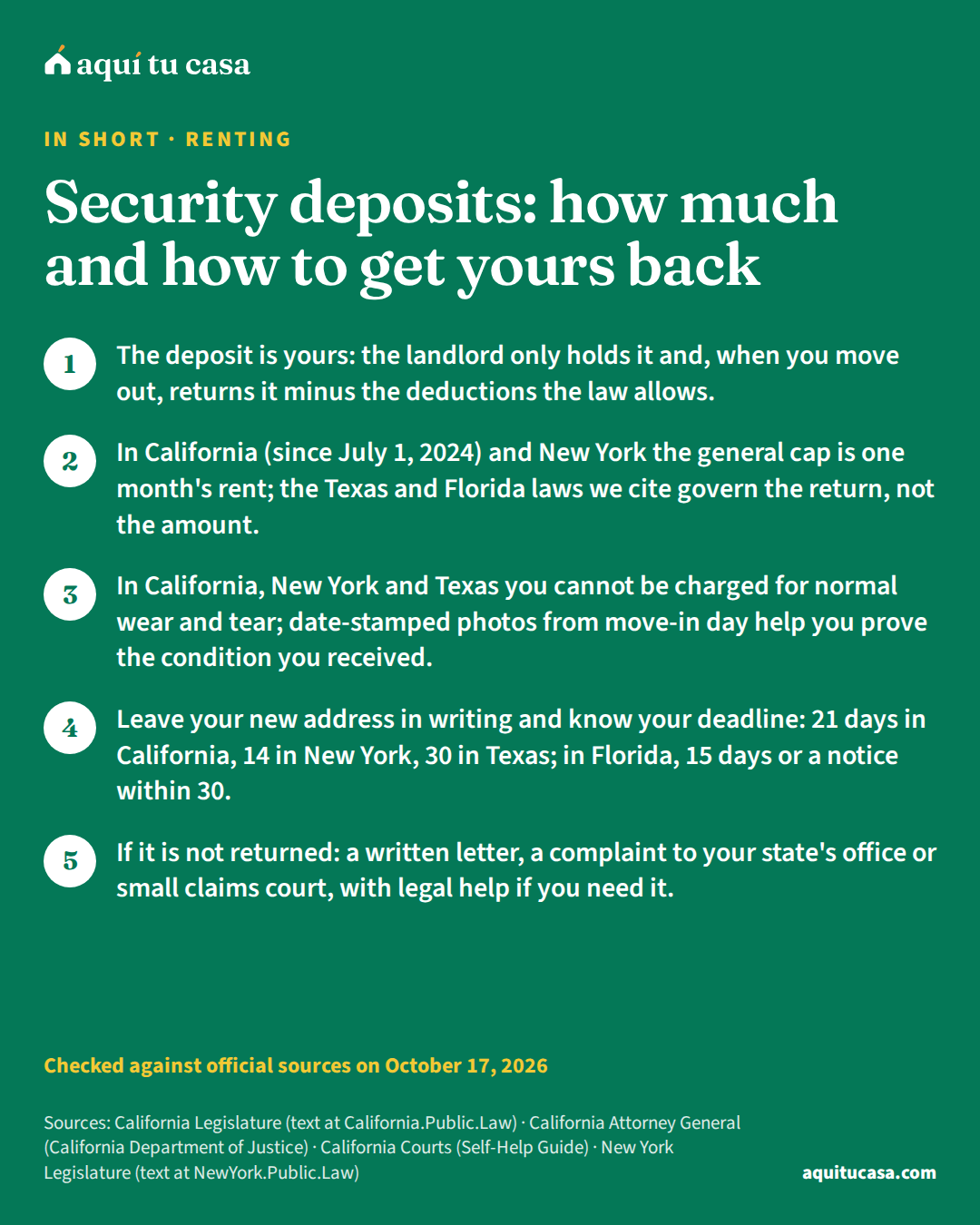
- Renting Security deposits: how much and how to get yours back What a security deposit is, how much a landlord may charge in your state, what can be deducted, when it must be returned and where to complain if it isn't. 14 minute read
Tools for this topic
Was this guide useful?
Thank you. Your answer stays in your browser; nothing is sent.