Using your 401(k) or IRA for a down payment: what it costs
The IRS first-home exception for IRAs, 401(k) loans and hardship withdrawals: the taxes, the deadlines and what a mortgage lender looks at.
Verified against official sources on October 31, 2026 11 official sources

Show contents
In short
What you need to know
Quick answer
You can use retirement savings to buy a home, but it is almost never free. From an IRA, the IRS lets you take up to $10,000 over your lifetime for your first home without the 10% additional tax, although with a traditional IRA you still pay income tax. A 401(k) has no such exception: your plan may offer a loan, which you repay with payments, or a hardship withdrawal, which is taxed and cannot be put back. Before you decide, get your plan's rules in writing and figure out how much reaches you after taxes.
What matters most
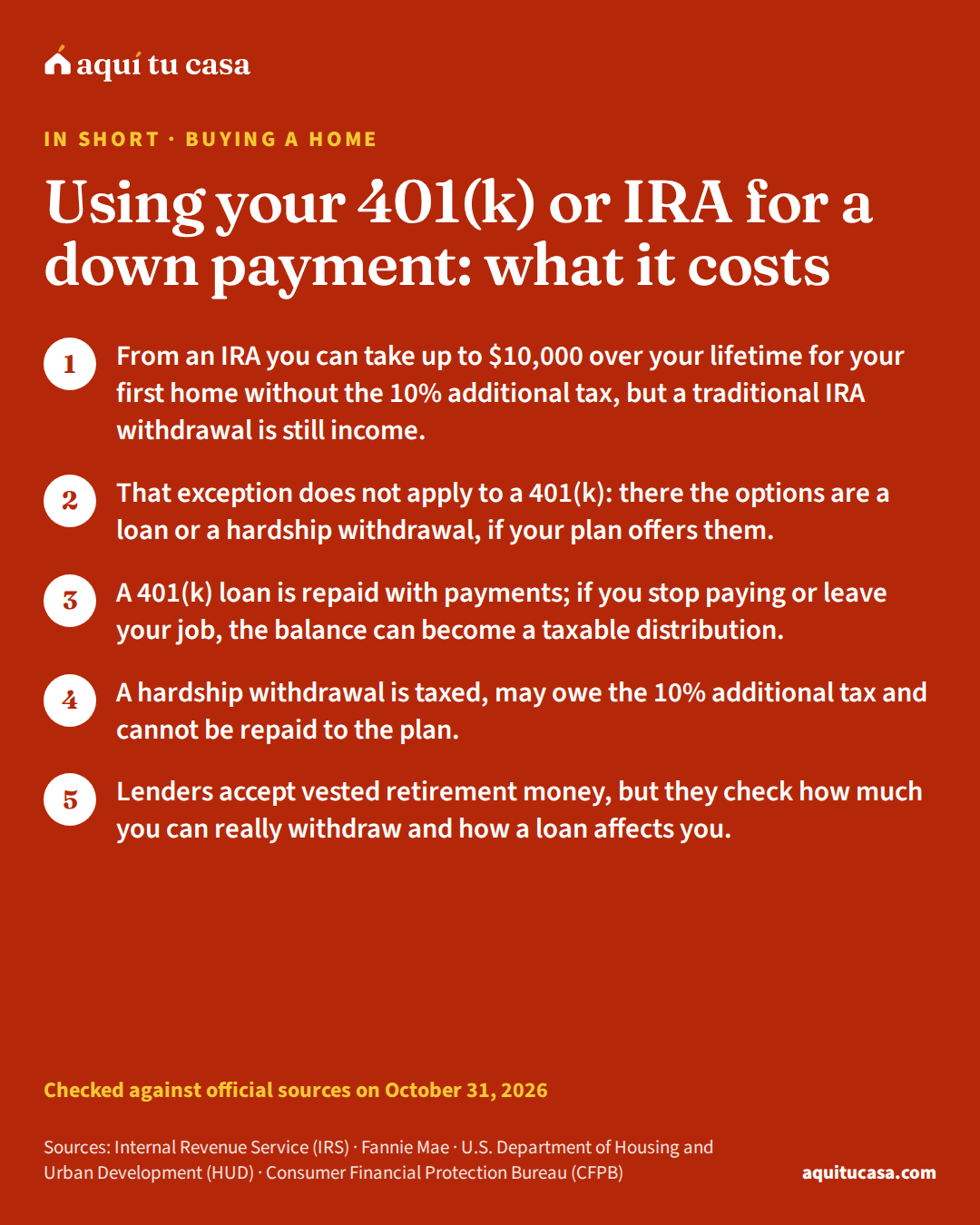
- From an IRA you can take up to $10,000 over your lifetime for your first home without the 10% additional tax, but a traditional IRA withdrawal is still income.
- That exception does not apply to a 401(k): there the options are a loan or a hardship withdrawal, if your plan offers them.
- A 401(k) loan is repaid with payments; if you stop paying or leave your job, the balance can become a taxable distribution.
- A hardship withdrawal is taxed, may owe the 10% additional tax and cannot be repaid to the plan.
Is this for you?
This guide is for you if…
- You have money in a 401(k), a 403(b) or an IRA and are thinking of using it for the down payment or closing costs.
- You were told you can take money out of your IRA without a penalty for your first home and want to know the conditions.
- Your workplace plan offers loans or hardship withdrawals and you want to compare before you ask for one.
Get direct help first if…
- You need the money to keep your home or your rental: read «If you can't pay your mortgage» or «If you can't pay your rent» first.
- You are looking for help with the down payment that you do not have to repay: read «Down payment assistance: how it works».
Saving for a down paymentdown paymentThe down payment is the part of the home's price you pay out of your own pocket when you buy; the loan covers the rest. In U.S. Spanish it is also called enganche, cuota inicial or entrada. Each loan type has its own minimum: FHA requires at least 3.5% of the value, VA and USDA loans may require none, and conventional loans ask for more if you want to avoid private mortgage insurance. A larger down payment lowers the loan, the monthly payment and the total interest; many state programs help families put it together.See the full definition takes years. If you have money in a workplace retirement plan, such as a 401(k), or in an IRA, it is natural to think about using it. The law allows it in several cases, but each path has a different cost: income tax, a 10% additional tax or payments that come out of your paycheck. This guide explains the three paths with the IRS rules and what the lender looks at, so you can run the numbers before you move your money.1
Three paths and what each one costs
Before age 59½, taking money out of a retirement account generally costs you a 10% additional tax on the part that counts as income. That applies to IRAs and to workplace plans.12 For buying a home there are three ways out, and only one avoids that 10%:
- The IRA first-home withdrawal. Up to $10,000 over your lifetime without the 10% additional tax.3
- A 401(k) loan. It is not a withdrawal: you borrow your own money and pay it back with payments.5
- A hardship withdrawal. It leaves the plan for good, is taxed and may owe the 10% additional tax.6
The first-home exception does not work for a 401(k). In the IRS table, it applies to IRAs and not to qualified workplace plans.4 Many people mix this up and get a surprise at tax time.
The three paths, side by side
No 10% additional tax
IRA withdrawal for your first home
- Up to $10,000 over your lifetime, per person
- You use it on the purchase within 120 days
- With a traditional IRA you still pay income tax
- It is not put back, unless the purchase falls through
You repay it
401(k) loan
- Only if your plan offers loans
- Up to the maximum the law sets
- Payments at least quarterly, generally over 5 years
- If you stop paying, the balance becomes a taxable distribution
Gone for good
401(k) hardship withdrawal
- Only if your plan allows it
- Limited to what you need for the purchase
- Taxed, and may owe the 10% additional tax
- Cannot be repaid or rolled over to an IRA
Get your plan's rules in writing and compare how much reaches your hands on each path.
The IRA withdrawal for your first home
The IRS lets you take up to $10,000 from your IRA to buy, build or rebuild a first home without paying the 10% additional tax, even if you are under 59½. These are the conditions:3
- The deadline. You use the money to pay the costs of the purchase before the close of the 120th day after you receive it.
- For whom. The home must be the main home of a first-time homebuyer: you, your spouse, or your or your spouse’s child, grandchild, parent or other ancestor. So you can help a child with a first home.
- The limit. All your first-home withdrawals, over your whole life, cannot exceed $10,000. If you and your spouse are both first-time homebuyers, each of you can take up to $10,000.
Who is a “first-time homebuyer”? To the IRS it does not mean you never owned a home. Generally, it is someone who had no present interest in a main homeprincipal residenceYour principal residence is the home where you live permanently and spend most of the year. According to FHA, a person can have only one principal residence at a time. Lenders tell it apart from a second home, which you occupy in addition to your principal residence but for less than most of the year, and from an investment property, which you own but do not live in. Fannie Mae buys loans on all three, but it applies a loan-level price adjustment (LLPA) to loans on investment properties.See the full definition during the 2 years before the date of acquisition. If you are married, your spouse must also meet this. The date of acquisition is the day you sign a binding contract to buy, or the day construction begins. The money can pay for the purchase and usual or reasonable closing costsclosing costsClosing costs are all of the costs you pay on closing day on top of the down payment: lender fees, the appraisal, the credit report, title insurance, the closing agent's fees, any transfer taxes your state or county charges and the first deposits into the escrow account. The lender must itemize them on the Loan Estimate within days of your application and confirm them on the Closing Disclosure before you sign. Some can be paid by the seller, and several state programs help cover them.See the full definition.3 This definition is the IRS’s; assistance programs may use another one to decide who is a first-time buyerfirst-time homebuyerUnder the definition HUD uses, a first-time homebuyer is a person, and his or her spouse, who has not owned a home during the three years before the purchase. There are exceptions: a single parent or a displaced homemaker is not excluded just because he or she owned a home with a spouse while married. Nor does it count if you only owned a home that was not on a permanent foundation, or one that did not meet building codes and could not be brought up to code for less than the cost of building a new one. Each program may use its own definition.See the full definition.
If the purchase falls through. If the purchase is canceled or delayed, you can generally put the money back into an IRA within 120 days without paying income tax or the 10% additional tax.3 Write down the date you received the money.
Traditional or Roth IRA: not the same
With a traditional IRA, the exception only removes the 10% additional tax. The money you take out generally counts as income that year, and you pay income tax on it.3 Federal income tax is also withheld from IRA withdrawals unless you elect out; if you do, you may owe more when you file.1
With a Roth IRA, money comes out in order: first your regular contributions, then conversions and last earnings. Your regular contributions do not count as income. Earnings do not either, if the withdrawal is qualified: the 5-year period since your first Roth contribution must have passed, and it must meet a condition such as the first-home rules, with the same $10,000 lifetime limit.3
A loan from your 401(k)
A 401(k) loan is not a withdrawal: you borrow your own money and pay yourself back with interest. These are the IRS rules:5
- Your plan decides. A plan may offer loans, but it does not have to. IRAs do not allow loans.
- How much. The most is the lesser of $50,000 or the greater of $10,000 or 50% of your vested balance (the money that is already yours).
- How you repay. Generally over 5 years, in equal payments of principal and interest, at least quarterly. If the loan is to buy your principal residence, the plan can give you more than 5 years.
The big risk is falling behind. If you do not pay according to the terms, the unpaid balance is generally treated as a taxable distribution.5 Before age 59½, that can add the 10% additional tax. If you leave your job or the plan ends, many plans reduce your account by what you owe. In that case, the IRS gives you until your tax return due date, including extensions, to roll that amount into another plan or an IRA.5 Ask your plan what happens to your loan if you change jobs.
Think about your budget too. The loan payment comes out of your paycheck at the same time you start paying the mortgage. The how much house can I afford calculator helps you see whether both payments fit.

The hardship withdrawal
Some plans allow a hardship withdrawal. The plan does not have to offer it. It must be due to an immediate and heavy financial need and limited to what you need. Costs directly related to buying your principal residence count as that need; mortgage payments do not.6
The cost is high:6
- It is subject to income tax, except the part that comes from Roth contributions.
- It may owe the 10% additional tax, because the first-home exception does not apply to a 401(k).
- You cannot put it back in the plan or roll it into another plan or an IRA. That money stops growing for your retirement.
Example with real numbers
A couple thinking about using their traditional IRAs
An example in words, not a real case, of how the costs add up.
- What they take out
- Up to $10,000 each from their IRAs, because both are first-time homebuyers
- The 10% additional tax
- They do not owe it if they use the money on the purchase within 120 days
- Income tax
- They do owe it: the money counts as income for the year
- What reaches their hands
- Less than they took out, because of federal withholding
- What they decide
- Run the numbers with a free VITA preparer before they ask for the withdrawal
The rules in this example come from the IRS.33 Use the savings plan to see how much you still need to save without touching your retirement.
Run it with your numbersDown payment savings planWhat the lender looks at
The lender checks where every dollar of your down payment comes from. Retirement money works, with conditions:
- With Fannie Mae. Vested money from an IRA or a 401(k) can go toward the down payment, closing costs and reservesreservesReserves are the cash and other easy-to-cash assets you still have available after the mortgage closes. They are measured in months: how many full monthly house payments (principal, interest, taxes, insurance and association dues) you could cover with them. Under Fannie Mae's rules, they include money in checking or savings accounts, investments, the vested part of a retirement account and the cash value of a life insurance policy; personal loans and the money you use to close do not count. An eligible gift can also be used. How many months are required depends on the loan and the property.See the full definition. The lender checks that the account is yours and allows withdrawals even if you leave your job. If you only use it as reserves, you do not have to take the money out.7
- The 401(k) loan and your debts. With Fannie Mae, the lender does not have to count that payment in your debt-to-income ratiodebt-to-income ratio (DTI)Your debt-to-income ratio (DTI) is all your monthly debt payments divided by your gross monthly income, that is, income before taxes. If you pay a certain amount each month across a car, cards, student loans and the mortgage you are asking for, and you earn three times that, your DTI is one third. Lenders use it to measure whether you can manage the payment; each loan type and lender sets its own limit, and assistance programs usually publish theirs. Paying down debt before applying improves your DTI.See the full definition if it has a copy of the loan document. But if you use the same account as reserves, it subtracts what you borrowed and the fees.8
- With FHA. The lender may count up to 60% of the value of your retirement accounts, minus any loans against them, unless you show you can withdraw more after taxes and penalties. It asks for your latest statement and the withdrawal and loan terms.9 Our FHA loan guide explains the rest.
Talk with your lender before you move the money. That way you know which papers it will ask for and when it makes sense to take the withdrawal or the loan. Our guide Cash savings and your mortgage explains how to document your savings.

Before you take money out of your retirement
1. Find out which account you have
Today
Traditional IRA, Roth IRA, 401(k) or 403(b): each has different rules.4
2. Get your plan's rules in writing
This week
Ask whether it offers loans or hardship withdrawals, how much, and what happens if you leave your job.5
3. Check whether you are a first-time homebuyer
Before you sign the contract
Count the 2 years before the contract date, for you and your spouse.3
4. Ask your lender how it counts the money
Before you move the money
Which statement it needs and how it counts a 401(k) loan payment.8
5. Take the money out on time
Close to closing
From the IRA withdrawal, use it on the purchase within 120 days.3
6. File correctly the next year
On your tax return
Check the code on your 1099-R; if it does not show the exception, file Form 5329.1
If this is you
It is your first home and you have an IRA
You can take up to $10,000 without the 10% additional tax if you use it on the purchase within 120 days.3
You want to help your child with a first home
Your IRA exception also works for your child's or grandchild's first home.3
You owned a home a long time ago
You can count as a first-time homebuyer if you had no main home in the last 2 years.3
You are self-employed and have an IRA
IRAs do not allow loans; the way out is the withdrawal, with its taxes.5
Your plan only offers hardship withdrawals
They are taxed, may owe the 10% additional tax and cannot be repaid; compare with down payment assistance first.6
You may change jobs soon
Ask what happens to your 401(k) loan; if it is not repaid, it becomes a taxable distribution.5
Mistakes that cost you
Mistake: Believing a 401(k) has the first-home exception.
Instead: That exception is for IRAs; from a 401(k) the withdrawal may owe the 10% additional tax.4
Mistake: Thinking that without the 10%, a traditional IRA withdrawal costs nothing.
Instead: It generally counts as income and you pay income tax on it.3
Mistake: Taking the money out months before you have a contract.
Instead: You have 120 days to use it on the purchase; take it out once the closing date is clear.3
Mistake: Taking a 401(k) loan without asking what happens if you leave your job.
Instead: If it is not repaid, the balance can become a taxable distribution.5
Mistake: Taking more than you need as a hardship withdrawal.
Instead: It must be limited to what is necessary, and you cannot put it back in the plan.6
Mistake: Not checking the code on your Form 1099-R.
Instead: If it does not show your exception, file Form 5329 to claim it.1

Free help and other options
Before you touch your retirement, see whether you qualify for down payment assistance, which some programs do not ask you to repay, or whether your family can give you a documented gift of money. Our guide How much down payment you need shows what each loan type asks for. And remember that your retirement savings are also your safety net: if you use them up, it helps to have an emergency fundemergency fundAn emergency fund is cash you set aside only for unplanned expenses or emergencies, such as car or home repairs, medical bills or a loss of income. It is not for routine monthly spending. The CFPB explains that without savings, even a small financial shock can push you into debt that is hard to pay off. How much you need depends on your situation; the CFPB suggests thinking about the unexpected expenses you have had before. You can keep it in a bank or credit union account, on a prepaid card or in cash, and it grows more easily with automatic saving or part of a tax refund.See the full definition.
For taxes, the IRS’s VITA and TCE programs prepare basic returns for free for people who qualify.10 Our guide Free tax filing explains how to find a site. For the buying plan, a HUD-approved housing counselorHUD-approved housing counselorA HUD-approved housing counselor works at an agency HUD has approved to provide housing counseling: independent, expert advice customized to your situation about buying a home, renting, a missed mortgage payment, a foreclosure or credit problems. The agencies usually charge little or nothing; many serve in Spanish and offer the homebuyer education course several assistance programs require. They are not lenders or real estate agents and sell you nothing. Your county page lists the official agencies with phone numbers.See the full definition can help you for free or at low cost; search by ZIP code on the CFPB’s website.11
What to do this week
- Find your most recent statement and write down which kind of account you have and your vested balance.7
- Call your workplace plan and ask for the rules on loans and hardship withdrawals in writing.5
- Check whether you and your spouse meet the rule of 2 years without a main home.3
- Work out how much reaches you after taxes with the down payment savings plan.3
- Ask your lender how it will count that money and which papers it needs.9
Your numbers
We start with the typical home value in the United States ($332,700). Enter the price you are looking at.
Adjust advanced details
The minimum for this loan is 3.5%. A larger down payment lowers the monthly payment but takes longer to save.
As a share of the price. It is an example; your lender's Loan Estimate has the real figure.
Annual interest of the account where you keep the money. Leave it at zero if you do not know.
Let's do the math
Time to reach your goal
Enter how much you can save each month.
Your goal
- Down payment (3.5% of the price)
- $11,645
- Closing costs (3% of the price)
- $9,981
- Savings target
- $21,626
- You already have
- $0
- Still missing
- $21,626
What helps
- Set up an automatic transfer on payday into a separate account you do not use for spending.
- Ask about your state's and city's assistance programs before setting the goal: many cover part of the down payment or closing costs.
- If family gives you part of it, the lender usually asks for a gift letter and the transfer record; ask beforehand how they want it.
- Revisit the goal whenever the price you are looking at, the loan type or what you can save changes.
An educational estimate, not a loan offer. Closing costs are an example (3% of the price); the real figure comes in the Loan Estimate. We do not count the reserves some lenders require after closing.
Ready to see the numbers? Find your county here
See how this applies in your county: its loan limits, prices and rents, from the official data.
Printable checklist
Frequently asked questions
Can I take money out of my IRA for my first home without paying anything?
Without the 10% additional tax, yes, up to $10,000 over your lifetime, if you meet the IRS rules. But if the IRA is traditional, that money generally counts as income and you pay income tax on it. With a Roth, your contributions come out first and are not taxed.
Who counts as a first-time homebuyer for the IRS?
Generally, someone who had no present interest in a main home during the 2 years before signing the purchase contract. If you are married, your spouse must also meet this. You can use it for your own home or for your child's, grandchild's, parent's or other ancestor's.
Does a 401(k) also have the first-home exception?
No. In the IRS table, the up-to-$10,000 first-time homebuyer exception applies to IRAs, not to workplace plans like a 401(k). Your plan may offer a loan or a hardship withdrawal, each with its own rules.
How much can I borrow from my 401(k)?
Whatever your plan allows, up to a legal maximum: the lesser of $50,000 or the greater of $10,000 or half of your vested balance. The plan does not have to offer loans, so ask first.
What happens to my 401(k) loan if I leave my job?
It depends on your plan. Many reduce your account by what you owe. If that happens because you left your job, the IRS gives you until your tax return due date, including extensions, to roll that amount into another plan or an IRA so it does not count as a distribution.
Does a 401(k) loan count in my debts for the mortgage?
With Fannie Mae, the lender does not have to count that payment in your monthly debts if it has a copy of the loan document. But if you use the same account as reserves, it subtracts what you borrowed. Ask your lender how it counts it in your case.
If the purchase falls through, do I lose the money I took from my IRA?
Not necessarily. The IRS says that if the purchase is canceled or delayed, you can generally put the money back into an IRA within 120 days without income tax or the 10% additional tax.
Sources
Every figure in this guide comes from one of these official sources. The number next to a sentence leads to the source behind it.
Each source on one line: who publishes it, its title, its address and the date we read it.
- 1. Internal Revenue Service (IRS) · Topic no. 557, Additional tax on early distributions from traditional and Roth IRAs · irs.gov · Accessed October 31, 2026
- 2. Internal Revenue Service (IRS) · Topic no. 558, Additional tax on early distributions from retirement plans other than IRAs · irs.gov · Accessed October 31, 2026
- 3. Internal Revenue Service (IRS) · Publication 590-B, Distributions from Individual Retirement Arrangements (IRAs) · irs.gov · Accessed October 31, 2026
- 4. Internal Revenue Service (IRS) · Retirement topics - Exceptions to tax on early distributions · irs.gov · Accessed October 31, 2026
- 5. Internal Revenue Service (IRS) · Retirement plans FAQs regarding loans · irs.gov · Accessed October 31, 2026
- 6. Internal Revenue Service (IRS) · Retirement topics - Hardship distributions · irs.gov · Accessed October 31, 2026
- 7. Fannie Mae · Selling Guide B3-4.3-03, Retirement Accounts · selling-guide.fanniemae.com · Accessed October 31, 2026
- 8. Fannie Mae · Selling Guide B3-6-05, Monthly Debt Obligations · selling-guide.fanniemae.com · Accessed October 31, 2026
See the other 3 sources
- 9. U.S. Department of Housing and Urban Development (HUD) · Handbook 4000.1, FHA Single Family Housing Policy Handbook · hud.gov · Accessed October 31, 2026
- 10. Internal Revenue Service (IRS) · Free tax return preparation for qualifying taxpayers · irs.gov · Accessed October 31, 2026
- 11. Consumer Financial Protection Bureau (CFPB) · Find a housing counselor · consumerfinance.gov · Accessed October 31, 2026
Keep reading
Related guides
If this guide helped, these follow the same path.

Buying a home 11 minute read
How much do you need for a down payment?
20% is not required: what each loan asks for (FHA, conventional, VA, USDA), what changes with less than 20% down, and where the money can come from.
- 20% is not a rule: FHA asks for 3.5% and a conventional HomeReady loan for 3%.
- VA (veterans and service members) and USDA (rural areas, with an income limit) may require no down payment.
- With less than 20% down there is mortgage insurance: PMI on conventional loans, which can be removed; MIP on FHA, with an upfront premium.
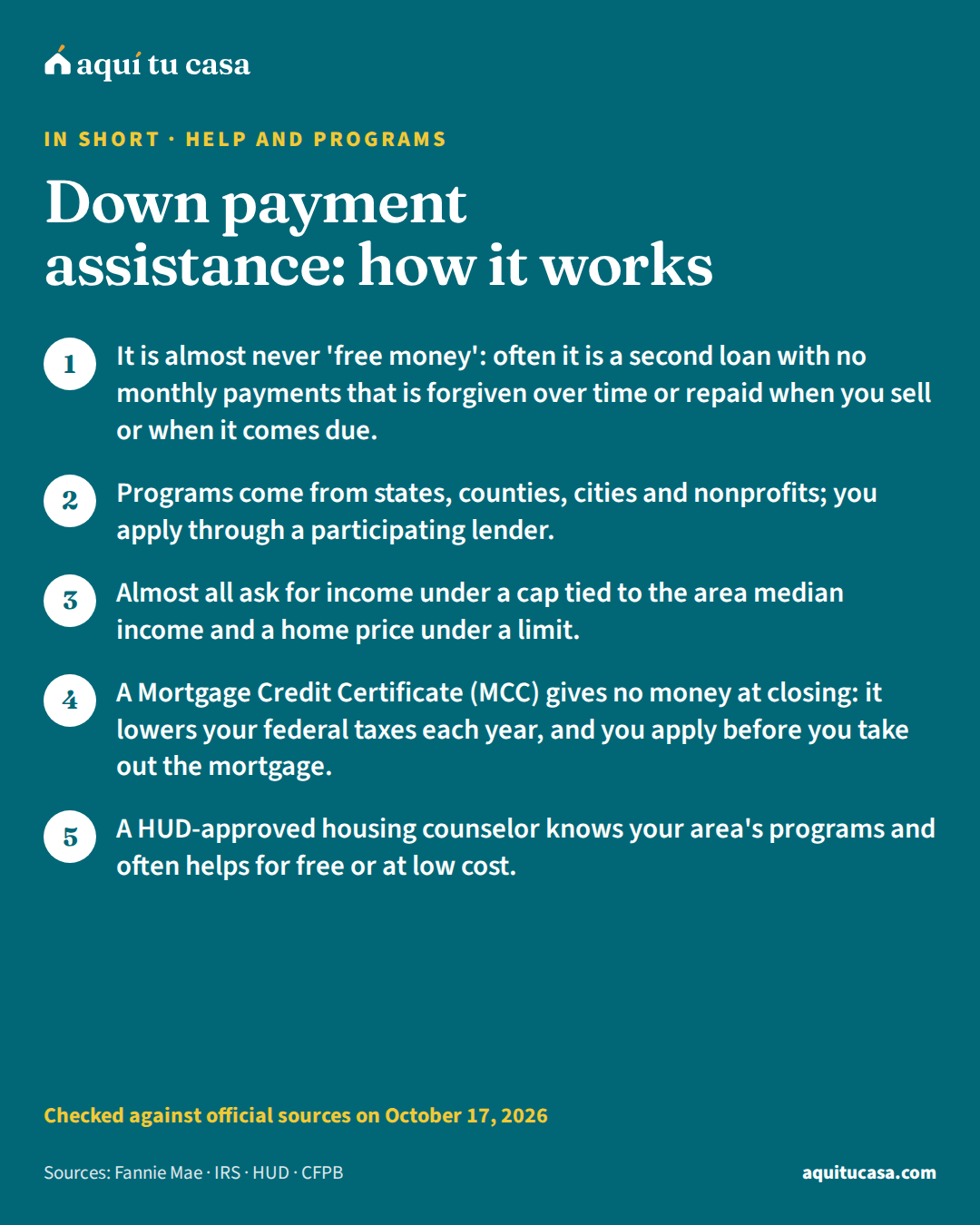
- Help and programs Down payment assistance: how it works What down payment assistance is, the types that exist (grant, forgivable or deferred second loan, tax credit), who qualifies and where to find it. 12 minute read
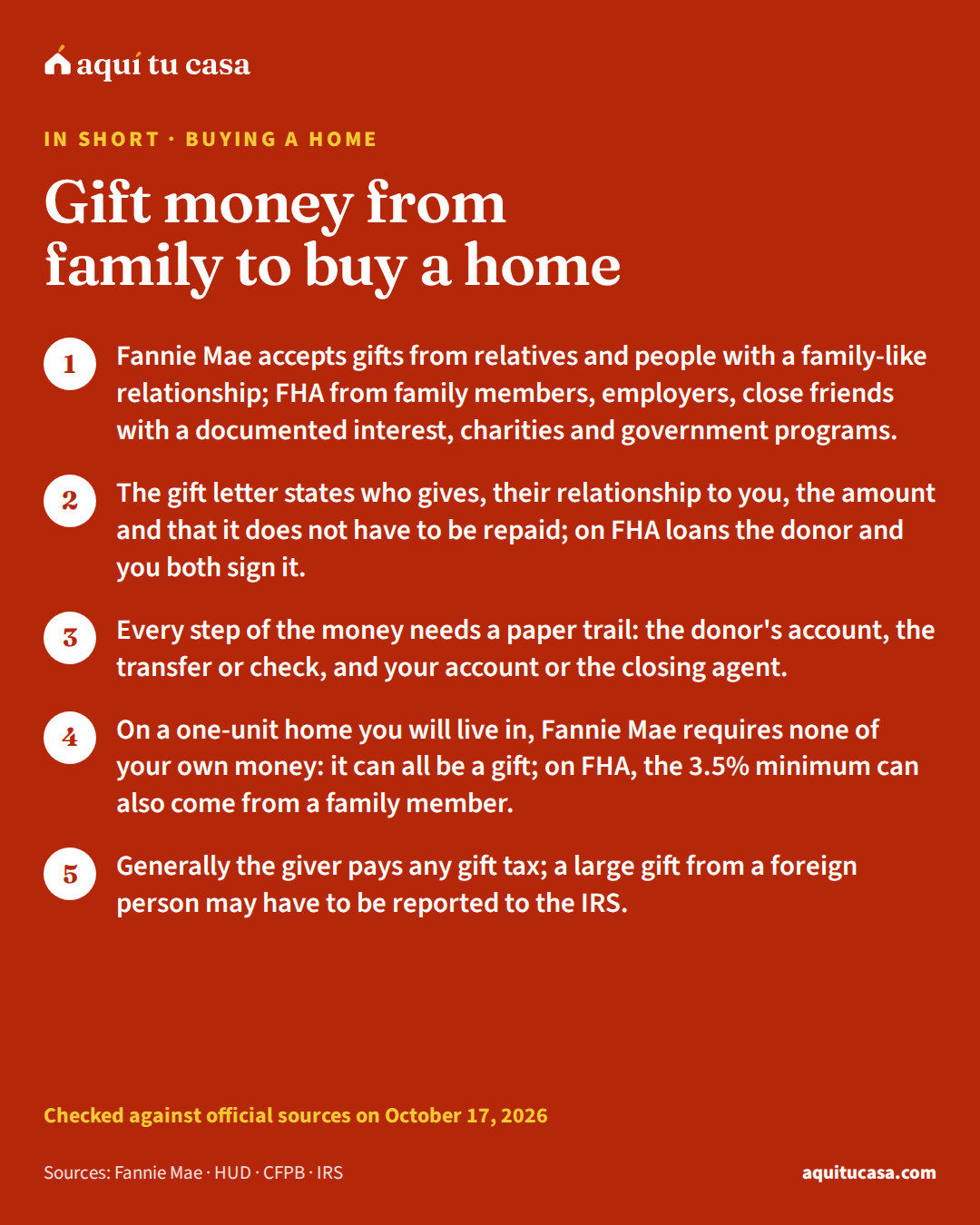
- Buying a home Gift money from family to buy a home Who can give you money for the down payment, what the gift letter must say, how the transfer is documented and what happens with taxes. 11 minute read
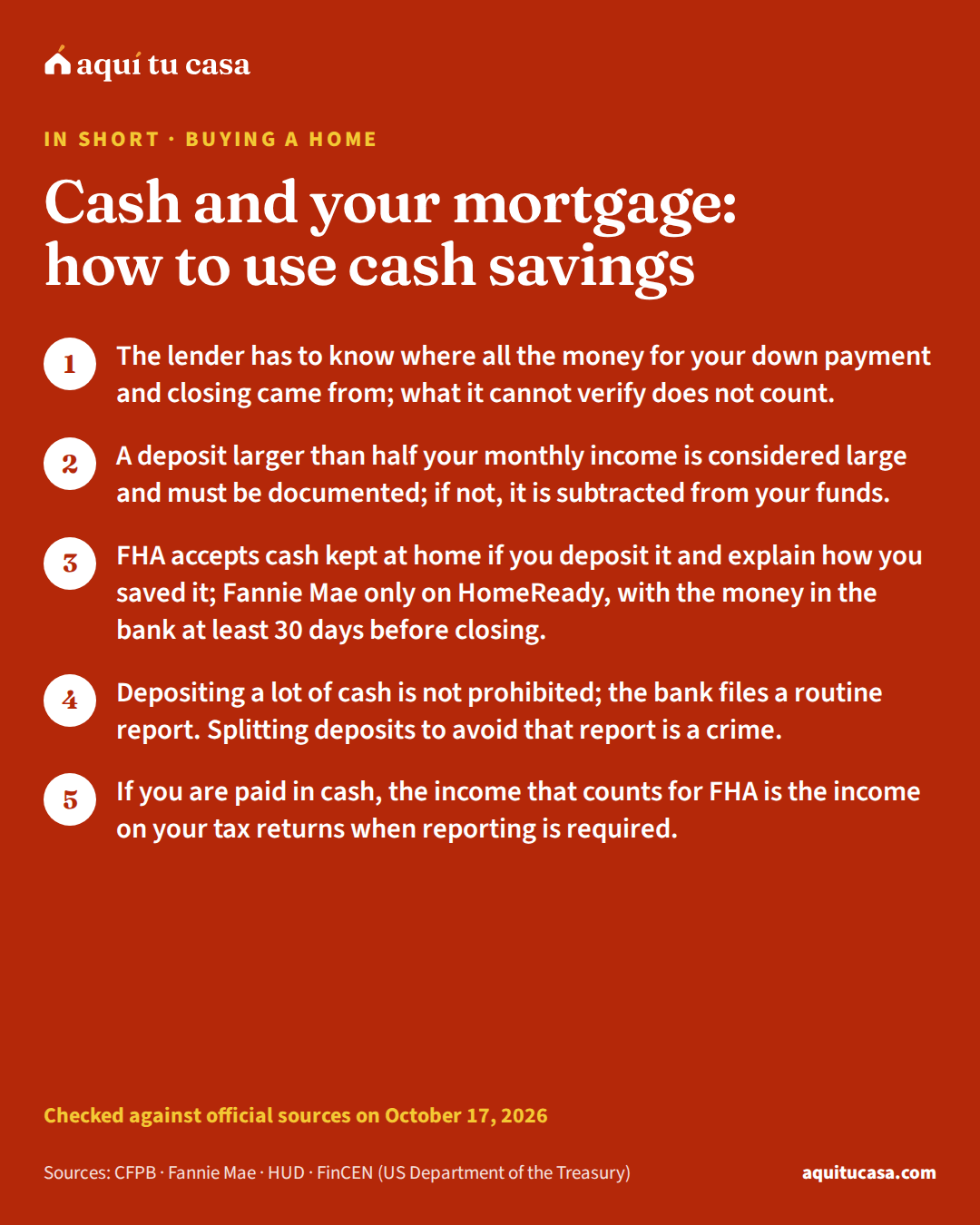
- Buying a home Cash and your mortgage: how to use cash savings If you save or get paid in cash: why the lender asks where your money came from, what a large deposit is and how to move your cash into the bank. 11 minute read
Tools for this topic
Was this guide useful?
Thank you. Your answer stays in your browser; nothing is sent.