Manufactured homes in a park: lot rent and title
What you buy when the home sits on a rented lot, what to check in the lot lease, the HUD label, and what happens if lot rent goes up or the park closes.
Verified against official sources on October 31, 2026 14 official sources

Show contents
In short
What you need to know
Quick answer
In a manufactured home park you usually buy the home and rent the lot. That means two payments: the loan on the home, which is often a chattel loan, and the lot rent with its fees. Because value comes mostly from the land, a home on a rented lot tends to lose value, and moving it is rare and costly. Before you buy, read the lot lease: the term, how and with how much notice rent goes up, the rules and what happens if the park closes. Check the home's HUD label too. Protections vary by state.
What matters most
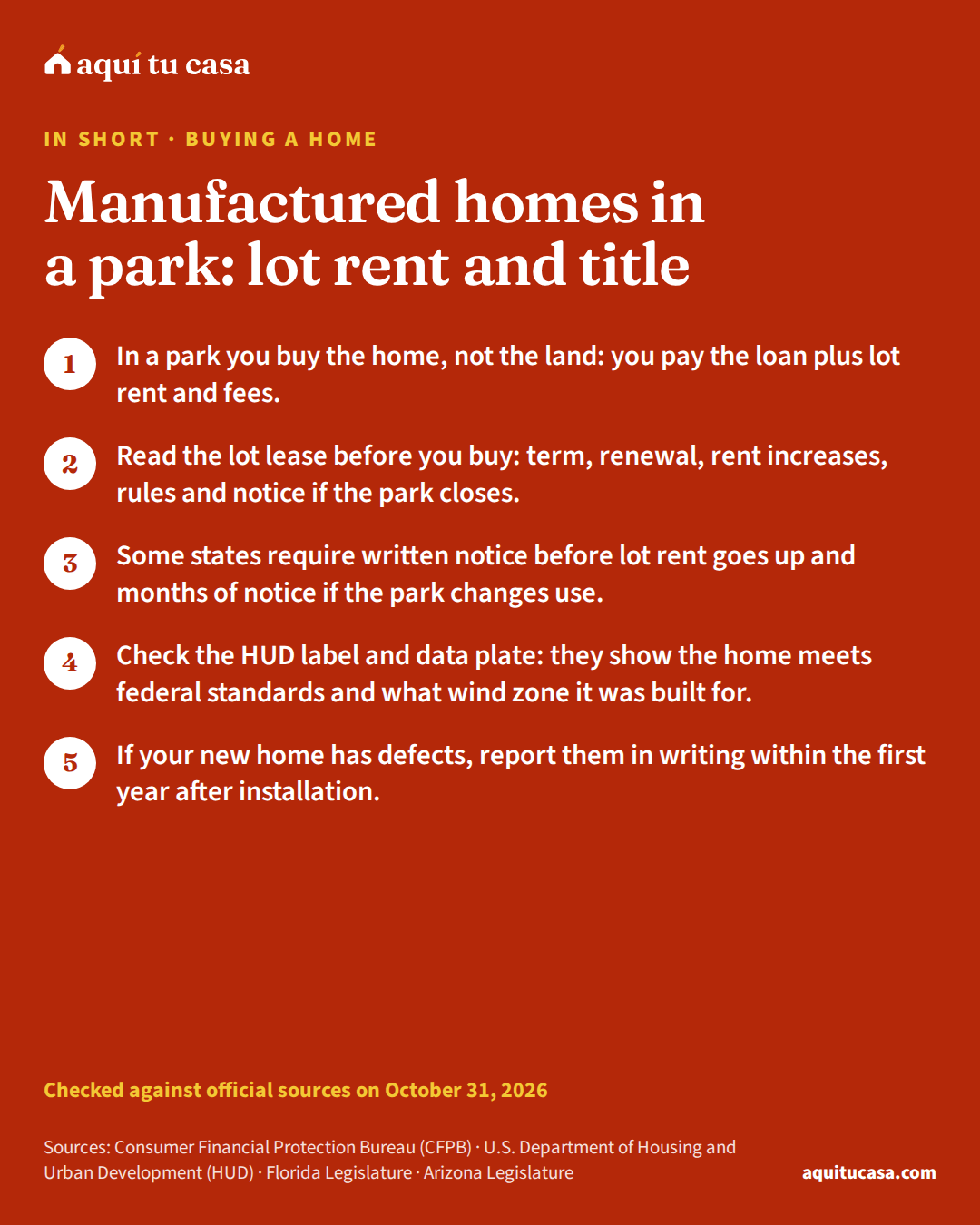
- In a park you buy the home, not the land: you pay the loan plus lot rent and fees.
- Read the lot lease before you buy: term, renewal, rent increases, rules and notice if the park closes.
- Some states require written notice before lot rent goes up and months of notice if the park changes use.
- Check the HUD label and data plate: they show the home meets federal standards and what wind zone it was built for.
Is this for you?
This guide is for you if…
- You are thinking of buying a manufactured (mobile) home in a park or community where you rent the lot.
- You already live in a park and want to understand your lot lease, rent increases and what happens if the park closes.
- Your new manufactured home has defects the seller will not fix.
Get direct help first if…
- You are buying the land along with the home: read «Buying land or a manufactured home: title, loans and risks» first.
- You are being evicted from the park right now: look for free legal aid today and read «What to do if you get an eviction notice».
A manufactured homemanufactured homeA manufactured home is a home built in a factory and moved in one or more sections, on its own chassis, to the site. Federal law defines it this way, with or without a permanent foundation, including its plumbing, heating, air-conditioning and electrical systems. Many people call it a mobile home or trailer. For Fannie Mae, it must meet HUD's federal standards; modular homes and what it calls prefabricated or panelized homes do not count as manufactured homes. It can be titled as real estate, generally when it sits on a permanent foundation on land the owner also owns, or as personal property, which is usually financed with a chattel loan.See the full definition in a park or community can be the most affordable way to own a home. But in a park you almost always buy the home and rent the land, and that changes everything: how much you pay each month, how it is financed, whether it gains or loses value and what happens if the park owner raises rent or closes. This guide covers what to check before you buy and what protections exist. Our guide Buying land or a manufactured home explains titling and loans when you buy the land too.1
What you buy in a park, and what you do not
In a park, the home is yours but the lot usually is not. The CFPB explains that many manufactured homes sit on rented lots in a community, and those communities charge ground rent plus fees for shared amenities, services and utilities.1 So your housing cost has two parts:
- The home payment. If you finance it, it is often a chattel loanchattel loanA chattel loan is a personal property loan. For a manufactured home, it is secured by the home but not the land, and it is how a home titled as personal property is usually financed. According to the CFPB, chattel loans generally have higher interest rates and fewer consumer protections than mortgages; for example, the federal RESPA law, which gives you the right to certain disclosures when you apply and close, protects only mortgage borrowers. In exchange, their origination costs are lower and they close faster. Some people choose them to avoid putting their land at risk if they stop paying.See the full definition, secured by the home and not the land. The CFPB says these generally have higher rates and fewer protections than a mortgage, and limited chances to refinance.2
- Lot rent and fees. Paid every month to the park owner, even after the home is paid off.
Value. Most of a manufactured home’s appreciationhome appreciationHome appreciation is the increase in your home's value over time. It is one of the two ways your home equity grows, equity being the difference between what the home is worth and what you owe; the other is paying down your mortgage principal. A home's value can go up or down: it can fall because of economic conditions, lack of upkeep or a drop in neighborhood home values, and some markets appreciate faster than others. The FHFA House Price Index (HPI) measures how single-family home values change.See the full definition comes from the land, not the structure. That is why owning the land is generally what most decides whether the home gains or loses value.1 People who do not own the land are more likely to see their homes depreciate and have fewer protections if they fall behind.2
Moving the home. Although they are called mobile homes, once placed they are typically not moved.1 If the park raises rent sharply or closes, moving the home can cost a lot. That is why the lot lease matters as much as the home.
Use the family budget to add up the home payment, lot rent, fees and insurance before you decide.
Home on a rented lot or home on your own land
Cheaper up front
Home in a park, rented lot
- You pay for the home plus lot rent
- Often financed with a chattel loan
- Tends to lose value without the land
- You depend on the lease and the park's rules
More stable
Home on your own land
- No lot rent
- Can be titled as real property and financed with a mortgage
- Appreciation comes mostly from the land
- You decide what to do with your land
If you buy in a park, the lot lease is as important as the price of the home.
Example with real numbers
A family comparing two parks
An example in words, not a real case, of why the lot lease weighs as much as the price.
- Park A
- The home is cheaper, but the lot lease is month to month and does not say how rent goes up
- Park B
- The home costs a bit more, the lease runs several years and explains notice for increases and closing
- What they add up
- The home payment, lot rent, water and trash fees and insurance
- What they ask
- What happens if the park is sold and who pays to move the home
- What they decide
- They compare the monthly cost and how secure the lease is, not just the price
Lot rent and fees are paid on top of the home, according to the CFPB.1 Use the family budget to add it all up.
Run it with your numbersFamily budgetThe title: personal property or real property
A manufactured home can be titled as personal property, like a car, or as real property, like a site-built house. According to the CFPB, in most states titling it as real property is a choice if the home is permanently affixed to land you own, or to rented land with a sufficiently lengthy lease. Even then, the owner may leave it as personal property.1
This matters because certain protections, such as parts of RESPA and some state foreclosure and repossession laws, apply only to mortgages.1 In a park with a rented lot, the home is most commonly personal property. Before you buy a used home, ask for the titletitleTitle is your legal right to own and possess a property. The deed is the document showing that the seller transferred that right to you, and legal title is the title that can be documented in public records. As part of the purchase, a title search is done to see whether anyone else has a claim against the home; common claims come from a previous owner's unpaid taxes or from contractors who say they were not paid for work on the home. Title insurance protects you if such a claim shows up later.See the full definition and confirm the seller’s name matches. Ask your state’s titling agency whether the home has any lienlienA lien is a legal right a creditor holds in your property to make sure you repay a debt. It usually prevents the property from being sold until the debt is paid, and if you do not pay, the creditor may be able to take the property. Your mortgage is a lien on your home: when you pay it off, the lien is released and that shows up in your county's property records. There are other kinds, such as a federal tax lien, which is the government's legal claim against all your property when you do not pay a tax debt.See the full definition or debt on it.
The lot lease: what to read
The lot lease is a rental agreementleaseA lease, or rental agreement, is the contract in which the owner or landlord gives you the right to live in and use a property for a set period of time in exchange for payment, usually rent. While the lease lasts you have possession, but the landlord still owns the property. The lease says how much you pay and when, who handles maintenance and how the agreement can end. Your rights as a tenant are usually spelled out in the lease and in your state and local laws. Before complaining to the landlord, it helps to read the lease and make sure you are also following the rules you agreed to.See the full definition for the land. Get a full copy before you buy the home and check:
- Term and renewal. How long does it last? Does it renew automatically? With what notice?
- Rent and fees. What is included: water, trash, common areas. What is charged separately.
- Increases. How and how often rent can go up, and with how much notice.
- Rules. Pets, guests, who can live with you, changes to the home, whether you can rent it out or sell it inside the park.
- What happens if the park closes or changes use.
If the loan is FHA Title I, HUD sets minimums for the lease. In a community of three or more homes owned by the same entity, the lease must run three years or longer, be renewable for terms of one year or more, and require the owner to give you written notice at least 180 days before the term ends if you must move because the community is closing; if the notice is late, it renews automatically for one more year. Every lease must state the address, term and rent, be signed by both parties and disclose possible lot rent increases.3 Even if your loan is not FHA, that list helps you review any lease.
What some states require: two examples
Park rules vary a lot by state. Two examples, so you know what to ask in yours:
- Florida. In a park with 26 or more lots, the owner must give you a state-approved prospectus before the lease or at occupancy, whichever comes first, and you can void the lot lease for 15 days after receiving it.4 To raise lot rent, reduce services or change the rules, the owner must give written notice at least 90 days before, and that right cannot be waived.5
- Arizona. The lot lease must be written and signed, with the rent and deposit, for a specific term; if you disagree on the term, it is twelve months. Signed copies must be given within ten days. Rent can change only when the agreement expires or renews, with at least ninety days’ written notice.7 And the owner may not terminate or refuse to renew without good cause, explained in writing.8
If you live in another state, ask a housing counselorHUD-approved housing counselorA HUD-approved housing counselor works at an agency HUD has approved to provide housing counseling: independent, expert advice customized to your situation about buying a home, renting, a missed mortgage payment, a foreclosure or credit problems. The agencies usually charge little or nothing; many serve in Spanish and offer the homebuyer education course several assistance programs require. They are not lenders or real estate agents and sell you nothing. Your county page lists the official agencies with phone numbers.See the full definition or legal aid which law protects home owners in parks.

If the park is sold or changes use
This is the biggest risk of living on a rented lot: the owner selling the land for something else. Some state laws give you time and help:
- In Florida, before changing the land use, the owner must offer to sell the park to the homeowners’ association, which has 45 days to sign a contract. The owner must also give you at least 6 months’ notice of eviction, and the notice must say you may be entitled to compensation from a state relocation fund. The owner also may not give notice of a rent increase within 90 days before giving notice of the change in use.6
- In Arizona, written notice of a change in use must arrive at least one hundred eighty days ahead. The owner may not raise rent within ninety days before that notice and must tell you about the state relocation fund, which can pay the cost of moving the home within the state up to a maximum.9
If you get a notice like that, keep the envelope and letter, note the date and look for legal help the same month. Our guide What to do if you get an eviction notice explains the first steps.
Before you buy a home in a park
1. Ask whether the lot is sold or rented
On the first visit
And how much lot rent is with all the fees.1
2. Ask for the lot lease and the rules
Before the offer
Check the term, renewal, increases and what happens if the park closes.3
3. Find out what your state requires
Before you sign
For example, in Florida, the prospectus and 15 days to void the lease.4
4. Check the label and data plate
During the inspection
Write down the HUD label numbers and check the wind zone.11
5. Check the title
Before you pay
The seller's name should match and there should be no outstanding debt.1
6. Compare the loan
Before you sign
A chattel loan usually costs more; get offers from several lenders.2
The HUD label and the data plate
Manufactured homes are built to federal standards. HUDDepartment of Housing and Urban Development (HUD)HUD (the U.S. Department of Housing and Urban Development) is the federal department that runs housing and community development assistance programs and works to ensure fair and equal housing opportunity. The Federal Housing Administration (FHA), which insures mortgages made by private lenders, is part of HUD. HUD funds local public housing agencies (PHAs) that run public housing and Section 8 vouchers. It also approves housing counseling agencies across the country, and you can file a housing discrimination complaint with its Office of Fair Housing and Equal Opportunity (FHEO).See the full definition’s Office of Manufactured Housing Programs enforces those construction, safety and installation standards, inspects factories and retailer lots, and authorizes a certification label for each section of a compliant home.10
Before you buy, look for two things:11
- The HUD label (HUD tag). A metal plate fixed to the outside of the home, with three letters and six numbers. Each section of the home has its own.10
- The data plate. It is inside the home: near the main electrical panel, in a kitchen cabinet or in a bedroom closet. It has the same numbers and a map showing the wind zone and the snow and roof loads the home was built for.
If the label is missing, HUD does not reissue it, but you can request a letter of label verification.11 Take photos of both and keep them with your papers.
Installation. In states where HUD runs the installation program, whoever installs the home must be licensed by HUD.10 Ask who will install your home and ask for the license.

If your new home has defects
If you bought a new home and problems show up, HUD recommends starting with the retailer or the manufacturer; most problems get resolved there. If not, the next step is your state agency or HUD: depending on where the home is, the state agency or HUD’s dispute resolution program helps.12
For HUD’s program, the home must be new, you must be the first owner and you must have reported the problem within the year after installation. So report every defect in writing and with a date, and keep a copy. If you call, write down the date, time, the name of the person you spoke with and the number. The program is free for homeowners.12
If this is you
Your first home is in a park
Add up the home payment, lot rent and fees before you decide.1
You have lived in a park for years
Keep every rent increase notice; in Florida they must arrive at least 90 days ahead.5
The park announced it will close
In Arizona the notice must arrive at least one hundred eighty days ahead, with information about the relocation fund.9
You are offered a chattel loan
Compare with other lenders; it generally costs more and protects less than a mortgage.2
Your new home has leaks or cracks
Report it in writing to the retailer and the manufacturer within the first year.12
Mistakes that cost you
Mistake: Looking only at the price of the home.
Instead: Add lot rent and fees: you pay them even after the home is paid off.1
Mistake: Buying without reading the lot lease.
Instead: Check the term, renewal, increases and what happens if the park closes.3
Mistake: Assuming you can always move the home.
Instead: Once placed, homes are rarely moved; the lot is part of the decision.1
Mistake: Not checking the HUD label.
Instead: Write down its numbers and find the data plate inside the home.11
Mistake: Reporting a defect only by phone.
Instead: Do it in writing with a date, or write down the details of the call.12
Mistake: Throwing away a rent increase or closing notice.
Instead: Keep it with its date; your state may give you deadlines and help.6

Free help
A HUD-approved housing counselor can help you, for free or at low cost, compare a chattel loan with other options; search by ZIP code on the CFPB’s website.14 If you have a problem with the park owner, a rent increase or a closing notice, look for free legal aidlegal aidLegal aid is the free civil legal help that nonprofit organizations and their lawyers provide to low-income people in civil, not criminal, matters. In housing, that includes representing families facing eviction or foreclosure, alongside matters such as custody, child support, protection from domestic violence and access to benefits. In the United States, the Legal Services Corporation, created by Congress, funds a nationwide network of these organizations; its finder points you to the one in your area. Each sets its own income limits.See the full definition: the LSC website finds the nearest organization, and LawHelp.org has free information and forms.13 Our guide Free legal aid explains how to ask for it.
What to do this week
- Ask whether the lot is sold or rented, and get the rent with all fees in writing.1
- Ask for the lot lease and the park rules, and read them calmly.3
- Find out which law in your state protects home owners in parks; in Florida, ask for the prospectus.4
- Take photos of the HUD label and the data plate.11
- Get loan offers from several lenders and compare them.2
Your household this month
Let's do the math
Left each month
Enter what at least one person takes home to see the result.
What helps
- Pay savings first: set the goal aside the day the money arrives, before flexible spending.
- Add up the bills that come every few months (car insurance, school) and divide by twelve.
- If income changes, plan on a low month and save the extra from good months.
- A HUD-approved housing counselor can go over the budget with you, often for free.
This is a planning tool with your numbers, not a credit evaluation or an approval. The split reference is only a guide.
Ready to see the numbers? Find your county here
See how this applies in your county: its loan limits, prices and rents, from the official data.
Printable checklist
Frequently asked questions
If I buy a home in a park, do I own the land too?
Usually not. The CFPB explains that many manufactured homes sit on rented lots in a community that charges ground rent plus fees for shared amenities and services. Always ask whether the lot is sold or rented.
Can they raise my lot rent whenever they want?
It depends on your state and your lease. In Florida, the park owner must give you written notice at least 90 days before raising rent. In Arizona, rent can change only when the agreement expires or renews, with at least ninety days' written notice.
What happens if the park is sold or closes?
It depends on the state. In Florida, if the land use changes, you must get at least 6 months' notice and you may be entitled to compensation from a state fund. In Arizona, the notice is at least one hundred eighty days and there is a relocation fund.
Can I title my home as real property if it is on a rented lot?
In most states, according to the CFPB, it is an option if the home is permanently affixed to land you own, or to rented land with a sufficiently lengthy lease. Each state has its own process; ask the agency that issues titles.
What is the HUD label?
It is a metal plate on the outside of the home, with three letters and six numbers, showing that section was built to federal standards. The same numbers are on the data plate inside. If it is missing, HUD does not reissue it, but you can request a letter of label verification.
My new home has defects and the seller does not respond. What do I do?
Report it in writing, with a date, to the retailer and the manufacturer. If they do not fix it, contact your state agency or HUD's dispute resolution program, which is free. For HUD, you must have reported it within a year of installation and be the first owner.
Why do loans for homes in parks cost more?
Many are chattel loans, secured by the home and not the land. The CFPB says they generally have higher rates and fewer protections than a mortgage, and limited chances to refinance.
Sources
Every figure in this guide comes from one of these official sources. The number next to a sentence leads to the source behind it.
Each source on one line: who publishes it, its title, its address and the date we read it.
- 1. Consumer Financial Protection Bureau (CFPB) · Manufactured-housing consumer finance in the United States · files.consumerfinance.gov · Accessed October 31, 2026
- 2. Consumer Financial Protection Bureau (CFPB) · Manufactured Housing Loan Borrowers Face Higher Interest Rates, Risks, and Barriers to Credit · consumerfinance.gov · Accessed October 31, 2026
- 3. U.S. Department of Housing and Urban Development (HUD) · Handbook 4000.1, FHA Single Family Housing Policy Handbook · hud.gov · Accessed October 31, 2026
- 4. Florida Legislature · Florida Statutes §723.011, Disclosure prior to rental of a mobile home lot; prospectus · leg.state.fl.us · Accessed October 31, 2026
- 5. Florida Legislature · Florida Statutes §723.037, Lot rental increases; reduction in services or utilities; change in rules · leg.state.fl.us · Accessed October 31, 2026
- 6. Florida Legislature · Florida Statutes §723.061, Eviction; grounds, proceedings · leg.state.fl.us · Accessed October 31, 2026
- 7. Arizona Legislature · Arizona Revised Statutes §33-1413, Terms and conditions of rental agreement · azleg.gov · Accessed October 31, 2026
- 8. Arizona Legislature · Arizona Revised Statutes §33-1476, Termination or nonrenewal of rental agreement by landlord · azleg.gov · Accessed October 31, 2026
See the other 6 sources
- 9. Arizona Legislature · Arizona Revised Statutes §33-1476.01, Change in use; notices; compensation for moving expenses · azleg.gov · Accessed October 31, 2026
- 10. U.S. Department of Housing and Urban Development (HUD) · HUD's Office of Manufactured Housing Programs · hud.gov · Accessed October 31, 2026
- 11. U.S. Department of Housing and Urban Development (HUD) · Manufactured Housing HUD Labels (Tags) · hud.gov · Accessed October 31, 2026
- 12. U.S. Department of Housing and Urban Development (HUD) · Manufactured Home Dispute Resolution Program · hud.gov · Accessed October 31, 2026
- 13. Legal Services Corporation (LSC) · I Need Legal Help · lsc.gov · Accessed October 31, 2026
- 14. Consumer Financial Protection Bureau (CFPB) · Find a housing counselor · consumerfinance.gov · Accessed October 31, 2026
Keep reading
Related guides
If this guide helped, these follow the same path.

Buying a home 12 minute read
Buying land or a mobile home: title, loans and risks
How to buy land or a manufactured (mobile) home: real or personal property, how it is titled, FHA and chattel loans, leased lots and colonias.
- The same manufactured home can be real estate or personal property; that decides which loan you can use and which protections you have.
- Chattel loans (without the land) usually have higher rates and fewer protections, and they do not come with a Loan Estimate.
- FHA Title II requires the home and land to be real estate, with a permanent foundation and a HUD label from 1976 on.
- Buying a home Contract for deed (land contract): the risks What a contract for deed is, why you can lose the home and what you paid, how to record it and what some states require before a seller can take it back. 12 minute read
- Renting Your lease explained: what to check before you sign What a lease is, which clauses to read before you sign, the lead paint disclosure, your fair housing rights and where to get free help. 15 minute read
- Renting What to do if you get an eviction notice Notice, lawsuit and the judge's order: what you can do at each moment, where free legal help is and what federal law says about the 30-day notice. 14 minute read
Tools for this topic
Was this guide useful?
Thank you. Your answer stays in your browser; nothing is sent.