Buying a home as a single parent
How to buy a home on one income: your rights, child support as income, filing as head of household, co-borrower or co-signer, and help programs.
Verified against official sources on October 31, 2026 9 official sources

Show contents
In short
What you need to know
Quick answer
Yes, you can buy a home on one income. Federal law prohibits a lender from discriminating against you because of your marital status, because your income comes from public assistance or because you have children, and the Fair Housing Act protects families with children under 18. Your child support can count as income if you disclose and document it. If you file taxes as head of household, your rate is usually lower. If a relative signs with you, decide whether they will be a co-borrower, with a share of the home, or a co-signer, who owes the debt without being an owner. A HUD-approved housing counselor can help you build your plan for free.
What matters most
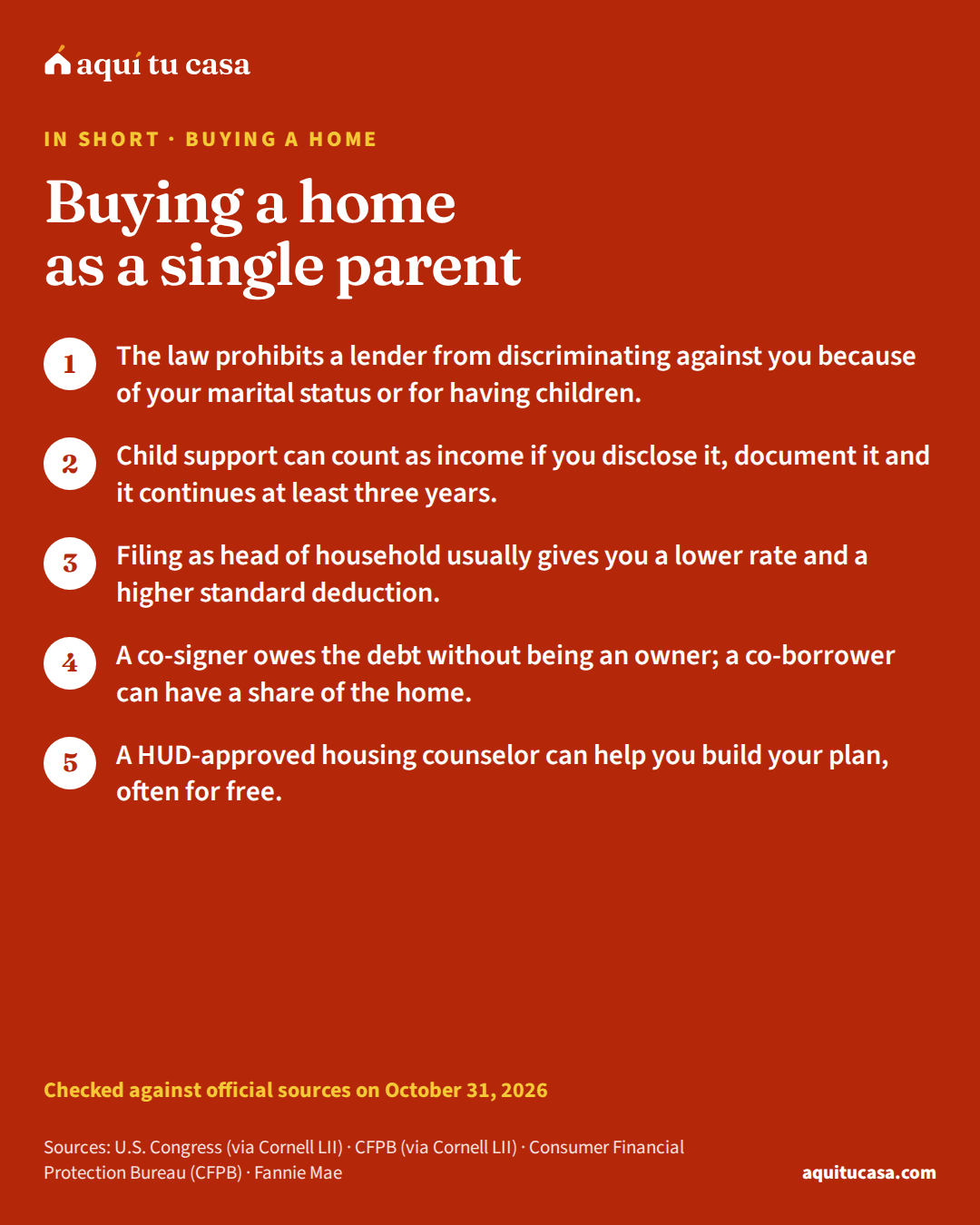
- The law prohibits a lender from discriminating against you because of your marital status or for having children.
- Child support can count as income if you disclose it, document it and it continues at least three years.
- Filing as head of household usually gives you a lower rate and a higher standard deduction.
- A co-signer owes the debt without being an owner; a co-borrower can have a share of the home.
Is this for you?
This guide is for you if…
- You are a single mother or father and want to buy a home of your own.
- You live on one income and do not know whether it is enough for a mortgage.
- A relative offered to sign with you and you do not know what makes sense.
Get direct help first if…
- You are in the middle of a divorce and the question is who keeps the current home: read «Divorce, separation or death: who keeps the house» first.
- You want details on how child support is counted: read «Child support, alimony and your mortgage application».
Raising your children on your own and saving for a home at the same time is a lot of work. But buying on one income is possible, and the law protects you along the way. This guide explains your rights with the lender, which income can help you qualify, how your taxes may be affected, what it means for a relative to sign with you and where to find free help. It does not tell you what to do in your case, but it does tell you what to ask.
Your rights with the lender
Federal law is clear. The Equal Credit Opportunity Act prohibits a lender from discriminating against you in any part of the loan because of your marital status or your sex, among other things, or because all or part of your income comes from a public assistance program.1
Regulation B adds two important protections for you:
- They cannot assume you will earn less because you have children. The lender may not use assumptions or statistics about the likelihood that someone will have or raise children and earn less for that reason.3
- Your marital status, only with three options. On a mortgage they may ask whether you are married, but only with the options married, unmarried and separated. “Unmarried” includes single, divorced and widowed.2
The Fair Housing Act protects you too. Familial status covers households with one or more children under 18 living with a parent or another person with legal custody, and also anyone who is pregnant or in the process of securing custody of a minor. And it is illegal for anyone who makes home loans to discriminate because of familial status in making them available or in their terms.4 If you feel you were treated differently, read Lending discrimination: your rights.
Your budget on one income
Lenders measure your ability to pay with the debt-to-income ratiodebt-to-income ratio (DTI)Your debt-to-income ratio (DTI) is all your monthly debt payments divided by your gross monthly income, that is, income before taxes. If you pay a certain amount each month across a car, cards, student loans and the mortgage you are asking for, and you earn three times that, your DTI is one third. Lenders use it to measure whether you can manage the payment; each loan type and lender sets its own limit, and assistance programs usually publish theirs. Paying down debt before applying improves your DTI.See the full definition: all your monthly debt payments divided by your gross monthly income. Each product and lender has its limits.5 On one income, every debt weighs more, so lowering or paying off a card before you apply can make a difference. The guide Debt-to-income ratio and how to lower it explains how.
But what the lender calculates is not all that matters. Your real budget includes things that do not appear on your credit report, such as child care, school, food and transportation. Before you decide how much to pay for a home, build your family budget with all those expenses and see how much is left. And build a cushion for emergencies: if you get sick or lose hours at work, there is no other income in the home to cover you. The guide Building an emergency fund helps you start.

Income that can help you qualify
Your child support. It can count as income, but only if you choose to disclose it and ask that it be considered. With Fannie Mae, you need a written agreement or order, at least six months of full, regular and timely payments, and documentation that it will continue at least three years. Because child support is not taxed, it can be grossed up when your income is calculated.6 Regulation B also says that if you rely on it, the lender must count it to the extent it is likely to be paid consistently.3 The guide Child support, alimony and your mortgage application explains the FHA and Fannie Mae rules.
Your taxes as head of household. According to the IRS, you can file as head of household if on the last day of the year you are unmarried or considered unmarried, you paid more than half the cost of keeping up your home for the year and a qualifying person, such as your child, lived with you more than half the year, except for temporary absences such as school. With this status, your tax rate is usually lower and your standard deduction higher than if you file as single.7 Paying less tax leaves you more money to save. Child credits can help too; read EITC and child tax credit and file for free at a VITA site.
Co-borrower or co-signer: if a relative signs with you
Sometimes a parent or sibling offers to sign the loan with you so you qualify. There are different ways to do it, and they do not mean the same thing:
Three ways a relative can sign
Owner and debtor
Co-borrower who lives with you
- Signs the note and is usually on the title
- Their income and debts are added to yours
- Owns the home with you
Fannie Mae B2-2-04
Borrower who will not live in the home
- Signs the note and owes the whole debt
- May or may not be on the title
- Cannot be the seller or the agent
Fannie Mae B2-2-04
Co-signer or guarantor
- Signs the note and owes the whole debt
- Has no share of the home on the title
- If you do not pay, they get billed
In every case, whoever signs owes the full debt if you do not pay; talk about that before signing.
According to Fannie Mae, co-signers and guarantors sign the note and are jointly liable for it, but have no ownership interest on the title. Non-occupant borrowers also sign and are liable, and may or may not be on the title. None may have an interest in the sale, such as the seller or the agent. And on manually underwritten loans, if that person’s income is used, you, as the one who will live in the home, must make the first 5% of the down payment from your own money, unless the loan is 80% of value or less or you can use a gift or other permitted help; also, your DTI using only your income cannot exceed 43%.8
Signing for someone carries risks for the relative: read Risks of cosigning a loan or lease and Buying with family: co-borrowers before you decide.
Questions to ask the lender
Bring these questions to every lender you talk to, and compare the answers:
- How will you count my child support and what papers do you need?6
- What maximum debt-to-income ratio do you use for the loan you are offering me?5
- Do you accept a gift from a relative for the down payment? The guide Gift money from family explains the letter you will be asked for.
- If a relative signs with me, will they be a co-borrower or a co-signer, and what changes?8
- What would my total monthly payment be, with taxes and insurance included?
Ask for each offer in writing on a Loan Estimate, so you can compare them line by line. The guide How to compare Loan Estimates shows you how.

Programs and free help
Each down payment assistancedown payment assistance (DPA)Down payment assistance (DPA) is money a public or nonprofit program contributes toward your down payment and sometimes your closing costs. Many states, local governments and nonprofits offer programs to make homeownership more affordable; most focus on low- and moderate-income families buying their first home, and some target teachers, firefighters and other public service employees. The help can be a grant you never repay, a second loan with no payments that is forgiven over the years or repaid when you sell, and many can be used with a regular FHA or conventional loan.See the full definition program has its own requirements. The Which programs do I qualify for? tool helps you find the ones in your area, and the guide Down payment assistance: how it works explains the types. Many require a homebuyer education coursehomebuyer education courseA homebuyer education course is a class with a set curriculum that covers the homebuying process, how to maintain a home, budgeting and why good credit matters. It can be in a group, in person, online or by phone. It is not the same as housing counseling, which is one-on-one help with an action plan for your situation. Some loans and some down payment assistance programs require you to finish a course before closing, especially first-time homebuyers. When you finish, you get a certificate.See the full definition.
A HUD-approved housing counselorHUD-approved housing counselorA HUD-approved housing counselor works at an agency HUD has approved to provide housing counseling: independent, expert advice customized to your situation about buying a home, renting, a missed mortgage payment, a foreclosure or credit problems. The agencies usually charge little or nothing; many serve in Spanish and offer the homebuyer education course several assistance programs require. They are not lenders or real estate agents and sell you nothing. Your county page lists the official agencies with phone numbers.See the full definition can review your budget, your credit and the programs in your area with you, often at little or no cost. You search by ZIP code on the CFPB’s website.9
Your plan to buy on one income
1. Build your real budget
This month
With child care, school and an emergency cushion.5
Try it with your numbersFamily budget2. Gather your child support papers
If you receive it
The order or agreement and six months of deposits.6
4. Talk with a HUD counselor
Before house hunting
Review your credit, your savings and the programs in your area.9
5. Look for down payment help
Before preapproval
Each program has its own requirements; find the ones in your area.9
Try it with your numbersWhich programs might I qualify for?6. Decide whether someone signs with you
Before applying
Co-borrower or co-signer; both owe the whole debt.8
Example with real numbers
A mother buying on one income
An example in words, not a real case, of how the rules combine.
- She receives child support under a court order
- She discloses it and brings six months of deposits
- Her youngest son is 8
- The support continues more than three years
- She files as head of household
- She pays less tax and saves the difference
- Her father offers to sign as co-signer
- He would owe the whole debt if she does not pay, without being an owner
- What she decides
- Talk with a HUD counselor before asking her father to sign
The rules come from Fannie Mae and the IRS.678 Try the how-much-house calculator with your income.
Run it with your numbersHow much house can I afford?Also think about your children’s future
When you are the only adult in the home, it is wise to think about what would happen to the house if something happens to you. The guide Wills, transfer-on-death deeds and inheriting a home explains the options for leaving the home to your children, and How to hold title with family explains the ways to own with someone else.
If this is your situation
You receive child support
It can count as income if you disclose it, have six months of payments and it continues three more years.6
Part of your income is public assistance
The law prohibits discrimination because your income comes from public assistance.1
Your mom offers to sign with you
As a co-signer she would owe the whole debt without being an owner; decide first how to sign.8
You are pregnant
Familial status protection also covers anyone who is pregnant.4
You pay almost all the cost of your home
Ask whether you qualify as head of household on your taxes.7

Costly mistakes
Mistake: Not disclosing child support out of embarrassment or not knowing.
Instead: If you disclose and document it, it can help you qualify.6
Mistake: Figuring how much home you can afford without child care.
Instead: Build your budget with all your real expenses.5
Mistake: Asking a relative to sign without explaining the risk.
Instead: Whoever signs owes the whole debt if you do not pay.8
Mistake: Filing as single when you qualify as head of household.
Instead: Check the IRS requirements; it may lower your taxes.7
Mistake: Staying quiet if you are treated differently for having children.
Instead: The law prohibits that discrimination; keep everything in writing.34
What to do this week
- Build your family budget with child care included.5
- If you receive child support, gather the order and six months of bank statements.6
- Check whether you qualify as head of household for your next return.7
- Find a HUD-approved housing counselor by ZIP code.9
- Try the how-much-house calculator and look for help with Which programs do I qualify for?.5
- If a relative will sign with you, read Risks of cosigning a loan or lease together.8
Your numbers
The minimum for this loan is 3.5%. More down lowers the monthly payment.
Adjust advanced details
First number: share of income for housing. Second: housing plus debts. Lender references, not fixed rules.
Let's do the math
Estimated top price
National figure$227,000
Limited by the housing payment: at that price it would be about $1,883 a month, 28% of your income.
- By the housing payment (28% of income)Limits you$227,000
- By your total debts (36% of income)$292,000
- By your cash (down payment + closing)$330,500
- Typical home in the United States
- $332,700
- Your cap is 68% of the typical home.
What changes if…?
- …you save $10,000 more$227,000
- …you cut $200 a month in debts$227,000
Your maximum price with four loans
Same income, debts and savings; only the down payment and the loan type change. ITIN uses an example down payment and rate.
| FHA 3.5% | Conventional 5% | Conventional 20% | ITIN 15% (example) | |
|---|---|---|---|---|
| Maximum price | $227,000 | $232,000 | $93,000 | $119,000 |
| Payment per month | $1,883 | $1,882 | $616 | $898 |
Educational estimate, not a pre-approval. Uses example insurance (0.5% of value per year) and example closing costs (3% of price); the tax is the place’s typical rate.
Ready to see the numbers? Find your county here
See how this applies in your county: its loan limits, prices and rents, from the official data.
Printable checklist
Frequently asked questions
Can I be denied a mortgage for being a single mother?
Not for that. The Equal Credit Opportunity Act prohibits discrimination based on marital status or sex, and Regulation B prohibits assuming your income will drop because you have children. The Fair Housing Act also protects families with children under 18 in home loans.
Can the lender ask whether I am married?
On a mortgage it can ask, but only with the options married, unmarried and separated. Unmarried includes single, divorced and widowed.
Does my child support count as income?
It can, if you choose to disclose it. With Fannie Mae you need a written agreement or order, six months of full, timely payments, and for it to continue at least three years. Read the guide on child support and your mortgage for details.
What is filing as head of household?
It is an IRS filing status for someone who is unmarried on the last day of the year, paid more than half the cost of keeping up their home and lived more than half the year with a qualifying person, such as a child. It usually gives you a lower rate and a higher standard deduction.
My mom wants to sign with me. Co-borrower or co-signer?
For Fannie Mae, a co-signer signs the note and owes the debt, but has no share of the home on the title. A non-occupant borrower also owes it and may or may not be on the title. Either way, your mom owes the whole debt if you do not pay.
Is there down payment help for families like mine?
Each down payment assistance program has its own requirements. Use the which-programs-do-I-qualify-for tool to find the ones in your area and ask a HUD-approved housing counselor.
What do I do if I feel I was treated differently for having children?
Keep everything in writing and read the guide Lending discrimination: your rights, which explains how to file a complaint.
Sources
Every figure in this guide comes from one of these official sources. The number next to a sentence leads to the source behind it.
Each source on one line: who publishes it, its title, its address and the date we read it.
- 1. U.S. Congress (via Cornell LII) · 15 U.S.C. §1691, Scope of prohibition (Equal Credit Opportunity Act) · law.cornell.edu · Accessed October 31, 2026
- 2. CFPB (via Cornell LII) · 12 CFR §1002.5, Rules concerning requests for information (Regulation B) · law.cornell.edu · Accessed October 31, 2026
- 3. CFPB (via Cornell LII) · 12 CFR §1002.6, Rules concerning evaluation of applications (Regulation B) · law.cornell.edu · Accessed October 31, 2026
- 4. U.S. Congress (via Cornell LII) · 42 U.S.C. §3602, Definitions, and §3605, Discrimination in residential real estate-related transactions (Fair Housing Act) · law.cornell.edu · Accessed October 31, 2026
- 5. Consumer Financial Protection Bureau (CFPB) · What is a debt-to-income ratio? · consumerfinance.gov · Accessed October 31, 2026
- 6. Fannie Mae · Selling Guide B3-3.4-02, Alimony, Child Support, Equalization Payments, or Separate Maintenance · selling-guide.fanniemae.com · Accessed October 31, 2026
- 7. Internal Revenue Service (IRS) · Publication 501, Dependents, Standard Deduction, and Filing Information · irs.gov · Accessed October 31, 2026
- 8. Fannie Mae · Selling Guide B2-2-04, Guarantors, Co-Signers, or Non-Occupant Borrowers on the Subject Transaction · selling-guide.fanniemae.com · Accessed October 31, 2026
See the other 1 sources
- 9. Consumer Financial Protection Bureau (CFPB) · Find a housing counselor · consumerfinance.gov · Accessed October 31, 2026
Keep reading
Related guides
If this guide helped, these follow the same path.

Mortgage loans 10 minute read
Child support, alimony and your mortgage application
When the child support or alimony you receive counts as income, and when what you pay counts as debt, under FHA, Fannie Mae and federal law.
- The child support or alimony you receive only counts if you choose to disclose it; the lender must tell you so.
- Fannie Mae asks for six months of payments received; FHA, three months with a court order.
- Both require the payment to continue at least three years: your children's ages matter.
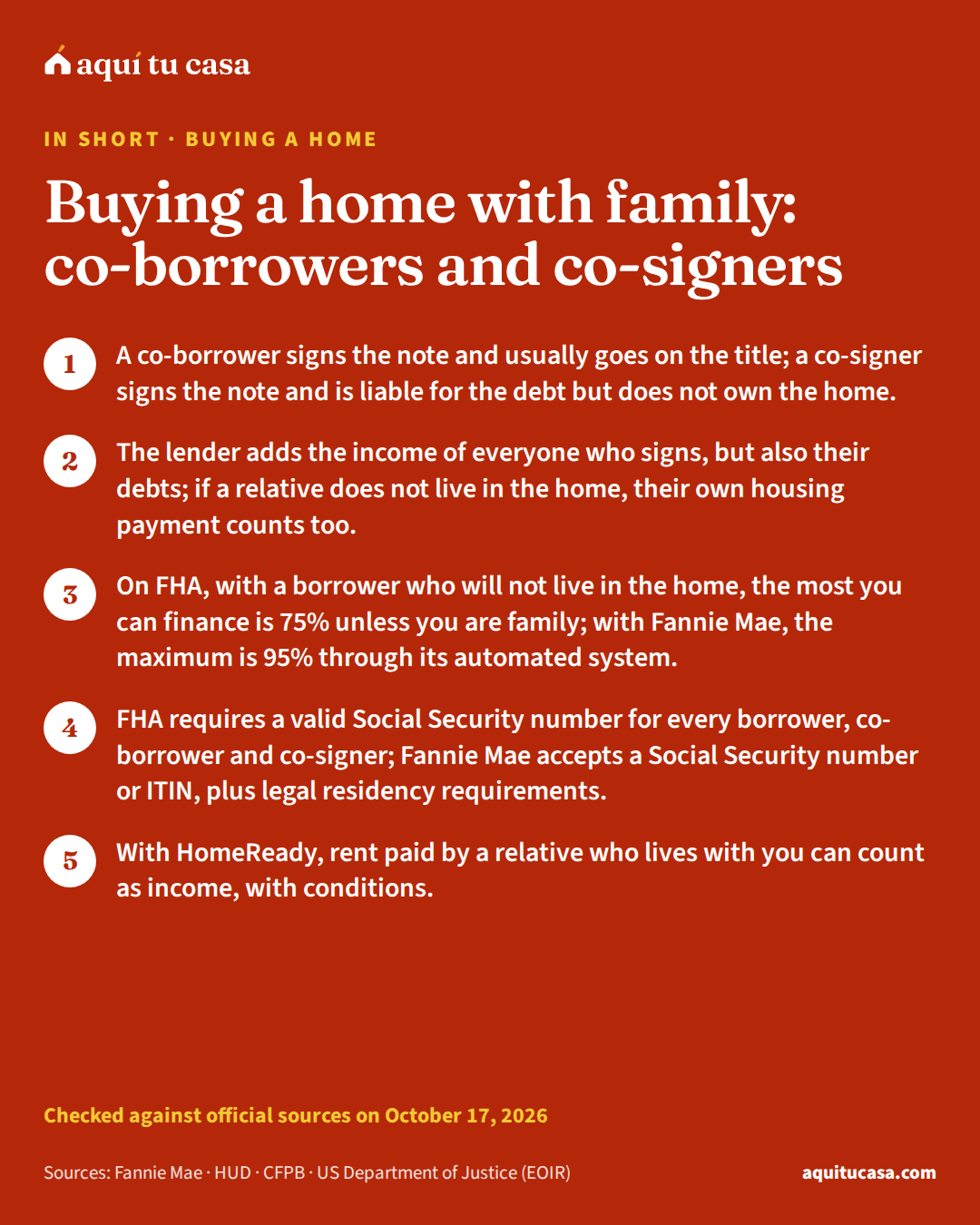
- Buying a home Buying a home with family: co-borrowers and co-signers Who in your family can sign the loan with you, how incomes and debts add up, and what changes if your relative will not live in the home or has an ITIN. 11 minute read
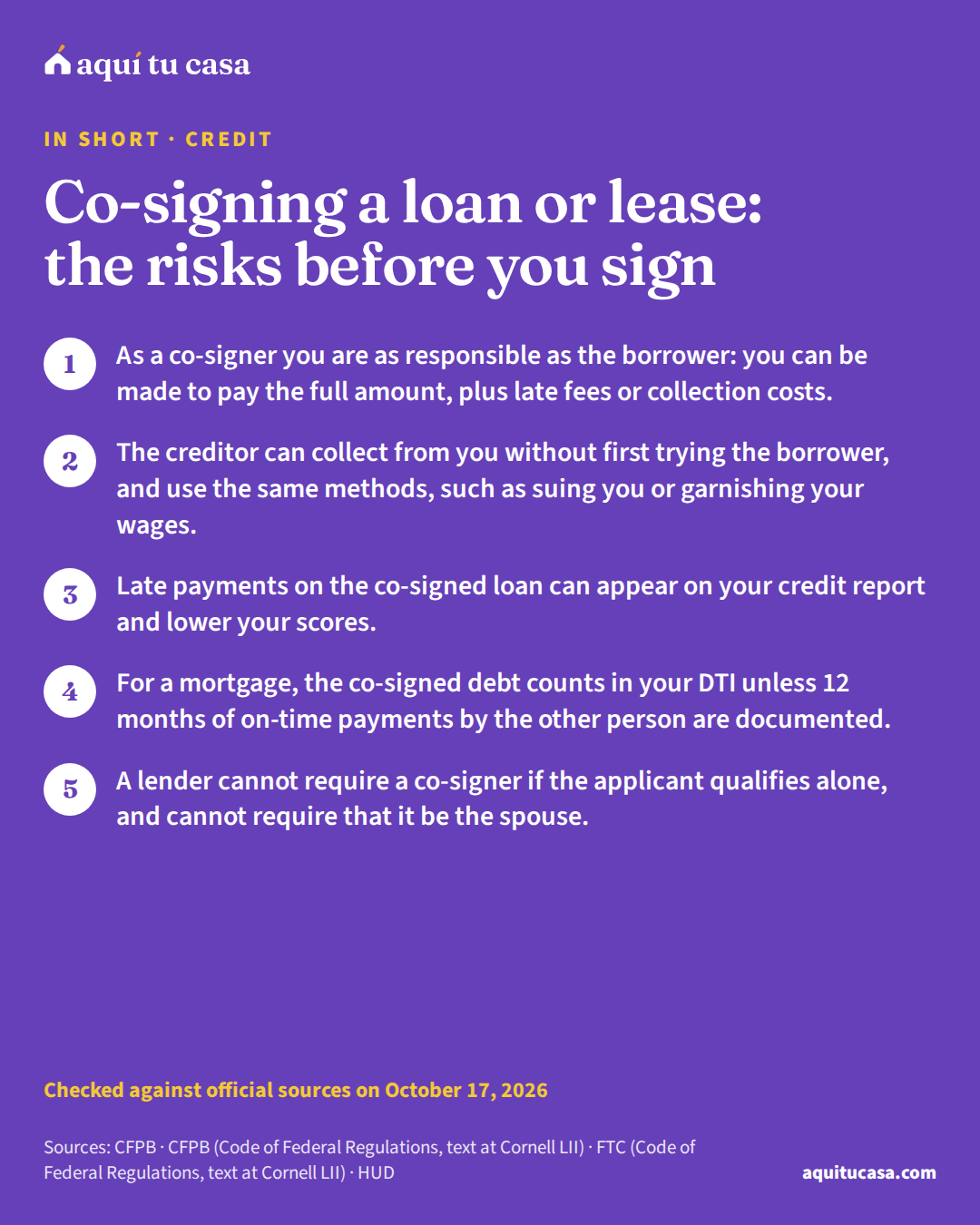
- Credit Co-signing a loan or lease: the risks before you sign What co-signing a loan or a lease means, what you can be made to pay, how it affects your credit and a future mortgage, and how to protect yourself. 11 minute read
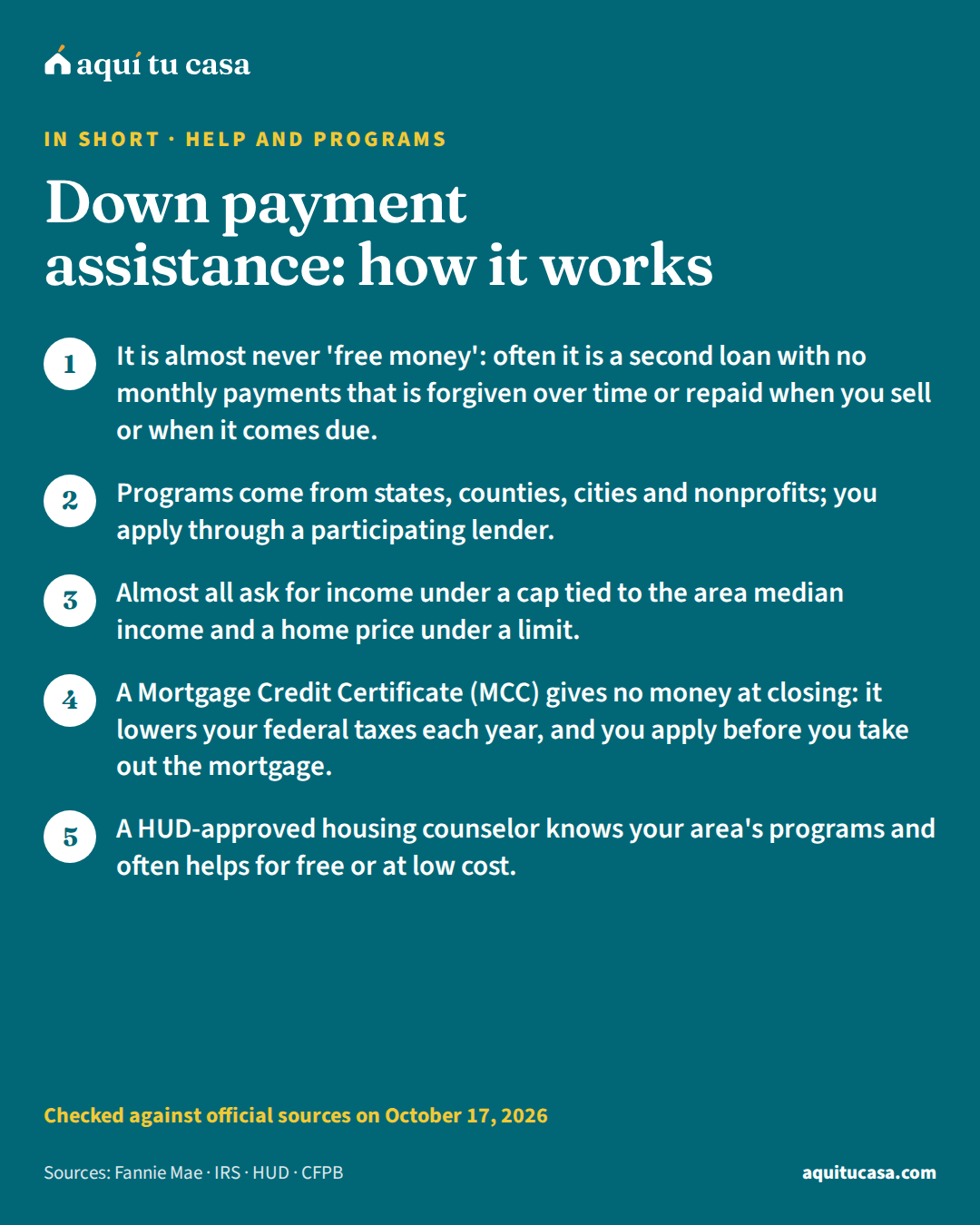
- Help and programs Down payment assistance: how it works What down payment assistance is, the types that exist (grant, forgivable or deferred second loan, tax credit), who qualifies and where to find it. 12 minute read
Tools for this topic
Was this guide useful?
Thank you. Your answer stays in your browser; nothing is sent.