Bidding wars: appraisal gaps and escalation clauses
What it costs to offer more than the appraisal, how an escalation clause works and what you risk if you waive the inspection or appraisal to win.
Verified against official sources on October 31, 2026 10 official sources

Show contents
In short
What you need to know
Quick answer
In a bidding war, the price can climb above what the home is worth to the lender. The lender figures your loan on the lower of the price or the appraisal, so the difference (the appraisal gap) comes out of your pocket, on top of your down payment. The CFPB says it is very risky to pay more than the appraised value. An escalation clause raises your offer automatically against others, but it has pitfalls, and agents in some states may not draft one. Before you waive the inspection or appraisal to win, decide how much extra cash you could lose without being left with no cushion.
What matters most
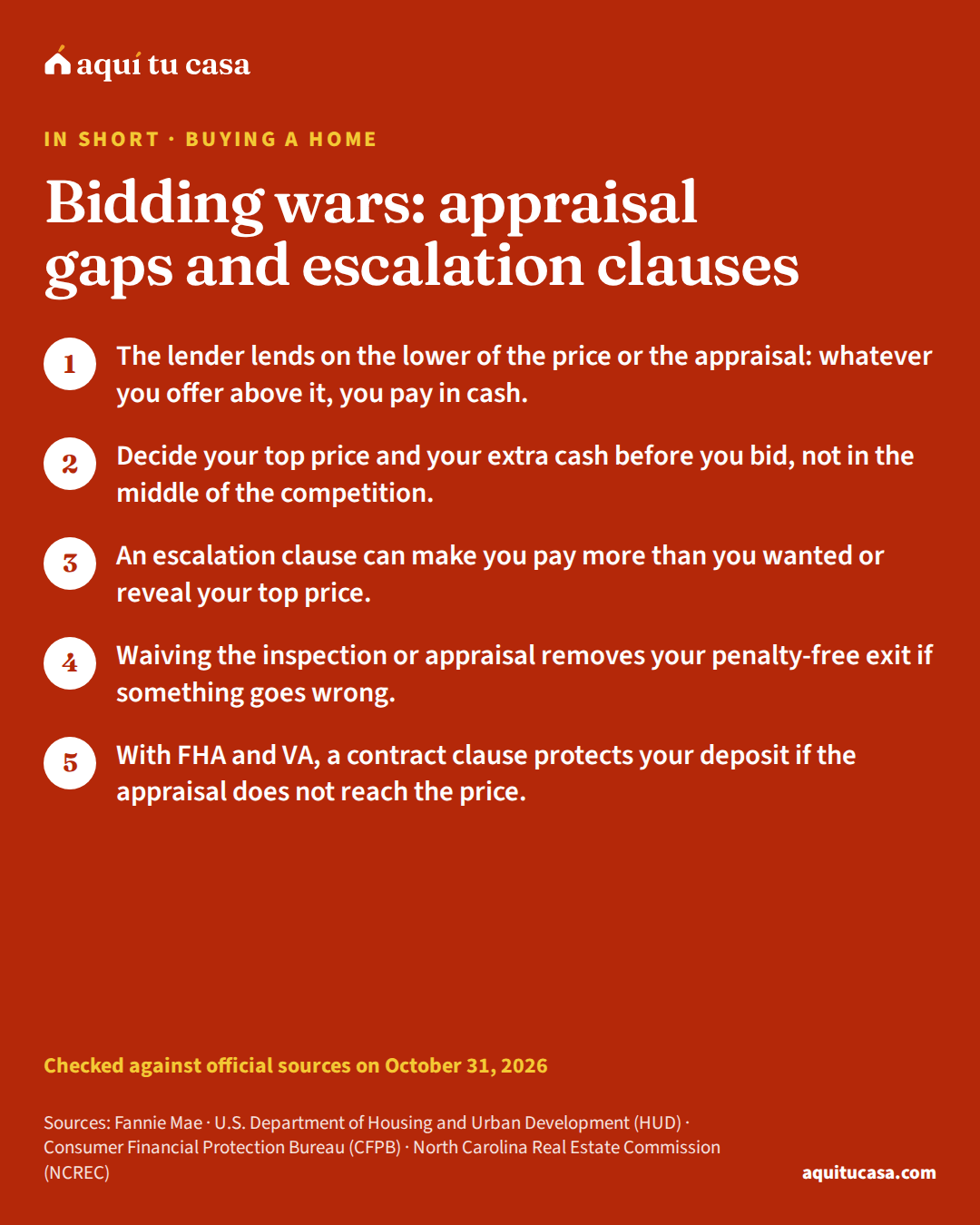
- The lender lends on the lower of the price or the appraisal: whatever you offer above it, you pay in cash.
- Decide your top price and your extra cash before you bid, not in the middle of the competition.
- An escalation clause can make you pay more than you wanted or reveal your top price.
- Waiving the inspection or appraisal removes your penalty-free exit if something goes wrong.
Is this for you?
This guide is for you if…
- There are several offers on the home you like and you are being asked to bid above the price.
- Your agent suggests an escalation clause or covering the gap if the appraisal comes in low.
- You are wondering whether to waive the inspection or appraisal so your offer gets accepted.
Get direct help first if…
- Your appraisal already came in low and you have to decide what to do: read «What if the appraisal comes in low?».
- You do not know yet how much you can afford: start with «Preapproval vs. prequalification» and the how much house can I afford calculator.
You found the home, but you are not the only one. When there are several offers, it is easy to push the price up in the heat of the moment. The problem is that the lender does not lend on what you offer, but on what the home is worth in the appraisalhome appraisalAn appraisal is a written document that gives a professional appraiser's opinion of how much a property is worth. The lender orders it before approving the mortgage, because the home is the loan's collateral and the lender does not want to lend more than it is worth. If the appraisal comes in below the price you agreed, the bank bases the loan on the lower value and you will have to cover the difference, renegotiate the price or walk away if your contract allows it. An appraisal is not an inspection: it measures value, not the home's condition.See the full definition. This guide explains what it costs to offer too much, how an escalation clause works and what you risk if you give up your protections to win. Our guide What if the appraisal comes in low? covers what to do once you have the appraisal in hand.3
What the appraisal gap is and who pays it
The appraisal gapappraisal gapAn appraisal gap is the difference between the price you agreed to pay for a home and an appraisal that comes in lower. It matters because the lender measures your loan against the property's value (the loan-to-value ratio): on loans Fannie Mae buys, that value is the lower of the sales price or the appraised value. With a VA loan, for example, you can request a reconsideration of value, negotiate a lower price with the seller or pay the difference at closing. An appraisal contingency in the contract can let you renegotiate the price or walk away from the purchase.See the full definition is the difference between the price you offered and the appraised value, when the appraisal comes in lower. You almost always pay that difference:
- With a conventional loan, Fannie Mae figures the loan-to-value ratioloan-to-value ratio (LTV)The loan-to-value ratio (LTV) compares the amount of your mortgage with the appraised value of the property. It is expressed as a percentage: a loan that covers almost the whole value has a high LTV; one with a large down payment, a low LTV. Lenders use it to measure risk: the higher the LTV, the stricter the requirements and the more likely you will be asked for mortgage insurance. Over time, as you pay down principal or the home gains value, your LTV falls, which can let you cancel PMI on a conventional loan.See the full definition using the lower of the sales price or the appraisal.1 If the appraisal is lower, your loan is based on that value.
- With FHA, the maximum loan is based on the adjusted value, which for a purchase is the lower of the price (less inducements) or the property value.2
- With VA, if you go ahead, the loan is capped at the lower of the price or VA’s reasonable value.9
In all three cases, whatever you offered above the appraisal is not covered by the loan. You put it in as cash, on top of your down paymentdown paymentThe down payment is the part of the home's price you pay out of your own pocket when you buy; the loan covers the rest. In U.S. Spanish it is also called enganche, cuota inicial or entrada. Each loan type has its own minimum: FHA requires at least 3.5% of the value, VA and USDA loans may require none, and conventional loans ask for more if you want to avoid private mortgage insurance. A larger down payment lowers the loan, the monthly payment and the total interest; many state programs help families put it together.See the full definition and closing costs. The CFPB says it plainly: it is very risky to buy a home for more than its appraised value.3
That cash has to come from somewhere. If you use your reservesreservesReserves are the cash and other easy-to-cash assets you still have available after the mortgage closes. They are measured in months: how many full monthly house payments (principal, interest, taxes, insurance and association dues) you could cover with them. Under Fannie Mae's rules, they include money in checking or savings accounts, investments, the vested part of a retirement account and the cash value of a life insurance policy; personal loans and the money you use to close do not count. An eligible gift can also be used. How many months are required depends on the loan and the property.See the full definition or emergency fund to cover the gap, you may be left with no cushion just as the costs of the new home begin. The how much house can I afford calculator and the down payment savings plan help you see what you would have left.
Example with real numbers
A couple who bids above the price
An example in words, not a real case, of how the gap appears.
- What they offer
- More than the list price, to beat other offers
- What the appraisal says
- A value lower than their offer
- What the bank lends
- It figures the loan on the appraised value, not on their offer
- What they are short
- The difference between their offer and the appraisal, in cash, on top of their down payment
- Their options
- Negotiate the price with the appraisal in hand, pay the difference or cancel if their contract allows
The rules in this example come from Fannie Mae and the CFPB.13 Use the closing costs calculator to see your total cash.
Run it with your numbersClosing costsIf the appraisal comes in low after you win
Winning the offer does not end the story. If the appraisal comes in low, the CFPB suggests using it to negotiate: it is strong evidence the price was above market value. If the seller will not lower the price, you may want to cancel. Depending on your contract, canceling may cost you something, but the CFPB says those costs are likely small compared with buying a home that is not worth what you paid.3
What you can do depends on what you promised in your offer. If your contract has an appraisal contingencycontingencyA contingency is a condition you add to your offer or purchase contract to protect yourself: if it is not met, you can change or end the contract and, in general, get your earnest money back. The most common are the inspection contingency, if the inspection finds problems; the appraisal contingency, if the appraisal comes in below the price; the financing or mortgage contingency, if you cannot get the loan within the agreed time; and the home sale contingency, tied to selling your current home. Contingencies are a normal part of buying, but too many can make your offer less attractive to the seller.See the full definition, you have a way out. If you promised to pay the difference, or waived that condition, your earnest moneyearnest moneyEarnest money is a deposit the buyer pays when signing the purchase contract to show good faith that the offer is serious. The seller does not keep it: a neutral third party (the title company or a closing agent) normally holds it, and at closing it is applied to your down payment or closing costs. If you back out for a reason the contract allows, such as an inspection or financing contingency, you get it back; if you back out without a valid reason, you can lose it.See the full definition may be at risk: it is returned if the contract ends for a permissible reason, but you can lose it if you do not perform.8
With FHA and VA you have a protection that does not depend on what you negotiate. With FHA, if you did not have the appraised value when you signed, the contract must be amended before closing with a clause saying you do not have to buy or lose your deposit if the value does not reach the price; you decide whether to proceed.2 With VA, the escape clause does the same against VA’s reasonable value.9 Our FHA loan and VA home loan guides explain the rest.
The escalation clause: how it works and its pitfalls
An escalation clause is part of your purchase offerpurchase offerA purchase offer is the formal proposal you make to a seller to buy their home. Your real estate agent writes it up and sends it to the seller's agent. It includes the price you offer and the terms of the purchase: your target closing date, who pays certain fees, a deadline for the seller to respond and any contingencies, which are conditions that must be met before you buy. The seller can accept it or answer with a counteroffer, and you can accept, reject or counter again. Once both parties sign the written offer, it becomes a contract.See the full definition saying you will pay a specific amount more than the highest competing offer. It may or may not have a maximum price.5 The Texas Real Estate Commission gives this example: paying “X amount more than the highest offer if other offers are present”.6
It sounds good, but the North Carolina Real Estate Commission discourages it and explains the risks:5
- With no cap, you may end up paying much more than you wanted.
- With a cap, the seller immediately knows your top price, and you lose bargaining power.
- The offer may not be enforceable until a specific price is written into the contract.
- The seller could invent a fake offer to drive up your price.
Also, to know how much you would pay, someone would have to show you the other offer. In North Carolina, a broker may not disclose the price or other material terms of an offer to a competing buyer without the express permission of the person who made it.5 That is why the Commission says the seller’s best response is usually to ask all buyers for their highest and best offers.5
Who writes it? A purchase contractpurchase agreementA purchase agreement is the written contract between you and the seller that is final once the seller accepts your offer and both of you sign it. It gathers the details of the sale: the names of the buyers and sellers, the total price, the real estate agent's commission, the requested closing date and the contingencies. You use it to get your loan, and it is submitted with the closing paperwork. The settlement agent pays out the money according to the contract and the loan, and whether the seller pays some closing costs is also set by the contract.See the full definition is a legal document, and any change can affect your rights. In Texas, a licensed agent may not draft or add language that defines or affects the parties’ rights, such as an escalation clause, because that is the unauthorized practice of law.6 In North Carolina, brokers may not draft them either.5 Ask your agent which approved forms your state uses and what they can and cannot write for you.
And the appraiser will see it. Fannie Mae requires that the appraiser receive the complete, ratified contract with all addenda.4 An escalation clause does not raise the home’s value: the appraisal still measures what it is worth.

Waiving contingencies to win
In a competitive market, you may be told to drop conditions so your offer looks stronger. Before you do, understand what you lose:
- The inspection. According to the CFPB, if your contract is contingent on a satisfactory inspection, you can cancel without penalty if you are not satisfied with the results. With a serious flaw, such as a cracked foundation, you may decide not to buy, or negotiate for the seller to fix it or give you a credit, though the seller may say no.7 Without that condition, walking away can cost your deposit.8 Our guide Home inspection explains what it covers.
- The appraisal. The inspection and the appraisal are different, and you generally need both.7 With no appraisal contingency, if the value comes in low you will have to pay the gap or risk your deposit.
- Financing. It protects you if you do not get the loan. Our guide Preapproval vs. prequalification explains why a preapproval is not a promise.
A strong offer or a risky offer
Safer
Strong, with protections
- Preapproval ready and short deadlines
- An earnest money deposit you can afford
- A top price decided in advance
- Inspection and appraisal as conditions
More risk
No protections
- No inspection: with a serious defect, walking away can cost your deposit
- No appraisal: the gap comes out of your pocket
- Escalation with no cap: you may pay more than you wanted
- Your savings can end up tied to the offer
If you want a stronger offer, start with what does not take away your protections.
Before you bid in a competition
1. Have your preapproval
Before you search
That way you know how much the bank lends and on what value.1
2. Decide your top price and extra cash
Before you see other offers
Write down the price you will not go past and how much you could add if the appraisal comes in low.3
Try it with your numbersHow much house can I afford?3. Ask which forms your state uses
Before you write the offer
And whether your agent can add an escalation clause.6
4. Check which contingencies you drop
Before you sign
Every condition you drop is a penalty-free exit you lose.7
5. With FHA or VA, confirm the clause
When you sign the contract
The amendatory or escape clause protects your deposit.9
If this is you
It is your first offer and there is competition
Decide your top price first; the lender only lends on the lower of the price or the appraisal.1
Your down payment already uses most of your savings
Bidding high can leave you with no cushion: the gap is paid in cash.3
You are buying with a VA loan
The escape clause lets you leave without losing your deposit if the price exceeds VA's value.9
Your agent suggests an escalation clause
Ask whether it has a cap and who drafts it; in Texas, the agent may not.6
You are asked to drop the inspection
Without that condition, if you find a serious defect and walk away, you can lose your deposit.7

Mistakes that cost you
Mistake: Bidding high without knowing where the difference will come from.
Instead: The loan is figured on the lower of the price or the appraisal; the gap is your cash.1
Mistake: Using an escalation clause with no cap.
Instead: You may end up paying much more than you wanted.5
Mistake: Asking your agent to draft any clause.
Instead: In some states they may not; ask which approved forms are used.6
Mistake: Dropping the inspection to win.
Instead: With it you can cancel without penalty if the results do not satisfy you.7
Mistake: Thinking an escalation clause will raise the appraisal.
Instead: The appraiser sees the whole contract but measures what the home is worth.4
Mistake: Believing that with FHA you will lose your deposit if the appraisal is low.
Instead: FHA's amendatory clause lets you walk away without losing it.2
Free help
A HUD-approved housing counselorHUD-approved housing counselorA HUD-approved housing counselor works at an agency HUD has approved to provide housing counseling: independent, expert advice customized to your situation about buying a home, renting, a missed mortgage payment, a foreclosure or credit problems. The agencies usually charge little or nothing; many serve in Spanish and offer the homebuyer education course several assistance programs require. They are not lenders or real estate agents and sell you nothing. Your county page lists the official agencies with phone numbers.See the full definition can help you for free or at low cost decide your top price and understand your offer; search by ZIP code on the CFPB’s website.10 Our guide HUD-approved housing counselors explains what they do. If you have a question about what your contract says, our guide Free legal aid explains how to find no-cost legal help, and How to choose a real estate agent helps you ask the right questions.

What to do this week
- Get your preapproval and ask what value the bank lends on.1
- Write down your top price and the extra cash you could add without touching your emergency fund.3
- Ask your agent for a blank offer form and read which contingencies it includes.7
- Ask whether, in your state, your agent can add an escalation clause.6
- If you use FHA or VA, ask to have the amendatory or escape clause explained.2
Your numbers
The minimum for this loan is 3.5%. More down lowers the monthly payment.
Adjust advanced details
First number: share of income for housing. Second: housing plus debts. Lender references, not fixed rules.
Let's do the math
Estimated top price
National figure$227,000
Limited by the housing payment: at that price it would be about $1,883 a month, 28% of your income.
- By the housing payment (28% of income)Limits you$227,000
- By your total debts (36% of income)$292,000
- By your cash (down payment + closing)$330,500
- Typical home in the United States
- $332,700
- Your cap is 68% of the typical home.
What changes if…?
- …you save $10,000 more$227,000
- …you cut $200 a month in debts$227,000
Your maximum price with four loans
Same income, debts and savings; only the down payment and the loan type change. ITIN uses an example down payment and rate.
| FHA 3.5% | Conventional 5% | Conventional 20% | ITIN 15% (example) | |
|---|---|---|---|---|
| Maximum price | $227,000 | $232,000 | $93,000 | $119,000 |
| Payment per month | $1,883 | $1,882 | $616 | $898 |
Educational estimate, not a pre-approval. Uses example insurance (0.5% of value per year) and example closing costs (3% of price); the tax is the place’s typical rate.
Ready to see the numbers? Find your county here
See how this applies in your county: its loan limits, prices and rents, from the official data.
Printable checklist
Frequently asked questions
What is an appraisal gap?
It is the difference between the price you offered and the appraised value, when the appraisal comes in lower. Because the lender figures the loan on the lower of the two, you pay that difference in cash, on top of your down payment.
Is it a bad idea to offer above the list price?
Not always, but the CFPB says it is very risky to buy for more than the appraised value. If you offer more, be clear on how much extra cash you might need if the appraisal comes in low, and whether that money leaves you with no cushion.
What is an escalation clause?
It is part of your offer saying you will pay a set amount more than the highest competing offer, with or without a cap. The North Carolina Real Estate Commission discourages them, partly because you may pay more than you wanted or reveal your top price.
Can my agent write the escalation clause?
It depends on the state. In Texas and North Carolina, licensed agents may not draft them, because that is the unauthorized practice of law. Ask your agent which approved forms your state uses.
What do I lose if I waive the inspection?
The penalty-free exit. According to the CFPB, if your contract is contingent on a satisfactory inspection, you can cancel without penalty if you are not satisfied with the results. Without that condition, if you find a serious defect and walk away, you can lose your deposit.
With FHA or VA, can I give up the appraisal protection?
With FHA, if you did not have the appraised value when you signed, the contract must include a clause that lets you walk away without losing your deposit if the value does not reach the price. With VA, the escape clause does the same. In both cases you can choose to proceed and pay the difference.
What if I lose the home in the bidding war?
If you did not win, your savings are still with you. Go over with your agent what made the other offer win and get ready for the next one with your top price and extra cash already decided.
Sources
Every figure in this guide comes from one of these official sources. The number next to a sentence leads to the source behind it.
Each source on one line: who publishes it, its title, its address and the date we read it.
- 1. Fannie Mae · Selling Guide B2-1.2-01, Loan-to-Value (LTV) Ratios · selling-guide.fanniemae.com · Accessed October 31, 2026
- 2. U.S. Department of Housing and Urban Development (HUD) · Handbook 4000.1, FHA Single Family Housing Policy Handbook · hud.gov · Accessed October 31, 2026
- 3. Consumer Financial Protection Bureau (CFPB) · My appraisal is less than the sale price. What does that mean for me? · consumerfinance.gov · Accessed October 31, 2026
- 4. Fannie Mae · Selling Guide B4-1.1-05, Disclosure of Information to Appraisers · selling-guide.fanniemae.com · Accessed October 31, 2026
- 5. North Carolina Real Estate Commission (NCREC) · The Pitfalls of Using Escalation Clauses · bulletins.ncrec.gov · Accessed October 31, 2026
- 6. Texas Real Estate Commission (TREC) · Escalating to Trouble · trec.texas.gov · Accessed October 31, 2026
- 7. Consumer Financial Protection Bureau (CFPB) · Schedule a home inspection · consumerfinance.gov · Accessed October 31, 2026
- 8. Consumer Financial Protection Bureau (CFPB) · Mortgage key terms · consumerfinance.gov · Accessed October 31, 2026
See the other 2 sources
- 9. U.S. Department of Veterans Affairs (VA) · VA Escape Clause · benefits.va.gov · Accessed October 31, 2026
- 10. Consumer Financial Protection Bureau (CFPB) · Find a housing counselor · consumerfinance.gov · Accessed October 31, 2026
Keep reading
Related guides
If this guide helped, these follow the same path.

Buying a home 11 minute read
What if the appraisal comes in low, and what you can do
Why a low appraisal matters, your right to a copy, how to negotiate, pay the difference or cancel, and how to ask for a reconsideration of value.
- On a purchase, the lender uses the lower of the price and the appraisal: if the appraisal comes in low, your maximum loan goes down.
- You have the right to a free copy of the appraisal, no later than three business days before closing.
- Your options: negotiate a lower price, pay the difference yourself or cancel, depending on what your contract says.
- Buying a home Earnest money deposit: how it works and how to protect it What the earnest money deposit is when you make an offer on a home, who holds it, when you get it back, when you can lose it and how to avoid wire fraud. 12 minute read
- Buying a home Home inspection: what it covers and when to get it What a home inspection is, how it differs from the appraisal, when to get it under a contingency, radon and lead tests, and what to do with the report. 12 minute read
- Buying a home How much do you need for a down payment? 20% is not required: what each loan asks for (FHA, conventional, VA, USDA), what changes with less than 20% down, and where the money can come from. 11 minute read
Tools for this topic
Was this guide useful?
Thank you. Your answer stays in your browser; nothing is sent.