
How much house can I afford?
The price your income can carry.
What you get → maximum price
Someone shared this page with you.
Questions and answers
Every question our 36 guides about buying a home in the United States answer, grouped by guide. Each answer is the guide's own and leads to it, with its sources.
Open a question to read its answer. Each group ends with the full guide, its sources and, when it has one, its calculator.
We found no questions with those words. Try another word or open a topic.
From the guide
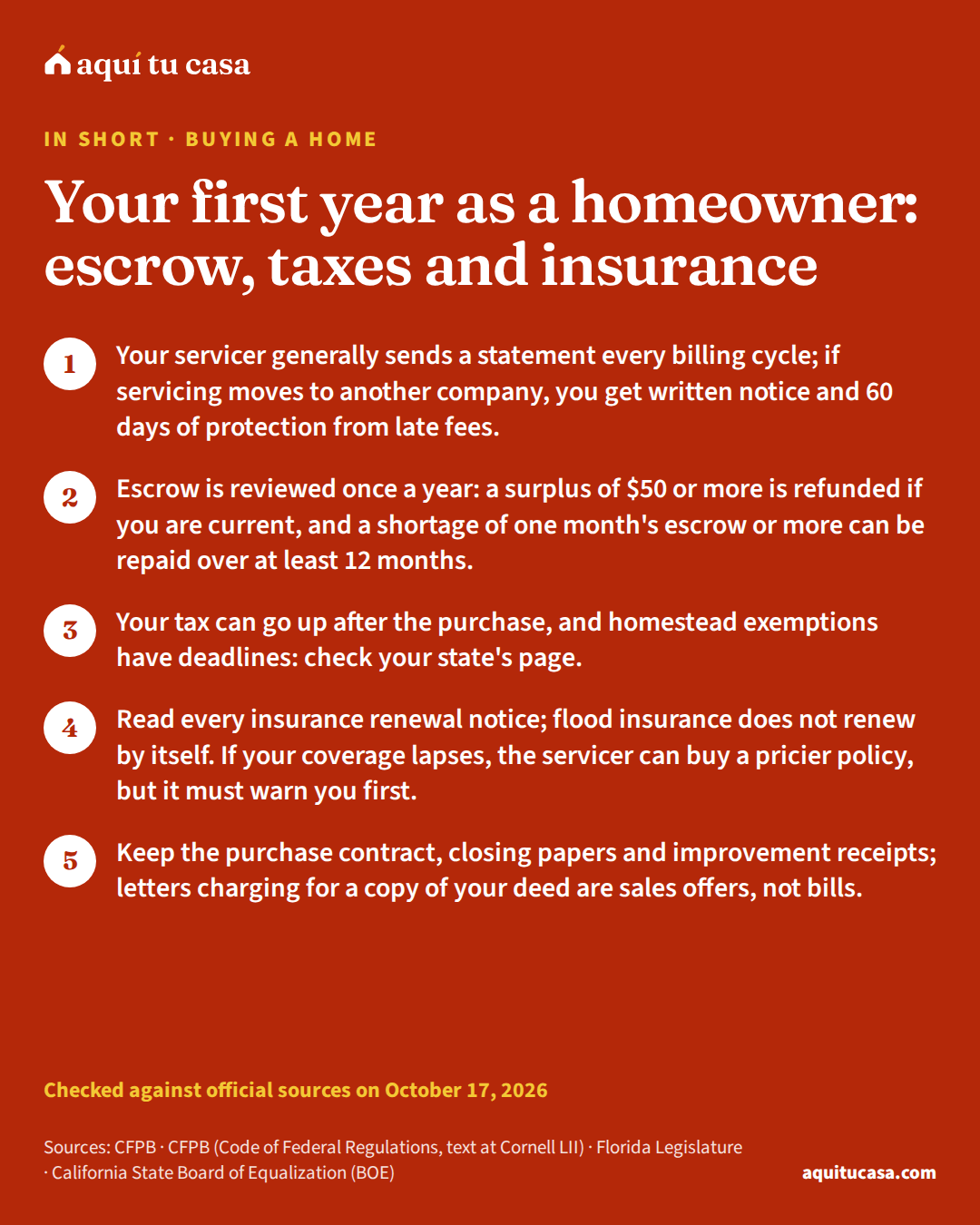
Who collects your mortgage and what happens if that changes, the yearly escrow review, taxes, exemptions, insurance, records and scams aimed at new owners.
Verified on October 17, 2026 20 official sources
If you have escrow, your payment changes when property taxes or insurance go up: the yearly analysis resets your payment and may spread out a shortage. The annual escrow statement shows what changed; if it does not add up, you can send your servicer a written notice of error.
Read the full guideServicing transfers are common, and the rules require both companies to notify you, with their phone numbers and the date you start paying the new one. Confirm by calling the number on your last statement, not the one in the letter, and tell your bank if you pay automatically.
Read the full guideMost owners receive a copy of their deed at purchase, and if you need another, your county or town records office provides it for far less than the companies sending those letters. The Rhode Island and Virginia attorneys general warn that these letters are sales offers, not government notices.
Read the full guideIf the shortage is one month's escrow or more, the servicer may ask you to repay it in equal monthly payments over at least 12 months, not all at once. If that still does not fit your budget, a HUD-approved housing counselor can help you review options, often free or at low cost.
Read the full guideAccording to the IRS, if you paid $600 or more of mortgage interest during the year, the lender should send you a Form 1098 or similar statement by January 31 of the following year. It shows the interest you paid and, in the year you buy, the deductible points. If you want free help with your return, look for an IRS VITA site.
Read the full guideSend a written notice of error, to the special address on your statement if there is one. It cannot charge you to respond; it generally has 5 business days to acknowledge it and 30 business days to fix it or explain why there was no error.
Read the full guideNo. According to FEMA, you have to renew it every year. If it lapses, a new policy takes 30 days to take effect and you may lose discounts.
Read the full guideThe IRS calls for full records: the purchase contract, the closing papers and the receipts for improvements. They establish your home's basis, and you keep them while you own the home and, after you sell, for the period of limitations that applies to you.
Read the full guideThe data behind these guides
The guides on Buying a home cite these figures. They update when their sources publish new ones; what you see here is current.
See all the dataSources: U.S. Census Bureau (Average 2020–2024) · HUD (2026 data) · Freddie Mac (As of November 5, 2026)
From the guide
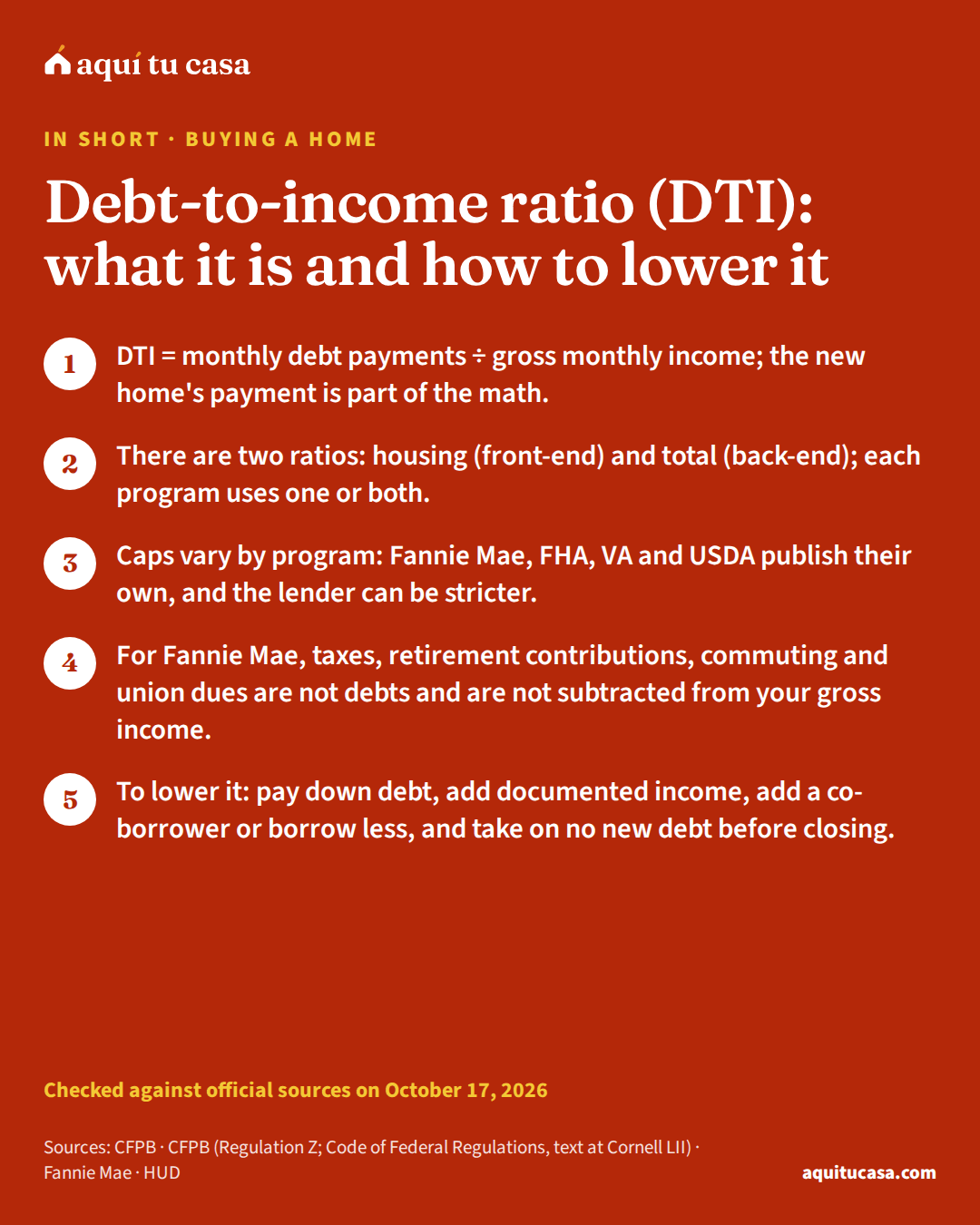
What the debt-to-income ratio (DTI) is, how to calculate it, which payments count, the caps FHA, Fannie Mae, VA and USDA publish and how to lower it.
Verified on October 17, 2026 13 official sources
Read the full guide Do the math: How much house can I afford?
It depends on the loan. Fannie Mae publishes 36% for manually underwritten loans (up to 45% with the required credit score and reserves) and 50% for loans run through its DU system; FHA starts at 31/43 for manual underwriting; VA uses 41% as its standard and USDA 29/41. Each lender can also be stricter.
Read the full guideIf the home you are buying will be your principal residence, Fannie Mae uses the new home's payment as your housing payment. If a co-borrower will not live in the home, that person's rent or mortgage does count.
Read the full guideAccording to Fannie Mae, no. If you pay off the balance at or before closing, its payment is left out of your DTI and the account does not need to be closed. Paying off debt just to qualify is evaluated carefully, along with your credit history.
Read the full guideYes, as a co-borrower: their income can count even if they will not live in the home, as long as it meets the same standards. But they sign the note, share liability for the debt with you, and Fannie Mae's DU system also looks at their income, debts and credit.
Read the full guideAccording to the CFPB, gross income is generally what you earn before taxes and other deductions. For Fannie Mae, your taxes, 401(k) contributions, commuting costs and union dues are not subtracted from it. The lender has to document that your income is stable and reasonably expected to continue.
Read the full guideAs an example with national numbers: the payment on a typical $332,700 home with FHA would be $2,759 a month, and a typical household's monthly income is $6,728. The home payment alone would be 41% of income, before adding other debts. For your own numbers, use the how much house can I afford calculator.
Read the full guideIt is what you have left each month after paying your debts. The federal ability-to-repay rule lets the lender look at your DTI or your residual income. VA uses both: it compares what you have left with tables by region and family size, and it counts everyone in your household.
Read the full guideYes. With Fannie Mae, if your student loan is deferred or in forbearance, the lender may use 1% of the balance as the monthly payment, or a payment that pays off the loan under its terms.
Read the full guide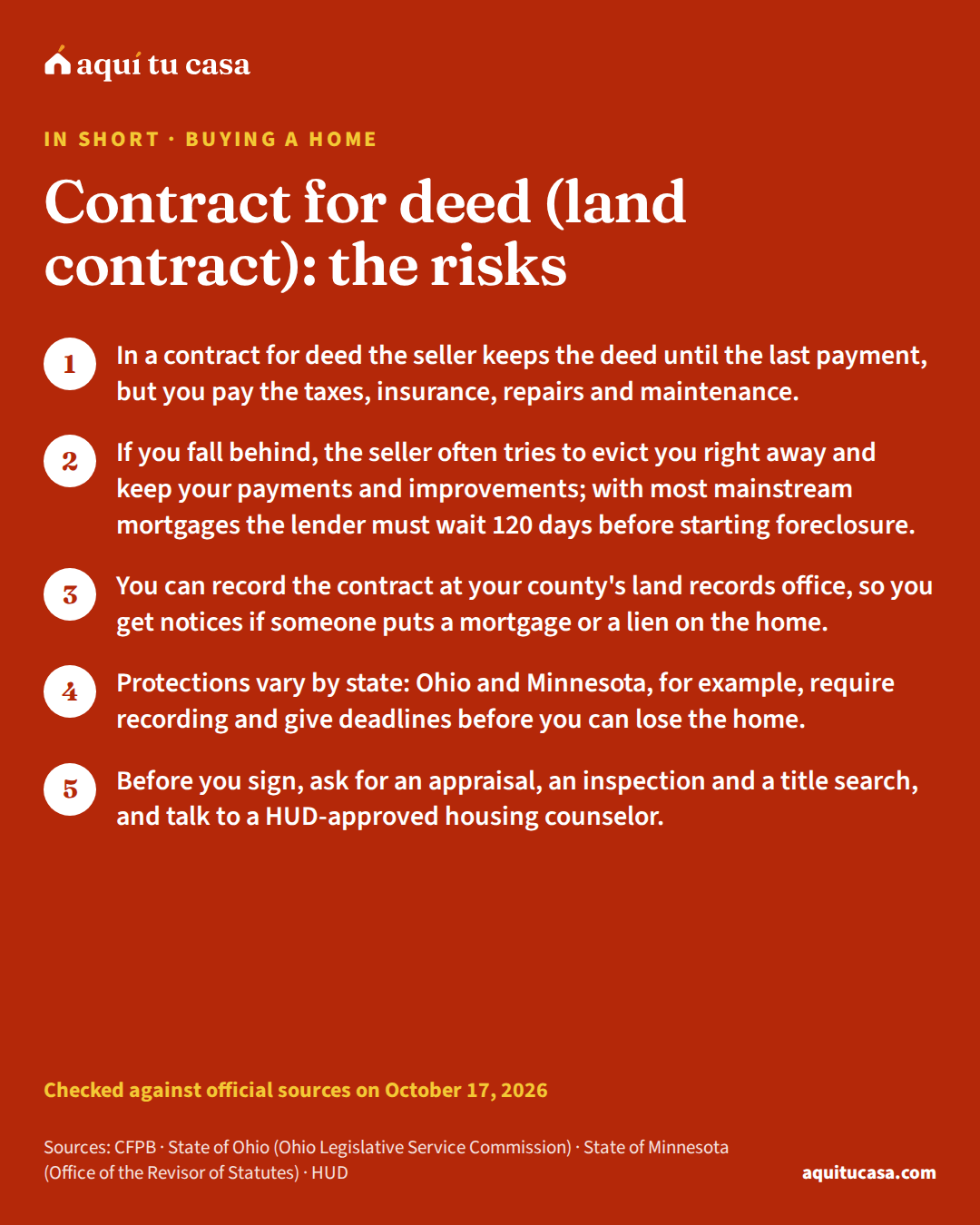
From the guide
What a contract for deed is, why you can lose the home and what you paid, how to record it and what some states require before a seller can take it back.
Verified on October 17, 2026 10 official sources
It is an installment purchase: you pay the seller instead of borrowing from a bank, and the seller keeps the deed until you finish paying. It is also called a land contract, bond for deed or land installment contract. According to the CFPB, in the meantime you act as the owner: you pay the taxes, insurance, repairs and maintenance.
Read the full guideNo. With a contract for deed you are already buying and paying the price in installments. Minnesota law, for example, says a lease with an option to purchase is not a contract for deed. The rent-to-own guide explains that other arrangement.
Read the full guideAccording to the CFPB, the seller often tries to evict you right away and keep what you paid, though protections vary by state. In Ohio, for example, the seller must wait 30 days from the default, and if you have paid for five years or 20% of the price the seller has to go through foreclosure. If this happens to you, look for free legal aid as soon as you can.
Read the full guideIt depends on the state. In Ohio the seller must have it recorded within 20 days of signing, and in Minnesota it must be recorded within four months. Even if your state does not require it, the CFPB says you can file it with the land records office, which gets you notices if someone takes out a mortgage or files a lien on the home.
Read the full guideIn a typical contract, the buyer. The CFPB warns that sometimes the seller collects the tax and insurance money but does not pay it, and the buyer ends up facing large bills and penalties. Ask for proof of every payment.
Read the full guideThe CFPB says sellers sometimes refuse to hand over the deed even after you pay everything. You can file a complaint with the CFPB, contact your state's attorney general and ask for free legal aid. In Ohio, for example, the law lets the buyer enforce their rights in court.
Read the full guideThe CFPB report says seller-financers often do not check whether you can repay and do not do an appraisal, inspection or title search. That can make it feel fast, but many contracts have inflated prices, higher interest rates and large balloon payments at the end.
Read the full guideThe CFPB takes complaints at consumerfinance.gov/complaint or (855) 411-2372: choose 'Mortgage', then 'Other type of mortgage', and type 'contract for deed'. You can also contact your state's attorney general.
Read the full guide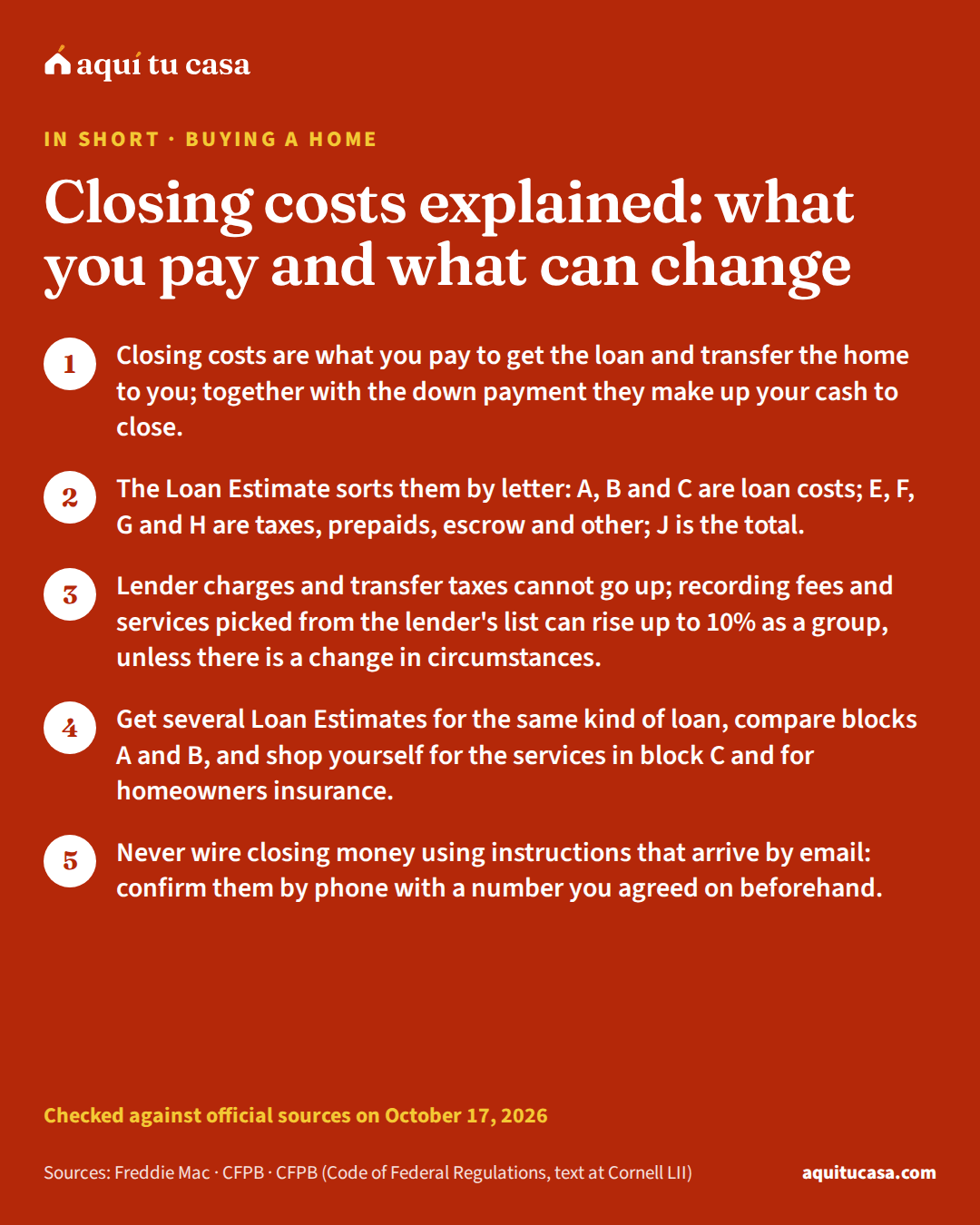
From the guide
What closing costs are, how to read them on your Loan Estimate, which charges cannot go up before closing and how to compare offers to pay less.
Verified on October 17, 2026 17 official sources
It depends on the lender, the loan, the price and your state. The CFPB says they can add up to thousands of dollars and that estimates vary widely among lenders. Your real figure is on page 2 of your Loan Estimate; before you have one, our closing cost calculator gives you a ballpark with your own numbers.
Read the full guideYou can negotiate a seller credit toward your closing costs, and depending on the contract or your state's law the seller may pay some of them. But the CFPB warns that the seller will usually ask for a higher price to cover that credit: you still pay those costs, through your loan.
Read the full guideBefore you receive the Loan Estimate and say you want to proceed, the regulation only allows a bona fide and reasonable fee for your credit report. Some lenders do not charge even that.
Read the full guideCompare it with your latest Loan Estimate and see which group it belongs to. If it is a charge that cannot go up, or the up-to-10% group went over, and there was no change in circumstances, ask in writing for a correction before you sign. If you find out afterwards, you are entitled to a refund of the excess; the regulation gives the lender up to 60 days after closing.
Read the full guideSome loans are advertised that way, but according to the CFPB every mortgage has costs. The lender covers them with a higher interest rate in exchange for a credit, or by adding them to the loan amount: you pay more over time or owe more.
Read the full guideCash to close adds your down payment and closing costs, then subtracts the deposit you already gave, seller credits and other adjustments. Freddie Mac says to be prepared to pay between 2% and 5% of the price in closing costs. On a $332,700 home, the typical US value, with an FHA loan and the minimum down payment, that comes to between $18,299 and $28,280. Your real number is on your Loan Estimate.
Read the full guideAccording to the CFPB, one point equals 1% of the loan amount and lowers your rate in exchange for paying more at closing. On an FHA loan of $321,056, one point would cost $3,211. Ask each lender for the same number of points so you can compare.
Read the full guideThe lender must make sure you receive it no later than three business days before you sign. Use those days to compare it with your last Loan Estimate.
Read the full guide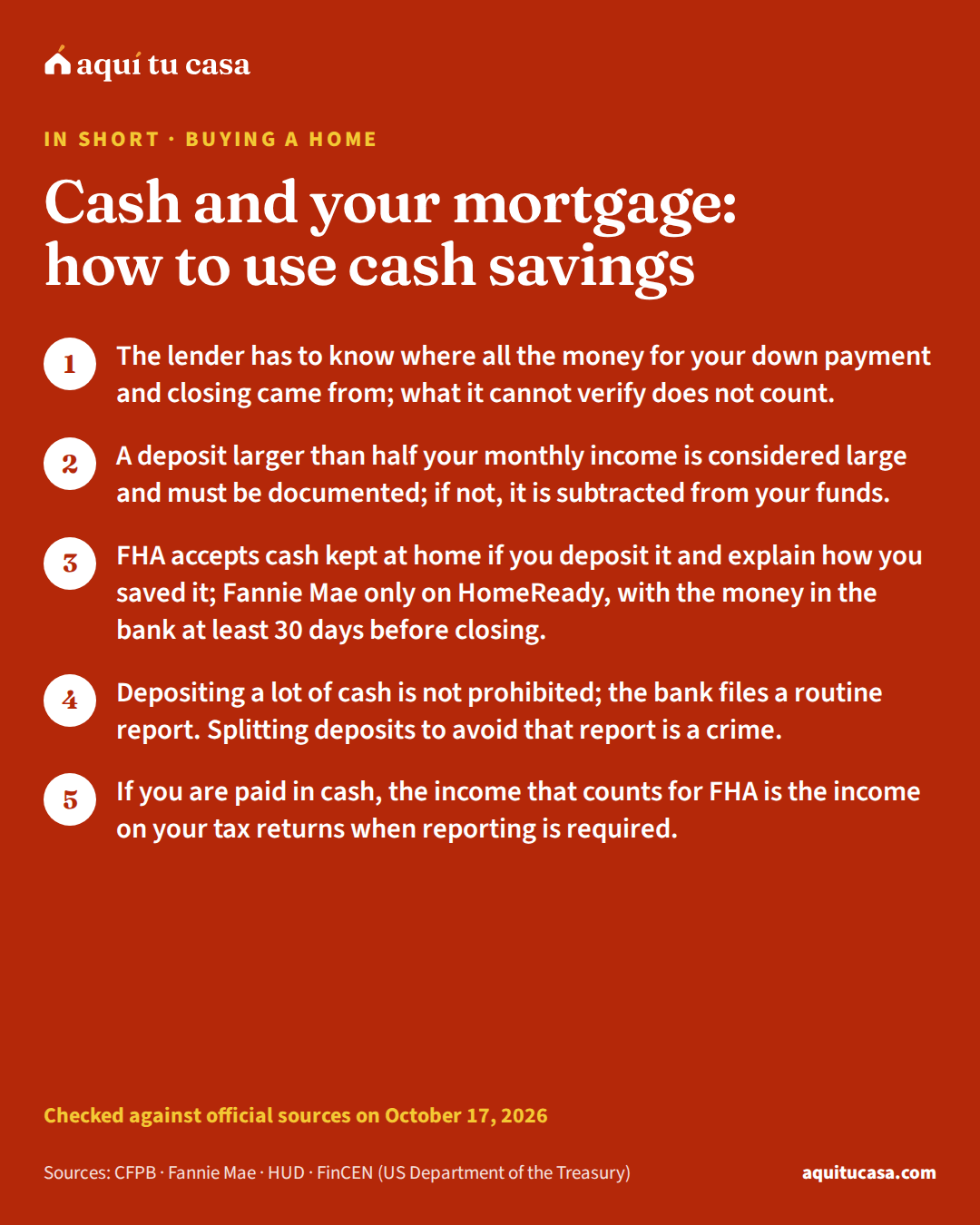
From the guide
If you save or get paid in cash: why the lender asks where your money came from, what a large deposit is and how to move your cash into the bank.
Verified on October 17, 2026 16 official sources
It depends on the loan. On an FHA loan, yes, if you deposit it in a bank or with the title company and explain how and over how long you saved it. Fannie Mae does not accept cash on hand for the down payment except on its HomeReady loan, which has its own rules.
Read the full guideThere is no single deadline for every loan. Lenders usually review your two most recent months of statements, and on Fannie Mae's HomeReady the money must be on deposit at application or at least 30 days before closing. Depositing early leaves a history the lender can see.
Read the full guideFor Fannie Mae, a single deposit of more than 50% of your monthly qualifying income. FHA asks for documentation of each deposit of more than 50 percent of your monthly effective income. If it cannot be documented, Fannie Mae subtracts that money from your available funds.
Read the full guideThe bank has to file a Currency Transaction Report when one person's cash transactions go over $10,000 in a day. According to FinCEN, there is no general prohibition against handling a lot of cash, and the report is filed regardless of the reason.
Read the full guideDo not do it. According to FinCEN, breaking deposits into smaller amounts to avoid the bank's report is a federal crime, even if the money is yours and legal. Several deposits on the same day are also added together for the report.
Read the full guideIt can work. FHA accepts money paid out to you by a private savings club if it is documented with the club's records and a statement from the treasurer. Fannie Mae accepts pooled savings if you document regular contributions, and anything you still have to pay in counts as debt.
Read the full guideThe IRS says income must be reported even when you are paid in cash. On an FHA loan, the lender may only count income that, when required, is on your tax returns. Federal rules accept records such as your tax returns, bank records and even check cashing receipts as proof of income.
Read the full guideFor FHA, the lender asks for an explanation of how you saved the money and how long it took, and compares it with your income, expenses and banking history. Explain in your own words how and over how long you saved it, and keep the receipts for your deposits.
Read the full guide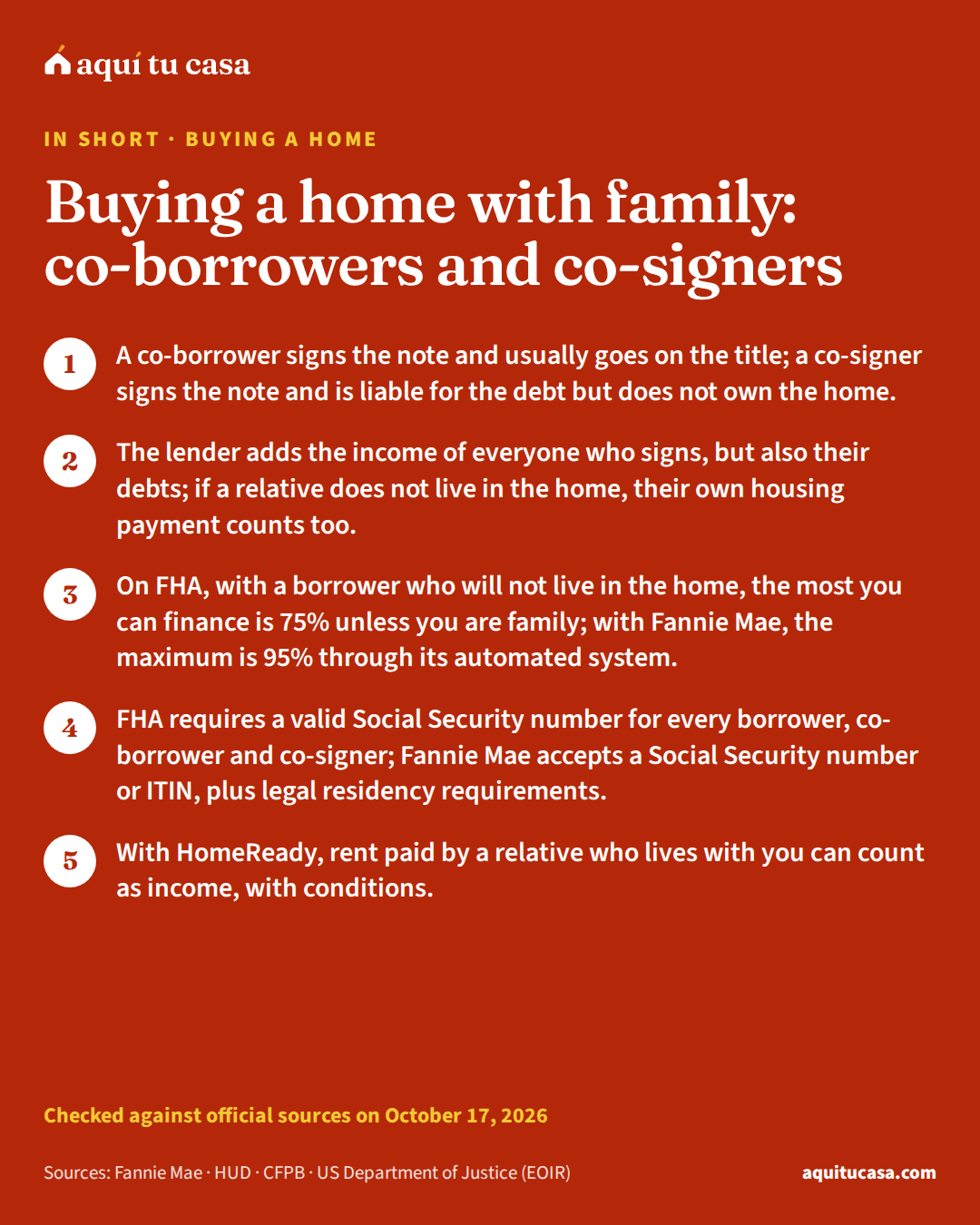
From the guide
Who in your family can sign the loan with you, how incomes and debts add up, and what changes if your relative will not live in the home or has an ITIN.
Verified on October 17, 2026 13 official sources
Read the full guide Do the math: How much house can I afford?
Yes. Your parents can sign the loan with you as co-borrowers, whether or not they live in the home, or as co-signers. The lender will add their income and their debts, and all of you will be responsible for the full loan.
Read the full guideBoth sign the note and are liable for the debt. The difference is the home: on FHA loans the co-borrower takes title and signs the mortgage, while the co-signer does not own the home or sign the mortgage. For Fannie Mae, a co-signer has no ownership interest as shown on the title.
Read the full guideNo, but extra rules apply. On FHA, someone who will not live in the home must be a US citizen or have their principal residence in the US, and the maximum financing drops to 75% unless you are family. With Fannie Mae, the maximum is 95% through its automated system and 90% with manual underwriting.
Read the full guideYes, to the extent they are used to qualify. Fannie Mae figures the debt-to-income ratio with the income of all borrowers and adds their debts, including the housing payment of anyone who will not live in the home. Each person's income must meet the same standards.
Read the full guideNot always. According to the CFPB, if you qualify on your own, a lender generally cannot require your spouse's signature, but it can if your state's law requires it for the lien on the home to be valid. In community property states, FHA does not require your spouse to be a borrower.
Read the full guideIt depends on the loan. FHA requires the lender to validate a Social Security number for every borrower, co-borrower and co-signer. Fannie Mae requires a Social Security number or an ITIN, plus legal residency requirements. The ITIN mortgage guide explains what other options exist.
Read the full guideTheir debts go into the calculation too, and can raise everyone's debt-to-income ratio. If your relative signed a debt that someone else actually pays, Fannie Mae allows leaving it out with 12 months of documented on-time payments.
Read the full guideOn a Fannie Mae HomeReady loan, yes, up to 30% of your qualifying income, if that person is not on the loan, has lived with you for the last 12 months and can show they paid you rent. Your total income has to fit HomeReady's limits.
Read the full guideTools
The calculators these guides use. Each one leaves you with a result you can use today.
The price your income can carry.
What you get → maximum price
Your monthly payment with taxes and insurance.
What you get → monthly payment
The cash you need on closing day.
What you get → cash to close
The documents you'll be asked for.
What you get → your document list
From the guide
How to buy land or a manufactured (mobile) home: real or personal property, how it is titled, FHA and chattel loans, leased lots and colonias.
Verified on October 17, 2026 15 official sources
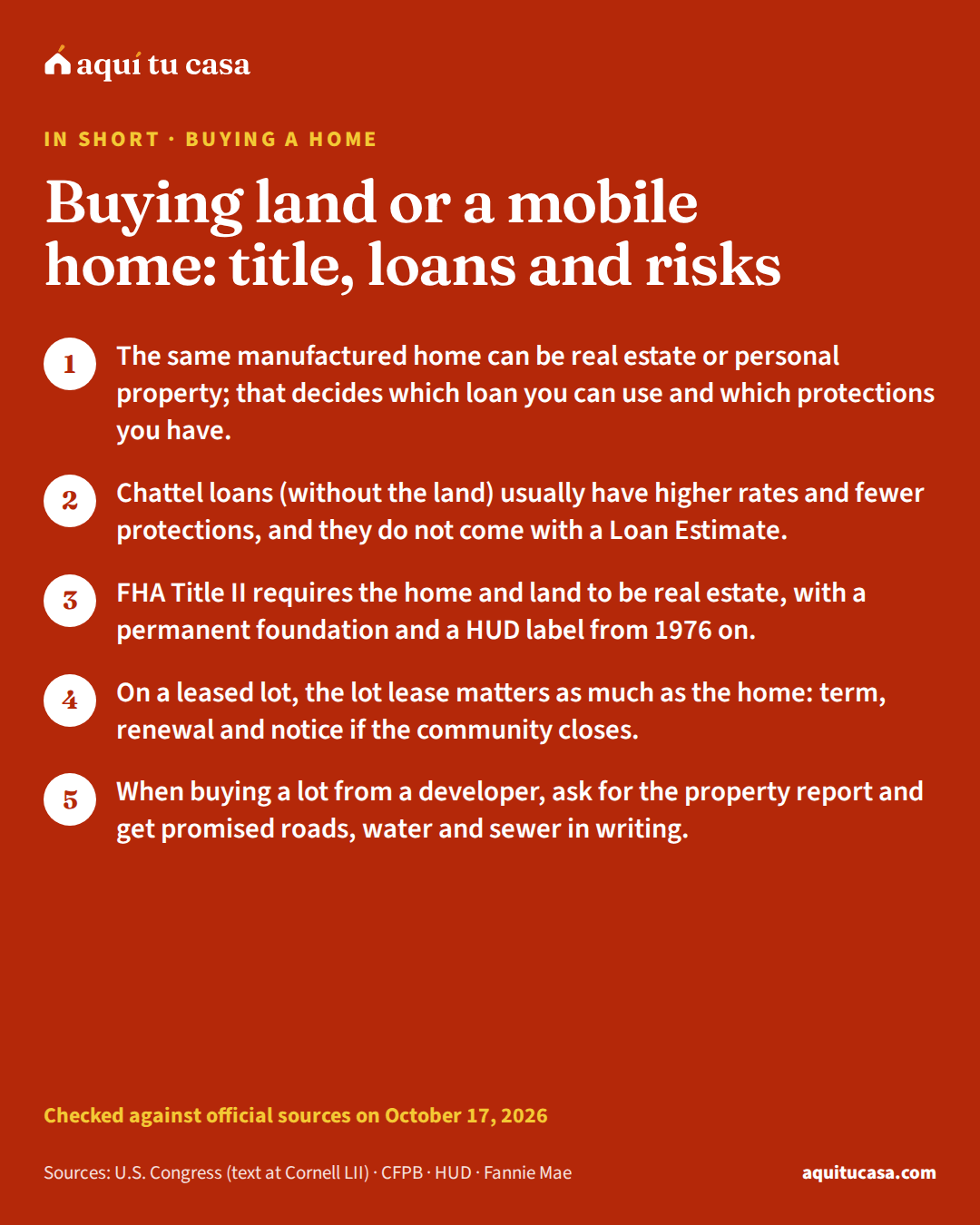
People say mobile home or trailer, but federal law uses manufactured home: a transportable structure designed as a dwelling with or without a permanent foundation. For FHA Title II, the home must carry the HUD label showing it was built on or after June 15, 1976, under federal standards.
Read the full guideIt is a personal property loan: it is secured by the home but not the land. According to the CFPB, it generally has higher rates and fewer protections than a mortgage, although origination costs are lower and it closes quickly.
Read the full guideYes, in two ways. With Title II, the home and land must be real estate, with a permanent foundation, at least 400 square feet and the HUD label. With Title I, FHA insures loans for the home alone, the lot alone or both, and the home can be personal property; you must live in it.
Read the full guideOnly if the loan is secured by real estate. According to the CFPB, for a manufactured or mobile home loan not secured by real estate you do not get a Loan Estimate or Closing Disclosure, but Truth-in-Lending disclosures instead.
Read the full guideIt depends on your state. In Florida, for example, if the home is permanently affixed to land you own, you record certain documents with the county and ask the state to retire the mobile home title; afterwards it is conveyed by deed together with the land. Ask your state's title office and your county recorder.
Read the full guideIf the sale is not exempt from the Interstate Land Sales Full Disclosure Act, you can cancel until midnight of the seventh day after signing, or longer if your state allows. If you did not get the property report before signing, you have up to two years.
Read the full guideFederal law defines a colonia as a community in Arizona, California, New Mexico or Texas, within 150 miles of the Mexican border, that existed before November 28, 1990 and is identified by lack of potable water, adequate sewage or decent housing. Those states set aside part of their federal community development funds for water, sewage and housing in colonias.
Read the full guideThere are several ways. FHA Title I has loans to buy a lot for placing a manufactured home. For building, a construction loan is usually short-term, with higher rates than a mortgage, and you may need to apply for a new loan afterwards if it does not convert on its own.
Read the full guide
From the guide
How to buy a new home from a builder: incentives and rate buydowns, its affiliated lender, inspections, the warranty and the tax once it is built.
Verified on October 17, 2026 21 official sources
No. The CFPB says builders often work with an associated lender, but you do not have to use it and you have the right to shop for a better deal. Get a Loan Estimate from the builder's lender and from others, for the same kind of loan, and compare.
Read the full guideRegulation X says offering a package or discount for using several services does not count as requiring you to use them, as long as it is optional, a true discount below generally available prices and not made up by higher costs elsewhere in the closing. That is why it pays to compare the whole offer: rate, fees and price.
Read the full guideRESPA says a seller cannot require, as a condition of selling, that you buy title insurance from a particular company when you buy with a federally related mortgage loan. A seller who does is liable for three times the charges for that insurance.
Read the full guideThe CFPB recommends an independent inspection by an inspector accountable to you, and warns that an inspector paid by someone else might underemphasize problems. The papers and inspections an FHA loan requires are gathered by the lender for the loan; the independent inspection is for you.
Read the full guideIt depends on your contract and your state. If you buy with FHA or VA, the builder signs form HUD-92544: it warrants the home against defects in equipment, material or workmanship for one year from conveyance of title, and you must notify the builder in writing. You must get a copy at closing.
Read the full guideBecause the finished home is reassessed. In Florida, a home not substantially completed on January 1 receives no value that year. In California, completed new construction is assessed at market value and you may get a supplemental bill. If your escrow comes up short, a shortage of one month or more is spread over at least 12 months.
Read the full guideYes, in one case. If the lender expects to close more than 60 days after giving you the Loan Estimate, it can revise it at any time up to 60 days before closing, but only if the original Loan Estimate clearly says so.
Read the full guideIt depends on your contract. The CFPB recommends asking the builder, before you commit, under what conditions the deposit is returned, and making your contract contingent on getting the loan and on a satisfactory inspection.
Read the full guide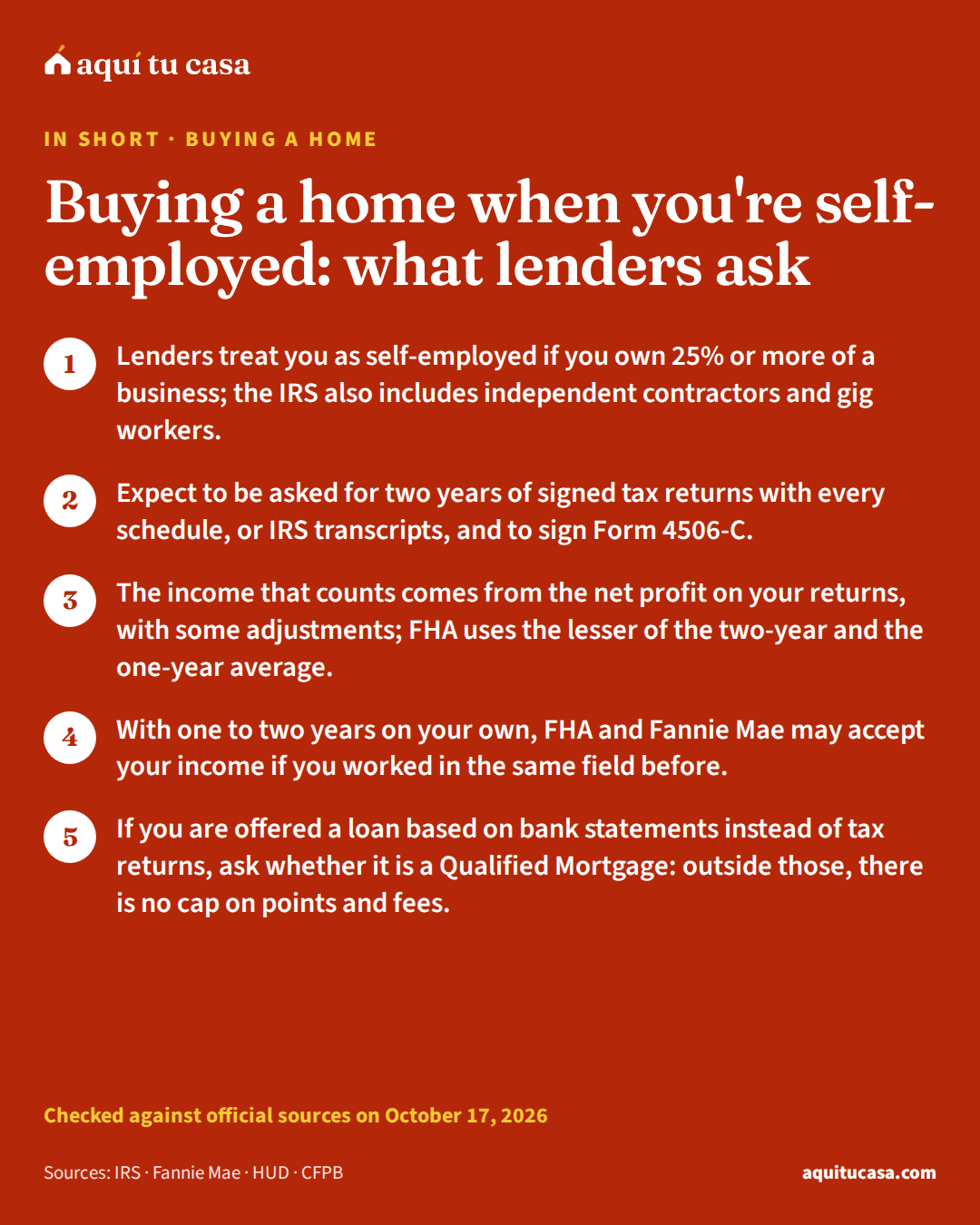
From the guide
How lenders check your income if you are self-employed or paid on a 1099: tax returns, Schedule C, IRS transcripts, profit and loss and bank statements.
Verified on October 17, 2026 18 official sources
Yes. The rules do not stop you, but the lender must document your income with third-party records, such as your tax returns or IRS transcripts. That is why it helps to have your returns filed and complete before you apply.
Read the full guideUsually two. FHA asks for your complete individual returns for the two most recent years, with all schedules, and Fannie Mae generally requires a two-year history. Fannie Mae may accept a single year if the business has existed for five years and you have owned 25% or more of it that whole time.
Read the full guideSometimes. FHA may count your income with one to two years on your own if you worked at least two years before in the same line of work or a related one. Fannie Mae wants your latest returns to show a full year from the current business and proof that you earned the same or more doing similar work before.
Read the full guideAccording to the IRS, if you work as an independent contractor or run your own business you are generally self-employed, and that income goes on Schedule C. For a lender, that means your income is documented with your tax returns, not just the 1099 forms.
Read the full guideRegulation Z allows income to be verified with financial institution records, not only tax returns. The FHA and Fannie Mae rules for self-employment income are built on your tax returns or IRS transcripts. If a lender offers to qualify you with bank statements, ask whether it is a Qualified Mortgage: outside those there is no limit on points and fees.
Read the full guideThe IRS says income must be reported even if you are paid in cash and even if you get no 1099. On an FHA loan, the lender may only count income that, when required, is reported on your tax returns. The guide on cash and your mortgage explains how cash savings are documented.
Read the full guideIt lets the lender request your transcripts directly from the IRS and compare them with the copies you provided. Fannie Mae requires every borrower whose income is used to qualify to sign one at or before closing.
Read the full guideIt can be an acceptable source if you are listed as an owner of the account. If you also qualify with that business's income, Fannie Mae requires the lender to check that taking the money out will not hurt the business, and it may ask for several months of business statements.
Read the full guide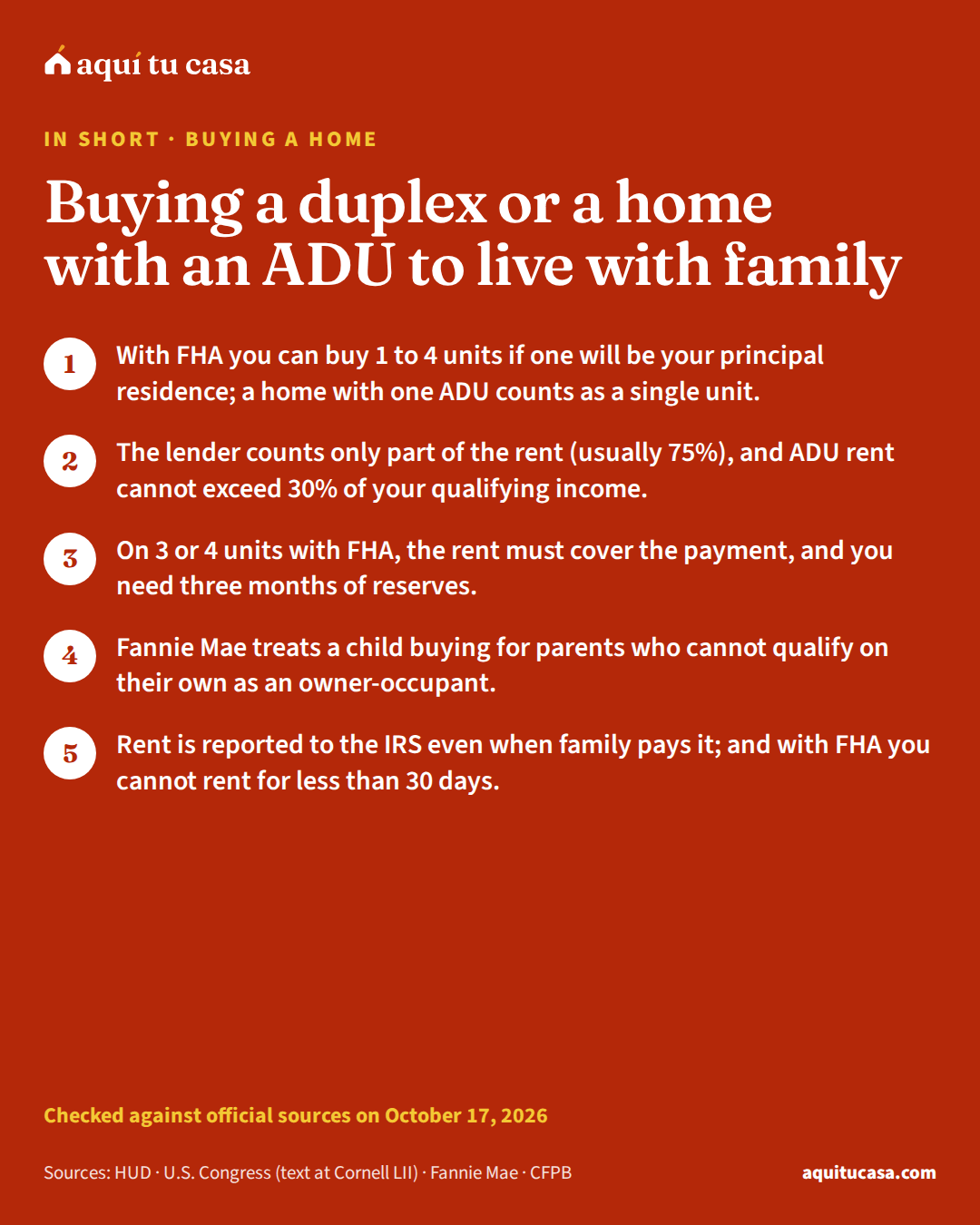
From the guide
How to buy a 2- to 4-unit home or a home with an accessory dwelling unit (ADU) for family or to rent out part: who lives there, rent, limits and reserves.
Verified on October 17, 2026 15 official sources
Read the full guide Do the math: How much house can I afford?
Yes. FHA's single family programs cover one- to four-unit properties that are the owner's principal residence. At least one borrower must move in within 60 days of signing and plan to live there for at least one year.
Read the full guideIt can help, but not in full. On FHA, if you have no rental history, the lender uses 75% of the lesser of market rent or lease rent. Fannie Mae multiplies gross rent by 75% and subtracts the property payment; if you have less than 12 months of landlord experience, it can only offset that payment.
Read the full guideFor FHA, a one-unit home with a single ADU remains one unit. For Fannie Mae, it depends on the property's features, such as separate meters, its own address and whether the unit can be legally rented; the appraiser decides.
Read the full guideFHA limits for multiple units are fixed multiples of the one-unit limit, which ranges from $541,287 to $1,299,500 depending on the county. You can look up your county's 2-, 3- or 4-unit limit on HUD's FHA mortgage limits page.
Read the full guideFannie Mae treats a child buying to house their parents as an owner-occupant if the parents cannot work or lack sufficient income to qualify on their own. Ask several lenders which programs they offer for your situation.
Read the full guideAccording to the IRS, in most cases you must include all rent you receive in your income. If a family member lives there without paying a fair rent as their main home, those days count as personal use, which changes how you split expenses. A VITA site can help for free if you qualify.
Read the full guideNot while the loan is FHA-insured. On form HUD-92561 you agree not to rent any part for transient or hotel use, which HUD defines as rentals of less than 30 days or with hotel services.
Read the full guideWith FHA, the lender must verify three months of payments in reserves on 3 or 4 units, and two months on a home with an ADU if rental income is used to qualify you. Fannie Mae loans evaluated with Desktop Underwriter require six months for a 2- to 4-unit principal residence.
Read the full guide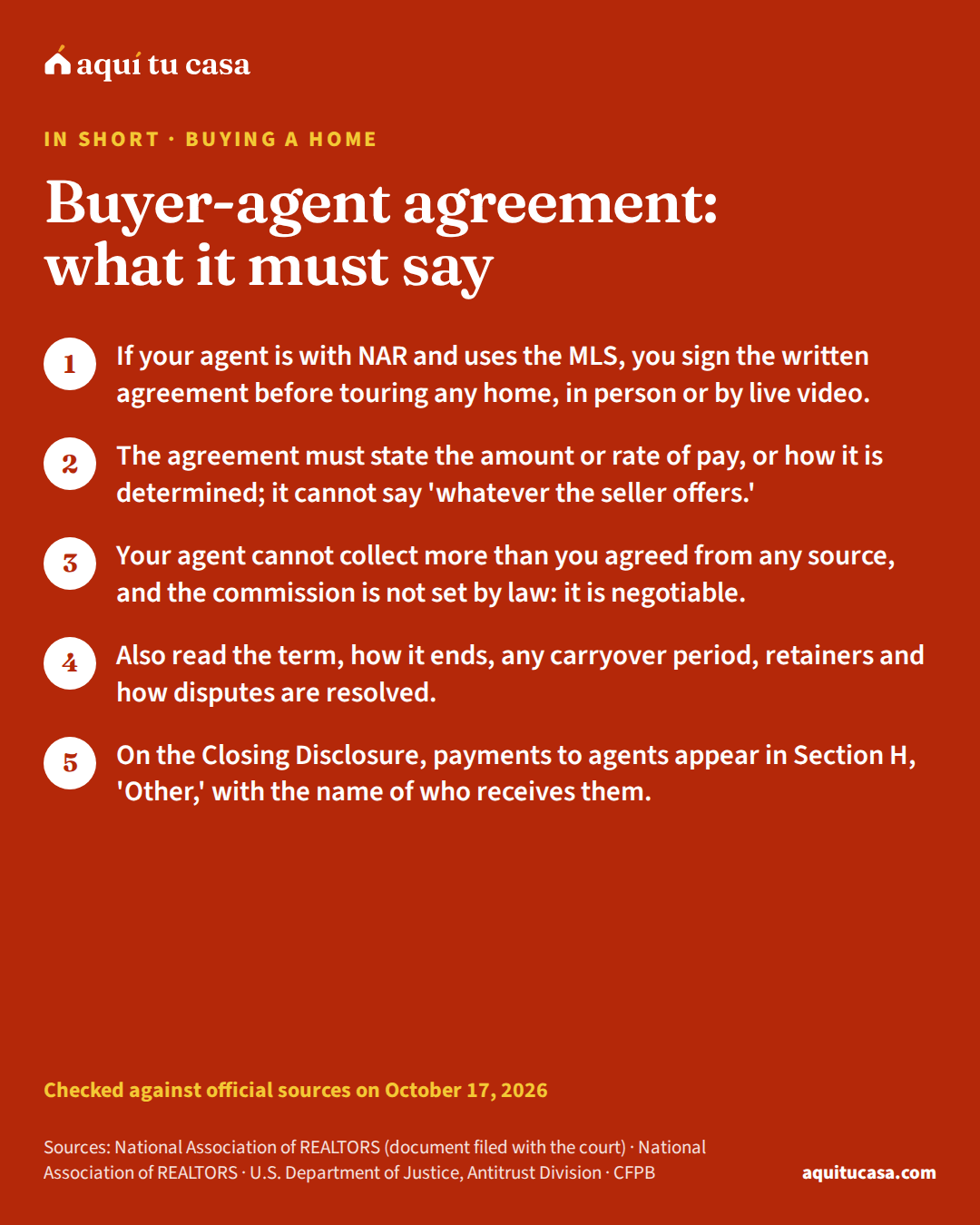
From the guide
What the written agreement with your agent is, what it must say about pay, who pays your agent, what to read before signing and what you can negotiate.
Verified on October 17, 2026 8 official sources
If the agent is an NAR member who participates in an MLS, yes: the NAR settlement requires a written agreement before you tour any home, and according to NAR it applies to in-person and live virtual tours. Your state's laws may also have their own rules.
Read the full guideAccording to NAR, you do not need a written agreement just to talk to an agent at an open house or ask about their services.
Read the full guideThere is no set figure. The NAR settlement requires its agents to say that commissions are not set by law and are fully negotiable. Your agreement must state the amount or rate, or how it is determined: according to NAR, it can be $0, a flat fee, a percent or an hourly rate.
Read the full guideIt depends on what is negotiated. According to NAR, the seller can offer to pay your agent, although that offer is not posted on the MLS. Either way, your agent cannot receive more from any source than your agreement says. Ask what happens if the seller offers nothing or pays less.
Read the full guideYes. According to NAR, your agent's pay remains fully negotiable, and the settlement requires the written agreement to say so in conspicuous language. Before signing, NAR recommends making sure the agreement reflects what you negotiated.
Read the full guideIt depends on what your agreement says. According to NAR, it may cover how to end it, with or without cause, and a carryover period in which you could owe the agent if you buy a home shortly after ending it. Read it before signing and ask about anything you do not understand.
Read the full guideThe NAR settlement prohibits its agents from saying their services are free unless they will receive no compensation from any source for them.
Read the full guideOn the Closing Disclosure. Section H, 'Other,' itemizes each charge with the name of who receives it, in the column of who pays it; on the CFPB's sample, broker commissions appear there.
Read the full guideChange topic without leaving the questions.

These answers explain the rules but do not know your situation. These organizations go over it with you, free.