
How much house can I afford?
The price your income can carry.
What you get → maximum price
Someone shared this page with you.
Questions and answers
Every question our 36 guides about buying a home in the United States answer, grouped by guide. Each answer is the guide's own and leads to it, with its sources.
Open a question to read its answer. Each group ends with the full guide, its sources and, when it has one, its calculator.
We found no questions with those words. Try another word or open a topic.
From the guide
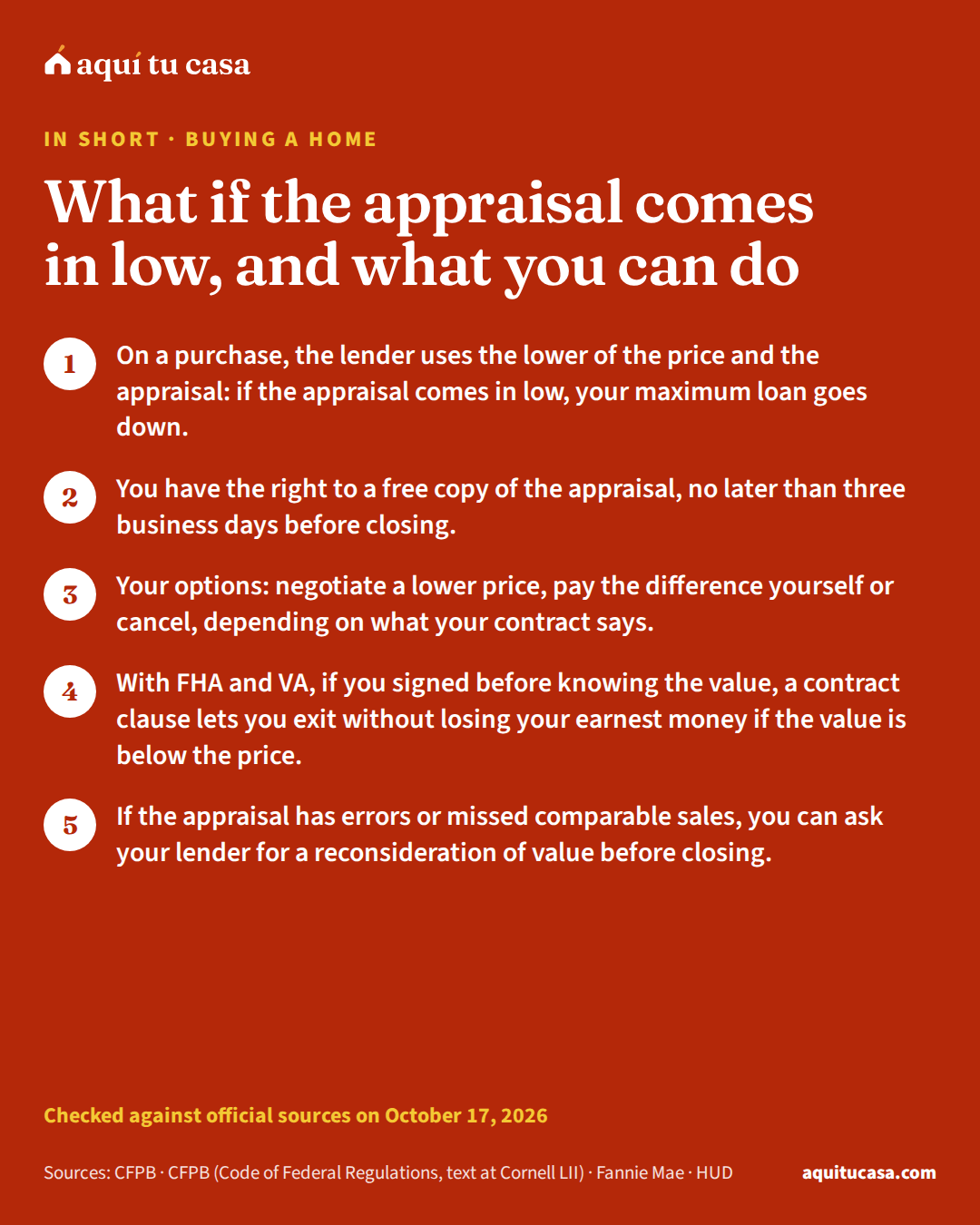
Why a low appraisal matters, your right to a copy, how to negotiate, pay the difference or cancel, and how to ask for a reconsideration of value.
Verified on October 17, 2026 16 official sources
Read the full guide Do the math: How much house can I afford?
The lender bases your loan on the lower of the price and the appraisal, so you would need more money to close. The CFPB suggests getting your copy of the appraisal and using it to negotiate a lower price with the seller. If the seller will not lower it, you can pay the difference or consider cancelling.
Read the full guideIt depends on your contract. The CFPB says that, depending on its terms, cancelling may have costs. If your contract has an appraisal contingency, check what it says about the deposit. With FHA and VA, if you signed before knowing the value, the contract clause lets you exit without losing your earnest money when the value is below the price.
Read the full guideYou can ask your lender for a reconsideration of value (ROV). For loans Fannie Mae buys, the lender must have a process for it: one request per appraisal, with up to five comparable sales, before closing. With FHA, the lender's underwriter can request one if the appraiser did not consider relevant information, and with VA you can request one too.
Read the full guideYes. Under Regulation B, the lender must give you a free copy of each appraisal as soon as it is done, or no later than three business days before closing, whichever comes first. You can be charged for the cost of the appraisal itself.
Read the full guideYes, if you want to go ahead. The loan is based on the lower value, so the difference comes out of your pocket, on top of the down payment. With FHA and VA, the contract clauses give you the option to proceed regardless of the appraisal.
Read the full guideThey cannot pressure the appraiser to report a minimum value. Regulation Z does allow asking the appraiser to consider additional information, such as comparable sales, to explain the conclusion or to correct errors.
Read the full guideIt can. The CFPB says that if the appraisal comes in higher or lower than expected, that is a change in circumstances and the lender can change your costs. Review the revised Loan Estimate it sends you.
Read the full guideThe Fair Housing Act prohibits discrimination in the appraisal of a home because of race, national origin and other characteristics. You can ask your lender for a reconsideration of value and complain to HUD at (800) 669-9777, no later than one year afterward.
Read the full guideThe data behind these guides
The guides on Buying a home cite these figures. They update when their sources publish new ones; what you see here is current.
See all the dataSources: U.S. Census Bureau (Average 2020–2024) · HUD (2026 data) · Freddie Mac (As of November 5, 2026)

From the guide
What your home's title is, the difference between the lender's and the owner's title insurance, where they appear on the Loan Estimate and how to compare.
Verified on October 17, 2026 14 official sources
The lender's policy usually is: the CFPB says it is usually required to get a mortgage. The owner's policy, in most cases, is not required by the lender and is optional; your Loan Estimate marks it '(optional).'
Read the full guideIt protects you if someone sues claiming something against the home from before you bought it. The CFPB gives as examples a previous owner's unpaid taxes and contractors who say they were not paid for work done before your purchase.
Read the full guideBecause the lender's policy protects only the lender, not your equity. According to the CFPB, if someone sues with a claim against your home, you are the first person responsible; the owner's policy is the one that protects your investment.
Read the full guideIf the title services are in section C of your Loan Estimate, yes: the lender must give you a list of providers and you can use another one if the lender agrees to work with them. And under RESPA, the seller cannot make you use a particular title company.
Read the full guideBecause of the formula the Loan Estimate uses when you buy both policies from the same company: the lender's policy shows its full premium and the owner's policy is calculated by subtraction. The lines may not match the quote, but the total of both policies is the same as what you pay.
Read the full guideAccording to the CFPB, the buyer generally pays the costs of the purchase, although depending on the contract or state law the seller may pay some. If the seller pays for the owner's policy, your Closing Disclosure does not have to say '(optional).'
Read the full guideIt depends on the company and the state. The CFPB says title services are the largest cost among the services you can shop for, and recommends getting quotes and comparing the total. Your figure appears in sections B, C and H of your Loan Estimate.
Read the full guideDo not follow them without confirming. The CFPB warns that scammers send fake emails posing as the settlement agent, and recommends never following instructions in an email and confirming with two trusted people.
Read the full guide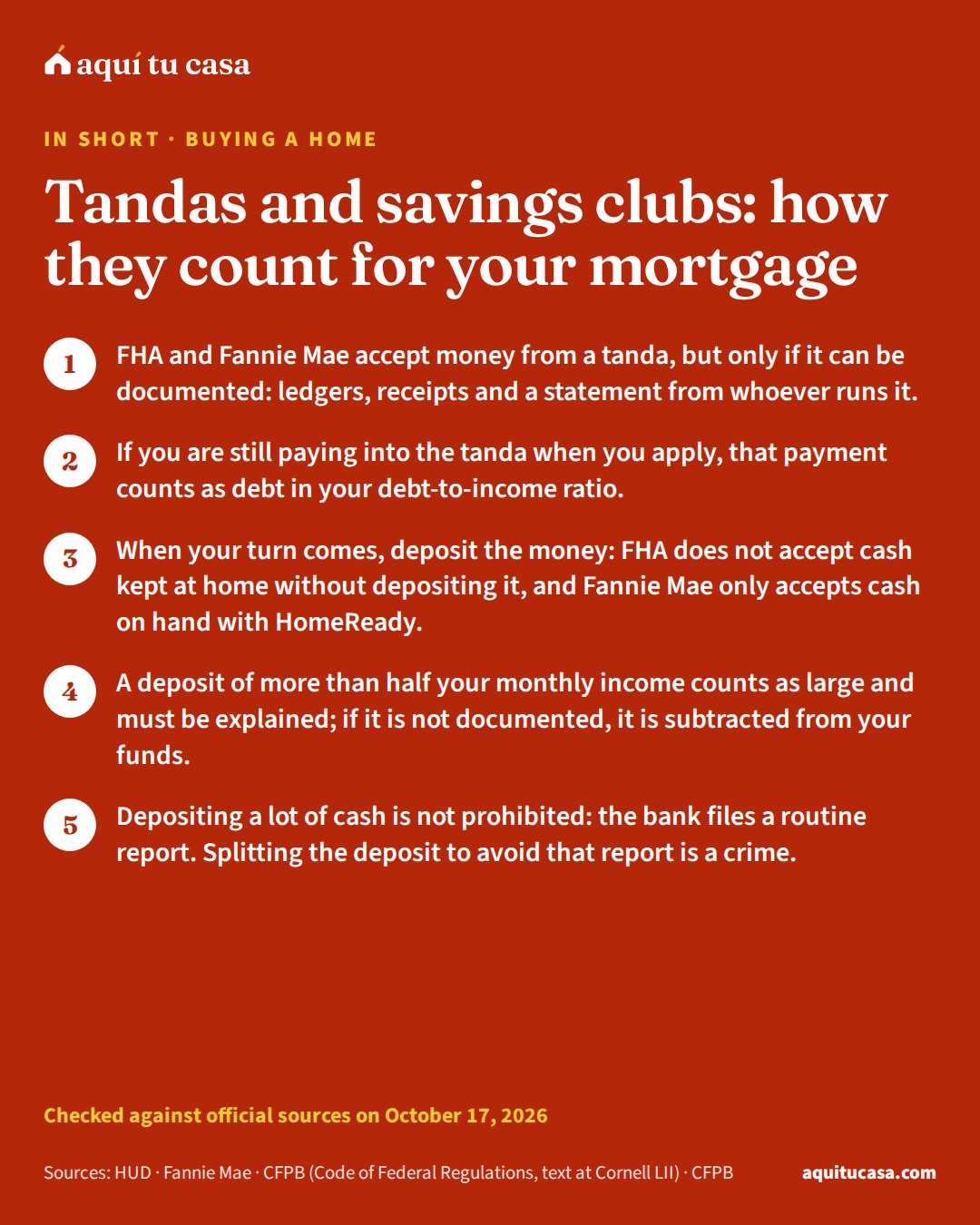
From the guide
What FHA and Fannie Mae say about money from a tanda or cundina, which papers the lender asks for and why your payments into it can count as debt.
Verified on October 17, 2026 12 official sources
Yes, if you can document it. FHA accepts money paid out to you by a private savings club, and Fannie Mae accepts pooled savings for the down payment if you document your regular contributions. Either way, the lender has to be able to verify it.
Read the full guideOn an FHA loan, the club's account ledgers and receipts, and a statement from the treasurer that the club is still active. For Fannie Mae, written confirmation from whoever manages the fund and proof of your regular contributions. Your bank statements also show when you deposited the money.
Read the full guideIf you still have to keep paying into it when you apply, yes. FHA says that obligation counts in your total debt, and Fannie Mae says it counts when calculating your debt-to-income ratio. If you are done with the tanda, you have no payment left to count.
Read the full guideOn an FHA loan, the cash must be deposited in a financial institution or held by the escrow or title company. Fannie Mae does not accept cash on hand for the down payment or closing costs except with HomeReady, where it must also be in an account when you apply or at least 30 days before closing.
Read the full guideIf you deposit more than $10,000 in cash, or several amounts that add up to more than that in one day, the bank files a Currency Transaction Report (CTR). According to FinCEN, there is no general prohibition against handling large amounts of cash, and the report is filed regardless of the reason. What is a crime is splitting the deposit to avoid the report.
Read the full guideFor Fannie Mae, money that cannot be verified does not count toward the down payment, closing costs or reserves. If you are missing papers for a large deposit, the lender must use reasonable judgment with what you have, such as your written explanation; any part that is not documented is subtracted from your funds.
Read the full guideThe bank statements the lender reviews usually cover the most recent two months, and the CFPB suggests having at least two months of history for your down payment money. If the deposit is large, you will still need to document it. With HomeReady, cash must be on deposit when you apply or at least 30 days before closing.
Read the full guideThis guide explains the FHA and Fannie Mae rules. The CFPB says requirements vary from lender to lender and depending on your situation, so ask your lender which documents it accepts for a tanda. Keep the same papers either way: ledgers, receipts, the statement from whoever runs it and your bank statements.
Read the full guide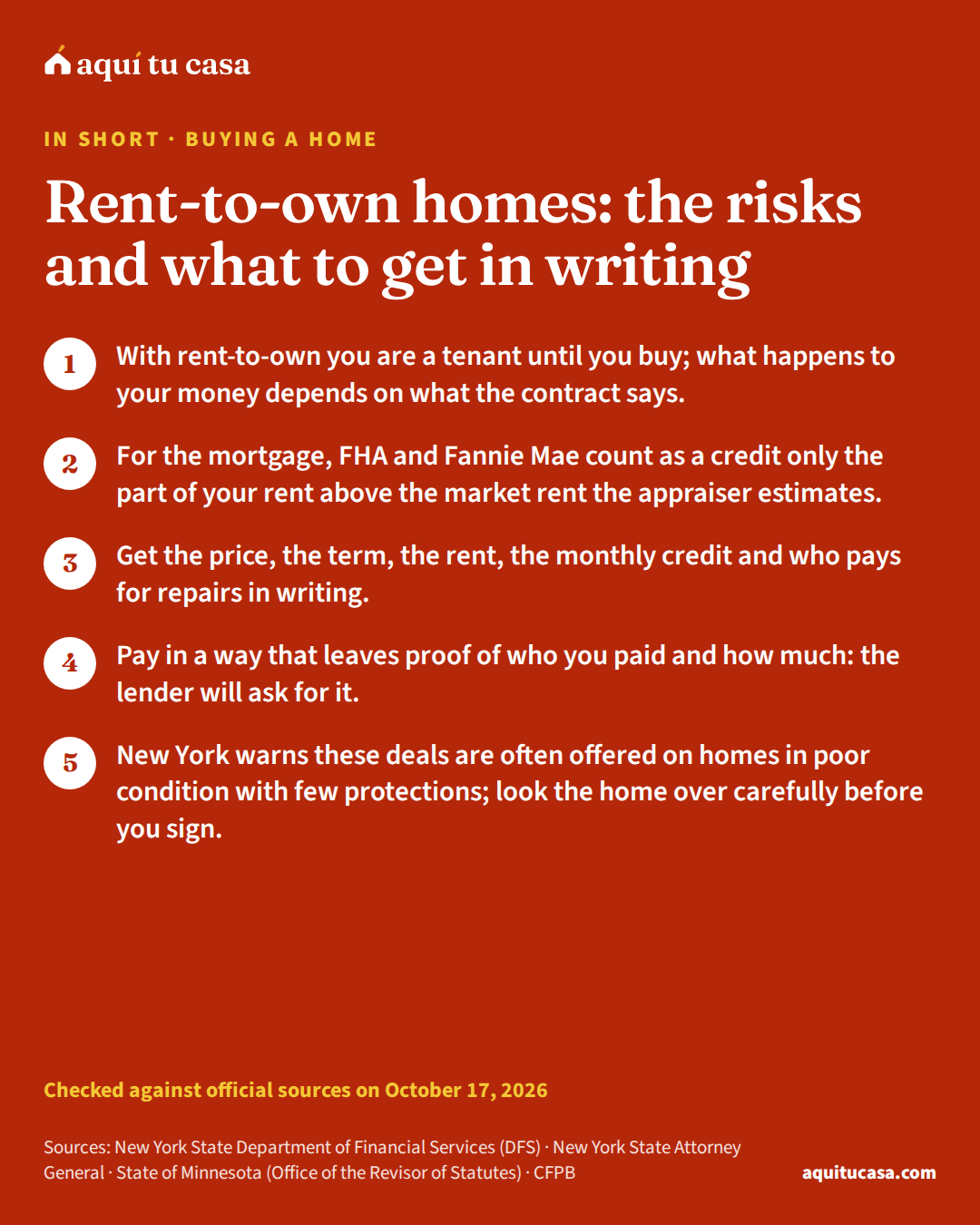
From the guide
How rent-to-own (a lease with an option to buy) works, the risks regulators warn about, what to get in writing and how your rent counts toward a mortgage.
Verified on October 17, 2026 9 official sources
It means renting a home with the right to buy it later, on the terms the contract sets. Until title is transferred, you are a tenant. It is also called lease-to-own or a lease with an option to purchase.
Read the full guideOnly what the contract says, and lenders set limits. FHA can count toward your minimum contribution the part of the rent above the fair market rent the appraiser estimates. Fannie Mae calculates the credit as the difference between market rent and what you paid, with an agreement of at least 12 months.
Read the full guideNo. With a contract for deed you are already buying in installments and you act as the owner, even though the seller keeps the deed. Minnesota law, for example, says a lease with an option to purchase is not a contract for deed.
Read the full guideIt depends on the contract and your state. New York DFS warns that these agreements often put all repairs on the consumer, even though that state's law would put them on the landlord. Ask for the contract to say clearly who pays for what.
Read the full guideIt depends on what the contract says, so get it in writing before you sign. New York DFS warns that these deals often do not lead to homeownership. In New York, for manufactured homes in a park, if the park owner ends the lease, the owner must pay back the payments made under the rent-to-own contract.
Read the full guideTo count your rent credit: the lease with option to purchase, proof of every payment (canceled checks, bank statements or receipts showing who you paid and how much) and the appraisal showing market rent. Plus the papers for any application, such as your most recent bank statements.
Read the full guideIt depends on your state and your contract. In New York, DFS says that under the equitable mortgage doctrine, someone who pays rent and improves a single-family home can build equity and be entitled to the protections of a foreclosure proceeding. If you get a notice, look for free legal aid as soon as you can.
Read the full guideA HUD-approved housing counselor can go over the contract and your numbers with you, often for free or at low cost. For a legal problem, LSC has a legal aid search by address or city. In New York, the HOPP program connects people with counselors and legal services at no cost.
Read the full guide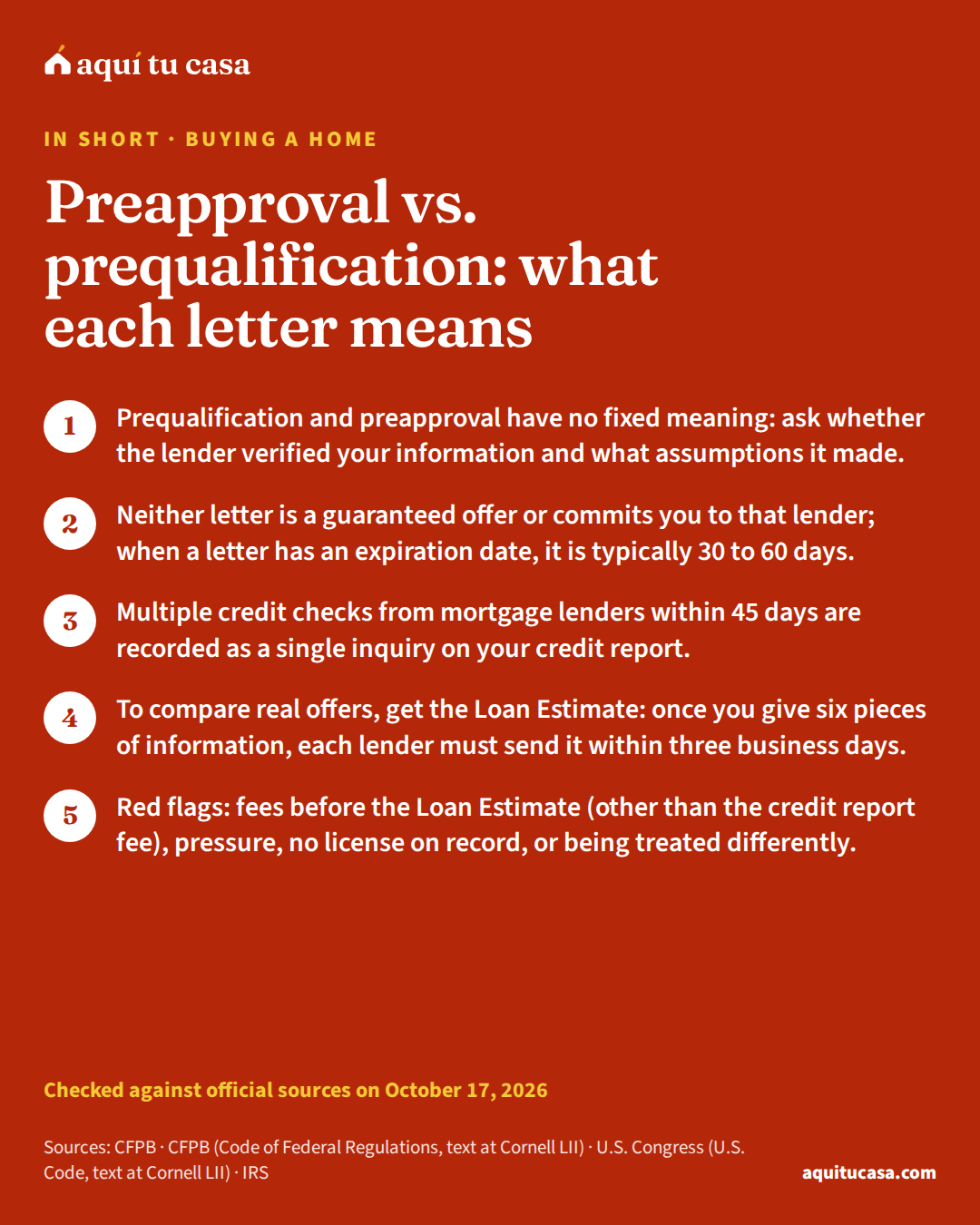
From the guide
What prequalification and preapproval letters are, what lenders check, why neither one is a loan, and how to compare lenders without hurting your credit.
Verified on October 17, 2026 14 official sources
Read the full guide Do the math: How much house can I afford?
It depends on what the lender did, not on the name. According to the CFPB, some lenders call a letter based on what you report a prequalification and one based on verified information a preapproval, but other lenders use a different word for the same letter. Ask whether it checked your credit, verified your income and what assumptions it made.
Read the full guideEach credit check by a lender typically lowers your score a little. But according to the CFPB, multiple checks from mortgage lenders within 45 days are recorded as a single inquiry, so you can shop around. Checking your own credit does not affect your score.
Read the full guideYes. According to the CFPB, a preapproval letter does not commit you to that lender. The CFPB suggests choosing after you have an offer on a home and official Loan Estimates from each lender.
Read the full guideUnder Regulation Z, no one may charge you a fee in connection with your mortgage application before you receive the Loan Estimate and say you want to proceed. The only exception is a bona fide and reasonable fee for pulling your credit report.
Read the full guideYou can ask; every lender has its own process and asks for its own documents. Ask on the first call whether the lender works with ITIN borrowers and which papers it needs, and read the ITIN mortgages guide to see which options exist.
Read the full guideAccording to the CFPB, the letter can have an expiration date, typically 30 to 60 days. If it expires before you find a home, ask the lender what it needs to renew it. If you get letters from several lenders, do it within the same 45-day window so the checks count as a single inquiry on your credit.
Read the full guideSix pieces: your name, your income, your Social Security number (so the lender can pull your credit report), the property address, an estimate of its value and the loan amount you want. According to the CFPB, the lender cannot require more to give you one, such as a purchase contract or proof of income, and it must send it within three business days.
Read the full guideIt can happen: the letter is based on assumptions and is not a guaranteed offer. The CFPB suggests asking the lender what assumptions it made and whether anything in your situation could lead to a denial later or raise your rate or costs. Meanwhile, avoid applying for other credit.
Read the full guide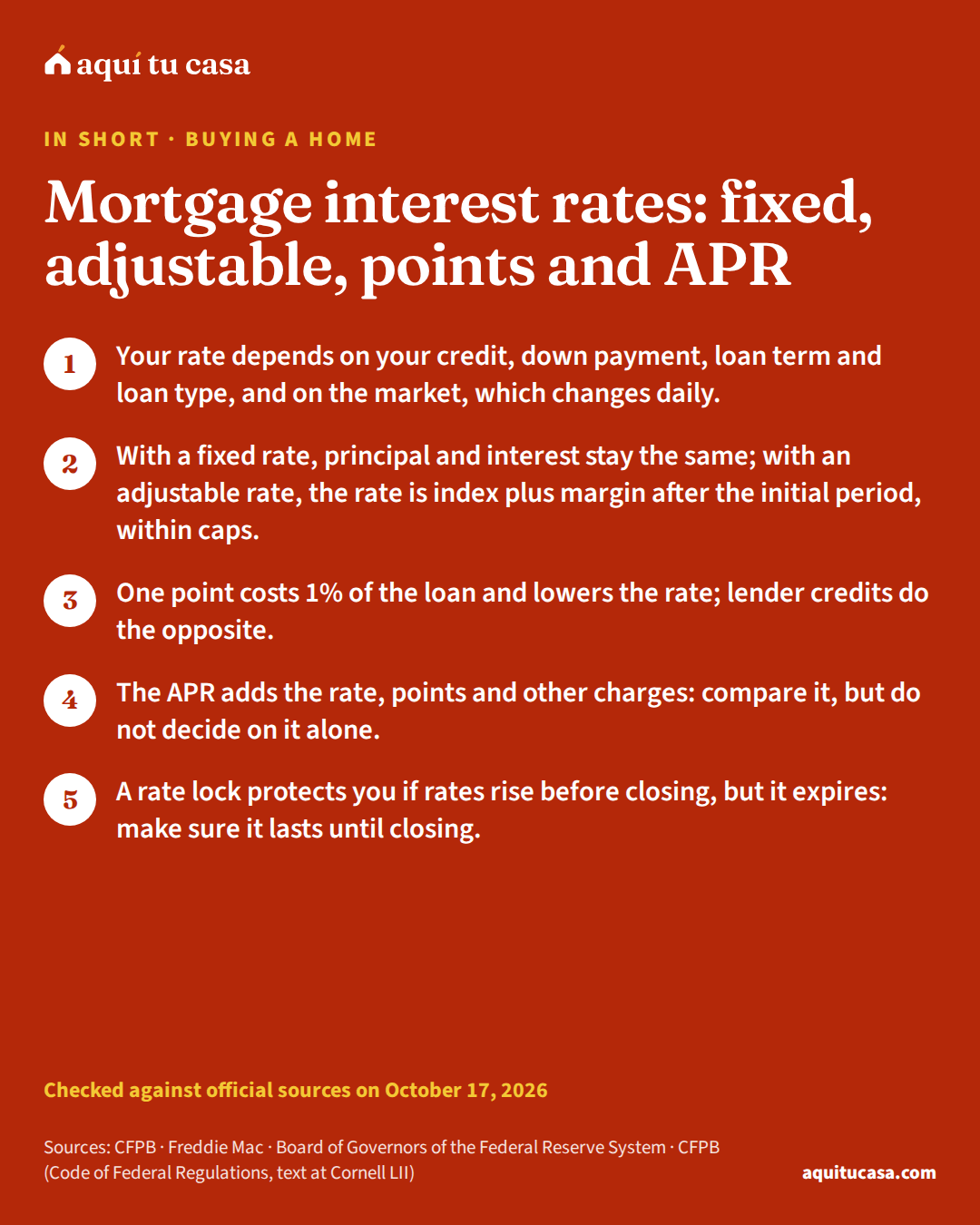
From the guide
What your mortgage rate is and what moves it, how fixed and adjustable rates differ, and how points, the APR and rate locks work.
Verified on October 17, 2026 20 official sources
In Freddie Mac's weekly survey, the average 30-year fixed rate was 7.18% as of November 5, 2026, and the 15-year rate was 6.57%. It is an average for conventional loans to borrowers with good or excellent credit and 20% down: your rate may differ. Your real rate is on your Loan Estimate.
Read the full guideIt depends on your situation; no one can decide it for you. The CFPB explains that a fixed rate gives stable principal and interest payments, while an adjustable rate is less predictable but could be cheaper in the short term, for example if you move during the initial fixed period. It also warns not to assume you will be able to sell or refinance before the rate changes.
Read the full guideOne point costs 1% of the loan amount and lowers your rate. The CFPB says points can make sense if you plan to keep the loan a long time, and the CHARM booklet suggests comparing the cost of the points with what you save with the lower rate. You never have to pay points.
Read the full guideBecause the APR adds points, broker fees and other charges for getting the loan to the rate. It helps compare the cost of similar offers, but on an adjustable rate it does not reflect the maximum rate, and the CFPB advises against deciding on the APR alone.
Read the full guideThe CFPB explains that a lock protects you if rates rise before closing, but it can also keep you from a lower rate if they fall, and extending it can be expensive. What matters is that the lock lasts until closing. Ask the lender how long it lasts, what a longer one costs and what happens if closing is delayed.
Read the full guideCaps limit it: one for the first adjustment, one for later adjustments and one for the life of the loan. The CFPB says the most common lifetime cap is five percent, though some loans have a higher one. Your Loan Estimate shows the maximum rate in the Adjustable Interest Rate (AIR) table.
Read the full guideNot directly. According to the Federal Reserve, its changes show up quickly on floating-rate loans, but rates on long-term loans depend on expectations for the economy over the life of the loan, not just today's federal funds rate.
Read the full guideIt is a written agreement in which someone, such as the seller or the lender, puts up money so you pay a lower rate at the start. On loans Fannie Mae buys, the buydown lasts at most 3 years, the rate rises by no more than 1% per year, and the lender qualifies you at the full note rate.
Read the full guide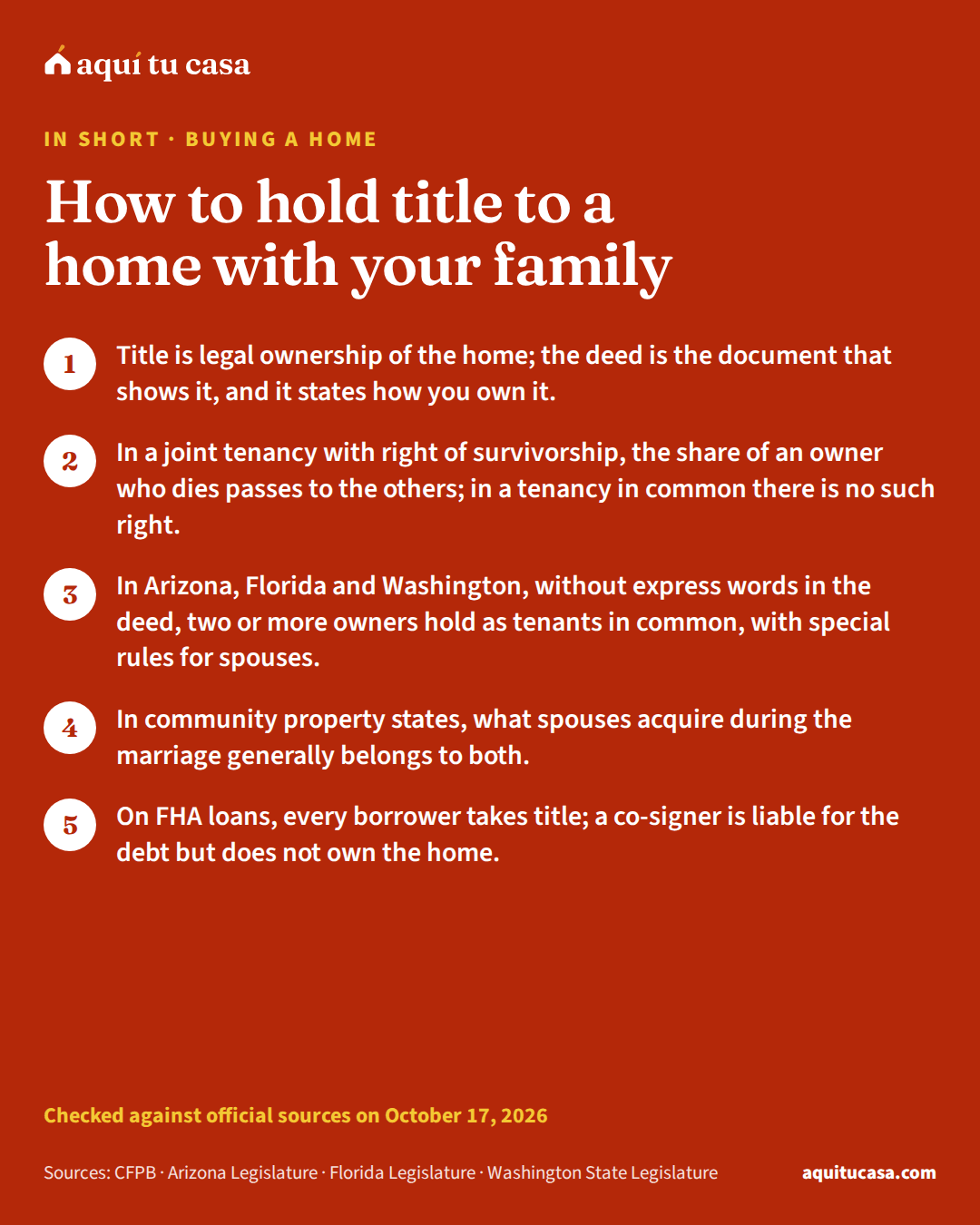
From the guide
Joint tenancy, tenancy in common and community property: what some state laws say, what loans require and where to find free legal help.
Verified on October 17, 2026 15 official sources
It depends on your family and your state's law, and choosing is a legal decision about your case. What the laws of Arizona, Florida and Washington say is that in a joint tenancy with right of survivorship the share of an owner who dies passes to the others, and that without express words the owners hold as tenants in common. A legal aid office can guide you for free if you qualify.
Read the full guideIt is a way of owning together where, when one owner dies, their share passes to the other owners. In Washington, the law says it lets the home pass to the survivor without the cost or delay of probate, and that it must be declared expressly in writing.
Read the full guideAccording to the IRS, in community property states, what spouses acquire during the marriage while living there generally belongs to both; what each owned before or received as a gift or inheritance is separate property. Those states are Arizona, California, Idaho, Louisiana, Nevada, New Mexico, Texas, Washington and Wisconsin.
Read the full guideIt depends on the loan and your state. On FHA loans, every borrower takes title, and every purchaser on the sales contract must be a borrower, although a family member of a purchaser may be listed on the contract. Ask the lender and the title company before you sign.
Read the full guideIt depends on your state's law. According to the CFPB, the lender may require your spouse's signature if state law requires it for the lien to be valid or the title to be clear. In community property states, FHA does not require your spouse to be a borrower, but the mortgage must be signed by whoever the law requires.
Read the full guideIt depends on how the title reads and on state law. With joint tenancy with right of survivorship, the share of the owner who dies passes to the other owners. With tenancy in common there is no such right. Some states, such as Arizona, allow a beneficiary deed that passes the home to the person you choose when you die.
Read the full guideNo. On FHA loans, a co-signer signs the note and is liable for the debt, but does not own the home or sign the mortgage. For Fannie Mae, a co-signer has no ownership interest as shown on the title.
Read the full guideThe Legal Services Corporation funds civil legal aid offices for low-income people; on its site you find the nearest one with your address or city, and LawHelp.org has free information and forms. Getting help is an option, not a requirement for buying.
Read the full guideTools
The calculators these guides use. Each one leaves you with a result you can use today.
The price your income can carry.
What you get → maximum price
Your monthly payment with taxes and insurance.
What you get → monthly payment
The cash you need on closing day.
What you get → cash to close
The documents you'll be asked for.
What you get → your document list
From the guide
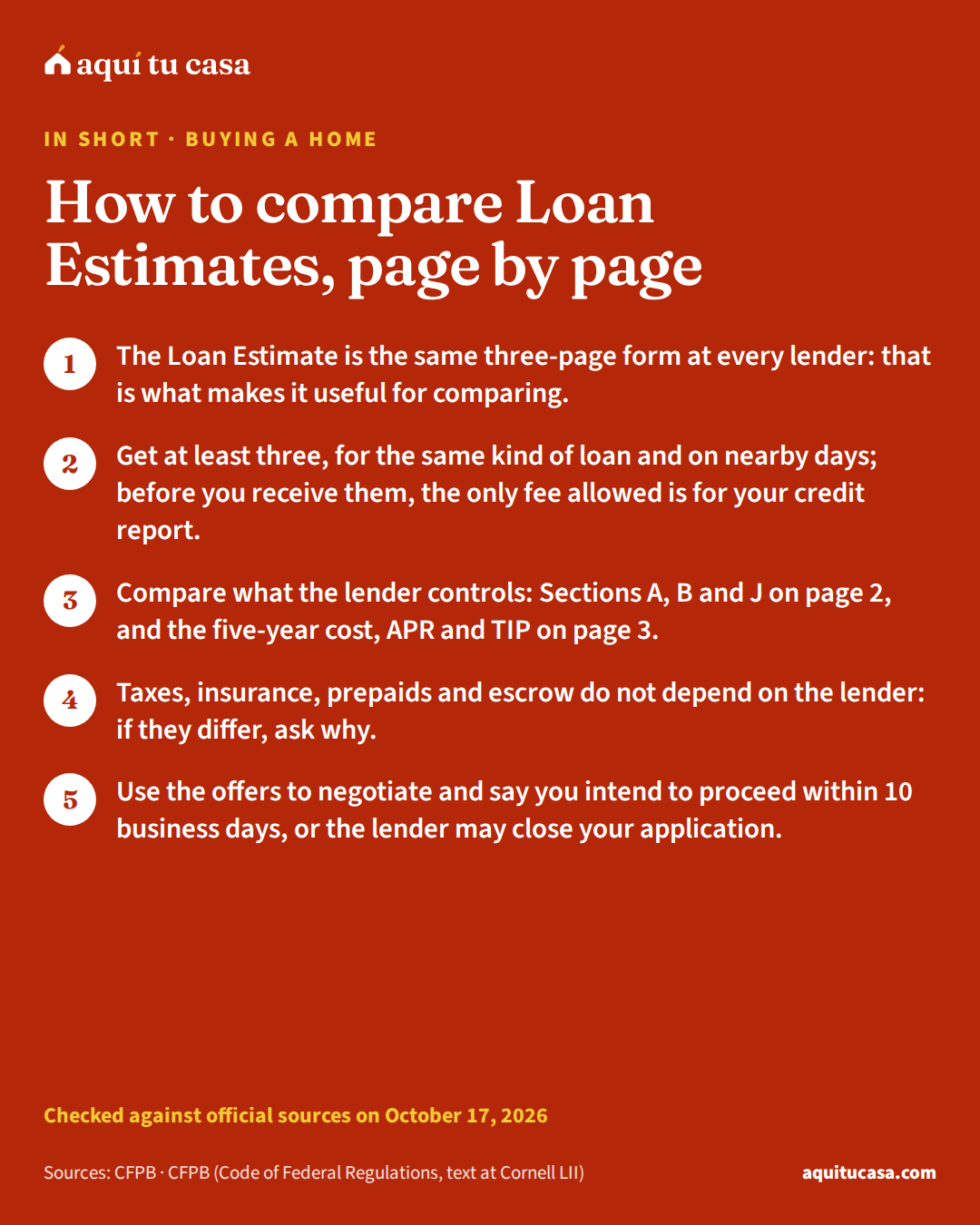
How to read and compare two or three Loan Estimates side by side: what to check on each page, what can change and how to negotiate with lenders.
Verified on October 17, 2026 17 official sources
The CFPB recommends getting at least three offers in writing, all for the same kind of loan. Requesting them on nearby days helps, because rates change daily and a difference may come from the market rather than the lender.
Read the full guideAccording to the CFPB, within a 45-day window, multiple credit checks from mortgage lenders are recorded on your credit report as a single inquiry. The impact is the same no matter how many lenders you consult in that time.
Read the full guideBefore you receive it and say you want to proceed, the only fee allowed is a bona fide and reasonable fee for your credit report. The CFPB says asking you to pay anything else to get a Loan Estimate is against the law.
Read the full guideNo. According to the CFPB, six pieces of information are enough: your name, income, Social Security number, the property address, an estimate of its value and the loan amount. The lender cannot require more to give you a Loan Estimate, although sharing more makes it more accurate.
Read the full guideNo. When you receive it, the lender has not yet approved or denied your loan, even if your rate is locked. It does not commit you either: you are not committed to a lender until you sign the final closing documents.
Read the full guideThe rate is what you pay each year to borrow the money. The APR adds the rate, points, broker fees and other charges to get the loan, which is why it is usually higher. The rate is on page 1 of the Loan Estimate and the APR on page 3.
Read the full guideIt is the Total Interest Percentage: how much interest you would pay over the full term, as a percentage of what you borrowed. It is useful for comparing Loan Estimates, but it assumes you keep the loan for the full term and it does not include upfront fees other than prepaid interest.
Read the full guidePage 1 says whether your rate is locked and until when, and the date and time the estimated costs expire. Also, according to the CFPB, if you do not say you intend to proceed within 10 business days of the lender sending it, the lender can close your application as incomplete.
Read the full guide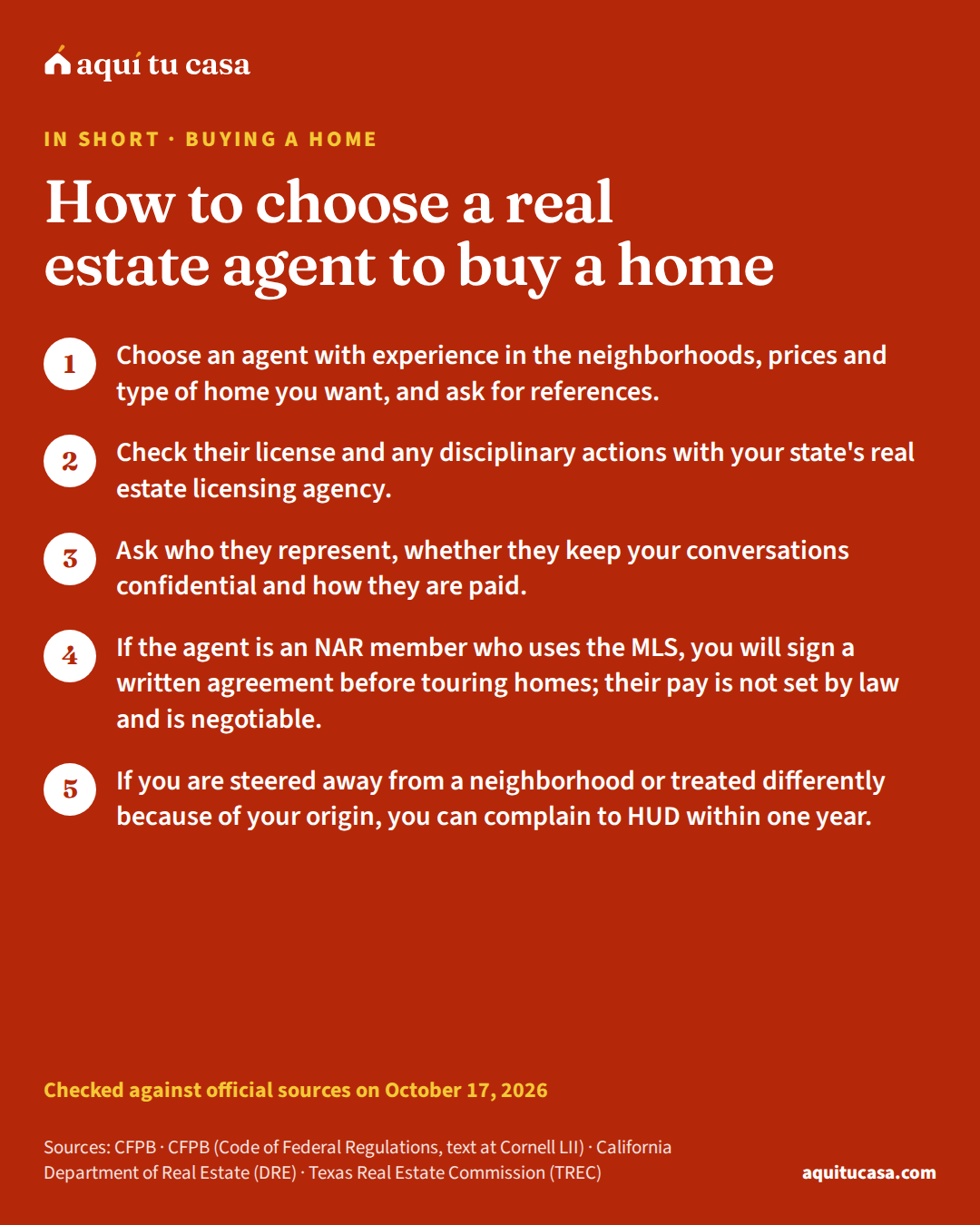
From the guide
What a real estate agent does, who they represent, how to check their license in your state, what to ask them and your fair housing rights.
Verified on October 17, 2026 14 official sources
Read the full guide Do the math: How much house can I afford?
The CFPB says many people work with an agent to shop for homes, but presents it as an option to consider. If you choose one, look for experience in the neighborhoods, prices and type of home you are interested in.
Read the full guideWith your state's real estate licensing agency, sometimes called the Department of Real Estate. There you can also see whether they have disciplinary actions. For example, California's DRE has 'Verify a License' and the Texas TREC has a 'License Holder Search.'
Read the full guideAccording to the CFPB, an agent can represent the buyer, the seller or sometimes both, and state laws can require them to tell you who they represent and on what terms. Ask how they would handle it if you like a home their brokerage is selling.
Read the full guideThere is no set figure: the NAR settlement requires its agents to say that commissions are not set by law and are fully negotiable. The written agreement must state the amount or rate, or how it is determined. The seller may offer to pay your agent, but that offer is not posted on the MLS.
Read the full guideIf the agent is an NAR member who participates in an MLS, yes: the NAR settlement requires a written agreement before you tour any home. According to NAR, you do not need one just to talk to an agent at an open house or ask about their services.
Read the full guideThe CFPB says many buyers feel obliged to, but you need someone with the experience to do the best job, who may or may not be your relative or friend.
Read the full guideThe Fair Housing Act prohibits discrimination based on national origin, race and other characteristics, including steering you away from a neighborhood for those reasons. You can complain to HUD at (800) 669-9777, no later than one year after what happened. Free legal aid is an option for your case.
Read the full guideNo. The CFPB says that even if your agent has a preferred lender you should compare, and that recommended providers might not offer the best deal. If your agent has an ownership interest in the provider, Regulation X calls for telling you in writing and not requiring you to use it.
Read the full guide
From the guide
How to find and compare mortgage lenders, check their license on NMLS, what to ask the loan officer and which warning signs to watch for.
Verified on October 17, 2026 17 official sources
The CFPB recommends contacting at least three lenders on your list and getting at least three offers in writing, on the Loan Estimate. It says borrowers who shop around can save thousands of dollars and that different lenders can offer different kinds of loans.
Read the full guideVery little. According to the CFPB, within a 45-day window, multiple credit checks from mortgage lenders count as a single inquiry on your credit report. Checking your own credit does not affect your scores.
Read the full guideAsk for the NMLS ID of the company and of the loan officer, and look them up on NMLS Consumer Access (nmlsconsumeraccess.org), a free service that shows whether they are authorized in your state. Your state regulator can also tell you about disciplinary orders. The ID must appear on your application and your Loan Estimate.
Read the full guideIt depends on what each one offers you. A lender lends directly; a broker does not lend money, shops among several lenders and charges a fee for that service. With either one, the CFPB recommends comparing terms, rates and fees, and asking who pays the broker.
Read the full guideNo. The CFPB says that even if a real estate agent or homebuilder has a preferred lender, you can and should shop around for a better deal.
Read the full guideBefore you receive it and say you want to proceed, Regulation Z only allows a bona fide and reasonable fee for your credit report. The application fee, the appraisal fee and most other fees come later.
Read the full guideOfficial sources document banks, credit unions and CDFIs that offer them. Ask on the first call and compare Loan Estimates the same way you would for any loan. A HUD-approved housing counselor can help you identify lenders, often for free or at low cost.
Read the full guideBefore you look for a home. The CFPB explains that once a seller accepts your offer, you may have as little as a couple of days to line up financing. Exploring early gives you time to compare without rushing.
Read the full guide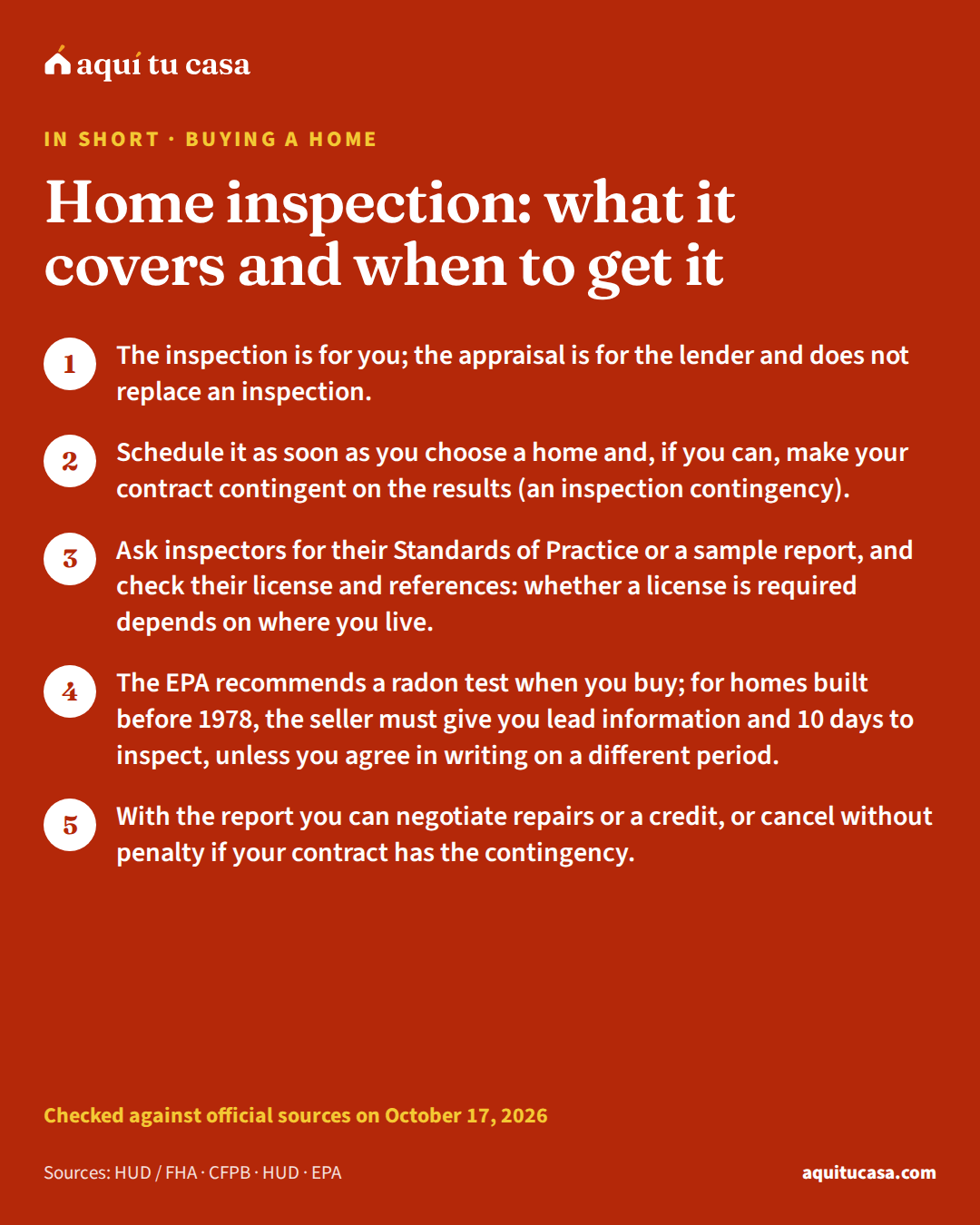
From the guide
What a home inspection is, how it differs from the appraisal, when to get it under a contingency, radon and lead tests, and what to do with the report.
Verified on October 17, 2026 14 official sources
According to FHA, an inspection only happens if you arrange for one; FHA does not perform inspections. The CFPB says not to buy a home without having it thoroughly inspected, because inspections are for your protection.
Read the full guideNot for you. The appraisal estimates the home's value for the lender and does not replace an inspection. FHA does not guarantee the home's condition either, and cannot help with repairs after closing.
Read the full guideYou arrange it and the inspector charges a fee. The CFPB warns that if the inspector is paid by someone else, or not paid until closing, they might underemphasize problems. For a radon test, the EPA suggests writing into the contract how the costs will be shared.
Read the full guideIt depends on where you live: according to the CFPB, some areas do not require one. Before hiring, ask for references from prior customers and look the inspector up with your state or county licensing authority and the Better Business Bureau (BBB).
Read the full guideIf it was built before 1978, the seller must give you an EPA-approved pamphlet, tell you what they know about lead in the home and give you 10 days (or another period agreed in writing) for a lead inspection before you are bound by the contract. You can waive those days, but only in writing.
Read the full guideThe CFPB recommends scheduling it as soon as possible once you have chosen the home, so you learn early about major problems and have time for other inspections. FHA adds that if you request it early in the process, you may be able to make your purchase contract contingent on its results.
Read the full guideIf your contract is contingent on a satisfactory inspection and you are not satisfied with the results, the CFPB says you have the right to cancel the sale without penalty. If you do not have that condition, check what your contract says; you can also negotiate repairs or a credit with the seller.
Read the full guideThe CFPB says it is very risky to buy a home for more than its appraised value. Get your copy of the appraisal and use that value to negotiate a lower price with the seller. If the seller will not agree, you may consider canceling, although depending on your contract there may be costs.
Read the full guideFHA's sheet lists the toll-free National Radon Information Line, 1-800-SOS-Radon (1-800-767-7236). The EPA recommends testing when you buy a home, and your state radon office can give you its approved list of testing companies.
Read the full guide
From the guide
Who can give you money for the down payment, what the gift letter must say, how the transfer is documented and what happens with taxes.
Verified on October 17, 2026 12 official sources
Yes. Fannie Mae accepts gifts from relatives by blood, marriage or adoption, and FHA accepts gifts from family members such as parents and grandparents. The lender will ask for a gift letter and proof of how the money reached your account or the closing agent.
Read the full guideFor Fannie Mae and FHA: the giver's name, address and phone number, their relationship to you, the gift amount and a statement that it does not have to be repaid. On FHA loans the donor and you both sign and date it. Ask the lender whether it has a form for the letter.
Read the full guideIn many cases, yes. Fannie Mae requires no contribution of your own on a one-unit principal residence, and all the money can come from a gift. On FHA, your 3.5% minimum investment can come from a family member, but not from the seller or someone who benefits from the sale. On a two- to four-unit home with Fannie Mae and more than 80% financing, you must put in 5% of your own.
Read the full guideIt depends on the loan. FHA accepts a close friend with a clearly defined and documented interest in you. Fannie Mae accepts someone with a long-standing family-like or mentorship relationship. In both cases the donor cannot be tied to the seller, builder or agent.
Read the full guideAccording to the IRS, if there is gift tax, the giver generally pays it, and gifts that do not exceed the annual exclusion are not taxable gifts. The IRS publishes the exclusion amount for each year, and the gift tax return is Form 709.
Read the full guideThe lender has to document where all the money came from, and Fannie Mae requires funds from assets outside the US to be exchanged into dollars and held in a US financial institution before closing, with documents in English or translated. Also, if you are a US person for tax purposes and receive more than $100,000 in a year from a nonresident alien, you have to report it on Form 3520.
Read the full guideIt is when the seller, say your mother, gives you part of her equity in the home as a credit in the purchase. Fannie Mae accepts it for the down payment and closing costs, not for reserves. On FHA loans, only a family member selling to another family member can give it.
Read the full guideOn an FHA loan, cash the donor keeps at home is not an acceptable source for a gift. The safest route is for the money to leave the donor's account by check or transfer, so every step leaves proof.
Read the full guideChange topic without leaving the questions.

These answers explain the rules but do not know your situation. These organizations go over it with you, free.