Secured credit cards: how they work and fees to watch
How a secured credit card works: the deposit, the fees and rate to compare, how it reports your payments and how to move up to a regular card.
Verified against official sources on October 17, 2026 17 official sources

Show contents
In short
What you need to know
Quick answer
A secured card is a credit card for people who do not qualify for a regular one: you put down a deposit, usually equal to your limit, and use it like any card. It builds history if the issuer reports your payments to the three agencies and you pay on time; over time your limit may go up and your deposit may be refunded. Its fees and interest can be high: Regulation Z caps the required fees in the first year at 25% of the opening limit, and the application must show you the rate and fees in a table.
What matters most
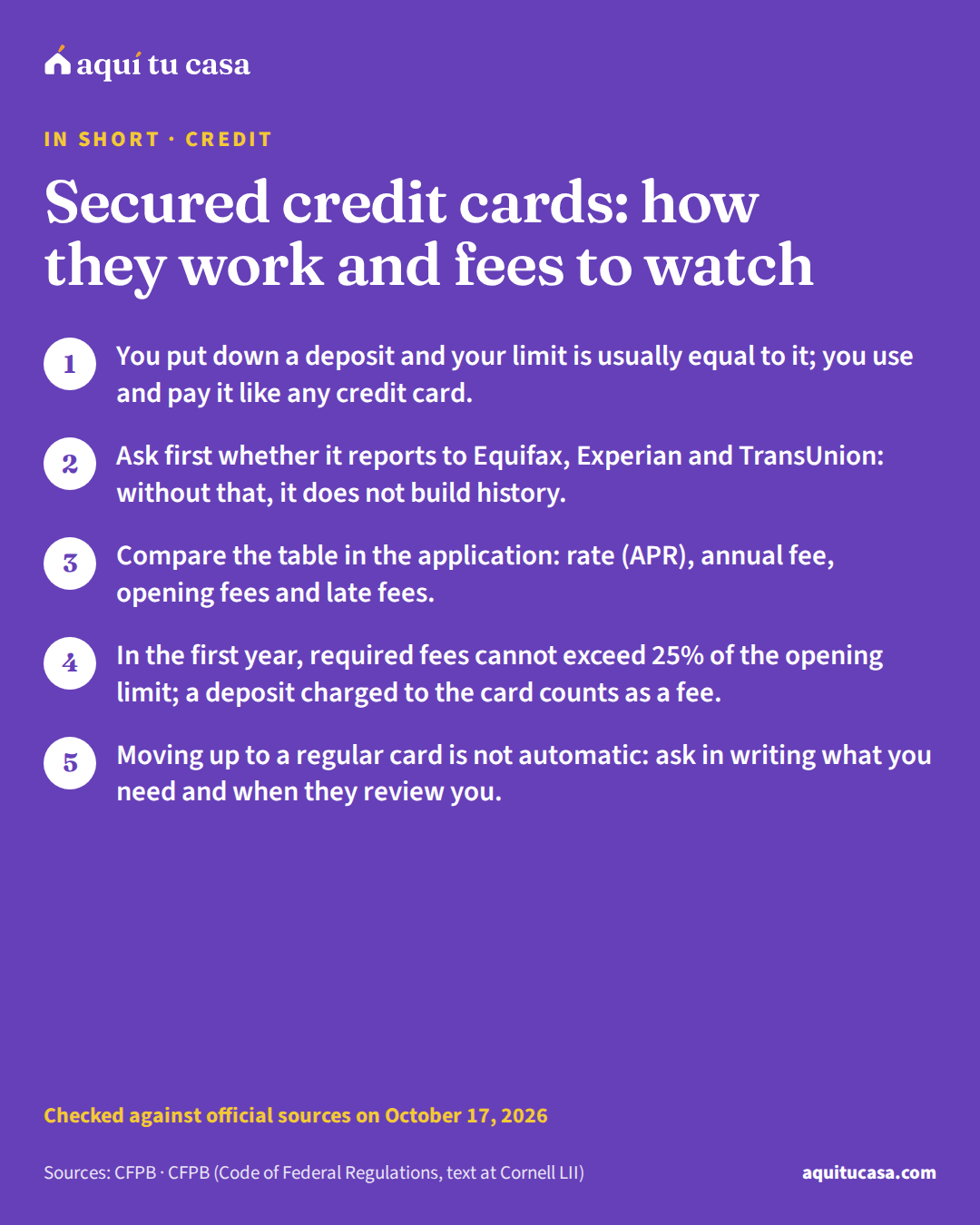
- You put down a deposit and your limit is usually equal to it; you use and pay it like any credit card.
- Ask first whether it reports to Equifax, Experian and TransUnion: without that, it does not build history.
- Compare the table in the application: rate (APR), annual fee, opening fees and late fees.
- In the first year, required fees cannot exceed 25% of the opening limit; a deposit charged to the card counts as a fee.
Is this for you?
This guide is for you if…
- You do not qualify for a regular credit card because you have no history or are rebuilding it.
- You were offered a secured card and want to know what to ask and which fees to check before you sign.
- You already have one and want to use it well so you can move up to a regular card later.
Get direct help first if…
- You do not yet know where to start your history: the Credit from zero guide compares the secured card with other options.
- You have past-due or collection debts: a new card will not fix them; a HUD-approved housing counselor can guide you, often for free.
- You want a card to control spending without borrowing: that is a prepaid card, which does not build a credit history.
If you do not qualify for a regular credit card, a secured card is one of the most common ways to start. This guide is for anyone about to open one or who already has one: it explains how the deposit works, which fees to check in the application, what limits the law puts on those fees and how to move up to a regular card later. Everything comes from what the CFPB (the federal consumer financial protection agency) and Regulation Z, the federal credit card rule, publish.
What it is and how it works
A secured credit cardsecured credit cardA secured credit card is a card that helps you start or rebuild your credit history. To open one, you put a deposit in an account, usually equal to your credit limit, which starts out small. You can spend up to that amount and, when you pay the bill, that room becomes available again. Payments are reported to the credit reporting companies, so paying on time helps. As you show you pay on time, your limit may go up and your deposit may be refunded. Fees and interest rates can be high. A prepaid card is different and does not build credit.See the full definition is a real credit card backed by a deposit. According to the CFPB, many banks and credit unionscredit unionA credit union is a not-for-profit financial institution that, like a bank, accepts deposits, makes loans and offers other services, but is owned by its members. Members elect a volunteer board of directors, and profits go back to them as lower fees, higher savings rates and lower loan rates. To join you need a common bond, such as your employer, your family, where you live or a group you belong to. It is chartered by the NCUA, a federal agency, or by a state. If the credit union is federally insured, your deposits are protected by the NCUA's insurance fund.See the full definition offer them. You put an amount equal to your credit limit in an account as a deposit, and with most of these cards the credit line starts out small. As you show you can pay on time, your limit may be raised and your deposit may be refunded.1
The CFPB explains it with an example: you put in an amount of cash, say $500, and you can spend up to that amount. When you pay the bill, your spending amount goes back up.2 You apply for it like any card: once approved, you deposit the money in a separate account and the bank extends a credit line matching the deposit.3
Example with real numbers
How your deposit works
An example in words: the numbers change from issuer to issuer.
- You put a deposit in an account
- The amount you choose and the issuer accepts
- Your credit limit
- Usually equal to your deposit
- Every month
- You use little of the limit and pay the full balance
- With on-time payments
- Your limit may go up and your deposit may be refunded
The CFPB explains that the limit is usually equal to the deposit and that, with on-time payments, it may go up and your deposit may be refunded.1 Plan your steps in the credit plan.
Run it with your numbersCredit planWhat sets it apart from a prepaid or debit card is that you borrow and pay later. With a prepaid card you only spend money you loaded beforehand, and it does not build history; with debit or cash you are not borrowing anything you have to repay later.2
Secured, prepaid or debit
Credit with a deposit
Secured card
Your own money
Prepaid card
If your goal is to build history, only the secured card of these three can help, and only if it reports your payments.3
Before you apply: what to ask
The CFPB suggests asking your bank, credit union or a local nonprofit credit counseling agency about cards and loans that help build credit.2 It also describes another option, the credit builder loancredit-builder loanA credit-builder loan helps you create or improve your credit history and save at the same time. Some banks and credit unions offer them. Unlike a secured card, you do not make an opening deposit: the lender puts the loan amount in a locked savings account and you pay it off in small payments. Then you receive that money, minus any interest or fees. The lender reports your payments to the three nationwide credit reporting companies. In a CFPB study, these loans helped people with no other debts the most.See the full definition, which you can compare with the card in Credit from zero.
Before you sign, ask these questions and get the answers in writing:
- Do you report my payments to Equifax, Experian and TransUnion? You can generally build credit with a secured card, but the CFPB suggests asking the issuer about reporting to the credit reporting companies.3 When payments are reported, the three agencies create a report for you.2
- What do I need to do to move up to a regular card, and when do you review my account? Many of these cards have a “graduation” feature after a pattern of consistent payments,3 but it is not automatic (we explain why below).
- When and how do I get my deposit back? The CFPB says it may be refunded as you show you can pay on time;1 the details are in your agreement.
- Is the deposit charged to the card or paid separately? It changes how it counts toward the first-year fee cap.6
The issuer may ask about your income, to know whether you can make the minimum payment, and for your Social Security number, to get your credit report.11 It usually sets your limit after you apply, reviewing your report and the income you gave.12
The fees to watch
The CFPB warns that fees and interest rates on secured cards can be high.1 The good news: the law makes the issuer put them in plain view. With the application or offer, the issuer has to give you a table (often called the Schumer box) with these items:7
| Item in the table | What it is |
|---|---|
| APR (annual percentage rate) | The interest rate for purchases, cash advances and balance transfers |
| Annual or other periodic fee | What they charge for having the card, and how often |
| One-time opening fee | What they charge once to open the account |
| Grace period | The time to pay for purchases without interest, if they give one |
| Cash advance and balance transfer fees | What it costs to take cash or move debt onto the card |
| Late, over-the-limit and returned-payment fees | What a mistake costs you |
If the required fees or the deposit charged to the card at opening add up to 15% or more of the minimum limit, the table also has to tell you how much available credit remains after they are charged.7 Look for that number: it is what you can actually use.
The first-year cap. Under Regulation Z, the total fees you are required to pay in the first year cannot exceed 25% of the limit the account had when it was opened. Late, over-the-limit and returned-payment fees do not count.5 The official commentary gives an example: with a $500 limit at opening, the issuer may charge $125 in fees. And it makes a key point for secured cards: if the deposit is charged to the card, it counts as a fee toward that cap; if you pay it separately, it does not.6
Penalty fees. A fee for violating the card’s terms cannot exceed the dollar amount associated with that violation. They cannot charge that kind of fee for a purchase the issuer declined, or more than one penalty fee for the same event.5
Interest. The APRannual percentage rate (APR)The annual percentage rate (APR) is a broader measure of the cost of borrowing money than the interest rate. Besides the interest, it includes certain loan charges, such as discount points and some lender fees, spread over the life of the loan and expressed as a yearly percentage. That is why the APR is almost always a little higher than the interest rate. It is useful for comparing offers: if two loans have the same interest rate but a different APR, the one with the higher APR charges more in fees.See the full definition is the price you pay for borrowing. On most cards, if you pay the full balance each month by the due date, you pay no interest on purchases.9 But companies are not required to give a grace period, and cash advances generally charge interest from the day of the transaction. Your bill must reach you at least 21 days before it is due.10

How to use it to build history
The card only builds history if you use it well. Most credit scores treat repayment history as the number one factor.13 “On time” means the payment reaches the company by the day the bill is due.1
With a small limit, a normal purchase can use up a large share of it. Experts cited by the CFPB advise using no more than 30% of your total limit, and paying the full balance each month helps you get the best scores.13 Paying in full also avoids finance charges and can build better credit than carrying a balance.1 That share is called credit utilizationcredit utilizationCredit utilization is how much of your credit limits you are using: it compares what you owe on your cards with your total available credit. Scoring models look at how close you are to being maxed out; if you use too much of your limit, your score can drop. According to the CFPB, experts advise using no more than 30% of your total credit limit. If you close cards and move the balances onto one, the share you use can go up. You do not need to carry a balance to have a good score: paying in full each month helps.See the full definition; the guide What moves your credit score explains how it weighs.

Your secured card, from application to graduation
1. Ask and compare
Before you apply
Get each card's table and ask in writing whether it reports to all three agencies.3
2. Put down the deposit
When you open it
Your limit is usually equal to your deposit. Check how much available credit remains if fees are charged at opening.7
3. Set up autopay
Before the first due date
An automatic payment or electronic reminder prevents the late payment that costs the most.13
5. Check your reports
Every few months
Confirm the card shows up and your payments appear on time. If it does not appear, ask the issuer whether it reports.3
6. Ask about graduation
After months of consistent payments
Ask them to review your account: your limit may go up and your deposit may be refunded.1
Moving up to a regular card
Many secured cards have a “graduation” feature to move to a traditional card after a pattern of consistent payments.3 But it is not automatic. In its exams, the CFPB found issuers that said orally the account would convert to unsecured on its own on a set timeline, such as six or twelve months, and did not: graduation depended on other factors. Others advertised “periodic” reviews and went a year or more without reviewing accounts.4
That is why it helps to have in writing what they require for graduation and how often they review your account. If they tell you something by phone, ask them to send it to you.
Once you graduate, think before closing the account. Closing a card can raise your utilization and lower your score, and an old account with a good history may help maintain a higher score. Closing it can make sense if the card has annual fees or poor terms that outweigh its benefits.14
If you fall behind or the terms change
A late payment on a secured card weighs the same as on any card. Credit reporting companies can generally report negative payment information for up to seven years.16 Recent negative information weighs more than older information, so getting current as soon as possible helps.1
Your deposit is collateral. The general rule bars the issuer from taking money you have on deposit with it to pay off your card debt, but it does not take away its right to enforce a security interest in those funds that you agreed to.15 Read in your agreement what happens to the deposit if you fall behind or close the account.
If the issuer lowers your limit, it generally has to give you an adverse action notice with the specific reasons, or the option to request them.12 If you have past-due debts, a HUD-approved housing counselorHUD-approved housing counselorA HUD-approved housing counselor works at an agency HUD has approved to provide housing counseling: independent, expert advice customized to your situation about buying a home, renting, a missed mortgage payment, a foreclosure or credit problems. The agencies usually charge little or nothing; many serve in Spanish and offer the homebuyer education course several assistance programs require. They are not lenders or real estate agents and sell you nothing. Your county page lists the official agencies with phone numbers.See the full definition can go over your budget and credit with you, often at little or no cost.17
If this is you
You have never had credit
If you do not qualify for a regular card, the CFPB suggests trying a secured one.1 Compare it with a credit builder loan in Credit from zero.
You have an ITIN
The issuer may ask for a Social Security number to see your report.11 Ask first whether they accept an ITIN and whether they report to all three agencies.
You are paid in cash
Cash does not build history.2 Open a bank account so you can pay the card on time every month.
The deposit is hard to put together
Ask your bank, credit union or a nonprofit agency about other credit-building products.2

Mistakes that cost you
Mistake: Opening the card without asking whether it reports to the agencies.
Instead: Ask first and get the answer in writing: no reporting, no history.3
Mistake: Choosing only by the size of the deposit.
Instead: Compare the whole table: rate, annual fee, opening fees and available credit.7
Mistake: Believing the card turns into a regular one on its own after six months.
Instead: The CFPB found promises like that went unkept; get the requirements in writing.4
Mistake: Using almost the whole limit every month.
Instead: Use little and pay in full: experts cited by the CFPB advise staying at or below 30% of the limit.13
Mistake: Taking cash out with the card.
Instead: Cash advances generally charge interest from day one.10
Mistake: Closing the card as soon as you graduate.
Instead: Closing it can raise your utilization; an old account with a good history can help you.14
What to do this week
- Ask your bank or credit union about secured cards and other credit-building products.2
- Get the table of rates and fees for each card and compare them; look up their agreements too.8
- Ask in writing whether they report to all three agencies and what you need to graduate.3
- Confirm whether the deposit is charged to the card or paid separately, and how much available credit remains.6
- Set up autopay for the full balance.13
- Get your reports in a few months to see your card; the guide AnnualCreditReport.com step by step shows you how, and the credit plan puts your steps in order.2
Your situation
If you have never had a card or a loan in the U.S., choose "None".
Your credit plan
12 steps
You have done 0 of 12.
This week
Get your three credit reports for free
At AnnualCreditReport.com you can get the Equifax, Experian and TransUnion reports for free once a week. Checking your own report does not lower your score. If it comes up empty, that is not an error: you simply have no history yet.
Source: CFPB: How do I get a free copy of my credit reports? ↗ · CFPB: Does requesting my credit report hurt my credit score? ↗
Dispute any error in writing
Write to the credit bureau and to the company that reported the item, with copies of your proof, by certified mail. By law, the bureau must investigate again for free and resolve it within 30 days of receiving your notice.
Source: CFPB: How do I dispute an error on my credit report? ↗ · Congreso de EE. UU. (texto en Cornell LII): Fair Credit Reporting Act, 15 U.S.C. §1681i, Procedure in case of disputed accuracy ↗
Talk to a HUD-approved housing counselor
They give independent advice on buying, renting, defaults and credit, often free or at low cost. You can go over your report and your plan with them.
Source: CFPB: Find a Housing Counselor ↗
This month
Open a secured card
You deposit an amount (for example, $500) and can spend up to that amount. With on-time payments, the limit can go up, and the deposit comes back. Before signing, ask whether they report to all three bureaus and compare the annual fee and the rate: they can be high.
Source: CFPB: What are some ways to start or rebuild a good credit history? ↗ · CFPB: How to rebuild your credit ↗
Or a credit builder loan
The bank or credit union holds the money as savings while you make small payments, usually for six to 24 months; when you finish, you get it. You build history and savings at the same time.
Source: CFPB: What are some ways to start or rebuild a good credit history? ↗
Ask for your rent to be reported
On-time rent payments can help build your credit. Ask your landlord whether they take part in a rent reporting program (often through a payment app) and check its fees.
Set up automatic payments
An automatic payment or a reminder before the statement date prevents the costliest kind of slip: payment history is the main factor in most models.
What does not build credit
Paying with a debit card or cash, prepaid cards and payday loans do not build history, according to the CFPB. They are ways to pay, not accounts that get reported.
From here on
Do not close your first account
A long history of on-time payments helps your score. When a better card comes along, keep the first one open and current.
Only apply for the credit you need
Opening several accounts in a short time is a risk signal for lenders, and each application leaves a hard inquiry that does affect your score.
Source: CFPB: How do I get and keep a good credit score? ↗ · CFPB: What is a credit inquiry? ↗
Watch your debt-to-income ratio
Lenders divide your monthly debt payments by your gross monthly income to see whether you can handle a new loan. While you prepare, avoid new payments, such as a car.
Watch out for "credit repair"
It is a scam if they charge before doing anything, promise to remove accurate negative information, tell you not to contact the bureaus or to dispute everything. Disputing errors is free by law, and if you already signed up for something like this, you can cancel within three business days.
Source: CFPB: How can I tell a credit repair scam from a reputable credit counselor? ↗
An educational plan built on what the CFPB, the NCUA and the federal credit reporting law publish; not individual advice. We recommend no brands and are paid for no product.
Ready to see the numbers? Find your county here
See how this applies in your county: its loan limits, prices and rents, from the official data.
Printable checklist
Frequently asked questions
Do I get my secured card deposit back?
According to the CFPB, as you show you can pay on time, your limit may be raised and your deposit may be refunded. Terms vary by issuer: ask in writing when and how they return it, and read what your agreement says if you close the account.
How much do I have to deposit?
It depends on the issuer. The CFPB explains that you put an amount equal to your credit limit in an account, and gives $500 as an example; with most of these cards, the credit line starts out small.
Does a secured card build credit like a regular card?
It can, if the issuer reports your payments to the three nationwide agencies and you pay on time. The CFPB suggests asking the issuer about reporting before you apply.
How long until I move up to a regular card?
The law sets no fixed timeline. The CFPB found issuers that promised orally to convert accounts to unsecured in six or twelve months and did not, because it depended on other factors. Ask in writing for the requirements and how often they review your account.
What fees can they charge me the first year?
Under Regulation Z, required fees in the first year cannot exceed 25% of the limit when the account was opened; late, over-the-limit and returned-payment fees do not count. If the deposit is charged to the card, it counts as a fee; if you pay it separately, it does not.
Is it the same as a prepaid card?
No. With a secured card you borrow and pay later, and that can be reported to the agencies. With a prepaid card you only spend money you loaded beforehand, and the CFPB says it does not build history.
Can I get a secured card with an ITIN?
It depends on the issuer. The CFPB says the issuer may ask for your Social Security number to get your credit report. Before applying, ask whether they accept an ITIN and whether they report your payments to the three agencies.
Will I pay interest if I pay everything each month?
On most cards, not on purchases, if you pay the full balance by the due date. Companies are not required to give a grace period, and cash advances generally charge interest from day one.
Sources
Every figure in this guide comes from one of these official sources. The number next to a sentence leads to the source behind it.
Each source on one line: who publishes it, its title, its address and the date we read it.
- 1. CFPB · How to rebuild your credit · consumerfinance.gov · Accessed October 17, 2026
- 2. CFPB · What are some ways to start or rebuild a good credit history? · consumerfinance.gov · Accessed October 17, 2026
- 3. CFPB · Building credit from scratch · files.consumerfinance.gov · Accessed October 17, 2026
- 4. CFPB · Supervisory Highlights, Issue 19, Summer 2019 · files.consumerfinance.gov · Accessed October 17, 2026
- 5. CFPB (Code of Federal Regulations, text at Cornell LII) · Regulation Z, 12 CFR §1026.52, Limitations on fees · law.cornell.edu · Accessed October 17, 2026
- 6. CFPB · Regulation Z, Official Interpretation of §1026.52, Limitations on fees · consumerfinance.gov · Accessed October 17, 2026
- 7. CFPB (Code of Federal Regulations, text at Cornell LII) · Regulation Z, 12 CFR §1026.60, Credit and charge card applications and solicitations · law.cornell.edu · Accessed October 17, 2026
- 8. CFPB · Credit card agreement database · consumerfinance.gov · Accessed October 17, 2026
See the other 9 sources
- 9. CFPB · What is a credit card interest rate? What does APR mean? · consumerfinance.gov · Accessed October 17, 2026
- 10. CFPB · What is a grace period for a credit card? · consumerfinance.gov · Accessed October 17, 2026
- 11. CFPB · Can the card issuer request information about my income, my age, and my Social Security Number when I apply for a credit card? · consumerfinance.gov · Accessed October 17, 2026
- 12. CFPB · Why did I get a low credit limit on a credit card? · consumerfinance.gov · Accessed October 17, 2026
- 13. CFPB · How do I get and keep a good credit score? · consumerfinance.gov · Accessed October 17, 2026
- 14. CFPB · Does it hurt my credit to close a credit card? · consumerfinance.gov · Accessed October 17, 2026
- 15. CFPB (Code of Federal Regulations, text at Cornell LII) · Regulation Z, 12 CFR §1026.12, Special credit card provisions · law.cornell.edu · Accessed October 17, 2026
- 16. CFPB · How long does information stay on my credit report? · consumerfinance.gov · Accessed October 17, 2026
- 17. CFPB · Find a Housing Counselor · consumerfinance.gov · Accessed October 17, 2026
Keep reading
Related guides
If this guide helped, these follow the same path.

Credit 16 minute read
Credit from zero: how to start your history in the U.S.
What credit reports and scores are, how to get them for free, and how to start a history from nothing with a secured card or a credit-builder loan.
- Your report is free once a week from each bureau, and requesting it does not lower your score.
- Paying on time, every time, is the number one factor in most scores; using little of your limit counts too.
- To start with no history: a secured card, a credit-builder loan or a store card with a low limit, as long as they report to the three bureaus.
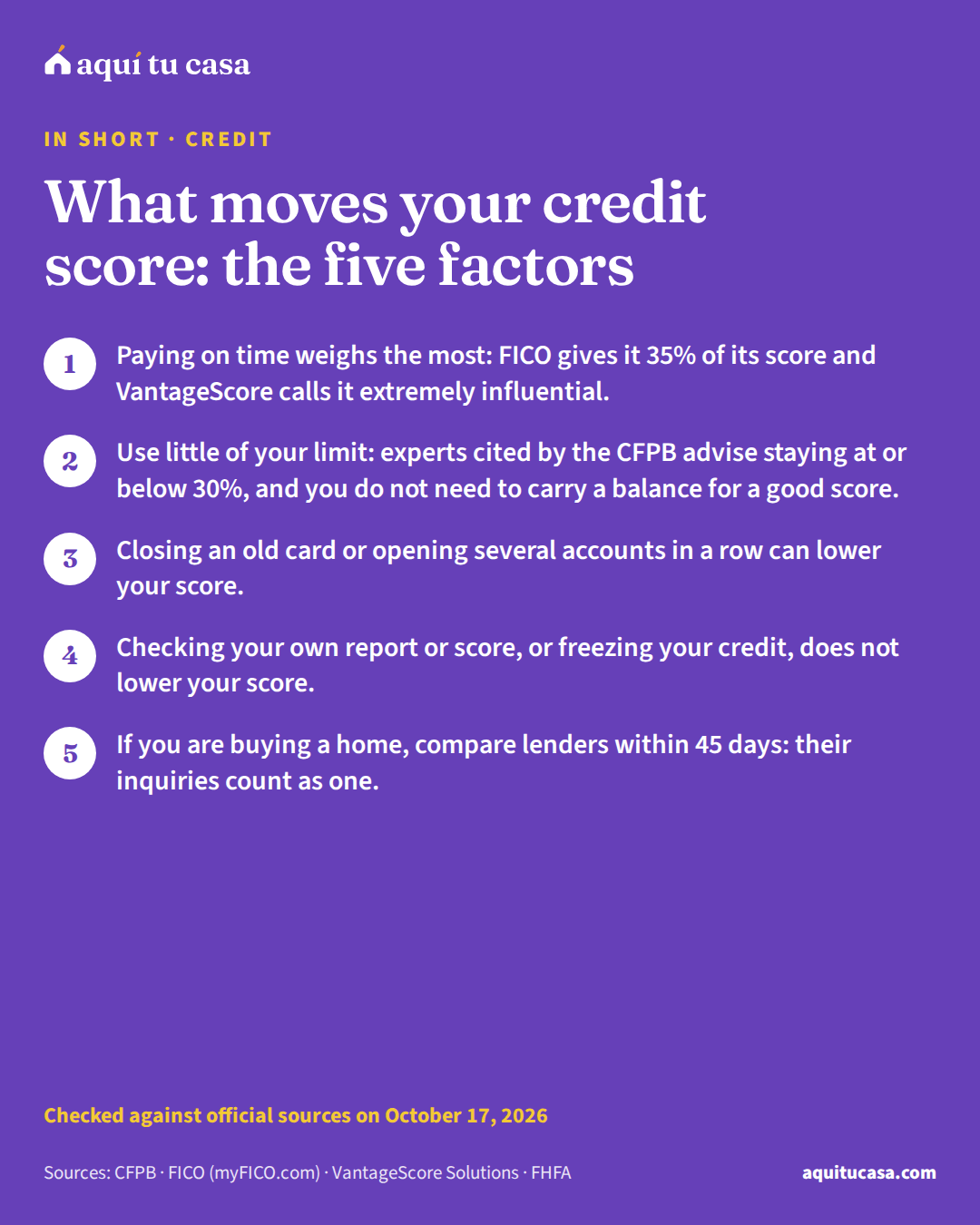
- Credit What moves your credit score: the five factors What raises and lowers your credit score according to the CFPB, FICO and VantageScore: on-time payments, credit use, age, new credit and account mix. 15 minute read
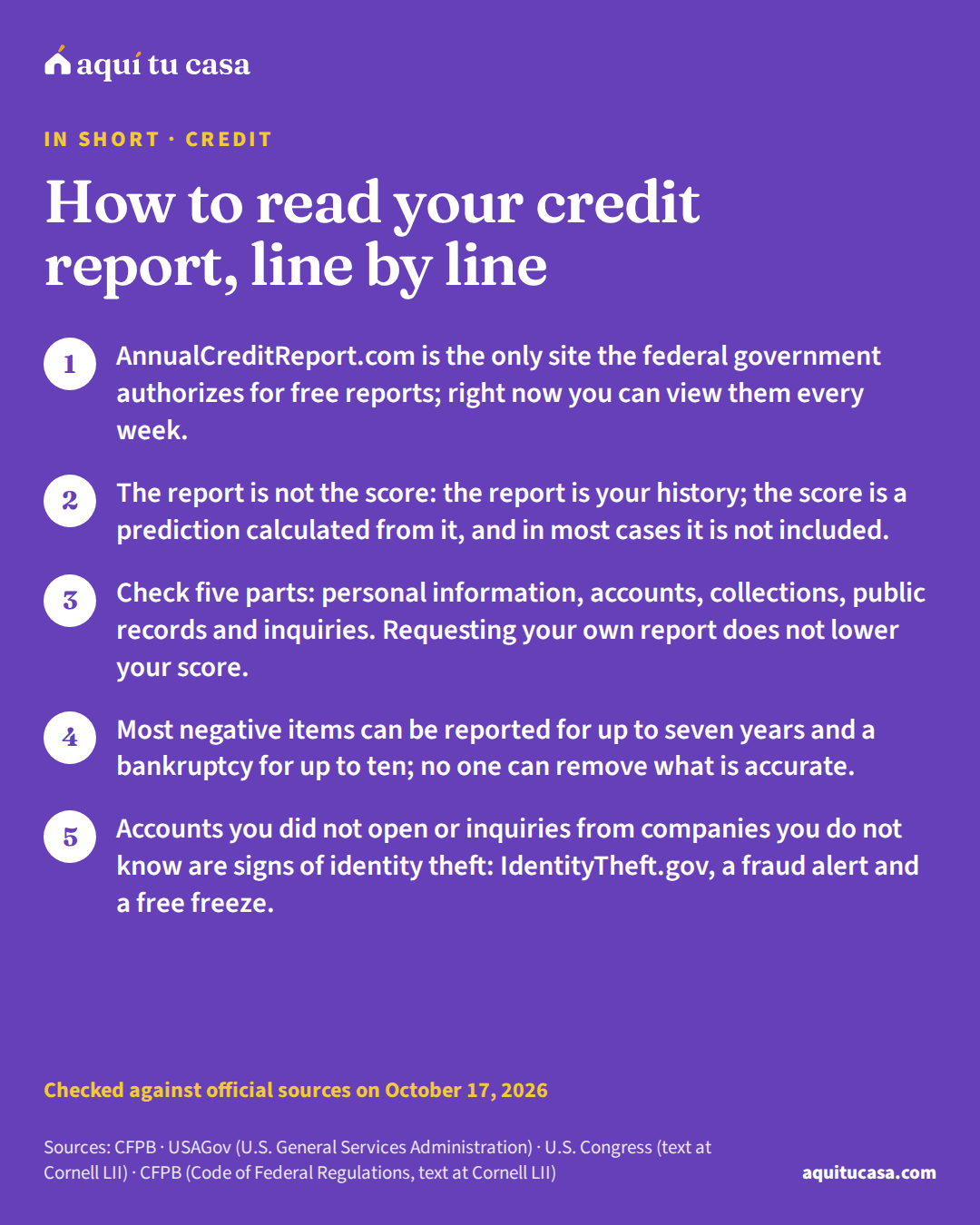
- Credit How to read your credit report, line by line Where to get your free credit reports, what each part says, how long negative items can stay and how to spot errors or identity theft. 13 minute read
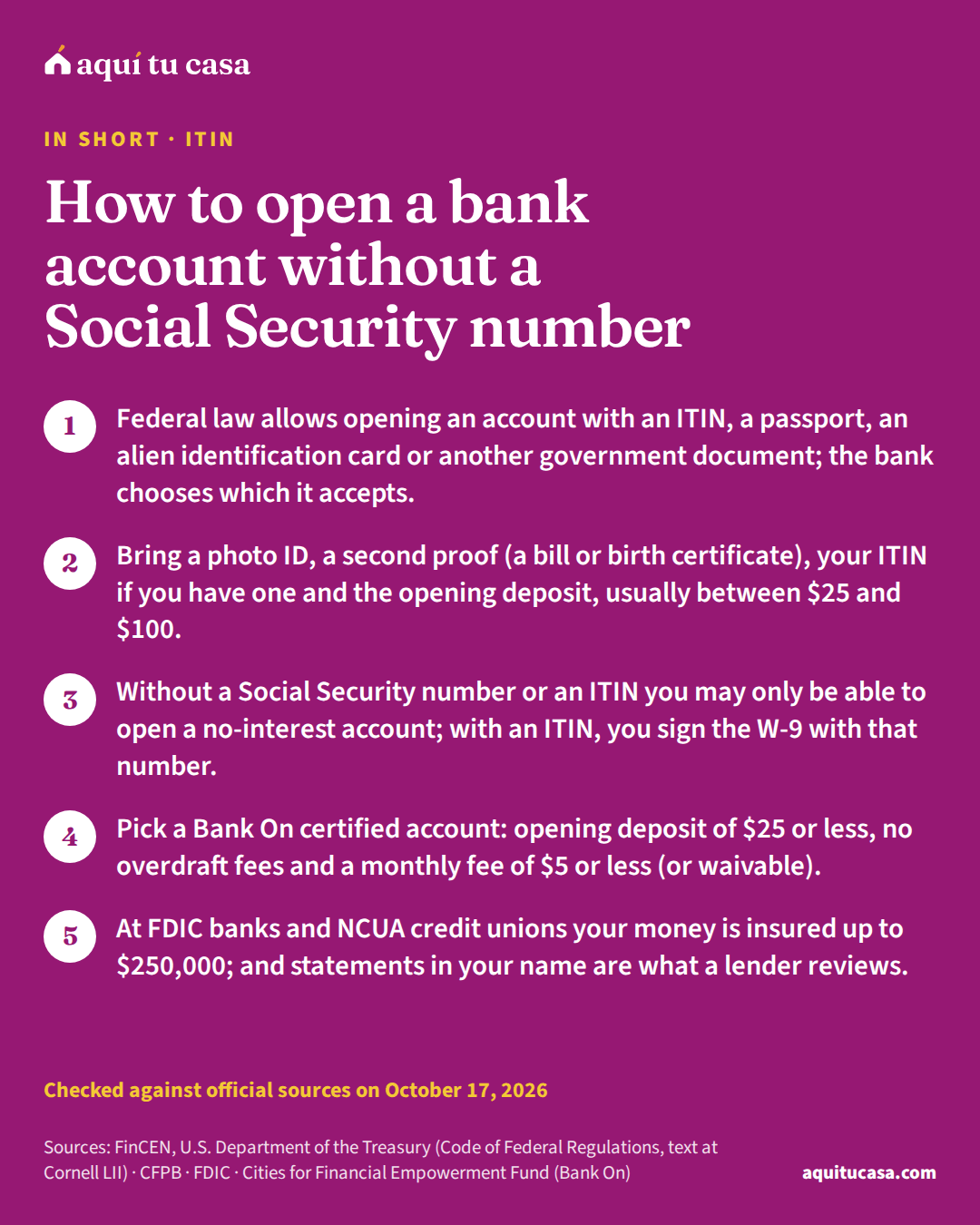
- ITIN How to open a bank account without a Social Security number What banks and credit unions ask for to open an account without a Social Security number (ITIN, passport or consular ID) and which account to pick. 11 minute read
Tools for this topic
Was this guide useful?
Thank you. Your answer stays in your browser; nothing is sent.