A family member was detained: a plan to keep your home
If a relative was detained: how to find them through official channels, protect the rent or mortgage, talk to the servicer and get free help.
Verified against official sources on October 17, 2026 22 official sources

Show contents
In short
What you need to know
Quick answer
First, find your relative only through official channels: ICE has an online detainee locator and the immigration court has a case information system. Then protect your home: if you rent, talk to the landlord early about a payment plan and look for help through 211; no one can force you out by changing the locks without a court order. If you have a mortgage, call the servicer before you fall behind and ask about options to avoid foreclosure; under a federal rule, it cannot start a foreclosure before 120 days of delinquency, with exceptions. Look for free legal help and never pay anyone who promises results.
What matters most
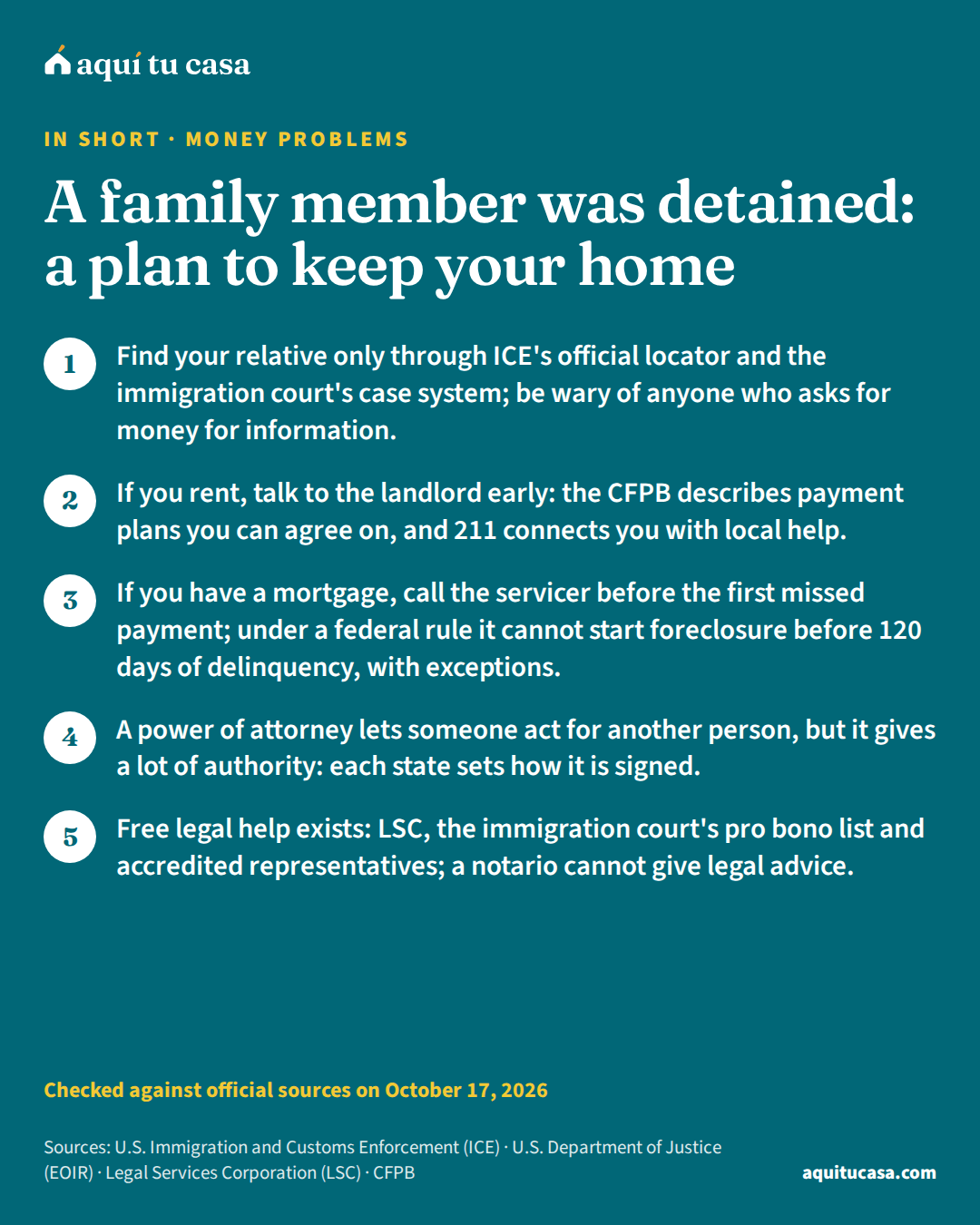
- Find your relative only through ICE's official locator and the immigration court's case system; be wary of anyone who asks for money for information.
- If you rent, talk to the landlord early: the CFPB describes payment plans you can agree on, and 211 connects you with local help.
- If you have a mortgage, call the servicer before the first missed payment; under a federal rule it cannot start foreclosure before 120 days of delinquency, with exceptions.
- A power of attorney lets someone act for another person, but it gives a lot of authority: each state sets how it is signed.
Is this for you?
This guide is for you if…
- Your partner, father, mother or another relative you live with was detained, and you are now in charge of the household.
- Their income is gone and you are worried about paying the rent or the mortgage this month.
- You need to talk to the landlord or the bank about an account in the detained person's name.
Get direct help first if…
- You need help with your relative's immigration case: look for an immigration lawyer or an accredited representative; this guide tells you where to find free help, but it does not cover the case.
- Your question is about custody of the children or about a bond: free legal aid and the immigration court are the places to ask.
If someone in your family was detained and you are now in charge of the household, this guide is for you. It does not cover the immigration case; it covers what you can do so your family does not lose its home in the meantime: find your relative through official channels, talk to the landlord or the bank, organize the household money and find free help. Go step by step; you do not have to solve everything today.
- The number to find local help with rent and utilities
- 21118
- Of delinquency, at most, before the mortgage servicer must try to reach you
- 36 days12
- Of delinquency, at least, before a foreclosure can start, with exceptions
- 120 days14
- For the servicer to evaluate a complete application received in time
- 30 days14
First: find out where they are and who can help
To find your relative, use official channels only. U.S. Immigration and Customs Enforcement (ICE) has an online tool called the Online Detainee Locator System, at locator.ice.gov.1 If your relative has an immigration court case, EOIR’s ACIS system gives basic case information with their A-Number and nationality; it does not show everything, and for bond hearing information you have to call the local court. The only official case documents are the ones the court gives the person or their representative.2
For the case itself, get help from people who are allowed to give it. The immigration court publishes a list of free legal service providers for people in immigration proceedings.3 Only licensed attorneys and accredited representativesDOJ-accredited representativeAn accredited representative is a non-attorney whom the U.S. Department of Justice, through its Recognition and Accreditation Program, authorizes to represent people in immigration matters before DHS and, with full accreditation, before the immigration courts. They may only do so through a recognized organization, which must be a non-profit, federally tax-exempt entity. It is the safe way to get low-cost immigration help: the Department of Justice publishes the official roster by state. Anyone who is not on that roster and is not a lawyer is not authorized to represent you.See the full definition can represent someone; a notarionotary publicIn the United States, a notary public is a person authorized by law to administer oaths and witness signatures on legal documents; the notary verifies who is signing and certifies the signature. The rules for becoming a notary vary by state. It is not the same as a "notario público" in many Latin American countries, where the title means someone with the equivalent of a law license. Here, a notary who is not a lawyer cannot give you legal advice or help you with immigration paperwork. Some states, such as Oregon, forbid them from advertising as a "notario" or "notario público".See the full definition cannot give legal advice.4 The Justice Department publishes the lists of accredited representatives by state.5
A plan in stages
1. Find your relative through official channels
The first days
ICE's locator and, if there is a court case, the ACIS system with the A-Number.2
2. Look for free legal help for the case
The first days
The immigration court's pro bono list and the accredited representatives in your state.3
3. Check what comes in and goes out this month
The first week
If you are short for rent or utilities, 211 helps you find local resources.18
Try it with your numbersFamily budget4. Talk to the landlord or the mortgage servicer
Before the next due date
Explain the situation and ask what options there are. Write down who you spoke with and what they said.10
5. Get whatever you agree on in writing
Once there is an agreement
A rent payment plan or an application to avoid foreclosure, with clear dates.14
If you rent: talk to the landlord early
Check your leaseleaseA lease, or rental agreement, is the contract in which the owner or landlord gives you the right to live in and use a property for a set period of time in exchange for payment, usually rent. While the lease lasts you have possession, but the landlord still owns the property. The lease says how much you pay and when, who handles maintenance and how the agreement can end. Your rights as a tenant are usually spelled out in the lease and in your state and local laws. Before complaining to the landlord, it helps to read the lease and make sure you are also following the rules you agreed to.See the full definition: according to the CFPB, your rights as a tenant are usually spelled out there and in your state or local laws.19 What helps most is not waiting until you fall behind. The CFPB says it is very rare for a landlord to prefer evicting you over receiving rent, and that often the hardest part is starting the conversation.16
There are options you can propose. The CFPB describes several: moving the due date to match your payday or splitting it into several payments; the landlord skipping late penalties as long as you pay what you agreed; smaller payments for a few months; or spreading back rent over, say, six months to a year. It also says many rental assistance programs accept applications from both the landlord and the tenant.17
To look for help, start with organizations in your state and city: 211 connects you with local resources for rent and utilities. Assistance can take several weeks to arrive, so apply early. For electricity and gas there is the LIHEAPLIHEAP (Low Income Home Energy Assistance Program)LIHEAP (the Low Income Home Energy Assistance Program) is a federally funded program that helps with home energy costs, such as heating and cooling. According to the Administration for Children and Families (ACF), it can help with bills, energy crises, preventing shutoffs or reconnecting service, weatherization and minor energy-related repairs. It targets low-income households with a high energy burden or with members who are elderly, disabled or young children. You apply through your local LIHEAP office, and the program does not charge a fee for help.See the full definition program.18 If you are worried about asking for help because of immigration status, the rental help and public charge guide explains what the rules say.
And something important: according to the CFPB, the landlord cannot force you out by changing the locks without a court order.19 If you get an eviction noticeeviction noticeAn eviction notice, also called a notice to quit or notice to vacate, is the written letter in which the landlord demands that you leave the home within a certain time. In general the landlord must give you this notice before starting an eviction case in court. At a minimum it should say why the landlord wants you out and what you can do to avoid it, such as paying the back rent. Your state's law decides when it can be given, how it must be delivered and how much time you get. The notice is not a court order: with the notice alone, the landlord cannot remove you.See the full definition, the guide on what to do if you get an eviction notice explains the steps, and if you can’t pay your rent has more options.
Example with real numbers
What an agreement with your landlord could look like
Options the CFPB describes for renters and landlords. It is an example in words; what you agree on depends on both of you.
- Due date
- Moved to your payday or split into several payments17
- Late fees
- Skipped as long as you pay what you agreed17
- The next few months
- A smaller payment for a while17
- Back rent
- Spread over, say, six months to a year17
Get the agreement in writing. To see what you can afford each month with one income less, use the family budget.
Run it with your numbersFamily budgetIf you have a mortgage: call before the first missed payment
If the home is yours, or your relative’s, the key contact is the loan servicerloan servicerThe loan servicer is the company that sends you your mortgage statements and handles the day-to-day tasks of the loan: it processes your payments, answers your questions, keeps track of principal and interest paid and manages your escrow account, if you have one. It can also offer options if you fall behind and, in certain cases, start a foreclosure. It may be the same company that lent you the money or a different one, and it is common for another company to take over the loan after closing.See the full definition: the company you send the payment to each month, whose number is on your bill. The CFPB recommends calling as soon as you know you cannot pay, asking for a mortgage assistance specialist, asking what options there are to stay in your home and asking questions until you understand what comes next.10 If the loan is in your relative’s name, also ask what authorization they need to talk to you.
Be ready to explain why the payment cannot be made, whether the problem is temporary or permanent, and the household’s income and expenses. If the servicer gives you an assistance application, fill it out. The options it may offer include a repayment plan, forbearanceforbearanceForbearance is an agreement with your loan servicer to pause your mortgage payments, or make smaller payments, for a while when you face a hardship such as losing your job, a natural disaster or unexpected medical costs. It does not erase or reduce what you owe: you have to repay the missed or reduced amounts later. Depending on the agreement, you may repay it all at once at the end, add it to the end of the loan, repay it with a new loan or spread it out through higher payments for a time. You have to request it from your servicer.See the full definition, a loan modificationloan modificationA loan modification is a change in the terms of your mortgage that you agree on with your loan servicer when you have trouble paying. It is a type of loss mitigation, meaning one of the options to avoid foreclosure. It can extend the time you have to repay, lower the interest rate, or defer or reduce part of the principal balance, which can lower your monthly payment. Often you start with a trial modification for a few months; if you make those payments on time, the change becomes permanent.See the full definition, refinancing, a short sale or a deed-in-lieu of foreclosure.11 With forbearance you still owe the full amount; before accepting, ask how much you will pay, for how long and how you will pay back what was paused.15
Regulation X sets timelines worth knowing. The servicer must try to make live contact with a delinquent borrower no later than the 36th day of delinquency and send a written notice no later than the 45th day, with examples of options.12 It cannot start a foreclosureforeclosureForeclosure is the process by which the lender or servicer takes back the property after the homeowner fails to make mortgage payments. The rules and timelines depend on each state; all of them include advance notices and, in general, time to catch up or ask for an alternative, such as a repayment plan or a loan modification. If you fall behind, call your servicer and a HUD-approved housing counseling agency early: foreclosure counseling is free and exists for exactly this.See the full definition before 120 days of delinquency, with exceptions.14 If you submit a complete application more than 37 days before a sale, it must evaluate it within 30 days.14 These rules have exceptions, for example for small servicers, and they apply to a principal residence.13
A HUD-approved housing counselorHUD-approved housing counselorA HUD-approved housing counselor works at an agency HUD has approved to provide housing counseling: independent, expert advice customized to your situation about buying a home, renting, a missed mortgage payment, a foreclosure or credit problems. The agencies usually charge little or nothing; many serve in Spanish and offer the homebuyer education course several assistance programs require. They are not lenders or real estate agents and sell you nothing. Your county page lists the official agencies with phone numbers.See the full definition gives free help to avoid foreclosure and to build a budget; the HOPE Hotline answers 24 hours a day at (888) 995-4673.11 No one should charge you for that help: being asked to pay upfront or being guaranteed you will not lose the home are signs of a scam.11 The if you can’t pay your mortgage guide explains each option.
Renting or owning: what to do first
Your contact is the landlord
If you rent
Either way, start the conversation early and write down every call.1610

Who can speak for the detained person
Many accounts are in one person’s name. The CFPB explains that, for a relative to help with money, there are options such as a convenience account, adding trusted contacts to the accounts or a power of attorney. With a power of attorney, the account stays in the name of the person who signs it, and if a copy is shared with the bank, the bank should honor it.20
A power of attorney is a legal document that lets another person act on behalf of the person who signs it, and it can also be used short term, for example to pay bills while they are away. It gives a great deal of authority over money without regular oversight, so you only name someone you really trust, and it can be revoked.21 Each state sets how it is signed. In Florida, for example, the agent must be 18 or older and the power of attorney is signed by the person granting it and two witnesses, and acknowledged before a notary public.22

Legal help and a budget, without paying anyone
The Legal Services Corporation (LSC) funds civil legal aid offices for low-income people in every state; on its site you find the nearest one with your address or city.8 Among other things, legal aid represents families facing eviction or foreclosure and helps with child custody and support.9 The free legal aid guide explains who qualifies. For the immigration case, use the immigration court’s pro bono list3 or an accredited representative.5
For the household money, the family budget tool helps you see what comes in and goes out with one income less, and the family budget with several incomes guide explains how to organize it. A HUD-approved housing counselor can also help with your budget, at little or no cost.11
If this is you
You rent and the lease is in your relative's name
Talk to the landlord before you fall behind and propose a plan.16 No one can force you out without a court order.19
The mortgage is in your relative's name
Call the servicer and ask what authorization it needs to talk to you and what options there are.10

Costly mistakes
Mistake: Paying someone who promises to get your relative out or 'fix' the case.
Instead: No one can guarantee results; use the pro bono list or an accredited representative.73
Mistake: Stopping payments without telling anyone and waiting to see what happens.
Instead: Talk to the landlord or the servicer before the due date.1610
Mistake: Leaving the home because someone told you that you will be put out.
Instead: A legal eviction goes through court; no one can change your locks without an order.19
Mistake: Paying a company to negotiate with the bank.
Instead: Help to avoid foreclosure is free from the servicer or a HUD-approved counselor.11
Mistake: Signing a power of attorney for someone you do not know well.
Instead: A power of attorney gives a lot of authority over money: only name someone you really trust.21
What to do this week
- Find your relative in ICE’s official locator and, if they have an A-Number, check their case in the ACIS system.12
- Look for free legal help for the case on the immigration court’s pro bono list.3
- List the due dates for rent or mortgage and utilities, and review your budget.18
- Call the landlord or the servicer before the next due date and write down who you spoke with.1610
- If money is short, call 211; if you have a mortgage, also the HOPE Hotline, (888) 995-4673.1811
- Find your nearest legal aid office on LSC’s site.8
Your household this month
Let's do the math
Left each month
Enter what at least one person takes home to see the result.
What helps
- Pay savings first: set the goal aside the day the money arrives, before flexible spending.
- Add up the bills that come every few months (car insurance, school) and divide by twelve.
- If income changes, plan on a low month and save the extra from good months.
- A HUD-approved housing counselor can go over the budget with you, often for free.
This is a planning tool with your numbers, not a credit evaluation or an approval. The split reference is only a guide.
Ready to see the numbers? Find your county here
See how this applies in your county: its loan limits, prices and rents, from the official data.
Printable checklist
Frequently asked questions
How do I find out where my relative is?
ICE has an official online tool, the Online Detainee Locator System, at locator.ice.gov. If your relative has an immigration court case, EOIR's ACIS system gives basic information with their A-Number and nationality. Use only those official pages and be wary of anyone who asks for money for information.
Do I still have to pay the rent?
Your obligations are in your lease and your state's laws. If you are short, the CFPB recommends talking to the landlord: it is very rare for a landlord to prefer evicting you over receiving rent, and you can agree to change the due date, make smaller payments for a few months or spread out what is overdue. 211 also helps you look for local rental assistance.
Can I be put out of the home because my relative was detained?
According to the CFPB, a landlord cannot force you out by changing the locks without a court order. An eviction is a legal process that goes before a judge. If you get a notice, do not ignore it and look for free legal help.
The mortgage is in the detained person's name. What do I do?
Call the loan servicer as soon as possible, explain the situation and ask what options there are to stay in the home and what authorization it needs to talk to you. Under a federal rule, the servicer must try to reach a delinquent borrower no later than the 36th day of delinquency and cannot start foreclosure before 120 days, with exceptions. A HUD-approved housing counselor can help you for free.
What is a power of attorney and do I need one?
According to the CFPB, it is a legal document that lets another person act on behalf of the person who signs it, including for a short time, for example to pay bills. It gives a lot of authority over money, so you only name someone you really trust, and it can be revoked. Each state sets how it is signed; free legal aid can guide you on your case.
Where can I get free legal help?
LSC funds civil legal aid offices in every state. For the immigration case, the immigration court publishes a list of free legal service providers and the Justice Department publishes lists of accredited representatives by state.
Someone called saying they can get my relative out if I pay. Is that real?
EOIR warns that its employees never call to ask for personal information or money, and says not to trust anyone who guarantees results or claims a special relationship with the courts. You can report it to EOIR.Fraud.Program@usdoj.gov.
Sources
Every figure in this guide comes from one of these official sources. The number next to a sentence leads to the source behind it.
Each source on one line: who publishes it, its title, its address and the date we read it.
- 1. U.S. Immigration and Customs Enforcement (ICE) · Online Detainee Locator System · locator.ice.gov · Accessed October 17, 2026
- 2. U.S. Department of Justice (EOIR) · Automated Case Information System (ACIS) · acis.eoir.justice.gov · Accessed October 17, 2026
- 3. U.S. Department of Justice (EOIR) · List of Pro Bono Legal Service Providers · justice.gov · Accessed October 17, 2026
- 4. U.S. Department of Justice (EOIR) · Can Someone Represent You Before EOIR? · justice.gov · Accessed October 17, 2026
- 5. U.S. Department of Justice (EOIR) · Recognition & Accreditation Roster Reports · justice.gov · Accessed October 17, 2026
- 6. U.S. Department of Justice (EOIR) · Fraud and Abuse Prevention Program · justice.gov · Accessed October 17, 2026
- 7. U.S. Department of Justice (EOIR) · Self-Help Guide: Are You a Victim of Fraud? How to Protect Yourself from Fraud · justice.gov · Accessed October 17, 2026
- 8. Legal Services Corporation (LSC) · I Need Legal Help · lsc.gov · Accessed October 17, 2026
See the other 14 sources
- 9. Legal Services Corporation (LSC) · What are Legal Services? · lsc.gov · Accessed October 17, 2026
- 10. CFPB · How to work with your mortgage servicer · consumerfinance.gov · Accessed October 17, 2026
- 11. CFPB · If I can't pay my mortgage loan, what are my options? · consumerfinance.gov · Accessed October 17, 2026
- 12. CFPB (Code of Federal Regulations, text at Cornell LII) · 12 CFR §1024.39, Early intervention requirements for certain borrowers (Regulation X) · law.cornell.edu · Accessed October 17, 2026
- 13. CFPB (Code of Federal Regulations, text at Cornell LII) · 12 CFR §1024.30, Scope (Regulation X, servicing) · law.cornell.edu · Accessed October 17, 2026
- 14. CFPB (Code of Federal Regulations, text at Cornell LII) · 12 CFR §1024.41, Loss mitigation procedures (Regulation X) · law.cornell.edu · Accessed October 17, 2026
- 15. CFPB · What is mortgage forbearance? · consumerfinance.gov · Accessed October 17, 2026
- 16. CFPB · What to do if you're facing eviction · consumerfinance.gov · Accessed October 17, 2026
- 17. CFPB · Start a conversation about rent repayment · consumerfinance.gov · Accessed October 17, 2026
- 18. CFPB · Get help paying rent and bills · consumerfinance.gov · Accessed October 17, 2026
- 19. CFPB · Your tenant and debt collection rights · consumerfinance.gov · Accessed October 17, 2026
- 20. CFPB · Can a family member or friend help me with bill paying and banking? · consumerfinance.gov · Accessed October 17, 2026
- 21. CFPB · What is a power of attorney (POA)? · consumerfinance.gov · Accessed October 17, 2026
- 22. Florida Legislature · Florida Statutes §709.2105, Qualifications of agent; execution of power of attorney · leg.state.fl.us · Accessed October 17, 2026
Keep reading
Related guides
If this guide helped, these follow the same path.

Money problems 12 minute read
If a family member is deported: money, papers and the house
What to do with bank accounts, a power of attorney, the mortgage or lease and sending money when a family member is deported or leaves the country.
- Decide early who will help with the money: convenience account, trusted contact or power of attorney.
- A power of attorney gives a lot of authority without oversight; give it only to someone you trust deeply, and it can be revoked.
- If you are named agent, act only in their interest, keep their money separate and keep records.
- Money problems Can't pay your rent: what to do and where to get help If you can't cover the rent: how to talk to your landlord, where to find rental assistance (211, local programs, HUD) and what an eviction requires. 13 minute read
- Money problems Can't pay your mortgage? What to do in the first week Can't pay your mortgage? Call your servicer, learn the options that exist, the federal rules that protect you and the rescue scams to avoid. 14 minute read
- Renting Rental help and public charge: what the rules say What public charge is, what changed in September 2026, whether housing help counts, and where to find rent help and free advice. 10 minute read
Tools for this topic
Was this guide useful?
Thank you. Your answer stays in your browser; nothing is sent.