Chapter 7 vs. Chapter 13 bankruptcy: what happens to your home
How Chapters 7 and 13 differ, the homestead exemption, the required credit counseling course and how long to wait before another mortgage.
Verified against official sources on October 31, 2026 12 official sources

Show contents
In short
What you need to know
Quick answer
Chapter 7 bankruptcy sells the property that is not protected and wipes out many debts in a few months, but it does not remove the mortgage lien on your home: if you do not pay, the lender can still foreclose. Chapter 13 is a three- to five-year payment plan that lets you catch up on a past-due mortgage, as long as you keep paying each new monthly payment. Before filing either one, the law requires a credit counseling course with an agency approved by the Justice Department, within the 180 days before. Talk first with free legal aid or a housing counselor.
What matters most
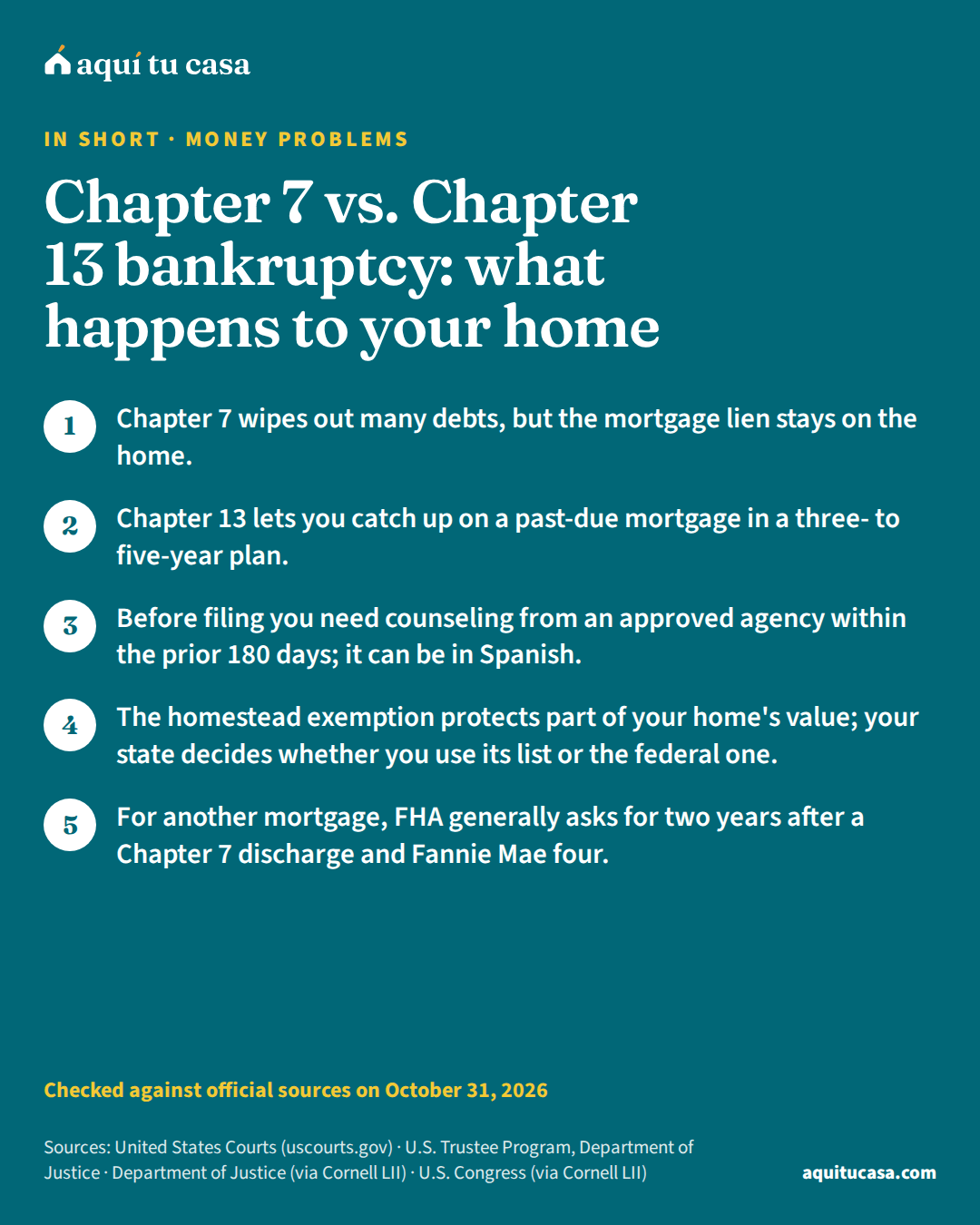
- Chapter 7 wipes out many debts, but the mortgage lien stays on the home.
- Chapter 13 lets you catch up on a past-due mortgage in a three- to five-year plan.
- Before filing you need counseling from an approved agency within the prior 180 days; it can be in Spanish.
- The homestead exemption protects part of your home's value; your state decides whether you use its list or the federal one.
Is this for you?
This guide is for you if…
- You have debts you can no longer pay and someone mentioned bankruptcy.
- You are behind on your mortgage and want to know whether bankruptcy can stop a foreclosure.
- You already went through a bankruptcy and want to know when you can apply for a mortgage again.
Get direct help first if…
- You only missed one or two mortgage payments: read «If you can't pay your mortgage» first.
- A collection agency is calling you about a debt: read «Debt collection: your rights» first.
Bankruptcy is a federal court process to wipe out debts or pay them through a plan. For a family that owns a home, the big question is what happens to the house and the mortgage. The answer depends on the chapter used, on your state’s exemption rules and on whether you are current on your payments. This guide explains what the federal courts and the law say, so you arrive better prepared to talk with legal aid. It is not legal advice for your case.
Chapter 7 and Chapter 13: two different paths
Families usually use one of these two chapters of the Bankruptcy Code. They work very differently:
Chapter 7 is a liquidation. The court appoints a trustee who administers the case and sells the property that is not exempt. What the law protects is not sold.1 Between 21 and 40 days after filing there is a meeting of creditors: you must attend and answer questions about your money and your property. The wiping out of the debts, called the discharge, generally comes 60 to 90 days after the date first set for that meeting.1 If your monthly income is higher than your state’s median, a means test applies to see whether you can use this chapter.1
Chapter 13 is a payment plan. It is for people with regular income. You propose a plan to pay your creditors over three to five years, and you start paying the trustee within 30 days.2 If you stop making plan payments, the court may dismiss the case or convert it to Chapter 7.2
What each chapter does with your home
Liquidation
Chapter 7
- The trustee sells the property that is not exempt
- The discharge comes in a few months
- The mortgage stays on the home: if you do not pay, the lender can foreclose
- To keep secured property, you can reaffirm the debt
Payment plan
Chapter 13
- You pay a three- to five-year plan
- You catch up on past-due mortgage payments over time
- You must keep paying each new mortgage payment on time
- It also protects people who signed debts with you
Which one fits depends on your income, your property and your state's law: review it with legal aid before filing.
What happens to your home and your mortgage
The automatic stay. Filing under either chapter automatically stops most collection actions against you and your property.1 This can pause a foreclosureforeclosureForeclosure is the process by which the lender or servicer takes back the property after the homeowner fails to make mortgage payments. The rules and timelines depend on each state; all of them include advance notices and, in general, time to catch up or ask for an alternative, such as a repayment plan or a loan modification. If you fall behind, call your servicer and a HUD-approved housing counseling agency early: foreclosure counseling is free and exists for exactly this.See the full definition for a while, but it does not solve the debt by itself.
In Chapter 7, the lien stays. The discharge wipes out your personal obligation on many debts, but it does not remove the lienlienA lien is a legal right a creditor holds in your property to make sure you repay a debt. It usually prevents the property from being sold until the debt is paid, and if you do not pay, the creditor may be able to take the property. Your mortgage is a lien on your home: when you pay it off, the lien is released and that shows up in your county's property records. There are other kinds, such as a federal tax lien, which is the government's legal claim against all your property when you do not pay a tax debt.See the full definition on the home. A secured creditor can keep the right to seize the property that backs the debt.1 In plain terms: if you do not keep paying the mortgage, the lender can still foreclose. If you want to keep secured property, you can reaffirm the debt: you sign an agreement under which you stay liable and the creditor does not take the property while you keep paying.1
In Chapter 13, you can catch up. According to the federal courts, the most significant feature of this chapter is that it gives you a chance to save your home from foreclosure, because it lets you pay mortgage arrears over time within the plan. The condition is clear: you must make on time every mortgage payment that comes due during the plan.2 And if someone signed a debt with you, Chapter 13 has a special protection for that person.2
The guide The foreclosure process step by step explains the timeline in your state, so you know how much time you have.
The homestead exemption: how much of your home is protected
In bankruptcy, an exemption is the part of your property that the law does not let anyone sell to pay creditors. The homestead exemption protects your interest in the home where you or someone who depends on you lives.7 Do not confuse it with the property tax homestead exemption: the names are similar, but they are different rules.
The Bankruptcy Code lets you use the federal exemption list or your state’s list, unless your state does not allow the federal one. The state that counts is generally where you lived for the 730 days before filing.7 The federal homestead exemption has a cap that is adjusted over time: since April 1, 2025 it is $31,575. In a joint case, for example a married couple, the rule applies separately to each debtor.7 Many states have their own lists, with different caps. That is why the question “do I keep the house?” is answered case by case, with your state’s law in hand.
Example with real numbers
How the protected part of a home is thought through
An example in words, not a real case or a calculation for your state.
- Value of the home
- What it could sell for today
- Minus what you owe on the mortgage
- The lien stays on the home
- What is left is your interest (equity)
- That is what the exemption can protect
- Homestead exemption
- Federal or your state's, depending on where you lived the last 730 days
- What gets reviewed with legal aid
- Whether your interest in the home fits within the exemption that applies to you
The rules come from 11 U.S.C. §522 and the federal courts.71 Use the family budget to see whether you can keep paying the mortgage each month.
Run it with your numbersFamily budget
The required credit counseling course
Before filing a Chapter 7 or 13 bankruptcy, you must receive credit counseling from an approved agency within the 180 days before.2 If you do not complete it before filing, the case could be dismissed. After filing there is a second course, debtor education, which you generally must complete to receive the discharge.5
The Justice Department’s U.S. Trustee Program publishes the list of approved agencies at justice.gov/ust. Many offer services in other languages and the list can be filtered for Spanish. In some places counseling is only by internet or telephone. Cases in Alabama and North Carolina are not under this program: there you ask the district’s Bankruptcy Administrator.4
If you cannot pay for the course: an approved agency must waive its fee in whole or in part if you show you cannot pay it. You are presumed unable to pay if your household’s current income is less than 150% of the poverty guidelines.6 Ask for the waiver before you start. Note: this course is not the same as a debt management plandebt management planA debt management plan is a payment plan that a credit counseling organization, usually a nonprofit, sets up with you. According to the CFPB, you make a single payment to the organization each month or pay period, and it pays your creditors. The plan does not erase your debts: it aims to lower your total monthly payment, for example with more time to repay or lower interest rates, if your creditors agree. The organization may charge fees. Before you send any money, the CFPB recommends confirming with your creditors that they accepted the plan.See the full definition, even though some agencies offer both.
From the first step to the discharge
1. Look for free legal aid
Before deciding
Ask whether bankruptcy makes sense and which chapter to use in your state.3
2. Take credit counseling
Up to 180 days before
With an agency on the Justice Department list; it can be in Spanish.2
4. Attend the meeting of creditors
21 to 40 days later
You answer questions about your money and your property.1
6. Receive the discharge
Chapter 7, a few months; Chapter 13, at the end of the plan
In Chapter 13 it comes after all plan payments are made.2
What it costs and what is not wiped out
In Chapter 7, the courts charge a $245 filing fee, a $75 administrative fee and a $15 trustee surcharge. With the court’s permission you can pay in installments, and if your income is less than 150% of the poverty level and you cannot pay even in installments, the court may waive them.1 In Chapter 13, the filing fee is $235 plus the $75 administrative fee.2
Not every debt is wiped out. In Chapter 7, debts that are not discharged include child support and alimony, and certain taxes.1 If you have those debts, you still owe them after the case.

Your credit and your next mortgage
A bankruptcy case can appear on your credit reportcredit reportA credit report is a statement that has information about your credit activity and current credit situation: your loans and cards, the balances, whether you have paid on time, accounts in collection and who has checked your credit. Credit reporting companies, also called credit bureaus, compile it from what banks and creditors report; your credit score is computed from it. When you apply for a mortgage, the lender pulls your report from the three bureaus. You have the right to see it for free and to dispute anything that is wrong.See the full definition for up to 10 years from the order for relief, and the report must say which chapter it was under, if the source provides it. That 10-year limit does not apply when the report is used for credit of $150,000 or more.8 Check your report with the guide How to read your credit report.
Buying a home again is possible, with waiting periods:
- FHA: a Chapter 7 does not disqualify you from an FHA loan if at least two years have passed since the discharge, and in that time you re-established good credit or chose not to take on new credit. Twelve to 24 months may be enough if the bankruptcy was caused by circumstances beyond your control and you have managed your money responsibly since. With a Chapter 13, you can qualify once at least 12 months of the plan have passed, with every payment on time and written permission from the court.10
- Conventional (Fannie Mae): after a Chapter 7 the wait is four years from the discharge or dismissal, or two if you document extenuating circumstances. After a Chapter 13, two years from the discharge (no exceptions) or four from the dismissal. With more than one case in the past 7 years, five years. You also need to have re-established traditional credit.9
Use the credit plan to put in order the steps that bring you closer to those dates.
If this is your situation
You owe several months of mortgage
Chapter 13 lets you catch up over time, if you pay each new payment on time.2
You cannot pay for the course or the fees
The agency must waive its fee if you cannot pay, and the court may waive Chapter 7 fees.61
You prefer the course in Spanish
The Justice Department list can be filtered for Spanish.4
You pay child support
That debt is not wiped out in Chapter 7; it is still owed after the case.1
You want to buy a home again
FHA generally asks for two years after a Chapter 7 discharge.10
Free help and how to avoid scams
You can file bankruptcy without an attorney, but the federal courts strongly recommend the advice of a qualified attorney, because the process takes an understanding of legal issues. Bankruptcy petition preparers can only enter information into forms: they cannot give legal advice or take the money for court fees. If you cannot afford an attorney, you may qualify for free legal services.3
The Legal Services Corporation funds legal aidlegal aidLegal aid is the free civil legal help that nonprofit organizations and their lawyers provide to low-income people in civil, not criminal, matters. In housing, that includes representing families facing eviction or foreclosure, alongside matters such as custody, child support, protection from domestic violence and access to benefits. In the United States, the Legal Services Corporation, created by Congress, funds a nationwide network of these organizations; its finder points you to the one in your area. Each sets its own income limits.See the full definition offices in every state; on its website you find the nearest one with your address or city.11 The guide Free legal aid explains how to ask for it. If your problem is the mortgage, a HUD-approved housing counselorHUD-approved housing counselorA HUD-approved housing counselor works at an agency HUD has approved to provide housing counseling: independent, expert advice customized to your situation about buying a home, renting, a missed mortgage payment, a foreclosure or credit problems. The agencies usually charge little or nothing; many serve in Spanish and offer the homebuyer education course several assistance programs require. They are not lenders or real estate agents and sell you nothing. Your county page lists the official agencies with phone numbers.See the full definition can review the options with you, often for free.12 See the guide to HUD-approved housing counselors.
Be wary of anyone who promises to “save the house” for an upfront payment or for you to sign the deed over to them. The guide Loan modification and foreclosure rescue scams explains the warning signs.

Costly mistakes
Mistake: Filing bankruptcy without having taken credit counseling.
Instead: Take it with an approved agency within the 180 days before; otherwise the case could be dismissed.5
Mistake: Believing Chapter 7 erases the mortgage on the home.
Instead: The lien stays; if you do not pay, the lender can still foreclose.1
Mistake: Stopping mortgage payments during the Chapter 13 plan.
Instead: You must make each new payment on time; if the plan fails, the case may be dismissed.22
Mistake: Asking a petition preparer for legal advice.
Instead: They can only fill in forms; look for free legal aid.3
Mistake: Forgetting the second course after filing.
Instead: Debtor education is generally required for the discharge.5
Mistake: Paying the course fee without asking for a waiver.
Instead: The agency must waive it if you cannot pay.6
What to do this week
- Make a list of your debts and set apart the mortgage, child support and taxes.1
- If you are behind on the mortgage, call your servicer and a HUD-approved housing counselor.12
- Find a free legal aid office with the LSC search tool.11
- If you decide to go ahead, take credit counseling with an agency on the Justice Department list, in Spanish if you want.4
- Check your credit reports and put your steps in order with the credit plan.8
- Read Debt collection: your rights if you are getting calls about a debt.
Your situation
If you have never had a card or a loan in the U.S., choose "None".
Your credit plan
12 steps
You have done 0 of 12.
This week
Get your three credit reports for free
At AnnualCreditReport.com you can get the Equifax, Experian and TransUnion reports for free once a week. Checking your own report does not lower your score. If it comes up empty, that is not an error: you simply have no history yet.
Source: CFPB: How do I get a free copy of my credit reports? ↗ · CFPB: Does requesting my credit report hurt my credit score? ↗
Dispute any error in writing
Write to the credit bureau and to the company that reported the item, with copies of your proof, by certified mail. By law, the bureau must investigate again for free and resolve it within 30 days of receiving your notice.
Source: CFPB: How do I dispute an error on my credit report? ↗ · Congreso de EE. UU. (texto en Cornell LII): Fair Credit Reporting Act, 15 U.S.C. §1681i, Procedure in case of disputed accuracy ↗
Talk to a HUD-approved housing counselor
They give independent advice on buying, renting, defaults and credit, often free or at low cost. You can go over your report and your plan with them.
Source: CFPB: Find a Housing Counselor ↗
This month
Open a secured card
You deposit an amount (for example, $500) and can spend up to that amount. With on-time payments, the limit can go up, and the deposit comes back. Before signing, ask whether they report to all three bureaus and compare the annual fee and the rate: they can be high.
Source: CFPB: What are some ways to start or rebuild a good credit history? ↗ · CFPB: How to rebuild your credit ↗
Or a credit builder loan
The bank or credit union holds the money as savings while you make small payments, usually for six to 24 months; when you finish, you get it. You build history and savings at the same time.
Source: CFPB: What are some ways to start or rebuild a good credit history? ↗
Ask for your rent to be reported
On-time rent payments can help build your credit. Ask your landlord whether they take part in a rent reporting program (often through a payment app) and check its fees.
Set up automatic payments
An automatic payment or a reminder before the statement date prevents the costliest kind of slip: payment history is the main factor in most models.
What does not build credit
Paying with a debit card or cash, prepaid cards and payday loans do not build history, according to the CFPB. They are ways to pay, not accounts that get reported.
From here on
Do not close your first account
A long history of on-time payments helps your score. When a better card comes along, keep the first one open and current.
Only apply for the credit you need
Opening several accounts in a short time is a risk signal for lenders, and each application leaves a hard inquiry that does affect your score.
Source: CFPB: How do I get and keep a good credit score? ↗ · CFPB: What is a credit inquiry? ↗
Watch your debt-to-income ratio
Lenders divide your monthly debt payments by your gross monthly income to see whether you can handle a new loan. While you prepare, avoid new payments, such as a car.
Watch out for "credit repair"
It is a scam if they charge before doing anything, promise to remove accurate negative information, tell you not to contact the bureaus or to dispute everything. Disputing errors is free by law, and if you already signed up for something like this, you can cancel within three business days.
Source: CFPB: How can I tell a credit repair scam from a reputable credit counselor? ↗
An educational plan built on what the CFPB, the NCUA and the federal credit reporting law publish; not individual advice. We recommend no brands and are paid for no product.
Ready to see the numbers? Find your county here
See how this applies in your county: its loan limits, prices and rents, from the official data.
Printable checklist
Frequently asked questions
Will I lose my home if I file for bankruptcy?
Not always. In Chapter 7 the trustee sells the property that is not exempt, and the homestead exemption protects part of your home's value. But the mortgage stays: if you do not pay, the lender can foreclose. Chapter 13 is designed for people who want to keep the home and catch up.
Does bankruptcy stop a foreclosure?
Filing automatically stops most collection actions. In Chapter 13 you can catch up on past-due payments during the plan, as long as you make each new payment on time. In Chapter 7 the pause does not remove the mortgage lien.
Where do I take the credit counseling course?
With an agency on the U.S. Trustee Program list at justice.gov/ust. The list can be filtered for Spanish. In Alabama and North Carolina, ask your district's Bankruptcy Administrator.
How much does the course cost if I have no money?
The approved agency must waive its fee in whole or in part if you show you cannot pay it. You are presumed unable to pay if your household income is less than 150% of the poverty guidelines. Ask before you start.
Does bankruptcy wipe out my child support?
No. According to the federal courts, child support and alimony debts are not discharged in Chapter 7, and neither are certain taxes.
How long does bankruptcy stay on my credit report?
Federal law allows it to appear for up to 10 years from the order for relief. That limit does not apply to credit of $150,000 or more.
When can I buy a home again?
It depends on the program. For FHA, generally two years after a Chapter 7 discharge. Fannie Mae asks for four years after Chapter 7 and two from a Chapter 13 discharge. There are exceptions if you document circumstances beyond your control.
Sources
Every figure in this guide comes from one of these official sources. The number next to a sentence leads to the source behind it.
Each source on one line: who publishes it, its title, its address and the date we read it.
- 1. United States Courts (uscourts.gov) · Chapter 7 - Bankruptcy Basics · uscourts.gov · Accessed October 31, 2026
- 2. United States Courts (uscourts.gov) · Chapter 13 - Bankruptcy Basics · uscourts.gov · Accessed October 31, 2026
- 3. United States Courts (uscourts.gov) · Filing Without an Attorney · uscourts.gov · Accessed October 31, 2026
- 4. U.S. Trustee Program, Department of Justice · List of Credit Counseling Agencies Approved Pursuant to 11 U.S.C. 111 · justice.gov · Accessed October 31, 2026
- 5. U.S. Trustee Program, Department of Justice · Credit Counseling & Debtor Education Information · justice.gov · Accessed October 31, 2026
- 6. Department of Justice (via Cornell LII) · 28 CFR §58.21, Minimum requirements to become and remain approved agencies relating to fees · law.cornell.edu · Accessed October 31, 2026
- 7. U.S. Congress (via Cornell LII) · 11 U.S.C. §522, Exemptions · law.cornell.edu · Accessed October 31, 2026
- 8. U.S. Congress (via Cornell LII) · 15 U.S.C. §1681c, Requirements relating to information contained in consumer reports · law.cornell.edu · Accessed October 31, 2026
See the other 4 sources
- 9. Fannie Mae · Selling Guide B3-5.3-07, Significant Derogatory Credit Events — Waiting Periods and Re-establishing Credit · selling-guide.fanniemae.com · Accessed October 31, 2026
- 10. U.S. Department of Housing and Urban Development (HUD) · Handbook 4000.1, FHA Single Family Housing Policy Handbook · hud.gov · Accessed October 31, 2026
- 11. Legal Services Corporation (LSC) · I Need Legal Help · lsc.gov · Accessed October 31, 2026
- 12. Consumer Financial Protection Bureau (CFPB) · Find a housing counselor · consumerfinance.gov · Accessed October 31, 2026
Keep reading
Related guides
If this guide helped, these follow the same path.

Money problems 14 minute read
Can't pay your mortgage? What to do in the first week
Can't pay your mortgage? Call your servicer, learn the options that exist, the federal rules that protect you and the rescue scams to avoid.
- Call your loan servicer as soon as you know you cannot pay; answer its calls and ask about your options.
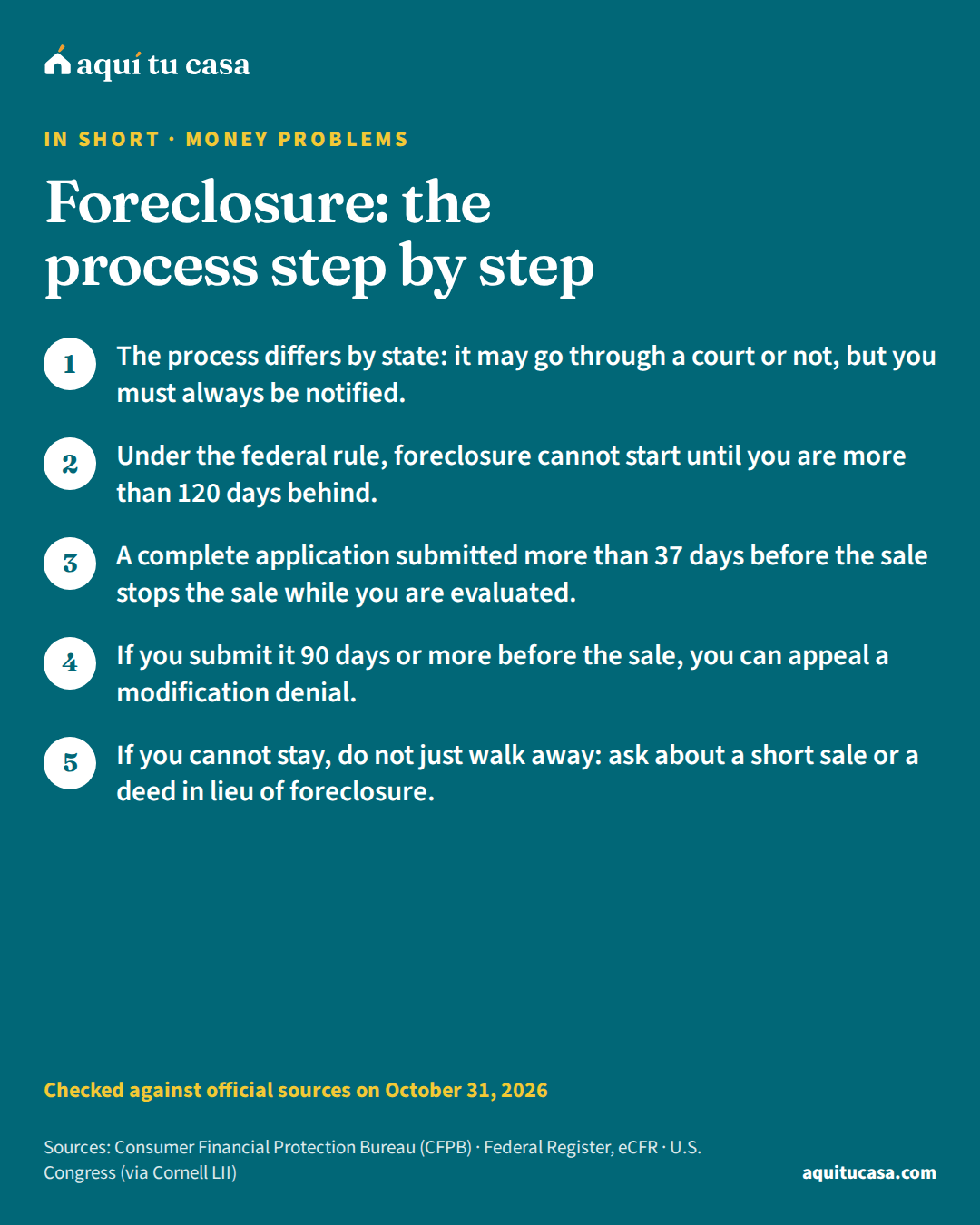
- Under federal regulation, foreclosure generally cannot start until you are more than 120 days behind, with some exceptions.
- A complete application sent in time triggers protections: a written evaluation, a pause in the process and, if a modification is denied, the reason and sometimes an appeal.
- Money problems Foreclosure: the process step by step How foreclosure works, the federal deadlines that protect you before the sale, and what you can still do: apply for help, short sale or deed in lieu. 12 minute read
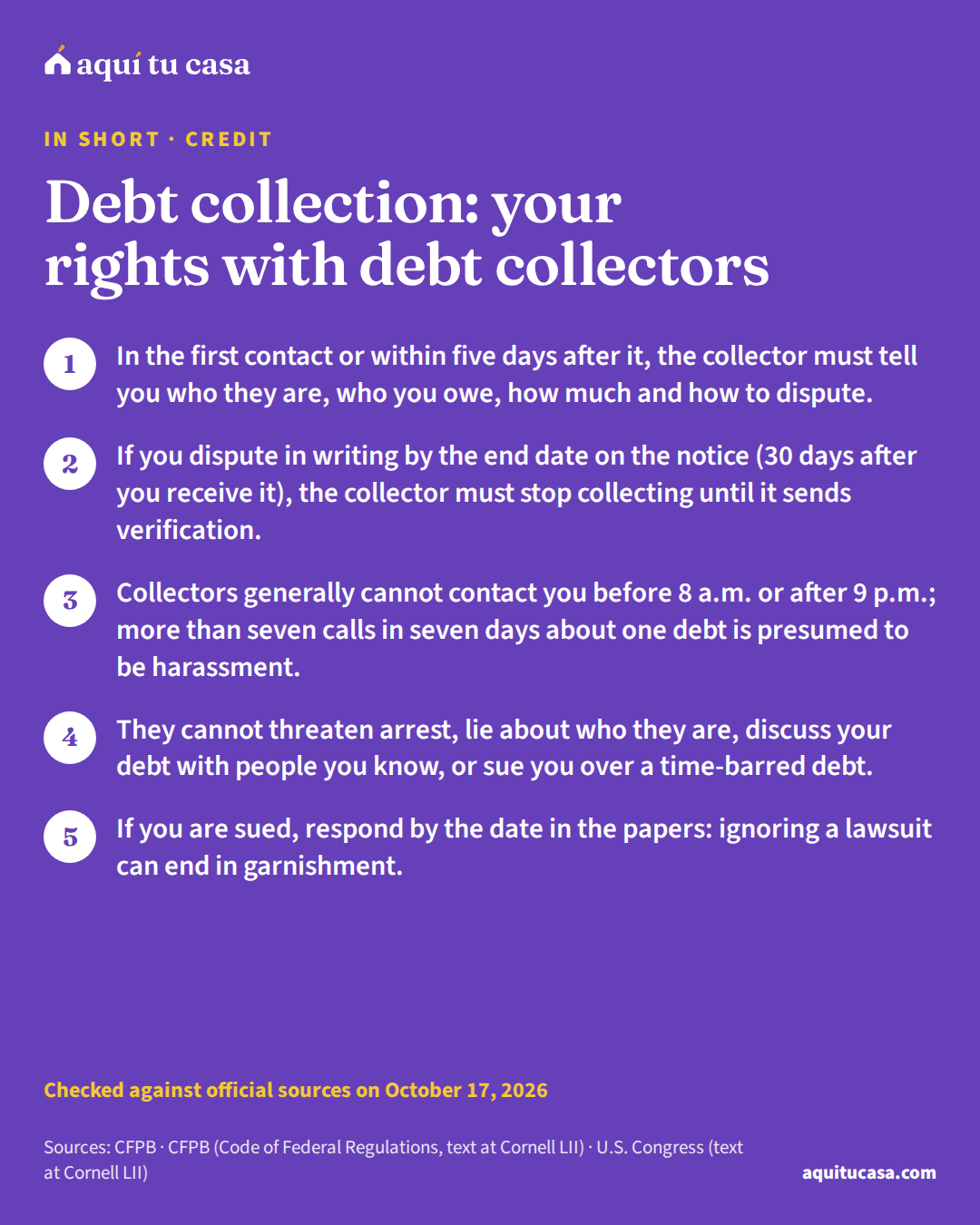
- Credit Debt collection: your rights with debt collectors What a debt collector must tell you, how to dispute in writing, when and how often they can call, old debts, and what to do if you are sued. 16 minute read
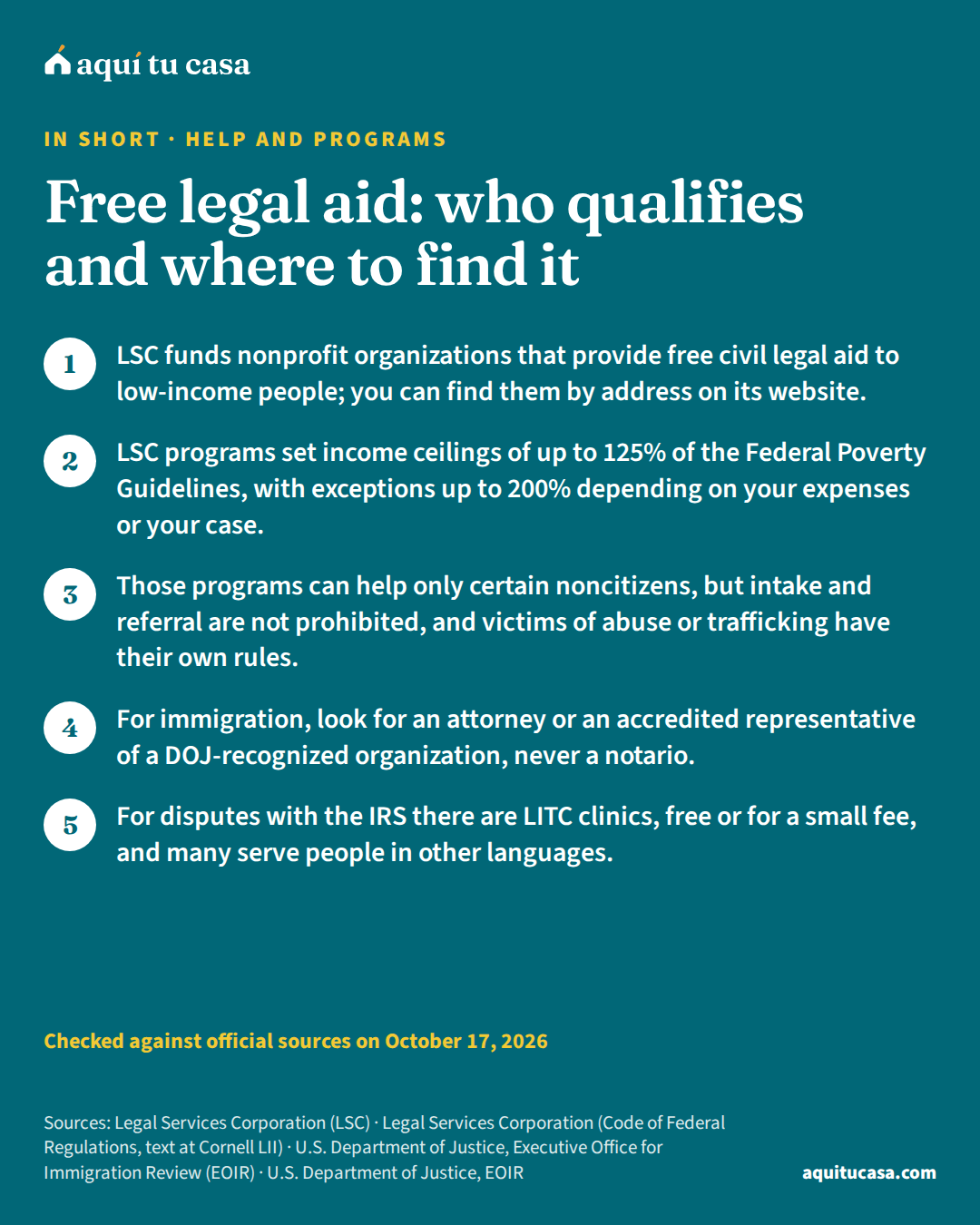
- Help and programs Free legal aid: who qualifies and where to find it What free legal aid is, who qualifies, which rules apply if you are not a citizen, and where to get help with immigration and tax problems. 11 minute read
Tools for this topic
Was this guide useful?
Thank you. Your answer stays in your browser; nothing is sent.