I lost my job: unemployment, housing and health coverage
If you lost your job: how to apply for unemployment, talk to your landlord or lender, keep your health coverage and rebuild your budget.
Verified against official sources on October 17, 2026 13 official sources

Show contents
In short
What you need to know
Quick answer
Apply for unemployment insurance with your state's agency as soon as possible, generally in the state where you worked: each state decides who qualifies and how much it pays, and the first payment usually takes two to three weeks. Before you fall behind, talk to your landlord or call your mortgage servicer to ask about a payment plan or forbearance, and get free help from a HUD-approved housing counselor or by calling 211. If you lost job-based health insurance, you have 60 days to enroll in the Health Insurance Marketplace, or you can choose COBRA if it is offered. Then rebuild your budget with the essentials first.
What matters most
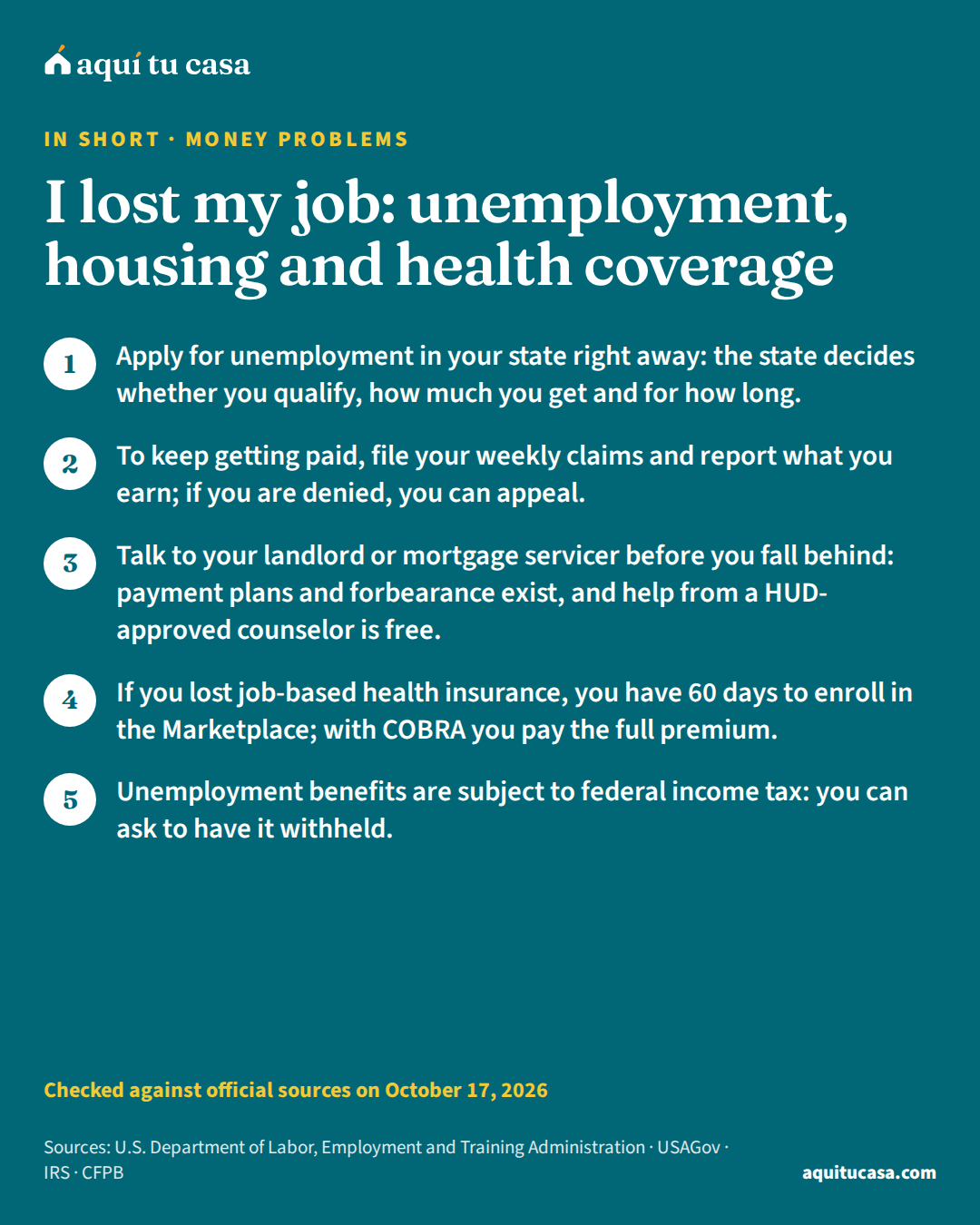
- Apply for unemployment in your state right away: the state decides whether you qualify, how much you get and for how long.
- To keep getting paid, file your weekly claims and report what you earn; if you are denied, you can appeal.
- Talk to your landlord or mortgage servicer before you fall behind: payment plans and forbearance exist, and help from a HUD-approved counselor is free.
- If you lost job-based health insurance, you have 60 days to enroll in the Marketplace; with COBRA you pay the full premium.
Is this for you?
This guide is for you if…
- You were laid off, had your hours cut or your workplace closed, and you do not know where to start.
- You are worried about paying next month's rent or mortgage.
- You lost the health insurance you had through work.
Get direct help first if…
- You already have an eviction notice or a lawsuit: start with the eviction notice guide or contact a legal aid office today.
- You are already several months behind on your mortgage: the guide 'If you can't pay your mortgage' covers the options in more detail.
- You have questions about whether your immigration status lets you apply for benefits: this guide does not answer them; a legal aid office or an accredited representative can guide you.
Losing a job shakes the whole family: money, housing, health coverage. This guide is for anyone who just lost their job, or had their hours cut, and wants to know what to do first: how to apply for unemployment, how to talk to the landlord or lender before falling behind, what happens to health insurance and how to rebuild the budget.
The first days: what to do and in what order
You do not have to solve everything today, but order matters. Some things have deadlines, and others get harder if you wait.
First things first, step by step
1. Apply for unemployment
As soon as possible
Contact your state's unemployment agency; generally, in the state where you worked.1
2. Check your health coverage
This week
You have 60 days from losing job-based coverage to enroll in the Health Insurance Marketplace.13
3. Talk to your landlord or servicer
Before your next due date
Ask about a payment plan or forbearance before you fall behind.8
4. Rebuild your budget
This week
Put housing, food, utilities and health coverage first.
Try it with your numbersFamily budget5. File your weekly claims
Every week or every two weeks
Report what you earn and any job offers you receive or turn down.1
Keep every document about your job loss: the layoff letter if you got one, your last pay stubs, and the names, addresses and dates of your recent jobs. You will be asked for them when you apply for unemployment.1
Unemployment insurance: who qualifies and how to apply
Unemployment insurance pays temporary help to people who lose their job through no fault of their own.2 There is no single federal program: each state runs its own, and each state’s law decides who qualifies, how much is paid and for how long.1
To qualify, you must meet your state’s requirements for what you earned or how long you worked during a “base period.” In most states, that is the first four of the last five completed calendar quarters before you file.1 USAGov explains that many states require that you earned a certain amount or worked consistently in the last 12 to 24 months, and that you are looking for work.2
Where do you apply? Generally in the state where you worked, not where you live. If you worked in another state or remotely, your home state’s unemployment office can help you file in the other one.2 In many states you can apply online or by phone. You will be asked for details such as the addresses and dates of your previous jobs; give complete and correct information so your claim is not delayed.1
How much it pays, when it arrives and what to do each week
Benefits are generally a percentage of what you earned over a recent 52-week period, up to a maximum set by each state. In most states they are paid for a maximum of 26 weeks, and extra weeks may be available when unemployment is high.1
The first payment usually arrives two to three weeks after you apply, and some states have an unpaid one-week waiting period.1 To keep getting paid:1
- File your claims every week or every two weeks and answer the questions about whether you are still eligible.
- Report what you earn from work during those weeks, even a few hours.
- Report any job offers you receive or turn down.
- If you are scheduled for an interview, go: if you miss it, benefits may be denied.
Your local One-Stop employment office offers free re-employment services, such as job referrals and training programs.1
If you are denied. You have the right to appeal. The state will tell you your appeal rights, and you must appeal within the time frame it sets.1 Read the decision letter carefully and note the deadline.
Taxes. Unemployment benefits are subject to federal income tax, and you can have the state withhold it.1 The IRS explains that you can request withholding with Form W-4V, and that at the end of the year you will receive a Form 1099-GForm 1099Form 1099 is a family of IRS information returns that report income other than employee wages. Anyone who paid you in the course of their business must file it with the IRS and send you a copy, on paper or electronically, early in the year. There are several types: 1099-NEC for freelance or contract work, 1099-K for payments by card or through online platforms, 1099-INT for bank interest, 1099-G for government payments such as unemployment, and 1099-MISC for other income. You use that information on your tax return.See the full definition showing what you were paid. If you get a 1099-G for money you never received, it may be fraud: tell your state agency and ask for a corrected one.3

Your home: talk before you fall behind
With housing, what helps most is talking before you are behind.
If you rent or if you have a mortgage
Talk to your landlord
If you rent
Either way, explain what happened and what you are doing to get back on your feet: calling before you fall behind gives you more options.10
If you rent. The CFPB explains that besides applying for rental help, you can talk with your landlord about a repayment plan. Some options: changing the due date to line up with payday, splitting rent into two payments, forgiving late fees if you pay something, accepting a smaller payment for a few months or repaying back rent over time. Explain why you want to work it out and what you are doing to make ends meet.5
To find help, the CFPB says to start with organizations in your state, county or city, and to call 211. For electric and gas bills there is LIHEAP and a national referral line, (866) 674-6327. Some HUD-approved agencies offer low- or no-cost rental counseling, at 800-569-4287.6 The guide If you can’t pay your rent explains what to do if you are already behind.
If you have a mortgage. The CFPB says to call your loan servicerloan servicerThe loan servicer is the company that sends you your mortgage statements and handles the day-to-day tasks of the loan: it processes your payments, answers your questions, keeps track of principal and interest paid and manages your escrow account, if you have one. It can also offer options if you fall behind and, in certain cases, start a foreclosure. It may be the same company that lent you the money or a different one, and it is common for another company to take over the loan after closing.See the full definition right away; the number is on your monthly statement. Be ready to explain why you cannot pay, whether the problem is temporary or permanent, and your income and expenses.9 You can start, as the CFPB suggests, by saying “I recently lost my job,” and ask what options exist to reduce or pause payments, when late fees will be waived and whether interest is charged during forbearance.10
ForbearanceforbearanceForbearance is an agreement with your loan servicer to pause your mortgage payments, or make smaller payments, for a while when you face a hardship such as losing your job, a natural disaster or unexpected medical costs. It does not erase or reduce what you owe: you have to repay the missed or reduced amounts later. Depending on the agreement, you may repay it all at once at the end, add it to the end of the loan, repay it with a new loan or spread it out through higher payments for a time. You have to request it from your servicer.See the full definition lets you pause or reduce payments for a while, but it does not erase the debt: you pay back later what you did not pay. Keep asking until you understand how much you will pay and for how long, how interest accrues and when and how you will repay what you missed. Some servicers require you to request it within a certain time after the event.8 If you do fall behind, the regulation requires your servicer to try to reach you by the 36th day of delinquency and tell you about your options.11
You do not have to pay anyone to avoid foreclosure: a HUD-approved counselor helps for free.9 The guide If you can’t pay your mortgage covers each option, and the guide to HUD-approved housing counselors shows how to find one.
Your health coverage
If you had health insurance through work, check your options this week. HealthCare.gov explains that if you are unemployed, you have options:12
- The Health Insurance Marketplace. One application tells you whether you qualify for a Marketplace plan, Medicaid or CHIP. Savings and eligibility depend on your household size and estimated income for the year, not on whether you have a job.12
- COBRA, if your former employer offers it. It lets you keep coverage for a while, but you pay 100% of the premium, including the part your employer used to pay, plus a small administrative fee.12
Timing matters. You may qualify for a Special Enrollment Period if you lost job-based coverage in the past 60 days or expect to lose it in the next 60 days. And when your COBRA ends, you also have 60 days to enroll in the Marketplace.13 If you cannot afford a plan, you can find low-cost care at a community health center. HealthCare.gov’s help line is 1-800-318-2596.12
Your emergency budget
With less income, your budget changes overnight. Start with what keeps your family housed, fed, with utilities and health care, and leave for later what can wait. An emergency fundemergency fundAn emergency fund is cash you set aside only for unplanned expenses or emergencies, such as car or home repairs, medical bills or a loss of income. It is not for routine monthly spending. The CFPB explains that without savings, even a small financial shock can push you into debt that is hard to pay off. How much you need depends on your situation; the CFPB suggests thinking about the unexpected expenses you have had before. You can keep it in a bank or credit union account, on a prepaid card or in cash, and it grows more easily with automatic saving or part of a tax refund.See the full definition, if you had one, exists for exactly this.
Example with real numbers
How much rent weighs in a typical household
With typical US household income and rent, to see why housing is the first thing worth talking about.
- Typical household income, per month
- $6,728
- Typical US rent
- $1,413
- Rent equal to 30% of typical income
- $2,018
This is an example with national numbers. HUD uses 30% of monthly adjusted income as a benchmark in its housing programs;7 if your income drops, the same rent weighs more. Run the numbers with your own figures.
Run it with your numbersFamily budget
The family budget tool helps you see, with your numbers, how much comes in and goes out each week. The guide to a budget with several incomes explains how to organize money when there is more than one income at home, and the emergency fund guide covers rebuilding one when you are back at work. If debt collectors call about past-due bills, the guide to debt collection explains your rights.

Watch out for unemployment scams
When you lose your job, you also become a target for scams. USAGov warns that scammers file for unemployment benefits using other people’s names and information. Warning signs: you filled out your application on a fake website, or the unemployment office rejected you because a claim was already filed in your name.4
If that happens, report it to your former employer, your state’s unemployment program and, if your information was stolen, the FTC at IdentityTheft.gov.4 If you already gave out your information or money, the guide I was scammed: what now goes step by step.
If this is you
If this is you
You rent and cannot cover this month
Talk to your landlord before the due date and call 211 for help.56
You have a mortgage
Call your servicer and ask about forbearance or a repayment plan.8 A HUD-approved counselor helps for free.9
Your family lost health coverage
You have 60 days to enroll in the Marketplace; savings depend on household income.1312
You cannot pay the power or gas bill
LIHEAP helps with energy bills; referral line: (866) 674-6327.6

Costly mistakes
Mistake: Waiting weeks to apply for unemployment.
Instead: Apply as soon as possible: the first payment already takes two to three weeks.1
Mistake: Skipping weekly claims or not reporting what you earn.
Instead: File on time and report your earnings and job offers.1
Mistake: Stopping rent or mortgage payments without saying anything.
Instead: Talk first with your landlord or servicer and ask about a plan.58
Mistake: Believing forbearance erases what you owe.
Instead: You repay later what you did not pay: ask how and when.8
Mistake: Letting the 60 days for health coverage run out.
Instead: Check the Marketplace as soon as you lose job-based coverage.13
Mistake: Paying someone who promises to “save” your home.
Instead: You do not have to pay anyone: help from your servicer and a HUD-approved counselor is free.9
What to do this week
- File your unemployment claim with your state’s official agency and save the confirmation number.1
- Review your health coverage options in the Marketplace and the COBRA offer, if it arrived.12
- Call your landlord or mortgage servicer before your next due date.59
- Call 211 to look for help with rent and utilities in your area.6
- Rebuild your budget with the family budget tool, essentials first.7
- If you want help with housing or debts, talk with a HUD-approved housing counselorHUD-approved housing counselorA HUD-approved housing counselor works at an agency HUD has approved to provide housing counseling: independent, expert advice customized to your situation about buying a home, renting, a missed mortgage payment, a foreclosure or credit problems. The agencies usually charge little or nothing; many serve in Spanish and offer the homebuyer education course several assistance programs require. They are not lenders or real estate agents and sell you nothing. Your county page lists the official agencies with phone numbers.See the full definition, for free.9
Your household this month
Let's do the math
Left each month
Enter what at least one person takes home to see the result.
What helps
- Pay savings first: set the goal aside the day the money arrives, before flexible spending.
- Add up the bills that come every few months (car insurance, school) and divide by twelve.
- If income changes, plan on a low month and save the extra from good months.
- A HUD-approved housing counselor can go over the budget with you, often for free.
This is a planning tool with your numbers, not a credit evaluation or an approval. The split reference is only a guide.
Ready to see the numbers? Find your county here
See how this applies in your county: its loan limits, prices and rents, from the official data.
Printable checklist
Frequently asked questions
How do I apply for unemployment?
Contact your state's unemployment insurance agency as soon as possible; in many states you can apply online or by phone. You generally apply in the state where you worked, and you will be asked for the addresses and dates of your past jobs. USAGov has a map to find your state's agency.
How much will I get and for how long?
Your state decides. According to the Department of Labor, benefits are generally a percentage of what you earned over a recent 52-week period, up to a state maximum, and most states pay for a maximum of 26 weeks. The first payment usually arrives two to three weeks after you apply.
Can I be denied unemployment if I quit?
Unemployment insurance is for people who are unemployed through no fault of their own, as defined by each state's law. If you left for a reason other than lack of work, the state decides whether you qualify. If you are denied, you have the right to appeal within the time the state gives you.
Do I have to pay taxes on unemployment?
Yes, generally. The IRS says you must include unemployment compensation in your income; you can ask to have federal tax withheld using Form W-4V. At the end of the year you will receive a Form 1099-G showing what you were paid.
What do I do if I can't pay rent this month?
Talk to your landlord before the due date. The CFPB suggests options such as splitting rent into two payments, paying less for a few months or paying back what you owe over time. Also call 211 to look for help with rent and utilities in your area; assistance can take several weeks.
What is mortgage forbearance?
It is an agreement with your servicer to pause or reduce your payments for a while. It does not erase the debt: you pay back later what you did not pay. Call your servicer right away and ask how much you will pay, how interest accrues and how you will repay what you missed.
I lost my job-based health insurance. What are my options?
You can apply in the Health Insurance Marketplace: you have 60 days from losing job-based coverage, and savings depend on your income and household size, not on whether you have a job. If your former employer offers COBRA, you can keep the same plan, but you pay 100% of the premium plus an administrative fee.
Sources
Every figure in this guide comes from one of these official sources. The number next to a sentence leads to the source behind it.
Each source on one line: who publishes it, its title, its address and the date we read it.
- 1. U.S. Department of Labor, Employment and Training Administration · State Unemployment Insurance Benefits · oui.doleta.gov · Accessed October 17, 2026
- 2. USAGov · Unemployment benefits · usa.gov · Accessed October 17, 2026
- 3. IRS · Topic no. 418, Unemployment compensation · irs.gov · Accessed October 17, 2026
- 4. USAGov · Unemployment scams · usa.gov · Accessed October 17, 2026
- 5. CFPB · Start a conversation about rent repayment · consumerfinance.gov · Accessed October 17, 2026
- 6. CFPB · Get help paying rent and bills · consumerfinance.gov · Accessed October 17, 2026
- 7. HUD (Code of Federal Regulations, text at Cornell LII) · 24 CFR §5.628, Total tenant payment · law.cornell.edu · Accessed October 17, 2026
- 8. CFPB · What is mortgage forbearance? · consumerfinance.gov · Accessed October 17, 2026
See the other 5 sources
- 9. CFPB · If I can't pay my mortgage loan, what are my options? · consumerfinance.gov · Accessed October 17, 2026
- 10. CFPB · How to work with your mortgage servicer · consumerfinance.gov · Accessed October 17, 2026
- 11. CFPB (Code of Federal Regulations, text at Cornell LII) · Regulation X, 12 CFR §1024.39, Early intervention requirements for certain borrowers · law.cornell.edu · Accessed October 17, 2026
- 12. HealthCare.gov (CMS) · Health coverage options if you're unemployed · healthcare.gov · Accessed October 17, 2026
- 13. HealthCare.gov (CMS) · Getting health coverage outside Open Enrollment · healthcare.gov · Accessed October 17, 2026
Keep reading
Related guides
If this guide helped, these follow the same path.

Money problems 13 minute read
Can't pay your rent: what to do and where to get help
If you can't cover the rent: how to talk to your landlord, where to find rental assistance (211, local programs, HUD) and what an eviction requires.
- Talk to your landlord before you fall further behind: landlords very rarely prefer an eviction to getting paid, and many assistance programs need their help.
- Start local: programs in your city, county or state, and 211; assistance can take several weeks to arrive.
- LIHEAP helps with power and gas bills year-round; HUD-approved counselors (800-569-4287) who offer rental counseling can help you make a plan.
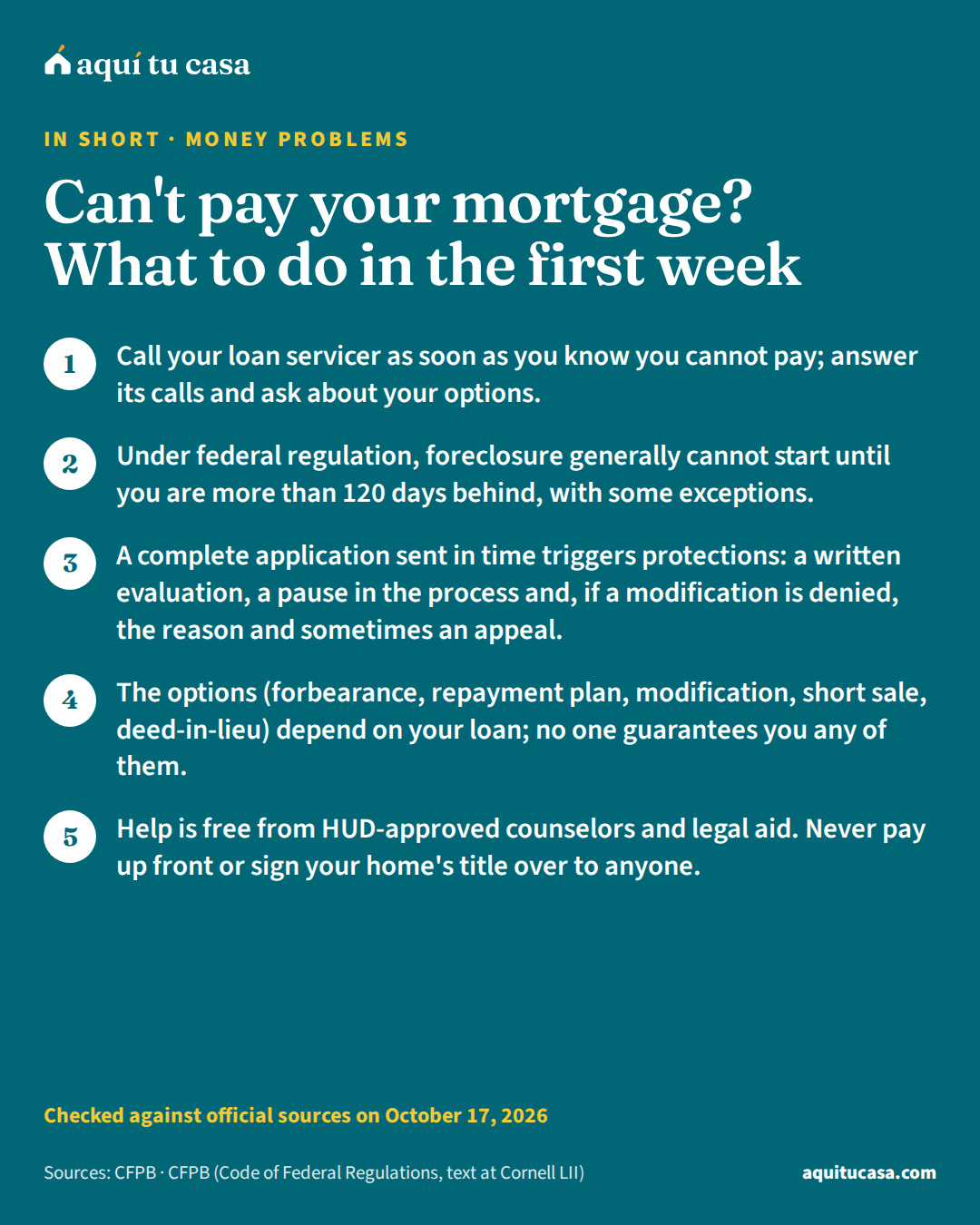
- Money problems Can't pay your mortgage? What to do in the first week Can't pay your mortgage? Call your servicer, learn the options that exist, the federal rules that protect you and the rescue scams to avoid. 14 minute read
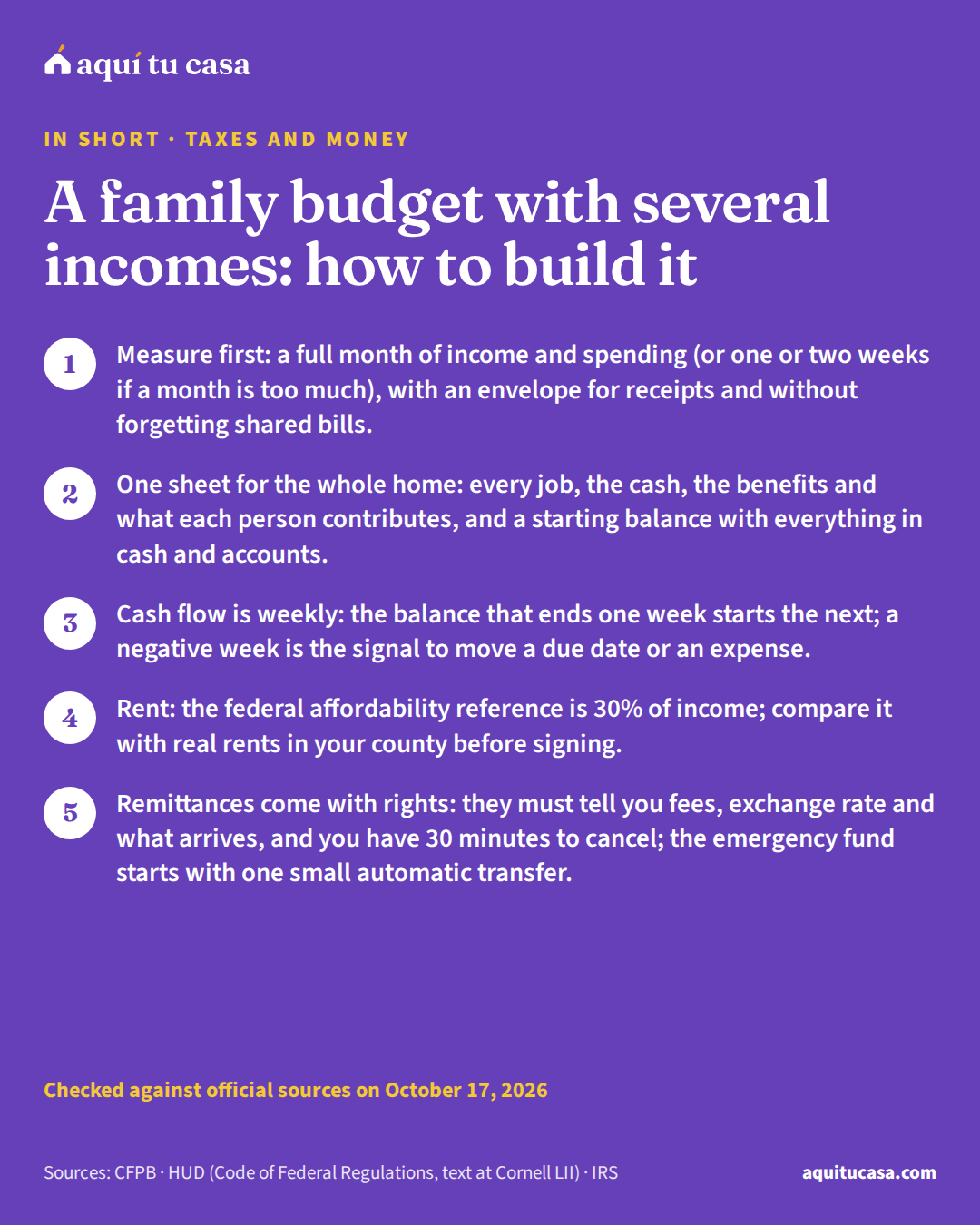
- Taxes and money A family budget with several incomes: how to build it How to budget when several incomes, cash and remittances come into the home: tracking, weekly cash flow, rent and the emergency fund. 11 minute read
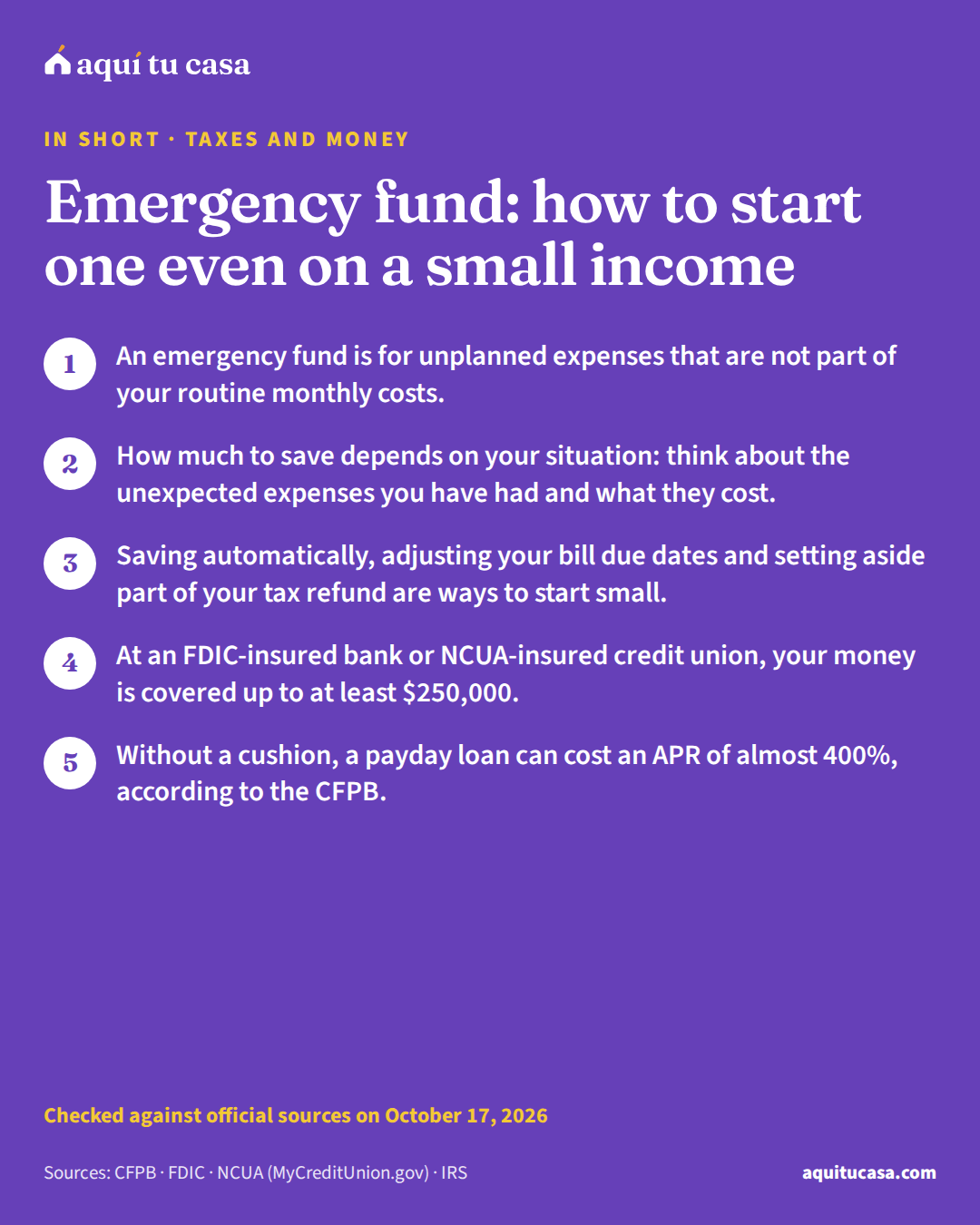
- Taxes and money Emergency fund: how to start one even on a small income What an emergency fund is, how much to save for your situation, how to start with little money, where to keep it safe and what it costs not to have one. 10 minute read
Tools for this topic
Was this guide useful?
Thank you. Your answer stays in your browser; nothing is sent.