Emergency shelter and rapid rehousing: how to get help
What HUD's homeless programs (ESG and the Continuum of Care) pay for, how to reach coordinated entry, what 211 does and what the rules say today.
Verified against official sources on October 31, 2026 16 official sources
Show contents
In short
What you need to know
Quick answer
If you have nowhere to sleep or are about to lose your housing, dial 211: it is confidential and gives housing and shelter referrals. You can also search for shelters with HUD's Find Shelter tool. In each area, the local homeless services network (the Continuum of Care) has a coordinated front door that assesses what you need and connects you to shelter, prevention or rapid rehousing. Rapid rehousing can pay the deposit, the move and part of the rent for a while so you get back into your own place soon. The rules on immigration status changed recently and a court vacated HUD's notice; ask the program and get legal aid.
What matters most
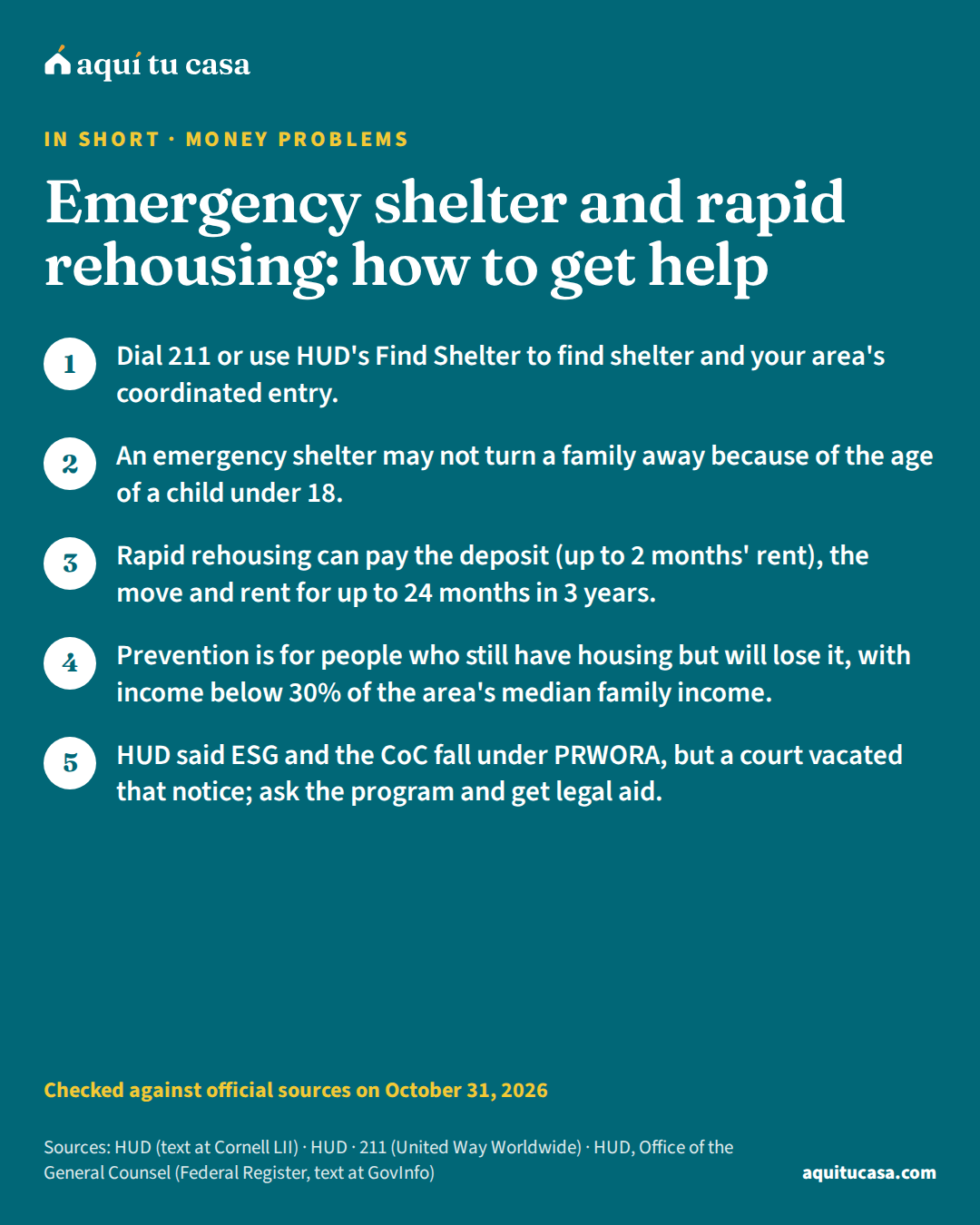
- Dial 211 or use HUD's Find Shelter to find shelter and your area's coordinated entry.
- An emergency shelter may not turn a family away because of the age of a child under 18.
- Rapid rehousing can pay the deposit (up to 2 months' rent), the move and rent for up to 24 months in 3 years.
- Prevention is for people who still have housing but will lose it, with income below 30% of the area's median family income.
Is this for you?
This guide is for you if…
- You have nowhere to sleep tonight, or you sleep in your car or a place that is not a home.
- You are going to lose your housing in the next few days and have nowhere to go.
- You are helping a relative, a neighbor or a newly arrived family that lost its housing.
Get direct help first if…
- You are in immediate danger: call 911.
- You are a homeless veteran: our HUD-VASH guide explains the VA program and its free line.
Losing your home is frightening, even more so if you have your children with you or just arrived in the country. This guide is for you if you have nowhere to sleep, will lose your housing in the next few days or are helping someone in that situation. It explains what HUDDepartment of Housing and Urban Development (HUD)HUD (the U.S. Department of Housing and Urban Development) is the federal department that runs housing and community development assistance programs and works to ensure fair and equal housing opportunity. The Federal Housing Administration (FHA), which insures mortgages made by private lenders, is part of HUD. HUD funds local public housing agencies (PHAs) that run public housing and Section 8 vouchers. It also approves housing counseling agencies across the country, and you can file a housing discrimination complaint with its Office of Fair Housing and Equal Opportunity (FHEO).See the full definition’s homeless programs pay for, how to reach the front door in your area, what 211 does and what the rules on immigration status say today.
Two HUD programs that pay for the help
Two HUD programs fund shelters and help for people who are homeless. You do not ask for them by name, but knowing them helps you understand what you can be offered.
Emergency Solutions Grants (ESG). They can pay for five things: street outreach (people who go out to find those sleeping outside), emergency shelter, prevention so you do not lose your housing, rapid rehousing and the data system programs use.1 In a shelter, ESG can pay to run and renovate the building and for essential services such as case management, child care, job help, legal services, mental health, substance use treatment and transportation.2
The Continuum of Care (CoC). This is the local homeless services network. Its funds can pay for permanent housing, which includes permanent supportive housing and rapid rehousing; transitional housing; supportive services only; the data system; and, in some cases, prevention. In its rapid rehousing, participants must meet with a case manager at least once a month, except in violence cases protected by law.8
Shelter, prevention or rapid rehousing
Tonight
Emergency shelter
- A safe place to sleep while another way out is found
- Services such as case management, child care and transportation
- A family may not be turned away because of the age of a child under 18
Before you lose your housing
Prevention
- Rental help and services so you do not have to go to a shelter
- For income below 30% of the area's median family income
- Only what you need to regain stability
To leave the shelter soon
Rapid rehousing
- Help to move as quickly as possible into permanent housing
- Can pay the deposit, the move, utilities and part of the rent
- With a written, legally binding lease
Your area's coordinated entry decides which one fits based on what you need.
Who counts as homeless
The ESG rules define homelessness in several ways. They include someone with no fixed, regular and adequate place to spend the night, such as someone sleeping in a car, on the street or in a shelter; someone who will lose their housing within 14 days of asking for help and has nowhere to go and no resources to find another place; certain unaccompanied youth under 25 and families with children; and someone fleeing domestic violence, dating violence, sexual assault or stalking.3
If you still have housing but are at risk of losing it, there is prevention. It can give you rental help and services so you do not have to go to a shelter. It is for households with annual income below 30% of the area’s median family income, and only to the extent you need the help to regain stability.4 If you already got a notice to leave, also read What to do if you get an eviction notice and If you can’t pay your rent.
The front door: 211 and coordinated entry
Every area has a shared front door. By rule, each Continuum of Care must have a centralized or coordinated assessment system that does an initial, comprehensive assessment of what each person or family needs in housing and services.9 When that system exists, ESG-funded programs in the area must use it. The exception is victim service providers, which may choose not to use it.10
You have two simple ways to reach that door:
- 211. You dial 211 from your phone. They give you referrals for housing, homeless services and help with utilities, and every call is confidential. The 211 site is also in Spanish.12
- HUD’s Find Shelter. You pick a category (shelter, food, clinics or clothing), enter your location and search. You can also search for a Continuum of Care provider in your community.11
From the first call to a home of your own
1. Dial 211 or search Find Shelter
Today
Ask for a shelter for tonight and how to reach coordinated entry.12
2. You get an assessment
At coordinated entry
They ask what you need in housing and services to connect you with the right program.9
3. Shelter or prevention
Depending on your case
If you have no housing, shelter; if you still have it, prevention can help you keep it.4
4. You search for housing with help
With your case manager
Rapid rehousing can pay for the search, the application, the deposit and the move.6
6. You meet with your case manager
At least once a month in the CoC
They help you keep the housing when the assistance ends.8

What rapid rehousing can pay for
Rapid rehousing helps a homeless person or family move as quickly as possible into permanent housing and stay stable there.5 With ESG funds, it can pay the application fee, a security depositsecurity depositA security deposit is money you pay the landlord when you start renting as security that you will follow the lease: pay the rent and take care of the home. The money still belongs to you. The landlord holds it and, when you move out, must return it minus the charges the law allows, such as past-due rent or damage beyond normal wear and tear. You should not be charged for damage that was already there when you moved in. The maximum amount and the deadline to return it depend on your state's law and sometimes your city's.See the full definition of no more than 2 months’ rent, last month’s rent, utility deposits and payments, and moving costs. It can also provide services: housing search, case management, mediation with the landlord, legal services and help repairing your credit.6
Rental assistance has limits. Short-term is up to 3 months, and medium-term is more than 3 and no more than 24 months. In total, up to 24 months can be given in any 3-year period. The rent may not exceed HUD’s Fair Market Rentfair market rent (FMR)The fair market rent (FMR) is the rent HUD estimates every year for each area and each unit size, including the cost of utilities (except telephone). It is neither the lowest nor the highest rent: by rule it is set at the 40th percentile, the dollar amount below which 40% of the area's standard-quality rental units rent. HUD uses it to set the payment standards of the Housing Choice Voucher program (Section 8) and for other programs; on aquitucasa we use it as the benchmark for what renting costs in your county and for the wage needed to pay it.See the full definition and must be reasonable for the area. And you must have a written, legally binding leaseleaseA lease, or rental agreement, is the contract in which the owner or landlord gives you the right to live in and use a property for a set period of time in exchange for payment, usually rent. While the lease lasts you have possession, but the landlord still owns the property. The lease says how much you pay and when, who handles maintenance and how the agreement can end. Your rights as a tenant are usually spelled out in the lease and in your state and local laws. Before complaining to the landlord, it helps to read the lease and make sure you are also following the rules you agreed to.See the full definition.7
Example with real numbers
A family leaving the shelter with rapid rehousing
An example in words, not a real case, of how the help can be used.
- Where they are now
- In an emergency shelter, with two children
- What the program aims for
- That they move soon into their own apartment
- What the help can pay
- The application, the deposit (up to 2 months' rent), the move and part of the rent
- The rent limit
- No more than HUD's Fair Market Rent for the area
- What the family signs
- A written, legally binding lease
- How long rental help lasts
- Up to 24 months in a 3-year period, as the program decides
The rules in the example come from the ESG rule.7 Use the budget tool to plan how you will pay the rent when the help ends.
Run it with your numbersFamily budget
Families with children and people fleeing violence
If you have your children with you, one rule protects you. In an ESG-funded shelter that takes families with children, the age of a child under 18 may not be used to turn your family away.2 If a shelter tells you your teenage son cannot come in with you, ask 211 for another shelter in the network.
If you are fleeing domestic violence, dating violence, sexual assault or stalking, you count as homeless for ESG.3 Victim service providers may choose not to use coordinated entry.10 Our VAWA protections guide explains your housing rights. If you are a veteran, our HUD-VASH guide explains help from VA.
What the rules on immigration status say today
This subject is changing, so here is only what the official documents say.
A federal welfare reform law (PRWORA) says aliens who are not “qualified aliensqualified alien"Qualified alien" is a term in a federal law, 8 U.S.C. 1641, used to decide who may apply for or receive certain federal public benefits. The law defines it with a list of categories. They include lawful permanent residents, people granted asylum, refugees, certain people paroled into the country for at least one year, people whose deportation is being withheld, Cuban and Haitian entrants and, in certain cases, people subjected to battery or extreme cruelty. The same law has exceptions and other conditions, so the definition alone does not say whether a person can receive a benefit.See the full definition” are not eligible for a “Federal public benefit.” The same law has exceptions, including short-term in-kind emergency relief and services such as short-term shelter specified by the Attorney General that are necessary to protect life or safety. In a Federal Register notice, HUD said it considers ESG and the Continuum of Care subject to that law’s eligibility and verification rules. In the same notice, HUD acknowledges that nonprofit charitable organizations are not required to verify eligibility, and says it would issue new guidance on how to verify.13
Later, a federal district court in Rhode Island declared several agencies’ notices on that law unlawful, including HUD’s, and ordered them set aside and vacated. It also barred the agencies from enforcing them by other means against the states that sued. The order makes clear HUD can adopt new rules if it first asks the public for comment.14
What does that mean for you? That the rules may change and may differ by program and by state. Do not hold back from asking for shelter out of fear. Ask the program which documents it requires and why. If you are denied help because of your status, get free legal aid: LSC has a finder by address or city.15 For any question about your immigration case, talk only to a lawyer or an accredited representativeDOJ-accredited representativeAn accredited representative is a non-attorney whom the U.S. Department of Justice, through its Recognition and Accreditation Program, authorizes to represent people in immigration matters before DHS and, with full accreditation, before the immigration courts. They may only do so through a recognized organization, which must be a non-profit, federally tax-exempt entity. It is the safe way to get low-cost immigration help: the Department of Justice publishes the official roster by state. Anyone who is not on that roster and is not a lawyer is not authorized to represent you.See the full definition; notarios and consultants cannot give you legal advice.16 Our guide to public charge and housing explains another topic many families worry about.
If this is you
You have your children and nowhere to sleep
Dial 211; an ESG-funded shelter may not turn your family away because of the age of a child under 18.2
You will be forced out of your housing in a few days
If you will lose it within 14 days and have nowhere to go, you count as homeless for ESG.3
You still have housing but cannot keep up
Ask about prevention: rental help for income below 30% of the area's median family income.4
You are fleeing violence at home
You count as homeless, and victim service providers may choose not to use coordinated entry.10
You are afraid you will be asked for papers
A court vacated HUD's notice on this and the rules may change; ask what they require and get legal aid.14

Mistakes that can cost you
Mistake: Waiting until you are on the street to ask for help.
Instead: Call 211 as soon as you know you will lose your housing; prevention is for before.4
Mistake: Going from shelter to shelter without going through coordinated entry.
Instead: Ask to be assessed at coordinated entry: it is the door to the area's programs.9
Mistake: Splitting up from your teenager because a shelter asked you to.
Instead: The age of a child under 18 may not be used to turn your family away.2
Mistake: Making a verbal rental deal with the landlord.
Instead: With ESG help you need a written, legally binding lease.7
Mistake: Not asking for shelter out of fear about your status.
Instead: Ask what they require and why, and get legal aid if you are denied help.15
Mistake: Paying someone who promises you a spot in a program.
Instead: 211 and coordinated entry are free; no one can sell you a spot.12
What to do today and this week
- Dial 211 and ask for a shelter for tonight or help to keep your housing.12
- If you would rather search yourself, use HUD’s Find Shelter with your location.11
- Ask to be assessed at your area’s coordinated entry.9
- Keep your eviction notice, your ID if you have one and your family’s medicines.
- If you are denied help or do not understand why, find legal aid with the LSC finder.15
- Once you have housing, work out with your case manager how you will pay the rent when the help ends.7
Your income
Let's do the math
Rent that fits your budget (30% of income)
$2,018
With an income of $6,728 a month. Up to $3,364 would already be a severe burden (50% of income).
Compared with HUD’s Fair Market Rent in the United States
- 2 bedrooms$1,750Fits · 26%Needs $33.65 an hour
The wage needed pays that rent without going over 30% of income, working 40 hours a week all year.
The typical rent households actually pay in the United States is $1,413 a month (Census).
A reference to give you an idea. Each landlord and each program sets its own requirements.
Ready to see the numbers? Find your county here
See how this applies in your county: its loan limits, prices and rents, from the official data.
Printable checklist
Frequently asked questions
Where do I find a shelter tonight?
Dial 211, which gives referrals for housing and homelessness and is confidential. You can also use HUD's Find Shelter tool: pick shelter, enter your location and search. If you are in danger, call 911.
What is coordinated entry?
It is the front door to the local homeless services network. By rule, each Continuum of Care must have a system that assesses the housing and service needs of each person and family, and ESG-funded programs in the area must use it. 211 or a shelter can tell you how to reach it.
What does rapid rehousing pay for?
Under the ESG rule, it can pay the application fee, a deposit of no more than 2 months' rent, last month's rent, utility deposits and payments, moving costs and rental assistance for up to 24 months in a 3-year period. It also provides services such as housing search, mediation and legal services.
Can the shelter split up my family?
The ESG rule says the age of a child under 18 may not be used to deny a family admission to an ESG-funded shelter that takes families with children. If a shelter sets that condition, ask for another shelter in the network and get legal aid.
Will a shelter ask for immigration papers?
HUD published a notice saying ESG and the Continuum of Care fall under PRWORA's rules, and that nonprofit charitable organizations are not required to verify eligibility. Later, a federal court vacated that notice. The rules may change: ask the program what it requires and get legal aid or an accredited representative.
What if I am fleeing domestic violence?
The definition of homeless includes people fleeing domestic violence, dating violence, sexual assault or stalking. Victim service providers may choose not to use coordinated entry. Our VAWA guide explains your housing protections.
I still have housing, but I am being forced out. Is there help?
Yes, there is prevention. Under the ESG rule, it can provide rental assistance and services so you do not have to go to a shelter, if your annual income is below 30% of the area's median family income and the help is needed for you to regain stability. Call 211 as soon as you can.
Sources
Every figure in this guide comes from one of these official sources. The number next to a sentence leads to the source behind it.
Each source on one line: who publishes it, its title, its address and the date we read it.
- 1. HUD (text at Cornell LII) · 24 CFR 576.100, General provisions and expenditure limits · law.cornell.edu · Accessed October 31, 2026
- 2. HUD (text at Cornell LII) · 24 CFR 576.102, Emergency shelter component · law.cornell.edu · Accessed October 31, 2026
- 3. HUD (text at Cornell LII) · 24 CFR 576.2, Definitions · law.cornell.edu · Accessed October 31, 2026
- 4. HUD (text at Cornell LII) · 24 CFR 576.103, Homelessness prevention component · law.cornell.edu · Accessed October 31, 2026
- 5. HUD (text at Cornell LII) · 24 CFR 576.104, Rapid re-housing assistance component · law.cornell.edu · Accessed October 31, 2026
- 6. HUD (text at Cornell LII) · 24 CFR 576.105, Housing relocation and stabilization services · law.cornell.edu · Accessed October 31, 2026
- 7. HUD (text at Cornell LII) · 24 CFR 576.106, Short-term and medium-term rental assistance · law.cornell.edu · Accessed October 31, 2026
- 8. HUD (text at Cornell LII) · 24 CFR 578.37, Program components and uses of assistance · law.cornell.edu · Accessed October 31, 2026
See the other 8 sources
- 9. HUD (text at Cornell LII) · 24 CFR 578.7, Responsibilities of the Continuum of Care · law.cornell.edu · Accessed October 31, 2026
- 10. HUD (text at Cornell LII) · 24 CFR 576.400, Area-wide systems coordination requirements · law.cornell.edu · Accessed October 31, 2026
- 11. HUD · Find Shelter · hud.gov · Accessed October 31, 2026
- 12. 211 (United Way Worldwide) · 211 · 211.org · Accessed October 31, 2026
- 13. HUD, Office of the General Counsel (Federal Register, text at GovInfo) · Personal Responsibility and Work Opportunity Reconciliation Act of 1996 (PRWORA); Interpretation of “Federal Public Benefit” (90 FR 54363) · govinfo.gov · Accessed October 31, 2026
- 14. U.S. District Court for the District of Rhode Island (copy posted by the New York Attorney General) · State of New York v. U.S. Department of Justice, Memorandum and Order (D.R.I., 1:25-cv-00345) · ag.ny.gov · Accessed October 31, 2026
- 15. Legal Services Corporation (LSC) · I Need Legal Help · lsc.gov · Accessed October 31, 2026
- 16. Department of Justice, Executive Office for Immigration Review (EOIR) · Can Someone Represent You at EOIR? · justice.gov · Accessed October 31, 2026
Keep reading
Related guides
If this guide helped, these follow the same path.

Money problems 13 minute read
Can't pay your rent: what to do and where to get help
If you can't cover the rent: how to talk to your landlord, where to find rental assistance (211, local programs, HUD) and what an eviction requires.
- Talk to your landlord before you fall further behind: landlords very rarely prefer an eviction to getting paid, and many assistance programs need their help.
- Start local: programs in your city, county or state, and 211; assistance can take several weeks to arrive.
- LIHEAP helps with power and gas bills year-round; HUD-approved counselors (800-569-4287) who offer rental counseling can help you make a plan.
- Renting What to do if you get an eviction notice Notice, lawsuit and the judge's order: what you can do at each moment, where free legal help is and what federal law says about the 30-day notice. 14 minute read
- Renting Your first apartment as a new arrival in the U.S. Renting your first apartment after arriving with parole, a pending asylum case or TPS: what landlords ask for, what to offer, your rights and free help. 12 minute read
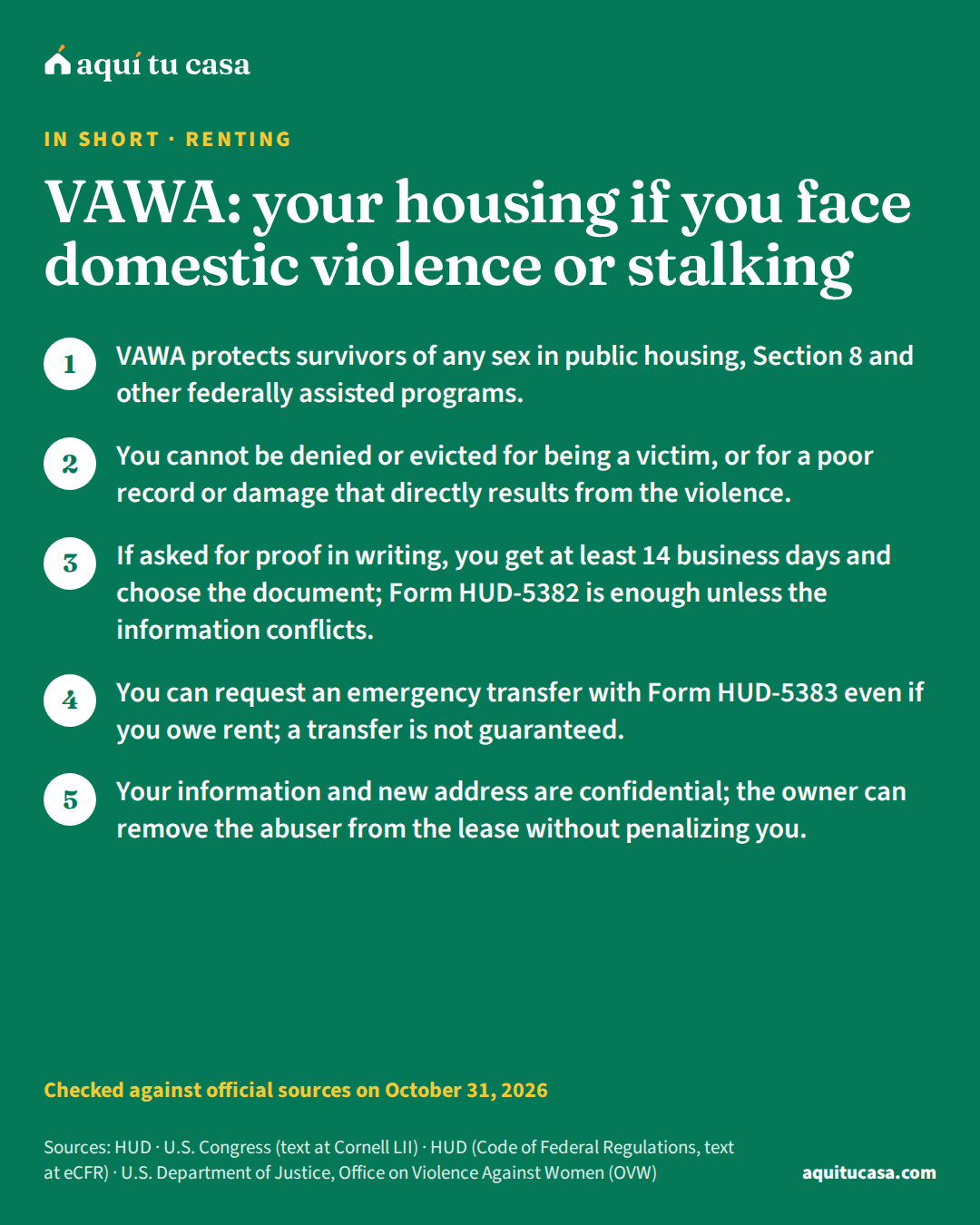
- Renting VAWA: your housing if you face domestic violence or stalking How VAWA protects you in federally assisted housing: no denial or eviction for being a victim, Form HUD-5382 and emergency transfers to a safe home. 14 minute read
Tools for this topic
Was this guide useful?
Thank you. Your answer stays in your browser; nothing is sent.