Your first apartment as a new arrival in the U.S.
Renting your first apartment after arriving with parole, a pending asylum case or TPS: what landlords ask for, what to offer, your rights and free help.
Verified against official sources on October 31, 2026 17 official sources

Show contents
In short
What you need to know
Quick answer
When you just arrived, the hard part is usually not the money but the history: the landlord checks your credit, your rental history and your job, and you do not have any of that in the United States yet. Bring what you do have: your ID, your work permit if you have one, job letters or bank statements, and references. If you are asked for a cosigner or a bigger deposit because of your report, you have a right to a notice and a free copy of the report. No one can turn you down because of your national origin. For your immigration case, go only to a lawyer or an accredited representative.
What matters most
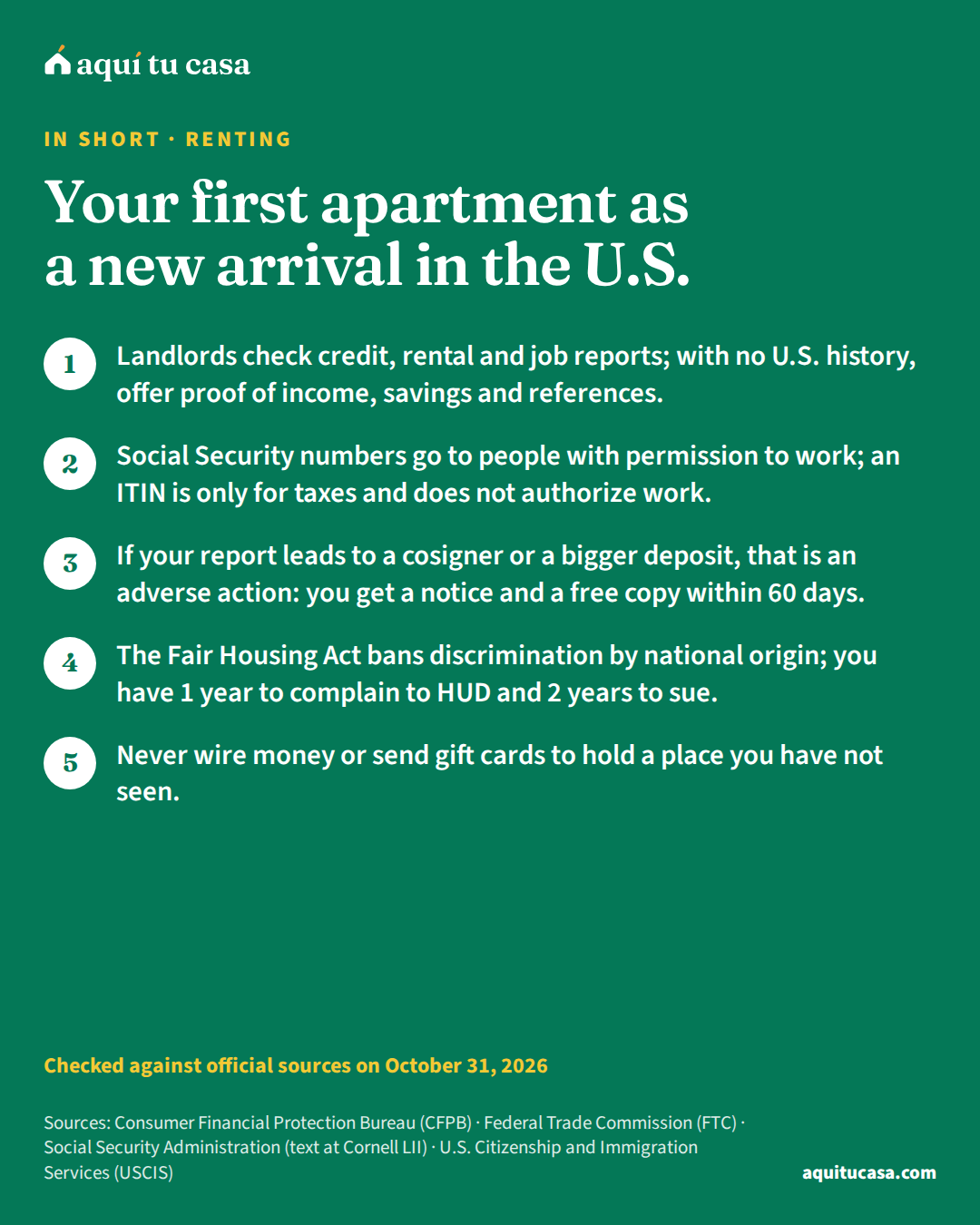
- Landlords check credit, rental and job reports; with no U.S. history, offer proof of income, savings and references.
- Social Security numbers go to people with permission to work; an ITIN is only for taxes and does not authorize work.
- If your report leads to a cosigner or a bigger deposit, that is an adverse action: you get a notice and a free copy within 60 days.
- The Fair Housing Act bans discrimination by national origin; you have 1 year to complain to HUD and 2 years to sue.
Is this for you?
This guide is for you if…
- You recently arrived in the United States (with parole, an asylum application, TPS or another situation) and are looking for your first apartment.
- You have no U.S. rental history and no U.S. credit history and do not know what you will be asked for.
- You are helping a relative or a neighbor who just arrived find a place to live.
Get direct help first if…
- You have nowhere to sleep tonight: call 211 or search HUD's shelter finder; our emergency shelter guide explains how it works.
- You need advice on your immigration case: only a lawyer or an accredited representative can give it.
Arriving in a new country and looking for a place to live at the same time is a lot. This guide is for you if you arrived recently, with paroleparole (immigration)In immigration, parole is permission to enter or stay in the United States temporarily. Federal law, 8 U.S.C. 1182(d)(5), lets the Secretary of Homeland Security grant it at their discretion, case by case, for urgent humanitarian reasons or significant public benefit. The law says parole is not an admission to the country. When its purpose has been served, the person returns to the situation they were in and their case continues like that of any other applicant for admission. Under the regulation, parole ends automatically if the person leaves the country or the authorized time expires.See the full definition, an asylum application, TPSTPS (Temporary Protected Status)Temporary Protected Status (TPS) is a status created by a federal law, 8 U.S.C. 1254a. The government may designate a country, or part of one, when there is armed conflict, an environmental disaster or other extraordinary and temporary conditions that keep people from returning safely. The designation is published in the Federal Register and lasts a limited period that can be extended or ended. While a person has TPS, the law says they may not be removed and are authorized to work. Being from a designated country is not enough: the law sets other requirements.See the full definition or another situation, and are looking for your first apartment. It explains what a landlord checks, which documents you may be asked for and which ones you can offer, what the law protects and where to get help without paying anyone.
Why renting is harder when you just arrived
To decide whether to rent to you, many landlords buy a tenant screeningtenant screening reportA tenant screening report is a report many landlords use to decide whether to rent to you and how much to charge for the security deposit. Specialty companies prepare it, and it can include your credit report, your rental history including eviction cases and lawsuits, employment verification, criminal history and a score or recommendation. It is not the same as a credit report. If a landlord denies you, or asks for a larger deposit or higher rent, because of the report, federal law requires the landlord to tell you, name the company and explain your right to a free copy and to dispute errors.See the full definition report. According to the CFPB, that report can include your credit, your rental history (with evictions and lawsuits), verification of your job and your criminal history. The landlord uses it to decide whether to rent to you and how much to charge for the deposit.1
When you just arrived, that report comes back almost empty. It is not a bad report: it is a report with no history. The problem is that the landlord has nothing to compare you with. That is why it helps to arrive with proof of what you do have: your income, your savings and people who know you.
If you already have a Social Security number or an ITIN, you can start building credit now. Our guide to credit from zero explains the first steps, such as a secured card or a credit-builder loan.
The documents you may be asked for
Each landlord decides what to ask for. Most ask for ID, proof of income and a number to check your credit. This is what official sources say about the numbers asked for most:
- The Social Security number. Under the Social Security regulation, it is given to citizens, permanent residents, people with other legal authority to work and, only for nonwork reasons, some people who need it for a federal benefit.3 If you do not have one yet, do not make one up or use someone else’s.
- The work permitEmployment Authorization Document (EAD)The Employment Authorization Document (EAD, Form I-766) is a photo document issued by the federal government to show that a person is authorized to work in the United States. Federal regulations say some people may work because of their status and others must apply for permission; in those cases USCIS decides and, if approved, the document is valid for a specific period. The EAD is one of the documents an employer may accept on Form I-9. When it expires, the employer must reverify that you can work. It is not the same as a permanent resident card.See the full definition (EAD). According to USCIS, certain noncitizens can request an Employment Authorization Document with Form I-765.4 For example, people with TPS can get one during the designation period.5 If you have an EAD, it is proof you can work, and many landlords accept it together with your passport. What applies to you depends on your case: ask a lawyer or an accredited representative.
- The ITIN. According to the IRS, it is a federal tax number for people who cannot get a Social Security number. An ITIN does not authorize you to work, does not give you immigration status and is not ID outside of taxes.6 Some landlords accept it to check credit; ask first.
Our guide What documents to share with lenders and landlords explains what to give and what not to, and how to protect your data. And the one on renting without a Social Security number or credit goes into detail on the alternatives.
What you may be asked for and what you can offer
The landlord decides
What landlords usually ask for
- A photo ID
- A number to check your credit
- Proof of income or employment
- Rental history and references from past landlords
Ask whether they accept it
What you can offer if you have no history
- Your passport and your work permit, if you have one
- A job letter, pay stubs or a job offer
- Statements that show your savings
- Reference letters from an employer, a sponsor or an organization that helps you
Bring copies, not originals, and do not hand over immigration papers you were not asked for.
If you are asked for a cosigner or a bigger deposit
When you have no history, the landlord may ask for a cosignerco-signerA co-signer is a person who signs another person's loan or credit account to back it up, and by doing so becomes responsible for the debt. If the borrower does not pay, the creditor can collect up to the full debt from the co-signer, plus late fees or collection costs, without first trying to collect from the borrower, and the default may become part of the co-signer's credit record. A federal FTC rule calls for the co-signer to get a written notice explaining these risks before signing. On a mortgage, according to Fannie Mae, a co-signer signs the note and shares liability for the debt with the borrower but has no ownership interest in the home on the title.See the full definition, meaning another person who signs and pays if you do not. It may also ask for a bigger deposit. Before you ask someone to sign for you, read our guide on the risks of cosigning: it explains what that person is risking.
There is an important rule. According to the FTC, if the landlord makes a negative decision because of something in your background report, that is an adverse action. Requiring a cosigner, asking for a bigger security deposit or charging more rent all count. In that case you are entitled to an adverse action noticeadverse action noticeAn adverse action notice is the notice you get when a company denies you credit or takes another action against you on your application or account. Under federal law, the lender must give you the main reasons or tell you how to ask for them. If the decision was based on a credit report or another consumer report, the company must also give you the score that was used, the name and contact information of the company that supplied the report, and explain your right to a free copy of that report and to dispute errors. The reporting company did not make the decision and cannot tell you why it was made.See the full definition with the name, address and phone number of the report company. The company must give you a free copy if you ask within 60 days, and if you find a mistake, it must investigate your dispute within 30 days.2
The CFPB says the same: if you were denied housing because of a report, the landlord must tell you, give you the company’s details and explain your right to dispute it.1 Always ask for the notice in writing. Our security deposit guide explains how much can be charged in your state and how to get it back.
Example with real numbers
An application with no U.S. history
An example in words, not a real case, of how the application can be put together.
- U.S. credit
- None yet
- U.S. rental history
- None yet
- What she offers
- Passport, work permit, job letter and savings statements
- What the landlord asks for
- A cosigner because of what came up in the report
- What she asks for in return
- The adverse action notice in writing and the free copy of the report
- What she decides
- Get the report, check it for mistakes and find someone she trusts who understands the risk of signing
The rules in the example come from the FTC.2 Use the calculator to see how much rent your income can cover before you fill out applications.
Run it with your numbersHow much rent can I afford?
Your rights: no one can turn you down for your national origin
The Fair Housing ActFair Housing ActThe Fair Housing Act is the federal law that makes it illegal to refuse to sell or rent a dwelling, or to discriminate in its terms, because of race, color, religion, sex, familial status (having children), national origin or disability. It applies to landlords, real estate agents and managers, and also to banks and lenders when their practices make housing or credit unavailable for those reasons. National origin covers your language and the country you come from, regardless of immigration status. If you believe you were discriminated against, you can file a complaint with HUD at no cost; many states add protections.See the full definition makes it unlawful for a landlord, because of your national originnational originNational origin is one of the characteristics the Fair Housing Act protects. According to the Department of Justice, national origin discrimination can be based on the country where you were born or where your ancestors came from. The law prohibits refusing to sell or rent you a home, setting different terms or publishing ads that state a preference based on your national origin. According to the CFPB, the Equal Credit Opportunity Act also prohibits lenders from discriminating against you because of your national origin when you apply for credit, such as a mortgage.See the full definition, to refuse to rent or negotiate with you, set different conditions for you, publish ads that exclude people from certain countries or tell you a place is not available when it is.7 According to HUD, the law applies to nearly all housing, including private housing, public housing and housing that receives federal funding.9
The Department of Justice explains that national origin discrimination can be based on the country where you were born or on where your ancestors came from, and that the Department has taken action against private landlords who discriminated against new immigrants.8
What about language? In its enforcement guidance on limited English proficiency, HUD says language, by itself, is not a protected trait and that the law does not categorically require translation services. HUD prioritizes cases where language was used as a pretext or a means to discriminate on purpose because of national origin. And it makes clear this does not change your right to sue in court within two years.10 In practice: if a landlord says “we don’t rent to people from your country” or uses your accent as an excuse to turn you down, write down what happened, with dates and names.
Your immigration status is a separate matter. Some states and cities protect it in addition to federal law. Our guide Your immigration status and your landlord explains what a landlord may ask and what to do if you are threatened.

How and when to report
According to HUD, you can report housing discrimination online, by calling 1-800-669-9777 or by mail to the regional office. There are time limits, and HUD asks you to report as soon as possible.11 By law, you have up to one year after what happened to file a complaint with HUD12, and up to 2 years to file a lawsuit in federal or state court.13 Our guide Housing discrimination: how to file a complaint walks through the process.
From the search to the keys
1. Work out what you can pay
Before you search
Add up your income and your expenses, so you do not pay application fees for places you cannot afford.
Try it with your numbersHow much rent can I afford?2. Gather your documents
Before you visit
ID, work permit if you have one, proof of income, savings and references.1
3. Visit the place in person
Always
Do not pay anything for a place you have not seen; get a copy of the contract before the deposit.14
4. Apply and ask what they check
When you apply
Ask which company does the report and which documents they accept if you have no Social Security number.1
5. If you are turned down or asked for more
In the next 60 days
Ask for the notice in writing and the free copy of the report; dispute any mistakes.2
6. Read the lease before you sign
Before the keys
Check the rent, the deposit, how long it lasts and who makes repairs.
Scams that target people who just arrived
People who just arrived are in a hurry, do not know local prices and sometimes cannot see the place first. Scammers know this. According to the FTC, the fake owner may tell you the only way to hold the place is a wire transfer through Western Union or MoneyGram, and usually says they are out of the country. Wiring money, sending gift cards or paying with cryptocurrency is the same as sending cash: you almost never get it back. If anyone pressures you to decide quickly, walk away. Get a copy of the contract before you send any deposit, and report the scam at ReportFraud.ftc.gov.14 Our guide How to avoid rental scams shows more warning signs.
Another trap is the person who offers to “fix” your papers for money. USCIS warns that some unauthorized practitioners claim they can file TPS forms and charge for it.5 EOIR says notarios, document preparers, immigration consultants and travel agents are not allowed to practice law or give you legal advice.15 Our guide Notario is not a lawyer explains why.
If this is you
You have no U.S. credit or rental history
Offer proof of income, savings statements and references; the report comes back empty, not bad.1
You have an ITIN but no Social Security number
An ITIN is for taxes and does not authorize work; ask whether the landlord accepts it to check credit.6
You are asked for a cosigner
If it is because of your report, you must get an adverse action notice, and you can ask for the free copy within 60 days.2
You are turned down for your country or your accent
The law bans discrimination by national origin; write it all down and report it to HUD within one year.12
You are asked to wire money without seeing the place
That is the scam sign the FTC describes: do not pay, and report it at ReportFraud.ftc.gov.14
Where to get free help
You do not have to figure this out alone, or pay anyone for “connections.”
- For your immigration case. Go to a lawyer or an accredited representative. EOIR publishes the official rosters of recognized organizations and accredited representatives, also by state.16
- For a problem with your landlord or an eviction. LSC has a free legal aid finder: you enter your address or city.17 Our free legal aid guide explains who qualifies.
- If you have nowhere to sleep. Dial 211. Our guide to emergency shelter and rapid rehousing explains how to reach help in your area.
- To understand your lease. Our guide Your lease explained goes through each part before you sign.

Mistakes that cost you
Mistake: Paying several application fees without asking what they check.
Instead: Ask first which company does the report and which documents they accept if you have no Social Security number.1
Mistake: Using someone else's Social Security number.
Instead: Numbers are issued based on your situation; if you do not have one, ask about other ways to review your application.3
Mistake: Accepting a cosigner requirement without asking for the notice.
Instead: If it is because of your report, ask for the adverse action notice and the free copy of the report.2
Mistake: Wiring money to hold a place you have not seen.
Instead: Visit it, get the contract before the deposit and report the scam at ReportFraud.ftc.gov.14
Mistake: Paying a notario or a consultant to handle your papers.
Instead: Only a lawyer or an accredited representative can give you legal advice.15
Mistake: Letting time pass after unfair treatment.
Instead: You have 1 year to complain to HUD; write down dates and names from day one.12
What to do this week
- Gather copies of your ID, your work permit if you have one, your proof of income and your bank statements.1
- Ask two or three people who know you for reference letters.
- Before paying an application fee, ask what they check and what they accept if you have no Social Security number.1
- If you are turned down or asked for a bigger deposit because of your report, ask for the notice in writing and the free copy within 60 days.2
- If you think you were discriminated against because of your national origin, call HUD at 1-800-669-9777.11
- For your immigration case, find an accredited representative on EOIR’s official roster.16
Your income
Let's do the math
Rent that fits your budget (30% of income)
$2,018
With an income of $6,728 a month. Up to $3,364 would already be a severe burden (50% of income).
Compared with HUD’s Fair Market Rent in the United States
- 2 bedrooms$1,750Fits · 26%Needs $33.65 an hour
The wage needed pays that rent without going over 30% of income, working 40 hours a week all year.
The typical rent households actually pay in the United States is $1,413 a month (Census).
A reference to give you an idea. Each landlord and each program sets its own requirements.
Ready to see the numbers? Find your county here
See how this applies in your county: its loan limits, prices and rents, from the official data.
Printable checklist
Frequently asked questions
Can I rent an apartment if I just arrived and have no U.S. credit?
Yes, many people do. The landlord checks your credit, rental history and job to decide. If you have no credit, offer proof of income, savings statements, job letters and references. Each landlord decides what it accepts, so ask before you pay an application fee.
Can I be denied an apartment because I do not speak English?
The law bans discrimination based on national origin. HUD says language, by itself, is not a protected trait, but it investigates when language is used as a pretext to discriminate on purpose because of where you are from. If you think it happened to you, write everything down and report it to HUD within one year.
I do not have a Social Security number. What number do I give?
Social Security gives numbers to citizens, permanent residents and people with other legal authority to work. If you cannot get one, the IRS issues the ITIN for taxes. An ITIN does not authorize work and is not ID outside of taxes. Ask the landlord what other documents it accepts.
The landlord asked me for a cosigner. Is that legal?
Many landlords ask people with no history for one. If it is required because of something in your background report, the FTC says it is an adverse action: you must get a notice with the report company's details, and you can ask for a free copy within 60 days.
Can the landlord ask about my immigration status?
Federal law protects your national origin, and some states and cities also protect immigration status. Our guide on your immigration status and your landlord explains what may be asked and where to report. Do not share immigration papers you were not asked for.
I was asked to wire money to hold an apartment. What do I do?
Do not send it. The FTC says a request for a wire transfer through Western Union or MoneyGram is a scam sign, and that wiring money, gift cards or cryptocurrency are the same as sending cash. Ask to see the place and get a copy of the contract before paying, and report the scam at ReportFraud.ftc.gov.
Where can I get free help if I have a problem with my landlord?
For housing problems, find free legal aid with the LSC finder or a HUD-approved housing counseling agency. For your immigration case, go only to a lawyer or an accredited representative on EOIR's official roster.
Sources
Every figure in this guide comes from one of these official sources. The number next to a sentence leads to the source behind it.
Each source on one line: who publishes it, its title, its address and the date we read it.
- 1. Consumer Financial Protection Bureau (CFPB) · What should I know about tenant screening when applying for rental housing? · consumerfinance.gov · Accessed October 31, 2026
- 2. Federal Trade Commission (FTC) · Tenant Background Checks and Your Rights · consumer.ftc.gov · Accessed October 31, 2026
- 3. Social Security Administration (text at Cornell LII) · 20 CFR 422.104, Who can be assigned a social security number · law.cornell.edu · Accessed October 31, 2026
- 4. U.S. Citizenship and Immigration Services (USCIS) · I-765, Application for Employment Authorization · uscis.gov · Accessed October 31, 2026
- 5. U.S. Citizenship and Immigration Services (USCIS) · Temporary Protected Status · uscis.gov · Accessed October 31, 2026
- 6. IRS · Individual taxpayer identification number (ITIN) · irs.gov · Accessed October 31, 2026
- 7. U.S. Congress (text at Cornell LII) · 42 U.S.C. 3604, Discrimination in the sale or rental of housing · law.cornell.edu · Accessed October 31, 2026
- 8. Department of Justice, Civil Rights Division · The Fair Housing Act · justice.gov · Accessed October 31, 2026
See the other 9 sources
- 9. HUD · Fair Housing Act Overview · hud.gov · Accessed October 31, 2026
- 10. HUD, Office of Fair Housing and Equal Opportunity (FHEO) · Enforcement Guidance – National Origin Discrimination based on Limited English Proficiency under the Fair Housing Act and Title VI of the Civil Rights Act · hud.gov · Accessed October 31, 2026
- 11. HUD · Report Housing Discrimination · hud.gov · Accessed October 31, 2026
- 12. U.S. Congress (text at Cornell LII) · 42 U.S.C. 3610, Administrative enforcement; preliminary matters · law.cornell.edu · Accessed October 31, 2026
- 13. U.S. Congress (text at Cornell LII) · 42 U.S.C. 3613, Enforcement by private persons · law.cornell.edu · Accessed October 31, 2026
- 14. Federal Trade Commission (FTC) · Rental Listing Scams · consumer.ftc.gov · Accessed October 31, 2026
- 15. Department of Justice, Executive Office for Immigration Review (EOIR) · Can Someone Represent You at EOIR? · justice.gov · Accessed October 31, 2026
- 16. Department of Justice, EOIR · Recognition and Accreditation (R&A) Roster Reports · justice.gov · Accessed October 31, 2026
- 17. Legal Services Corporation (LSC) · I Need Legal Help · lsc.gov · Accessed October 31, 2026
Keep reading
Related guides
If this guide helped, these follow the same path.

Renting 11 minute read
How to rent without a Social Security number or credit
What a landlord can ask for, what to offer instead of an SSN and credit, how much rent fits your income and your rights if you are turned down.
- Each landlord decides what to ask for: ask what they accept instead of a Social Security number and a credit history.
- Without credit, your file speaks for you: photo ID, proof of income, bank statements and references.
- If a report gets you rejected or asked for a cosigner or a bigger deposit, they must name the company; the copy is free if you ask within 60 days.
- Money problems Emergency shelter and rapid rehousing: how to get help What HUD's homeless programs (ESG and the Continuum of Care) pay for, how to reach coordinated entry, what 211 does and what the rules say today. 11 minute read
- Renting Your first apartment: a guide for students and young adults Renting for the first time as a student or young adult: the budget, a cosigner, roommates, renters insurance and the student rules for low-cost housing. 11 minute read
- Renting Your immigration status and your landlord: what they can ask What a landlord may ask about your immigration status, what protects you, which states ban those questions and what to do if you are threatened. 10 minute read
Tools for this topic
Was this guide useful?
Thank you. Your answer stays in your browser; nothing is sent.