Your first apartment: a guide for students and young adults
Renting for the first time as a student or young adult: the budget, a cosigner, roommates, renters insurance and the student rules for low-cost housing.
Verified against official sources on October 31, 2026 9 official sources

Show contents
In short
What you need to know
Quick answer
Your first apartment starts with a budget: add up rent, utilities, the deposit and insurance before you sign. Because you have little history, the landlord may ask for a cosigner or a bigger deposit; if it is because of your report, you have a right to a notice and a free copy. If you share with roommates, put in writing who pays what. Renters insurance covers your belongings and your liability, which the owner's insurance does not. And if you are looking for low-cost housing, watch out: Section 8 and tax credit buildings have special rules for students.
What matters most
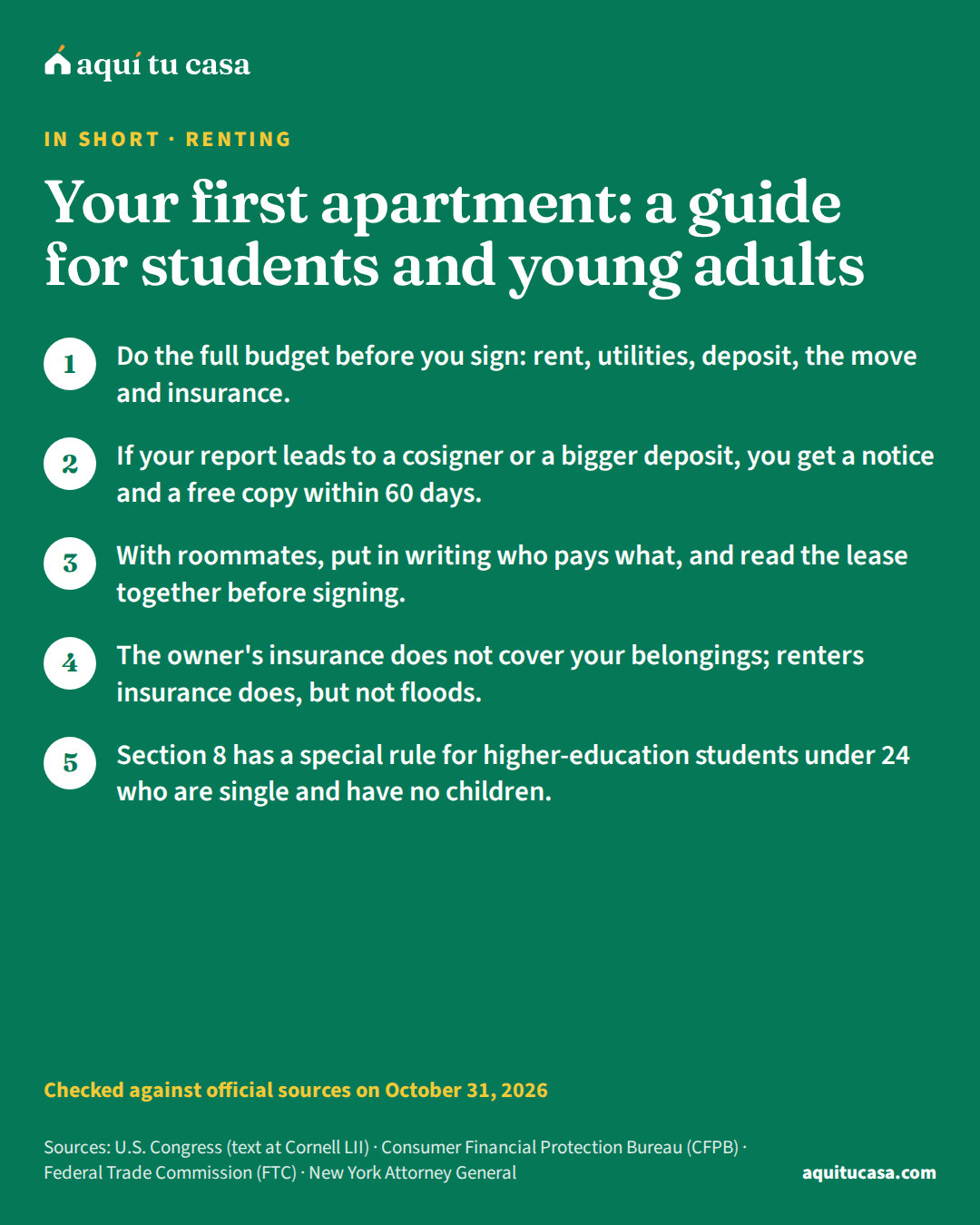
- Do the full budget before you sign: rent, utilities, deposit, the move and insurance.
- If your report leads to a cosigner or a bigger deposit, you get a notice and a free copy within 60 days.
- With roommates, put in writing who pays what, and read the lease together before signing.
- The owner's insurance does not cover your belongings; renters insurance does, but not floods.
Is this for you?
This guide is for you if…
- You are renting your first apartment because you are starting college, a job or life on your own.
- You want to split the rent with roommates and do not know who signs or who is responsible.
- Your parents or a relative will cosign and want to understand the commitment.
Get direct help first if…
- You just arrived in the United States and have no history here: our first-apartment guide for new arrivals explains what changes.
- You live in a college residence hall: your school sets the rules; ask its housing office.
Your first apartment is a big step. Whether you are starting college, a job or simply life on your own, renting for the first time brings new questions: how much you can pay, why you are asked for a cosigner, how to share with roommates without fighting and what insurance you need. This guide answers with what official sources say and points you to the guides that cover each topic in depth.
Before you search: how much you can pay
Rent is not the only cost. When you move in you pay the security depositsecurity depositA security deposit is money you pay the landlord when you start renting as security that you will follow the lease: pay the rent and take care of the home. The money still belongs to you. The landlord holds it and, when you move out, must return it minus the charges the law allows, such as past-due rent or damage beyond normal wear and tear. You should not be charged for damage that was already there when you moved in. The maximum amount and the deadline to return it depend on your state's law and sometimes your city's.See the full definition, sometimes the first month in advance, the move and utility deposits. Every month, besides rent, come electricity, water, internet, food and transportation. Do the full math before you fall in love with an apartment.
If you are a student, look at your financial aid letter. By law, the cost of attendance used for federal aid includes tuition, books, transportation, personal expenses and an allowance for living expenses, with food and housing. If you live off campus and not in school housing, it includes a standard allowance for rent; if you live with your parents, an allowance that cannot be zero.1 Ask the financial aid office how much it is and when the money arrives, because rent is due every month and aid sometimes arrives by semester.
Example with real numbers
The first month of a student who shares with a roommate
An example in words, not a real case, of what to put together before moving.
- Her half of the first month's rent
- Paid at signing
- Her half of the security deposit
- Paid at signing; our deposit guide explains how to get it back at the end
- Electricity and internet deposits
- Split between the two of them
- Renters insurance
- A policy for her belongings and her liability
- The move
- A truck rented for one day, with friends
- What she does before signing
- Adds it all up and compares it with her income and her semester's financial aid
Use the calculator to see how much rent you can afford and the move-in tool to add up the first month's costs.
Run it with your numbersHow much rent can I afford?What the landlord checks and why you are asked for a cosigner
According to the CFPB, many landlords buy a tenant screeningtenant screening reportA tenant screening report is a report many landlords use to decide whether to rent to you and how much to charge for the security deposit. Specialty companies prepare it, and it can include your credit report, your rental history including eviction cases and lawsuits, employment verification, criminal history and a score or recommendation. It is not the same as a credit report. If a landlord denies you, or asks for a larger deposit or higher rent, because of the report, federal law requires the landlord to tell you, name the company and explain your right to a free copy and to dispute errors.See the full definition report that can include your credit, your rental history, verification of your job and your criminal history. They use it to decide whether to rent to you and how much deposit to charge.2 At your age, that report has very little credit historycredit historyYour credit history is the record of your credit accounts and of whether you paid them on time, as shown in your credit report. Credit reporting companies collect and update this information and provide it to other businesses, which use it to make decisions about you. A good history helps you get housing, bank accounts, cards and loans, and lowers the interest you pay. If you have no history, or very little (a thin file), there may not be enough information to produce a score. Paying with a debit card, cash or a prepaid card usually does not build it.See the full definition, which is why you are often asked for a cosignerco-signerA co-signer is a person who signs another person's loan or credit account to back it up, and by doing so becomes responsible for the debt. If the borrower does not pay, the creditor can collect up to the full debt from the co-signer, plus late fees or collection costs, without first trying to collect from the borrower, and the default may become part of the co-signer's credit record. A federal FTC rule calls for the co-signer to get a written notice explaining these risks before signing. On a mortgage, according to Fannie Mae, a co-signer signs the note and shares liability for the debt with the borrower but has no ownership interest in the home on the title.See the full definition, also called a guarantor.
One rule protects you. According to the FTC, if the landlord makes a negative decision because of something in your report, it is an adverse action. Requiring a cosigner, asking for a bigger deposit or charging more rent all count. You are entitled to an adverse action noticeadverse action noticeAn adverse action notice is the notice you get when a company denies you credit or takes another action against you on your application or account. Under federal law, the lender must give you the main reasons or tell you how to ask for them. If the decision was based on a credit report or another consumer report, the company must also give you the score that was used, the name and contact information of the company that supplied the report, and explain your right to a free copy of that report and to dispute errors. The reporting company did not make the decision and cannot tell you why it was made.See the full definition with the report company’s details, a free copy if you ask within 60 days and an investigation of your dispute within 30 days if there is a mistake.3
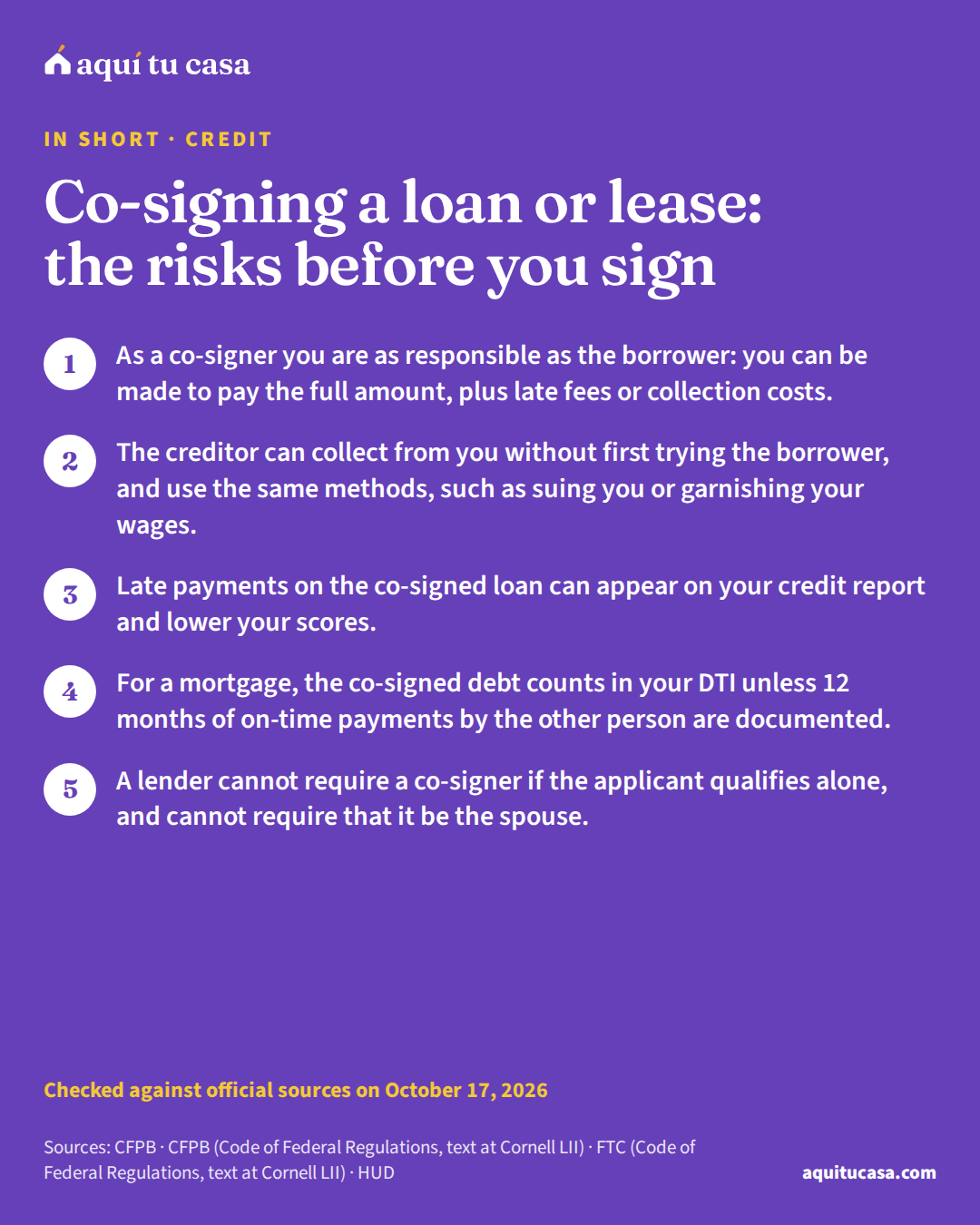
A cosigner is not a formality: it is a person who pays if you do not. Before you ask your mom, your dad or an uncle to sign, read our guide on the risks of cosigning together.
Sharing with roommates: who signs and who is responsible
Splitting the rent helps pay for a first apartment, but it can also bring problems. Before signing, talk about money openly: how the rent is split, who pays each utility, what happens if someone leaves early and how the deposit is divided at the end. Put it in writing and have everyone sign it.
The rules on who may live in the home change by state and by lease. One example: according to the New York Attorney General, in that state it is unlawful for a landlord to restrict occupancy to the named tenant and immediate family. With a single-tenant lease, the tenant may share with immediate family, one additional occupant and that occupant’s dependent children, if the tenant lives there as a primary residence, and must tell the landlord the occupant’s name within 30 days.4
What if you leave for the summer? SublettingsubletTo sublet, or sublease, is to rent all or part of the home you rent to another person, for a shorter time than your own lease. It is a new contract between you and that person: you become their landlord, but the owner has no contract with them. You remain responsible to the owner for meeting your lease. The owner can forbid subletting, although some places allow it in certain cases despite that ban. In public housing, the federal rule requires the lease to prohibit subletting.See the full definition has rules too. In New York, tenants in buildings with three apartments or fewer have no right to sublet, and those in buildings with four or more do, with the landlord’s advance consent, asked for in writing by certified mail and with the written consent of any co-tenant or guarantor. If the landlord does not answer within 30 days, consent is presumed.4 Your state may be different: check your lease. Our guide Sharing a home and occupancy limits explains more.
Signing alone or signing with your roommates
Everyone is a tenant
Everyone signs the lease
- Each person signs the same lease
- Read together what the lease says if one person stops paying
- Put in writing how rent and the deposit are split
One signs with the owner
One signs and the others are occupants
- Only one person signs the lease with the landlord
- The others must be allowed by the lease and state law
- In New York, the tenant must give the occupant's name within 30 days
Either way, make a written agreement among yourselves about who pays what.

Renters insurance
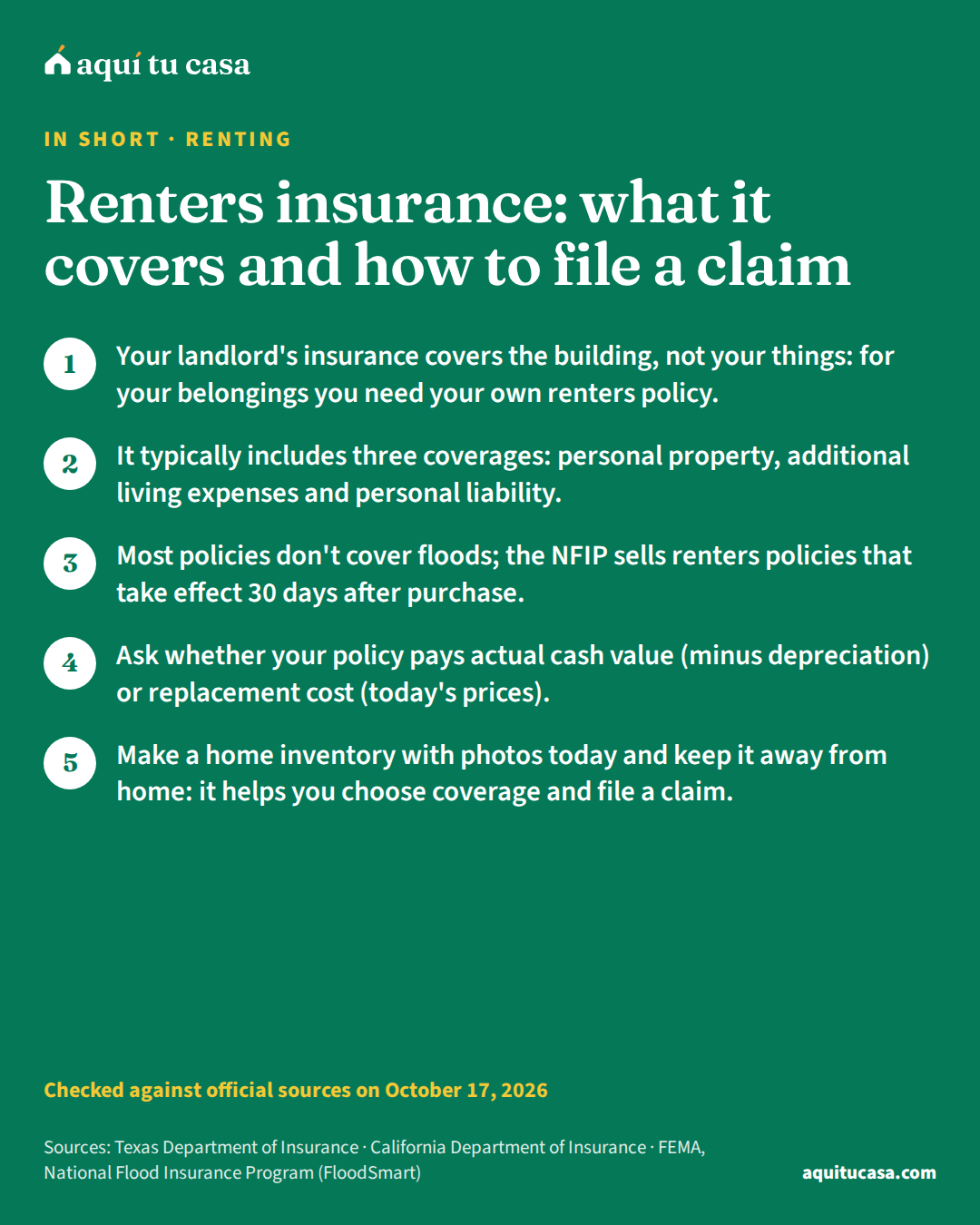
It is easy to think that if something happens, the building’s insurance covers you. It does not. According to the Texas Department of Insurance, the landlord’s insurance will not cover your belongings. Renters insurancerenters insuranceRenters insurance, also called tenants insurance, protects your belongings and protects you when you rent. The landlord's insurance covers the building, but not your furniture, clothes or electronics. It usually includes three coverages: your personal property, even if it is stolen away from home; additional living expenses if a covered loss forces you to move out for a while; and personal liability if someone is hurt in your home. A standard policy does not cover floods, which are insured separately. Some landlords require it.See the full definition covers your belongings, even items stolen from your car or while traveling; pays the extra cost of food and rent if you have to move out for a while; and protects you if someone is injured in your home, including legal costs if you are liable. Some landlords require it. It does not cover floods. A basic policy pays what each item is worth today, and one that covers replacement value costs more. And a home inventory helps you know whether you have enough coverage.5
If you live with roommates, ask the insurer whether each of you needs your own policy. And if you study far from home, ask your parents’ insurer whether their policy covers you at all and up to how much. Our renters insurance guide explains what it covers, what it does not and how to file a claim.

If you are looking for low-cost housing: the student rules
If your income is low, you may think of a Section 8 voucher or a low-rent building. Keep in mind there are special rules for students.
Section 8. Under HUD’s rule, no Section 8 assistance goes to a person who meets all of these conditions: is enrolled as a student in higher education, is under 24, is not a veteran, is unmarried, has no dependent child, is not a person with disabilities who was already receiving that assistance from before the rule, and is not individually eligible or has parents who are not income-eligible.6 If you do not meet one of them, for example if you have a child or are a veteran, that rule does not apply to you. Our Section 8 guide explains how the housing voucherHousing Choice Voucher (Section 8)The Housing Choice Voucher, the program almost everyone calls Section 8, is the country's largest federal rental assistance. HUD pays rental subsidies so eligible families can afford decent, safe and sanitary housing. Local public housing agencies administer it with HUD funds. The family finds its own home on the private market; if the agency approves the unit and the tenancy, it contracts with the owner to pay part of the rent, and the family pays the rest. Waiting lists are usually long and open for limited periods.See the full definition works.
Tax credit (LIHTC) buildings. The law for this credit names student cases that do not make a unit stop counting as low-income: a student receiving assistance under title IV of the Social Security Act, a student who was in state foster care or a person in a job training program; or a household made up only of full-time students who are single parents with their children, or married and filing a joint return.7 If everyone in your household would be a full-time student, ask the building’s office before applying. You can find low-income apartments on your county’s page in Places.
From the search to the keys
1. Do your full budget
Before you search
Rent, utilities, deposit, the move, insurance and food.
Try it with your numbersHow much rent can I afford?3. Talk with your roommates and your cosigner
Before you apply
Agree on who signs, who pays what and what the cosigner is risking.
4. Apply and ask what they check
When you apply
If your report leads to a cosigner or a bigger deposit, ask for the notice and the free copy.3
6. Document the condition of the place
On move-in day
Photos and video of every room for your move-in inspection and your deposit.
Your credit starts now
What you do in your first apartment counts for the next one. Paying rent and utilities on time helps you get good references. If you want to start your credit history with a card, there is a rule for younger people: under Regulation Z, an issuer may not open a credit card for someone under 21 unless they show they can make the minimum payments with their own income or have a cosigner who is at least 21.8
If you do not have enough income, there are other ways to start. Our guide Credit from zero explains the first steps, and the one on secured credit cards explains how a secured cardsecured credit cardA secured credit card is a card that helps you start or rebuild your credit history. To open one, you put a deposit in an account, usually equal to your credit limit, which starts out small. You can spend up to that amount and, when you pay the bill, that room becomes available again. Payments are reported to the credit reporting companies, so paying on time helps. As you show you pay on time, your limit may go up and your deposit may be refunded. Fees and interest rates can be high. A prepaid card is different and does not build credit.See the full definition works.
Scams that target students
If you are looking for housing from a distance and in a hurry, you are an easy target. According to the FTC, the fake owner may tell you the only way to hold the place is a wire transfer through Western Union or MoneyGram, and usually says they are out of the country. Wiring money, sending gift cards or paying with cryptocurrency is the same as sending cash. If anyone pressures you to decide quickly, walk away. Get a copy of the contract before you send any deposit, and report the scam at ReportFraud.ftc.gov.9 Our guide How to avoid rental scams shows more warning signs.
If this is you
You have no credit or rental history
You may be asked for a cosigner; if it is because of your report, ask for the adverse action notice and the free copy.3
Your parents will cosign
They pay if you do not; read the lease and the cosigning guide together.
You share with roommates
Put in writing who pays what, and check your state's occupancy rules.4
You are a student with low income
Section 8 has a rule for students under 24 with no children; ask whether it applies to you.6
It is your first credit card
Before 21 you need your own income or a cosigner who is 21 or older.8

Mistakes that cost you
Mistake: Counting only the rent.
Instead: Add the deposit, the move, utilities and insurance; check your financial aid if you are a student.1
Mistake: Accepting a cosigner requirement without knowing why.
Instead: If it is because of your report, ask for the adverse action notice and the free copy.3
Mistake: Sharing without a written roommate agreement.
Instead: Write down who pays what, what happens if someone leaves and how the deposit is split.
Mistake: Thinking the building's insurance covers your things.
Instead: The landlord's insurance does not cover your belongings; renters insurance does.5
Mistake: Subletting over the summer without asking.
Instead: Check your lease and your state's law; in New York the request is made in writing.4
Mistake: Wiring a deposit for an apartment you have not seen.
Instead: Visit it, get the contract before the deposit and report the scam at ReportFraud.ftc.gov.9
What to do this week
- Work out your first month’s and monthly budget with the rent calculator.
- If you are a student, ask the financial aid office how much your housing allowance is and when it arrives.1
- Talk with your roommates and put in writing who pays what.
- If you need a cosigner, read the cosigning guide together before they sign.
- Get renters insurance quotes and make a list of your belongings.5
- Visit every apartment in person and never wire a deposit before you see the contract.9
Your income
Let's do the math
Rent that fits your budget (30% of income)
$2,018
With an income of $6,728 a month. Up to $3,364 would already be a severe burden (50% of income).
Compared with HUD’s Fair Market Rent in the United States
- 2 bedrooms$1,750Fits · 26%Needs $33.65 an hour
The wage needed pays that rent without going over 30% of income, working 40 hours a week all year.
The typical rent households actually pay in the United States is $1,413 a month (Census).
A reference to give you an idea. Each landlord and each program sets its own requirements.
Ready to see the numbers? Find your county here
See how this applies in your county: its loan limits, prices and rents, from the official data.
Printable checklist
Frequently asked questions
Why am I asked for a cosigner if I have a job?
Because the landlord checks your credit, rental history and job, and at your age there is very little history. If you are asked for a cosigner because of something in your report, the FTC says it is an adverse action: you must get a notice with the report company's details, and you can ask for a free copy within 60 days.
Do my parents take any risk if they cosign?
Yes. A cosigner pays if you do not. Before they sign, read our guide on the risks of cosigning together, which explains what they are risking, and read the full lease.
Do I need renters insurance?
It is not always required, but some landlords require it. According to the Texas Department of Insurance, the landlord's insurance does not cover your belongings; renters insurance covers your belongings, your liability if someone is hurt and extra costs if you have to move out for a while. It does not cover floods.
Can my financial aid pay the rent?
The cost of attendance used for federal aid includes a housing allowance. For students living off campus, it is a standard allowance for rent. Ask your school's financial aid office how much it is and when the money arrives.
Can I get Section 8 if I am a student?
It depends. HUD's rule gives no Section 8 assistance to a higher-education student under 24 who is not a veteran, is unmarried and has no children, unless they are individually eligible and their parents are income-eligible, among other conditions. Ask the housing authority.
I want to sublet my room over the summer. Can I?
It depends on your lease and your state's law. In New York, for example, in buildings with four or more apartments you have the right to sublet with the landlord's advance consent, asked for in writing; in smaller buildings there is no such right. Check your lease and ask first.
Can I get a credit card to build history if I am 19?
Under Regulation Z, before age 21 you need to show you can pay with your own income, or have a cosigner who is at least 21. A secured card or a credit-builder loan are other ways to start.
Sources
Every figure in this guide comes from one of these official sources. The number next to a sentence leads to the source behind it.
Each source on one line: who publishes it, its title, its address and the date we read it.
- 1. U.S. Congress (text at Cornell LII) · 20 U.S.C. 1087ll, Cost of attendance · law.cornell.edu · Accessed October 31, 2026
- 2. Consumer Financial Protection Bureau (CFPB) · What should I know about tenant screening when applying for rental housing? · consumerfinance.gov · Accessed October 31, 2026
- 3. Federal Trade Commission (FTC) · Tenant Background Checks and Your Rights · consumer.ftc.gov · Accessed October 31, 2026
- 4. New York Attorney General · Residential Tenants' Rights Guide · ag.ny.gov · Accessed October 31, 2026
- 5. Texas Department of Insurance · Renters insurance · tdi.texas.gov · Accessed October 31, 2026
- 6. HUD (text at Cornell LII) · 24 CFR 5.612, Restrictions on assistance to students enrolled in an institution of higher education · law.cornell.edu · Accessed October 31, 2026
- 7. U.S. Congress (text at Cornell LII) · 26 U.S.C. 42, Low-income housing credit · law.cornell.edu · Accessed October 31, 2026
- 8. CFPB, Regulation Z (text at Cornell LII) · 12 CFR 1026.51, Ability to pay · law.cornell.edu · Accessed October 31, 2026
See the other 1 sources
- 9. Federal Trade Commission (FTC) · Rental Listing Scams · consumer.ftc.gov · Accessed October 31, 2026
Keep reading
Related guides
If this guide helped, these follow the same path.

Renting 15 minute read
Your lease explained: what to check before you sign
What a lease is, which clauses to read before you sign, the lead paint disclosure, your fair housing rights and where to get free help.
- Your rights are in your lease and in your state or local laws: read them together before you sign.
- Check the rent and due date, fees, the deposit, utilities, repairs, entry, occupants, subletting and how the lease ends.
- A landlord cannot charge fees you did not agree to, refuse necessary repairs or lock you out without a court order.
- Credit Co-signing a loan or lease: the risks before you sign What co-signing a loan or a lease means, what you can be made to pay, how it affects your credit and a future mortgage, and how to protect yourself. 11 minute read
- Renting Renters insurance: what it covers and how to file a claim What renters insurance covers, why it leaves out floods, actual cash value vs. replacement cost, liability coverage and how to file a claim. 13 minute read
- Renting Security deposits: how much and how to get yours back What a security deposit is, how much a landlord may charge in your state, what can be deducted, when it must be returned and where to complain if it isn't. 14 minute read
Tools for this topic
Was this guide useful?
Thank you. Your answer stays in your browser; nothing is sent.