Este sitio también está en español. Leer en español

State

Data from November 2026

Housing , home prices, rents and assistance in Indiana (2026)

A typical home in Indiana is worth $218,200; the typical rent is $1,062 a month. The FHA limit for a one-unit home is $541,287 in every one of its counties. 21 HUD-approved counseling agencies serve Indiana; 7 say they serve you in Spanish.

Most populous:

Typical home value by county

  • Under $153,200
  • $153,200–$171,800
  • $171,800–$196,800
  • $196,800–$229,600
  • $229,600 or more

Tap the map to see each county’s figure and open its page.

The key numbers

Typical home value
$218,200
34% less than the U.S.
U.S.: $332,700
Typical rent per month
$1,062
25% less than the U.S.
U.S.: $1,413
Typical household income
$71,957
11% less than the U.S.
U.S.: $80,734
FHA limit, 1 unit
$541,287
It is the same across Indiana.
U.S.: $541,287 to $1,299,500
Property tax
0.74%
of value a year
The typical bill is $1,614 a year.
U.S.: 0.94%

Source: American Community Survey (ACS) 5-year estimates Average 2020–2024 American Community Survey (ACS) 5-year estimates (external site) Source: FHA mortgage limits (HUD) Data from 2026 data FHA mortgage limits (HUD) (external site)

In short

Living in Indiana

A typical home in Indiana is worth $218,200, 34% less than in the country overall. Across its 92 counties, the typical value runs from $107,500 in Blackford County to $405,500 in Hamilton County. A typical household earns $71,957 a year and pays $1,062 a month in rent; 48% of renters put 30% or more of their income toward housing. 71% of households live in a home they own; they pay a typical property tax of $1,614 a year, about 0.74% of value.

The conforming loan limit for a one-unit home is $832,750 across Indiana. To pay HUD’s fair rent for a 2-bedroom apartment in Indiana ($1,302) without spending more than 30% of income, you need about $25.04 an hour working full time.

Source: Conforming loan limits (FHFA) Data from 2026 data Conforming loan limits (FHFA) (external site) Source: Fair Market Rents (HUD) Fiscal year 2027 Fair Market Rents (HUD) (external site)

The essentials in Indiana

More on property tax
  • Homestead standard deduction: the amount drops each year

    The amount of the homestead standard deduction depends on the year of the assessment date. For assessment dates after December 31, 2024, it is $48,000 in 2025, $40,000 in 2026, $30,000 in 2027, $20,000 in 2028 and $10,000 in 2029. Beginning with the 2030 assessment date, and every year after, it is $0.

    Indiana Department of Local Government Finance (DLGF), Form HC10 · Verified October 24, 2026

  • Supplemental homestead deduction (rises each year)

    Anyone entitled to the homestead standard deduction also receives a supplemental deduction from the assessed value of the home. It applies after the standard deduction and before any other deduction, exemption or credit. For property taxes first due and payable after December 31, 2025, it is a percentage of the assessed value left after the standard deduction: 40 percent in 2026, 46 percent in 2027, 52 percent in 2028, 57 percent in 2029, 62 percent in 2030 and 66.7 percent in 2031 and every year after. For 2025 taxes it was 37.5 percent of the value up to $600,000 and 27.5 percent of the assessed value above $600,000.

    Indiana Department of Local Government Finance (DLGF), Form HC10 · Verified October 24, 2026

  • What the homestead application asks for (Social Security or another number)

    The Sales Disclosure Form (SDF) can be used to apply for the homestead deduction. The applicant gives their full legal name, as it appears in Social Security Administration records, and the last 5 digits of their Social Security number. A married person also gives the spouse's legal name and the last 5 digits of the spouse's Social Security number. If either person has no Social Security number, they may instead give the last 5 digits of their driver's license number, state identification number or IRS preparer tax identification number (PTIN). If they have none of those, they may give the last 5 digits of a control number on a document issued to them by the United States government. This information is kept confidential to the extent possible under Indiana law. Not giving it may mean the person cannot receive the deduction.

    Indiana Department of Local Government Finance (DLGF), Sales Disclosure Form Instructions · Verified October 24, 2026

  • Deadline: application to the county auditor by January 15

    To get the deduction for a year, the application is completed, dated and filed with the county auditor (or postmarked) on or before January 15 of the year in which those taxes are first due and payable. The application covers that first year and every following year for which the deduction is allowed.

    Indiana Department of Local Government Finance (DLGF), Form HC10 · Verified October 24, 2026

  • Deadline to appeal the assessment: June 15 (Form 130)

    To appeal the assessment, you file Form 130 with the township assessor or, if your township has none, with the county assessor. For the current year's assessment, the deadline depends on when the Form 11 assessment notice was mailed. If it was mailed before May 1 of the assessment year, the deadline is June 15 of that year. If it was mailed on or after May 1, the deadline is June 15 of the year the tax statements are mailed.

    Indiana Department of Local Government Finance (DLGF), Form 130 · Verified October 24, 2026

  • Credits for owners 65 and older

    The Over 65 Credit is $150. If you share ownership with others and not all of them are 65 or older, the credit is reduced proportionally, unless the only owners are you and your spouse. There is also an Over 65 Circuit Breaker Credit: it equals this year's tax minus 1.02 times the prior year's tax. In other words, the tax does not rise more than 2 percent over the prior year. For the Over 65 Credit, adjusted gross income (AGI) from two years before the year the taxes are due may not exceed $60,000 on a single return, or $70,000 on a joint return or, combined, when you share ownership with others. For the Circuit Breaker, the limits are $60,000 (single return) or $70,000 (joint return with your spouse), and they change each year with the Social Security cost-of-living increase. For example, 2026 taxes use 2024 AGI.

    Indiana Department of Local Government Finance (DLGF), State Form 43708 · Verified October 24, 2026

The homes here

Housing in Indiana

What homes there are in Indiana, what they cost, how that changed and how people live, from Census figures (2020–2024).

What homes there are

U.S. Census Bureau, ACS 5-year, 2020–2024

Kind of home
Kind of home: Indiana and its comparisons
MeasureIndianaUnited States
Detached house 73%61%
Attached house 4%6%
Building of 2 to 4 6%8%
Apartments (5 or more) 13%19%
Mobile home 4%6%
Boat, RV and other 0%0%

In Indiana, 7 in 10 homes are single-family detached houses; in the U.S., 6.

Year built
Year built: Indiana and its comparisons
MeasureIndianaUnited States
Before 1960 31%26%
1960–1979 24%24%
1980–1999 23%25%
2000–2009 12%14%
2010 or later 10%11%

In Indiana, half of the homes were built before 1976; in the U.S., before 1980.

In Indiana, 64% of homes have 3 bedrooms or more, more than in the U.S. (61%).
All homes, occupied or empty. A figure the Census cannot measure precisely enough here is not shown.

Census tables: B25024, B25034, B25035, B25041

What it costs here

U.S. Census Bureau, ACS 5-year, 2020–2024

Value of owner-occupied homes
Value of owner-occupied homes: Indiana and its comparisons
MeasureIndiana
Under $100K 16%
$100K–$200K 29%
$200K–$300K 25%
$300K–$500K 22%
$500K–$750K 6%
$750K–$1M 2%
$1M or more 1%

The most common value range in Indiana is between $100K and $200K: that is where 29% of owner-occupied homes sit.

Monthly rent with utilities
Monthly rent with utilities: Indiana and its comparisons
MeasureIndiana
Under $500 7%
$500–$999 37%
$1,000–$1,499 39%
$1,500–$1,999 12%
$2,000–$2,499 4%
$2,500–$2,999 1%
$3,000 or more 1%

The largest group of rented homes in Indiana pays between $1,000 and $1,499 a month: 39%.

With a mortgage

$1,404 a month

United States: $1,963 a month

Without a mortgage

$517 a month

United States: $638 a month

Owners with a mortgage

64%

United States: 61%

In Indiana, 64% of owners have a mortgage, and their typical cost is $1,404 a month, against $1,963 in the U.S.. Without one it drops to $517.

Value: what owners think their home is worth. Rent: rent plus utilities, for homes of every size. The FHA limit is the most an FHA loan (Federal Housing Administration) lends for a one-unit home; the fair market rent (FMR) is the one HUD uses for housing vouchers.

Census tables: B25075, B25063, B25088, B25081

How it changed

U.S. Census Bureau, ACS 5-year, 2015–2019 and 2020–2024

Change since 2015–2019
Change since 2015–2019: Indiana and its comparisons
MeasureIndianaUnited States
Typical home value +54%+53%
Typical rent +29%+33%
Typical household income +28%+29%

Much as in the U.S., the typical home value in Indiana rose 54% since 2015–2019.

The typical rent in Indiana rose 29% over the same time; in the U.S., it rose 33%.

While home values in Indiana changed +54% and rent +29%, the typical household income rose 28%.

Change between two 5-year periods that do not overlap, in each period's dollars, not adjusted for inflation.

Census tables: B25077, B25064, B19013

How people live

U.S. Census Bureau, ACS 5-year, 2020–2024

How people live: Indiana and its comparisons
MeasureIndianaUnited States
Rental vacancy 5.6%5.5%
Homeowner vacancy 0.8%0.9%
More than one person per room 1.8%3.4%
People per household 2.462.53
Drive alone 76%69%
Carpool 9%9%
Public transit 1%3%
Walk or bike 2%3%
Work from home 11%15%
Other means 1%2%
Typical commute 20 to 29 minutes20 to 29 minutes

Open rentals in Indiana look like those in the U.S.: the rental vacancy rate is 5.6%.

More than one person per room: that is how 1.8% of households in Indiana live, less than in the U.S. (3.4%).

Much as in the U.S., a household in Indiana has 2.46 people on average.

To get to work, 76% of workers in Indiana drive alone; in the U.S., 69%.

Vacancy: empty homes offered for rent or for sale. Rooms: every room in the home, not only bedrooms. Commute: the minute range of the typical worker.

Census tables: B25004, B25003, B25014, B25010, B08301, B08303

Places

Explore the counties in Indiana

Sort by any column or type a name. The 25 most populous are shown; the button reveals the rest.

See the counties page

Source: American Community Survey (ACS) 5-year estimates Average 2020–2024 American Community Survey (ACS) 5-year estimates (external site) Source: FHA mortgage limits (HUD) Data from 2026 data FHA mortgage limits (HUD) (external site) Source: Fair Market Rents (HUD) Fiscal year 2027 Fair Market Rents (HUD) (external site)

Calculator

Work out your payment in Indiana

Start from the typical home value in Indiana, $218,200, and this week’s average rate. Move the price and the down payment to see your monthly payment. If you already visited a county, the calculator uses its numbers.

More math for Indiana

$
%

Estimated monthly payment

$1,773

FHA loan over 30 years, with estimated taxes and insurance.

See the full calculation

Prices and risks

Three official measures that help you decide: how much home prices have changed according to FHFA, how prices compare with the national average according to BEA, and how many homes sit in a flood zone according to FEMA.

Home prices

How have home prices changed?

According to the FHFA House Price Index, home prices in Indiana rose 95% in the 10 years through 2025.

Price change each year

Annual change in the FHFA House Price Index in Indiana, 2021 to 2025.
  1. 2021: +12.0%
  2. 2022: +15.2%
  3. 2023: +8.0%
  4. 2024: +5.5%
  5. 2025: +4.3%
Home price change in Indiana, in its state and in the U.S., according to FHFA
Period Indiana United States
In 2025 +4.3% +2.9%
5 years (2020–2025) +53% +47%
10 years (2015–2025) +95% +85%

The index follows the prices of the same homes over time (sales and appraisals on loans bought or guaranteed by Fannie Mae and Freddie Mac). It is not the average price of a home. FHFA considers its annual state indexes experimental.

Source: FHFA House Price Index (HPI) Data from 2025 data FHFA House Price Index (HPI) (external site)

Cost of living

How expensive are prices here?

According to the Bureau of Economic Analysis (BEA), in 2024 prices in Indiana were 7% lower than the U.S. average. Housing rents were 27% lower than nationwide.

Regional price parities in Indiana and in the U.S. in 2024, according to BEA
Category Indiana United States Versus the U.S.
All prices Consumer goods and services 93.3 100.0 7% less
Housing rents What renters pay 73.9 100.6 27% less
Water, power and gas Water, sewer, electricity and gas 85.5 98.4 13% less
Goods Food, clothing, transportation and more 95.5 99.6 4% less
Other services Services other than rent 99.1 100.1 1% less

BEA expresses each index as a percentage of the average U.S. price level: a higher number means higher prices, and a lower one, lower prices.

Source: Regional price parities (BEA) Data from 2024 data Regional price parities (BEA) (external site)

Flooding

Is there a flood risk?

According to FEMA, in Indiana 2.3% of homes (58,196) are in a high-risk flood zone. Of those homes, 17% have NFIP flood insurance.

  • A high-risk zone (Special Flood Hazard Area) has a 1% or greater chance of flooding each year. 44 CFR 59.1
  • If the home is in that zone and the loan comes from a regulated lender, federal law requires flood insurance for the life of the loan, in communities that take part in the NFIP. 42 U.S.C. 4012a
  • Most homeowners insurance does not cover flood damage. FEMA, FloodSmart
Homes in a high-risk flood zone and with NFIP insurance in Indiana, in its state and in the U.S., according to FEMA
Measure Indiana United States
Homes in a high-risk zone 2.3% 3.5%
Of those, with NFIP insurance 17% 48%
All homes with NFIP insurance 0.5% 2.9%

The NFIP is the federal flood insurance program; private policies are not counted. FEMA counts homes with its National Structure Inventory. We add up the county figures FEMA publishes.

Look up your address on FEMA’s map Source: Homes with flood insurance (NFIP, FEMA) As of August 3, 2026 Homes with flood insurance (NFIP, FEMA) (external site)

Places

Cities in Indiana

The 16 most populous cities with a page. Each one compares its prices and rents with its county.

See the other cities (119)

    Help to buy

    Assistance programs in Indiana

    Our list has 2 official programs that help you buy in Indiana. Each card says what kind of help it gives and when we checked its official page.

    See all 2 programs
    1. Next Home

      Indiana state agency program with down payment assistance of 2.5% or 3.5% of the price, alongside a 30-year FHA or conventional mortgage. Offered by Indiana Housing and Community Development Authority (IHCDA).

      Type not stated Verified November 5, 2026

    2. First Step

      Indiana state agency 30-year FHA or conventional mortgage for first-time buyers (or homes in designated areas), with down payment assistance as a second mortgage with no interest or payments, repaid when the first mortgage ends. Offered by Indiana Housing and Community Development Authority (IHCDA).

      Deferred Verified November 5, 2026

    Tenant rights

    Tenant rights in Indiana

    Indiana law answers 3 of these 5 questions, each answer with its citation. Where it says “Data not available”, we have not verified it against the source yet.

    A summary of state law, not legal advice. Cities may have additional rules.

    See every right
    1. How much can they charge for a deposit?

      Data not available

    2. When must they return my deposit?

      When the rental agreement ends and you give back the home, the landlord must return your security deposit. The landlord may deduct only unpaid rent, damages from not following the law or the lease, and utility or sewer charges the lease made you pay. Deductions must be itemized in a written notice, with the amount due to you, delivered no more than 45 days later. The landlord is not liable under this law until you give a mailing address in writing. Unless you agreed otherwise, you cannot use the deposit to pay rent.

      Ind. Code §32-31-3-12(a)

    3. If I fall behind on rent, what notice must I get?

      If you do not pay rent when it is due, the landlord may end the lease with at least 10 days' notice. If you pay the rent in full before the notice period ends, the landlord cannot end it for that reason. This rule does not apply if you and the landlord agreed otherwise.

      Ind. Code §32-31-1-6

    4. How much notice ends a month-to-month rental?

      A month-to-month tenancy can be ended with one month's notice.

      Ind. Code §32-31-1-4

    5. Are there limits on late fees?

      Data not available

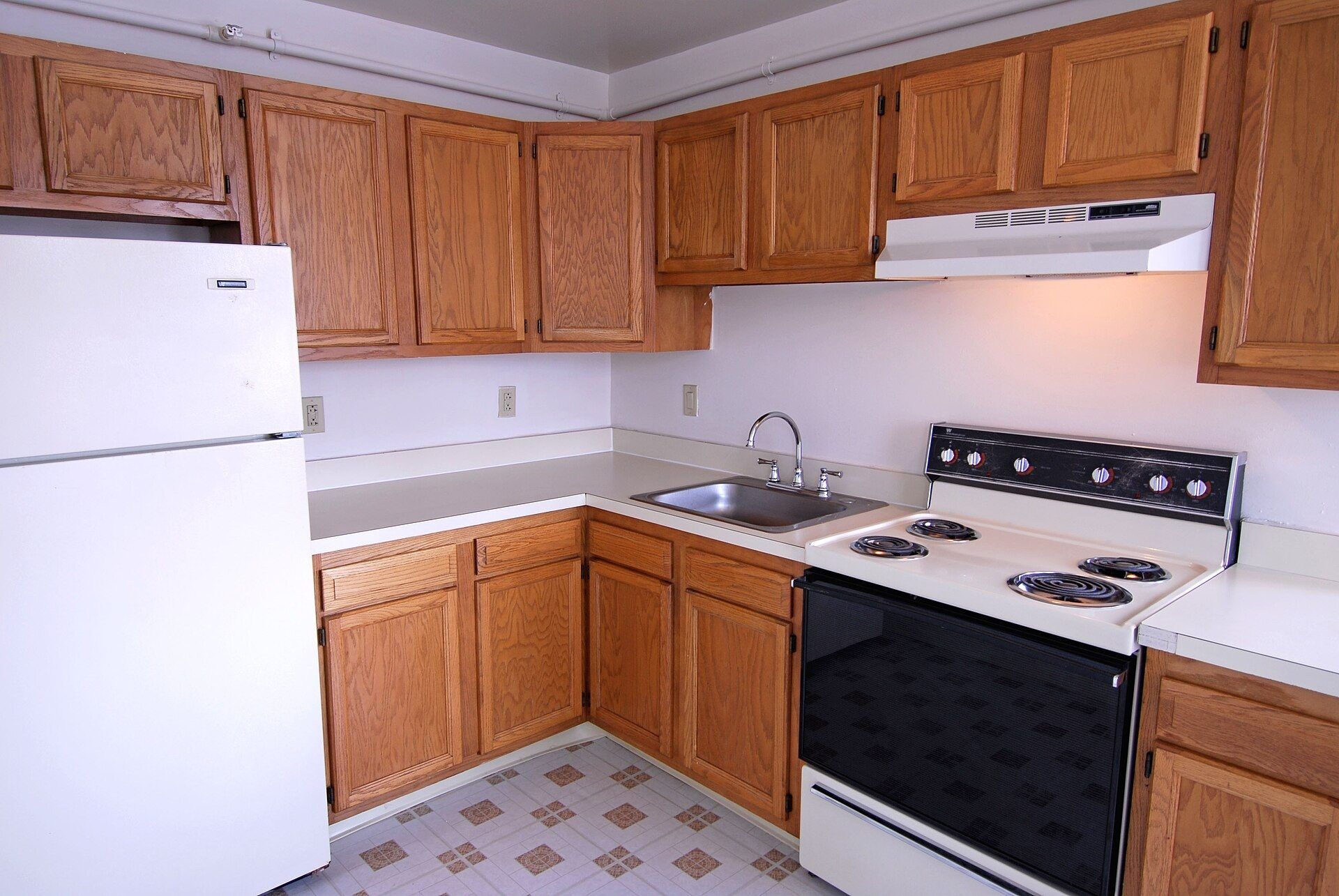
    The simple kitchen of an apartment, with an electric stove, a refrigerator and wood cabinets.

    Help and advice

    Who can help you in Indiana?

    You do not have to do this alone. A HUD-approved housing counselor gives independent advice on buying, renting, late payments and credit, often free or at low cost.

    21 HUD-approved counseling agencies serve Indiana; 7 say they serve you in Spanish. Choose your county to see the closest ones with their phone number.

    54 public housing authorities run Section 8 vouchers and public housing in Indiana.

    Who runs the help in Indiana

    • Indiana Housing and Community Development Authority (IHCDA)

      The Indiana Housing and Community Development Authority (IHCDA), through its Homeownership Department (HOD), offers mortgage programs to help people who want to buy a home in any of Indiana's 92 counties.

      The agency's official page · Verified October 24, 2026

    Where to file a complaint in Indiana

    • Where to file a housing discrimination complaint

      If you believe you faced housing discrimination based on a protected class, you may be able to file a complaint with the Indiana Civil Rights Commission (ICRC). Housing complaints must be filed within 1 year of when the discriminatory act occurred. The first step is filing an inquiry, and there is no cost.

      Indiana Civil Rights Commission (ICRC) · Verified October 24, 2026

    • Help with insurance questions or complaints

      The Indiana Department of Insurance (IDOI) Consumer Services Department informs and protects consumers from illegal insurance practices by making sure insurance companies and licensed producers operating in Indiana follow state insurance laws. It can help with an inquiry or complaint about health, life, auto, and property and casualty insurance policies. For questions, call 800-622-4461 or 317-232-2395, or email consumerservices@idoi.in.gov.

      Indiana Department of Insurance (IDOI) · Verified October 24, 2026

    Guides

    Guides for you in Indiana

    We picked them with the numbers of Indiana. Each one says why it can help you.

    Frequently asked questions about housing in Indiana

    What is the FHA limit in Indiana in 2026?

    In Indiana, the FHA limit for a one-unit home is $541,287 in every one of its counties.

    How much does a typical home cost in Indiana?

    The typical home value in Indiana is $218,200 (Average 2020–2024, U.S. Census). The highest is in Hamilton County ($405,500) and the lowest in Blackford County ($107,500).

    How much does it cost to rent in Indiana?

    The typical rent in Indiana is $1,062 a month (Average 2020–2024, U.S. Census).

    How much do you need to earn to rent a 2-bedroom apartment in Indiana?

    At HUD's average fair market rent in Indiana ($1,302, Fiscal year 2027), about $25.04 an hour working full time, so rent stays under 30% of income.

    How much is property tax in Indiana?

    The typical property tax in Indiana is $1,614 a year, about 0.74% of home value (Average 2020–2024, U.S. Census).

    Where can I find free help in Spanish to buy a home in Indiana?

    There are 21 HUD-approved counseling agencies in Indiana; 7 say they serve you in Spanish. Each county page lists the closest ones with their phone number.

    Sources: American Community Survey (Average 2020–2024); FHA mortgage limits (2026 data); Conforming loan limits (2026 data); Fair Market Rents (Fiscal year 2027); HUD-approved housing counseling agencies (Retrieved November 6, 2026); Public Housing Agencies (Retrieved November 6, 2026); FHFA House Price Index (2025 data); Homes with flood insurance (As of August 3, 2026); Regional price parities (2024 data); Census Bureau cartographic boundary files (2024 data).